S. Torii
, A. Tricomi
and W.C. Turner
1Solar-Terrestrial Environment Laboratory, Nagoya University, Nagoya, Japan 2Kobayashi-Maskawa Institute for the Origin of Particles and the Universe,
Nagoya University, Nagoya, Japan
3INFN Section of Florence, Italy 4University of Florence, Italy
5Ecole-Polytechnique, Palaiseau, France 5RISE, Waseda University, Japan 7INFN Section of Catania, Italy 8CERN, Switzerland
9Kanagawa University, Japan 10University of Catania, Italy 11LBNL, Berkeley, California, USA
Abstract. The Large Hadron Collider forward (=LHCf) experiment has successfully finished the first
phase of data taking at LHC√s=0.9 and 7 TeV proton-proton collisions in 2010. As current status, we concentrate on analyzing the obtained data. As the first result, the energy spectra of photon measured by LHCf during = 7 TeV p-p collision has been published recently. Also the study of the upgraded version of LHCf detector for future=14 TeV run scenario is developed with the GSO scintillator. Another possible plan of p-A(nuclear) collision in LHC is also studied. In this paper, as the current status of the experiment, analyses, and works for foreseen detector upgrade are summarized.
1. INTRODUCTION
The LHCf experiment[1,2] is one of the LHC forward region experiments dedicated to the cosmic ray physics. Because we can only observe the UHECRs by indirectly way with particle cascade(called air-shower), we have to care about systematic errors caused by the air-shower development. To measure the particles emitted in the forward region it is important to understand the cosmic ray interactions as verification of the models. However, currently the models were verified up to 1014eV by the UA7 [3] experiment at the CERN-SPS. On the other hand, the LHCf experiment is designed to obtain data with a energy corresponding to 1017eV in cosmic-ray energy (equivalent to 14 TeV in collision energy).
ae-mail:
Figure 1. Left: Arm1 detector, Right: Arm2 detector.
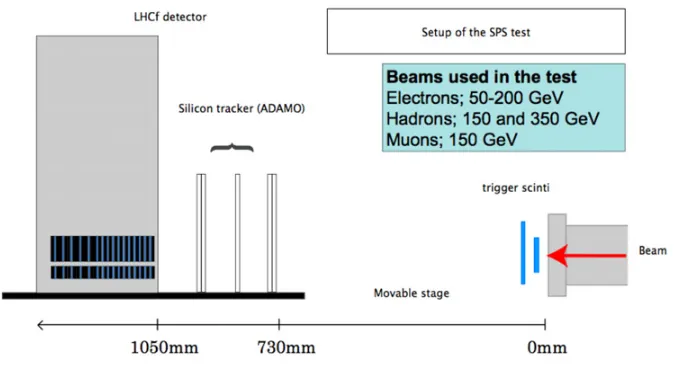
Figure 2. Set up of the beam test.
The physics target is to provide energy and transverse momentum spectra of particles emitted to the forward region of the LHC interaction point (IP1). It will be expected to reduce the uncertainty of the model dependence close to the UHECR energy.
1.1 The LHCf Detector
Two independent detectors called “Arm1” and “Arm2” were installed ±140m away from LHC IP1 (ATLAS). Figure1shows a schematic picture of the LHCf detectors. Each detector has two calorimeter towers composed of 44 r.l. of tungsten plates, 16 sampling layers of plastic scintillators, and four X-Y pairs of lateral position sensitive detectors (SciFi in Arm1 and silicon strip detector in Arm2). The responses of the LHCf detectors for high energy particles were studied in the fixed target experiments using electron beams below 220 GeV, proton beams below 350 GeV and muon beams below 150 GeV [4]. The performance for electromagnetic showers up to equivalent to 3.5 TeV are well understood using the Monte Carlo simulations.
1.2 The study of the LHCf detectors
true energy[GeV]
0 50 100 150 200 250
0 1000 2000 3000
true energy[GeV]
0 50 100 150 200 250
Deviation[%] -10 -5 0 5 10
Figure 3. Energy linearity obtained from the beam test (upper). Deviation from the linear fitting (lower).
energy [GeV] 0 Resolution [%] 0 2 4 6 8 10 12
14 SPS2007 20mm cal. with 600V SPS2007 40mm cal. with 600V MC 20mm cal. MC 40mm cal.
600V (High Gain) Energy Resolution (arm1)
energy [GeV] 0 Resolution [%] 0 2 4 6 8 10 12
14 SPS2007 25mm cal. with 600V SPS2007 32mm cal. with 600V MC 25mm cal. MC 32mm cal.
600V (High Gain) Energy Resolution (arm2)
50 100 150 200 250 50 100 150 200 250
Figure 4. Energy resolution of the Arm1 (left) and Arm2 (right) detector for electro magnetic incidents.
Particle incident position was measured with an external silicon strip detector (ADAMO) placed in front of the LHCf calorimeters.
The energy linearity was obtained as shown in Fig. 3. This figure shows the summation of shower particles as function of the beam energy. Linear fits to the beam test data and residuals from the fits are also shown. A deviation from linearity is less than 2% in the beam test data (filled markers) and shows good agreement between the data and MC simulations (open markers) except at 50 GeV.
Figure4shows the energy resolution obtained by beam test and MC simulations [4]. The absolute energy scale was determined in these data.
Lateral hit position resolutions were also obtained as below 200m for Arm1 detector and below 60m for Arm2 detector by the beam test. The results that were obtained (<5% energy resolution and
Figure 5. Energy spectra of the photon observe in LHCf detectors. Left(Right) panel shows the spectra of
Arm1(Arm2). lower panel shows the MC spectra divided by its data.
2. THE PHYSICS RESULTS
2.1 Photon spectra at√s=7 TeV
The LHCf experiment has successfully measured the energy spectra of photon emitted in the very forward region of the LHC proton-proton collisions in 2010. We compared the results of√s=7 TeV collision at the LHC with the several hadronic interaction models used in cosmic ray observations. Figure5shows the energy spectra of data and MC simulations.
No model is able to describe completely the experimental data. The Data used in this analysis was obtained on 15 May 2010 during proton-proton collisions at√s=7 TeV with zero degree beam crossing angle (LHC Fill 1104). The total luminosity of the three crossing bunches in this fill was L=(6.3−6.5)×1028cm−2s−1. The ranges used for the small calorimeters and the large calorimeters are [>10.94,= 360.0] and [8.99>>8.81,=20.0], respectively. Only single hit events were selected in this analysis. The result was summarized in [5].
3. UPGRADE WITH GSO SCINTILLATOR
The LHCf detectors will be upgraded with GSO scintillators for the coming√s=14 TeV run (for more radiation hardness) due to the radiation resistibility. Figure6shows a EJ260 scintillator (currently used) and GSO scintillator.
Figure 6. We replace scintillators from EJ260 to GSO for more radiation hardness.
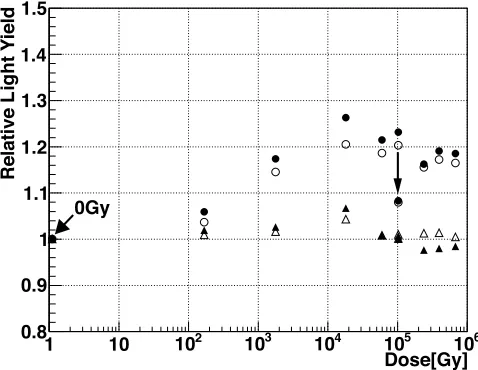
Figure 7. Stability of light yield of GSO scintillator under radiation exposure. Horizontal axis shows exposed dose
and vertical shows relative light yield of GSO.
light yield of GSO scintillator did not decrease, but rather an increase up to about 25% was observed [6]. Figure7shows the stability of light yield of GSO scintillator under radiation exposure.
4. FUTURE PLAN
4.1 Analysis
4.2 Measurement
We are preparing for foreseen data acquisitions with the proton-ion collision in 2012, and the p-p collisions at√s=14 TeV in 2014 [7].
4.3 Research and development
The first GSO-LHCf detector will be constructed in summer 2012 and tested using CERN-SPS beams.
5. SUMMARY
The LHCf experiment is dedicated to cosmic-ray physics and successfully finished the 1st phase of data taking at 2010. The energy spectra of photon at>10.94 and 8.81<<8.99 at√s=7 TeV have been obtained and compared with several hadronic interaction models. None of the models agrees perfectly with data. Other analyses such as0 spectra, photon spectra at 0.9 TeV, hadron spectra, P
t distribution, wider coverage, etc are also ongoing. LHCf is also assured to take data at 14 TeV (or at the maximum LHC energy) collisions foreseen after the long shutdown. Detectors will be upgraded with GSO scintillators for the coming highest energy run. Additional possibility to take data at p-A and A-A collisions is also in study to infer the nuclear effect or directly simulate CR-air interaction. Using both existing data and future experiments, LHCf will provide crucial data to constrain hadron interaction models and improve the interpretation of UHECR observations.
References
[1] O.Adriani et al., LHCf Technical Design Report, CERN-LHCC-2006-004 (2006) [2] O.Adriani et al., Journal of Instrumentation S08006 (2008), 3
[3] E. Pare et al., Physics Letter B 242 (1990), 531 [4] T.Mase et al., NIM A 671 (2012), 129
[5] O.Adriani et al., Physics Letters B 703 (2011), 128