Research article Available online www.ijsrr.org
ISSN: 2279–0543
International Journal of Scientific Research and Reviews
Dissolution Rate Improvement of Prasugrel Hydrochloride by Solid
Dispersion Method Using HPMC-AS as a Polymer
Warkad S. S
1*, Anantwar P. S
2, Bhusari M. R
1, Tale P. D
1and Pakhare V. S
11
Department of pharmaceutics, MVP’s college of pharmacy,Gangapur road, Nashik, Affiliated to savitribai phule pune university, pune, Maharashtra email ID :[email protected], Mob no:9970787103; [email protected], Mob no : 9527690632; [email protected],
Mob no: 7775829054; [email protected], Mob no :8856063641
2
Shri. Saptashrungi Ayurved Mahavidyalay Hirawadi, Nashik. Affiliated to Maharashtra university of health sciences Nashik, Maharashtra, Mob no : 9423173911
http://doi.org/10.37794/IJSRR.2019.8427
ABSTRACT:
The aim of this study was Dissolution rate Improvement of Prasugrel Hydrochloride by solid dispersion technique. Prasugrel HCL is a poorly water soluble (BCS class II) antiplatelet drug. Due to poor water solubility of this drug, its bioavailability is dissolution rate limited. The purpose of the present work is to improve the dissolution rate of Prasugrel HCL in aqueous media as well as at high pH conditions by solid dispersion technique. Solid dispersions are one of the most promising strategies to improve the solubility and dissolution rate of poorly water-soluble drugs. Solid dispersion was prepared by two preferable methods (Grinding method, solvent evaporation method). HPMC-AS was used as polymer to prepare solid dispersion. HPMC-AS is an enteric polymer which is used as a carrier for Bioavailability enhancement in various solid dispersion methods. Four drug polymer ratios were selected (1:1, 1:2, 1:3, 1:4) for each method to prepare solid dispersion. Solid dispersion prepared from both the methods was further evaluated for solubility, total drug content, compatibility testing, and drug release. Solid dispersion was prepared by using (1:2) drug polymer show significant increase in solubility than the other drug polymer ratio. Above this ratio there is no significant change in solubility. In case of optimized solid dispersion, drug release was found to be higher in Grinding method (F2= Optimized batch from Grinding method and % CDR 90.9%) in 900ml of phosphate buffer pH 6.8. And optimized solid dispersion from Solvent evaporation method drug release was found to be (S2= Optimized batch from solvent evaporation method and % CDR 84.1%) in 900 ml phosphate buffer 6.8 which is less as compared with the optimized batch obtained from Grinding method.
KEYWOERDS:
Prasugrel HCl, solid dispersion technique, dissolution rate, HPMC-AS, Grinding method.
*Corresponding author
Mr. Sachin S. Warkad
Research scholar, Department of Pharmaceutics, MVP Samaj’s college of pharmacy,
Gangapur road, Nashik, Maharashtra-422002 Email Id- [email protected]
1.
INTRODUCTION
1,2,3,4,5Acute coronary syndrome:
Acute coronary syndromes are conditions characterized by the sudden onset of coronary
insufficiency as a result of thrombotic occlusion of one or more coronary arteries. Acute coronary
syndrome is a major cause of morbidity and mortality. Arterial thrombosis after coronary artery
plaque rupture is the proposed most common mechanism for ACS, and platelet activation, adhesion,
and aggregation play central roles in its development. Haemostas is consists of a complex
interplay of the vascular endothelium, platelets and coagulation factors. This process can lead to clot
formation in the arteries or veins, which ultimately manifests as an acute coronary syndrome or
venous thrombolism. As such, antithrombotic drugs, including antiplatelet therapies and
anticoagulants, are frequently used in patients with cardiovascular disease. Platelets play a central
role in the pathogenesis of a the rothrombos is and in the formation of thrombi following coronary
angioplasty, with and without stent implantation. Platelets initially adhere at sites of vascular injury,
atherosclerotic plaque rupture, balloon angioplasty, and stenting. Platelet activation following these
interactions results in the release of ADP promotes platelet activation via the G-protein linked P2Y1
and P2Y12 purinergic receptors leading to further platelet activation, aggregation, and other platelet
functions, Such as platelet shape change, secretion and the development of coagulant and
pro-inflammatory activities. Activated platelets are recruited to sites of coronary plaque rupture and
intraarterial stenting, thereby forming aggregates that may lead to platelet rich thrombi, vascular
occlusion, tissue ischemia, and myocardial necrosis in what is collectively known as Acute coronary
syndrome (ACS). The term ACS is a pathophysiological continuum progressing from ischemic chest
pain with sudden onset and worsening, to ischemia severe enough to cause irreversible myocardial
damage detected with cardiac biomarkers without persistent ST-segment elevation, to total occlusion
of the culprit coronary artery with persistent ST-segment elevation, resulting in myocardial necrosis
and elevated biomarkers. ACS occurs in a diverse global population and has a significant
socioeconomic impact as patients require hospitalization, rehabilitation, and often suffer subsequent
ischemic events. Acute coronary syndromes will likely remain one of the causes of hospitalization
worldwide due to the increasing prevalence of risk factors for coronary heart disease and the
increasing size of the aged population.
Prasugrel as an Antiplatelet Agent:
Prasugrel is a novel antiplatelet prodrug belongs from the thienopyridine class which is
approved by the united states food and drug administration on July 10, 2009 for the treatment of
Prasugrel is a prodrug it requires conversion to its active metabolite for therapeutic effect.
Antiplatelet agents are drugs that inhibit enzymes or receptors required for platelet activation,
aggregation and thrombus formation. Antiplatelet drugs protect against myocardial infarction, stroke,
cardiovascular death, ischemia and other serious vascular events in patients with a history of
previous vascular events or known risk factors for cardiovascular disease.
Prasugrel HCL is a poorly soluble (BCS Class II) drug used for the treatment of Acute
coronary syndrome. Due to poor water solubility of this drug, its bioavailability is dissolution rate
limited. Prasugrel HCL is 3rd generation thienopyridine which is an antiplatelet drug, recently
approved for prevention of thrombotic cardiovascular complications in patients with an acute
coronary syndrome and in patients who are managed with percutaneous coronary intervention.
Prasugrel HCL is a BCS Class II drug which is soluble to slightly soluble at pH 1-4, very slightly
soluble at pH 5, practically insoluble at pH 6-7 and water. During ACS an antiplatelet drug should
show quick and high oral bioavailability which can be achieved by high aqueous solubility. The oral
bioavailability of Prasugrel HCL is (~79%) but it may vary due to its disparity in its solubility.
Solid Dispersion as a dosage type has been established a superior choice for the compounds having
poor aqueous solubility. Solid dispersions in water-soluble carriers have caught right interest as a
method of enhancing the dissolution rate and bioavailability of hydrophobic compounds. Though
solid dispersions have large potential for enhancing drug solubility. There are numerous methods
accessible to boost the solubility of the new drug during which solid dispersion emerged promising.
Solid dispersion systems can increase dissolution rate and bioavailability of water insoluble
compounds as when these are exposed to aqueous media, the carrier dissolves, and also the drug is
released as fine particles. This greatly reduces particle size and increases surface area, which results
in improved dissolution rates and absorption.
Advantages of Solid Dispersions
The major advantage of solid dispersions is that it improves the dissolvability of a poorly
water soluble drug in a pharmaceutical composition and end up in speedy dissolution rates thereby
enhancing the bioavailability of compound. In conjunction with this approach may additionally
supply alternative benefits are,
1. Speedy disintegration of oral tablets.
2. As a formulation vehicle.
3. Particles with reduced particle size.
5. Particles with higher porosity.
6. Compounds in amorphous state.
Disadvantages of Solid Dispersions
Moreover, most of the polymers used in solid dispersions can absorb moisture, which can end
in section separation, crystal growth or conversion from the amorphous to the crystalline state or
form a metastable crystalline form to a more stable structure during storage.
2.
MATERIAL AND METHOD
Prasugrel HCL was obtained from Amneal Pharmaceutical, Ahmedabad HPMC-AS was obtained
as gift sample from Glenmark pharmaceutical Ltd. Mumbai.
Preparation of Solid Dispersion
Solid dispersion was prepared by two preferable methods.
Grinding Method
With the help of Grinding Technique for preparing solid dispersion taking a carrier material and
a drug with the quantities relation of 1:1-1:4 was mixed uniformly, by putting them in a mortar, after
that the blend was taken out, and screened through an 80 mesh sieve.
Solvent evaporation Technique Solvent Technique for preparing a solid dispersion during which
physical mixture of the drug and carrier material was dissolved in a very common
solventi.e.Acetone, which is stirred continuously for uniform distribution of drug in carrier material
and evaporated until clear, solvent free film is left. The film was additionally dried to constant
weight.Four batches were taken, having weight ratio (1:1, 1:2, 1:3, 1:4) for each method.
3.
EVALUATION
3.1. Solubility (S)
For the determination of Prasugrel HCL (Solid dispersion) solubility, in various solvents
(Distilled water, 0.1N HCL, Phosphate buffer-pH 6.8) an excess amount of solid dispersion
containing Prasugrel HCL was placed in glass bottles containing 10ml of solvent. The bottles were
kept for 24hrs at room temperature. The supernatant was taken and analyzed by using UV
spectrophotometer at respective wavelength of maximum absorption in respective solvents. The
solubility values found by solid dispersion prepared by grinding method and solid dispersion method
3.2. Determination of Drug content in Drug: Polymer solid Dispersion (15)
The drug content was determined by using UV Analysis.
From Standard curve of Prasugrel HCL total Prasugrel HCL content was determined. The
drug content was calculated by dissolving Solid Dispersions equivalent to 10mg drug into a 100 ml
volumetric flask and dissolved in minimum amount of phosphate buffer pH 6.8 . And the volume
was made upto the mark using phosphate buffer pH 6.8 and filtered through 0.45µ filter and assay
for drug content using UV double beam spectrophotometer at 254nm. Three replicates were
prepared, and the average drug contents were estimated in the prepared solid dispersion. Actual drug
content was calculated for all batches using the equation:
Drug content (%) = Gact/Gsd x 100
Where Gact is Actual Prasugrel HCL content in weighed quantity of solid dispersion, and Gsd is
theoretical amount of Prasugrel HCL in SD.
3.3. XRD Analysis:
XRD Analysis is used to find out any changes in the crystallinity of the drug which
precipitated in amorphous form, when formulated into a solid dispersion. Powder XRD is used to
study any changes in crystallinity of the drug which could be one of the mechanisms responsible for
the improved dissolution
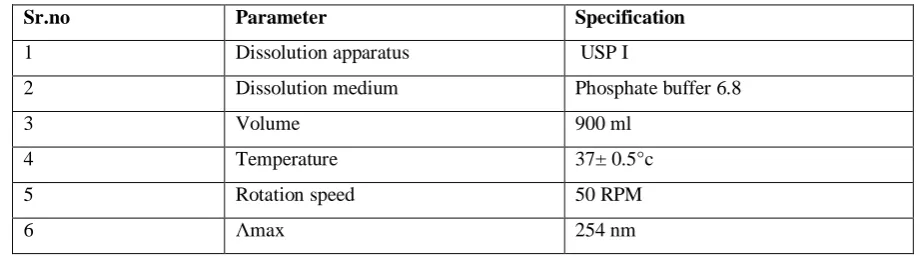
3.4. Dissolution study (In-Vitro drug Release)
In-Vitro release of Prasugrel HCL from solid dispersion was studied using USP dissolution
apparatus I (Lab-India Disso 8000). The amount of solid dispersion equivalent to 10 mg of Prasugrel
HCL Was taken into the muslin cloth and each formulation was exposed to dissolution medium
(Phosphate buffer 6.8) maintained at 37± 0.5°C stirred at 50 rpm for 30 min. 5 ml of aliquots
withdrawn from the vessel at time interval of (05, 10, 15, 20, 25, 30min.) and replaced with 5ml of
fresh dissolution medium after each sampling to maintain the constant volume (sink conditions). The
withdrawn samples were analyzed by UV-spectrophotometer at 257nm. Prasugrel HCL
concentration was calculated and expressed as percentage of Prasugrel HCL dissolved. Results
obtained by solid dispersion prepared by grinding method and solvent evaporation method are shown
in table no 9.15, 9.16 respectively. And comparison of dissolution profile of optimized batches from
Table No: 1. Dissolution study parameter.
Sr.no Parameter Specification
1 Dissolution apparatus USP I
2 Dissolution medium Phosphate buffer 6.8
3 Volume 900 ml
4 Temperature 37± 0.5°c
5 Rotation speed 50 RPM
6 Λmax 254 nm
4.
RESULT AND DISCUSSION
4.1. Preliminary characterization
:
Identification of drug
a. Drug sample and polymer procured were studied for organoleptic properties such as colour, odour
and appearance. The results are shown below.
1. Drug
Table no: 2. Organoleptic properties of Drug.
Sr.no Parameter Reported standard Observed standard
1 Colour White crystalline solid White crystalline solid
2 Odour Odourless Odourless
3 Appearance Crystalline Crystalline
2. Polymer
Table No 3. Organoleptic properties of polymer
Sr.no Parameter Reported Standard Observed Standard
1 Colour White –off white White –off white
2 Odour Odourless Odourless
4.2. Melting point
Table no 4. Melting Point
Sr. no. Parameter(Melting Point
°C)
Reported Standard Observed Standard
1 Drug 1850C-1870C 1850C-1870C
2 Polymer 650C-670C 650C-670C
4.3. Determination of solubility:
The solubility of Prasugrel HCL was studied in different solvents like water, Phosphate buffer pH
6.8, 0.1N HCL.
Table no 5. Determination of Solubility.
Solvent Prasugrel HCL (mg/ml)
Distilled water 0.0020
Phosphate buffer pH 6.8 0.0024
0.1N HCL 0.0513
4.4. Determination of wavelength maxima for Prasugrel Hydrochloride
The maximum absorption value of pure drug Prasugrel hydrochloride in methanol was found
at 252nm. Therefore, 252nm were recorded as λmax of the pure drug Prasugrel hydrochloride. The observed λmax value of drug was found to be similar as given in literature. Hence the drug was
considered to be pure.
4.5.Construction of Calibration curve (Beer-Lambert’s plot) of Prasugrel HCL.
Calibration curve of Prasugrel HCL in water Concentration and Absorbance values for Prasugrel HCL in Water. (λmax- 254nm)
Table No 6. Concentration and Absorbance values for Prasugrel HCL in Water.
Sr. no. Concentration (ppm) Absorbance
1 10 0.081
2 20 0.172
3 30 0.243
4 40 0.318
5 50 0.407
6 60 0.492
Figure No.2 Calibration curve of Prasugrel HCL in Water.
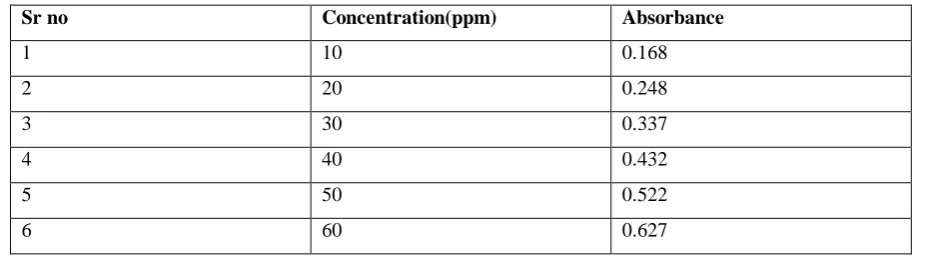
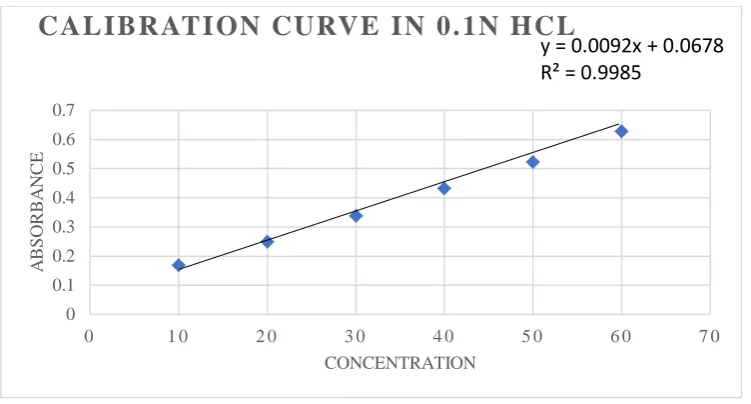
4.6. Calibration curve (Beer-Lamberts plot) of Prasugrel HCL in 0.1N HCL
Concentration and Absorbance values for Prasugrel HCL IN 0.1N HCL (λmax- 254nm)
Table No 7.Concentration and Absorbance values for Prasugrel HCL IN 0.1N HCL
Sr no Concentration(ppm) Absorbance
1 10 0.168
2 20 0.248
3 30 0.337
4 40 0.432
5 50 0.522
6 60 0.627
0 0.1 0.2 0.3 0.4 0.5 0.6
0 1 0 2 0 3 0 4 0 5 0 6 0 7 0
A B S O R B A N C E CONCENTRATION
C ALIBR AT ION C URVE IN WATER
0 0.1 0.2 0.3 0.4 0.5 0.6
0 1 0 2 0 3 0 4 0 5 0 6 0 7 0
A B S O R B A N C E CONCENTRATION
C A L I B R AT I O N C U RV E I N PH O S PH AT E
B U FFE R 6 . 8 y = 0.0081x + 0.0013
R² = 0.9981
Figure No 3 Calibration curve of Prasugrel HCL in 0.1N HCL
4.7. Calibration curve (Beer-Lamberts plot) of Prasugrel HCL in phosphate buffer
Concentration and Absorbance values for Prasugrel HCL in phosphate buffer 6.8 (λmax- 254nm)
Table No 8. Concentration and Absorbance values for Prasugrel HCL in phosphate Buffer 6.8.
Sr. no. Concentration(ppm) Absorbance
1 10 0.082
2 20 0.171
3 30 0.244
4 40 0.316
5 50 0.405
6 60 0.496
Figure No. 4 Calibration curve in Phosphate buffer 6.8 0 0.1 0.2 0.3 0.4 0.5 0.6 0.7
0 1 0 2 0 3 0 4 0 5 0 6 0 7 0
A B S O R B A N C E CONCENTRATION
CAL I B RAT I ON CURVE I N 0. 1N HCL
Figure No. 5 ATR spectra of Prasugrel HCL
4.8.
Fourier Transform Infrared Spectroscopy (FTIR)
FTIR spectra of Prasugrel HCL andHPMC-AS showed all the peaks corresponding to the functional groups present in the structures and thus identification of Prasugrel HCL and HPMC- AS was confirmed.
Values of major peaks in ATR spectrum of Prasugrel hydrochloride.
Table No 9. Values of major peaks in ATR spectrum of Prasugrel hydrochloride
Frequency (cm-1) Functional Group Standard Value
1755.22 C=O (Aliphatic ester) 1750-1735 cm-1
1687.71 C=O stretch(ketone) 1695-1680 cm-1
1496.76 C=C Aromatic stretch 1600-1475 cm-1
1219.01 C-N stretch(Aromatic amine) 1350-1250 cm-1
759.95 C-H Aromaticstretch
(Assymmetricstretch)
900-690 cm-1
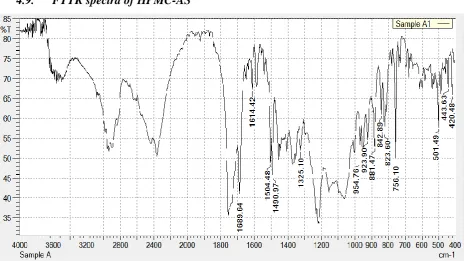
4.9. FTTR spectra of HPMC-AS
Figure No 6 FTTR spectra of HPMC-AS
Table No 10.Values of major peaks in FTIR spectrum of HPMC-AS.
Functional group Frequency(cm-1) Standard value
C-O(Ether) 1325.10 1300-1000
C=O (Ester) 1689.64 1750-1735
C-H (Alkane) 1490 1465
C=O (Acid) 1750 1700-1725
OH (acid) 3090 2400-3400
4.10. FTIR Spectra of physical mixture of Prasugrel HCL and HPMC-AS
Table No 11. Values of major peaks in FTIR spectrum of solid Dispersion
Frequency Functional group Standard value
1758.02 C=O (Aliphatic ester) 1750-1735 cm-1
1689.64 C=O stretch (Ketone) 1695-1680 cm-1
1492.90 C=C Aromatic 1600-1475 cm-1
1325.10 C-F Stretch 1400-1000 cm-1
758.02 C-H Aromatic stretch 900-690 cm-1
The Characteristic peaks of Prasugrel HCL appeared in the spectrum of solid dispersion
without any significant change in the position. It indicates that there was no any interaction
between drug and polymer.
4.11. DSC Analysis
Thermal behavior of pure drug and corresponding drug dispersion system are depicted in
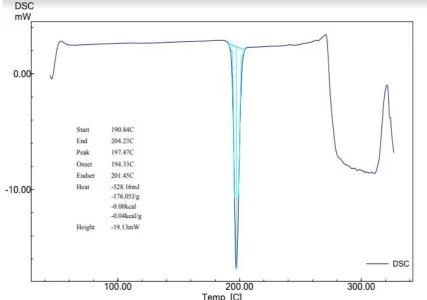
Fig. 9.8, 9.9, 9.10. The pure Prasugrel HCL shows a sharp endothermic peak at 186°C. The
characteristic endothermic peak corresponding to melting peak of pure Prasugrel HCL was
shifted towards lower temperature, with reduced intensity in solid dispersion prepared by
grinding method. This could be attributed to higher polymer concentration and uniform
distribution of Prasugrel Hydrochloride in the crust of polymer, resulting in complete
miscibility of molten drug inpolymer.
Figure No 9 DSC of Physical Mixture (Grinding Method)
The pure Prasugrel HCL shows a sharp endothermic peak at 186°C. The characteristic
endothermic peak corresponding to melting peak of pure Prasugrel HCL was shifted towards
higher temperature, in solid dispersion prepared by Solvent evaporation method. This could be
attributed to Non-uniform distribution of Prasugrel Hydrochloride in the crust of polymer,
resulting in poor miscibility of molten drug in polymer.
4.12.
Drug Content:
1. Grinding method
Table No 12. Drug content of Grinding method.
Batch No % Drug content
F2 (1:2) 65.16%
2. Solvent Evaporation Method
Table No 13. Drug content of Solvent evaporation Method
Batch No % Drug content
S2 (1:2) 56.93%
4.13.Solubility Study:
1. Grinding method
Table No 14. Solubility of Grinding Method
Batch F1(mg/ml) F2(mg/ml) F3(mg/ml) F4(mg/ml) API(mg/ml)
Water 0.6123 0.767 0.7283 0.6753 0.0020
pH 6.8 0.7477 0.8798 0.8304 0.7675 0.0024
0.1N HCL 0.9936 1.0013 0.8936 0.8763 0.0513
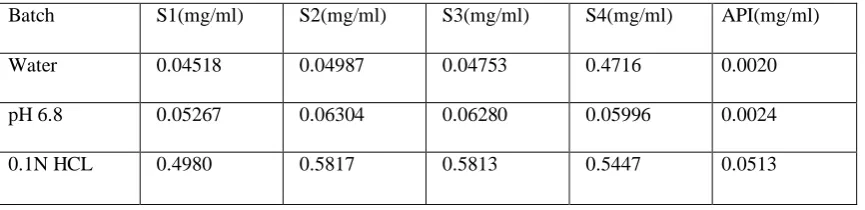
2. Solvent Evaporation Method
Table No 15. Solubility of Solvent Evaporation Method.
Batch S1(mg/ml) S2(mg/ml) S3(mg/ml) S4(mg/ml) API(mg/ml)
Water 0.04518 0.04987 0.04753 0.4716 0.0020
pH 6.8 0.05267 0.06304 0.06280 0.05996 0.0024
4.14.XRD Study
Figure No 11 XRD Spectra of Prasugrel HCL
.
Fig No. 13 XRD Spectra of Physical Mixture (Solvent Evaporation Method)
XRD analysis is used to judge any changes in the crystallinity of the drug which
precipitated in an amorphous form, when formulated into a solid dispersion. Powder XRD is
used to study any changes in crystallinity of the drug which could be one of the mechanisms
responsible for the improved dissolution. Powder XRD of pure Prasugrel HCL and solid
dispersion by both Grinding method and solvent Evaporation Method are shown in Figure.
The X-ray Diffractogram of pure Prasugrel HCL showed that the drug Prasugrel HCL was in
crystalline in nature as shown in the XRD graph. The XRD of solid dispersion of Prasugrel
HCL prepared with HPMC-AS by Grinding method showed that some peaks of the pure drug
were absent and or intensity of the peaks was reduced. But the XRD of solid dispersion of
Prasugrel HCL prepared with HPMC-AS by Solvent Evaporation method showed that still
some peaks of the pure drug was present. Thus the result of Powder XRD indicates that the
drug in solid dispersion in Grinding method is in amorphous form than the pure Prasugrel
HCL. Results from solvent evaporation method reveal that drug still shows some crystalline
nature. Thus the increased dissolution of the drug was observed more in Grinding method
than the Solvent Evaporation Method.
4.15.
Dissolution Study
Release of Prasugrel Hydrochloride from solid dispersion prepared by Grinding method
% CDR
API F1 F2 F3 F4
100 90
80
70
60
50
40
30
20
10
0
0 5 10 15 20 25 30 35
TIME (MIN)
solvent evaporation method found to be 84.1% within 30 min which is less as compared tosolid
dispersion prepared with grinding method. In case of 1:3 ratio drug release was also increased
but it was negligible than 1:2 ratio. So as per above observation it was concluded that 1:2 ratio
is optimized ratio for the preparation of solid dispersion and above this ratio drug release was
not found to be increasedmuch.
1. Grinding Method(% CDR)
Table No 15. Dissolution Study of Grinding Method
Time
(min)
0 5 10 15 20 25 30
API
% release
0 18.54 20.97 26.76 31.5 35.18 42.22
F1
% release
0 44.1 50.15 59.59 65.79 74.28 85.08
F2
% release
0 48.55 53.53 64.12 70.38 81.14 90.9
F3
% release
0 41.87 45.68 56.18 65.68 71.95 79.39
F4
% release
0 38.54 43.42 48.35 54.42 58.35 70.08
2. Solvent Evaporation Method (%CDR)
Table No 16. Dissolution Study of solvent evaporation Method
Figure No 15 Dissolution profile of pure drug and solid dispersion in phosphate Buffer 6.8 (Solvent evaporation
method). Time
(min)
0 5 10 15 20 25 30
API
% release
0 18.54 20.97 26.76 31.5 35.18 42.22
S1
% release
0 42.99 49.03 57.34 63.52 67.54 77.16
S2
% release
0 46.33 52.4 60.75 68.08 77.71 84.1
S3
% release
0 36.66 44.57 53.88 62.26 69.59 56.96
S4
% release
0 30.77 36.67 43.73 48.66 56.96 69.8
TIME (MIN) 35 30 25 20 15 10 5 0 90 80 70 60 50 40 30 20 10 0 S4 S3
% CDR
S1 S2
1. Comparison of Dissolution Profile between Grinding method and Solvent
Evaporation Method.
Table No 17. Comparison of Dissolution Study between two methods.
Figure No 16 Comparison of Dissolution profile between optimized batches ofSolid dispersion prepared by
Grinding method and solvent evaporation Method in phosphate buffer 6.8.
5.
CONCLUSION:
From Preformulation study it was concluded that Drug and Polymer were found to be as per
standards.
From IR and DSC studies it can be revealed that Drug and Polymer were compatible.
Solid dispersion was prepared by two preferable methods (Grinding method, Solvent evaporation
method) by using different drug polymer ratio (1:1, 1:2, 1:3, 1:4). In solid dispersion solubility was
Time
(min)
0 5 10 15 20 25 30
F2
%
Release
0 48.55 53.53 64.12 70.38 81.14 90.9
S2
%
Release
0 46.33 52.4 60.75 68.08 77.71 84.1
F2 S2
% CDR
100
80
60
40
20
0
0 5 10 15 20 25 30 35
TIME (MIN)
%
C
D
increased with increased concentration of HPMC-AS. Solid dispersion prepared by using 1:2
drug:polymer ratio show significant increase in solubility than the other drug polymer ratio from
both the methods. From XRD Analysis it can be concluded that drug in solid dispersion prepared by
Grinding method is in amorphous form than the pure Prasugrel HCL. Thus the higher dissolution of
the drug was observed from solid dispersion prepared by Grinding method.
In case of solid dispersion prepared by solvent evaporation method drug is in amorphous
form but still shows some crystalline nature, hence dissolution is lesser from solvent evaporation
method as compared to grinding method. From comparison of dissolution profile between two
methods it was found that drug release was increased only upto 1:2 ratio. In case of solid dispersion
prepared by grinding method F2(1:2) was the optimized batch and % CDR showed 94.4% at the end
of 30 min. similarly in case of solid dispersion prepared by solvent evaporation method S2(1:2) was
the optimized batch and % CDR showed 84.1 at the end of 30 min which is less as compared with
the % CDR of solid dispersion prepared by Grinding method.
Finally, it is concluded that solid dispersion method and HPMC-AS as a carrier for solid dispersion
preparation are useful for dissolution rate improvement of poorly soluble drug like Prasugrel HCL in
aqueous media as well as at high pH conditions.
6.
REFERENCES
1. MegaJ. L., SimonT. Pharmacology of antithrombotic drugs: An assessment of oral
antiplatelet and anticoagulant treatments.The Lancet.2015; 1–10.
2. Eli Lilly Nederland B. V. DOC. Ref: EMEA/117561/2009.
3. QuatromoniN. et al. Novel Anti-platelet Agents in Acute Coronary Syndrome:
Mechanisms of Action and Opportunities to Tailor Therapy.CurrentAtherosclerosis
Reports,2015; 1–10.
4. GukathasanN.,Mehran R.Acute Coronary Syndromes: Advances in Antithrombotics’,
Current Atherosclerosis Reports.2013; 1–8.
5. Bramhankar D.M., S. B. J.Biopharmaceutics and
Pharmacokinetics.VallabhPrakashan.2009;27-35.
6. Nikghalb L. A.et al.Solid Dispersion: Methods and Polymers to increase the solubility of
poorly Soluble Drugs. Journal of Applied Pharmaceutical Science. 2012;2(10):170–175.
7. Devara R.K,Reddipogu P.,Kumar S. ,Rambabu B., Jithan A., H. M. Investigation of
Solubility Enhancement of Prasugrel Hydrochloride: Nanosuspensions and Cyclodextrin
Inclusion Complexes.Indian Drugs. 2014;51(02): 29–38.
Aifeng Li, J. (CN).Pharmaceutical composition for improving dissolution rate of prasugrel
and its preparation method.2015;US Patent, US 9,050,328B2.
9. Zecevic Det al. Site-specific solubility improvement using solid dispersions of HPMC-
AS/HPC SSL – Mixtures. European Journal of Pharmaceutics and Biopharmaceutics.
2014;87(2): 1–7.
10. Ghareeb Met al. Kneading Technique for Preparation of Binary Solid Dispersion of
Meloxicam with Poloxamer 188.AAPS Pharm Sci Tech. 2009;10(4): 1206–1215.
11. Tanno F.et al.Evaluation of Hypromellose Acetate Succinate (HPMCAS) as a Carrier in
Solid Dispersions.Drug Development and Industrial Pharmacy. 2004;30(1): 9–17.
12. Maulvi F. A.et al. Improvement of Dissolution Rate of Aceclofenac by Solid Dispersion
Technique, Powder Technology. 2011;207: 47–54.
13. Thirupathaia A., Sunder R. S. Enhancement of Solubility and Dissolution of Atorvastatin
by Solid Dispersion Technique with Novel Carriers’, Scholars Research Library.
2016;8(8): 180–191.
14. Choudhary D., Kumar S., Enhancement of solubility and dissolution of glipizide by solid
dispersion(kneading) technique. Asian Journal of Pharmaceutics.2019;245–251.
15. NikghalbL. A. et al. Solid Dispersion: Methods and Polymers to increase the solubility of
poorly soluble Drugs. Journal of Applied Pharmaceutical Science. 2012;2(10): 170–175.
16. Schrör K., Siller-Matula,Huber, K. Pharmacokinetic basis of the antiplatelet action of
Prasugrel. Fundamental and Clinical Pharmacology. 2012;26: 39–46.
17. Ashland. Physical and Chemical Properties Handbook (Aquasolve-Hydroxy
propylmethylcellulose acetate succinate.2016;1-15.
18. The Indian Pharmacopoeia. Government of India ministry of Health and Family Welfare.
Published byThe Indian Pharmacopoeia commission Ghaziabad, 2007;2: 480.
19. Donald L. Pavia, Gary M. Lampman, G. S. K.Introduction to Spectroscopy.2001;1328.
20. Kanwar N., KumarR. Sinha, V. R. Preparation and Evaluation of Multi-Particulate System
(Pellets) of Prasugrel Hydrochloride. Open Pharmaceutical Sciences Journal. 2015; 2: 74–
80.
21. Shrestha P., BhandariS. K., Adhikari, S.Design and Development of Immediate and
Sustained Release Tablets. Research Journal of Pharmaceutical, Biological and Chemical
Sciences. 2014; 5(811): 1056–1064.
22. Rumondor, A. C. F., Dhareshwar, S. S. Kesisoglou, F. Amorphous Solid Dispersions or
Prodrugs: Complementary Strategies to Increase Drug Absorption. Journal of
23. Chandira R.M., Palanisamy P.,Jaykar B., Pasupathi1 A., Sreedharan D. B. Formulation,
Development and Evaluation of Immediate Release Tablets of Prasugrel. world Journal of
Pharmaceutical Research. 2015;4(8): 1421–1437.
24. Kim K.S.et al. Development of novel Prasugrel base Microsphere-loaded Tablet with
enhanced stability: Physicochemical characterization and in vivo Evaluation in Beagle
Dogs. Colloids and Surfaces B: Biointerfaces. 2016;146: 754–761.
25. Balogh A., Farkas B., Palv€olgyi A., Domokos A., Demuth B., MarosiG., Z. K. N.Novel
Alternating Current Electrospinning of Hydroxypropylmethylcellulose Acetate Succinate
(HPMCAS) Nano fibers for Dissolution Enhancement: The Importance of Solution
Conductivity. Journal of Pharmaceutical Sciences. 2017;106: 1634–1643.
26. Al-Obaidi H. Buckton, Evaluation of Griseofulvin Binary and Ternary Solid Dispersions
with HPMCAS.AAPS Pharm SciTech. 2009;10(4): 1172–1177.
27. Curatolo W., NightingaleJ. A., Herbig, S. M. Utility of hydroxypropylmethylcellulose
Acetate Succinate (HPMCAS) for Initiation and Maintenance of Drug Supersaturation in
the GI Milieu. Pharmaceutical Research. 2009;26(6): 1419–1431.
28. Friesen D. T. et al. Hydroxypropyl Methylcellulose Acetate Succinate-Based Spray-Dried
Dispersions: An Overview Dwayne. Molecular Pharmaceutics. 2008;5(6): 1003–1019.
29. ChiouW. L., Riegelman S. Pharmaceutical Applications of Solid DispersionSystems.
Journal of Pharmaceutical Sciences. 1971;60(9): 1281–1302.
30. BakerW. L., WhiteC. M.Role of prasugrel, a novel P2Y12 receptor antagonist, in the
Management of Acute Coronary Syndromes’, American Journal of Cardiovascular Drugs.