Volume 2009, Article ID 140492,15pages doi:10.1155/2009/140492
Research Article
Image Segmentation Method Using Thresholds Automatically
Determined from Picture Contents
Yuan Been Chen
1, 2and Oscal T.-C. Chen
11Department of Electrical Engineering, National Chung Cheng University, Chia-Yi 62102, Taiwan
2Department of Electronic Engineering, Chienkuo Technology University, Changhua City 500, Taiwan
Correspondence should be addressed to Yuan Been Chen,[email protected]
Received 1 June 2008; Revised 5 November 2008; Accepted 28 January 2009
Recommended by Jean-Philippe Thiran
Image segmentation has become an indispensable task in many image and video applications. This work develops an image segmentation method based on the modified edge-following scheme where different thresholds are automatically determined according to areas with varied contents in a picture, thus yielding suitable segmentation results in different areas. First, the iterative threshold selection technique is modified to calculate the initial-point threshold of the whole image or a particular block. Second, the quad-tree decomposition that starts from the whole image employs gray-level gradient characteristics of the currently-processed block to decide further decomposition or not. After the quad-tree decomposition, the initial-point threshold in each decomposed block is adopted to determine initial points. Additionally, the contour threshold is determined based on the histogram of gradients in each decomposed block. Particularly, contour thresholds could eliminate inappropriate contours to increase the accuracy of the search and minimize the required searching time. Finally, the edge-following method is modified and then conducted based on initial points and contour thresholds to find contours precisely and rapidly. By using the Berkeley segmentation data set with realistic images, the proposed method is demonstrated to take the least computational time for achieving fairly good segmentation performance in various image types.
Copyright © 2009 Y. B. Chen and O. T.-C. Chen. This is an open access article distributed under the Creative Commons Attribution License, which permits unrestricted use, distribution, and reproduction in any medium, provided the original work is properly cited.
1. Introduction
Image segmentation is an important signal processing tool that is widely employed in many applications including object detection [1], object-based coding [2–4], object tracking [5], image retrieval [6], and clinical organ or tissue identification [7]. To accomplish segmentations in these applications, the methods can be generally classified as based and edge-based techniques. The region-based segmentation techniques such as semisupervised sta-tistical region refinement [8], watershed [9], region growing [10], and Markov-random-field parameter estimation [11] focus on grouping pixels to become regions which have uniform properties like grayscale, texture, and so forth. The edge-based segmentation techniques such as Canny edge detector [12], active contour [13], and edge following [14–
16] emphasize on detecting significant gray-level changes near object boundaries. Regarding to the above-mentioned
methods, the segmenting mechanisms associated with users can be further categorized as either supervised segmentation or unsupervised segmentation.
to nonspecific image type is also unsupervised [9,17]. The implementation manners of the watershed method can be classified into rain falling and water immersion [18]. Some recent watershed methods use the prior information-based difference function instead of the more-frequently-used gradient function to improve the segmented results [19] and employ the marker images as probes to explore a gradient space of an unknown image and thus to determine the best-matched object [20]. The advantage of the watershed method is that it can segment multiple objects in a single threshold setting. The disadvantage of the watershed method is that the different types of images need different thresholds. If the thresholds are not set correctly, then the objects are under-segmented or over-under-segmented. Additionally, slight changes in the threshold can significantly alter the segmentation results. In [21,22], the systematic approach was demonstrated to analyze nature images by using a Binary Partition Tree (BPT) for the purposes of archiving and segmentation. BPTs are generated based on a region merging process which is uniquely specified by a region model, a merging order, and a merging criterion. By studying the evolution of region statistics, this unsupervised method highlights nodes which represent the boundary between salient details and provide a set of tree levels from which segmentations can be derived.
The edge-based segmentation can simplify the analysis by drastically minimizing the amount of pixels from an image to be processed, while still preserving adequate object structures. The drawback of the edge-based segmentation is that the noise may result in an erroneous edge. In the literature, the Canny edge detector employed the hysteresis threshold that adapts to the amount of noise in an image, to eliminate streaking of edge contours where the detector is optimized by three criteria of detection, localization, and single response [12]. The standard deviation of the Gaussian function associated with the detector is adequately determined by users. The Live Wire On the Fly (LWOF) method proposed by Falcao et al. helps the user to obtain an optimized route between two initial points [23]. The user can follow the object contour and select many adequate initial points to accomplish that an enclosed contour is found. The benefit of LWOF is that it is adaptive to any type of images. Even with very complex backgrounds, LWOF can enlist human assistance in determining the contour. However, LWOF is limited in that if a picture has multiple objects, each object needs to be segmented individually and the supervised operation significantly increases the operating time. The other frequently adopted edge-based segmentation is the snake method first presented by Kass et al. [24]. In this method, after an initial contour is established, partial local energy minima are calculated to derive the correct contour. The flaw of the snake method is that it must choose an initial contour manually. The operating time rises with the number of objects segmented. Moreover, if the object is located within another object, then the initial contours are also difficult to select. On the other hand, Yu proposed a super-vised multiscale segmentation method in which every pixel becomes a node, and the likelihood of two nodes belonging together is interpreted by a weight attached to the edge
linking these two pixel nodes [25]. Such approach allows that image segmentation becomes a weighted graph partitioning problem that is solved by average cuts of normalized affinity. The above-mentioned supervised segmentation methods are suitable for conducting detailed processing to objects of segmentation under user’s assistance. In the unsupervised snake method also named as the active contour scheme, the geodesic active contours and level sets were proposed to detect and track multiple moving objects in video sequences [26, 27]. However, the active contour scheme is generally applied when segmenting stand-alone objects within an image. For instance, an object located within the complicated background may not be easily segmented. Additionally, con-tours that are close together cannot be precisely segmented. Relevant study, the Extended-Gradient Vector Flow (E-GVF) snake method proposed by Chuang and Lie has improved upon the conventional snake method [28]. The E-GVF snake method can automatically derive a set of seeds from the local gradient information surrounding each point, and thus can achieve unsupervised segmentation without manually specifying the initial contour. The noncontrast-based edge descriptor and mathematical morphology method were developed by Kim and Park and Gao et al., respectively, for unsupervised segmentation to assist object-based video coding [29,30].
Smooth
Complicated
(a) (b)
0 50 100
0 1000 2000
0 50 100
0 1000 2000
0 50 100
0 200 400
0 100 200
0 200 400
0 50 100
0 200 400
0 50 100
0 1000 2000
0 50 100
0 2000 4000
0 100 200
0 500
0 100 200
0 100 200
0 50 100
0 2000 4000
0 100 200
0 500 1000
0 100 200
0 100 200
0 50 100
0 1000 2000
0 50 100
0 1000 2000
0 100 200
0 200 400
0 100 200
0 100 200
Figure1: Content characteristics of the “garden” image. (a) Image partitioned into 16 blocks. (b) Histogram formed by average values of gradients for all points in each block.
only be obtained from one side of the image, while the objects from the other side are not accurately segmented.
This work proposes a robust segmentation method that is suitable for nonspecific image type. Based on the hierarchical segmentation under a quad-tree decomposition [32, 33], an image is adequately decomposed into many blocks and subblocks according to the image contents. The initial-point threshold in each block is determined by the modified iterative threshold selection technique and the initial-point threshold of its parent block. Additionally, the contour threshold is calculated based on the histogram of gradients in each block. Using these two thresholds, the modified edge-following scheme is developed to automatically and rapidly attain fairly good segmentation results. Segmentations on various types of images are performed during simulations to obtain the accuracy of segmentations using methods such as the proposed, watershed, active contour, and others. To do fair comparison, the data set and benchmarks from the Computer Vision Group, University of California at Berkeley were used [34]. Simulation results demonstrate that the proposed method is superior to the conventional methods to some extent. Owing to avoiding human interferences and reducing operating time, the proposed method is more robust and suitable to various image and video applications than the conventional segmentation methods.
2. Proposed Robust Image
Segmentation Method
This work develops a robust image segmentation method based on the modified edge-following technique, where different thresholds are automatically generated according to the characteristics of local areas. Taking the “garden” image inFigure 1(a) as an example,Figure 1(b) divides this image
(a) (b)
Figure2: Blocks and subblocks resulted from the quad-tree decom-position process. (a) Original image. (b) Decomposed blocks.
2, 10,−6 1, 9,−7
0, 8,−8 7, 15,−1 6, 14,−2
5, 13,−3 4, 12,−4
3, 11,−5
Figure3: Values ofdrepresenting eight compass directions.
are used to determine the initial points while contour thresholds can eliminate inappropriate contours to increase the accuracy of search and minimize the required searching time. Finally, the modified edge-following method is used to discover complete contours of objects. Details of each stage are described below.
2.1. Stage of Applying the Modified Iterative Threshold Selection Technique. In this stage, the gradient between the currently processed point (x,y) and its neighboring point in one of eight compass directions is first determined by using the following equation:
Gd(x,y)= |I(x,y)−I(xd,yd)|, (1)
where (xd,yd) neighbors to (x,y) in directiond, andI(x,y)
andI(xd,yd) denote the gray-level values at locations (x,y)
and (xd,yd), respectively. Here,dis a value denoting one of
the eight compass directions as shown inFigure 3. Ford >7, the remainder ofddivided by 8 is taken. Whend <0,dis added by a multiple of 8 to become a positive value smaller than 8. Hence, “1”, “9”, and “−7” denote the same directions. This will be useful inSection 2.4.
G(x,y) is defined to take a mean of Gd(x,y) in eight
directions for the point (x,y) in the following equation:
G(x,y)=1
8
7
d=0
Gd(x,y). (2)
The iterative threshold selection technique that was proposed by Ridler and Calvard to segment the foreground and back-ground is modified to calculate the initial-point threshold of the whole image or a particular block from the quad-tree decomposition, for identifying initial points [35]. The modified iterative threshold selection technique is illustrated as follows.
(1) Let k = 0, Tk = (MAX[G(x,y) | (x,y) ∈
all points in a decomposed block])/2, where MAX is a function to select the maximum value.
(2)Tk is adopted to classify all points in a decomposed
block into initial and noninitial points. A point with
G(x,y) ≥ Tk is an initial point, while a point with
G(x,y) < Tk is a noninitial point. The groups of
initial and noninitial points are denoted byIandNI, respectively. In these two groups, the averagedG(x,y) is computed by
uk=
(x,y)∈IG(x,y)
#I ,
vk=
(x,y)∈NIG(x,y)
#NI ,
(3)
where #Iand #NIdenote the numbers of initial and noninitial points, respectively,
(3)
Tk+1=round(wI×uk+wNI×vk), (4)
where round(λ) rounds off the value of λ to the nearest integer number. wI andwNI, ranging from
0 to 1, denote the weighting values of initial and noninitial groups, respectively. Additionally, wI +
wNI=1.
(4) IfTk+1=/Tk, thenk = k+ 1 and go to Step 2, else
Tg=Tk.
Notably, Tk is limited to the range between 0 and 255,
and rounded off into a specific integer in the iterative procedure so that the above-mentioned iteration always converges. Usually, wI andwNI are set to 0.5 to allow Tg
locating in the middle of two groups. To avoid missing some initial points in low-contrast areas of an image with complicated contents, wNI can be increased to lower Tg.
However, with an increasing decomposition level in the quad-tree decomposition process, wNI can be lowered for
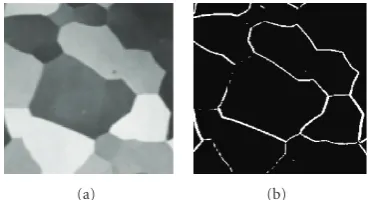
a small decomposed block that has a consistent contrast. Taking the “alumgrns” image inFigure 4as an example, the initial-point thresholdTg of the entire image calculated by the modified iterative threshold selection is 16 underwI =
wNI =0.5.The rough contour formed by initial points can
be found as depicted inFigure 4(b), but the contour is not intact. Hence, the quad-tree decomposition in the following stage would take thisTg as the basis to compute the initial-point threshold value of each decomposed block depending on the complexity of each area.
(a) (b)
Figure4: “alumgrns” image. (a) Original image. (b) White points withG(x,y)> Tg.
shows the flow chart of the quad-tree decomposition to determine whether the currently processed block is further decomposed and to calculate the initial-point threshold of this block. Assume that the blockBt with a meanMt and
a standard deviation St of gray-level gradients is currently
processed. The parent block ofBt is represented byBt−1in
which initial-point threshold, mean and standard deviations are denoted by Tgt−1, Mt−1 and St−1, respectively. While G(x,y) of each point in the block Bt is smaller thanTgt−1,
the block Bt does not contain any initial point and thus
its initial-point threshold Tgt is set to Tgt−1 in order to
avoid the initial-point generation. Under such a situation, there is no further decomposition in the block Bt. On the
other hand, when G(x,y) of any point of the block Bt is
larger thanTgt−1, the block Bt is further decomposed into
four subblocks. Additionally,Tgtis temporarily given by the
value computed by the modified iterative threshold selection technique in the blockBt. IfMt < Mt−1andSt < St−1, then
the blockBt would contain a smoother area than the block
Bt−1. LetTgt=Tgt−1to prevent the reduction of the
initial-point threshold from yielding the undesired initial initial-points. If Mt ≥ Mt−1 andSt ≥ St−1, the complexity of the block Bt is increased. In this situation, the block Bt may contain
contour points, but may also include many undesired noises or complicated image contents. Hence, raising the initial-point threshold by Tgt = MAX(Tgt,Tgt−1) to allow that Tgt ≥Tgt−1can eliminate the noises and reduce the over-segmentation result in the block Bt. Otherwise, the initial
point thresholdTgtof the blockBtthat may contain objects
is remained as the value from the modified iterative threshold selection technique conducted in the blockBt.
During the quad-tree decomposition process,wIcan be
set by a value smaller than 0.5 at the first decomposition level to lower Tg for capably attaining initial points from low-contrast areas. Additionally, wI is increased with a
decomposition level. For the smallest decomposed block in the last decomposition level,wI can be a value larger than
or equal to 0.5 for increasing Tg to avoid the undesired initial points. Notably, the initial-point thresholds of blocks with drastic gray-level changes would rise, whereas the initial-point thresholds of blocks with smooth gray-level changes would fall. This approach of determining initial-point threshold can obtain adequate initial initial-points based on the complexity of image contents.
After the quad-tree decomposition is finished, the posi-tions and moving direcposi-tions of initial points in each block are recorded accordingly.
(1) (x,y) is a point from a decomposed blockBt.
(2) If G(x,y) ≥ Tgt then (x,y) is labeled as the
initial point andd∗ is recorded whereGd∗(x,y) =
MAX[Gd(x,y), for 0≤d≤7].
(3) Repeat step 2 for all points in the blockBt.
2.3. Stage of Determining the Contour Threshold Tc. At the end of the quad-tree decomposition process, the gradients of each decomposed block are computed to determine the contour thresholdTc. According to (1), the largest value of
Gd(x,y) in the eight directions is Gd∗
(x,y), whered∗ is a specific value ofdfor yielding the maximumGd(x,y). The
histogram ofGd∗
(x,y) from all points of the decomposed block is calculated. Here,H(k) is assumed to be the number of the absolute gray-level difference beingk. If a decomposed block comprises many one-pixel lines that are all black and white in an interlaced manner, then this decomposed block contains the maximum number of contour points, which is half the number of points in the decomposed block. Restated, the first half of the histogram results from noncontour points at least. Accordingly, the contour thresholdTc can be the index value, indicating that Tck=0H(k) denotes half the number of points in a decomposed block, as indicated in
Figure 6. This threshold does not miss any contour points. When the search is conducted for contour points,Tcis used to determine whether to stop the search procedure in the modified edge-following scheme. If the differences between the predicted contour point and its left and right neighboring points are less thanTc, then the search has taken the wrong path, and should stop immediately. This approach not only prevents searching in the wrong path, but also saves on the search time. Additionally,Tc of each decomposed block is independently determined to adapt to the characteristics of each area.
2.4. Stage of Applying the Modified Edge-Following Method.
The initial-point threshold Tg, contour threshold Tc, and initial points are obtained in the previous stages. In this stage, the searching procedure is started from each initial point until the closed-loop contour is found. The position and direction of thekth searched contour point are represented by wk = (xk,yk) anddk, respectively. The modified
edge-following method is given as follows.
(1) Select an initial point and its d∗. This initial point is represented byw0 and setd0 = d∗ + 2 where the
edge-following direction d0 is perpendicular to the
maximum-gradient directiond∗. Here,d0is a value denoting one of the
eight compass directions as shown inFigure 3.
(2) Letk =0, wherekis the contour-point index. The searching procedure begins from the initial pointw0and the
directiond0.
Start
Currently processed blockBt
Tgt−1,Mt−1&St−1fromBt−1
Yes
No further decomposition Tgt=Tgt−1
No
G(x,y)< Tgt−1, for all (x,y) ofBt
Btdecomposed to 4 subblocks
calculatingTgt,Mt&St
No
No No
Yes
Yes Yes
End Mt≥Mt−1
St≥St−1
Mt< Mt−1
Tgt=Tgt−1 Tgt Tgt=MAX(Tgt,Tgt−1)
Figure5: Flow chart of quad-tree decomposition.
0 500 1000 1500 2000 2500 3000 3500 4000 4500 5000
H
(
k
)
0 50 100 150 200
k Tc
Noncontour points
Contour points
Figure6: Histogram ofGd∗(x,y).
denotes the number of directions needed. The directiondk+1
of the next point thus has three possible values:dk−1, dkand
dk+1. For instance, ifdk=1, then the next contour pointwk+1
could appear at the predicted contour point p0
k+1,p1k+1 or
p2k+1, as shown inFigure 7(a). With the left-sided pointldk+j
k+1
and right-sided point rdk+j
k+1 of the predicted contour point
pdk+j
k+1 , the line formed bywkandp dk+j
k+1 points is perpendicular
to the line between ldk+j
k+1 and r
dk+j
k+1, where j indicates the
direction deviation, as revealed inFigure 7(b)underdk =1
andj=0. Additionally,ldk+j
k+1 andr
dk+j
k+1 can be represented as
ldk+j
k+1 =
xk+ round
2 cos
(dk+j+ 1)×π
4
,
yk−round
2 sin
(dk+j+ 1)×π
4
,
rdk+j
k+1 =
xk+ round
2 cos
(dk+j−1)×π
4
,
yk−round
2 sin
(dk+j−1)×π
4
, (5)
respectively, where j ranges from −(i−1)/2 to (i−1)/2, round(λ) rounds off the value ofλ to the nearest integer number.
(4) The gray-level average values Lk and Rk of the
previous contour points are calculated as
Lk=
1
k+ 1
k
p=0 Ildkk−−pp,
Rk=
1
k+ 1
k
p=0 Irdk−p
k−p
.
(6)
(5)Ek+1,l(j) andEk+1,r(j) that interpret the relationships
points, andLk andRk, are used to obtain the next probable
contour point:
Ek+1,l(j)=I
pdk+j
k+1
−Ildk+j
k+1−I
ldk+j
k+1
−Lk, (7)
Ek+1,r(j)=I
pdk+j
k+1
−Irdk+j
k+1−I
rdk+j
k+1
−Rk. (8)
Equations (7) and (8) are used to determine the (k+ 1)th contour point. The first term represents the gradient between the predicted point and its left-sided or right-sided point. The second term may prevent (7) or (8) from finding the wrong contours due to the noise interference. If the difference in the second term is too large, then the wrong contour point may be found.
(6) Select the largest value by using Fk+1(j) =
MAX[Ek+1,l(j) orEk+1,r(j), for −(i−1)/2≤ j≤(i−1)/2].
IfFk+1(j) ≥Tc, then the correct direction has been found,
and go to step 8. Here,Tccomes from the decomposed block which the predicted contour pointpdk+j
k+1 belongs to.
(7) Ifi=3, then the previously searched direction may have deviated from the correct path and seti =7 to obtain the seven neighboring points for direction searching, going to step 5. Otherwise, stop the search procedure, and go to step 10.
(8) FromFk+1(j), the correct directiondk+1and position
of the (k+ 1)th contour point are calculated as follows:
dk+1=dk+j,
wk+1=
xk+ round
cos
dk+1×π
4
,
yk−round
sin
dk+1×π
4
.
(9)
(9) The searching procedure is finished when the (k+ 1)th contour point is in the same position as any of the previous searched contour points or has gone beyond the four boundaries of the image. If neither condition is true, then setk =k+ 1, and return to step 3 to discover the next contour point.
(10) Ifd0 = d∗+ 2, setd0 =(d∗+ 6) and go to step 2
to search for the contour points in the opposite direction to
d∗+ 2.
(11) Go to step 1 for another initial point that is not searched. When all initial points are conducted, the procedure of the modified edge-following method is ended.
During the searching process, taking in the left and right neighboring points of the next predicted contour point in computation would significantly reduce the tendency of the edge-following method to deviate from the correct edge due to noise interferences. Only three directions are first searched in the searching process. If theFk+1(j) values of these three
directions are all belowTc, then the search proceeds to the seven directions. The searching time is thus significantly decreased, since most searches only need the computation of the gradients in three directions.Figure 8depicts the flow chart of the proposed modified edge-following scheme that searches from an initial point.
p2
k+1 p1k+1
wk p0k+1
(a)
l1k+1
r1k+1 wk
p1k+1
(b)
Figure 7: Relationship of wk with its neighboring points. (a)
Predicted points ofp0
k+1,p1k+1andp2k+1underdk=1. (b)p1k+1,l1k+1 andr1
k+1underdk=1 andj=0.
Start d0=d∗+ 2
k=0
ComputingFk+1(j) for the three directions in
dk−1,dk,dk+ 1
Yes
Yes
Yes Yes
No No
No
No
End Fk+1(j)Tc
ComputingFk+1(j) for the seven directions other than the opposite
direction ofdk
Fk+1(j)Tc
Determiningdk+1&wk+1 k=k+ 1 wk+1
being in the same position as any of the previous searched contour points or having gone
beyond image boundaries
d0=d∗+ 2 d0=d∗+ 6
Figure8: Flow chart of the modified edge-following scheme.
3. Computational Analyses
(a) (b) (c) (d) (e) (f)
Figure9: Segmented results of the “bacteria” image. (a) Original image. (b) Result obtained by the LWOF method. (c) Result obtained by the E-GVF snake method. (d) Result obtained by the watershed method with a threshold of 20. (e) Result obtained by the watershed method with a threshold of 40. (f) Result obtained by the proposed method.
small circles indicating the positions selected by the user for segmentation. The user can adequately select some points close to an object to obtain a segmentation result that is closest to that observed with naked eyes. However, LWOF requires a very long computational time, and is dependent on the user. Consequently, the processing time of LWOF must include the manual operational time. The segmentation function adopted by the watershed method is gradient [9]. Additionally, the merging operation is based on the region mean where the threshold indicates the criterion of region merging. Here, two quantities, precision and recall, are employed to evaluate the segmented results from each segmentation method [34,36]. Precision,P, is the probability that a detected pixel is a true one. Recall,R, is the probability that a true pixel is detected:
Precision(P)= True boundary pixels extracted
Total number of boundary pixels extracted,
Recall(R)= True boundary pixels extracted
Total number of true boundary pixels.
(10)
Additionally, the F-measure,F, with consideringPandRis adopted and defined as
F= PR
αR+ (1−α)P, (11)
whereαis set to 0.5 in our simulations.
Figure 9(a) shows a 256 × 256-pixel “bacteria” image, which includes about 20 bacteria objects that do not overlap with each other. The shot was taken out of focus, causing the image edges to be blurry, thus affecting some of the segmented results. Figure 9(b) displays the result from LWOF. LWOF takes a long time because it must perform about 20 object selection operations. Figure 9(c) depicts the result from the E-GVF snake method. Some groups of connected neighboring bacteria objects are mistaken for single objects. Figures 9(d)and9(e)show the results from utilizing the watershed method with thresholds of 20 and 40, respectively. Many erroneous borders are found when the threshold is 20, with some single objects being segmented into multiple smaller parts. While fewer erroneous contours are found when the threshold is 40, some objects are still missing. The number of missing objects increases with the
threshold. Contrasts in this picture are significantly reduced owing to the unfocused image, making the threshold hard to adjust. An excessively large threshold causes missing objects, but a very small threshold would cause the background to blur with the bacteria, which make it even more difficult to segment. To do fair comparison, the watershed method is iteratively conducted under different thresholds to yield the best segmented results in the following analyses.Figure 9(f)
displays the results from the proposed method, which is not affected by the out-of-focus image due to adequate initial points attained, and thus can segment every bacteria object.
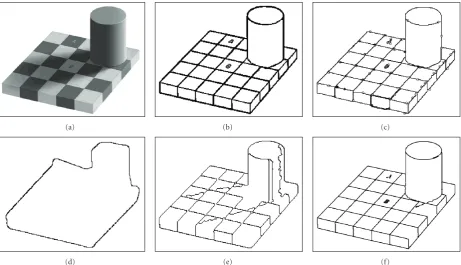
Figure 10(a) shows the 540 × 420-pixel “chessboard” image, which is a 3D manmade image including a chessboard and cylinders. The light effect is added in the picture, reflecting shadows of the cylinders on the chessboard.
Figure 10(b) shows the ground truth from Figure 10(a). The result from LWOF is depicted inFigure 10(c). A fairly good result is obtained using the manual operation, but a large number of initial points required means that the computational time is very long.Figure 10(d) displays the result from the E-GVF snake method, which is clearly not appropriate for an image, with objects all very close to each other. The simulation result indicates that contour of the outermost layer is segmented, but that the squares inside the chessboard cannot be detached from each other, leaving the result with only one object.Figure 10(e) shows results from using the watershed method at a threshold being 27 with the maximum F-measure.Figure 10(f)depicts the result from the proposed method. The proposed method not only can segment the two letters and the cylinders, it also segments the chessboard itself better than does the watershed method with the best threshold value. The segmentation of the side surface in the chessboard is also far more accurate than that generated from the watershed method. Table 1
(a) (b) (c)
(d) (e) (f)
Figure10: Segmented results of the “chessboard” image. (a) Original image. (b) Ground truth. (c) Result obtained by the LWOF method. (d) Result obtained by the E-GVF snake method. (e) Result obtained by the watershed method with a threshold value of 27. (f) Result obtained by the proposed method.
Table1: Segmentation results of the LWOF, E-GVF, watershed and proposed methods.
Methods Performance
Numbers of segmented objects F-measures Segmentation manners
LWOF 36 0.97 supervised
E-GVF 1 0.44 unsupervised
Watershed 29 0.86 unsupervised
Proposed 32 0.95 unsupervised
Figure 11 shows the 360 × 360-pixel “square” image corrupted by the Gaussian noise, at the Signal-to-Noise Ratio (SNR) of 18.87 dB. Figures 11(a) and 11(b) depict the noisy image and ground truth, respectively. The result from adopting the LWOF segmentation is displayed in
Figure 11(c). Not many points are selected manually since the angles of turns are not very large. However, the contour is not smooth due to the noise.Figure 11(d)shows the result obtained by using the E-GVF snake method. Some dark areas could be lost in the sharp corners. The result from using the watershed method at a threshold being 45 with the maximum F-measure is depicted in Figure 11(e). The proposed method can eliminate the problem and obtain the correct area as shown inFigure 11(f).Table 2 compares F-measures and computational time of the four segmentation methods at SNRs of 18.87 dB, 12.77 dB and 9.14 dB in which the watershed method adopts thresholds of 42, 44, and 45, respectively. By using the proposed method, the segmented
area has the highest F-measures in each of the three SNR scenarios. The proposed method using the modified edge-following technique is significantly faster than LWOF when the manual operational time is considered. Additionally, the proposed method provides comparable or even better results than the LWOF. The results obtained by the watershed method at thresholds with the maximum F-measures take slightly lower processing time than the proposed method when the threshold selection time is not counted in the watershed method. The above experiments were conducted by using C programs running on a Pentium IV 2.4 GHz CPU under Windows XP operating system.
(a) (b) (c) (d) (e) (f)
Figure11: Segmented results of the “square” image added by noises with the Gaussian distribution at SNR of 18.87 dB. (a) Noisy image. (b) Ground truth. (c) Result obtained by the LWOF method. (d) Result obtained by the E-GVF snake method. (e) Result obtained by the watershed method with a threshold of 45. (f) Result obtained by the proposed method.
Table2: F-measures and computational time of the LWOF, snake, watershed and proposed methods.
Methods
Performance
SNR=18.87 dB SNR=12.77 dB SNR=9.14 dB
F-measures Processing time (sec) F-measures Processing time (sec) F-measures Processing time (sec)
LWOF 0.95 7.20∗ 0.86 10.60∗ 0.80 15.30∗
E-GVF Snake 0.93 1.21 0.81 1.32 0.75 1.51
Watershed 0.94 0.26∗∗ 0.86 0.29∗∗ 0.81 0.31∗∗
Proposed 0.96 0.31 0.88 0.32 0.82 0.34
Note: the symbol of “∗” indicates the processing time including manual operational time. Additionally, the symbol of “∗∗” denotes that the processing time is calculated under a specific threshold where the iterative process under different thresholds is not included.
in Figures9(d)and9(e), respectively.Figure 10reveals that both the proposed and watershed methods demonstrate the capability of fully segmenting objects inside another object and overlapping objects but the E-GVF snake method cannot be applied in these pictures. The proposed method can segment more objects out of the image in Figure 10, which contains many individual objects, than the watershed method. In the simulation results shown in Figure 11, by considering the gray-level changes of the left and right neighboring points during the contour-searching process, the proposed method not only reduces the noise interference, it also outperforms both the E-GVF snake and watershed methods against noise interference.
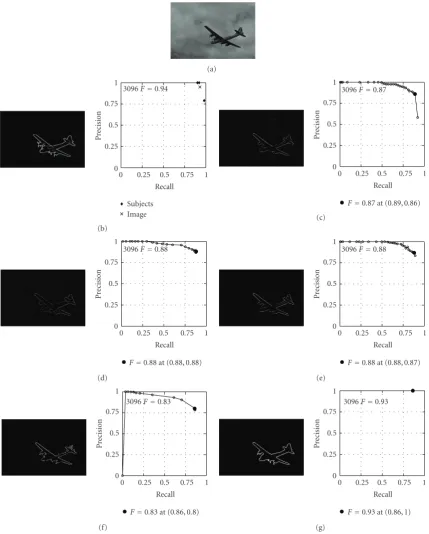
To do fair comparison, the data set and benchmarks from the Computer Vision Group, University of California at Berkeley were applied in the proposed and watershed methods, where the watershed method is also iteratively performed to search for the optimized threshold. Since the E-GVF snake method is not suitable for the image with objects inside another object, it is not addressed in this data set. The segmentation results of the conventional methods such as Brightness Gradient (BG), Texture Gradient (TG), and Brightness/Texture Gradients (B/TG) are referred from [34] for comparison. The precision-recall (P-R) curve shows the inherent trade-off between P andR.Figure 12 depicts the segmented results and the precision-recall curves from Human, BG, TG, B/TG, watershed and proposed methods. In Figures12(c),12(d),12(e), and12(f), the BG, TG, B/TG and watershed methods are iteratively conducted under different thresholds to yield the best segmented results with F of 0.87, 0.88, 0.88, and 0.83, respectively. In the proposed method, the threshold is automatically determined
to be a specific value that only yields a converged point in
Figure 12(g), where the F-measure of 0.93 can be achieved. Hence, the proposed method does not need the ground truth to iteratively determine the best-matched thresholds and thereby greatly reduces the computational time demanded by the BG, TG, B/TG, and watershed methods.
The proposed method is applied to all test images, and its segmentation results are evaluated according to the ground truths. Particularly, six images from 100 test images are added by the Gaussian noise to become noisy images at the SNR of 18.87 dB.Figure 13displays the segmented results of original and noisy images using the proposed and watershed methods, where F-measures and computational time are listed inTable 3. FromFigure 13, the segmented results from the proposed method exhibit more apparent and complete objects than those from the watershed method at specific thresholds with the maximum F-measures. In Figures13(a),
13(b),13(c),13(d),13(e), and13(f), the watershed method is conducted under thresholds of 23, 30, 7, 45, 16, and 32 to yield the best segmented results, respectively. Additionally,
P-R curves from proposed and watershed methods are depicted. Moreover, the proposed method with thresholds adapting to image contents has higher or equal F-measure values than the watershed methods as illustrated inTable 3. Regarding to computational time, the proposed method at most cases takes slightly longer time than the watershed method owing to additional threshold determination process required by the proposed method when the iterative process of determining the best threshold of the watershed method is not included.
(a)
0 0.25 0.5 0.75 1
P
recision
0 0.25 0.5 0.75 1 Recall
Subjects Image 3096F=0.94
(b)
0 0.25 0.5 0.75 1
P
recision
0 0.25 0.5 0.75 1 Recall
F=0.87 at (0.89, 0.86) 3096F=0.87
(c)
0 0.25 0.5 0.75 1
P
recision
0 0.25 0.5 0.75 1 Recall
F=0.88 at (0.88, 0.88) 3096F=0.88
(d)
0 0.25 0.5 0.75 1
P
recision
0 0.25 0.5 0.75 1 Recall
F=0.88 at (0.88, 0.87) 3096F=0.88
(e)
0 0.25 0.5 0.75 1
P
recision
0 0.25 0.5 0.75 1 Recall
F=0.83 at (0.86, 0.8) 3096F=0.83
(f)
0 0.25 0.5 0.75 1
P
recision
0 0.25 0.5 0.75 1 Recall
F=0.93 at (0.86, 1) 3096F=0.93
(g)
Figure12: Segmented results and precision-recall curves of the 3096th image in the Berkeley segmentation data set. (a) Original image. (b) Human. (c) Brightness gradient. (d) Texture gradient. (e) Brightness/texture gradients. (f) Watershed. (g) Proposed method.
Figure 14. Although the proposed method yields little poor performance in few images under very low contrast, it still has above 0.6 of F-measure for 70 test images. The number of F-measures between 0.6 and 0.9 in the proposed method is 68 larger than 64 in BG and 59 in TG, and smaller than 73 in B/TG while the number of F-measures between 0.9 and 1.0 in the proposed method is 2 better than none in
0 0.25 0.5 0.75 1
P
recision
0 0.25 0.5 0.75 1 Recall
F=0.78 at (0.72, 0.85) 78004F=0.78
0 0.25 0.5 0.75 1
P
recision
0 0.25 0.5 0.75 1 Recall
F=0.69 at (0.74, 0.64) 78004F=0.69
(a)
0 0.25 0.5 0.75 1
P
recision
0 0.25 0.5 0.75 1 Recall
F=0.67 at (0.73, 0.61) 21077F=0.67
0 0.25 0.5 0.75 1
P
recision
0 0.25 0.5 0.75 1 Recall
F=0.6 at (0.69, 0.52) 21077F=0.6
(b)
0 0.25 0.5 0.75 1
P
recision
0 0.25 0.5 0.75 1 Recall
F=0.64 at (0.65, 0.63) 210088F=0.64
0 0.25 0.5 0.75 1
P
recision
0 0.25 0.5 0.75 1 Recall
F=0.64 at (0.81, 0.52) 210088F=0.64
(c)
0 0.25 0.5 0.75 1
P
recision
0 0.25 0.5 0.75 1 Recall
F=0.78 at (0.72, 0.87) 300091F=0.78
0 0.25 0.5 0.75 1
P
recision
0 0.25 0.5 0.75 1 Recall
F=0.73 at (0.78, 0.69) 300091F=0.73
(d)
0 0.25 0.5 0.75 1
P
recision
0 0.25 0.5 0.75 1 Recall
F=0.64 at (0.64, 0.64) 271035F=0.64
0 0.25 0.5 0.75 1
P
recision
0 0.25 0.5 0.75 1 Recall
F=0.63 at (0.73, 0.55) 271035F=0.63
(e)
0 0.25 0.5 0.75 1
P
recision
0 0.25 0.5 0.75 1 Recall
F=0.6 at (0.72, 0.51) 219090F=0.6
0 0.25 0.5 0.75 1
P
recision
0 0.25 0.5 0.75 1 Recall
F=0.59 at (0.67, 0.52) 219090F=0.59
(f)
Table3: F-measures and computational time of the noisy images conducted by the proposed and watershed methods.
Image indices
Performance
Proposed method Watershed
F-measures Processing time (sec) F-measures Processing time (sec)
78004 0.78 0.34 0.69 0.35∗
21077 0.67 0.37 0.60 0.36∗
210088 0.64 0.48 0.64 0.38∗
300091 0.78 0.32 0.73 0.30∗
271035 0.64 0.36 0.63 0.38∗
219090 0.60 0.37 0.59 0.35∗
Note: the symbol of “∗” denotes that the processing time is calculated under a specific threshold where the iterative process under different thresholds is not included.
0 5 10 15 20 25 30 35
Fre
q
u
en
cy
o
f
F
-m
ea
su
re
0 0.2 0.4 0.6 0.8 1
F-measure (a)
0 5 10 15 20 25 30 35 40 45
Fre
q
u
en
cy
o
f
F
-m
ea
su
re
0 0.2 0.4 0.6 0.8 1
F-measure (b)
0 5 10 15 20 25 30 35 40
Fre
q
u
en
cy
o
f
F
-m
ea
su
re
0 0.2 0.4 0.6 0.8 1
F-measure (c)
0 5 10 15 20 25 30 35
Fre
q
u
en
cy
o
f
F
-m
ea
su
re
0 0.2 0.4 0.6 0.8 1
F-measure (d)
Figure14: Histograms of F-measures from 100 test images. (a) BG. (b) TG. (c) B/TG. (d) Proposed method.
computational time point of view, the proposed method that uses automatically determined thresholds to perform image segmentation apparently takes the least time than the conventional methods that are iteratively conducted under different thresholds to converge their minima.
segmentation method does not need the ground truths and iterative operations to determine the segmentation results, and therefore is very suitable to various real-time image and video segmentation applications under no ground truth.
4. Conclusion
This work proposes an automatically determined threshold mechanism to perform a robust segmentation. Different initial-point thresholds are determined and given to areas with drastic and smooth changes in gray-level values. The contour thresholds are generated by analyzing the decom-posed blocks, thus preventing the search from falling into the wrong path, and saving computational time. The contour search process also considers the gradients of the left and right neighboring points of every predicted contour point, in order to lower the possibility of the method being affected by the neighboring noise interferences. Additionally, most of the searching process requires only the computation of the gradients of three directions, thus minimizing the searching time. The proposed method can perform segmentation on objects inside another object and objects that are close to each other, which the E-GVF snake method cannot perform. The proposed method also solves problems encountered by the watershed method, in which the results may change significantly as the threshold values differ. The proposed method can significantly reduce noise interference, which easily affects the conventional edge-following method. In handling blurry objects from an out-of-focus shot, the pro-posed method can also segment the required objects. Finally, the benchmark from Computer Vision Group, University of California at Berkeley was conducted to demonstrate that the proposed method could take the least computational time to obtain robust and good segmentation performance than the conventional ones. Therefore, the proposed method can be widely and effectively employed in various segmentation applications.
Acknowledgments
Valuable discussions with Professor Tsuhan Chen, Carnegie Mellon University, Pittsburgh, USA is highly appreciated. Additionally, the authors would like to thank the National Science Council, Taiwan, for financially supporting this research under Contract nos.: NSC 95-2221-E-270-015 and NSC 95-2221-E-194-032. Professor W. N. Lie, National Chung Cheng University, Chiayi, Taiwan is appreciated for his valuable suggestion. Dr. C. H. Chuang, Institute of Statistical Science, Academia Sinica, Taipei, Taiwan, is thanked for kindly providing the software program of the snake and watershed methods.
References
[1] D. Liu and T. Chen, “DISCOV: a framework for discovering objects in video,”IEEE Transactions on Multimedia, vol. 10, no. 2, pp. 200–208, 2008.
[2] J. Pan, C. Gu, and M. T. Sun, “An MPEG-4 virtual video conferencing system with robust video object segmentation,”
inProceedings of Workshop and Exhibition on MPEG-4, pp. 45–
48, San Jose, Calif, USA, June 2001.
[3] J.-F. Yang, S.-S. Hao, P.-C. Chung, and C.-L. Huang, “Color object segmentation with eigen-based fuzzy C-means,” in Pro-ceedings of the IEEE International Symposium on Circuits and
Systems (ISCAS ’00), vol. 5, pp. 25–28, Geneva, Switzerland,
May 2000.
[4] S.-Y. Chien, Y.-W. Huang, B.-Y. Hsieh, S.-Y. Ma, and L.-G. Chen, “Fast video segmentation algorithm with shadow cancellation, global motion compensation, and adaptive threshold techniques,”IEEE Transactions on Multimedia, vol. 6, no. 5, pp. 732–748, 2004.
[5] J. Y. Zhou, E. P. Ong, and C. C. Ko, “Video object segmentation and tracking for content-based video coding,” inProceedings of IEEE International Conference on Multimedia and Expo
(ICME ’00), vol. 3, pp. 1555–1558, New York, NY, USA, July
2000.
[6] C.-C. Chiang, Y.-P. Hung, and G. C. Lee, “A learning state-space model for image retrieval,”EURASIP Journal on
Advances in Signal Processing, vol. 2007, Article ID 83526, 10
pages, 2007.
[7] Y. B. Chen, O. T.-C. Chen, H. T. Chang, and J. T. Chien, “An automatic medical-assistance diagnosis system applicable on X-ray images,” in Proceedings of the 44th IEEE Midwest
Symposium on Circuits and Systems (MWSCAS ’01), vol. 2, pp.
910–914, Dayton, Ohio, USA, August 2001.
[8] R. Nock and F. Nielsen, “Semi-supervised statistical region refinement for color image segmentation,”Pattern Recogni-tion, vol. 38, no. 6, pp. 835–846, 2005.
[9] L. Vincent and P. Soille, “Watersheds in digital spaces: an efficient algorithm based on immersion simulations,”IEEE
Transactions on Pattern Analysis and Machine Intelligence, vol.
13, no. 6, pp. 583–598, 1991.
[10] R. Adams and L. Bischof, “Seeded region growing,” IEEE
Transactions on Pattern Analysis and Machine Intelligence, vol.
16, no. 6, pp. 641–647, 1994.
[11] D. H. Kim, I. D. Yun, and S. U. Lee, “New MRF parameter estimation technique for texture image segmentation using hierarchical GMRF model based on random spatial inter-action and mean field theory,” in Proceedings of the 18th
International Conference on Pattern Recognition (ICPR ’06),
vol. 2, pp. 365–368, Hong Kong, August 2006.
[12] J. Canny, “Computational approach to edge detection,”IEEE
Transactions on Pattern Analysis and Machine Intelligence, vol.
8, no. 6, pp. 679–698, 1986.
[13] I. Bogdanova, X. Bresson, J.-P. Thiran, and P. Vandergheynst, “Scale space analysis and active contours for omnidirectional images,”IEEE Transactions on Image Processing, vol. 16, no. 7, pp. 1888–1901, 2007.
[14] I. Pitas,Digital Image Processing Schemes and Application, John Wiley & Sons, New York, NY, USA, 2000.
[15] Y. B. Chen and O. T.-C. Chen, “Robust fully-automatic segmentation based on modified edge-following technique,”
inProceedings of IEEE International Conference on Acoustics,
Speech, and Signal Processing (ICASSP ’03), vol. 3, pp. 333–336,
Hong Kong, April 2003.
[16] M. Sonka, V. Hlavac, and R. Boyle,Image Processing, Analysis,
and Machine Vision, Brooks/Cole, New York, NY, USA, 2nd
edition, 1998.
[17] S.-Y. Chien, Y.-W. Huang, and L.-G. Chen, “Predictive water-shed: a fast watershed algorithm for video segmentation,”IEEE
Transactions on Circuits and Systems for Video Technology, vol.
[18] C. J. Kuo, S. F. Odeh, and M. C. Huang, “Image segmentation with improved watershed algorithm and its FPGA implemen-tation,” inProceedings of the IEEE International Symposium on
Circuits and Systems (ISCAS ’01), vol. 2, pp. 753–756, Sydney,
Australia, May 2001.
[19] V. Grau, A. U. J. Mewes, M. Alca˜niz, R. Kikinis, and S. K. Warfield, “Improved watershed transform for medical image segmentation using prior information,”IEEE Transactions on
Medical Imaging, vol. 23, no. 4, pp. 447–458, 2004.
[20] Y. Hu and T. Nagao, “A matching method based on marker-controlled watershed segmentation,” in Proceedings of the
International Conference on Image Processing (ICIP ’04), vol.
1, pp. 283–286, Singapore, October 2004.
[21] P. Salembier and L. Garrido, “Binary partition tree as an effi -cient representation for image processing, segmentation, and information retrieval,”IEEE Transactions on Image Processing, vol. 9, no. 4, pp. 561–576, 2000.
[22] H. Lu, J. C. Woods, and M. Ghanbari, “Binary partition tree for semantic object extraction and image segmentation,”IEEE
Transactions on Circuits and Systems for Video Technology, vol.
17, no. 3, pp. 378–383, 2007.
[23] A. X. Falcao, J. K. Udupa, and F. K. Miyazawa, “An ultra-fast user-steered image segmentation paradigm: live wire on the fly,”IEEE Transactions on Medical Imaging, vol. 19, no. 1, pp. 55–62, 2000.
[24] M. Kass, A. Witkin, and D. Terzopoulos, “Snakes: active contour models,” International Journal of Computer Vision, vol. 1, no. 4, pp. 321–331, 1988.
[25] S. X. Yu, “Segmentation using multiscale cues,” inProceedings of IEEE Computer Society Conference on Computer Vision
and Pattern Recognition (CVPR ’04), vol. 1, pp. 247–254,
Washington, DC, USA, June-July 2004.
[26] N. Paragios and R. Deriche, “Geodesic active contours and level sets for the detection and tracking of moving objects,”
IEEE Transactions on Pattern Analysis and Machine Intelligence,
vol. 22, no. 3, pp. 266–280, 2000.
[27] D. P. Mukherjee, N. Ray, and S. T. Acton, “Level set analysis for leukocyte detection and tracking,”IEEE Transactions on Image
Processing, vol. 13, no. 4, pp. 562–572, 2004.
[28] C.-H. Chuang and W.-N. Lie, “A downstream algorithm based on extended gradient vector flow field for object segmentation,”IEEE Transactions on Image Processing, vol. 13, no. 10, pp. 1379–1392, 2004.
[29] B.-G. Kim and D.-J. Park, “Novel noncontrast-based edge descriptor for image segmentation,” IEEE Transactions on
Circuits and Systems for Video Technology, vol. 16, no. 9, pp.
1086–1095, 2006.
[30] H. Gao, W.-C. Siu, and C.-H. Hou, “Improved techniques for automatic image segmentation,”IEEE Transactions on Circuits
and Systems for Video Technology, vol. 11, no. 12, pp. 1273–
1280, 2001.
[31] Y. B. Chen and O. T.-C. Chen, “Semi-automatic image seg-mentation using dynamic direction prediction,” inProceedings of the IEEE International Conference on Acoustics, Speech, and
Signal Processing (ICASSP ’02), vol. 4, pp. 3369–3372, Orlando,
Fla, USA, May 2002.
[32] J. Tierny, J.-P. Vandeborre, and M. Daoudi, “Topology driven 3D mesh hierarchical segmentation,” in Proceedings IEEE International Conference on Shape Modeling and Applications
(SMI ’07), pp. 215–220, Lyon, France, June 2007.
[33] J. R. Smith and S.-F. Chang, “Quad-tree segmentation for texture-based image query,” inProceedings of the 2nd Annual
ACM Multimedia Conference, pp. 279–286, San Francisco,
Calif, USA, October 1994.
[34] D. Martin, C. Fowlkes, D. Tal, and J. Malik, “A database of human segmented natural images and its application to evaluating segmentation algorithms and measuring ecological statistics,” inProceedings of the 8th IEEE International
Con-ference on Computer Vision, vol. 2, pp. 416–423, Vancouver,
Canada, July 2001.
[35] T. W. Ridler and S. Calvard, “Picture thresholding using an iterative selection method,” IEEE Transactions on Systems,
Man, and Cybernetics, vol. 8, no. 8, pp. 630–632, 1978.