FACTS BASED CONTROLLER FOR
INTERCONNECTED HYDROTHERMAL
POWER SYSTEM
Ravi Shankar, *Kalyan Chatterjee, T.K. Chatterjee Department of Electrical Engineering, ISM, Dhanbad, India - 826004
[email protected], [email protected]
Abstract:
This research paper introduce the FACTS based decentralized controller for load frequency control of two area interconnected hydrothermal power system considering the combined effect of RFB ( Redox Flow Batteries ) and TCPS ( Thyristor Control Phase Shifter ) as a FACTS device which is incorporated with tie-line power flow of the given system. The proposed controller is design using genetic algorithm based integral controller in which Integral Square Error (ISE) criterion is consider for the optimization of the system error. This proposed controller is implemented into the two area interconnected hydrothermal power system and its different performance is studies with and without RFB and TCPS control scheme. This studies revels that the proposed controller gives better transient responses and helps in better stabilizing frequency response as well as improve the tie line power flow of the system.
Keywords: TCPS, genetic algorithm, RFB, ISE (integral square error), reheat turbine, AGC (Automatic Generation Control).
1. INTRODUCTION
So, here a study & implementation of the combination of TCPS and RFB in AGC of interconnected power system has been performed, to improve the performance of power system parameters. The developed model [27-29] of rechargeable batteries like redox flow batteries are not aged by frequent charging and discharging cycle and also frequent quick response like superconducting magnetic energy storage device (SMES) and better transient performance during overload. In this paper we develop the control scheme which includes the effect of TCPS and RFB incorporated with the tie line power flow. The integral gain setting of the integral controller is optimize using genetic algorithms optimization method using integral square error (ISE) as the objective function of the given interconnected hydrothermal power system. Complete paper can classified as :
a) Brief study and analysis of individual as well as combined effect of the RFB and TCPS as a FACTS device which is installed into the tie line power flow of the given system and its combined effects on the dynamics on the stability and different parameters of the interconnected hydrothermal power system.
b) To develop the linearized model of the interconnected hydrothermal power system which including the effects of the RFB and TCPS devices.
c) Optimization of the integral gain setting via genetic algorithms optimization method using the ISE as the objective function of the given interconnected hydrothermal power system.
2. DYNAMIC MODELING FOR TWO AREA INTERCONNECTED HYDROTHERMAL POWER SYSTEM WITH TCPS AND RFB
The following equations describe the dynamic modeling of the interconnected power system.
For thermal unit, following relation hold for given block diagram of the control area
∆ 1 1
1 ∆ 1 ∆ 1 ∆ 1 ∆ 1 ∆ 1 (1)
∆ 1
1
∆ 1 ∆ 1
1
1∆ 1 (2)
∆ 12 1
∆ 12 ∆ 1 (3)
∆ 12 2 120 ∆ 1 ∆ 2 (4)
∆ 1
1 ∆
1 ∆ 12 1
1
∆ 1
1
(5)
Again in the similar manner, we can described the hydro unit dynamic modelling as
∆ 2 1
2 ∆ 2 2 ∆ 12 ∆ 2 ∆ 2 (6)
∆ 2
1
1 ∆ 2 ∆ 2
1
2 (7)
∆ 21
∆ 2
2 1 1
∆ 2
1 2 1 2 2
∆ 21
2 (8)
∆ 2
0.5∆ 2
0.5 2
1 1
2 1 1
0.5 ∆ 2
1 2
0.5∆ 21
2
0.5
And
∆ 1 11 ∆ 1 ∆ 1∆ 1 (10)
∆ 2 12 ∆ 2 ∆ 2∆ 2
(11)
The state space equations of the interconnected power system is given as
(12)
(13)
Where, A is system matrix, B is input matrix and is disturbance distribution matrix and also C is output matrix, X is state vector, u is the control vector and d is the disturbance vector. Hence system state space equations of the given interconnected power system is given, where, A is equal to
1
1
∆ 1
1
0 0 0 ∆ 1
1
0 0 0 0
0 1 1 0 0 0 0 0 0
0 0 1 1 0 0 0 0 0 0
1
1
0 0 1 0 0 0 0 0 0
0 0 0 1 0 0 0 0 0
2 12 12
0 0 0 12 0 2 12 0 0 0
0 0 0 0 0 12 2
2
1
2
2
2 0 0
0 0 0 0 0 0 0 0.5 0.5
2
0.5 0.5
2 0.5
2
0 0 0 0 0 0 0 0 1
2
1
2 1 2
0 0 0 0 0 0 0 0 0 1
1
`
0 0 0 0 0 0 0 0
0 0 0 0 0 0 0
∆
0 0 0 0 0 0 0 0 0
0 0 0 0 0 0 . and
∆ ∆ ∆ ∆ ∆ ∆ ∆ ∆ ∆ ∆
3. MODELING OF REDOX FLOW BATTERIES
Figure3. Reduced block-diagram of redox flow battery
Since RFB (Redox Flow Battery) gives fast response and outstanding performance during the overload of the
power system. When the charging cycle period becomes shorter than its efficiency will significantly increase
and improves [27-29].
RFB helps in secondary control of the power system. So, hunting will not occur due to response delay. ACE is acting as the controlling signal to the redox flow batteries. So, in this way RFB gives the controlling element to the load frequency control and significantly helping the quality of the power system flow of the interconnected power system.
4. DESIGN PROCEDURE FOR INTEGRAL CONTROLLER USING TCPS
In the present scenario, due to very fast and rapid development of electronic device or equipment which support the concepts of the conventional controller in a very efficient way which lead to raise the new concepts of the control design and analysis in the power system. One such device is thyristor control phase shifter (TCPS) which change the relative phase angle between the system voltage and thus the real power flow can be maintained and eliminate the frequency deviation and finally enhance the power system stability [20].
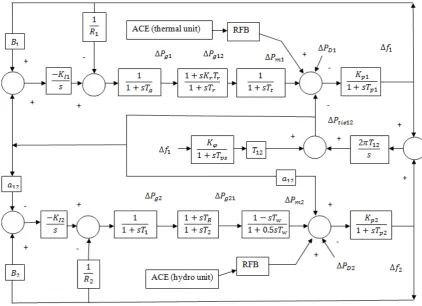
In the above figure two interconnected power system block diagram is shown. A TCPS is installed in series with tie line and area 1 represent the thermal unit and area 2 represent the hydro unit of the power system and they are interconnected via tie-line. Resistance of the tie-line is neglected and reactance of the tie-line is considered.
Figure 4. Block-diagram of two area interconnected hydrothermal power system with TCPS installed in series with Tie-line
Without TCPS, the incremental tie-line power flow from area1 to area 2 can be expressed as
∆ 0 12 2 120
∆ 1 ∆ 2 (14)
The current following through area1 to area 2 is
12
| 1| 1 | 2| 2
12 (15)
From fig (17), we can write as,
12 12 | 1| 1
| 1| 1 | 2| 2
12 (16)
Separating real and imaginary part, we get
12
| 1|| 2|
12
| 1|| 2|
12 sin 1 2 cos 1
0 2
0 0
(18)
For very small change we can also write as
12
| 1|| 2|
12 sin 1 2 cos 1
0 2
0 0 (19)
Let
12
| 1|| 2|
12 cos 1
0 2
0 0
(20)
Thus eqn. (21) reduced as,
∆ 12 12 ∆ 1 ∆ 2 ∆ (21)
∆ 12 12 ∆ 1 ∆ 2 12∆ (22)
As we know that,
∆δ1 2π ∆f1dt (23)
and
∆ 2 2 ∆ 2 (24)
From equn. (22), (23) and (24)
∆ 12 2 12 ∆ 1 ∆ 2 12∆ (25)
Also, the Laplace transform of equn. (25)
∆ 12
2 12
∆ 1 ∆ 2 12∆ (26)
Tie-line power flow can be controlled by TCPS,hence, its phase shifter angle can be described as
∆ ∆ (27)
And finally we get the net tie-line power flow of the system as
∆ ∆ ∆ ∆ (28)
5. GENETIC ALGORITHM AND ITS APPLICATION
Genetic algorithm is used to optimize the objective function of the given system which is mainly based on the search technique through natural selection and genetics of the system [3],[19] and [21]. Since this technique generally converge to global optima over conventional technique because it search the best point from the randomly generated population of point. Its operation is probabilistic transition in nature and their different tools and operators are as follows.
5.1 Objective function
The objective function is to minimization the performance index which is the linear combination of the two area deviation of frequency multiplied by their respective bias constant and net tie-line power flow & of course, these variation are weighted together by a single variable know a ACE (area control error) of the respective power units i.e. differ for hydro &thermal units. So fitness function to be minimized in this research paper is
∆ ∆ ∆ (29)
5.2 Reproduction
selection process for the selection or reproduction of the next generation population. The brief study has been performed in past some decade [16], [17], [18].
5.3 Crossover
Crossover is also known as recombination of the population or reshuffled the selected population. Here, we
select two random selected population & then we choose random site & interchanged the individual
Chromosomes with each other and finally produced the new off spring, and we proceed for next process. The performed analysis is studied [18].
5.4 Mutation
In this process, we select the individual bit randomly and interchanged with ‘0’ or ‘1’and it gives some variations in information of the population, although its probability rate is quite small as compare to crossover probability rate. The mutation and its application has been analyzed [18].
5.6 Structure of Genetic Algorithms
Figure 5. Block-diagram of the genetic-algorithm
6. RESULT AND DISCUSSION
Figure 9. Generator mechanical power flow deviation graph of hydro unit subjected to load change of 0.01pu considering with
and without proposed controller
Figure 8.. Net tie-line power flow deviation graph of interconnected power system subjected to load change of 0.01pu considering with and without proposed controller
Figure 6. Frequency deviation graph of thermal unit subjected to load change of 0.01pu with and without proposed controller
Figure 7. Frequency deviation graph of hydro unit subjected to load change of 0.01pu with and without proposed controller
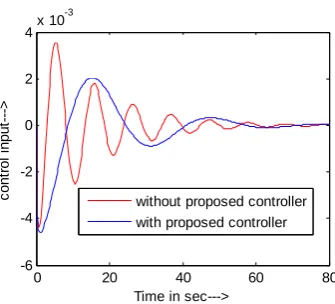
Figure. 11.Control input deviation (ACE) of the thermal unit subjected to load change of 0.01pu considering with and
without proposed controller
Figure 10. Generator mechanical power flow deviation graph of thermal unit subjected to load change of 0.01pu
considering with and without proposed controller
0 10 20 30 40 50 60 70 80
-5 0 5 10 15
20x 10
-3
Time in sec.--->
g ene ra to r mec ha ni c al po w er f low --->
with proposed controller without proposed controller
0 10 20 30 40 50 60 70 80
-1 -0.5 0 0.5 1 1.5 2 2.5 3
3.5x 10
-3
Time in sec--->
N e t t ie -l in e de v iat ion --->
without proposed controller with proposed contoller
0 20 40 60 80
-0.05 -0.04 -0.03 -0.02 -0.01 0 0.01 0.02
Time in sec.--->
F re quenc y d ev iat ion ( H z )--->
with proposed controller without proposed controller
0 10 20 30 40 50 60 70 80
-0.06 -0.05 -0.04 -0.03 -0.02 -0.01 0 0.01 0.02
Time in sec.--->
F re quen c y d ev iat io n (H z )--->
with proposed controller Without proposed controller
0 20 40 60 80
-6 -4 -2 0 2
4x 10
-3
Time in sec--->
c o nt rol i n pu t- -->
without proposed controller with proposed controller
0 20 40 60 80
0 0.005 0.01 0.015 0.02
Time in sec--->
gen er a tor m ec h ani c al po w er f low --->
Table 1: Comparison of the system integral gain and system ISE error of the interconnected power system
7. CONCLUSION
In this paper, we have proposed a FACTS device using the combination of TCPS and RFB control scheme for two area interconnected hydrothermal power system. The basic idea behind this controller is to incorporate the proposed FACTS device with Tie-line and by using Genetic Algorithms based optimization technique corresponding integral gain is obtained. Simulation result demonstrated that, the proposed control strategy ensuring the transient improvement as well as improve the tie-line power flow after different load change conditions.
APPENDIX AND NOMENCLATURES
The system parameter values and nomenclatures used in this paper or in the power system model is given as
1 2 1200 , 1 2 120 / , 1 2 20 ., 0.3 ., 0.5 .,
1
0.416, 1 41.6 ., 2 0.513 ., 1 ., 5 ., 12 0.0866 ., 1 2
2.4 . , 1 2 8.33 10 3 / , 0.1 ., 1 2 0.4249 / , Ф
1.5 / , Ф 100, Ф 100, 1.8, 0, 0
1 Time constant of power system in thermal unit, 2 Time constant of power system in hydro unit
1 Gain constant of power system in thermal unit, 2 Gain constant of power system in hydro unit
Ф Gain constant of TCPS in the given system, Time constant of TCPS in thermal unit
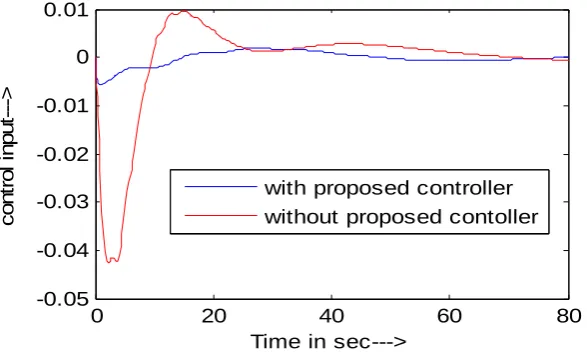
Figure 12. Control input deviation (ACE) of the hydro unit subjected to load change of 0.01pu considering with and without proposed controller.
With Proposed Control Strategy Without Proposed Control Strategy
ISE = 0.0010 ISE = 2.6347e+003
KI1 = 0.8408 KI1 = 0.0151
KI2 = 0.9322 KI2 = 0.1177
0 20 40 60 80
-0.05 -0.04 -0.03 -0.02 -0.01 0 0.01
Time in sec--->
c
ont
rol
i
nput
--->
1 Frequency bias constant in thermal unit of the given power system, 2 Frequency bias constant in
thermal unit of the given power system, Water starting time constant of the power system in hydro unit,
1 Damping coefficient of the thermal power system, 2 Damping coefficient of the hydro-power system
Gain-coefficient of reheat turbine thermal unit, Time constant of reheat turbine thermal unit,
1 Net mechanical power of thermal unit, 2 Net mechanical power of hydro-unit
1 Load change in the thermal unit, 2 Load change in the hydro- unit, 1 Governor output in
the thermal unit, 12 Turbine output in the thermal unit, 2 Governor output in the hydro-unit,
21 Turbine output in the hydro- unit, 1 Integral gain constant of the thermal unit, 2 Integral gain
constant of the hydro- unit, Time constant of turbine of their respective units, 1 Frequency deviation
in the thermal unit, 2 Frequency deviation in the hydro-unit, 12 Net tie-line power flow deviation in
the given power system model, ∆ TCPS phase shifter angle.
ACKNOWLEDGMENTS
The authors sincerely acknowledge the financial support provided by the ISM, Dhanbad, INDIA for carrying out the present work.
REFERENCES
[1] K. S. S. Ramakrishna, Pawan Sharma, T. S. Bhatti, “Automatic generation control of interconnected power system with diverse sources of power generation,” International Journal of Engineering, Science and Technology, vol.2, no.5, 2010,pp.51-65
[2] Y. L. Abdel Magid, M. M. Dawoud, “ Genetic Algorithms Applications in Load Frequency Control,” Genetic Algorithms in Engineering Systems: Innovations and Applications, 12-14 September 1995, Conference Publication.
[3] H S. Farook, P. Sangamasmeswara Raju “optimization of feedback controller power system using Evolutionary Genetic Algorithm” International Journal of Engg. Science & Tech; vol.3 , No.5 May 2011
[4] O. I. Elgerd and C. Fosha, “optimum megawatt frequency control of multi-area electric energy systems,”IEEE Transactions on Power Apparatus and Systems, vol. PAS-89, no. 4, pp. 556-563, Apr. 1970.
[5] N. cohn, “ Techniques for improving the control of bulk power transfers on interconnected systems,” IEEE Transactions on Power Apparatus and Systems, vol. PAS-90, no. 6, pp. 2409-2419,1971.
[6] S.M. Miniesy and E. V. Bohn, “Two level control of interconnected power plants,” IEEE Transactions on Power Apparatus and Systems, vol. PAS-90, pp. 2742-2748, June 1971.
[7] Y. L. Karnavas and D. P. Papadopoulos, “Age for autonomous power system using combined intelligent techniques,” International Journal of Electric Power System Research, vol. 62, pp. 225-239, 2002.
[8] R. K. Green, “Transformed automatic generation control,” IEEE Transactions on Power Systems, vol.11, no. 4, pp. 1799-1804, 1996. [9] M. Reformat, E. Kuffel, D. Woodford, and W. Pedrycz, “Application of genetic algorithms for control design in power systems,” Proc
. IEE, Generation, Transmission & Distribution, vol. 145, no.4, pp.345-354, 1998.
[10] T. Hiyama, “design of decentralized load-frequency regulators for interconnected power systems,” Proc.IEE, vol. 129, Pt. C, no.1,pp. 17-22, 1982.
[11] Y. H. Moon, H.S. Ryu, J.G.Lee, K.B. Song, and M.C. Shin, “Extended integral control for load-frequency control with the consideration of generation rate constraints,” International Journal of Electrical Power and Energy systems, vol.24, pp.263-269, 2002. [12] A. Bose and I. Atiyyah, “Regulation Error in Load-Frequency Control” IEEE Transactions on Power Apparatus and Systems, vol.
PAS-99, no.2, pp. 650-657, 1980.
[13] I.A.Chidambaram and B.Parasmasivam,”Genetic Algorithm based decentralized controller for load frequency control of interconnected power system with RFB and TCPS in the tie-line” int. journal of electronics engineering research,vol.1(2009),pp.299-312.
[14] Y. L. Abdel Magid, M. M. Dawoud, “ Genetic Algorithms Applications in Load Frequency Control,” Genetic Algorithms in Engineering Systems: Innovations and Applications, 12-14 September 1995, Conference Publication.
[15] Y. L. Abdel Magid, M. M. Dawoud, “Tunning of AGC of interconnected reheat thermal systems with genetic algorithms,” IEEE-1995. [16] Pingkang Li1, Xiuxix Du ,(2009)-“multi-area AGC system performance improvement using GA based Fuzzy logic control”, The
international conference on electric engineering.
[17] K.S.S. Ramakrishna, T.S.Bhatti,(ICEE-2006)-“load frequency control of interconnected hydro-thermal power system”. International conference on energy and environment-2006.
[18] A. Konark et al,(2006) – “multi-objective optimization using GA algorithms”-A tutorial/Reliasation engineering and system safety,91,992-1007.
[19] A.Y.Abdelaziz, M.A. El-Sharkawy“Optimal allocation of TCSC device using using genetic algorithms” cario university,Egypt,Dec. 19-21,2010.
[20] R.Mamatha, D.Devraray “genetic algorithm approach for optimal power flow with facts device”2008,IEEE-conferenceon ‘intelligent system’.
[21] Ibraham, Omveer Singh, Namuail Hassan “Genetic Algorithms based scheme for optimization of AGC gains of interconnected power system” Journal of theoretic & applied information technology 2005-2009.
[23] Ibraheem I, Kumar P and Kothari DP, “Recent philosophies of automaticgeneration control strategies in power systems” IEEE Transaction on power 2005: 20(1): 346-357.
[24] Doola.S, Bhatti.TS, “Automatic Generation Control of an isolated small hydro power plant”, Electric Power System Research, 2006:76(9-10); 889-896.
[25] Chidambaram IA, Velusami S, “Design of decentralized biased controllers for load-frequency control of interconnected power systems, International Journal of Electric Power Components and Systems”, 2005:33(12):1313-1331.
[26] Velusami S, Chidambaram IA, “Decentralized biased dual mode controller forLFC of interconnected power systems considering GDB and GRC nonlinearities”, Energy Conversion & Management 2007:48:1691-1702.
[27] Sasaki T, Enomoto K, “Dynamic analysis of generation control performance standards”, IEEE Transactions on Power systems 2002:17:806-811.
[28] Tokuda N, “Development of redox flow battery system”, Engineering conf., CO 1998: IECEC-98-1074.
[29] Enomoto K, Sasaki T, Shigematsu T, Deguchi H, “Evaluation study about redox flow battery response and its modeling”. IEEE Transaction Power Eng., 2002: 122-B(4):554-560.
[30] Abdel-Magid YL, Dawoud MM, “Optimal AGC tuning with genetic algorithms”. Electric Power System Research 1996:38(3): 231-238.