~;1
r . ... ..".
Indian J. Plant Physiol., Vol. XXVIII No.3, pp. 287-291 (September 1985)
SHORT COMMUNICATION
ROOTING PATTERN OF DIFFERENT GENOTYPES OF WHEAT IN RELATION TO IRRIGATION
S.C. MEHTA, S.B. MITTAL AND M.L. CHAUDHARY
Department of Soils, Haryana Agricultural University, Hissar
Root distribution study of wheat varieties Kalyan sona, HD 1977 and HD 1941 in relation to irrigation was conducted in a sierozem soil of Haryana using tracer technique. In all the varieties except HD 1977 with increase in number of irrigation, the lateral and vertical root prolification increased in the upper surface. However, the vertical root prolificaHon was not much affected and lateral prolification was erratic with increased irrigation in variety HD 1977. Presence of hard pan of CaeOa due to soil heterogenity at 60-120 em depth retarded the root prolification in the treatment where one irrigation at crown root initiation stage was given. whereas in other treatments. no such hard pan was encountered. Deeper penetration of roots at low moisture percentage has been explained. Root weight and grain yield increased with increasing the number of irrigation.
The knowledge of the extent and activity of root system of field crops can be best utilized in making spacing recommendations. better utilization of the added nutrients and scheduling of irrigation. This assumes further significance in view of importance of irrigation in affecting yield. The present study, there fore, was undertaken to study the effect of number of irrigations at different stages of plant growth on the root distribution of different genotypes of wheat.
Field experiment was conducted at the Re~earch Farm of H.A.U.• Hissar.
Some pertinent physico-chemical properties of the experimental site soil were as undeer :
pH (I : 2) 8.5; Be (mmhos/cm) 0.38; clay (%) 19.5; O.C. (%) 0.32; Total
porosity (%) 50.2; Bulk density and particle density (g/cm) ] .32 and 2.65, respectively. Leavin. aside presowing irrigation of 10cm. irrigations were given
(I to 4) to three genotypes of wheat (Kalyan sona, HD 1977 and HD 1941) at (1)
at crown root initiation stage (II); (ii) one at C.R.I.
+
one at flowering stage (IJ;(iii) one each at C.R.I., flowering and dough stale (Is); (iv) one each at C.R.I.•
tillering flowering and dough stages (I4). Each irrigation was of 8 cm as meas
t-.) 00 00 Table I: Effect of scheduling of irrigation on the root distribution (%) of three genotypes of wheat
Depth ()...lS 15-30 30-45 45-60 60-120 0-15 15-30 30-45 45-60 0-15 IS-30 30--45 45-60 60-120
11
5
10
is
5
em
---_
.. 8.2 9.0 7.8 8.0 8.3 9.6 7.2 11.3 9.6 11.0 8.5 11.2 10.9 7.1 . 6.0 9.5 Concrete layer 8.5 8.0 8.1 7.0 7.8 7.8 8.0 6.0 8.0 8.0 8.6 5.0 8.2 8.8 6.2 4.4 8.0 7.7 7.5 5.0 8.5 7.8 7.4 4.8 8.0 8.4 8.0 4.0 7.0 8.6 11.4 3.3 8.4 8.8 7.2 3.1 8.0 I. 10 15 em Kalyan Sona 4.5 2.2 7.7 3.6 7.6 3.3 9.4 2.7 7.6 2.6 HD-J977 7.0
4.3 4.0
8.0 9.2
4.1 8.0 5.0 HD-J94J 7.0 5.8 7-8 4.8 6.7 4.0 8.0 4.6 7.2 4.2 5
11.4 9.7 8.9 7.6 4.7
8.0 8.6 8.4 7.7 9'8 9.0 8.0 7.0 7.0 10 em 10.7 11'9 6.8 5.5 4.5 8.5 8.0 8.0 6.0 9.0 8.0 7.8 6.0 5.0
I. IS 6.2 5.6 3.7 2.8 2.8 5.6 4.7 4.9 4.2 6.0 5.8 4.6 4.0 3.0
5
12.3 10.3 11.7 4.0 3.7 9.0 8.8 6.0. 80 10.8 9.8 8.0 7.2 7.0 10 em
12.1 10.1 7.8 4.3 2.1 9.8 8.6 6.8 7.0 9.0 9.0 7.6 6.0 5.0
I,
15 5.5 6.7 1.2 3·0 2.0 6.0 4.9 4.4 3.7 6.0 5.0 4.3 3.0 2.3 fI.I ~ II: !!!
~
!!! o-j ;»0 l:"'\
\ \ ~ \I
..~
~
t
f
(
r
I
;
IROOTING PATTERN IN WHEAT 289
irrigation in the main plot and four replications were kept. Recommended dose
of fertilizers, i.e., 120 kg N, 60 kg PaOs and 60 kg K20!ha were applied. HalfN
and full dose of P and K was applied at the time of sowing and rest of N was applied after irrigation. For all the cultivars the seed rate was 100 kg!ha.
For root distribution study, radio-tracer technique was adopted one month
before harvesting of the crop. 25 p. Ci of pall dissolved in one ml of water was
injected in each plant and two plants in each plot were selected for this. After 5 days of equiliberation, the soil samples were eollected from 5, 10 and 15 cm laterally and 0-15, 15-30. 30-45. 45-60 and 60-120 cm depth vertically. Soil samples were ignited in a muffle furnace at 500°C and weight of root calculated as follows:
Specific activity of root
Wt. of root =
x
Weight of shootSpecific activity of shoot
A ]00 mg ground root or shoot material was taken for radio-active assay on a G.M. Counter.
Root distribution of Kalyan sona and HD 1941 genotypes increased laterally and vertically with increase in number of irrigation as in top layer (0-15 cm) the percentage ofroots were 8.2, 8.0, 11.4 anc;l12.3 for Kalyan Sona . and 7.7, 8.5, 9.8 and 10.8 for HD 1941 in 110 Ill. Ia. and I" respectively (Table 1). In this variety the root prolification was more in surface than subsurface layer
in treatment I, over II. Due to soil heterogentiy, a hard pan of CaCO. at 60-120
cm depth was found in main plot receiving the II treatment. Deeper penetration
of roots at lower moisture stress may be due to more availability of water reduced soil strength and increased availability of nutrients at deeper depth as
suggested by Salim et 01. (1965). As a result of limited soil depth available due
to hard pan the percentage of roots in 15-30, 30-45 and 45-60 cm layers due to
110 treatment was much more in comparison to other treatments. Lipps and Fox
. (1964) reported that as moisture deficiency developed, in top soil, the root acti vity shifted to deeper layers. Extra irrigation at dought stage showed no positive effect on root prolification of Kalyan sona.
290 S.C. MEHTA ET AL.
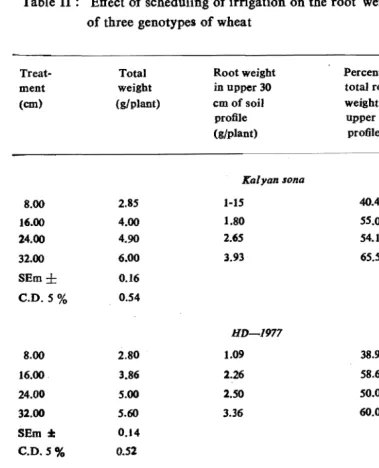
Table II: Effect of scheduling of irrigation on the root weight and grain yield of three genotypes of wheat
Treat- Total Root weight Percentage of Grain
ment weight in upper 30 total root yield
(em) (g/plant) em of soH weight in (qJha)
profile upper 30 em
(gJplant) profile
---~--...._----_...- .. ....
Kalyan Ilona
8.00 2.85 1-15 40.4 20.1
16.00 4.00 1.80 55.0 31.6
24.00 4.90 2.65 54.1 33.5
32.00 6.00 3.93 65.5 40.7
SEm 0.16
C.D.5% 0.54
HD-I977
8.00 2.80 1.09 38.9 22.4
16.00. 3.86 2.26 58.6 27.9
24.00 5.00 2.50 50.0 32.9
32.00 5.60 3.36 60.0 37.6
SEm :I: 0.14
C.D.5% 0.52
HD-I941
8.00 2.60 0.78 30.0 21.8
16.00 3.40 1.46 43.0 26.2
24.00 4.60 2.30 50.0 27·0
32.00 5.00 2.90 58.0 31.8
SEm± 0.10
C.D.5% 0.36
\ Grain yield of three genotypes varied from 20.1 to 40.7,22.4 to 37.6 and 21.8 to 31.8 q/ha for Kalyan sona, HD 1977 and HD 1941, respectively. Grain yield increased with the increase in number of irrigation and thus brought out
I
ROOTING PATTERN IN WHEAT 291
a direct relationship between root distribution and grain yield. These observa tions support the findings of Campbell (1968) and Bhatia et al. (1977).
f
~
REFERENCES
!
,
Bhatia, B.R., Chaudhry, M.L. and Virmani, S.M. (1977). Rooting pattern of wheat and grain int
relation to soil moisture regimes and their implication on irrigation scheduling.r
J. Indian Soc. Soil Sci., 25: 69.t
t
Campbell, C.A. (968). Influence of soil moisture stress applied at various stages of growth on the yield components of chinook wheat. Can. J. Pl. Sci., 48 : 313.
Lipps, R.C. and Fox, R.L. (1964). Root activity of subirrigated alfalfa as related to soil moisture, temperature and oxygen supply. Soil Sci., fJ7 : 4.
Salim, H.M., Todd, G.W. and Schlehufer, A.M. (1965). Root development of wheat, oats and barley under conditions of soil moisture stress. Agron. J., 57: 603.
r '