
SPHERICAL AGGLOMERATION: DIRECT TABLETTING TECHNIQUE
6
0
0
Full text
(2) Patil Pradnya B et al. IRJP 2011, 2 (11), 30-35 Lesser amount of bridging liquid will yield fine particles where as larger amount of bridging liquid will produce coarse particles13. By increasing stirring rate the agglomeration get reduced because of increasing disruptive forces14. Higher stirring rate produces agglomerates that are less porous and more resistant to mechanical stress. The porosity decreases when the concentration of solid increases15. The viscosity of the continuous phase has an effect on the size distribution of the agglomerates. The choice of bridging liquid has an influence on the rate of agglomeration and also on the strength of the agglomerates. Steps involved in solvent change method Good solvent +drug In bad solvent Formation of crystals With addition of bridging liquid (Drop wise) &continuous agitation Precipitated crystals and aggregation with bridging liquid Random coalescence Spherical agglomerates Enlarged spherical agglomerates Quasi emulsion solvent diffusion method (QESD) In the case of quasi emulsion solvent diffusion method16, affinity between the drug and a good solvent is stronger than that of the drug and poor solvent. Residual good solvent in droplets acts as a bridging liquid to agglomerate the generated crystals. Due to the interfacial tension between the two solvents, the good solvent diffuses gradually out of the emulsion droplet into the outer poor solvent phase. The crystallization of drug occurs by counter diffusion of good solvent and poor solvent. In this process, the emulsion is stabilized by the selection of suitable polymer which is required for proper crystallization. In the droplets, the process of solidification proceeds inwards and the liquid is not maintained on the surface and the agglomerate formed without coalescence. Steps involved in QESD method Drug +good solvent Into poor solvent Formation of emulsion (With agitation) Good solvent which acts as a bridging liquid diffuses out into poor solvent phase Formation of spherical agglomerates Polymeric solution Stabilized Spherical crystals Ammonia diffusion method (AD) In this method, the mixture of acetone, ammonia water and dichloromethane shall be used as a crystallization system. In this system ammonia water acts as bridging liquid as well as good solvent. The other components of the system, like poor solvent and a hydrocarbon derivative are selected depending upon the drug’s solubility in that solvent. Acetone (hydrocarbon derivative) is miscible with the system but it reduces the miscibility of ammonia water with poor solvent. The ammonia water exists as immiscible phase forming droplets. The counter diffusion process across the droplet involves movement of poor solvent into and ammonia out of the droplet. Inside the droplet agglomeration takes place as the drug precipitates slowly in ammonia water and causes growth of crystal17.. The technique is mainly applicable for amphoteric drugs, which have the same properties as enoxacin. Drug +ammonia water Added Acetone Dichloromethane added drop wise Spherical agglomerates Neutralization method The method consists of dissolving the drug in the good solvent and placing in the cylindrical vessel with constant stirring. During stirring an aqueous polymer solution and one neutral solution was added to neutralize the good solvent, which crystallizes out the drug. The bridging liquid shall be added drop wise at a definite rate. The agglomeration of the crystal form of the drug takes place18. Steps involved in neutralization method Drug + good solvent Added in Neutralizing solution Crystallization Add bridging liquid Drop wise Spherical agglomerates Crystal-co-agglomeration technique (CCA) Applications of spherical crystallization to obtain directly compressible agglomerates without diluents are restricted to water insoluble large-dose drugs only. Most of the excipients, such as diluents and disintegrating agents, are hydrophilic in nature. Hence incorporation of these excipients in the agglomerates formed by using organic bridging liquid is difficult. Due to this limitation, spherical crystallization could not be applied to obtain agglomerates of low-dose or poorly compressible materials19. To overcome these limitations of spherical crystallization Kadam et al. developed the crystallo-co-agglomeration (CCA) technique. It is a modification of the spherical crystallization technique in which a drug is crystallized and agglomerated with an excipient or with another drug, which may or may not be crystallized in the system. The agglomeration is performed using bridging liquid. The process enables design of agglomerates containing two drugs (Mahadik et al., 2004) or a lowdose20 or poorly compressible drug in combination with diluents21, 22. The difference in the physicochemical properties of the drug molecules and the excipient become the major challenge in the selection of a solvent system for the crystal-co-agglomeration technique. Steps involved in crystal-co-agglomeration technique Drug+ good solvent Agitation Bridging liquid (homogenous solution) Added continuous stirring Bad solvent /polymeric solution Crystal’s formation Spherical agglomerates CHARACTERIZATION OF SPHERICAL AGGLOMERATES Particle Size and Size Distribution Particle size and distributions can be determined by sieve analysis. With the help of Ro-Tap sieve shaker, particle size analysis can be determined. In advance technology image-analyzer is used to determined size and volume of the particle. Density Density23 of the spherical crystals is the mass per unit volume. Density = Mass/Volume Densities such as true density, granular density, apparent bulk density, tapped density shall be evaluated.. INTERNATIONAL RESEARCH JOURNAL OF PHARMACY, 2(11), 2011.
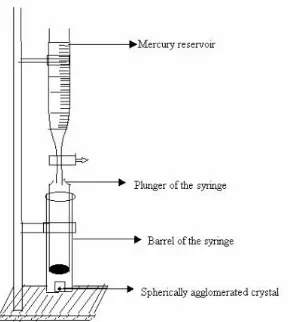
(3) Patil Pradnya B et al. IRJP 2011, 2 (11), 30-35 Porosity Porosity of granules affects the compressibility. Porosities are of two types “intragranular and intergranular” and these are measured with the help of true and granular densities. Intra granular porosity = 1- Granular density /True density. Inter granular porosity = 1- Bulk density / Granular density Flowability- The flow properties of spherical agglomerates were characterized by following methods. a) Angle of repose Flow property of the material depends on the particle size, shape, distribution, surface texture or roughness, surface area and applied force. The angle of repose can be determined by using the following equation. Tan θ = h/0.5d Where h- height of the pile and d- diameter of the pile Values for angle of repose ≤ 30 usually indicate free flowing material and angle ≥ 40 suggested a poor flowing material. b) Compressibility or Carr index The ease with which a material can be induced to flow is given by application of compressibility index. I = (1-V/Vo)*100 Where V = the volume occupied by a sample of the powder after being subjected to a standardized tapping procedure and VO = the volume before tapping. Value below 15% indicates good flow characteristics and value above 25% indicate poor flowability. c) Hausner ratio It is calculated from bulk and tapped densities. Hausner ratio = Tapped density / Bulk density, Values less than 1.25 indicate good flow (20% Carr index.) and the value greater than 1.25 indicates poor flow (33% Carr index.). If it is between 1.25-1.5 add the glident to improve flow. Packability Sample packability was assessed by analysis of the tapping process with the Kawakita and Kuno methods, and using the parameters a, b, and k in the equations. n/C = 1/ (ab) +n/a. C = (Vo-Vn) / Vo, a = (Vo-V∞) /Vo. ρf- ρn= (ρf- ρo) . exp. (-kn) Where, a is the degree of volume reduction when the tap number is infinity, b and k are constants for the apparent packing rate, V0 and Vn are the volume in the initial loosely packed and the nth tapped state, and ρo, ρn, and ρf are the apparent density in the initial state, the nth tapped state, and the most densely packed state. The angle of friction, shear cohesive stress and shear indexes of spherical agglomerates should be less than the pure drug which can improve the packability of the agglomerates. Compression Behavior Analysis For direct compression the particles must possess good compatibility and compressibility. The compaction behavior of the spherical agglomerates and the pure drug can be studied by using the plots constructed between the relative volume and compression pressure. The inter particle plastic bonds and compression force are inversely proportional to each other. The inter particle plastic bonds are more in spherical agglomerates rather than the pure drug. During compression the particles get broken down which results in the formation of new surfaces which improves the inter particle plastic bonds. This is more in agglomerates than the pure drug crystals which results in requirement of lower compression force in agglomerates when compared to that of pure drug crystals.. Compaction behavior of agglomerated crystals were evaluated by using following parametersa) Heckel Analysis The following Heckel's24,25 equation used to analyze the compression process of agglomerated crystals and assessed their compactibility. In [1/(1-D)]=KP+A Where: D is the relative density of the tablets under compression Pressure K is the slope of the straight portion of the Heckel Plot, the reciprocal of K is the mean yield, the mean yield pressure (Py). The following equation gives the intercept obtained by extrapolating the straight portion of the plots A=1n [1/(1-D0)]+B Where: D0 is the relative density of the powder bed when P=0. The following equation gives the relative densities corresponding to A and B. DA=1-e-A DB=DA-D0 b)Stress Relaxation Test In this test, specific quantity of spherical crystals sample has to be placed in a die of specific diameter whose surface was coated with magnesium stearate in advance and the sample is to be compressed using universal tensile compression tester at a constant speed. After attaining the desired pressure limit, the upper punch should be held in the same position for 20 min, during which measure time for the reduction amount of the stress applied on the upper punch. The result was corrected by subtracting from this measurement the relaxation measured without powder in the die under the same conditions. The following equation finds the relationship between relaxation ratio Y(t) and time t, calculated the parameters As and Bs, and assessed relaxation behavior. 19, 20 t/Y (t) =1/AsBs-t/As Y(t) =(P0-Pt)/P0 Where: P0 is the maximum compression pressure, and Pt is the pressure at time t. Mechanical Properties Mechanical Properties26-31 like tensile strength of spherical agglomerates shall be determined by compressing 500 mg of spherical crystals using hydraulic press at different ton/cm2 for 1 min. The compact should be stored in desiccator for overnight to allow elastic recovery. The thickness and diameter should be measured for each compact. The hardness of each compact shall be measured using Pfizer hardness tester. The tensile strength (σ) of the compact (ton/cm2) shall be calculated using following equation. σ = 2F/π Dt Where, F, D and t are hardness (ton), compact diameter (cm) and thickness (cm) respectively. Crushing Strength Crushing strength32 is determined by using hypodermic glass syringe which consists of hallow plunger. The syringe has to be modified slightly by making a window at the lower end of the barrel and by removing the top end of the plunger as shown in the figure. The hallow plunger with open end serves as load cell in which mercury has to be placed. The crystal has to be placed in the barrel which was on base plate. The plunger acts as movable plate and should be set directly on the granules positioned on the base plate as the rate of loading may affect crushing load (gm). Mercury is introduced from reservoir into the upper chamber at the rate of 10 gm/sec until the single granule to be crushed, loading time should be <3 minutes. The total weight of the plunger and the mercury required to fracture a granule is the crushing load.. INTERNATIONAL RESEARCH JOURNAL OF PHARMACY, 2(11), 2011.
(4) Patil Pradnya B et al. IRJP 2011, 2 (11), 30-35. Friability For friability studies, 2 g (Wo) of spherical agglomerates (particle size 250-600 µm) shall be placed in a friabilator, and subjected to the impact test at 50 rpm for 2 min. After passing this through a sieve having a mesh size 125 μm, the weight (W) of the material which did not pass through the sieve shall be determined, and friability (X) was calculated using equation X = Wo – W/WO X 100 Wettability Wettability depends on the crystallinity and elementary crystal size of the agglomerated crystals. As the contact angle decreases the wettability increases. Crystals with low crystallinity are more wettable than crystals with higher crystallinity. By determing the contact angle, one can assess the wettability of the agglomerates. Solubility Changes in internal energy of the molecules play an important role to increase solubility of prepared spherical crystals. Dissolution Rate and Bioavailability Dissolution rate and bioavailability of the API from pure crystals and agglomerates can be determined by performing dissolution test using USP Dissolution apparatus and in vivo studies in animal models respectively. Moisture Uptake Study The study indicates the behavior of uptake of moisture by drug and the prepared spherical crystals, which affect the stability. The weighed quantity of drug and spherical crystals were placed in crucible at accelerated condition of temperature and humidity, 40 0 ± 1 0 C and 75% ± 3% respectively. The gain in weight of drug and spherical crystals should be measured 33. Table 1: Equipments to be used for characterization of spherical crystals S.No Parameters to be studied Name of the equipment 1 Size, shape, dimensions of the Optical microscopy, Scanning spherical crystals Electron Microscopy (SEM) 2 Polymorphism existence X-ray powder diffraction Structure and Compatibility studies Fourier Transform Infrared 3 spectrometer (FTIR) 4 Dehydration, Dissociation, Differential scanning calorimeter Decomposition, Phase transfer, (DSC) Purity, Glass transition, Heat capacity Drug and the polymer interaction Thin layer chromatography 5 and stability of drug in solvents. Factors Controlling the Process of Agglomeration Solubility profile The selection of solvent is dictated by solubility characteristic of drug. A mutually immiscible three solvent system consisting of a poor solvent suspending liquid, good solvent and bridging liquid are necessary. Physical form of product i.e. whether micro agglomerates or irregular macro-agglomerates or a paste of drug substance can be controlled by varying solvent proportions. The proportion of solvent. to be used is determined by carrying out solubility studies and constructing triangular phase diagram to define the region of mutual immiscibility by using Ternary diagram. Mode and intensity of agitation High speed agitation is necessary to disperse the bridging liquid throughout the system. Any change in agitation pattern or fluid flow would affect the shape of agglomerate. So the extent of mechanical agitation and mode of addition and the amount of bridging liquid determines the rate of formation of agglomerate and their final size. Temperature of the system Studies revealed that the temperature has a significant influence on the shape, size and texture of the agglomerates. Indirectly it affects on the solubility of drug substances. Residence time: The time for which agglomerates remain suspended in poor solvent affects its strength. Role of bridging liquid Agglomerates are formed by agitating the crystals in a liquid suspension on adding a bridging liquid, which is immiscible with reaction mixture is capable of aggregating the particles to form agglomerates. Bridging liquid preferentially wets the crystal surface to cause binding. The addition of bridging liquid promotes the formation of liquid bridges between the drug crystals to form spherical agglomerates. The spherically agglomerated crystals are formed by coalescence of these dispersed crystals. THE PRINCIPLE STEPS INVOLVED IN THE PROCESS OF SPHERICAL CRYSTALLIZATION Bermer and Zuider Wag proposed four steps in the growth of agglomeration. Flocculation Zone In this zone, the bridging liquid displaces the liquid from the surface of the crystals and these crystals are brought in close proximity by agitation, the adsorbed bridging liquid links particles by forming bridges or lens between them. In these zones, loose open flocs of particles are formed by pendular bridges. At this stage of agglomeration process, particles are brought by mutual attraction due to surface tension of the liquid and the liquid bridges. The capillary stage is reached when all the void spaces within the agglomerate is completely filled with the liquid. An intermediate state known as funicular state exists between the pendular and capillary stage. The cohesive strength of agglomerate is attributed to the bonding forces exerted by the pendular bridges and capillary suction pressure. Zero Growth Zone Loose floccules get transferred into tightly packed pellets, during which the entrapped fluid is squeezed out followed by squeezing of the bridging liquid onto the surface of small flocs causing pore space in the pellet to be completely filled with the bridging liquid. The driving force for the transformation is provided by the agitation of the slurry causing liquid turbulence, pellet-pellet and pellet-stirrer collision. Fast Growth Zone The fast growth zone of the agglomerates takes place when sufficient bridging liquid has squeezed out of the surface on the small agglomerates. This formation of large particles following random collision of well-formed nucleus is known as coalescence. Successful collision occurs only if the nucleus has slight excess surface moisture. This imparts plasticity on the nucleus and enhances particle deformations and subsequent coalescence. The other reason for the growth of agglomerates size is attributed to growth mechanisms that describe the successive addition of material on already formed nuclei. Constant Size Zone In this zone agglomerates cease to grow or even show slight decrease in size. Here the frequency of coalescence is balanced by the breakage frequency of agglomeration. The size reduction may be. INTERNATIONAL RESEARCH JOURNAL OF PHARMACY, 2(11), 2011.
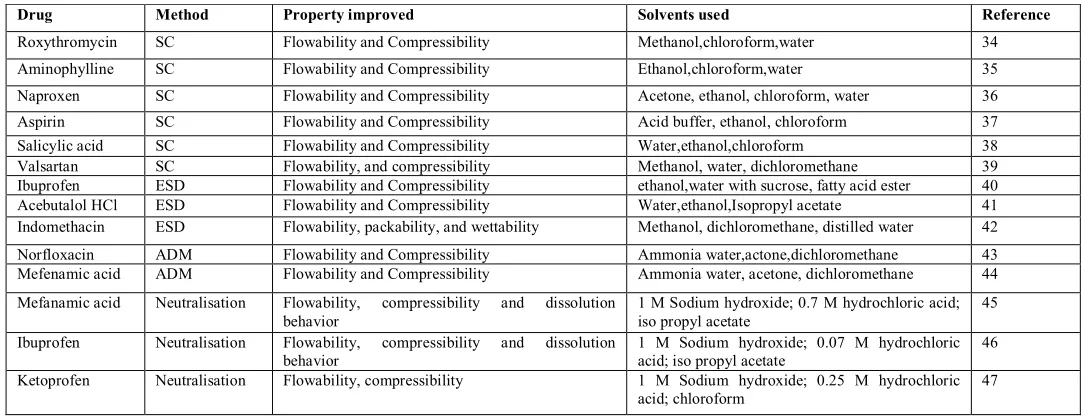
(5) Patil Pradnya B et al. IRJP 2011, 2 (11), 30-35 due to attrition, breakage and shatter. The rate determining step in agglomeration growth occurs in zero growth zones when bridging liquid is squeezed out of the pores as the initial floccules are transformed into small agglomerates. The rate determining step is the collision of particle with the bridging liquid droplets prior to the. formation of liquid bridges. The rate is governed by the rate of agitation. The strength of the agglomerates is determined by interfacial tension between the bridging liquid and the continuous liquid phase, contact angle and the ratio of the volumes of bridging liquid and solid substances .. Table 2-List of drugs on which spherical agglomeration technique has been carried out Drug. Method. Property improved. Solvents used. Reference. Roxythromycin. SC. Flowability and Compressibility. Methanol,chloroform,water. 34. Aminophylline. SC. Flowability and Compressibility. Ethanol,chloroform,water. 35. Naproxen. SC. Flowability and Compressibility. Acetone, ethanol, chloroform, water. 36. Aspirin. SC. Flowability and Compressibility. Acid buffer, ethanol, chloroform. 37. Salicylic acid Valsartan Ibuprofen Acebutalol HCl Indomethacin. SC SC ESD ESD ESD. Flowability and Compressibility Flowability, and compressibility Flowability and Compressibility Flowability and Compressibility Flowability, packability, and wettability. Water,ethanol,chloroform Methanol, water, dichloromethane ethanol,water with sucrose, fatty acid ester Water,ethanol,Isopropyl acetate Methanol, dichloromethane, distilled water. 38 39 40 41 42. Norfloxacin Mefenamic acid. ADM ADM. Flowability and Compressibility Flowability and Compressibility. Ammonia water,actone,dichloromethane Ammonia water, acetone, dichloromethane. 43 44. Mefanamic acid. Neutralisation Neutralisation. Ketoprofen. Neutralisation. 1 M Sodium hydroxide; 0.7 M hydrochloric acid; iso propyl acetate 1 M Sodium hydroxide; 0.07 M hydrochloric acid; iso propyl acetate 1 M Sodium hydroxide; 0.25 M hydrochloric acid; chloroform. 45. Ibuprofen. Flowability, compressibility behavior Flowability, compressibility behavior Flowability, compressibility. and. dissolution. and. dissolution. REFERENCES 1. Kawashima Y, Handa T, Takeuchi H, Okumura M, Katou H, Nagata O. Crystal modification of phenytoin with polyethylene glycol for improving mechanical strength, dissolution rate and bioavailability by a spherical crystallization technique. Chem. Pharm. Bull.1986; 34(8): 3376-3383. 2. Kuriki ST, Handa T, Takeuchi H, Kawashima Y. Particle design of tolbutamide in the presence of soluble polymer or surfactant by the spherical crystallization technique: Improvement of dissolution rate. J. Pharm. Sci.1987; 76(6): 471 – 474. 3. Gupta VR, Mutalik S, Patel M, Girish K .Spherical crystals of celecoxib to improve solubility,dissolution rate and micromeritic properties. Acta Pharm.2007; 57: 173–184. 4. Di Martino P, Barthélémy C, Piva F, Joiris E, Palmieri GF, Martelli S. Improved dissolution behavior of fenbufen by spherical crystallization. Drug Dev. Ind. Pharm.1999; 25(10): 1073-81. 5. M.K. Chouracia, A. Jain, S. Valdya, S.K .Jain. Indian Drugs. 2004; 41 (6), 31929. 6. Yadav VB, Yadav AV. Comparative tabletting behavior of carbamazepine granules with spherical agglomerated crystals prepared by spherical crystallization technique. Int. J. Chem. Tech. Res. 2009;1 (3): 476-482 . 7. Kawashima Y. Development of spherical crystallization technique and its application to pharmaceutical systems. Arch Pharm. Res 1984; 7(2): 145-151. 8. M.C. Gohle, R.K. Parikh, H. Shen, R.R. Rubey. Ind J Pharm Sci. 2003; 634-37. 9. M. Ueda, Y. Nakamura, H. Makita, Y. Imasato, Y. Kawashima. Chem Pharm Bull. 1991; 39(5):1277-1281. 10. Patil SV, Pharmaceutical overview of spherical crystallization, Scholars research library, Der pharmacia letter. 2010; volume 2(1), pg: 421-426 11. Narendra Kr. Goyal, Nitin Sharma, P. K. Sharma. Spherical crystallization: A method for improving powder and tablet characteristics. Der Pharmacia Lettre, 2010, 2(4): 246-25 12. Mudit Dixit, P. K. Kulkarni, P. Subhash Chandra Bose, Rami Reddy. Spherical agglomeration of indomethacin by solvent change method. IJPRD. 2010, 2(9), 33.43. 13. A. Bausch, H. Leuenberger.Wet spherical agglomeration of proteins as a new method to prepare parentral fast soluble dosage forms. Int J Pharm. 1994; 101: 63–70. 14. A.S. Bos, F.J. Zuiderweg.Size of agglomerates in batch wise suspension agglomeration. Chem Eng Res Des. 1987; 65a: 187. 15. A.F. Blandin, D. Mangin, A. Rivoire, J.P. Klein, JM Bossoutrot.Agglomeration in suspension of salicylic acid fine particles: influence of some process parameters on kinetics and agglomerate final size.powder Technol. 2003; 130: 316–323. 16. Srinivasarao. Prathipati, V.Ganesan. Spherical crystallization: A method to improve physicochemical properties. IJPSRR. 6,(1), 2011, 60-63. 17. A. Sano, T. Kuriki, Y. Kawashima, H. Takeuchi, T. Hino, T. Niwa.Particle design of tolbutamide by spherical cystallisation technique.Improvement of dissolution and bioavailability of direct compressed tablets prepared using tolbutamide agglomerated crystals. Chem Pharm Bull.1992; 40: 3030–3035.. 46 47. 18. P.K. Kulkarni, B.G. Nagavi,.spherical cystallisation, Ind. Jr. Pharm. Eudc. 2002; 36(2), 66-71. 19. Mahadik KR, Pawar AP, Paradkar AR, Kadam S. Crystallo-co-agglomeration: A novel technique to obtain ibuprofen-paracetamol agglomerates. AAPS Pharm SciTech. 2004; 5 (3): 1-8. 20. Paradkar A, Jadhav N, Pawar A. Design and Evaluation of Deformable Talc Agglomerates Prepared by Crystallo-Co-Agglomeration Technique for Generating Heterogeneous Matrix. AAPS PharmSciTech. 2007; 8 (3): E1-E7. 21. Chavda V, Maheshwari RK. Tailoring of ketoprofen particle morphology via novel crystallo-coagglomeration technique to obtain a directly compressible material. Asian J. Pharm. 2008; 2(1): 61-67. 22. Pawar A, Paradkar A, Kadam S, Mahadik K. Agglomeration of Ibuprofen with Talc by Novel Crystallo-Co-AgglomerationTechnique. AAPS PharmSciTech 2004; 5(4): 1-6. 23. Martin A., Bustamante, P., Chun, A. H., Physical Pharmacy, Principles in the pharmaceutical sciences, (4 th Edition), Published by Lea and Febiger, Philadelphia, London.1993; 444-446. 24. Heckel, R. W. “Density-pressure Relationships in Powder Compaction,” Trans. Met. Soc. AIME. 1961, 221, 671. 25. Heckel, R. W. “An Analysis of Powder Compaction Phenomena,”Trans. Met. Soc. AIME. 1961; 221, 1001. 26. Paradkar AR, Pawar AP, Chordiya JK, Patil VB and Ketkar AR. Spherical crystallization of celecoxib. Drug DevInd Pharm2002; 28(10):1213-1220. 27. Chourasia MK, Vijaya R, Jain N, Jain SK, Jain S. and Jain NK. Preparation and characterization of Spherical crystal agglomerates for direct tabletting by spherical crystallization technique. Indian Drugs. 2004; 41(4):214-220. 28. Takeo K, Kawashima Y, Hirofumi T, Tomoaki H, and Toshiyuki N. Modification of tolbutamide by solvent change technique. III. Micromeritic properties, dissolution rate of tolbutamide spherical agglomerates prepared by QESD method and SC method.Chem Pharm Bull 1990; 38(3):733-739. 29. Piera D.M, Roberta D.C, Christine B, Etienne J, Giovanni P.F and Martelli S. Improved compression properties of propyphenazone spherical crystals. Int J Pharm 2000; 197(1-2):95-106. 30. Nocent M, Bertocchi L, Espitalier F, Baron M, Courraze G. Definition of a solvent system for spherical crystallization of salbutamol sulfate by quasiemulsion diffusion (QESD) method. J Pharm Sci 2004; 90(10):1620-1627. 31. Yousef J, Mohammad R.S and Mohammad B.J. The effect of type and concentration of vehicles on the dissolution rate of a poorly soluble drug (indomethacin) from liquisolid compacts. J PharmSci2005; 8(1):18-25. 32. Jarosz, P.J. and Parrott, E.L. Compression of granule strength and tablet tensile strength. Jr. Pharm. Sci. 1983; 72(5), 530-34. 33. Kaur, H., Mariappan, T. T. and Singh, S. Behavior of uptake of moisture by drugs and excipients under accelerated conditions of temperature and humidity in the absence and presence of light Part-III, Various drug substances and excipients. Pharma Technology, 2003; 52-56. 34. BermerGG, Zuiderweg FG.Proceedings of international symposium of fine particles.AIME, New York.1992; 1524-46.. INTERNATIONAL RESEARCH JOURNAL OF PHARMACY, 2(11), 2011.
(6) Patil Pradnya B et al. IRJP 2011, 2 (11), 30-35 35. Kawashima Y, Aoki S, Takenaka H, Miyake Y.Preparation of spherically agglomerated crystals of aminophylline.J Pharm Sci .1984;73(10):1407-10. 36. Gordon MS, ChowhanZT.Manipulation of naproxen particle morphology via the spherical crystallization technique to achieve a directly compressible raw material. Drug Dev Ind Pharm.1990;16(8):1279-1290. 37. Deshpande MC,Mahadik KR, PawarAP,Paradkar AR.Evaluation of spherical crystallization as particle size enlargement technique for Aspirin.Ind J Pharm Sci. 1997;59(1):32-34. 38. Kawashima Y, Okumura M, and Takenaka H, Spherical crystallization: direct spherical agglomeration of salicylic acid crystals during crystallization.Science.1982; 216(4):1127-28. 39. Amit R. Tapas, Pravin S. Kawtikwar, Dinesh M. Sakarkar, Spherically agglomerated solid dispersions of valsartan to improve solubility, dissolution rate and micromeritic properties. International Journal of Drug Delivery.2010; 2: 304313. 40. Kawashima Y,Niwa T,Handa T, Takeuchi,H,Iwamoto T,Itch.Preparation of controlled release microspheres of Ibuprofen with acrylic polymers by anovel quasi- emulsion solvent diffusion method.J Pharm Sci.1989;78(1);68-72.. 41. Kawashima Y,Cui F, Takeuchi,H,Hino T , Niwa T,Kiuchi, K.Parameters determining the agglomeration behavior and the micromeritic properties of spherically agglomerated crystals prepared by spherical crystallization technique with miscible solvent system.Int. J Pharm.1995; 119:139-147. 42. V.B.Yadav, A.V.Yadav, Recrystallized agglomerates of Indomethacin by emulsion. Solvent diffusion (ESD) technique. International Journal of Pharma and Bio Sciences.2010; V1 (1):1-13. 43. Hector GP, Jorge B, Carlo A. Preparation of Norfolxacin spherical agglomerates using the ammonia diffusion system. J. Pharm. Sci 1998; 87(4): 519-523. 44. Bhadra S,Kumar M,Jain S,Agrawal S,Agrawal GP.Spherical cystallisation of mefanamic acid. Pharm Tech.Feb.2004; 66-76. 45. Kulkarni P. K., Dixit Mudit, Preparation and characterization of spherical agglomerates of mefenamic acid by neutralization method. IJPLS.2010; 1(7):373381. 46. Kulkarni P. K., Dixit Mudit, Preparation and characterization of spherical agglomerates of Ibuprofen by neutralization method. IRJP.2010; 1(1):305-313. 47. Mudit dixit, P. K. Kulkarni, Shahnawaz anis, Ashwini g kini, Preparation and characterization of spherical agglomerates of ketoprofen by neutralization method. IJPBS.2010; 1(4):395-406 .. INTERNATIONAL RESEARCH JOURNAL OF PHARMACY, 2(11), 2011.
(7)
Figure
Related documents
The four statements from part B of the instrument (barriers to the application of research in CAM ) that achieved an agreement rating ≥ 70% included “ inconsist- ent research
The data of digital systems is usually stored in Flip-Flops (FFs), each having its own internal clock driver. Shown in Fig. 1a, an edge- triggered 1-bit FF contains
Balram Dogra and Karminder Ghuman (2007)This book has given the description about the development of Indian Agriculture in Post Indepedence Scenario, Brief
The time taken to reach a steady state of atmospheric corrosion will obviously depend on the environmental conditions of the atmosphere where the steel is exposed, and to address
Melting solvent method is a blend of the two cycles all at once, i.e., melting and solvent evaporation technique. In this innovation, drug is broken up in reasonable solvent
in bone marrow-derived stem progenitor cells, where cells were labeled with the T2 contrast agent ferumoxide and a fluorescent tissue marker.. 49 Ferumoxide has also
In this manuscript, we report the isolation of starch from a new plant source ( Ipomoea batata ) and its use as an alternative binder and disintegrant to maize and
It consists of a metal cone radiator, a small ground plane, four shorting poles and a top- cross plate, among which the top-cross plate with two slots shorted to the ground planet
