SHORT COMMUNICATION
VARIABILITY IN RESPONSE TO ZINC APPLICATION IN WHEAT GENOTYPES
N.B. SINGH*, VINAY KUMAR, G.S. SINGH, Y.P. SINGH, I.J. SINGH, J. KUMAR, K.N. SINGH AND J.K. SRIVASTAVA
Department of Crop Physiology, C.S. Azad University of Agriculture and Technology, Kanpur-208 002, U.P. Received on 18 Sept., 2008, Revised on 20 Dec., 2009
Field experiments were conducted during two consecutive rabi seasons at experimental research farm of C.S.Azad University of Agriculture & Technology, Kanpur to find out the physiological variability and yield under rice-wheat cropping system. Results revealed a significant differential response of wheat genotypes in term of specific flag leaf weight, total chlorophyll, zinc content in leaf, yield and its determining attributes at different levels of zinc application under rice –wheat cropping system. Genotypes namely PBW 343 and K9162 were found to be more responsive as compared to other genotypes both at high and low levels of zinc under rice-wheat cropping system where soil is abnormally deficient in zinc. Further yield gain in PBW343 and K9162 was about 6.0% more over control and hence these genotypes could be selected as a most efficient cultivars for successful cultivation under zinc deficient soil.
Key words: Chlorophyll, flag leaf, wheat, yield, zinc
characteristics of new wheat genotypes under rice-wheat ecosystem with 15 wheat genotypes, viz. K9351, UP2425, K9824, K88, PBW343, K8962, K9006, K9644, NW1014, HD2285, NW2036, K9423, K7903, K9162 and K68 and three levels of zinc, i.e. 0, 15 and 25 kg/ha. The experiment was laid out in randomized block design with 45 treatment combinations and each replicated three times during two consecutive rabi seasons at experimental research farm of C. S .Azad University of Agriculture & Technology, Kanpur. The soil was sandy loam slightly alkaline in reaction (pH 7.7), containing organic carbon (0.255%), total nitrogen (0.430%), total phosphorus (24 ppm), total zinc (1.04 ppm). The plot size was 3.0m x 1.25m. The seed rate was kept 100kg/ha. Three levels of zinc as ZnSO4, i.e. 0, 15 and 25 kg/ha alongwith 120 kg N, 60 kg P and 40 kg K per hectare were given. Total zinc was determined by the method described by Jackson (1973) in AOAC (1975). Zinc content in leaf was determined by atomic absorption spectrophotometer (Elements AS AAS4141). Total With the advent of high yielding varieties of wheat
and rice, farmers by and large adopt rice-wheat cropping system as an economically most profitable in entire north-eastern plain zone of country. The intensive cropping led to deficiency of Zn in soil. Zinc is an essential micro-nutrient hence its deficiency adversely affects crop productivity. It is generally presumed that soil deficient in zinc may adversely affect early vigour, chlorophyll content, photosynthesis and activity of carbonic anhydrase which, in turn, results in drastic reduction in crop yield (Patil et al. 1997). There is a pressing demand from farmers for suitable wheat genotypes which could be grown successfully in zinc deficient soil. Keeping this in view, the present study was undertaken to elucidate the effect of zinc on physiological variability and yield characteristics of new wheat genotypes under rice-wheat ecosystem.
A field experiment was conducted to study the effect of zinc on physiological variability and yield
chlorophyll was measured by Arnon (1949). Specific flag leaf weight was determined using formulae, i.e. dry weight of flag leaf / area. The grain yield and its attributes were recorded at physiological maturity and correlation coefficient of zinc content with physiological traits, yield and its attributes were also determined. The data recorded on different traits were pooled over two years for statistical analysis.
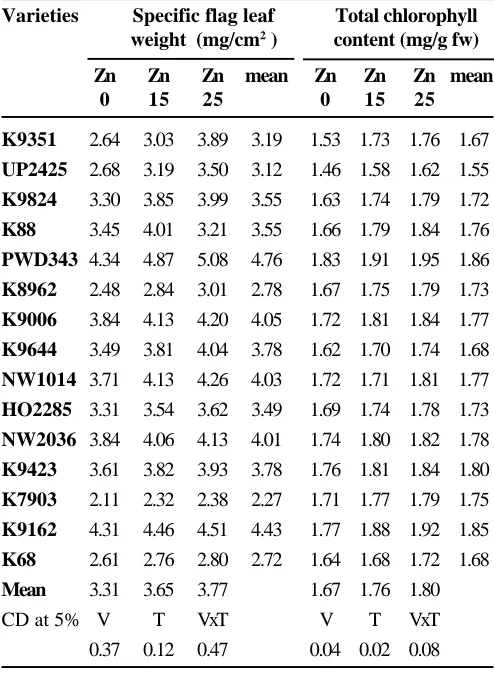
Specific weight of flag leaf (Table 1) exhibited significant variation due to genotypes and different levels of zinc application. Higher level of applied zinc (@ 25 kg ZnSO4/ha) significantly increased specific flag leaf weight (3.7 mg/cm2) over control (3.3 mg/cm2). Genotypes PBW 343 and K9162 had significantly higher
value of specific flag leaf weight, over rest of genotypes. Among the genotypes both PBW343 and K9162 recorded significantly greater value of specific leaf weight (5.08 – 4.51 mg/cm2) as compared to other genotypes at 25 kg ZnSO4/ha. The lowest value for this trait was recorded in genotype K7903 (2.1 mg/cm2). Genotypes responded differently for specific flag leaf weight at different levels of zinc. Specific flag leaf weight is a sensitive indicator of photosynthetic activity in many crops such as soybean (Bhatia et al. 1996), rice (Reddy et al. 1995) and mungbean (Islam et al. 1994). Thus, present findings indicated that zinc application helped in increasing the specific weight of flag leaf in wheat genotypes and thereby influenced the photosynthetic rate of flag leaf.
Significant variation in total chlorophyll content in flag leaf of wheat varieties determined at 50% anthesis stage were observed (Table 1). Higher dose of zinc application (@ 25 kg ZnSO4/ha) significantly increased total chlorophyll content in flag leaf at anthesis over control. Wheat genotype PBW 343 closely followed by K 9162 recorded significantly higher chlorophyll content. From the results it was deduced that zinc application enhanced total chlorophyll content in flag leaf by about 4.1% over control at anthesis stage. Thus, it is evident that elevated supply of zinc increased total chlorophyll content over control thereby delaying the leaf senescence by maintaining greenish colour of leaf for a longer period of crop growth duration. Among the genotypes PBW343 and K9162 had higher value of chlorophyll content in zinc deficient soil which enable them to perform better under such condition. These findings are in a close agreement with those of Khan et al. (1992) and Sharma et al. (1990).
Zinc content in the flag leaf varied significantly among genotypes and at different levels of zinc (Table 2). Higher dose of zinc application (25 kg ZnSO4/ha) significantly increased zinc content in flag leaf at different crop growth stage, i.e. tillering, anthesis, dough and physiological maturity, over rest of treatments. Genotype PBW343 followed by K9162 had significantly higher zinc content in flag leaf at all crop growth stages. This demonstrated that PBW 343 and K9162 were more efficient in zinc uptake over other genotypes. From the results it was observed that under rice wheat ecosystem Table 1. Effect of different levels of zinc application on
specific leaf weight and total chlorophyll content in the flag leaf of wheat varieties at anthesis stage (data pooled over two years).
Varieties Specific flag leaf Total chlorophyll weight (mg/cm2 ) content (mg/g fw)
Zn Zn Zn mean Zn Zn Zn mean 0 15 25 0 15 25 K9351 2.64 3.03 3.89 3.19 1.53 1.73 1.76 1.67
UP2425 2.68 3.19 3.50 3.12 1.46 1.58 1.62 1.55
K9824 3.30 3.85 3.99 3.55 1.63 1.74 1.79 1.72
K88 3.45 4.01 3.21 3.55 1.66 1.79 1.84 1.76
PWD343 4.34 4.87 5.08 4.76 1.83 1.91 1.95 1.86
K8962 2.48 2.84 3.01 2.78 1.67 1.75 1.79 1.73
K9006 3.84 4.13 4.20 4.05 1.72 1.81 1.84 1.77
K9644 3.49 3.81 4.04 3.78 1.62 1.70 1.74 1.68
NW1014 3.71 4.13 4.26 4.03 1.72 1.71 1.81 1.77
HO2285 3.31 3.54 3.62 3.49 1.69 1.74 1.78 1.73
NW2036 3.84 4.06 4.13 4.01 1.74 1.80 1.82 1.78
K9423 3.61 3.82 3.93 3.78 1.76 1.81 1.84 1.80
K7903 2.11 2.32 2.38 2.27 1.71 1.77 1.79 1.75
K9162 4.31 4.46 4.51 4.43 1.77 1.88 1.92 1.85
K68 2.61 2.76 2.80 2.72 1.64 1.68 1.72 1.68
Mean 3.31 3.65 3.77 1.67 1.76 1.80
CD at 5% V T VxT V T VxT
Table 2. Effect of different levels of zinc application on zinc content (ppm) in the leaves at different stages in wheat varieties. (data pooled over two years)
Variety Tillering stage Anthesis stage Dough stage Physiological maturity
Zn Zn Zn mean Zn Zn Zn mean Zn Zn Zn mean Zn Zn Zn mean
0 15 25 0 15 25 0 15 25 0 15 25
K9351 20.48 23.00 23.45 22.31 19.46 19.57 20.23 19.75 18.24 19.36 19.68 19.09 17.59 18.72 19.57 18.62 UP2425 22.23 24.09 24.71 23.68 20.75 21.73 22.03 21.50 19.75 21.11 21.47 20.77 19.08 19.62 20.67 19.79 K9824 19.87 21.65 22.51 21.34 18.60 20.61 21.33 20.18 17.67 18.86 19.66 18.73 17.06 17.91 18.50 17.82 K88 22.54 24.63 25.43 24.20 21.08 22.05 22.26 21.80 20.07 21.32 21.83 21.07 19.34 19.68 20.75 19.92 PWD343 22.59 26.95 27.54 25.69 23.00 24.50 24.75 24.08 21.88 22.73 23.61 22.74 21.08 21.83 22.77 21.89 K8962 22.54 24.12 24.50 23.72 21.09 21.54 22.14 21.59 20.07 20.83 21.82 20.90 19.33 19.99 21.01 20.11 K9006 22.54 24.01 24.50 23.68 21.10 21.66 22.28 21.68 20.04 20.60 21.48 20.70 19.04 20.08 20.81 19.97 K9644 17.41 19.09 19.47 18.66 16.30 17.36 17.68 17.11 15.50 16.59 16.92 16.33 14.96 15.85 16.68 15.83 NW1014 21.51 23.10 23.67 22.76 20.14 21.87 22.32 21.44 19.14 20.53 21.50 20.39 18.46 19.94 20.69 19.69 HO2285 20.49 22.08 22.42 21.66 19.20 20.63 21.48 20.43 18.24 19.58 24.98 20.93 17.62 18.95 19.70 18.75 NW2036 21.51 22.65 23.09 22.42 20.13 20.82 21.25 20.73 19.14 20.53 21.02 20.23 18.46 19.95 20.60 19.67 K9423 22.54 23.75 24.13 23.48 21.13 22.23 22.55 21.97 19.53 20.94 21.82 20.76 19.34 20.01 20.68 20.01 K7903 15.46 20.59 21.05 19.03 18.60 19.49 22.24 20.11 18.32 19.19 21.76 19.75 16.69 18.04 19.75 18.16 K9162 24.07 25.05 25.50 24.87 22.53 22.17 24.31 23.00 21.41 21.98 23.66 22.35 20.66 21.92 22.67 21.75 K68 19.93 18.88 19.21 19.34 16.78 18.06 18.60 19.81 15.92 17.83 18.46 17.40 15.15 17.15 17.61 16.63 Mean 21.05 22.91 23.41 19.99 20.95 21.70 18.99 20.13 21.31 18.25 19.30 20.16
CD at 5% V T V xT V T VxT V T VxT V T VxT
0.98 0.43 1.70 1.64 0.55 NS 1.09 0.49 NS 0.83 0.36 NS
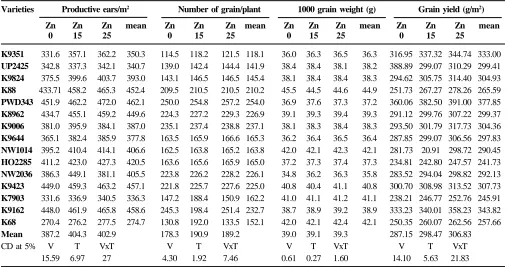
Table 3. Effect of different levels of zinc application on grain yield and its components in wheat varieties (data pooled over two years).
Varieties Productive ears/m2 Number of grain/plant 1000 grain weight (g) Grain yield (g/m2)
Zn Zn Zn mean Zn Zn Zn mean Zn Zn Zn mean Zn Zn Zn mean
0 15 25 0 15 25 0 15 25 0 15 25
K9351 331.6 357.1 362.2 350.3 114.5 118.2 121.5 118.1 36.0 36.3 36.5 36.3 316.95 337.32 344.74 333.00 UP2425 342.8 337.3 342.1 340.7 139.0 142.4 144.4 141.9 38.4 38.4 38.1 38.2 388.89 299.07 310.29 299.41 K9824 375.5 399.6 403.7 393.0 143.1 146.5 146.5 145.4 38.1 38.4 38.4 38.3 294.62 305.75 314.40 304.93 K88 433.71 458.2 465.3 452.4 209.5 210.5 210.5 210.2 45.5 44.5 44.6 44.9 251.73 267.27 278.26 265.59 PWD343 451.9 462.2 472.0 462.1 250.0 254.8 257.2 254.0 36.9 37.6 37.3 37.2 360.06 382.50 391.00 377.85 K8962 434.7 455.1 459.2 449.6 224.3 227.2 229.3 226.9 39.1 39.3 39.4 39.3 291.12 299.76 307.22 299.37 K9006 381.0 395.9 384.1 387.0 235.1 237.4 238.8 237.1 38.1 38.3 38.4 38.3 293.50 301.79 317.73 304.36 K9644 365.1 382.4 385.9 377.8 163.5 165.9 166.6 165.3 36.2 36.4 36.5 36.4 287.85 299.07 306.56 297.83 NW1014 395.2 410.4 414.1 406.6 162.5 163.8 165.2 163.8 42.0 42.1 42.3 42.1 281.73 20.91 298.72 290.45 HO2285 411.2 423.0 427.3 420.5 163.6 165.6 165.9 165.0 37.2 37.3 37.4 37.3 234.81 242.80 247.57 241.73 NW2036 386.3 449.1 381.1 405.5 223.8 226.2 228.2 226.1 34.8 36.2 36.3 35.8 283.52 294.04 298.82 292.13 K9423 449.0 459.3 463.2 457.1 221.8 225.7 227.6 225.0 40.8 40.4 41.1 40.8 300.70 308.98 313.52 307.73 K7903 331.6 336.9 340.5 336.3 147.2 188.4 150.9 162.2 41.0 41.1 41.2 41.1 238.21 246.77 252.76 245.91 K9162 448.0 461.9 465.8 458.6 245.3 198.4 251.4 232.7 38.7 38.9 39.2 38.9 333.23 340.01 358.23 343.82 K68 270.4 276.2 277.5 274.7 130.8 192.0 133.5 152.1 42.0 42.1 42.4 42.1 250.35 260.07 262.56 257.66 Mean 387.2 404.3 402.9 178.3 190.9 189.2 39.0 39.1 39.3 287.15 298.47 306.83
CD at 5% V T VxT V T VxT V T VxT V T VxT
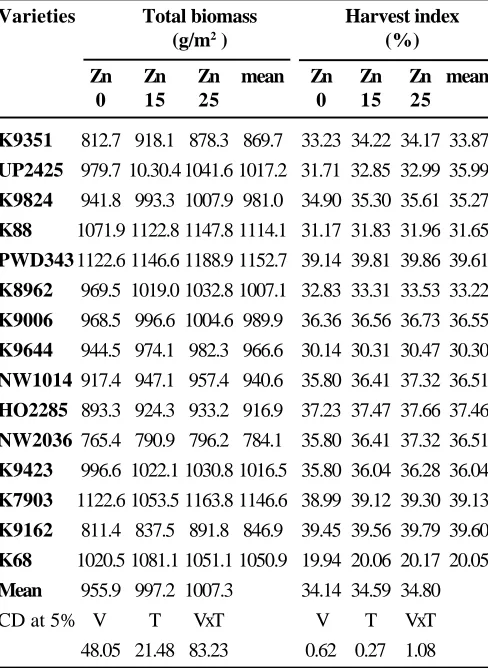
Table 4. Effect of different levels of zinc application on dry matter production and partitionoing in wheat varieties (data pooled over two years).
Varieties Total biomass Harvest index (g/m2 ) (%)
Zn Zn Zn mean Zn Zn Zn mean 0 15 25 0 15 25 K9351 812.7 918.1 878.3 869.7 33.23 34.22 34.17 33.87
UP2425 979.7 10.30.4 1041.6 1017.2 31.71 32.85 32.99 35.99 K9824 941.8 993.3 1007.9 981.0 34.90 35.30 35.61 35.27
K88 1071.9 1122.8 1147.8 1114.1 31.17 31.83 31.96 31.65
PWD343 1122.6 1146.6 1188.9 1152.7 39.14 39.81 39.86 39.61 K8962 969.5 1019.0 1032.8 1007.1 32.83 33.31 33.53 33.22
K9006 968.5 996.6 1004.6 989.9 36.36 36.56 36.73 36.55
K9644 944.5 974.1 982.3 966.6 30.14 30.31 30.47 30.30
NW1014 917.4 947.1 957.4 940.6 35.80 36.41 37.32 36.51 HO2285 893.3 924.3 933.2 916.9 37.23 37.47 37.66 37.46 NW2036 765.4 790.9 796.2 784.1 35.80 36.41 37.32 36.51 K9423 996.6 1022.1 1030.8 1016.5 35.80 36.04 36.28 36.04
K7903 1122.6 1053.5 1163.8 1146.6 38.99 39.12 39.30 39.13
K9162 811.4 837.5 891.8 846.9 39.45 39.56 39.79 39.60
K68 1020.5 1081.1 1051.1 1050.9 19.94 20.06 20.17 20.05
Mean 955.9 997.2 1007.3 34.14 34.59 34.80
CD at 5% V T VxT V T VxT
48.05 21.48 83.23 0.62 0.27 1.08
higher dose of zinc application enhanced zinc uptake at all crop growth stages, i.e. tillering, anthesis, dough and physiological maturity over control which led these genotypes to perform better under zinc deficient soil. Randhawa and Takkar (1975) reported that 28-33ppm zinc in leaves of wheat plant is critical for grain yield.
Grain yield and its attributes differed significantly due to genotypes and various levels of zinc application (Table 3 and 4). Higher dose of zinc application, i.e. 25kg ZnSO4/ha resulted in significantly higher number of productive ears/m2, higher grain number/plant, test weight, grain yield m-2, total biomass m-2, harvest index, over rest of combinations. Genotypes PBW343 and K9162 recorded significantly higher value for yield and its other components over other genotypes. Further these
genotypes responded well to elevated levels of zinc supply and thus, proved to be more efficient under zinc depleted soil. The beneficial effect of higher dose of zinc application on grain yield and its attributes have also been reported by Sharma et al. (1971), Rai and Chmmnia (1971) and Randhawa and Takkar (1975) in wheat crop.
Zinc content in flag leaf at physiological maturity demonstrated strong positive relationship with chlorophyll content (r = 0.550), harvest index (r = 0630), grain number/plant (r = 570) and grain yield (r = 678). These results, which must be considered though preliminary but critical in nature, indicate that elevated zinc nutrition has the potential to delay the flag leaf senescence and maintain the photosynthetic apparatus which is essential for grain filling in wheat genotypes under rice-wheat cropping system. Further, work is needed to confirm this relationship and to establish the role of other metabolic process involved in increasing the grain yield under such zinc depleted soil conditions.
ACKNOWLEDGEMENT
Senior author is grateful to Dr. D. N. Singh, Ex-HOD and PI (Physiology), IIPR, Kalyanpur for critically going through the manuscript.
REFERENCES
A.O.A.C. (1975). Official Methods of Analysis, Association of Official Agricultural Chemists. (Edn. 12). Published by Benjamin Franklin Station, Washington D.C.
Arnon D.I. (1949). Copper enzymes in isolated chloroplast. Polyphenol oxidase in Beta vulgaris. Plant Physiol. 24: 1-15.
Bhatia, V.S., Tiwari, S.P. and Joshi, O.P. (1966). Interrelationship of lamina photosynthesis, specific lamina weight and lamina anatomical character in soybean. Indian J. Plant Physiol. 1: 6-9.
Islam, M.I., Anata, W., Kubata, F. and Hamid, A. (1994). Evalutation of characteristics related to photosynthetic rate and lamina area production in mungbean genotype.
Jap J. Crop Sci. 63: 502-509.
Khan, H.R., Faiz, B., Islam, K.R., Adachi, T. and Ahamad, I.U. (1992). Effect of gypsum and zinc on the growth and yield of rice genotype under saline water stress in costal saline soil. International J. Trop. Agric. 9: 182-189.
Patil, V.D., Malewar, G.U. and Kide, D.S. (1997). Chlorophyll synthesis and yield of wheat cultivars as influenced by Zn on vertisols. Ann. Plant Physiol. 11: 160-164.
Rai, M.M. and Chimania, B.P. (1971). Evaluation of extractants for determining available zinc and response of applied zinc by plant. Soil Fert. Evalin. Proc. 1: 975-981.
Randhava, N.S. and Takkar, P.M. (1975). Micronutrient research in India. The status and further projection.
Fert. News. 20: 11-19.
Reddy, Y.A.N., Prasad, T.G. and Udaykumar, M. (1995). Relationship between lamina area index, specific leaf weight and assimilation rate in rice genotypes. Madras
Agric. J. 82: 616-618.
Sharma, C.P., Agrawala, S.C., Sharma, P.N. and Ahmad, S. (1971). Performance of eight high yielding wheat varieties in some zinc deficient soil of U.P. and their response to zinc amendment in pot culture. Indian J.
Soil Sci. 19: 93-100.
Sharma, P.N., Chatterjee, C., Agarwala, S.C. and Sharma, C.P. (1990). Zinc deficiency and Pollen fertility in maize (Zea