ISSN (Online): 2320-9364, ISSN (Print): 2320-9356
www.ijres.org Volume 1 Issue 6 ǁ Oct. 2013 ǁ PP.29-37
A High Order Continuation Based On Time Power Series
Expansion And Time Rational Representation For Solving
Nonlinear Structural Dynamic Problems
Bouazza Braikat
1, Mohammad Jamal and Noureddine Damil
Laboratoire d’Ingénierie et MatériauxFaculté des Sciences Ben M’Sik, Université Hassan II Mohammedia - Casablanca Avenue Cdt Driss El Harti, B.P. 7955, Sidi Othman, 20450, Casablanca, Morocco.
Abstract
: In this paper, we propose a high order continuation based on time power series expansion and time rational representation called Padé approximants for solving nonlinear structural dynamic problems. The solution of the discretized nonlinear structural dynamic problems, by finite elements method, is sought in the form of a power series expansion with respect to time. The Padé approximants technique is introduced to improve the validity range of power series expansion. The whole solution is built branch by branch using the continuation method. To illustrate the performance of this proposed high order continuation, we give some numerical comparisons on an example of forced nonlinear vibration of an elastic beam.Key words: Nonlinear structural dynamics, finite element, power series expansion, Padé approximants, high
order continuation, nonlinear forced vibration beam.I.
Introduction
During the last two decades, several research activities have been devoted to the development of efficient algorithms for accessing numerically to the response of a nonlinear elastic structure subjected to dynamic loading. In literature, there is a variety of numerical approaches for solving this type of nonlinear dynamic problems. Some of them are currently implemented in several computer codes. The most popular ones are of iterative or prediction-correction type [1, 2, 3, 4, 5].
These methods are generally based on direct integrations of the equations that govern the studied nonlinear dynamic problems and which employ procedures for spatial classical discretization by finite elements, finite differences, finite volumemethods.... The time integration is performed by an implicit or explicit time scheme. These methods work very well and allow to obtain the nonlinear dynamic response, but this might require a very important CPU time of computation especially for implicit algorithms.
The implicit schemes are unconditionally stable and allow more freedom on the choice of time step size, which will be only limited by the accuracy requirements [3, 6]. Due to the large size of media meshes, the implicit schemes require large memory as well as many computations. For example, the Newmark implicit time schemes are unconditionally stable if the Newmark parameters are: and satisfy [6]. As for explicit schemes, they are conditionally stable. In many situations this forces the time step size to be very small and causes an increase in the number of time steps required for the integration. The explicit scheme can lead to stability problems related to time step size, when the structural mesh is much smaller than that for the media mesh.
The aim of this work is to extend this idea of time series expansion to nonlinear structural dynamic problems with multidegrees of freedom, and secondly to introduce other fractional representations based on the Padé approximants [12] in order to ameliorate the validity range of the considered time power series expansion. The whole nonlinear dynamic response of the structure is obtained by continuation method [12]. The efficiency of the proposed high order continuation is illustrated on an example of nonlinear forced vibration beam. A comparison with Newton Raphson method coupled with Newmark implicit scheme [6] is presented.
II.
Governing nonlinear structural dynamic equations
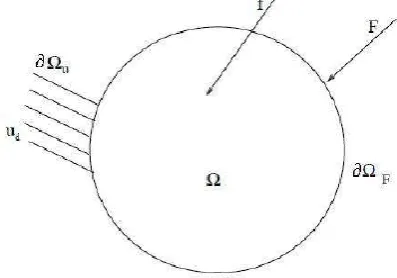
Let’s consider a tridimensional nonlinear elastic structure occupying a volume of boundary The structure, made of an isotropic homogeneous elastic material of density , is subjected to a prescribed displacement on a part and to a density of surface forces F on the complementary . Moreover, is submitted to a density of body forces (see figure 1).
Figure 1. Three-dimensional elastic structure
Neglecting the damping forces and applying the virtual work principle, the dynamic motion of the structure is given by the variational formulation:
(2.1)
where is the displacement vector, , and are respectively the initial and boundary conditions, is the nonlinear Green-Lagrange strain tensor defined by :
(2.2)
with and are respectively the linear and nonlinear quadratic parts of strain tensor, is the Piola-Kirchhoff stress tensor connected to via the constitutive law:
(2.3)
with is the elastic tensor. The aim of this work is to propose a high order continuation for solving the nonlinear dynamic problem governed by the equations (2.1), (2.3). This algorithm is developed using finite elements method and the power series expansion and rational representation called Padé approximants with respect to time variable . The proposed algorithm is presented and tested in the following sections.
III.
The proposed algorithm
To solve the variational problem (2.1), (2.3), we develop, in this section, a high order continuation based on the following three steps:
a- Space discretization by finite elements method of the nonlinear equations (2.1), (2.3)
c- Application of the continuation method to build the whole solution branch by branch [12].
3.1. Space discretization by finite elements method
The space discretization of the equations (2.1) and (2.3) by the finite elements method [1, 2, 13] is obtained in the following form:
(3.1)
where and are respectively the nodal displacement and acceleration vectors, , and are respectively the discretized initial and boundary conditions, is the shape matrix such that and
with , are the linear and nonlinear strain matrix corresponding respectively to the discretization of the
linear and nonlinear parts of , is the matrix of elasticity and is the space discretized forces vector. Using the usual notations, the expression (3.1-a) can be written in the matrix form:
(3.2)
where
(3.3)
are the mass and stiffness matrices. The time integration of the nonlinear problem (3.2) completed by (3.1-b) and (3.1-c) is generally carried out by classical numerical methods which use explicit or implicit time schemes [2, 3, 14]. We present, in the following section, another alternative for solving the nonlinear system (3.2), (3.1-b) and (3.1-c). It is based on the power series expansion with respect to time .
3.2. Power series expansion technique
The structural dynamic response q(t) of nonlinear problem (3.2), (3.1-b) and (3.1-c) is sought in the form of a power series expansion with respect to time truncated at the order p:
(3.4)
where the unknown vector is time independent, is the validity range of the series (3.4), see [15] and
is the initial time. Then, we expand the stress vector with respect to in the form:
S (3.5)
and we assume, in addition, that the vector force , in the problem (3.2), is developable in time up to the order as:
F (3.6)
By substitution of (3.4), (3.5) and (3.6) in (3.2), (3.1-b), we get the terms and of time series (3.4) and (3.5) are given by the following expressions:
For :
For :
(3.8)
For :
(3.9)
The expressions (3.7), (3.8) and (3.9) give each term of the series (3.4) and (3.5) in function of those computed at previous orders by inverting only one mass matrix . They are fully determined and the solution is computed at any time in the interval . It is important to underline that the validity range of the series representation (3.4) is finite and must be computed.
3.3. Validity range of the power series
When the power series expansions (3.4) and (3.5) are truncated at a given order , it is valid only up to a certain maximal time [7, 12], given by the criterion:
(3.10)
which requires that the power series representation ceases to be valid when the difference between the power series at two consecutive orders is small than a tolerance parameter _. This way gives the validity range that depends on the truncate order p and on the required tolerance. The nonlinear dynamic structural response is computed branch by branch by using the continuation method [15].
3.4. Improvement of validity range by Padé approximants
It is possible to improve the critical time by replacing the power series expansion (3.4) and (3.5)
by a rational representation one called Padé approximants [15, 16, 17]. This rational representation of the solution paths and is given in the form:
(3.11)
where are polynomials of degree with real coefficients ( :
(3.12)
with are calculated as in [12]. Those rational representations have been tested in many cases [18]. The Padé approximants improve significantly the validity range of the power series expansion (3.4) and (3.5). To get the critical time of the rational representation (3.11), one has only to require that the difference between two rational representations at consecutive orders remains small at the end of the step. The maximal value is
then defined by [12]:
(3.13)
where is a tolerence parameter. The solution is obtained branch by branch using the rational representation (3.11) and the relation (3.13) [12].
As soon as the critical times or evaluated respectively by the criteria (3.10) or (3.13), the complete solution is obtained branch by branch by means of the continuation method [12, 15]. At the end of each branch, we start with the new initial conditions computed at critical time or of the
previous step.
IV.
Application: Forced nonlinear vibrating
2D
elastic beam
We apply, in this paragraph, the proposed high order continuation in order to test its efficiency for solving the forced nonlinear vibration problem of a bidimensional elastic beam. We consider a beam, of length and of width , which is made of an homogeneous, isotropic and elastic material with density , Young modulus and Poisson’s ratio . The structure is clamped at one side and subjected to the other side to an harmonic force . The initial values are assumed to be equal to zero. The beam is meshed in quadriangle elements (see figure 2).
Figure 2. Beam meshed in 12 quadriangle elements subjected to an harmonic force
The numerical results obtained, in time interval , by the high order continuation are compared to those computed by the Newton Raphson method using the Newmark implicit time scheme which we will call next as a reference solution. The choice of this time interval is due to the smallest period of the excitation force F. The Newmark parameters and time step adopted in the numerical computation are: , , . We have verified that the optimal timestep corresponds to , gives a sufficient accuracy. For greater , the Newton Raphson solution diverges. We note that the reference solution, in the considered temporal domain, is get in iterations. In the following, we present the transversal displacement at loaded node versus time . The qualities of solutions are characterized by the logarithmof the norm of residual vectors. This residual vector, denoted by , is defined by:
(4.1)
4.1. Power series solution without continuation method
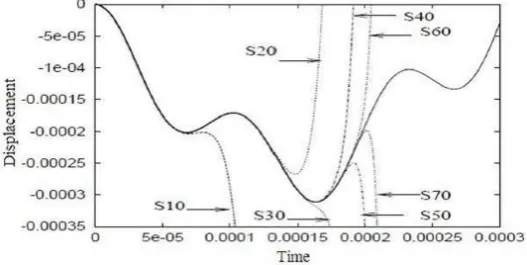
The comparison of power series solutions (see equation (3.4)), truncated at orders 10, 20, 30, 40, 50, 60 and 70, without continuation method with the Newton Raphson solution is reported in figure 3.
Figure 3. Power series solutions (S10, S20, S30, S40, S50, S60, S70),
The power series solutions are denoted by and (dashed curves) and the curve of the Newton Raphson solution is plotted with full line. This figure shows that the power series solutions are confounded with Newton Raphson solution in the interval . This power series representation (see equation (3.4)) is only valid up to critical time . For higher truncation order (order 70),
the power series solution seems to be valid until a critical time . The critical time increases with the truncation order. Then, by increasing the truncation order, we ameliorate the quality of the solution. The qualities of the power series solutions are better when we increase the truncate order . For large greater than , they become more and more weak. The effect of the tolerance parameter and of the truncation order on the critical time , without continuation process, is given in the table 1.
Table 1. Influence of the tolerance parameter and of the truncation order p on the critical time without continuation method.
One can see that the critical time increases, for a fixed tolerance , with the truncation order and decreases, for a fixed order , with the tolerance parameter .
4.2. Complete solution
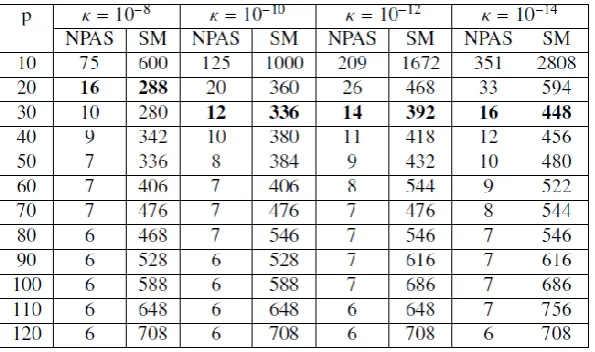
In the table 2, we report the influence of the tolerance parameter and the truncation order on the number of steps necessary to obtain the complete solution on the time interval .The symbols and , in the table 2, denote respectively the number of continuation steps and the number of computed right hand sides such that : . Optimal orders are those mentioned in bold in table 2.
Table 2. Influence of the tolerance parameter and of the truncate order p on the number continuation steps
Figure 4. Comparison between the reference solution and the power series solution truncated at order 30 with continuation method, .
The proposed high order continuation gives the same result as the Newton Raphson method as shown in figure 4. The complete solution is obtained in 12 continuation steps, with the parameters and . This solution is obtained by computing right hand sides and inverting only one mass matrix. While,
the Newton Raphson method gives the same result using 2000 iterations, an inversion of tangent matrix at each iteration is required triangulations, to obtain the complete solution.
4.3. Padé approximants solution without continuation method
The Padé series solutions (see equation (3.11)) denoted respectively by and , truncated at respective orders and without continuation method compared to Newton Raphson reference solution are plotted in figure 5 with .
Figure 5. Comparison between the Newton Raphson reference solution (N) and Padé approximants solution (P10, P20, P30 and P40) without continuation method truncated at respective orders 10, 20, 30 and 40
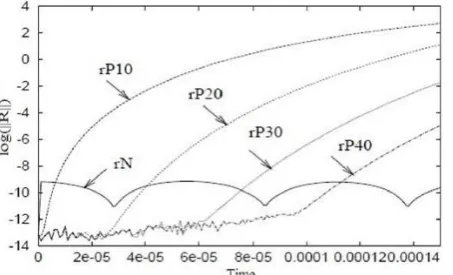
As for the power series solution, the validity range of the time Padé solution increases with truncature order. The qualities of these four Padé approximants solutions denoted respectively by and without continuation method compared to that computed by the Newton Raphson method are reported in figure 6.
One can see, on figure 7, that the use of Padé approximants ameliorates substantially the validity range of the power series solution. The three qualities of these solutions are given in the figure 8. Let us remark that the power series solutions and Padé approximants have the same quality in the interval . For , the quality of Padé representation truncated at order seems to be better than power series
expansion. For very small time , the power series expansion and its improvement by Padé approximant are more accurate than the Newton Raphson one.
Figure 7. Comparison between the Padé approximants solution (P30), power series solution (S 30) truncated at orders 30 without continuation method and the Newton Raphson reference solution (N)
Figure 8. Comparison of the qualities of the Pad´e approximants solution (rP30), power series solution (rS 30) truncated at orders 30 without continuation method and the Newton Raphson reference solution (rN)
4.4. Padé approximants solution with continuation method
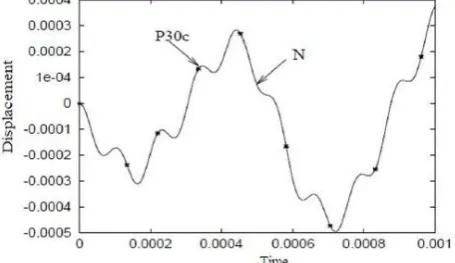
The complete solution obtained by the Padé approximants solution truncated at order using the continuation method is reported in figure 9 and compared to those obtained by power series and reference solutions.
Figure 9. Comparison of three solutions: Padé approximants (P30c), power series (S 30c) truncated at order 30 with continuation process and reference solution (N), , .
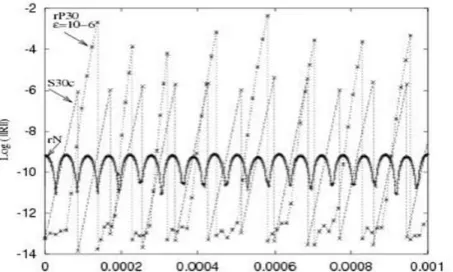
leads to a reduction of the computational steps. The Comparison of the qualities of the Padé approximants solution , power series solution truncated at orders 30 and the Newton Raphson solution (rN) are represented in figure 10.
Figure 10. Comparison of the qualities of the Padé approximants solution (rP30), power series solution (S 30c) truncated at orders 30 with continuation method and the Newton Raphson reference solution (rN)
This example shows that the Padé approximants combines efficiency and robustness. Indeed, it reduced the number of steps with respect to the power series and it permitted to compute this vibration problem without any difficulty.
V.
Conclusion
The paper has described an algorithm for solving nonlinear structural dynamic problems. It is based on the combination of a classical finite elements discretization procedure, a time power series expansion and time rational representation called Padé approximants and a continuation method. The different terms of this asymptotic expansion are obtained in a simple recurrent way. Their numerical computation requires only a single inversion of the mass matrix. The introduction of Padé approximants permits to improve the validity range of the power series solutions. The effectiveness of the proposed algorithm is tested in a problem of a forced nonlinear vibration of an elastic beam. The determination of the whole solutions improved by Padé approximants is performed by means of a continuation method.
References
[1] Bathe K. J. 1996. Finite Element Procedures. Prentice-Hall, Engewood Cliffs, New Jersey.
[2] Zienkiewicz O. C., Taylor R. L. 1987. The Finite ElementMethod, Solid and FluidMechanics and Non-linearity. Vol. 2, fourth edition, McGraw-Hill, Book Company.
[3] Argyrs J., Mlejnek H. P. 1991. Dynamic of structure. Texts on computational mechanics, North Holland, Amsterdam. [4] G´eradin M., Rixen D. 1993. Th´eorie des vibrations. Application `a la dynamique des structures. Masson, Paris
[5] Crisfield M. A. 1991. Nonlinear finite element analysis of solids and structures. Advance Topics, Ed. John Wiley and Sons, Vol. 1
[6] Newmark N. 1959. A Method of Computation for structural dynamics. Journal of the Engineering Mechanics Division, Proceedings of ASCE, pp. 67-94.
[7] Jamal M., Braikat B., Boutmir S., Damil N., Potier-Ferry M. 2002. A high order implicit algorithm for solving instationnary non-linear problems. Computational Mechanics, Vol. 28, pp. 375-380.
[8] Qaisi M. I. 1997. A power series solutions for the non linear vibration of beams. Journal of sound and vibration, pp. 587-594. [9] Fafard M., Henchi K., Gendron G., Ammar S. 1997. Application of an asymptotique method to transient dynamic problems.
Journal of Sound and Vibration, Vol. 208, pp. 73-99.
[10] Padé H. 1892. Sur la repr´esentation approch´ee d’une fonction par des fractions rationnelles. Annales de l’´ecole Normale Sup´erieure.
[11] Baker G. A., Morris P. G. 1981. Padé approximants. Part I, Basic Theory, Encyclopedia of Mathematics and its applications, Addison-Wesley Publishing Company, New York, Vol. 13, N 1.9
[12] AElhage-Hussein A., Potier-Ferry M., Damil N. 2000. A numerical continuation method based on Padé approximants. International Journal of Solids and Structures,Vol. 37, pp. 6981-7001.
[13] Crisfield M. A. 1997. Nonlinear finite element analysis of solids and structures. Advanced Topics, Ed. John Wiley and Sons, Vol. 2.
[14] Dhatt G., Tousot G. 1984. Une pr´esentation de la m´ethode des ´el´ements finis. Deuxi`eme ´edition, Maloine SA, Paris. [15] Cochelin B., Damil N., Potier-Ferry M. 1994. Asymptotic numerical methods and Padé approximants for non linear elastic
structures. International Journal for Numerical Methods in Engineering, Vol. 37, pp. 1187-1213.
[16] Baker G. A., Morris P. G. 1996. Encyclopedia of Mathematics and its Applications. Addison- Wesley New York, Vol. 13. [17] Brezinski C., Iseghem V. 1994. Padé approximants. In: Ciarlet, P.G., Lions, J.L. (Eds.), Handbook of Numerical Analysis,
North-Holland, Amsterdam, Vol. 3.