ISSN (e): 2250-3021, ISSN (p): 2278-8719
Vol. 09, Issue 11, November. 2019, Series -III, PP 01-05
Identification Method for Malware Detection System
S.Lakshman Raju
1,
Mr.Ch
.Raja
Jacob
2 1M.Tech Student, 2Associate Professor,Department of CSE, Nova College of Engineering,
Vegavarram,Jangareddy Gudem(M) AP. India.
Corresponding Author:S.Lakshman Raju
Received 08November 2019; Accepted 25 November 2019
Abstract:
The mobile ecosystem needs apps for malicious code detection. The approaches maybe system level
or network level. For this, we propose, an identification method for malware detection. The proposed system consists of three level pruning procedures for analyzing permission data is android system. The machine learning algorithm is adopted to efficiently classify kind and mean malicious code. The proposed method is evaluated with various permission database and the results expose the value of the proposed method.Keywords:
Android Malware Detection Techniques, Machine Learning
I.
INTRODUCTION
International organization of Scientific Research
2 | Page
The present paper is organized into four sections. Section- 1deals with introduction, section-2 deals with methodology, section-3 deals with results & discusses conclusion in section-4[10].II.
PROPOSED SYSTEM
In proposed paper, we implements (IDMMD) Identification method for malware detection (IDMMD).The goal of the (IDMMD) is to improve the apps permissions effectively and efficiently.. This Identification Method for Malware Detection System improves the accuracy and efficient recognition of malware application. With help machine learning algorithms such as Support Vector Machine and Decision Tree algorithms make a evaluation between training dataset and trained dataset .Support vector machine algorithms act as a classifier which is used to classify malicious application and benign app.
Support Vector Machine algorithms act as a classifier which is used to arrange malicious application in addition to benign app.
III.
METHODOLOGY
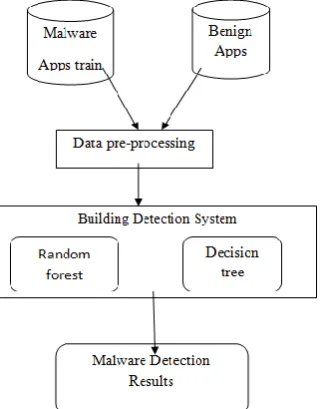
The goal of Identification Method for Malware Detection System is to accomplish immense malware disclosures certainty and adaptability during evaluation of minute total of permissions. In that progress, our proposed system model scheme draw outs the list of permissions from the application folders or containers rather than concentrating on all the available permissions. Significant Permission Identification method for malware detection system particularly targets on permissions that enhances the percentage of malware discovery. As an outcome, it excludes the demand to evaluate permissions which has less impact for the malware discovery efficiency. This is contained in of two main mechanisms: (i) Data pre- processing (ii) Building detection system a) Random Forest
b) Decision tree. After Building detection system, Significant Permission Identification method for malware detection system report to the malware detection results. The complete system architecture of Significant Permission Identification method for malware detection system is shown in Figure 1.
I.
Figure 1: Classification Overview Process as well as two major division: Data Pre-Processing, Building Detection System, Malware Detection Analysis
Data pre-processing might be a data processing system to involve remodeling data into a plain arrangement. Real- world in order is usually unfinished, conflicting, along with/otherwise missing in bound behaviors’ otherwise trend, with is almost certainly leaving to have some errors. In order pre-processing might be an evidence method of breakdown such trouble.
Decision trees are classifier models inside which both hub of the tree speak to an examination on the normal for the data set, with its children represent the result. The youngster hubs speak to the end program of the actualities point. It be an overseen classifier show which use data by perceived mark to appearance the decision of tree with then the style is apply on the check data.
IV.
RESULTS AND DISCUSSIONS
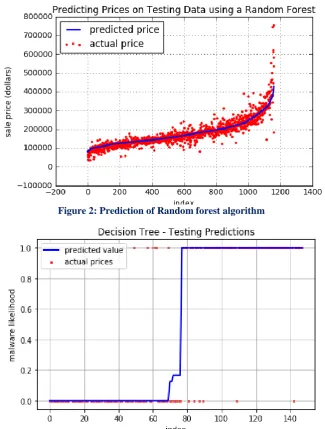
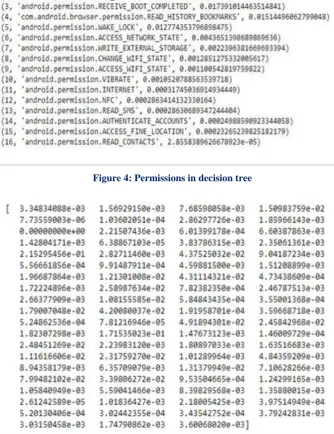
The present paper proposes a novel signification identification system for malware detection. The proposed method is developed based on the machine learning algorithms. It is developed with the Android environment. The proposed method is evaluated with 22 numbers of inputs. The prediction result is shown in figure: 2. from this figure, it is clear that the proposed method efficiently detects the malware. The figure 3. Illustrates the prediction results by using decision tree. It is observed that, with decision tree, the prediction results are found to be high. The figure 4. Shows the permissions identified by the decision tree based algorithm, with this algorithm, all the possible permissions are identified effectively from the malware based code.
V.
SYSTEM ARCHITECTURE
Figure 2: Prediction of Random forest algorithm
International organization of Scientific Research
4 | Page
Figure 4: Permissions in decision treeThe figure 5. Portraits the identified permissions with the random forest algorithm based method. It is found that the decision tree based algorithm result is efficient than random forest algorithm based result.
VI.
CONCLUSION
The planned technique during this paper is a plan for a more accurate and efficiently. To removes malware apps form our mobile by using machine learning algorithm similar to decision trees and random forest are used toward detect malware form our android mobiles. By using this method we can reduce malware from our mobiles.
REFERENCE
[1]. MayankJaiswal ; YasirMalik ; FehmiJaafar,“Androidgaming malware detection using system
callanalysis”,2018 6th International Symposium on Digital Forensic and Security (ISDFS), 2018,pages:1-5.
[2]. Bin Wu ; Tailing Lu ; Kangfeng Zheng ; Dongmei Zhang ; Xing Lin, “Smartphone malware detection model based on artificial immune system”, China Communications, Volume: 11 , Issue: 13,Year 2014, Page: 86 – 92.
International organization of Scientific Research
5 | Page
Phones”,2018 IEEE International Conference on System, Computation, Automation and Networking (ICSCA),year 2018, Pages: 1 – 4.[4]. B. Rajalakshmi ; N. Anusha, “Sensor based application for malware detection in android OS(Operating System) devices” 2017 International Conference on Information Communication and Embedded Systems (ICICES), Year: 2018,Pages: 1 – 4.
[5]. Anil Utku; İbrahim Alper Doğru, “Malware detection system based on machine learning
methods for Android operating systems”, 2017 25th Signal Processing and Communications Applications Conference (SIU), year:2018,pages:25.
[6]. Zhang Xiaosong ; Pan Xiaohui ; Long Xiaoshu, “Analysis of Virtual Machine Applied to Malware Detection System”,2009 International Symposium on Information Engineering and Electronic Commerce, Year: 2010,Pages: 201 – 203.
[7]. Muhammad Ejaz Ahmed ; Surya Nepal ; Hyoungshick Kim, “MEDUSA: Malware Detection Using
Statistical Analysis of System's Behavior” 2018 IEEE 4th International Conference on Collaboration and Internet Computing (CIC), Year: 2018,Pages: 272 – 278
[8]. S. Muthuraj kumar ; M. Vijayalakshmi ; S. Ganapathy ; A. Kannan, “Agent based intelligent approach for the malware detection for infected cloud data storage files”,2015 Seventh International Conference on Advanced Computing (ICoAC),Year-2015,Pages: 1 – 5.
[9]. Saba Arshad ; Munam A. Shah ; Abdul Wahid ; Amjad Mehmood ; Houbing Song ; Hongnian Yu, “SAMADroid: A Novel 3-Level Hybrid Malware Detection Model for Android Operating System”, IEEE Access, Volume: 6,year-2018,Page: 4321 – 4339.
[10]. Radoniaina And riatsimandefitra ; Valérie Viet Triem Tong, ”Detection and Identification of Android Malware Based on Information Flow Monitoring”, 2015 IEEE 2nd International Conference on Cyber Security and Cloud Computing,year:2015,pages- 2805-2809.