61
DATABASE INFORMATION SYSTEM
FOR THE RESULTS IN MINERAL PROCESSING
1SAŠA PUŠICA, 2M.PUŠICA
1M.Sc., Agencija “Smaj Business”, Crnovrških brigada 6/1, 19210 Bor, Serbia
2B.Sc., Regionalni centar za talente Bor, 3.oktobar 71, 19210 Bor, Serbia
E-mail: [email protected], [email protected]
ABSTRACT
Evolution of information technology and computer industry with direct or indirect implementation enable fast progress in many field of science. In mineral processing we use information technology and computer mostly like text processor, spreadsheet calculator or for graphical presentation for datas of analysis (grainsize, sediment, heavy media) using special software systems like EXCEL, QUATTRO, ORIGIN etc. After this, we can store the datas in various formats on disk, but can not directly store in format for searching this datas like: author of analysis, name of sample, type of sample, type of analysis, date of analysis, keywords, etc. With database information system, we can solve this problem and this paper show how to make the relationship model for the results of analysis in mineral processing, data model diagram, primary key for database and other things for database information system.
Keywords: Information systems, database, mineral processing, grain size, sedimentation, heavy media
1. INTRODUCTION
Information system is use for collect (gathering) information of real system, treat and storing this information in modyfied form (new information) in unique database and distribute them in the right time on the right place with minimum cost (database is a structured collection of records or data). Fig.1 shows diagram for real system and information system.
The components of information system is:
• hardware (computers )
• software (program for computers)
• orgware (organization who use information system)
• lifeware (people who use and modify the information system)
62
• netware (communication betwen information system and users).
2. DEVELOPMENT OF INFORMATION SYSTEM
Development of information system have two phase:
• planning of information system
• realization of information system
2.1.PLANNING OF INFORMATION SYSTEM
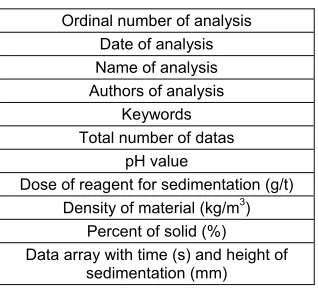
Planning (modeling) of information system define the model of any object from real system. This object has many properties (informations), but we must define what properties is necessary for storing in database information system. For the results of analysis in mineral processing, the objects of real system is: grain size analysis, sedimentation analysis and heavy media analysis. On Fig.2. , Fig.3. and Fig.4 is showed our suggested models with necesssary properties for storing in database.
Ordinal number of analysis Date of analysis Name of analysis Authors of analysis
Keywords Total number of datas Data array with partical size (µm)
and mass of sample (g)
Fig 2. The model of real system object “grain size analysis”
Ordinal number of analysis Date of analysis Name of analysis Authors of analysis
Keywords Total number of datas
pH value
Dose of reagent for sedimentation (g/t) Density of material (kg/m3)
Percent of solid (%) Data array with time (s) and height of
sedimentation (mm)
Fig 3. The model of real system object “sedimentation analysis”
Ordinal number of analysis Date of analysis Name of analysis Authors of analysis
Keywords Total number of datas
Name of component Type A:
Data array with a specific gravity of heavy media (kg/m3), mass of float (sink) product (g), percent of component in float (sink)
product (%)
Fig 4. The A-model of real system object “heavy media analysis”
Ordinal number of analysis Date of analysis Name of analysis Authors of analysis
Keywords Total number of datas
Name of component Type B:
Data array with a specific gravity of heavy media (kg/m3), mass of feed for separation
(g), percent of component in feed for separation (%), mass of float product (g),
percent of component in float product (%),mass of sink product (g), percent of
component in sink product (%)
Fig 5. The B-model of real system object “heavy media analysis”
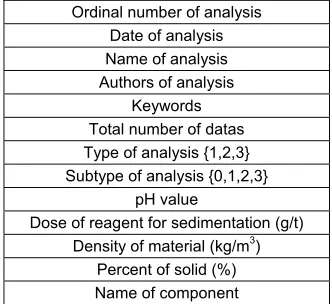
The suggested models of analysis in mineral processing have six equivalently property: ordinal number of analysis, date of analysis, name of analysis, authors of analysis, keyword, total number of datas. Based on this reason, we can suggest new model of real system object “analysis” (Fig.6.), “results of analysis” (Fig.7.), “type of analysis” (Fig.8.), “subtype of analysis” (Fig.9.)
63 Ordinal number of analysis
Date of analysis Name of analysis Authors of analysis
Keywords Total number of datas Type of analysis {1,2,3} Subtype of analysis {0,1,2,3}
pH value
Dose of reagent for sedimentation (g/t) Density of material (kg/m3)
Percent of solid (%) Name of component
Fig 6. The model of real system object “analysis”
Ordinal number of analysis Data array with partical size (µm) and
mass of sample (g) Data array with time (s) and height of
sedimentation (mm)
Data array with a specific gravity of heavy media (kg/m3), mass of feed for separation (g), percent of component in
feed for separation (%), mass of float product (g), percent of component in float
product (%),mass of sink product (g), percent of component in sink product (%)
Fig 7. The model of real system object “results of analysis”
1. Grain Size analysis 2. Sedimentation analysis 3. Heavy Media analysis
Fig 8. The model of real system object “type of analysis”
0. Null
1. Heavy Media with float product 2. Heavy Media with sink product
3. Heavy Media with feed, float and sink product
Fig 9. The model of real system object “subtype of analysis”
The suggested names for tables of our models is:
• ANALYSIS – for model “analysis”
• AN_RESULT – for model “results of analysis”
• AN_TYPE – for model “type of analysis”
• AN_STYPE – for model of “subtype of analysis”
Each table has the columns and every column in table is use to store data of one specified property (information) of real system object. The columns in our database table can be declared in one of this data types:
• INTEGER
• NUMBER (number with decimal place)
• STRING
• DATE
With this data types, we can define the columns for our database tables (TABLE 1., TABLE 2., TABLE 3., TABLE 4.).
TABLE 1. Definition of columns for table “ANALYSIS” Name of
column
Data Type Description
ID_A INTEGER(15) Ordinal number of
analysis
DATE_A DATE(10) Date of analysis
NAME_A STRING(255) Name of analysis
AUTHOR_A STRING(255) Authors of analysis
KEYW_A STRING(255) Keywords
TOTAL_A INTEGER(3) Total number of
datas
TYPE_A INTEGER(2) Type of analysis
STYPE_A INTEGER(2) Subtype of analysis
PH_A NUMBER(5,2) pH value
DOSE_A NUMBER(12,3) Dose of reagent for
sedimentation (g/t)
DENSITY_A NUMBER(12,3) Density of material
(kg/m3)
SOLID_A NUMBER(6,2) Percent of solid (%)
COMPO_A STRING(255) Name of component
TABLE 2.Definition of columns for table “AN_RESULT” Name of
column
Data Type Description
ID_DATA INTEGER(15) Ordinal number of
analysis
PSIZE_A NUMBER(12,3) Partical size (µm)
MSIZE_A NUMBER(12,3) Mass of sample (g)
64
sedimentation (s)
HSEDIM_A NUMBER(8,0) Height of
sedimentation (s)
SGRAV_A NUMBER(12,3) Specific gravity of
heavy media (kg/m3)
MSFEED_A NUMBER(12,3) Mass of feed for
separation (g)
PCFEED_A NUMBER(6,2) Percent of component
in feed for separation (%)
MSFLOAT_A NUMBER(12,3) Mass of float product (g)
PCFLOAT_A NUMBER(6,2) Percent of component
in float product (%)
MSSINK_A NUMBER(12,3) Mass of sink product
(g)
PCSINK_A NUMBER(6,2) Percent of component
in sink product (%)
TABLE 3.Definition of columns for table “AN_TYPE” Name of
column Data Type Description ID_TYPE INTEGER(2) Type of analysis NTYPE_A STRING(30) Name for type of
analysis
TABLE 3-A. Table “AN_TYPE”
ID_TYPE NTYPE_A 1 Grain Size analysis
2 Sedimentation analysis
3 Heavy Media analysis
TABLE 4. Definition of columns for table “AN_STYPE”
Name of column
Data Type Description
ID_STYPE INTEGER(2) Type of analysis
NSTYPE_A STRING(30) Name for subtype of
analysis
TABLE 4-A.Table “AN_STYPE”
ID_STYPE NSTYPE_A
0 Null
1 Heavy Media with float product
2 Heavy Media with sink product
3 Heavy Media with feed, float and sink
product
2.1.1. IDENTIFY THE RELATIONSHIPS BETWEEN TABLES
Every table in our database information system has one column named as the primary key. This is unique property for identify some model of real system object stored in database table. On Table 5. is showed the list of primary key for suggested tables of database information system.
TABLE 5. The primary key for the table of database information system Table Description of
table
Primary key
Description of primary key
ANALYSIS General datas
of any analysis
ID_A Ordinal number
of analysis, 0...N
AN_TYPE Type of
analysis
ID_TYPE Ordinal number
for type of analysis, 1...3
AN_STYPE Subype of
analysis
ID_STYPE Ordinal number
for subtype of analysis, 0...3
Now, we must define the relationship between one and more other tables in database information system. For this, we use the relational columns. These columns establish a link between information in one table and related information in another table. In TABLE 6. and on Fig.10. is showed the relation columns and relationship between our tables in database information system.
TABLE 6. The relational columns and relationship for the table of database information system
Table Table Description of
relationship
ANALYSIS ->ID_A
AN_RESULT ->ID_DATA
Relationship between general and specific datas for results of analysis
ANALYSIS ->TYPE
AN_TYPE ->ID_TYPE
Relationship between general datas and type of analysis
ANALYSIS ->STYPE
AN_STYPE ->ID_STYPE
65 2.2. REALIZATION OF INFORMATION
SYSTEM
Realization of information system has next phase:
• creating tables for database information system
• creating the moduls for inserting, modification or deleting the datas from database
• creating the moduls for data report from database
• creating the moduls for searching database
2.2.1. CREATING TABLES FOR DATABASE INFORMATION SYSTEM
For creating tables for database information system, we can use many commercial programm like MICROSOFT ACCESS® or very good and useful freeware MySQL. We recommend the MICROSOFT ACCESS® for creating tables for database information system, because this programm is the standard set of the MICROSOFT OFFICE® package and this is very simple programm for beginners and normal users.
With this programm we can create a database named as MINABASE.MDB (MDB is for Microsoft Data Base type of database) with all tables for our information system: ANALYSIS, AN_RESULT, AN_TYPE, AN_STYPE.
2.2.2. CREATING THE MODULS FOR INSERTING, MODIFICATION OR
DELETING THE DATAS FROM DATABASE
When the tables for database information system is created, we can create the moduls for inserting, modification or deleting the datas from database. In MICROSOFT ACCESS® we can do it with a form. A form is a type of a database object that is primarily used to enter or display data in a database. On this way, we can create all forms for our database (GRAIN_SIZE, SEDIMENTATION, HMEDIA1, HMEDIA2).
2.2.3. MODUL FOR DATA SEARCHING IN DATABASE
Data searching in database is primary function for any information system and this is the motive for creating database information system for data of analysis in mineral processing. When the datas of our analysis is stored in database information system, they are accessibly for searching in various format like: searching by date of analysis, authors, keywords, date of analysis and authors etc. For data searching in our database information system with MICROSOFT ACCESS®, we must create the object Form ASEARCH (the suggested design is showed on Fig.11). On this form user can determine the criteria for searching database using visual object like button, listbox, textbox for computer created SQL query.
2.2.4. DATA REPORT FOR DATABASE
With MICROSOFT ACCESS® creating the data report for database is very easy, and we can do it with a Report object. A report is a type of a database object that is used to display and print data from database (graphics or table view).
Table:
ANALYSIS
General datas of analysis
Table: AN_RESULT
Specific datas of analysis
Table:
AN_STYPE
Subtype of analysis
Table:
AN_TYPE
Type of analysis
ID_A (0...N)
ID_DATA (0...N) TYPE
(1...3)
ID_TYPE
(1...3) STYPE (0...3)
ID_STYPE (0...3)
66 Fig.11. Design of form ASEARCH
3. CONCLUSION
In mineral processing we use information technology and computer mostly like text processor, spreadsheet calculator or for graphical presentation for datas of analysis. We store this datas in various formats on disk (doc, xls, etc.) in format not applicable for searching this datas like: author of analysis, name of sample, type of sample, type of analysis, date of analysis, keywords, etc.
With database information system we can solve this problem, and this paper show the basic principle of information system and how to create database information system for the results of analysis in mineral processing (grain size analysis, sedimentation analysis and heavy media analysis).
4. REFRENCES:
[1] A.Njeguš, “Poslovni informacioni sistemi”, Univerzitet Singidunum, 2008
[2] A.Silberschatz, H.F.Korth and S.Sudarshan, “Database System Concepts”, McGraw-Hill, Fifth Edition, 2005
[3] D.E.Avison and G.Fitzgerald, “Information System Development: Methodologies, Techniques and Tools”, McGraw-Hill, London, 1995
[4] G.Simsion, “Data Modeling: Theory and Pratice”, Technics Publication, Bradley Beach, 2007
[5] H.Garcia-Molina, D.J.Ullman and J.Widom, “Database Systems: The Complete Book”, Prentice Hall, New Jersey, 2002
[6] J.D.Ullmann and J.Widom, “A First Course in Database Systems”, Prentice Hall Inc., 1997 [7] J.M.Hellerstein, M.Stonebraker and
J.Hamilton, “Architecture of a Database System”, Now Publishers, Hanover, 2007 [8] K.E.Kurbel, “The Making of Information
Systems”, Springer Berlin Heidelberg, 2008 [9] M.Blaha and W.Premerlani, “Object-Oriented
Modeling and Design for Database Applications”, Prentice Hall, 1998
[10] M.Milosavljević, M.Veinović and I.Franc, “Baze podataka”, Univerzitet Singidunum, 2008
[11] M.Milosavljević, M.Veinović and Z.Banjac, “Uvod u IS (informacione sisteme)”, Univerzitet Singidunum, 2008
[12] M.Pavlić, “Razvoj informacijskih sustava -
projektiranje, praktična iskustva,
metodologija”, Znak, Zagreb, 1996
[13] M.Varga, “Baze podataka; konceptualno, logičko i fizičko modeliranje podataka”, DRIP, Zagreb, 1994
[14] P.Hammersley, “Information Systems Design Methodologies - Book Reiews”, The Computer Yournal, Vol. 34, No. 2, 182-185., 1991
[15] V.Mišković, “Projektovanje informacionih sistema”, Univerzitet Singidunum, 2006