The influence of laser surface texturing on sliding bearings
working performance
Lin Kaiyi
,
Hang Lubin
*, ding honghan
,
Mao Jiajun Qing Zhe
Shanghai University of Engineering Science 201620
Abstract:- In recent years, regular texture shapes have been widely used in friction components, which can improve the performance of components effectively. In order to study the influence of regular texture shapes on fluid lubrication of sliding bearings, the influence of some key characteristics of regular texture on fluid lubrication of sliding bearings are researched based Simulation for a specific type of sliding bearings. Through the range analysis, it is found that the factors which affect the maximum dynamic pressure bearing oil film pressure and making the micro texture works efficiently of sliding bearing are Shape= depth> density. In a conclusion, under the condition that the density of five percents and the depth of 0.02 or 0.03 millimeter and ball type texture, which are the best factors to meet the dynamic pressure bearing oil film pressure and making the micro texture works efficiently of sliding bearing.
Keywords:- textures, the pressure of oil film, sliding bearings
I.INTRODUCTION
With the development of modern machinery, the requirement of bearings is increasingly higher and the sliding bearings with low-friction have better performance[1-3]. Therefore, how to improve the lubricating properties of the sliding bearings is the key study direction of sliding bearings. Meanwhile, the regular texture shapes have been widely used in friction components in recent years, which can improve the performance of components effectively[4-5]. In order to study the influence of regular texture shapes on fluid lubrication of sliding bearings, the influence of some key characteristics of regular texture on fluid lubrication of sliding bearings are researched based Simulation for a specific type of sliding bearings.
II. Basic Research Theory
2.1 The Basic Equation of the Hydrodynamic Lubrication
Figure 1 The distribution of oil film unit shear stress
As shown in Figure 1, the two plates are separated by lubricating oil. We set in A along the X axis at a speed of V mobile, the other a static B. And we also suppose the oil in two plates along the Z axis without flow. Then the following from laminar flow of the oil film takes a micro unit analysis.
According to the equilibrium condition of the direction of X, we can know:
(1)
According to Newton viscous fluid friction law, differentiate y:, we can know:
(2) (2) y integral ,we can know:
(3)
According to the boundary conditions ,we determine the integral constant : When y=0,u=v;y=h (h means oil film thickness), u=0, we can know:
(4)
From the above we can see that Oil film velocity u consists of two parts: The former means that speed seems Linear distribution. That is caused by shear flow. The later means that speed seems parabolic distribution. That is caused by the fact that the oil along the x axis direction and generate the pressure [8-10].
Figure 2 The texture of sliding bearing
In the picture: e-eccentricity, Φ—The angle of oil film on oil film ; δ—Relative clearance,δ=R-r;χ—runout,
x ;
1) When the bearing wall is without texture, the above model △ with delta cosine theorem.
If we ignore the micro-scale , we can get:
In random angle, the bearing oil film’s thickness is:
The minimum oil film thickness is:
The maximum oil film thickness is:
The dynamic pressure lubrication equation by liquid is:
The type of oil film pressure from the starting angle to arbitrary angle points can be polar angle as the oil film pressure.
III. THE SET OF FLAT MODEL
3.1 Establishment and physical division of the grid model
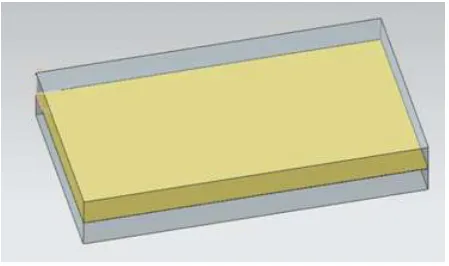
Figure 3 The equivalent model of sliding bearing
In order to study the influence of regular texture shapes on fluid lubrication of sliding bearings, the influence of some key characteristics of regular texture on fluid lubrication of sliding bearings are researched based Simulation for a specific type of sliding bearings. The equivalent model of sliding bearing is established with sliding plates as shown in Figure 3, the flatbed wide = 35mm, length = 315mm, the inlet gap c = 0.04mm. The UG software is used to establish three-dimensional model of an oil film between plate and gap. Hexahedral grid cells divide film, mesh, as shown in Figure 4.
Figure 4 Schematic diagram of flat film
3.2 The assumptions of the model and the Boundary conditions
(1)Within two flat gap fluid is considered incompressible three-dimensional steady flow[11].
(2)Lubricants inertial forces are negligible and there is no relative sliding between lubricant and plate.
(3)Critical Reynolds number ,after calculation it is less than 2300,Formula film by laminar
flow calculation:U—The linear velocity of plate, —The average of the film thickness,μ—The dynamic
According to the direction of the film flows into the oil,speed of A plate, 6.3m/s. 4 Results and analysis
Group 0 Group 1
Group 2 Group 3
Group 4 Group 5
Group 6 Group 7
Table 1: Various types of textured film pressure distribution
Group Shape depth density The maximum
pressure value
0 No No No 4.37e+08
1 Rectangular 0.01 0.1% 4.90e+08
2 Rectangular 0.02 0.3% 5.33e+08
3 Rectangular 0.03 0.5% 5.41e+08
4 Ball 0.01 0.3% 5.28e+08
5 Ball 0.02 0.5% 5.47e+08
6 Ball 0.03 0.1% 5.34e+08
7 Cylinder 0.01 0.5% 5.16e+08
8 Cylinder 0.02 0.1% 5.21e+08
9 Cylinder 0.03 0.3% 5.26e+08
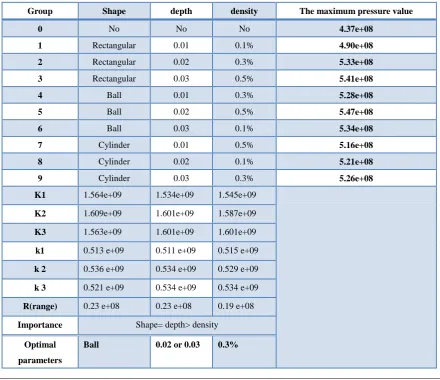
The range analysis method is the results of orthogonal experiment and visual analysis method, to analyze the problems of it by the average range of each factor, has the advantages of simple calculation and intuitive, easy to understand. What is the average effect in the range of maximum value and minimum value difference? You can find the main factors of impact indicators, and can help us to find the best combination of factor levels.
Table 2 The range analysis of orthogonal table
Group Shape depth density The maximum pressure value
0 No No No 4.37e+08
1 Rectangular 0.01 0.1% 4.90e+08
2 Rectangular 0.02 0.3% 5.33e+08
3 Rectangular 0.03 0.5% 5.41e+08
4 Ball 0.01 0.3% 5.28e+08
5 Ball 0.02 0.5% 5.47e+08
6 Ball 0.03 0.1% 5.34e+08
7 Cylinder 0.01 0.5% 5.16e+08
8 Cylinder 0.02 0.1% 5.21e+08
9 Cylinder 0.03 0.3% 5.26e+08
K1 1.564e+09 1.534e+09 1.545e+09
K2 1.609e+09 1.601e+09 1.587e+09
K3 1.563e+09 1.601e+09 1.601e+09
k1 0.513 e+09 0.511 e+09 0.515 e+09
k 2 0.536 e+09 0.534 e+09 0.529 e+09
k 3 0.521 e+09 0.534 e+09 0.534 e+09
R(range) 0.23 e+08 0.23 e+08 0.19 e+08
Importance Shape= depth> density
Optimal
parameters
density. In a conclusion, under the condition that the density of five percents and the depth of 0.02 or 0.03 millimeter and ball type texture, which are the best factors to meet the dynamic pressure bearing oil film pressure and making the micro texture works efficiently of sliding bearing.
V. CONCLUSIONS
In order to study the influence of regular texture shapes on fluid lubrication of sliding bearings, the influence of some key characteristics of regular texture on fluid lubrication of sliding bearings are researched based Simulation for a specific type of sliding bearings.
(1) Through the range analysis, it is found that the factors which affect the maximum dynamic pressure bearing oil film pressure and making the micro texture works efficiently of sliding bearing are Shape= depth> density.
(2) In conclusion, under the condition that the density of five percents and the depth of 0.02 or 0.03 millimeter and ball type texture, which are the best factors to meet the dynamic pressure bearing oil film pressure and making the micro texture works efficiently of sliding bearing.
ACKNOWLEDGEMENT
The authors would like to acknowledge the financial support of the Natural Science Foundation of China (NSFC) under Grant 51475050, Shanghai Science and Technology Committee under Grant 12510501100, and the Technological Innovation Project of Shanghai University of Engineering Science (SUES) under Grant cz1505008.
REFERENCES
[1]. Y.G. Schneider, Formation of surfaces with uniform micropatterns on precision machine and instrument parts,
Precision Engineering–Journal 6 (1984) 219–225.
[2]. Q.J. Wang, D. Zhu, Virtual texturing: modeling the performance of lubricated contacts of engineered surfaces, ASME Journal of Tribology 127 (2005) 722–728.
[3]. J.N. Anno, J.A. Walowit, C.M. Allen, Microasperity lubrication, Mechanical Engineering 90 (1968) 70–79. [4]. L. Mourier, D. Mazuyer, F.-P. Ninove, A.A. Lubrecht, Lubrication mechanisms with laser-surface-textured surfaces
in elastohydrodynamic regime: proceedings of the Institution of Mechanical Engineers, Part J–Journal of Engineering Tribology 224 (2010) 697–711.
[5]. Jeng, Y. R. ‘‘Impact of Plateaued Surfaces on Tribological Performance,’’ Tribol. Trans., 39(1996) 354–361.
[6]. I. Etsion, State of the art in laser surface texturing, ASME Journal of Tribology 127 (2005) 248–253.
[7]. W. Yi, X. Dang-Sheng, The effect of laser surface texturing on frictional performance of face seal, Journal of
Materials Processing Technology 197 (2008) 96–100.
[8]. S.B.Glavatskih,D.M.C.McCarthy,I.Sherrington,Hydrodynamicperformanceof a thrust bearing with micropatterned pads, Tribology Transactions 48 (2005) 492–498.
[9]. A. Ronen, I. Etsion, Y. Kligerman, Friction-reducing surface-texturing in reciprocating automotive components, Tribology Transactions 44 (2001) 359–366.
[10]. Y. Kligerman, I. Etsion, A. Shinkarenko, Improving tribological performance of piston rings by partial surface texturing, ASME Journal of Tribology 127 (2005) 632–638.
[11]. I. Krupka, M. Hartl, The effect of surface texturing on thin EHD lubrication films, Tribology International 40