Volume 4, Issue 3 (2015):127-135
International Journal of Pharmaceutical Research &
Allied Sciences
127
Method Development and Validation of RP-HPLC Method for the
Simultaneous Estimation of Olmesartan and Cilnidipine in Bulk and
Formulations
N. Sunitha1*, Subash C Marihal 2, J.Sai sravanthi 3, A.Venu 3, B.V.Narasimha Rao3 and B.Appa Rao3 1SIMS College of Pharmacy,Guntur - 522001,Andhra Pradesh, India
2HLT College of Pharmacy,Channapatna,Bengaluru, Karnataka, India 3Victoria College of Pharmacy, Guntur - 522005,Andhra Pradesh, India
Email:[email protected]
Subject: Analytical Chemistry
Abstract
A simple, accurate, precise RP-HPLC method was developed for the simultaneous estimation of the olmesartan and cilnidipine in tablet dosage form. Separation was performed on a ODS column (250 × 4.6mm ID, 5 µm) with buffer: acetonitrile (42:58A), flow rate of 1.0 ml/ min and UV detection at wavelength 240 nm. Retention time of olmesartan and cilnidipine were found to be 2.317min and 3.763 min respectively. The method was validated in terms of linearity, precision, accuracy, limit of detection, limit of quantitation and robustness as per the International Conference on Harmonisation (ICH) guidelines. Linearity of olmesartan and cilnidipine were in the range of 50-300 µg/mL and 25-150 µg/mL respectively. %RSD of the olmesartan and cilnidipine were and found to be 0.6 and 0.36 respectively. % assay was obtained as 100.14 and 100.01 for olmesartan and cilnidipine respectively. LOD, LOQ values are obtained from regression equations of olmesartan and cilnidipine were 0.43 mcg / ml, 1.31 mcg / ml and 1.17 mcg / ml, 3.53 mcg / ml respectively. Regression equation of olmesartan is y = 19780x + 2601 and of cilnidipine is y = 24481x + 8646 with regression co-efficient value was 0.999. Degradation products produced as a result of stress studies did not interfere with the detection of olmesartan and cilnidipine and the assay can thus be considered stability indicating. The developed method can be used for routine quality analysis of titled drugs in combination in tablet formulation.
Key words: Olmesartan, Cilnidipine, RP-HPLC, Assay and Validation.
Introduction
Cilnidipine 1,4-dihydro-2,6-dimethyl-4-(3-nitrophenyl)-3, 5-pyridine carboxylic acid 2- methoxyethyl(2E)-3-phenyl-propenyl ester is a novel and unique dihydropyridine calcium channel blocker that possesses a slow-onset, long-lasting vasodilating effect. It blocks the influx of calcium ions into both vascular smooth muscle at the level of L-type calcium channels and neuronal cells at the level of N-type calcium channels1-2. Olmesartan medoxomil, chemically 2,3-Dihydroxy-2-butenyl 4(1-hydroxy-1-methylethyl)-2-propyl-1-[p-(o-1H-tetrazol-5-ylphenyl)benzyl]imidazole5-carboxylate,
cyclic 2,3-carbonate is a prodrug used as antihypertensive, which belongs to the class of medications called angiotensin II receptor blockers{ARB}. It is indicated for the treatment of high blood pressure. It selectively inhibits the binding of angiotensin II to AT1, which is found in many tissues such as vascular smooth muscle and the adrenal glands. This effectively inhibits the AT1-mediated vasoconstriction and aldosterone-secreting effects of angiotensin II and results in a decrease in vascular resistance and blood pressure3.
128
Literature survey revealed that only few analytical methods are reported for both the drugs in alone. Very few analytical methods have been reported for simultaneous estimation of olmesartan and cilnidipine like, HPLC 4-7, UV 8-14 and LC-MS 15-16 methods.
Materials and Methods
Reagents and chemicals:
Analytically pure samples of olmesartan and cilnidipine were procured from Hetero HC Pvt.Ltd.,Hyderabad. The marketed combined pharmaceutical dosage form of olmesartan (10 mg) and cilnidipine (20 mg) i.e. CILNY O (INTAS) was purchased from local market. Distilled water, acetonitrile, phosphate buffer, methanol, potassium dihydrogen phosphate buffer, ortho-phosphoric acid from qualigens.
Instrument:
HPLC instrument used was of WATERS HPLC 2965 SYSTEM with auto injector and PDA detector. Software used is Empower 2. UV-VIS spectrophotometer PG Instruments T60 with special bandwidth of 2mm and 10mm and matched quartz was be used for measuring absorbance for olmesartan and cilnidipine solutions.
Methods:
Preparation of buffer: Buffer: (0.1% OPA)
1ml of ortho phosphoric acid was diluted to 1000ml with water
Preparation of mobile phase :
The mobile phase was prepared by mixing of buffer and acetonitrile (42:58 v/v) and the pH adjusted to 4.8 by using orthophosphoric acid. The mobile phase was sonicated for 15min and then it was filtered through 0.45µ Whatman filter paper. Standard preparation: (100µg/ml cilndipine & 200µg/ml olmesartan)
Accurately weighed and transferred 10mg & 20mg of cilnidipine and olmesartan working standards into a 10 ml clean dry volumetric flask, add 7ml of diluent, sonicated for 30 minutes and make up to the final volume with diluents. From the above stock solution, 1 ml was pipeted out in to a 10ml volumetric flask and then make up to the final volume with diluent.
Sample preparation:
Twenty tablets were weighed and calculate the average weight of each tablet, then the weight equivalent to one tablet was transferred into a 50ml volumetric flask, 30ml of diluent added and sonicated for 30 min, further the volume made up with diluent and filtered. From the filtered solution 1ml was pipeted out into a 10 ml volumetric flask and made upto 10ml with diluents
Linearity:
Linearity solutions are prepared such that 0.25ml, 0.5ml, 0.75ml, 1ml, 1.25ml, 1.5ml from the stock solutions of olmesartan and cilnidipine are taken in to six different volumetric flasks and diluted to 10ml with diluents to get 50ppm, 100ppm, 150ppm, 200ppm, 250ppm, 300ppm of olmesartan and 25ppm, 50ppm, 75ppm, 100ppm, 125ppm, 150ppm of cilnidipine.
Precision:
Standard preparation:
Accurately weighed and transferred 20mg and 10mg of olmesartan and cilnidipine working standards into 10ml clean dry volumetric flask, add 7ml of diluent, sonicated for 5 minutes and make up to the final volume with diluents. 1ml from the above two stock solutions was taken into a 10ml volumetric flask and made up to 10ml.
Sample preparation:
5 tablets were weighed and calculate the average weight of each tablet, then the weight equivalent to one tablet was transferred into a 50 mL volumetric flask, 35mL of diluent added and sonicated for 25 min, further the volume made up with diluent and filtered. From the filtered solution 0.5ml was pipeted out into a 10 ml volumetric flask and made up to 10ml with diluent.
Accuracy:
Standard preparation:
Accurately weighed and transferred 20mg and 10mg of olmesartan and cilnidipine working standards into 10ml clean dry volumetric flask, add 7ml of diluent, sonicated for 5 minutes and make up to the final volume with diluents. 1ml from the above two stock solutions was taken into a 10ml volumetric flask and made up to 10ml.
Sample preparation
The accuracy of analytical procedure expresses the closeness of agreement between the value which is accepted either as a conventional true value or as an accepted true value. Accuracy studies were performed at three different levels (50%, 100% and 150%) by standard addition method and the samples were analyzed in triplicate by the proposed method. Known amount of standards olmesartan and cilnidipine at 50%, 100% and 150% of predetermined sample was added to a pre quantified tablet sample.
Degradation studies: Oxidation:
129
and the chromatograms were recorded to assess the stability of sample.
Acid Degradation studies:
Pepette 1 ml of stock solution of cilinidipine and olmesartan into volumetric flask and 1 ml of 2N Hydrochloric acid was added. Then, the solutions kept for 30mins at 600C. The resultant solution was diluted to obtain 100µg/ml & 200µg/ml solution and 10 µ l solutions were injected into the system and the chromatograms were recorded to assess the stability of sample.
Alkali degradation studies:
Pepette 1 ml of stock solution of cilinidipine and olmesartan into volumetric flask and 1 ml of 2N sodium hydroxide was added and refluxed for 30mins at 600c. The resultant solution was diluted to obtain 100µg/ml & 200µg/ml solution and 10 µ l were injected into the system and the chromatograms were recorded to assess the stability of sample.
Dryheat degradation study
The standard drug solution w a s placed in oven at 105°C for 6 h to study dry heat degradation. For HPLC study, the resultant solution was diluted to 100µg/ml & 200µg/ml solution and 10µ l were injected into the system and the chromatograms were recorded to assess the stability of the sample.
Photostability S tudies:
The photochemical stability of the drug was also studied by exposing the 300µg/ml & 10µg/ml & 25µg/ml solution to UV Light by keeping the beaker in UV Chamber for 7days or 200 Watt hours/m2 in
photo stability chamber. For HPLC study, the resultant solution was diluted to obtain 100µg/ml & 200µg/ml solutions and 10 µ l were injected into the system and the chromatograms were recorded to assess the stability of sample.
Neutral degradation studies:
Stress testing under neutral conditions was studied by refluxing the drug in water for 6 hr at a temperature of 60ºc. For HPLC study, the resultant solution was diluted to 100µg/ml & 200µg/ml solution and 10 µl were injected into the system and the chromatograms were recorded to assess the stability of the sample.
Results and Discussions
Method development:
Optimized Method: Drugs were eluted with good retention time, resolution, all the system suitable parameters like plate count and tailing factor were within the limits.
Column used : ODS, 250 x 4.6 mm, 5µ. Buffer used : 0.1% OPA
Mobile
phase
: Buffer: Acetonitrile (42:58A)
Flow rate : 1ml/min
Diluents : Firstly dissolved in methanol then made up with water and acetonitrile in the ratio of (30:70). Wavelength : 240 nm
Temperature : 30o C Injection
volume
: 10µl
130
System suitability: All the system suitability parameters are within range and satisfactory as per ICH guidelines Table.1. System suitability studies of olmesartan and cilnidipine
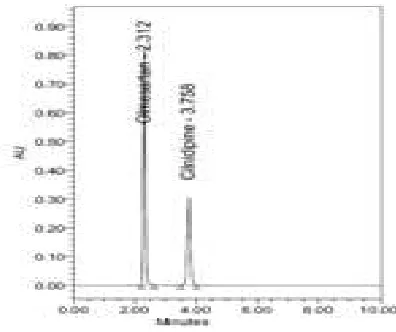
Property Olmesartan Cilnidipine Retention time (Rt) 2.317± 0.3 min 3.763±0.3min Theoretical plates (N) 7548 ± 163.48 7382± 163.48
Tailing factor (T) 1.18 ± 0.117 1.13± 0.117
Fig .4.Chromatogram of blank
Fig.5. Typical chromatogram of olmesartan and cilnidipine
Linearity: Six linear concentrations of olmesartan (50ppm to 300ppm) and cilnidipine (25ppm to 150ppm) are prepared and injected. Regression equation of the olmesartan and cilnidipine are found to be y = 19780x + 2601 and y = 24481x + 8646 and regression co-efficient was 0.999.
Table.2. Calibration data of olmesartan and cilnidipine
S.No
Concentration of
olmesartan(µg/ml) Peak area Concentration of
cilnidipine (µg/ml) Peak area
1 50 1051731 25 663958
2 100 1932330 50 1202192
3 150 2990737 75 1849116
4 200 3857394 100 2407109
5 250 4994175 125 3112600
6 300 5960555 150 3678237
Regression equation Y=19780+2601 Y=24481+8646 Correlation coefficient(r2) 0.999 0.999
131
Fig.6. Calibration curve of olmesartan Fig. 7. Calibration curve of cilnidipine
Precision:
Intraday precision (Repeatability): Intraday precision was performed and % RSD for olmesartan and cilnidipine were found to be 0.60% and 0.36% respectively.
Inter day precision: Inter day precision was performed with 24 hrs time lag and the %RSD Obtained for olmesartan and cilnidipine were 0.32 and 0.33.
Table.3. Intraday and Inter day precision results for olmesartan and cilnidipine
S.No.
Intraday precision Interday precision
Olmesartan Cilnidipine Olmesartan Cilnidipine
1 3844273 2319898 3838841 2387648
2 3800599 2323925 3848325 2380154
3 3827901 2326278 3842267 2385280
4 3816853 2310112 3849792 2384083
5 3855808 2315029 3870155 2400692
6 3799941 2333936 3870152 2384081
Mean* 3824229 2321530 3849876 2387571
S.D 22869.9 8455.6 12179.1 7819.7
%RSD 0.60 0.36 0.32 0.33
*Average of six determinations
Accuracy: Three concentrations 50%, 100%, 150%, were injected in a triplicate manner and amount recovered and % recovery were displayed in Table .4.
Table .4. Accuracy results of olmesartan and cilnidipine
Sample Amount added (µg/ml)
Amount
recovered (µg/ml) Recovery
(%) % RSD
Olmesartan
Olmesartan
100 100.18 100.18 0.43
200 199.54 99.77 0.46
300 301.11 100.37 0.46
Cilnidipine 50 50.01 100.03 0.52
100 99.53 99.53 0.63
132
LOD: Limit of detection was calculated by intercept method and LOD for olmesartan and cilnidipine were found to be 0.43 and 1.17 respectively.
LOQ: Limit of quantification was calculated by intercept method and LOQ for olmesartan and cilnidipine were found to be 1.31 and 3.53 respectively.
Robustness: Small deliberate changes in method like flow rate and wavelenght are made but there were no recognized change in the result and are within range as per ICH guide lines.
Table.5. Robustness data of olmesartan and cilnidipine
S.No Parameter Modification % RSD Tailing factor Olmesartan Cilnidipine Olmesartan Cilnidipine
1 Flow rate (ml/min)
0.8 1.14 0.95 1.25 1.26
1.2 1.42 1.06 1.242 1.255
2 Wavelength 238nm 0.97 0.79 1.22 1.259
225 nm 0.97 0.54 1.14 1.197
Assay: Standard preparations are made from the API and sample preparations are from formulation. Both sample and standards are injected six homogeneous samples. Drug in the formulation was estimated by taking the standard as the reference. The average % assay was calculated and found to be 100.14% and 100.01% for olmesartan and cilnidipine respectively.
Table. 6. Assay of tablet Dosage form Active
ingredients
Labeled amount
(mg/tab) Mean%±SD Assay %RSD
CILNY O TAB
Cilnidipine Olmesartan
10 mg 20 mg
10.014 ±0.36 20.002 ±0.60
100.14 100.01
0.36 0.60
Degradation studies:
Degradation studies were performed with the formulation and the degraded samples were injected. Assay of the injected samples was calculated and all the samples passed the limits of degradation.
Table.7. Degradation data of olmesartan and clinidipine S.NO Degradation
condition
% Drug degraded
Purity angle
Purity threshold
% Drug degraded
Purity angle
Purity threshold
1 Acid 7.81 0.313 0.411 7.42 0.190 0.406
2 Alkali 6.57 0.413 0.411 6.73 0.311 0.590
3 Oxidation 5.80 3.054 0.304 5.76 0.248 0.428
4 Thermal 4.82 0.494 0.691 4.92 0.282 0.392
5 UV 1.25 0.484 0.597 1.72 0.190 0.402
133
Fig. 8. Acid degradation chromatogram Fig. 9. Base degradation chromatogram
Fig. 10. Peroxide degradation chromatogram Fig.11. Thermal degradation chromatogram
134
Table.8. Validated parameters
Parameters Olmesartan Cilnidipine
Calibration range (mcg / ml) 50-300 25-150
Optimized wavelength 240 nm 240 nm
Retention time(min) 2.317 3.763
Regression equation (Y) y = 19780x + 2601 y = 24481x + 8646
Correlation coefficient(r2) 0.999 0.999
Precision (% RSD) 0.60 0.36
%assay 100.14 100.01
Limit of detection (mcg / ml) 0.43 1.17
Limit of quantitation (mcg / ml) 1.31 3.53
Conclusion
A simple, rapid, accurate and precise stability indicating HPLC analytical method has been developed and validated for the routine analysis of olmesartan and cilnidipine in API and tablet dosage forms. The results of the stress testing reveal that the method is selective and stability indicating. The proposed method has the ability to separate these drugs from their degradation products; excipients found in tablet dosage forms and can be applied to the analysis of samples obtained during accelerated stability studies.
“Cite this Article”
N. Sunitha, Subash C Marihal, J.Sai sravanthi, A.Venu , B.V.Narasimha Rao, B.Appa Rao “Method Development and Validation of RP-HPLC Method for the Simultaneous Estimation of Olmesartan and Cilnidipine in Bulk and Formulations”Int. J. of Pharm. Res. & All. Sci. 2015;4(3):127-135
Reference
1. Sean C.S. Martindale the Complete references; Pharmaceutical Press, 1 lambeth High Street, London SEI 7 IN, UK; 2002; 33:858-2. 2. Yoshimoto R, Dohmoto H, Yamada K, Goto
A. Prolonged inhibition of vascular contraction and calcium influx by the novel 1,4-dihydropyridine calcium antagonist cilnidipine (FRC-8653) J Pharmacol. 1991; 56:225–29. 3. O’Neil M J. The Merk Index- an encyclopedia
of chemicals and biological, New Jersy, Merk and Co., INC;13:1223-4,6909.
4. Xianhua Z, Suodi Z, Rongsheng, Jin O, Xiaoguang L, Willy G B. Determination of cilnidipine, a new calcium antagonist, in human plasma using HPLC with tandem mass spectrometric detection method. Analytical
Chemica Acta, September 2007; 600(1-2): 142-6.
5. Dongyang L, Pei Hu, Nobuko M, Xiaoming L, Li Li, Ji Jiang. Quantitative determination of olmesartan in human plasma and urine by liquid chromatography coupled to tandem mass spectrometry. J Chromatography B, September 2007; 856(1-2): 190-7.
6. Santosh R T, Rupali H S, Lalit R G, Vikas P, Santosh B B. Development of liquid extraction and spectrophotometric procedures and its applications for determination of olmesartan in human plasma using RP-HPLC. J Liquid Chromatography and Related Tech. 2010; 33(4):423-30.
7. Mohammed M S. Spectrophotometric method for the estimation of cilnidipine in bulk and pharmaceutical dosage forms. Oriental J Chemistry, 2013; 29(1): 131-4.
8. Vijayakumari M, Prasadbabu K, Lakshmi P, Soujanya P, Prathap M. A new method development and validation for quantitative estimation of olmesartan medoxomil in and pharmaceutical dosage form by UV-spectrophotometric method. Sch.Acad.J Pharm. 2014; 3(3):317-20.
9. Prabhakar K, Vipan K K, Sudhir R. Spectrophotometric estimation of olmesartan medoxomil in tablet dosage form with stability studies. Int J Chem Tech Res, 2010; 2(2): 1129-34.
10. Chaudhari P P, Bhalerao. Method validation for spectrophotometric estimation of cilnidipine in combined tablet dosage form. Int J Pharm Pharm Sci, 2012; 4(5): 96-8.
135
12. Pankaj P S, Bhalerao A V. Method validation for spectrophotometric estimation of cilnidipine. Int J Pharm Pharm sci.2012;4(5):96-8.
13. Narendra D, Satyanarayana T, Ganga B R. Simultaneous determination of olmesartan and hydrochlorothiazide in combined pharmaceutical dosage form. IJPBS, April-June 2012; 3(2): 107-15.
14. Chaudhari P P, Bhalerao. Method validation for spectrophotometric estimation of cilnidipine in combined tablet dosage form. Int J Pharm Pharm Sci. 2012;4(5):96-8.
15. Kyeong-ryoon L, Yoon-Jee C, Jong-Hwa L, Dae-Duk K, Saeho C, Chang-Koo S. Quantification of cilnidipine in human plasma by LC-MS. J Liquid Chromatography and Related Tech, 2012; 35: 308-20.