Integration of Improved BPNN Algorithm and
Multistage Dynamic Fuzzy Judgement and Its
Application on ESMP Evaluation
Zhibin Liu, Xiangsong Meng
Economics and Management Department, North China Electric Power University, Baoding City, China Email: [email protected]
Abstract—Under the information and knowledge economy era, strengthening the enterprise strategic management can realize its sustained development in the intense market competition environment, increase its ability of adapting environment, and enhance the competitive strength and the competitive advantage. To evaluate the enterprise strategic management performance (ESMP) scientifically and accurately, this paper overcomes the shortcoming of tradition linear ESMP evaluation method, proposes a evaluation method which unifies the improved BP neural network (BPNN) algorithm and the multistage dynamic fuzzy judgment (MDFJ), takes the multistage dynamic fuzzy judgment as the sampling foundation, uses the BP neural network principle to establish evaluation model. This method not only can exert the unique advantages of BP neural network, but also overcome the difficulty of seeking the high grade training sample data. The ESMP evaluation of 14 enterprises indicates that the method to evaluate the ESMP is stable and reliable.
Index Terms—improved BP neural network, multistage dynamic fuzzy judgement, enterprise strategic management performance, comprehensive evaluating, indices system
I. INTRODUCTION
In 1972, Ansoff published the paper named “the strategy management concept” in the magazine of “Enterprise Operational Policy”, officially proposed the concept of “strategic management”. In 1979, he specially wrote the monograph of “Strategic Management theory”. Ansoff believed that the enterprise strategy management, is refers to a series of management business which unifies the daily business decision-making with the long-term plan decision-making. The development of enterprise strategy management theory may divide into four stages: The first stage is the early strategic concept stage; the second stage is the traditional strategy theory stage; the third stage is the competitive strategy theory stage; the fourth stage is the dynamic strategic theory stage. In today's information and knowledge economy era, the competition among enterprises has been extended in space and strengthened in time. In order to obtain long-term survival and sustainable development, the enterprises must pay more attention to their development strategy management. Therefore, enterprises need to construct a whole set of comprehensive and objective
overall performance evaluation system. We may test and amend the enterprises' development strategy after considering the evaluation results, and evaluate the implementation effect about the enterprises' development strategy, then provide the basis for the adjustment of the development strategies and business strategies.
The enterprise strategic management performance (ESMP) evaluation is a systematic evaluation process, and a scientific and quantitative argumentation. There are many methods about the performance evaluation have been widely applied, such as: the analytic hierarchy process, the gray systematic evaluation, fuzzy comprehensive evaluation method, etc. However, these methods are subject to stochastic factors in the evaluation, and the evaluation results are influenced by subjective experience and knowledge limitations easily, which often with personal bias and one-sidedness. In recent years, the multi-goals and multi-level fuzzy synthesis evaluation method based on the fuzzy collection theory has already obtained the certain effect, but this method lacks the self-learning ability, and could not get rid of the randomness in the decision-making process and the evaluation experts' subjective uncertainty. How to establish an evaluating method that not only can reflect the different situation's non-linear rule, but avoid the subjective judgement uncertainty, is the urgent question for ESMP [1][2]. This paper designs a set of index system that is fit for the ESMP evaluation, and constructs an evaluation method base on the combination of improved BP neural network (BPNN) and multistage dynamic fuzzy judgment (MDFJ), carries on the scientific evaluation to the enterprise strategic management performance.
network, called BP network or BP algorithm. This algorithm is used to solve the problems that perceptron cannot settle, and it is the most widely used algorithm presently.
BP neural network is consisting of neurons and the connection between neurons, it can be divided into input layer, hidden layer and output layer, and it belongs to the learning algorithm with mentor. BP neural network is composed of positive propagation and the back propagation. In the positive propagation phase, the state of every layer neurons will only affect the neurons state in the next layer; if the expected output cannot be gotten in the output layer, the network enters into the error's back propagation phase. According to the error signal of back propagation, the network changes the network-connecting of all layers, to find out the best weight set and realize the correct network output. The output of the input layer neuron is equivalent to the input values.
For the p(p=1,2,…,P) sample, if the output of k(k=1,2,…,K) node (the node is on the output layer of BP neural network) is Okp, the connection weight values between hidden layer and output layer, input layer and hidden layer are wkjand vji, and the hidden layer and output layer neurons use the bipolar compression function as the output function, then the error function E on output layer can be defined as a square function, namely
2 P K
k k p
p 1 k 1 1
E= d O
2
¦¦
(1) In the formula, dk denotes corresponding desired output value.
BP algorithm is the guided learning, and the essential of learning is to revise the weight value constantly so as to the error function to zero, therefore, in accordance with the principle of error gradient decline, and the adjustment of wkjand vji can be expressed as:
kj
kj
E w
w
K w
'
w
(2)
ji
ji
E
v '
v
K
w'
w
(3)
Ș and Ș' denote learning rate.
The amending process of weight value is an iterative process, namely:
Pkj kj kp jp
P 1 P
ji ji jp jp
P 1
w n 1 w n O
v (n 1) v (n) ' O K G
K G
° ° ®
°
°¯
¦
¦
(4) In the formula:
kp k kp kp kp K
jp k p kj jp jp K 1
d O O 1 O w O 1 O
G
G G
°
® § ·
° ¨ ¸
© ¹
¯
¦
(5)BP algorithm steps are as follows:
(1)Initialize weight value, give the random number between 0-1 to all the weight value; (2) Input the samples, specify the output layer neuron's expectations; (3) Calculate the actual output of every layer neurons in
sequence; (4) Amend the weight value, starting from the output layer until hidden layer gradually; (5) Return to step 2, the network study concluded in less than a given error [3]-[6].
III. INTEGRATION OF IMPROVED BP NEURAL NETWORK AND MULTISTAGE DYNAMIC FUZZY JUDGEMENT
The evaluation method that unifies the BP neural network and the expert fuzzy judgement divides into 3 stages. First, we use the expert fuzzy judgement to evaluate, and obtain the massive samples; then establish the BP neural network model through the training samples; finally, use the BP neural network system to carry on the evaluation.
A. The Improved BPNN Algorithm
a) The parameters determination of improved BP neural network
The BP neural network algorithm proposed by D. E. Rumelhart and J. L. McClelland makes the neural network to have the more practical and effective training methods. However, the BP neural network application in the complex system is restricted because the initial BP algorithm has the defects of the low efficiency and the slow convergence speed owing to the highly non-linear system. At present, most advanced researches have focused on the algorithm improvements, and this paper imports the adjustable activation function and the Levenberg-Marquardt optimization algorithm to enhance the learning accuracy and the algorithm convergence speed.
The input vector in the input layer is: XęRn, X=(x0,x1,x2…,xn-1)T; the input vector in the first hidden layer is: X'ęRn1, X'=(x'0,x'1,x'2…,x'n-1)T, output vector is: Y'ęRm1, Y'=(y'0,y'1,y'2…,y'm1-1)T; the input vector in the second hidden layer is: X''ęRn2, X''=(x''0,x''1,x''2…,x'' n2-1)T, output vector is: Y''ęRm2, Y''=(y''0,y''1,y''2…,y''m2-1)T; the input vector in the output layer is: X'''ęRn3, X'''=(x'''0,x'''1,x'''2…,x'''n3-1)T, output vector is: YęRm, Y=(y0,y1,y2…,ym-1)T. The weight value between the input layer and the first hidden layer is denoted with Ȧij, the threshold value is șj, the weight value between the first hidden layer and the second hidden layer is denoted with
Ȧ'jk, the threshold value is ș'k, the weight value between the second hidden layer and the final output layer is denoted with Ȧ''kl, the threshold value is ș''l, then the input and output in every layer neurons are met:
n 1
j ij i j
i 0
x '
¦
Z
x
T
(6)1
m 1
k jk j k
j 0
x ''
Z
' y '
T
'
¦
(7)2
m 1
l kl k l
k 0
x'''
Z
'' y ''
T
''
¦
(8)k k k
y ''
f (x '' )
(9)l l l
j j j
y ' f (x ' ) (11)
The activation function f (u) is a nonlinear function. We normally choose sigrnoid function,
u 1 f (u)
1 e .
b) The learning process of the improved BP neural network
The study process of the BP neural network can be divided into two stages: the first stage is toward pass, namely input sample data from the input layer, transmit signal forward, and calculate the corresponding output neuron of every layer according to the above formula that is not feedback and connected among the layers. The second stage, namely the back pass, If the error between the actual output of the output layer and the goal output doesn't fall into the scheduled precision range, the error signal returns along the original pathway to amend the weight value and threshold value. By the two iterative processes, we make the network to achieve convergence at last. At this time, the error reaches the scheduled range. In the multilayer BP neural network, given a set of sample data (x,t), XęRn, tęRm, when input Pith sample, namely (xp1, tp1), we can calculate the network output yp1
ęRm, relative to the xp1 using the improved BP algorithm, then the error function is defined as:
l l
2 m 1
p p
l 0
1
(t
y )
2
H
¦
(12) To all samples, the total network error:l l
l
2 p m 1
p p
p =1 l 0
1
E
(t
y )
2
¦¦
(13) We enter into the second stage of the learning process, namely adjustment reversely the weight value and the threshold value, and revise every weight valueZ
nq:l
p nq
p 1
nq nq
E
( )
H
Z
K
K
Z
Z
w w
'
w
¦
w (14)K
is the learning rate.The learning process of the neural network is the process to seek the smallest of error E, but the traditional BP algorithm to complex networks, it very likely falls into local minimum value. This paper introduces the Levenberg-Marquardt optimization algorithm which can enhance the network convergence speed and reach the error range rapidly [7]-[10].
B. The Basic Principle of Multistage Dynamic Fuzzy Judgement
The practical thing has many kinds of attributes frequently or is influenced by many kinds of factors, the people need to carry on the comprehensive evaluation to these many kinds of attribute factors, and this is the comprehensive judgment. In the most situations, these attributes or the factors have the fuzziness, make the comprehensive evaluation to this kind of fuzziness factors, and this is the fuzzy comprehensive judgment. The basic principle and the step of the multi-factor fuzzy comprehensive judgment method are as follows:
(1) Carry on the classification to the factor sets, X={x1, x2… xn}, according to certain attributes, and form s subset.
^
i i in`
i x x x
X 1, 2,, i 1,2,,s. (15) In the formula:
¦
si
i n
n
1
;
;
1
i
i X
X
. ,i j O X
Xi j z z
(2) Make the comprehensive decision separately to each sub-factor Xi.
Suppose Yi={yi1, yi2, …, yin}, is the evaluation sets of subset Xi, the evaluation sets denote all levels of remark from high to low, weigh the certain sub-factor performance in the multi-layer structure model. For example, when m=5, Yi={yi1, yi2, …, yin} may express that superior, good, medium, ordinary, bad, and give certain scores separately.
The weighted distribution of the various factors in Xi is Ai={ai1, ai2, …, ain}. (16)
In the formula:
1
1¦
nii it
a
If Ri is the single factor matrix, then we can gain the first-level judgment vector: Bi=Ai·Ri= {bi1, bi2… bim}, i=1, 2… s.
(3) Regard each Xi as a factor, record X={x1, x2… xs}, and X is also a factor set, the single factor decision-making matrix of X is:
» » » »
¼ º
« « « «
¬ ª
» » » »
¼ º
« « « «
¬ ª
sm s
s
m m
s b b b b b
b
b b
b
B B B R
2 1
2 22
21
1 12
11 2 1
(17)
Each X1 is as a part of X, had reflected some kind of attribute of X, may give weighted distribution according to theirs importance A={a1, a2, …, as}, therefore we obtain the second-level judgment vector, namely comprehensive judgment result B, B=A·R= {b1, b2, …, bm}.
If the first-level factor set Xi (i=1,2,…, s) still contained many factors, we can carry on the subdivision to the Xi again, therefore has the third-level, four-level models, and so on.
C. Integration of Improved BP Neural Network and Multistage Dynamic Fuzzy Judgement
knowledge and the rich experience; then we unify the two methods, realize predominance complementarity each other, and make the overall system to achieve the higher intelligent level.
The evaluation method that unifies the BP neural network with the multistage dynamic fuzzy judgement may be divided into 3 stages. Firstly, use the expert fuzzy evaluation method to carry on the evaluation, and obtain the massive samples; then carry on the study using the BP nerve network method, and construct the BP nerve network through training sample; finally, carry on the evaluation using the BP neural network system.
The key of the evaluation method lies in: First, the experts carry on fuzzy synthesis judgment, and select the sample, and the following must pay attention to: (1)The evaluation system is applied for a long time and confirmatory, therefore cannot add and modify at will; (2)Judges each evaluation system weight to use the analytic hierarchy process and the gray relevancy method; (3)Chooses the expert, executes the eschewal system strictly; (4)The various samples data result must strictly be preserve after the fuzzy synthesis judgment. Next, the sample selection must be met: (1)All kinds of sample (superior, good, general, bad) distributes evenly; (2)The quantity is enough; (3)The sample has the representation; (4)The sample data must carry on the standardized pretreatment. Once more, the system provides multilayer BP neural network model of the momentum training method and the self-adapted study speed training method, enables the user to be allowed to select the training method and the neural network model level structure according to the special details, and establishes the evaluation model according to the sample [11]-[17].
IV. THEEVALUATING MODEL BASED ONIMPROVED BPNNALGORITHM ANDMULTISTAGE DYNAMIC FUZZY
JUDGEMENT
A. The Indices System Construction
When evaluating the enterprise strategic performance, we should keep to the ideas and methods of system engineering, follow the principle of comprehensive, value correlation, scientific pragmatism, unity and cost-benefit, and construct the multi-objective comprehensive strategic performance evaluation system. The following factors are taken into account when we evaluate the enterprise strategy performance.
a) The strategic performance evaluation index systems about the employee lay
The enterprise strategy management is to emphasize the future development. The investments for the future enable enterprises to maintain their core competitiveness and form strategic competitive advantage. In the formation process of these advantages people is the key, because all the work need people to operation, so it is important of the staff study and training, quality improvement and mobilizing their work enthusiasm, which has a direct impact on the enterprise development potential. For this reason, it is proposed to establish the following indicators: (1) The percentage of graduates
(U1); (2) The staff keeping rate (U2); (3) The staff training costs ratio (U3).
b) The strategic performance evaluation index systems about the organizational system and process lay
Organizational system and process performance evaluation are mainly on the production efficiency of machinery equipment (or product) and the information system capability. The production efficiency of the product is mainly related to the production cycle, product quality and cost. Machinery and equipment production efficiency is to reflect machinery and equipment utilization. The information system capability is the capability to gain the financial and non-financial information about the internal management and decision-making in time. Therefore, the information system capability is the essential element of the enterprise performance evaluation. (1) Organization and management efficiency (U4); (2) Information system capability (U5); (3) The production capacity utilization ratio (U6); (4) Product certified ratio (U7).
c) The strategic performance evaluation index systems about the innovation and technology lay
The enterprise innovation and technology lay is related with the investment scale and utilization efficiency of research and development expenses, the innovate ability of new products and new technology etc. According to the above analysis, the evaluation indicator systems of the innovation and technology lay are as follows: (1) The research and development expenses ratio; (2) The new product development ability (U9); (3) The investment return rate of new products (U10); (4) Technology yield ratio (U11).
d) The strategic performance evaluation index systems about the customer lay
Carrying through the customer relation management, we may improve customer satisfaction continuously, expanding market share and achieve as much as possible value so as to achieve strategic objectives of the enterprise. So the strategic performance evaluation indicator systems about the customer lay are as follows: (1) Market Share (U12); (2) The relative market share (U13); (3) The client retention rate (U14); (4) The customer profitability (U15).
e) The strategic performance evaluation index systems about the strategic alliance lay
The strategic alliance aimed at improving the relations with other business enterprises (such as suppliers), realizing the relation change between enterprises from competition to partnership, which aim to achieve a win-win situation. The strategic performance evaluation indicator systems about the strategic alliance lay are as follows: (1) The delivery rate on time (U16); (2) Strategic synergy (U17); (3) Orders satisfaction rate (U18).
f) The strategic performance evaluation index systems about the social responsibility lay
ecological environment indicators (U19); (2) Social contribution rate indicator (U20).
B. BP Neural Network Principle of Enterprise Strategic Performance Evaluation
We take the 20 indicator numerical values of describing the enterprise strategic performance as the input vector, and take the corresponding comprehensive testing results as the network expectation output. We take enough samples to train the network, make the relative error to meet the scheduled accuracy after ceaseless learning process. At this time the weight value and the threshold value hold by the neural network is the correct internal denotation acquired by the self-adaptive learning. Once the network has been trained, it could serve as an effective tool to evaluate the enterprise strategic performance.
C. The Improved BP Neural Network Model Construction
(1) S.K.Doherty and other scholars' studies have shown that three-layer feedforward neural network, namely the neural network only contains one hidden layer can approximate any nonlinear function relation with any accuracy. So we set up a three-tier feedforward neural network, the input layer neuron number is the above 20 indicators, the determination of the hidden layer neuron number has not to reach a unified theory yet. According to the experience, the node number of the hidden lay should meet 2n>m (m denotes the input layer node number). Therefore, we select 7 network neurons for the hidden layer, and the neuron in the output layer is only one, namely the power enterprise financial risk comprehensive value.
(2) Network parameters initialized: we endow with the link weight value Ȧij and the threshold value șj between the input layer and the hidden layer, the link weight value
Ȧ'jk and the threshold value ș'k between the hidden layer and the output layer.
(3) Select a tier model randomly as the input signal. (4) Calculate the input x'j and the output y'j of the hidden layer neurons.
(5) Calculate the input x''k and the output yk of the output layer neurons.
(6) Calculate the general error uk of the output layer neurons, judge uk whether to meet demands, if met to step (9) and not met to step (7).
(7) Calculate the general ion errors of the hidden layer neurons:
m 1
j k jk j j
k 0
v
[
(u
Z
' )]f ' (x ' )
¦
(18) (8) The amending weight value and the threshold value:jk jk jk
' (N 1) ' (N) ' (N)
Z Z 'Z (19)
ij(N 1) ij(N) ij(N)
Z Z 'Z (20)
k k k
' (N 1) ' (N) ' (N)
T T 'T (21)
j(N 1) j(N) j(N)
T T 'T (22) (9) We take the next tier model as the input signal so as to all the training models train a circumference, until the total error reaches the scheduled accuracy. The learn
process is terminated; otherwise we update the study frequency, and then return to training again [18]-[23].
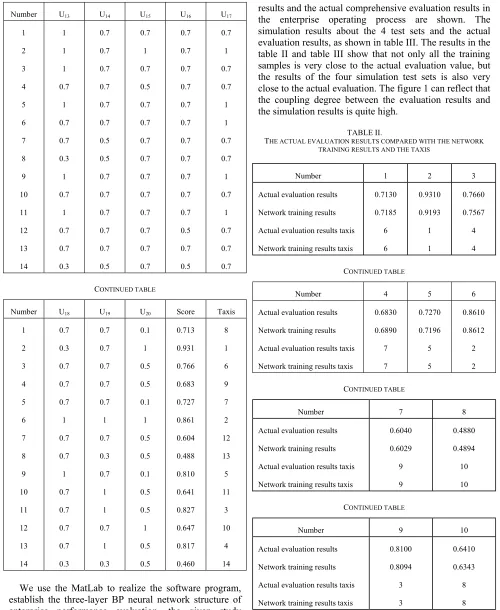
In this paper, we take the performance evaluation based on the improved BP neural network of 14 enterprises in Hebei Province as an example, which are shown in table ȱ.
TABLE I. THE EVALUATING DATA
Number U1 U2 U3 U4 U5 U6
1 2 3 4 5 6 7 8 9 10 11 12 13 14 0.5 1 0.7 0.7 0.7 0.7 0.5 0.5 1 0.7 0.7 0.7 0.7 0.7 0.5 0.7 0.7 0.7 0.7 1 0.7 0.5 0.7 0.7 0.7 0.5 1 0.7 0.5 1 0.5 1 1 1 0.5 0.5 1 0.5 1 0.5 1 0.3 0.7 1 1 0.7 0.7 0.7 0.7 0.5 1 0.7 1 0.7 1 0.5 0.7 1 0.7 0.7 0.7 0.7 0.7 0.7 1 0.7 0.7 0.7 0.7 0.3 0.5 1 1 0.5 0.5 1 0.5 0.3 1 0.5 0.5 0.5 1 0.5
CONTINUED TABLE
Number U7 U8 U9 U10 U11 U12
1 2 3 4 5 6 7 8 9 10 11 12 13 14 1 1 1 0.7 1 0.7 0.5 0.3 1 0.7 1 0.7 1 0.3 0.7 0.7 0.7 0.5 0.7 0.7 0.7 0.5 0.7 0.5 0.7 0.7 0.7 0.5 1 1 1 0.7 1 1 0.5 0.5 1 0.7 1 0.5 1 0.5 0.7 1 1 0.7 0.7 1 0.7 0.7 1 0.7 1 0.7 1 0.5 0.7 0.7 0.7 0.7 0.7 0.7 0.7 0.7 0.7 0.5 0.7 0.7 0.7 0.7 1 1 1 0.5 1 1 0.5 0.5 1 0.5 1 0.5 1 0.5
Number U13 U14 U15 U16 U17 1 2 3 4 5 6 7 8 9 10 11 12 13 14 1 1 1 0.7 1 0.7 0.7 0.3 1 0.7 1 0.7 0.7 0.3 0.7 0.7 0.7 0.7 0.7 0.7 0.5 0.5 0.7 0.7 0.7 0.7 0.7 0.5 0.7 1 0.7 0.5 0.7 0.7 0.7 0.7 0.7 0.7 0.7 0.7 0.7 0.7 0.7 0.7 0.7 0.7 0.7 0.7 0.7 0.7 0.7 0.7 0.7 0.5 0.7 0.5 0.7 1 0.7 0.7 1 1 0.7 0.7 1 0.7 1 0.7 0.7 0.7
CONTINUED TABLE
Number U18 U19 U20 Score Taxis
1 2 3 4 5 6 7 8 9 10 11 12 13 14 0.7 0.3 0.7 0.7 0.7 1 0.7 0.7 1 0.7 0.7 0.7 0.7 0.3 0.7 0.7 0.7 0.7 0.7 1 0.7 0.3 0.7 1 1 0.7 1 0.3 0.1 1 0.5 0.5 0.1 1 0.5 0.5 0.1 0.5 0.5 1 0.5 0.5 0.713 0.931 0.766 0.683 0.727 0.861 0.604 0.488 0.810 0.641 0.827 0.647 0.817 0.460 8 1 6 9 7 2 12 13 5 11 3 10 4 14
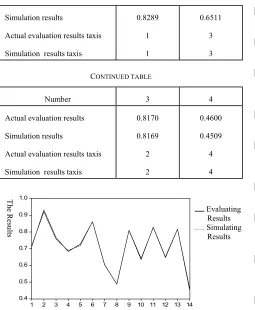
We use the MatLab to realize the software program, establish the three-layer BP neural network structure of enterprise performance evaluation, the given study accuracyȊ =0.0001, and we select 7 network neurons for the hidden layer. We take 1-10 group enterprise performance evaluation data and evaluation results in table ȱ as the training set, train the network, and carry through the simulation evaluation using the performance evaluation indicators data of the four residual groups and the trained network. In table ȱȱ, the network training
results and the actual comprehensive evaluation results in the enterprise operating process are shown. The simulation results about the 4 test sets and the actual evaluation results, as shown in table ȱȱȱ. The results in the table ȱȱ and table ȱȱȱ show that not only all the training samples is very close to the actual evaluation value, but the results of the four simulation test sets is also very close to the actual evaluation. The figure 1 can reflect that the coupling degree between the evaluation results and the simulation results is quite high.
TABLE II.
THE ACTUAL EVALUATION RESULTS COMPARED WITH THE NETWORK TRAINING RESULTS AND THE TAXIS
CONTINUED TABLE
Number 4 5 6
Actual evaluation results
Network training results
Actual evaluation results taxis
Network training results taxis
0.6830 0.6890 7 7 0.7270 0.7196 5 5 0.8610 0.8612 2 2
CONTINUED TABLE
Number 7 8
Actual evaluation results
Network training results
Actual evaluation results taxis
Network training results taxis
0.6040 0.6029 9 9 0.4880 0.4894 10 10
CONTINUED TABLE
Number 9 10
Actual evaluation results
Network training results
Actual evaluation results taxis
Network training results taxis
0.8100 0.8094 3 3 0.6410 0.6343 8 8 TABLE III.
THE ACTUAL EVALUATION RESULTS COMPARED WITH THE SIMULATION RESULTS AND THE TAXIS
Number 1 2
Actual evaluation results 0.8270 0.6470
Number 1 2 3
Actual evaluation results
Network training results
Actual evaluation results taxis
Network training results taxis
Simulation results
Actual evaluation results taxis
Simulation results taxis
0.8289
1
1
0.6511
3
3
CONTINUED TABLE
Number 3 4
Actual evaluation results
Simulation results
Actual evaluation results taxis
Simulation results taxis
0.8170
0.8169
2
2
0.4600
0.4509
4
4
0.4 0.5 0.6 0.7 0.8 0.9 1.0
1 2 3 4 5 6 7 8 9 10 11 12 13 14
Figure 1. The actual evaluation results compared with the simulation results
V. CONCLUSION
The enterprise strategic performance evaluation is associated with many factors, it needs large numbers of statistical calculation, and the factitious factors can be mixed into easily, which make the performance evaluation work is difficult. In this paper, we build the improved BP neural network model based on the analysis of the performance evaluation factors. It can not only overcome the limitations of the traditional evaluation methods and avoid the human errors in the evaluation process, but also enhance the learning accuracy and the algorithm convergence speed greatly. To the comprehensive evaluation problems of presenting the non-linear relation among the factors, it gives a more ideal outcome.
ACKNOWLEDGMENT
This research was supported by the Scientific Research Foundation for Young Teachers of North China Electric Power University, and the item No. is 200611037.
This research was supported by the Philosophy and Social Science Research Topics of Baoding City. The item is “Research on Current Situation and Countermeasures of Agricultural Information Degree Based on New Rural Construction in Baoding City”, and the item No. is 20080223.
REFERENCES
[1] Robert L Fry, “Observer-participant model of neural processing,”IEEE Trans on Neural Networks, pp. 918-928, 1997.
[2] SheLian, “A conception of research to mechanism of enterprise crisis early-warning,” Collection of ICMSE'96, pp.140-143, 1996.
[3] Tim Hill, Leorey Marquez, and Marcus O'Ionnor, “Artificial neural networks forecasting and deciding model,” International Journal of Forecasting, pp. 5-15, October, 1994.
[4] Mary M, and Linda S, “A neural network model for estimating option,” Journal of Applied Intelligence, pp. 193-206, March, 1993.
[5] C. Wang, “Study on enterprise organization Management system,” The 4th Annual Meeting of China Soft-Science Association, Literature of science and technology press, pp.298-302, 1998.
[6] Y.H. Hsu, and H.M. Huang, “Distribution system service restoration using a heuristic search approach,” IEEE Trans on PWRD, pp. 734-740, July, 1992.
[7] Miu N K, Chiang H D, and Yuan B, “Fast service restoration for large-scale distribution system with priority customers and constraints,” IEEE Trans on PWRS, no. 13, pp. 789-795, 1998.
[8] Tank D W, and Hopfield J J, “Simple neural optimization networks, an A/D converter, signal decision circuit, and linear programming circuit,” IEEE Trans on CAS, no. 13, pp. 533-541, 1986.
[9] M. P. Kenedy, “Unifying the tank and hopfild linear programming circuit of Chua and Lin,” IEEE Trans on CAS, no. 34, pp. 210-214, 1987.
[10] T. Nakagawa, Y. Hayashi, and S. Iwamoto, “Neural network application to state estimation computation,” IEEE Tran on CAS, no. 9, pp. 188-192, 1991.
[11] L.H. Xu, Y.L. Yu, Q.D. Wu, and J.H. Shi, “General fuzzy neural network: theory and applications,” Proceedings of 1999 IEEE International Fuzzy Systems, pp.518-523, 1999. [12] Shiying Kang, “Decision support system of performance measurement for provide chain on combining multistage dynamic fuzzy comprehensive performance evaluation with BP neural network method,” Journal of Chongqing Technology Business University, vol. 22, no. 4, pp. 373-377, 2005.
[13] Ridella S., and Rovetta S., “Circular back propagation networks for classification,” IEEE Trans on Neural Networks, vol. 18, no. 1, pp. 84-97, 1997.
[14] Karhunen J., Oja E., and L.Wang, “A Class of neural networks for independent component analysis,” IEEE Trans on Neural Networks, vol. 18, no. 3, pp. 486-504, 1997.
[15] Z. Yuan, “Research on improved BP neural network,” Information Technology, no. 2, pp. 88-91, 2006.
[16] Y.Y. Hsu, “A heuristic based fuzzy reasoning approach for distribute system service restoration,” IEEE Trans on PWRD, vol. 9, no. 2, pp. 948-953, 1994.
[17] X.Y. Li, “The model and application on the enterprise payoff ability evaluation based on improved BP neural network,”Industrial Technology Economy, vol. 25, no. 6, pp. 92-96, 2006.
[18] Xun, Y., “The research on the enterprise strategic performance evaluation system,” Changsha Science and Industry University Journal, no. 4, pp.25-27, 2005. [19] Zhao, Q.C., “The application research and improvement of
the enterprise comprehensive performance evaluation based on BP neural network,” Industrial Engineering Journal, vol. 8, no. 3, pp.102–107, 2005.
The Results
Evaluating Results ..…. Simulating
[20] He, J.G., “The credit evaluation system research based on improved BP neural network,” Computer Engineering and Design, vol. 27, no. 4, pp.605–621, 2006.
[21] Ren, F., “Comprehensive evaluation on sustainable development for electric power industry based on improved BP neural network model,” Journal of North China Electric Power University, vol. 33, no. 1, pp.80–83, 2006.
[22] Lee,S. J., Lim,S.I., Ahn,B.S., “Service restoration of primary distribution systems based on fuzzy evaluation of multi-criteria,” IEEE Trans on PWRS, vol. 13, no. 3, pp. 1156-1160, 1998.
[23] Xiaodong Wang, “The development of the enterprise strategy management theory,” Journal of Shanxi Economic Management Institute, vol. 14, no. 3, pp. 21-22, 2006.
Zhibin Liu, was born in Luannan County, China, and graduated from the Agricultural University of Hebei in 2004, gained the master's degree of management. The author’s major field of study is the information management.
Since 2004, he is always working at the North China Electric Power University, Baoding City, China. And he has published more than 20 papers and 3 books. Such as the Research on the Advancing Front Topic of Asset Valuation (Beijing: Chinese Finance and Economical Publishing Company). His current research interests include the information management, international finance and machine learning.
Xiangsong Meng, was born in Hejian City, China, and graduated from the Hebei University of Hebei in 2004, gained the master's degree of management. The author’s major field of study is the statistics and operational research.