INTERNATIONAL JOURNAL OF ENGINEERING SCIENCES
& MANAGEMENT
REDUCED IN SIDE LOBE LEVEL (SLL) USING GENETIC
ALGORITHM OF SMART ANTENNA SYSTEM
Harish Sukumar
1, Sanjeev Kumar
2Department of Electronics and Communication Engineering (Digital Communication)
TIT COLLEGE BHOPAL (M.P.), India
ABSTRACT
The demand for wireless communications constantly grows the need arises for better coverage, improved capacity, and higher transmission quality. Thus, a more efficient use of the radio spectrum is required. Smart antenna systems are capable of efficiently utilizing the radio spectrum and promise an effective solution to the present wireless system problems while achieving reliable and robust high speed high-data-rate transmission. Smart antennas dynamically adapt to changing traffic requirements whose adaptive beam forming approach can be studied with the help of different adaptive algorithms. The fundamental idea behind smart antennas is to improve the performance of the wireless communication system by increasing the gain in a chosen direction. This can be achieved by pointing the main lobes of the antenna-beam patterns towards the desired users. Smart antenna system combines multiple antenna elements with a signal processing capability to automatically optimize its radiation and/or reception pattern in response to the signal environment.
In this paper proposed a very simple and powerful method for the synthesis of linear array antenna. This method reduced the desired level of side lobe level (SLL) as well as to steer the main beam at different-different angle. A new method for adaptive beam forming for a linear antenna arrays using genetic algorithm (GA) are also proposed. Genetic Algorithm is an iterative stochastic optimizer that works on the concept of survival of the population values based on the fitness value. An adaptive genetic algorithm has been used in linear array to optimize the excitation levels of the elements resulting in a radiation pattern with minimum side lobe level. These algorithm can determinate the various values of side lobe level and phase excitation for each antenna to steer the main beam in specific direction.
Keyword: Smart Antenna, Genetic Algorithm (GA), Side Lobe Level (SLL), Linear Array Antenna.
INTRODUCTION
Smart antennas have recently been proposed as a solution to enhance the capacity of wireless communication systems for 3G network [1]. They are also considerably important because of their potential for decreasing interference, improving quality of service [2], enhancing power control and extending battery life in portable units. In an adaptive antenna system, beam forming algorithms the weight of antenna arrays can be adjusted to form certain amount of adaptive beam to track corresponding users automatically and at the same time to minimize interference arising from other users by introducing nulls in their directions [3]. Antennas are a very important component of communication systems. By definition, it is a device that converts guided electromagnetic waves into unguided ones and vice versa. Antennas demonstrate a property known as reciprocity, which means that an antenna will maintain the same characteristics regardless if it is transmitting or receiving. It is the most efficient leading innovation for maximum capacity and improved quality and coverage. Using beam forming algorithms the weight of antenna arrays can be adjusted to form certain amount of adaptive beam to track corresponding users automatically and at the same time to minimize interference arising from other users by introducing nulls in their directions.
Antenna pattern synthesis is an important topic in the smart antenna.This is the process of choosing various antenna parameter to obtain the given radiation pattern of antenna array like beam width, specific position of null, side lobe level etc. smart antenna which have great interest in many scientific fields such as telecommunication, medicine, military and astronomy thank to their precision. In telecommunication field, the principle of adaptive antenna consists to detect the position of the user and send to this location the service centre. This grouping of radiating elements can combine their capacity to increase the gain in a particular direction and to control the phase gradient applied to the array. In general, the synthesis of antenna array consists to determine the law of excitation using numerical methods .in order to optimize the radiation pattern .Genetic algorithm is one of these methods which are based on the principle of survival of fittest in their environments. Electromagnetic problems are often non linear problems with many local minima and genetic algorithm can solve this type of problem by exploiting the solution space to provide infinity of global solutions randomly.
MOTIVATION
data rates in the hundreds of megabits per second. This requirement translates into the demand for wide frequency bands. The problem of overcoming spectrum limitation while delivering high data rate requirement can be achieved using smart antennas. The adaptive antenna array is capable of automatically forming beams in the directions of the desired signals and steering nulls in the directions of the interfering signals. The dual purpose of a smart antenna system is to augment the signal quality of the radio-based system through more focused transmission of radio signals while enhancing capacity through increased frequency reuse. There exist many adaptive algorithms that have been used in the adaptive antenna array. But to improve the efficiency of adaptive antenna, there is requirement to implement it some more efficient algorithms. So we will be using here a hybridized technique of Genetic Algorithm and Artificial Immune system for its implementation.
GENETIC ALGORITHM
A genetic algorithm is a search technique used in computing to find exact or approximate solutions to optimization and search problems. Genetic algorithms are a particular class of evolutionary algorithms (also known as evolutionary computation) that use techniques inspired by evolutionary biology such as inheritance, mutation, selection, and crossover (also called recombination). Genetic algorithms are search algorithms based on mechanics of natural selection and natural genetics. In every generation, a new set of artificial creatures or strings is created using bits and pieces of the fittest of the old. In order to use antenna placement on crowded platforms, there are three methods for synthesizing amplitude and phased array excitations on uniformly arranged antenna element were computer programmed and compared: the numerical method, the analytic method and the Genetic Algorithm method (GA). The comparison of various elements was based on how closely the obtained patterns conformed to the desired pattern amplitudes, and on the resulting efficiency of the system. An equation for taper efficiency of a linear array was derived, showing directivity which Greater efficiency would increase gain for a given antenna size. Taper efficiency is useful in evaluating the system performance since different methods can produce very different output of in the form of radiation pattern despite similarity in the resulting patterns. Linear arrays were computer simulated ranging from 5-25 elements. Different excitations, element patterns, and desired pattern here investigated. GA method was programmed to reduce the SLL (side lobe level) and also to steer the main beam at different angle.
The one of the most important parameters in array designing is side lobe level (SLL) and first null beam width (FNBW). In array antenna, the desired value of parameter can be achieved by number of ways such as by having variation in the geometry configuration of antenna,
variation in current amplitude or phase feed to the antenna elements.
SMART ANTENNA CONSTRUCTION
Omni-directional or sectored antennas used in current wireless communication systems, can beconsidered as an inefficient use of power as mostof it has been radiated in other directions thantoward the user. Signals that miss the intendeduser will cause interference to other users in the same or adjoining cells [1].The concept of smart antennas is to employbase station antenna patterns that are not fixed inany direction but adapt to the current radioconditions. In other words, the antenna is todirect a single beam to each user. Smart antennas direct their main lobe, with increased gain, in thedirection of the user, and they direct nulls in directions away from the main lobe [2-3]. Shown in Figure 1.6, consist of an array of antenna elements and a smart processing of antenna signals. We will concentrate on the adaptive arrays that make use of the Direction of Arrival (DOA) information from the desired user to steer the main beam towards the desired user. The signals received by each antenna element are weighted and combined to create a beam in the direction of the mobile by utilizing signal processing signal processing algorithms [4]. These algorithms determine the uplink weight vectors for performing beam-forming on the received signals as well as the downlink weight vectors for performing beam forming on the transmittedsignals [3].
Fig. 1 Consist of an array of antenna elements
SMART ANTENNA SYSTEMS
antenna is not new but dates back to the early sixties when it was first proposed for electronic warfare as a counter measure to jamming [14]. Until recently, cost barriers have prevented the use of smart antennas in commercial systems.
Fig. 2 illustrated in Figure (a) Switched Beam Systems, (b) Phased Arrays and (c) Adaptive Systems.
Thus in existing wireless communication systems, the base station antennas are either omni-directional which radiate and receive equally well in all azimuth directions, or sector antennas which cover slices of 60 or 90 or 120 degrees [15]. However, the advent of low cost Digital Signal Processors (DSPs), Application Specific Integrated Circuits (ASICs) and innovative signal processing algorithms have made smart antenna systems practical for commercial use [15–17]. The smart antenna systems for cellular base stations can be divided into three main categories, which are illustrated in Figure 3.4.
Switched Beam Systems.
Phased Arrays and
Adaptive Systems.
It has to be noted that this division is not rigid and switched beam and phased array systems are simpler physical approaches to realizing fully adaptive antennas. This step by step migration strategy has been used to lower the initial deployment costs to service providers.
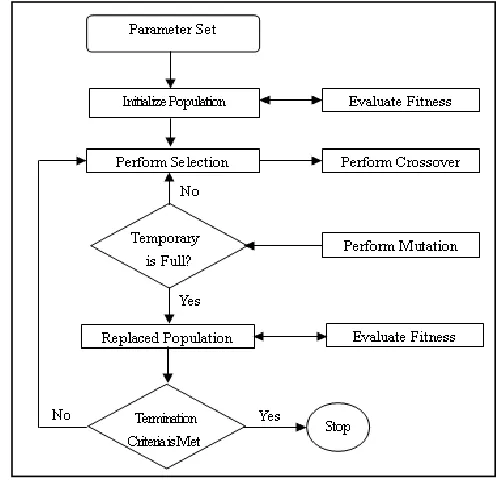
Flow Chart of the approach
The following parameters of Genetic Algorithm decide the performance of optimization.
1. Crossover – exchange of genetic material
(substrings) denoting rules, structural components, features of a machine learning, search, or optimization problem.
2. Selection – the application of the fitness
criterion to choose which individuals from population will go on to reproduce.
3. Reproduction – the propagation of individuals
from one generation to the next.
4. Mutation – the modification of chromosomes for
single individuals.
Fig. 3 flow diagram of Genetic Algorithm (GA)
SIMULATION RESULT
We have applied the genetic algorithm for reducing the side lobe level and also to steer the main beam at different angle. By using simulation tool MATLAB, a curve between SLL and phase angle for various element was taken into consideration.
Table 1 Simulation Parameters
S.
No. Parameter Description
1. Antenna array Linear antenna array
2. Optimization
method Genetic Algorithm 3. Analysis SLL 4. Frequency 2.4 GHz-2.9GHz 5. Element spacing /2
A. Analysis of linear array for SLL Reduction
This section gives the simulation result for various linear antenna array design obtained by GA technique. 5 linear array structures are assumed, each maintaining a fixed spacing between the elements. The antenna model consists of N elements equally spaced with distance of separation
array of 5, 10, 15, 20, elements. Small number of elements is preferred in this work. The selection of number of elements depends on the designer’s choice based on the cost, size, aperture of the antenna, and speed of convergence. As the number of elements increases, the cost increases. Aperture increases and the performance gets improved. Various results for pattern generation for side lobe level is given in following table.
Set No. Number of Element
SLL (db)
I 5 -12.0517
II 10 -12.8732 III 15 -13.3308 IV 20 -13.4222
To evaluate the results of GA more objectively, at the same time, the pattern array antennas can be designed based on Chebyshev methods with the same conditions we have observed that From the classical array antennas theories, the lowest side lobe level can be get using Chebyshev method on condition that it is given certain side lobe bandwidth. But It must satisfy the condition of distance of array elements d ≥2.When d ≤2. Chebyshev method is not best, while GA can still work effectively. Various results for different number of element as shown below.
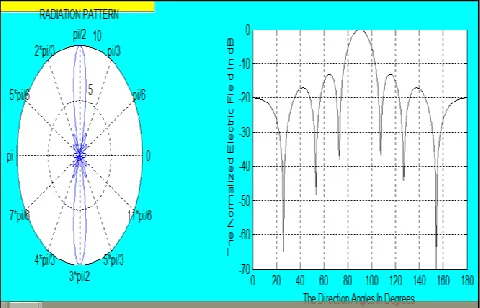
Fig. 4 Radiation pattern with side lobe level of -12.0517for N = 5 elements.
Fig. 5 Radiation pattern with side lobe level of -12.8732dB for N = 10 elements
Fig. 6 Radiation pattern with side lobe level of -13.3308dB for
N = 15 elements
CONCLUSION
From the above simulation results, it can be clearly seen that for frequency f = 2GHz, spacing between the antenna element is /2, side lobe level is reduced from -13.2233 to -12.0517. In case of N=5, spacing between two element is
/2, directivity 10.3645, the SLL is -12.0417, for N = 10 spacing between two element is /2, directivity 14.19 the SLL is -12.8732. In case of N = 15 spacing between two element is /2, directivity 16.1573, SLL is -13.3308. In case of N = 20 spacing between two element is /2, SLL is -13.4222.In case of N = 25 spacing between two element is /2, directivity 18.5064, SLL is -13.42233.
REFERENCES
[1] Freweyni Kidane, Tawatu Abreha, Dilip Mali “Smart
Antenna Techniques for Interference Suppression in WCDMA
Using LMS Algorithm” TECHNIA – International Journal of
Computing Science and Communication Technologies, VOL.6 NO. 1, July. 2013.
[2] Mohammed A. Abdala and Areej K. Al-Zuhairy “Integration
of Smart Antenna System in Mobile Ad Hoc Networks”
International Journal of Machine Learning and Computing, Vol. 3, No. 4, August 2013.
[3] Suraya Mubeen Dr.Am.Prasad Dr.A.Jhansi Rani “Smart
Antenna its Algorithms and Implementation” 2012, IJARCSSE
Volume 2, Issue 4, April 2012.
[4] R.L.Haupt, “Thinned arrays using genetic algorithm”, IEEE
Transaction on Antenna and Propagation, Vol.12 Issue 7, pp 993-999 July1994.
[5] R.L.Haupt, “Optimum quantized low sidelobe phase tapers
for array”, IEEE Electronics Lett. 31(14) pp1117- 1118 July 1995.
[6] S.A. Babale, D.D. Dajab, “Synthesis of a Linear Antenna
Array for Maximum Side-lobe Level Reduction” International Journal of Computer Applications (0975 – 8887) Volume 85 – No 16, January 2014.
[7] Aniruddha Basak, Siddharth Pal, Swagatam Das and Ajith
Abraham, “Circular Antenna Array Synthesis with a Differential
Invasive Weed Optimization Algorithm”, 10th International Conference on Hybrid Intelligent Systems (HIS 2010), Atlanta, USA (Accepted, 2010).
[8] Siddharth Pal, Anniruddha Basak, and Swagatam Das, Ajith
Abraham, “Linear Antenna Array Synthesis with Invasive Weed
Optimization Algorithm”, International Conference of Soft
Computing and Pattern Recognition”, IEEE DOI
10.1109/SoCPaR.2009.42, 2009.
[9] Karthick Ramachandran, “Smart Antennas in 4G”,
Innovative Systems Design and Engineering ISSN 2222-1727
(Paper) ISSN 2222-2871, Vol 3, No 2, 2012.
[10] T.S.Jeyali Laseetha, Dr. R.Sukanesh, “Synthesis of Linear
Antenna Array using Genetic Algorithm to Maximize Sidelobe
Level Reduction”, International Journal of Computer
Applications (0975 – 8887) Volume 20– No.7, April 2011.
[11] R.L.Haupt, “Adaptive Nulling With Weight Constraints”,
Progress In Electromagnetics Research B, Vol. 26, pp 23- 38, 2010.
[12] M.A.Panduro, “Design of Non-Uniform Linear Phased
Arrays using Genetic Algorithms To Provide Maximum Interference Reduction Capability in a Wireless Communication System”, Journal of the Chinese Institute of Engineers,Vol.29 No.7,pp 1195-1201(2006).
[13] Stephen Jon Blank, “On the Empirical optimization of
Antenna Arrays”, IEEE antenna and Propagation Magazine, 47,
2, pp.58-67, April 2005.
[14] C.L.Dolph, “A current distribution for broadside arrays
which optimizes the relationship between beam width and
side-lobe level,” Proc IRE 34 pp.3335-348 June 1946.
[14] Xiang_qian Che, Li Bian, “Low-Side-Lobe Pattern
Synthesis of Array Antennas by Genetic Algorithm” Scientific
Research Fund of Heilongjiang Provincial Education
Department 2008 IEEE.
[15] Yu-Bo Tian, Jian Qian , “Improve the Performance of a
Linear Array byChanging the Spaces Among Array Elements in Terms of Genetic Algorithm” IEEE Transactions on Antennas and Propagation, VOL. 53, NO. 7, JULY 2005.
[16] F. Soltankarimi, J. Nourinia and Ch. Ghobadi, “Side Lobe Level Optimization in Phased Array Antennas Using Genetic Algorithm”, ISSST A Sydney, Australia, 30 Aug. – 2 Sep 2004. [17] Lav R. Varshney and Daniel Thomas “Sidelobe Reduction for Matched Filter Range Processing”, IEEE Radar Conference, 2003.
[18] R.L.Haupt, “Synthesizing low sidelobe quantized amplitude
and phase tapers for linear arrays using genetic algorithm”s, Proc Inte.Conf. Electromagnetics in Advanced Application, Torino, Italy, pp 221-224 Sept.1995.
[19] C.L.Dolph, “A current distribution for broadside arrays
which optimizes the relationship between beam width and
side-lobe level”, Proc IRE 34 pp.3335-348 June 1946.
[20] Aritra Chowdhury et.al. “Linear Antenna Array Synthesis
using Fitness-Adaptive Differential Evolution Algorithm”, IEEE