GSJ© 2018
GSJ: Volume 6, Issue 5, May 2018, Online: ISSN 2320-9186
www.globalscientificjournal.comS
ECURITY
E
NHANCEMENT
&
S
OLUTION
FOR
A
UTHENTICATION IN
C
ORPORATE
N
ETWORK WITH
F
IREWALL
C
ONFIGURATION AND
A
UTHENTICATION FOR
S
ERVER
P
ROTOCOL
Syed Jamaluddin Ahmad, Roksana Khandoker, Farzana Nawrin
ABSTRACT
Firewalls are used to protect networks from malicious traffic from the outside and Limit the flow of information from inside protected networks to the outside world. Most firewalls filter traffic based on network addresses and packet contents. Unfortunately, one major goal of firewalling that of limiting the users and programs that can communicate, is not well served by such designs: it is difficult to accurately map network addresses and packet contents to user and program names. Firewalls can solve the problem of securely mapping user names to addresses when filtering inbound traffic from un trusted networks through the use of covert authentication systems such as port knocking and single packet authorization. Egress firewalls can identify users and programs on trusted networks through the use of application filters. In this thesis, I survey the current state of both types of systems, describe their weaknesses, and introduce techniques to alleviate some of these weaknesses.
Tools: SMTP, SPA, NAT, HTTP, UDP, GRE, ICMP, TLS. etc.
Syed Jamaluddin Ahmad, Assistant Professor, Department of Computer Science & Engineering, Shanto-Mariam University of Creative
Technology, City: Dhaka, Country: Bangladesh,
Mobile No.: +8801633628612 (Email: [email protected])
Roksana Khandoker, Senior Lecturer, Department of Computer Science & Engineering, University of South Asia, City: Dhaka, Country: Bangladesh, Mobile No.: +8801737157856
(Email: [email protected])
Farzana Nawrin, Lecturer, Department of Computer Science & Engineering, Shanto-Mariam University of Creative Technology, City: Dhaka, Country: Bangladesh, Mobile No.: +8801686521152 (Email: [email protected])
INTRODUCTION
In ancient times, towns and villages were based around market-places, where goods from many sources could be traded freely. Over time, as towns grew into cities and gathered wealth, barbarians grew envious of the city-dwellers. In response to this threat, cities erected defensive walls to protect against outsiders. However, as the cities were still dependent on trade, the walls needed to have many gates to allow passage in and out of the cities; guards monitored who entered and exited and attempted to keep the barbarians out.
So it is with the Internet. When first created, it was designed to foster sharing and collaboration. True to this goal, it was built to be as open as possible, with few to no restrictions. Later, as threats grew, network administrators deployed firewalls, which restrict the network traffic allowed to enter and leave local networks, while still allowing ―legitimate‖ traffic to pass.
GSJ© 2018
time of day, the volume of traffic that has been sent by the source, and others; while not all of these are necessarily appropriate under all circumstances, others that are important are frequently ignored due to lack of information or the difficulty of checking. Also, no defensive measure is perfect: walls can be scaled with ladders or battered down by trebuchets, and security software can be disabled or bypassed by exploiting software or configuration vulnerabilities. For this reason, security (of both cities and computers) depends on the principle of defense in depth: the principle that security comes in layers, where the defeat of one layer doesn‘t leave everything vulnerable and that attackers must bypass multiple layers to reach anything important.
Problems with Existing Firewall Technology
1. Firewalls can easily limit what services can be reached from outside. However, it may also be necessary to limit which users can connect to those services. A common assumption, made by many modern firewalls, is that trusted users only connect from small sets of trusted hosts with specific addresses; they implement user filtering by blocking incoming packets with source addresses not in these sets. Unfortunately, the source addresses on incoming packets tell little about the user who sent them; malicious users can spoof trusted hosts, and trusted users can connect from un trusted hosts. Since many trusted hosts may have dynamic (DHCP-assigned) IP addresses, opening a firewall to one trusted host may require opening it to thousands of IP addresses, making it easier for an attacker to find an address to spoof or a machine with a trusted address to hijack. Adjusting the set of trusted IP addresses typically involves either manual reconfiguration by a firewall administrator or connecting to some world-accessible authentication service, which itself may be vulnerable to attack.
2. Although users usually can be accurately linked to IP addresses within a local network, it can be difficult to limit the services with which those users are allowed to communicate. Firewalls generally attempt to filter outbound traffic by restricting the ports to which users may connect: for example,
disallowing outbound connections to anything except TCP ports 80 (HTTP), 443 (HTTPS), and 20 and 21 (FTP). Unfortunately, this isn‘t particularly effective: non-standard services may be running on these allowed ports. Whereas application-layer firewalls can easily filter traffic that doesn‘t match the expected protocol for a port, it is much more difficult to detect disallowed applications that tunnel traffic through standard protocols on standard ports. For instance, tunneling various protocols through port 80, normally used for unencrypted WWW traffic, has become quite common [Alb04, BP04], and encryption renders most application layer filters useless. Also, standard protocols can run on standard ports and still be used for unauthorized purposes. Restricting network access to only authorized local users and programs has the potential to alleviate these problems, but information about the users and applications that generated or will receive network traffic is usually only available at the source or destination hosts themselves, and isn‘t necessarily reliable.
1.1
Contributions of this thesis
GSJ© 2018
provides both cryptographically secure authentication and a method to authentication servers to clients; I propose port knocking and SPA designs using challenge-response authentication and show that the overhead imposed by such a system is not unreasonable under most circumstances. I present experimental analysis quantifying the degree of packet loss and re-ordering in packet streams typical of port knocking, and describe and compare several techniques for ensuring that messages transmitted by port knocking can be properly reassembled on delivery, regardless of the degree of reordering. I also propose several novel designs for port knocking systems and discuss their strengths and weaknesses compared to existing systems. Finally, I present and discuss several methods for creating logical associations between authentication exchanges and subsequent connections. This material expands and improves on my previously published work [dAJ05].
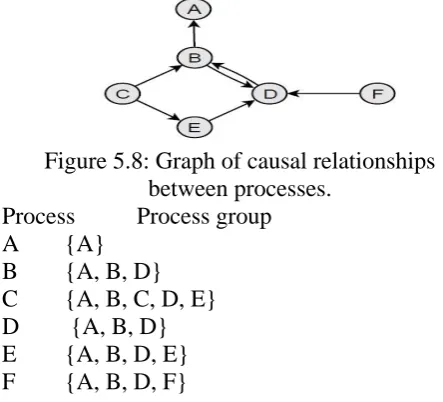
The second problem can be addressed by extending the capabilities of application filtering firewalls. Existing systems generally only provide application filtering on host firewalls; I discuss the advantages of extending network firewalls to also provide application filtering and mechanisms for communicating user and program information to network firewalls. Many designs for application filtering do not detect malicious programs masquerading as legitimate ones under certain circumstances; I suggest ways of preventing this through the use of integrity shells, but point out that solving this problem requires that the operating systems of hosts using application filtering must be trusted by the filtering system. Also, application filtering is ineffective against interpreted programs and those running inside virtual machines, unless the interpreters and virtual environments are also trusted. Finally, existing network firewalls do not always reliably detect when one process uses another as a client, potentially allowing malicious or un trusted programs to make unauthorized network connections. To solve this problem, I present an algorithm for tracking inter-process communication that can identify most such attempts.
Background
As background for the ideas presented in the following chapters, this chapter
presents a general overview of networking, cryptography, and relevant offensive and defensive computer security technologies.
2.1 Bibliography of Networking
The Internet was designed in the 1960s, ‘70s and ‘80s as a robust communication system between diverse local networks. Its design is based on a stack of five protocol layers:
1. Physical – responsible for encoding and decoding signals over a transmission medium, such as a wire, optical fiber, radio frequency, or avian carrier;
2. Data link – responsible for communication between hosts on a physical network segment; 3. Network – responsible for global addressing and routing packets between physical network segments;
4. Transport – responsible for communication between processes, and optionally, reliable connections;
5. Application – responsible for encoding and decoding information in formats
understood by applications, as well as providing any necessary services not provided by lower layers.
Each protocol layer provides services to layers above it; information being sent is passed down from the application layer to the physical layer, with each level performing transformations appropriate to that layer, before the physical layer handles the actual work of transmission. When information is received, each protocol layer undoes its transformations and passes information back up the stack, until it reaches the application layer. This design is similar to the OSI network stack model [Tan96], which mandates seven layers and a somewhat different breakdown of responsibilities.
The infrastructure of the Internet consists of a number of routers, interconnected computers whose function is to forward information from its source to its intended destination; the process of finding such a path and forwarding information along it is known as routing. Computers and other devices that communicate over the Internet are known as hosts.
2.2 Network and Transport Protocols
GSJ© 2018
for ―Internet Protocol‖, always refers to IPv4; the next-generation Internet protocol, IPv6 will not be discussed.) IP provides an unreliable datagram service: it breaks the information that it transmits into packets (also known as data grams) and routes each to its destination independently, but provides no guarantees that packets are properly delivered. Packets may be dropped, duplicated, delayed, re-ordered, or corrupted in transit; error messages (in the form of ICMP packets [Pos81b]) may or may not be returned if delivery fails. IP packets contain a header of 20 to 60 bytes and a payload of 8 to 65,516 bytes of data; packet sizes are selected based on the properties of lower protocol layers. IP headers contain metadata that enables packets to be routed to their destinations, such as the addresses of packets‘ sources and destinations. IP addresses are 32-bit numbers and are not necessarily unique; routers necessarily have more than one address, and some techniques allow hosts to share IP addresses.
The Internet doesn‘t strictly follow the OSI stack model: various protocols exist that allow IP packets to be encapsulated inside protocols that run on top of IP. This encapsulation of protocols is known as tunneling. For instance, IPsec (a security architecture for IP) [KS05] can create encrypted tunnels for IP and other network protocols on top of IP, whereas GRE (―Generic Routing Encapsulation‖) [FLH+00] can create plain-text tunnels. More information on tunneling is available in [CBR03].
A number of transport layers exist, each providing different services. ICMP (―Internet Control Message Protocol‖) is used for delivering many types of error messages from the network and transport layers as well as performing a variety of administrative functions [Pos81b]. UDP (―User Datagram Protocol‖) provides an unreliable datagram service between applications [Pos80]; the only important feature that it adds to IP is application addressing. TCP (―Transmission Control Protocol‖), the most common transport protocol on the Internet, provides reliable bidirectional streams between applications [Pos81a]. Other transport protocols exist, providing other services.
TCP breaks streams down into segments which are then encapsulated into IP packets. Like IP packets, TCP segments contain both headers and payload data. TCP assigns sequence numbers to every byte of payload data sent and requires that
every byte be acknowledged; if any segments are lost or corrupted, either they will be resent or an error will be detected. Duplicate and out-of-order packets can also be detected and corrected using the sequence numbers. TCP headers contain application-layer addresses, data and acknowledgement sequence numbers, and control flags, among other fields. Segments used to initiate connections have the SYN (―synchronize‖)
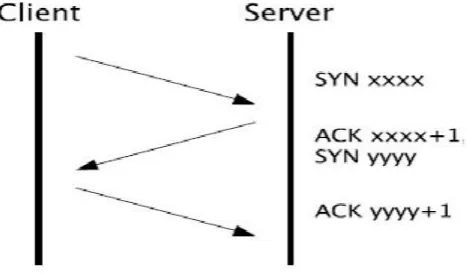
flag set; those used to finalize connections have the FIN flag set. The ACK flag indicates that a segment is acknowledging data received from the other end of the connection. Opening a TCP connection requires that both endpoints exchange initial sequence numbers (ISNs) using an algorithm known as the three-way handshake, shown in Figure 2.1. The client starts the handshake by choosing an ISN and sending it to the server in a segment with the SYN flag set. If the server chooses to accept the connection, it responds with its own ISN in a segment carrying the SYN flag; it also signals that it received the client‘s ISN by setting its acknowledgement number to the client‘s ISN plus one and setting the ACK flag. The client then acknowledges receipt of the server‘s ISN with an ACK segment carrying the server‘s ISN plus one in its acknowledgement number field. After completing this exchange, a TCP connection is established and both the client and server can send and receive data.
GSJ© 2018
Figure 2.2: TCP connection establishment handshake
privileged applications (those with super user or administrative privileges) to use TCP and UDP ports with numbers below 1024.
On most operating systems, applications use the socket interface [LFJ+86] to send and receive
messages. Unprivileged applications are typically limited to using TCP and UDP; headers, with the exception of addressing information, are automatically generated by the operating system, as are TCP connection establishment and finalization messages. Privileged applications can use the raw socket interface to generate arbitrary packets [LFJ+86].
Neither IPv4, TCP, nor UDP provide any authentication or privacy services; any host can generate any packet and any host observing packets at the network layer can read the packets‘ payloads. If these services are important, then they can be provided by application-layer protocols, TCP extensions such as TLS [DR06], IP extensions such as IPsec [KS05], or the next-generation Internet Protocol, IPv6 [DH98].
2.3
Network Application ArchitecturesApplications that communicate over networks usually follow the client-server model: client programs, which may interface with users, connect to servers and request resources. For instance, web browsers connect to servers and request documents, and SSH clients connect to servers and request login shells. Peer-to-peer (p2p) applications operate as both clients and servers, allowing them to connect to each other. Proxy servers act as intermediaries between clients and servers; clients connect to proxies, which then connect to servers on their behalf and forward data between the two connections. Such systems are often used for firewalling (as in
circuit and application gateways; see Section 2.4.1), caching, and load balancing.
2.4
Vulnerabilities in Internet ProtocolsWhen the core Internet protocols were designed, the Internet was a research network with a small user community who knew and trusted each other. As a result, security was not a high priority. Many pro tocols have useful features that easily lend themselves to malicious use; many even have outright design flaws that weaken security to no tangible benefit. For example,
• Hosts can assert any source IP address they want on packets that they generate (IP spoofing). Routers often have no way of determining if packets‘ source addresses are correct and are not required to block invalid packets even when they can be detected.
• Especially in early TCP implementations, the initial sequence numbers used for new connections were predictable; in conjunction with IP spoofing, this allowed attackers to establish TCP sessions with remote hosts while using spoofed IP addresses [Mor85].
• Many of the protocols used to distribute routing information on the Internet and map physical addresses to IP addresses on local networks are not secure, allowing attackers to intercept traffic destined to other hosts [Bel89, dVdVI98].
• IP packets can be fragmented at (almost) arbitrary boundaries, allowing attackers to split attack signatures between multiple packets. Furthermore, IP fragments and TCP segments are allowed to overlap; it is up to the receiver to decide how to re-assemble them. As a result, firewalls and IDSs that re-assemble streams before checking them may miss attacks against hosts that use different re-assembly strategies [PN98].
GSJ© 2018
to reduce the risk of an attack with minimal disruption to users.
2.5 Cryptography
Modern cryptography seeks to provide the services of authentication, data integrity, confidentiality and non-repudiation [MvOV96, p. 4] through the use of well-known algorithms whose security relies solely on the knowledge of relatively small cryptographic keys. Generally, the strengths of related cryptographic algorithms within a class of algorithms are proportional to the sizes of their keys; an algorithm is considered to be strong if it is computationally infeasible to determine anything about the key, given full knowledge of the plaintext, ciphertext, and algorithm; this is a principle known as Kerckhoffs‘ law [Ker83]. For instance, identifying properly-chosen keys for most modern ciphers is estimated to require thousands of years, even if all the computational power in the world was applied to the problem [Sch06b]. This section provides a brief overview of some of the building blocks of modern cryptography; more information can be found in [MvOV96, Sch06b, Sta03].
Security Services
Cryptographic algorithms are generally used to provide the following five services [IT91, Sta03]: Authentication The assurance that the identity an entity is as claimed.
Access control The prevention of unauthorized use of a resource.
Data confidentiality The protection of data against unauthorized disclosure.
Data integrity The assurance that data is received or retrieved exactly as it was sent or stored.
Non-repudiation Protection against an entity performing an action and later denying that it did so.
Digital Signatures
While MACs provide integrity and authentication, they depend on symmetric keys and don‘t provide non-repudiation. In a digital signature scheme, messages signatures are generated using senders‘ private keys; any party can use a sender‘s public key to verify the signature on a message. Unlike asymmetric ciphers, digital signatures do not provide confidentiality, but they do provide message
integrity, authentication and non-repudiation. In order to improve execution performance (the algorithms used in asymmetric cryptography tend to be slow) and prevent existential forgery attacks (in which an attacker can generate a valid signature for a message without having control over the message‘s contents) [MvOV96, p. 432], digital signatures are typically computed over cryptographic hashes of the original messages. Verification of a signature then requires applying the public key to the signature to recover the sender‘s hash and re computing the hash on the message; if the two hashes match, then the message must have been sent by the owner of the public key and has not been altered.
Digital signature algorithms are often constructed from asymmetric ciphers. For instance, the RSA cipher can be used to generate digital signatures by ―encrypting‖ message hashes with the sender‘s private key; the hash can be recovered by ―decrypting‖ the signature with the sender‘s public key [MvOV96, p. 433]. Other algorithms designed specifically for digital signatures include DSA [MvOV96, p. 451] and ECDSA [Cer00].
2.6 Key Exchange Algorithms
Both symmetric ciphers and MACs require that all participating parties know a secret key, whereas asymmetric ciphers and digital signatures require that all parties know each others‘ public keys. Securely distributing these keys is a difficult problem, requiring that all parties are able to guarantee that they received the correct keys and that they were not modified in transit.
GSJ© 2018
party generates the new key, establishes secure channels with all parties, and uses the secure channels to distribute the new shared key [Sta03, p. 211]. Similar techniques can be used for distributing public keys.
Instead of one party choosing a symmetric key and passing it to the other, the Diffie-Hellman key exchange algorithm [MvOV96, p. 515] (also known as exponential key exchange) can be used to allow both parties to contribute to the shared key. Diffie-Hellman is based on the believed intractability of computing discrete logarithms in multiplicative groups of integers modulo primes (with an equivalent existing for elliptic curves); it is computationally infeasible to calculate the shared secret given the messages exchanged between the two parties. However, to prevent man-in-the middle attacks (see the next section), the messages exchanged must authenticated, requiring that the two parties share a master key or have authenticated public keys for each other.
2.7 Attacks and Offensive Technologies
The barbarians at the gates of ancient cities came from many tribes and carried many different weapons. Likewise, attackers against computer systems take many forms and use many different strategies. This section describes some common attack strategies, including port scans, 0-day exploits, worms, and denial-of-service attacks.
Port Scans
Before an attacker, be it person or program, can launch an attack against something, it needs to gather information about its target. Possibly the single most important information about a target computer, from an attacker‘s perspective, is what services are running. The easiest way to gather this information is by attempting to connect to all ports suspected of running services of interest, in what is known as a port scan [Fyo97].
Attackers with a particular target in mind will often scan many or even all ports on the target, in order to identify all running services and gather as much information as possible. Scanning multiple ports on a single target in this manner is known as vertical scanning [SHM02]; the unqualified term ―port scan‖ generally refers to vertical scans. Other attackers looking for a particular service, not caring about what host is running it, will scan a single port over a large number of hosts; this is known as horizontal
scanning [SHM02] or network scanning [MMB05].
Port scans can take many forms [dVCIdV99, Fyo97]. The simplest form of scan against TCP ports is the connect scan, in which the attacker attempts to open a TCP connection to each port. If the connection attempt succeeds, then the attacker knows that something is listening there and can either attempt to determine what it is or simply make a guess based on the port number; if the connection attempt fails, then the attacker typically assumes that no service is using that port. Connect scans are not particularly stealthy, since a successful connection establishment will be noticed by the application listening on the target, which may log the event. However, there is no need to fully open a TCP connection to determine if something is listening; a TCP stack is required to send a SYN-ACK packet in response to a SYN to any open port and will either send an ICMP error or nothing at all in response to a SYN packet sent to a closed port. This takes place at the kernel level on the target system; the application is never informed of connections that are never fully opened. SYN scans take advantage of this by scanning with SYN packets only; the scanner may send RST packets to tear down the half-open connections that it creates. Other types of TCP scans include ACK scans, FIN scans, Xmas scans (using packets with many flags set) and null scans (using packets with no TCP flags set); these are used to penetrate certain firewalls that interfere with other types of scans or to gather information about firewall rule sets. UDP scanning is somewhat more difficult: ICMP errors in response to a packet sent to a UDP port imply that it is closed; UDP responses suggest that it is open, and no response at all can mean anything.
0-Day Exploits
GSJ© 2018
these may involve disabling certain functionality or even disabling vulnerable services entirely. When a new vulnerability is discovered, the practice of responsible disclosure is to first privately inform the vendor or maintainer of the vulnerable software of the existence of the flaw and wait until a patch or work-around is available before publishing details of the flaw. Unfortunately, the ―bad guys‖ rarely follow this practice: new vulnerabilities are often kept secret or circulated privately among the ―hacker‖ community, not becoming known to the security community until long after automated tools to exploit them are available. Newly discovered vulnerabilities to which the security community has not yet had the chance to react are known as 0-day vulnerabilities; methods to exploit them are known as 0-day exploits.
Defending against 0-day exploits is no easy task: since their existence is not known to defenders, no reactive measures can be taken. The only option is proactive security: using multiple layers of security so that a breach in one exposes little (a practice known as defense in depth) and aggressively auditing potentially vulnerable systems to attempt to detect flaws before the bad guys do. Unfortunately, defense in depth is not always easily implemented and many protocols and software systems are too complex to effectively audit: many flaws in common software have gone undiscovered for years. Nevertheless, short of disconnecting systems entirely, these are the only defenses available against 0-day attacks.
2.8 Worms and Malware
Malware is a generic term for any form of malicious software. Malware may take many forms, the best known of which is the virus. Two forms of malware particularly relevant to this thesis are worms and rootkits.
A worm is a program that replicates itself to new hosts across networks by scanning for targets and infecting them [Ayc06]. Worms usually gain access to computer systems by exploiting user errors or software vulnerabilities or miss configurations, and once inside, continue scanning for new targets. This allows worms to spread exponentially. The Sapphire worm of 2003 infected 90% of all vulnerable hosts within 10 minutes [MPS+03] of release; theoretically, some worms could infect nearly all available targets in under a second [SMPW04]. Worms are
usually non-specific as to what hosts they infect; they simply use horizontal port scanning to locate vulnerable hosts. On hosts that they infect, many worms install additional software, such as rootkits, backdoor software that allows the worms‘ creators to issue commands to infected computers, or spyware that attempts to collect passwords and credit card numbers. Worms are often written to exploit 0-day software vulnerabilities. This, combined with worms‘ rapid propagation, makes reactive security measures largely useless against worms.
Rootkits [HB06] are software that is used to hide the presence or activity of other software. These can take the form of modified user space programs or kernel drivers that modify the behavior of other drivers under certain circumstances. Common uses are to hide certain files from directory listings or certain processes from process listings; these files and processes typically belong to other forms of malware. In general, rootkits can be used to modify just about any form of operating system behavior.
2.9 Denial-of-Service Attacks
A denial-of-service (DoS) attack is simply any attack that results in the degradation of the quality of service of a targeted system, limiting or denying its use to legitimate users. DoS attacks can range from the unintentional [wik07] to the criminal [Vij04], and from single-packet logic attacks [Ken97] to massive resource-consumption attacks [Gib05]. Logic attacks leading to denial-of-service conditions are usually caused by software bugs and are easily correctable; more interesting (and more difficult to defend against) are the resource-consumption attacks.
GSJ© 2018
random spoofed source IP addresses. Since targets will attempt to open TCP connections with all of these apparent sources, a side effect of SYN floods is SYN-ACK packets being sent all over the Internet; this is known as backscatter [MSB+06].
2.10 Firewalls and Defensive Technologies Like the defenses of ancient cities, defensive network technologies are primarily based on keeping intruders out and identifying them when they manage to gain entrance. Firewalls are the walls themselves - they restrict the traffic that is allowed to enter and leave a protected area. Intrusion Detection Systems (IDSs) and related technologies take a more active role in attempting to detect and identify attacks that are being attempted or have succeeded, making them more like guards. Other technologies, such as Network Address Translators (NATs) and Virtual Private Networks (VPNs), also have roles in securing networks.
Firewalls
Bellovin and Cheswick [BC94] defined the following three design goals for firewalls:
1. All traffic from inside to outside, and vice-versa, must pass through the firewall.
2. Only authorized traffic, as defined by a local security policy, will be allowed to pass. 3. The firewall itself is immune to penetration.
Two architectural designs are possible to satisfy the first requirement: either firewalls are situated on all network paths in and out of protected networks (network or perimeter firewalls), or firewalls are situated on the protected hosts themselves (host firewalls). Local security policy differs from place to place. Firewalls are most frequently deployed as proactive security mechanisms that limit the traffic that is allowed to enter the protected host or network in order to block attacks: this is known as ingress filtering. Firewalls can also be used for egress filtering: restricting outbound traffic in order to limit information leaks, the spread of malware, and the outside resources that can be accessed. In general, firewalls can be used to enforce a number of types of access-control policies on both inbound and outbound traffic:
1. what services are available,
2. who may access those services,
3. from where those services may be accessed, 4. when those services may be accessed, and 5. how those services may be used.
There are many different types of firewalls, differing in how they filter traffic and what information is available to them. The properties of each are summarized in the following sections; more information is available in [CBR03].
Packet filters
The simplest type of firewall is the packet filter [CBR03, p. 176], which examines packets one at a time at the network layer and decides to accept or reject them based on available information. Packet filters typically have no knowledge of application layer protocols, but can make decisions based on link-, network- and transport-layer protocol headers and the network links on which packets arrive. Some packet filters are also capable of making decisions based on the current time, the volume of data transferred to or from a host within a time frame, the number of packets matching a rule within a time frame, and other conditions not directly related to the packets themselves. Common uses of packet filters include:
• preventing hosts outside the local network from connecting to an internal server,
• blocking packets with obviously spoofed source addresses (such as internal addresses on packets on an external network interface),
• blocking tiny IP fragments, packets using source routing, directed broadcasts, and other suspicious packets, and
• preventing employees from using peer-to-peer file-sharing software.
GSJ© 2018
connect to external web servers, then it must allow outbound TCP traffic to port 80. However, responses from these web servers must also be allowed through the firewall. Simply allowing all packets originating at port 80 through is not adequate; anyone could run a program on port 80 and bypass the firewall entirely. The usual solution is to allow all packets with the ACK flag coming from port 80 and destined to high-numbered ports, but this will still allow some packets through the firewall that are not part of any legitimate connection. Since packet filters have no knowledge of application-layer data, they can‘t prevent hapless users from downloading viruses from a web pages, nor can they prevent malicious insiders from sending trade secrets to third parties. They also have no knowledge of who or what is sending the packets they see. Packet filters can only identify users and programs by IP addresses and ports: they can‘t distinguish between worms and web browsers. Newer operating systems and firewall appliances generally use more elaborate forms of firewalls that address some of these problems. Some packet filters attempt to process application-layer data as well, in order to identify the application protocol being used or to detect and reject malformed or malicious application-layer messages. This is known as deep packet inspection [Dub03]. Unless deep packet filters perform some re assembly of packets, they can be confused by pathological fragmentation. They are often considered to be a form of Intrusion Prevention System (see Section 2.4.2).
Stateful packet filters
As opposed to simple packet filters, which consider packets independently, stateful (also known as dynamic) packet filters [CBR03, p. 188] consider packets to be parts of connections. Connections can be accepted or denied; packets associated with accepted connections are generally accepted with little further inspection. Stateful packet filters are also capable of the sorts of analysis performed by simple packet filters: connections may be filtered based on source, destination or any other packet characteristics, and packets may be blocked even if they belong to valid connections.
How packets are associated with connections differs based on the transport protocol being used. TCP connections are easily tracked; a partial implementation of the TCP state machine
is enough to determine when connections open and close. More advanced stateful firewalls may track TCP window sizes and other aspects of TCP to more accurately determine if a packet belongs to a given connection. UDP doesn‘t define ―connections‖ on its own, so UDP connections are usually tracked using intervals between packets; connections are opened for any UDP packet traveling between a pair of addresses and are closed when a timeout is reached without any more packets between the addresses being observed. ICMP error messages are usually treated as part of the TCP or UDP connections associated with the packets that triggered them; other types of ICMP messages (such as ―pings‖) may be treated as connections of their own. Other protocols‘ connection states are tracked in manners appropriate to those protocols. Since the underlying network protocol (IPv4) is fundamentally unreliable, connection-closing messages from TCP and other stateful transport protocols may never be received, so stateful packet filters may also use timeouts to close such connections.
Application-layer semantics can also play a role in connection tracking. Several common application-layer protocols, such as FTP, make use of more than one transport-layer connection. Stateful firewalls often have extensions that perform limited parsing of application-layer messages to treat these secondary connections as parts of the connections that created them, greatly simplifying firewall rules.
GSJ© 2018
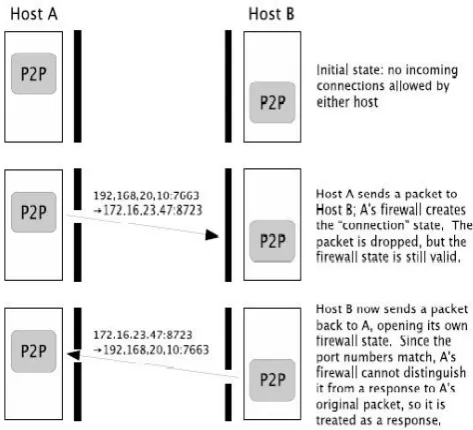
Figure 2.10: Flaw in UDP state tracking
this comes at a cost: stateful packet filters are far more complex and require large amounts of memory for state tracking. Additionally, the methods of generating state information for stateless protocols like UDP can be fooled. Two hosts whose firewalls allow outbound UDP packets between their addresses but deny inbound packets can nevertheless establish a connection by both attempting to connect to each other, as in Figure 2.2; many peer-to-peer applications use this technique to bypass firewalls [Sch06a]. As with simple packet filters, stateful packet filters have limited knowledge of application-layer protocols or of the actual users and programs sending and receiving the packets that they examine.
Most modern operating systems come with built-in stateful packet filters, as do most dedicated firewall appliances on the market. Typical examples include Linux‘s iptables [Wel06a] and OpenBSD‘s pf [KHM06]. Details of how iptables tracks connections are available in [And06].
Application filters
Packet filters are only capable of identifying users by IP address; all users of shared computers are treated alike. Likewise, packet filters are only capable of identifying programs by port numbers and treat all programs using the same ports alike. They cannot implement per-user access restrictions or limit network access to specific applications. There is good reason for this: the information necessary to implement such filters, user and application names, is not
included in IP packet headers and thus is not available to packet filters. This information is generally only available at the hosts sending or receiving the packets in question, thus preventing any form of network firewall from using it. However, host firewalls do have access to this information; most modern host firewalling software (including PC firewalling packages, such as Check Point‘s ZoneAlarm [Zon07]) make use of it to implement user and application filtering1 [CBR03, p. 226], as well as stateful packet filtering.
Unlike packet filters, application filters can tell the difference between legitimate software and malware that uses the same ports: for instance, spyware that communicates with valid HTTP messages over port 80/TCP would be indistinguishable from a web browser to a packet filter, but an application filter would be able to tell the difference. Application filters can also be used to block certain software that is known to have questionable security records, even if preventing its installation is not feasible or it is integrated into an operating system and cannot be removed, while still permitting network access to functionally equivalent software. They can also be used to prevent any network access when no user is logged in.
Application filtering is primarily used by egress firewalls, but may also be used on ingress.
Circuit gateways
Circuit gateways [CBR03, p. 186] are proxy servers that run at the transport layer. They don‘t allow end-to-end connections through themselves: instead, protected clients are required to connect to a gateway and communicate with it using a special protocol to request connections to the outside world. The gateway then makes the requested connection (if it is allowed by the gateway‘s security policy) and forwards data between the two connections. A similar approach is taken with local servers that want to make services available from outside the protected network.
GSJ© 2018
to filter traffic are not much different than those of stateful packet filters, despite requiring significantly more resources. Circuit gateways may require user names, passwords, and other information from clients before creating connections to the outside, potentially allowing them to filter based on local user and application, but they still have no knowledge of remote users, nor of application-layer protocols.
Circuit gateways are generally used as network firewalls; host-based circuit gateways would be pointless. A common circuit gateway system is SOCKS [KK92, LGL+96].
Application gateways
Application gateways [CBR03, p. 185] work as proxies at the application layer. As with circuit gateways, connections are not end-to-end but are made by the gateways on request. In addition to the information available to circuit gateways, application gateways are able to filter based on application-layer information, and possibly also user and application information, but, due to the diversity and complexity of application-layer protocols, separate gateways are required for each application.
Typical uses of application gateways are to filter for malware, malformed messages that could represent attacks against servers, and content that should not be entering or leaving the protected network, such as pornography or trade secrets. The tradeoff for this power is that application gateways require large amounts of memory and processing time and frequently cannot be made fully transparent to users. Most common web proxies and SMTP servers are able to function as application gateways for their respective protocols; gateways for more obscure or proprietary protocols can be difficult to find.
Distributed firewalls
Traditionally, network firewalls have been the most common method for protecting large numbers of hosts; they are easy to deploy and manage. However, they do have a number of disadvantages:
• Unauthorized or improperly protected network links can allow users to bypass firewalls entirely. • Laptops and other roaming hosts move in and out of protected areas; while outside of the network perimeter, they are not protected by its firewalls.
• Firewalls at network choke-points are single points of failure and possible performance bottlenecks.
• In networks with more than one route to the Internet, it is possible for packets to leave over one link and their responses to arrive on another. Stateful packet filters and gateways will not be able to re-assemble connections under these conditions.
As a way of improving on these weaknesses, Bellovin [Bel99] proposed using distributed firewalls in which each host in a protected network runs its own firewalling software but receives configuration from a central management server. Such a system has a number of advantages:
• The firewall is independent of network topology; hosts no longer need to be classified as ―inside‖ or ―outside‖ of a security perimeter. • There is no longer a single point of failure or performance bottleneck; if one host goes down, others are unaffected.
• The firewall can base its decisions on additional information that is not available to most network firewalls, such as user and application names and dynamically assigned ports, without needing to resort to computationally expensive application layer processing.
• Hosts that move between networks or otherwise change addresses frequently, such as laptop computers, are easily protected, regardless of their current locations.
The independence of network topology provided by this model is particularly important: many of the threats faced by modern networks are from the inside (spyware, worms carried into protected areas on laptops, malicious insiders, etc.). The traditional model of walled-in networks with barbarians outside that forms the basis of most firewall architectures provides little to no defense against internal attackers.
GSJ© 2018
rely on address-based authentication for communication with hosts outside of their administrative domains. Also, many older and less-capable systems are still in use for which IPsec support is not available.
Other disadvantages of distributed firewalls lie in the difficulty of managing configuration. Management servers may either attempt to push configuration updates to all hosts, in which case any hosts that are currently unreachable do not receive the updates, or rely on hosts polling for and pulling updates, in which case hosts that neglect to poll regularly (or are prevented from doing so) do not receive them. It is difficult to ensure that all hosts that should be running firewalling software actually are; hosts whose firewalls are malfunctioning or not present may not be protected at all. Finally, some malware (such as Y3K Rat 1.6 [Whi01]) attempts to disable local security software on hosts that it infects; if this succeeds, then the firewall is disabled at the moment when it is needed most. In one implementation [IKBS00] of Bellovin‘s concept [Bel99], simply disabling the policy daemon will disable the firewall. Since there are many fewer avenues for malware to be executed on network firewalls, this attack is much less of a threat for traditional firewalling systems.
Hybrid firewalls
Bellovin [Bel99] recognized some of the weaknesses of distributed firewalls in his original paper and suggested that hybrid firewalls, combinations of distributed and choke-point elements, could address some of them. There are a number of ways that such a system could be structured:
• A network of non-mobile hosts, each protected by distributed firewalling software but without cryptographic authentication of peers, could use simple network firewalls to drop inbound packets with spoofed internal addresses. This would prevent many spoofing attacks under the assumption that no internal hosts are engaging in spoofing.
• A network that uses distributed firewalling could employ network firewalls as a secondary protection mechanism: this would protect hosts whose firewalling software is missing, malfunctioning, or not configured correctly. If the network firewall failed, it could fail open without leaving the network completely exposed.
• Networks that contain both mobile and stationary hosts could use network firewalls with knowledge of network topology to protect stationary hosts, while using a distributed firewall and an IPsec gateway to allow protection for and secure communication with mobile hosts.
2.11 Intrusion Detection Systems
Unlike firewalls, intrusion detection systems (IDSs) take a reactive approach, attempting to identify attacks in progress or to detect evidence of past attacks and taking appropriate countermeasures. IDSs can use either statistical methods or pattern-matching to detect intrusions, can operate by monitoring logs or events on individual hosts or by monitoring network traffic, and can run periodically or in real time [DDW99].
Responses made by IDSs depend on the type of IDS and the type of attack. Single host signature matchers, such as some anti-virus engines, that detect successful intrusions may attempt automated clean-up operations or may simply notify an operator that clean-up is needed. Worm traffic detected on a local network may indicate that an intrusion has taken place; an IDS detecting such an event may attempt to isolate the infected host(s) in order to contain the worm [MSVS03]. Port scans detected at a perimeter firewall may result in all traffic from the scanning hosts being blocked [Sol98] or subjected to rate limitations [Wil02]. Unfortunately, automated responses can often cause unintended side effects: false positive detections may cause more harm over the long term than undetected intrusions and, even when attackers cannot hide from IDSs, they may attempt to trigger inappropriate responses. Signature-based detectors can be fooled into making inappropriate responses by deliberately matching the signature of different attacks, port scanners can spoof large numbers of source addresses in order to make port scan detectors block off large segments of the Internet, and worms can use spoofed source addresses to trick IDSs into quarantining too many hosts [PN98]. In many cases, the only safe automated response to intrusions is to inform the operator.
GSJ© 2018
also capable of functioning as IPSs. Many ―deep‖ packet filters are essentially combinations of stateful packet filters and simple IPSs [Ran05].
2.12 Network Address Translators
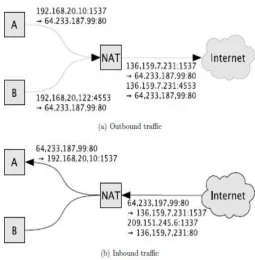
Network Address Translators (NATs) [SE01, SH99] are devices that re-write the source IP addresses of traffic leaving a network and the destination addresses of traffic entering it. This process is known as network address translation. The most common reason using for network address translation is to share a single IP address among many devices. Devices on a network are assigned IP addresses that are only valid inside the network (usually chosen from the RFC 1918 private address blocks [RMK+96]); they can communicate amongst each other using these addresses, but the addresses are not recognized by the Internet at large. In order to connect such a network to the Internet, all traffic entering and leaving the network is routed through a NAT, which re-writes the source addresses of all outbound packets to its own external IP address (as in Figure 2.3(a)), which is valid on the Internet. In order for responses to outbound packets to be correctly received, the NAT keeps state information allowing it to re-write the destination addresses of packets it receives to the appropriate internal addresses (as in Figure 2.3(b)). In such a system, the internal addresses are known as private addresses and the externally-valid address of the NAT is known as the public address. Since TCP and UDP connections are typically identified by the combination of source and destination addresses and source and destination ports, such a NAT cannot handle two internal hosts making connections to the same external host and port from the same source ports; to work around this, a variation called network address port translation, which also re-writes source port numbers on outbound packets, is used. Other variations on this system allow NATs to use more than one public address; some NATs support one-to-one mappings between private and public addresses.
Figure 2.12: Traffic passing through a NAT.
As a side-effect of network address translation used in this manner, outside hosts cannot normally initiate connections through a NAT: without state information to indicate which inside host should receive a packet, the NAT will simply drop it (as with the 2nd packet arriving at the NAT in Figure 2.3(b)). Therefore, though NATs are not designed as network security devices, they can function as simple packet filters. Since networks employing NATs require that all outbound traffic pass through them, they are ideal locations to place network firewalls; most available NATs have at least limited packet-filtering capabilities, and many existing firewalls can also function as NATs. The state-tracking mechanisms used by NATs are similar to those used by stateful packet filters and have the same weaknesses with regards to stateless transport protocols.
Network address translation can also be used in reverse in order to share a single IP address among many network servers or to load-share between them: this technique is often called port forwarding. The term destination network address translation is also used; in this case, re-writing source addresses of outbound packets is known as source network address translation. NATs resemble circuit gateways in that outside hosts see only the NATs‘ addresses, rather than those of the protected hosts, but differ in that protected clients and servers communicate
GSJ© 2018
directly with outside hosts. NATs only re-write addresses; packet boundaries and other network-layer semantics are preserved.
2.13 VPNs and Encrypted Channels
Many attacks against network services are only possible because of IPv4‘s lack of protection against sniffing and modification and its lack of verification that packet source addresses are correct. All of these problems can be solved by proper application of cryptography: encryption of payload data makes sniffing useless; data integrity checks can prevent insertion and modification attacks, and user or host authentication allows spoofed source addresses to be detected.
Virtual Private Networks (VPNs) are private networks that allow confidential communication over insecure public networks. VPNs are normally implemented by tunneling ordinary, insecure protocols inside encrypted channels on top of standard network and transport protocols. This can be done at different protocol layers. TLS [DR06] is normally used for encrypting application protocols on top of TCP, but can also be used to tunnel IP on top of TCP or UDP [Yon06]. IPsec [KS05] and other protocols tunnel IP packets inside a secure channel on top of IP. All of these are complicated cryptographic protocols that provide host authentication, key exchange, and confidential, integrity-protected channels.
The benefits of VPNs and encrypted channels come at a cost. Encryption is CPU intensive, adding a cost to communication that may be prohibitive for low-powered or busy hosts. VPN software often requires operating system support, which may not be available for some platforms. Tunneling of any sort makes it impossible to block access to applications by port number; a growing trend on the Internet is the tunneling of various protocols on top of HTTP [Alb04, BP04]. Furthermore, encryption makes firewalling difficult: unless a firewall knows all encryption keys in use, it cannot decrypt tunneled traffic to make filtering decisions. This leaves security up to destination hosts themselves, just as it would be without firewalls; some firewalls may block encrypted traffic for this reason. Thus, it is beneficial to use a technology that provides the minimum required security at the minimum cost, rather than using more powerful VPN systems, wherever possible.
Stealthy Authentication Mechanisms
A common goal in firewall policy design is to limit which remote users can connect to particular services. There are many reasons for implementing such access restrictions, including • strengthening a defense in depth: adding an extra layer that attackers must break through before reaching anything important,
• protecting systems with known un patched vulnerabilities from attackers until patches are available, while still allowing access to certain authorized users, and
• adding a measure of user authentication to legacy or proprietary systems with inadequate integrated security measures.
A side benefit of limiting access to services at a firewall in this manner is that unauthorized users will have difficulty even learning of the existence of the protected service; port scans against the service from unauthorized hosts cannot tell the difference between a port that appears closed because nothing is using it and a port that appears closed because a firewall is intervening. This adds a degree of security to the service: attackers are unlikely to attack services that they don‘t know about, so measures that make services more difficult to detect will reduce the number of attackers aware of the service and therefore the number of attacks made. Since the number of attackers is finite, a reduced number of attackers and attacks reduces the probability of a security breach.
GSJ© 2018
other method available is to use a world-accessible service that uses some form of user authentication to identify trusted users and grant them temporary access to the protected service, by creating a temporary association between the trusted user and its IP address. Unfortunately, this approach typically has drawbacks as well. Exploitable flaws in security and authentication software are discovered regularly [UC06a, UC06b, UC07a, UC07b]. Since the authentication service is visible to the world, it can be attacked by anyone, and since it controls firewall rules, successful attacks could be used to completely bypass the firewall.
Clearly, since IPv4 headers include no information about users, there is little that can be done with the approach of filtering by fixed sets of source IP addresses. The model of authenticating to a world-accessible service and requesting access has potential, but needs enhancements to correct the weaknesses described above. In particular:
• Since the whole point of the firewall access restrictions is to keep unauthorized users from connecting at all, the authentication service should be no easier for attackers to communicate with than the protected services. It must still be world accessible, but it could be hidden in some manner. One way to accomplish this is for communication with it to use a covert channel. • Since any attacker who discovers and is able to communicate with a hidden authentication service has already displayed significant skill and resources, the authentication service must be cryptographically secure. Also, it should be as simple as possible, so that it can easily be audited and reasonable assertions made about its vulnerability to attack.
Using a complex, highly visible mechanism would present a risk of attack not significantly different than that of the original, now protected, service; using a hidden service that provides strong authentication and is simple enough to easily audit provides a target that is both less likely to be compromised if attacked and less likely to be attacked at all.
This chapter will begin by discussing covert channels over networks and then describe several ways that covert channels could be used by firewall authentication services. Two existing techniques, port knocking and single packet authorization, will be discussed in detail,
including their design issues, strengths, weaknesses, and current implementations.
3.1 Single Packet Authorization
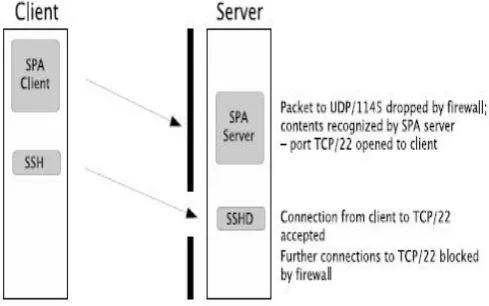
Single Packet Authorization, or SPA, has the same goals as port knocking, but, instead of encoding authentication information in a series of port numbers, it encodes it in the payload of a single UDP datagram (see Figure 3.2). This allows for authentication messages of several kilobytes to be used without concern for packet reordering.
The information encoded in an SPA message is generally similar to what might be encoded in a port knocking sequence (see Section 3.2.1). A message containing a plain-text secret could be used, although most existing implementations use some sort of encrypted or one-time message. Unfortunately, the phenomenon of misused cryptography and broken authentication protocols is not limited to port knocking. Cryptknock [Wal04] (actually an SPA system, despite its name) uses an unauthenticated Diffie-Hellman exchange to generate a session key which is then used to encrypt a shared secret; if the server accepts the secret, then it allows unrestricted access to the originating host. Since this protocol doesn‘t associate the shared secret with the client‘s IP address, an attacker could break it by re-writing the client‘s IP headers to make it appear to the server that they originated at the attacker, then forwarding the server‘s responses back to the client. Alternately, the standard man-in-the-middle attack against Diffie-Hellman [Sta03] would allow an attacker to recover the shared secret. Tailgate TCP (TGTCP) [BHI+02], Doorman [War05], tumbler [GC04],
and fwknop [Ras06] implement SPA with more robust authentication schemes.
GSJ© 2018
Figure 3.1: SPA example. A port is opened in the firewall in response to an authentication packet.
Advantages of SPA
As Rash [Ras06] points out, SPA is easier to implement and less failure-prone than port knocking and is probably preferable in most circumstances.
1. An SPA server can be written as a normal network service on an open port. Since UDP services are not required to respond to messages that they receive, and the protocol does not automatically generate any response, a non-responding UDP service on an open port on a system that silently drops unexpected packets is indistinguishable from a closed port to a port scan. An SPA server can therefore be written as a normal network service, without needing to resort to packet sniffers or any platform-specific mechanisms. (However, such a design may put constraints on the available mechanisms to manipulate firewall states.)
2. Since only one packet must be sent before opening a connection, an SPA authentication exchange takes much less time and is less vulnerable to packet loss than port knocking, besides being immune to packet reordering. 3. NATs and stateful firewalls between SPA clients and servers will only have to allocate resources for at most one logical connection, rather than one for each knock as required with port knocking.
4. Compared to port knocking, SPA can use relatively large authentication messages without sacrificing performance and reliability.
Disadvantages of SPA
Despite being much less sensitive to packet ordering than port knocking, SPA systems will still fail if a connection attempt reaches the
firewall before the authentication packet has been received and processed. They will also fail if an authentication packet, or a fragment of one, is dropped or corrupted in transit.
SPA servers typically cannot be implemented as log readers, since SPA systems need to access packet payloads and firewalls generally don‘t log any more than packet headers. However, this is not usually a problem, since log reading is an inefficient design compared to its alternatives (see Section 3.2.2) and is seldom used for SPA. Egress filters may not pass outbound traffic destined to unusual UDP ports, but SPA servers could run on ports regularly used for ―normal‖ traffic. For instance, most egress filters will permit DNS traffic; SPA messages bound to a server running on port 53/UDP would likely pass unmolested.
3.2 Variations on SPA
It is possible to encode SPA messages into the payloads of any protocol. In [Ras06], Rash suggests using the payloads of ICMP or GRE messages. In theory, raw IP messages with no transport headers at all could also be used. Although such systems have the potential to be extraordinarily stealthy (ICMP echo-request, (―ping‖) messages are very common in the Internet background radiation [PYB+04], although GRE and raw IP messages are rather unusual), they do present some implementation challenges.
GSJ© 2018
firewall‘s network stack, and some egress filters may drop SYN segments carrying data.
3.3 Active-covert SPA
Since SPA traffic is visible to packet sniffers and is not disguised as background noise, it cannot normally be considered active-covert. However, it is possible to give active-covert properties to SPA by encoding the payload as something that might normally be seen in background traffic and setting the destination port to match. For instance, authentication information encoded as ASCII text and sent to port 1026/UDP with the proper headers would resemble Windows Messenger spam [LUR03], and a message resembling Intel x86 machine code sent to port 1434/UDP might be mistaken for the Sapphire worm [MPS+03].
3.4 Concerns about “Security by Obscurity”
Port knocking systems in particular have often been accused [BBO05, MMETC05, Nar04] of being nothing more than ―security by obscurity‖. Generally, these claims are based on assumptions that the security of port knocking authentication systems is based solely on them remaining hidden, or that concealing security-sensitive information is bad and that all details of security systems should be visible.
Beale [Bea00] describes a system relying on security by obscurity as one that relies on critical knowledge about the system‘s design being kept secret, though the secret information could be discovered by an outsider without unreasonable effort. The authentication systems used by traditional services such as telnet and FTP, which send passwords in plain text, are generally considered insecure by modern standards [Bel89], but their well-specified protocols and documented reliance on the secrecy only of small easily-changeable per-user passwords leave them well outside of the realm of security by obscurity. This is equally true for similarly-designed services such as SSH, which employ cryptography to protect secrets in transit.
The security of port knocking systems and other covert authentication schemes is also dependent only on the knowledge of small, easily changeable secrets; in the case of port knocking systems, these are port sequences. Systems that send their secrets are equivalent in security to telnet, whereas those that use cryptographic protocols are more akin to SSH. In neither case
does the security of the authentication system depend on any other property. The covertness of the communication channels being used is not necessary; if the same information was transmitted across normal, open ports, the system would remain secure. Rather, the covertness only serves to increase the level of effort required to attack the systems. As Beale points out, concealing an already-secure service is not a weakness but rather has a number of advantages, reducing the number of attacks faced by the system and forcing attackers to do more work, which both slows them down and makes their actions more obvious.
Improvements to Port Knocking and SPA
As presented in the previous chapter, port knocking and SPA have a number of weaknesses. In this chapter, novel techniques for addressing some of these weaknesses and other improvements to port knocking are introduced. First, I introduce methods for conducting challenge-response authentication using SPA or port knocking, which improve on some of the limitations of the authentication algorithms described in Section 3.1 and enable authentication of the server as well as of the client. Next, a variety of strategies for ensuring that port knock sequences can be correctly decoded, even if delivered out of order, are discussed. Third, two alternate methods for encoding information into port sequences are introduced. Finally, several possible ways of associating authentication exchanges with connections and preventing race attacks are described.