
Keywords
Highlights
Abstract
Graphical abstract
197
Review Paper
Received 2018-03-26 Revised 2018-06-30 Accepted 2018-08-08 Available online 2018-08-08
MT-SOFC Sponge-like Finger-like Microstructure Extrusion
• There is limited information on the structure of anode and its effect to the cell performance. • Pore formation in anode and its effect to the MT-SOFC performance has been reviewed. • Finger-like voids affected the anode’s mechanical strength, permeation and conductivity. • Pore formation in anode become a key parameter in producing high performance MT-SOFC.
Journal of Membrane Science and Research 5 (2019) 197-204
Structure Formation in Anode and Its Effect on the Performance of Micro-Tubular SOFC: A
Brief Review
1
Advanced membrane Technology Research Centre, Universiti Teknologi Malaysia, 81310 UTM JB, Johor, Malaysia
2
Renewable Energy Research Group, Department of Energy Engineering, Faculty of Chemical and Energy Engineering, Universiti Teknologi Malaysai,
81310 UTM JB, Johor, Malaysia
Siti Munira Jamil
1,2, Siti Halimah Ahmad
1,2, Mazlinda Ab Rahman
1,2, Mohd Hafiz Dzarfan Othman
1,2,*, Mukhlis A
Rahman
1, Juhana Jaafar
1, Ahmad Fauzi Ismail
1Article info
© 2019 MPRL. All rights reserved.
* Corresponding author at: Phone: +607-5536373; fax: +607-5535925 E-mail address: [email protected] (M.H.D. Othman) DOI: 10.22079/JMSR.2018.83592.1187
1. Introduction
Recently, development in solid oxide fuel cells (SOFCs) are mainly
focusing on the structures, designs, materials, and fabrication techniques of
the components (i.e. anode, electrolyte, cathode, and interconnects) in order to
meet the requirement of power production and boost the SOFCs performance
in an economic way. There are two common structural designs; planar or
tubular SOFCs, depending on its shape and structure. The tubular design has
been introduced by extrusion method in order to prevent the thermal shock
problem facing by conventional planar design. Since the power density is
inversely proportional to the tubular cell diameter, Singhal and Kendall
[1]
had initiated an effort by introducing a smaller cell diameter known as
micro-Contents
1. Introduction ...197
2. Characteristics of an Efficient Anode Substrate for MT-SOFC...198
3. Fabrication Technique of Anode-Supported MT-SOFC...198
4. Pores in Anode Prepared by Phase Inversion...199
5. Effect of pores to the fuel cell performance...200
6. Conclusion and Future Direction...200
References ... 200
Journal of Membrane Science & Research
journal homepage: www.msrjournal.com
Anode-supported micro-tubular solid oxide fuel cell (SOFC) offers many advantages over the electrolyte and cathode-supported configurations in terms of simplicity, reliability, and efficiency. In such design, the anode substrates should possess a highly porous structure, provide active sites reaction as well as serving good mechanical strength. This structure is desired to provide enough fuel, which in turn increases the reaction rate and reduces the concentration polarisation. Hence, pore formation in anode become a key parameter in producing high performance micro-tubular SOFC. This review is mainly focusing on the fabrication of anode substrate for micro-tubular SOFC, the types of pores in anode structure and its effect to the cell performance.
S.M. Jamil et al. / Journal of Membrane Science and Research 5 (2019) 197-204
tubular SOFCs (MT-SOFCs). The development of this advanced cell design
promotes an excellent thermal stability during rapid heat cycling, quick
start-up capability, high power output density, low capital cost and portable
characteristics compared to the conventional planar and tubular SOFCs
[2]
.
In early 1990s to late 2000s, first generation of MT-SOFC developed was
designed in an electrolyte-supported SOFC system with YSZ electrolyte tubes
up to 5 mm in diameter. Thick electrolyte layer was first developed to serve
as support layer of the cell. Indeed, support layer responsible to provide
mechanical strength to the entire cell for deposition of the remaining cell
layers
[3]
. Other promising designs include electrode-supported SOFC which
uses thick anode or cathode as the supporting layer.
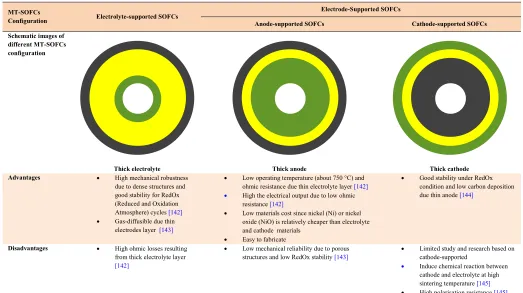
Table 1
shows the
comparison of different configurations in SOFC. Anode-supported
MT-SOFC
[4-104]
is more favourable than other type of configurations;
electrolyte-supported
[80,105–114]
and cathode-supported
[2,115–120]
since
it allows the deposition of thin electrolyte layer, which results to the reduction
in ohmic lose and consequently, enhance cell’s power density
[35,83,121]
.
Besides, it offers many other advantages in terms of simplicity, reliability,
and efficiency.
The anode will particularly serves as a “backbone” to support for the
whole micro-tubular cell which gives mechanical support for the thin
electrolyte and cathode layer
[122]
. Therefore, it is crucial to fully understand
the structural properties of the anode substrates because these structural
properties (i.e. particle size, porosity, pore-size distribution and composition
of phases) determine the performances of SOFC system
[4,11,50,123–127]
.
For instance, the performances represent its mechanical strength, gas
permeability, tortuosity, electrical conductivity, and power-generating
characteristic
[128]
. Therefore, this review focuses mainly on the fabrication
of anode tube as a substrate layer for MT-SOFC, types of pore structure in the
anode and how the pores could affect the performance of anode-supported
SOFC.
2. Characteristics of an Efficient Anode Substrate for MT-SOFC
Besides acting as the mechanical support for SOFCs cell (in
anode-supported case), anode tube primarily serves as a catalyst to provide active
sites reaction or known as triple-phase boundaries (TPB) regions for the
electrochemical oxidation of fuels. The electrochemical active sites in anode
are responsible to produce numbers of ionic and electronic conduction paths
besides create diffusion path for fuels and by-products (i.e. water and carbon
dioxide) to reach and leave the site reactions, simultaneously
[128]
.
Consequently, the anode substrates should possess a highly porous structure
and retain its porosity after sintering. However, excessive porosity may
degrade its mechanical strength
[53]
and its availability to provide the active
TPB areas
[125]
.
Metallic-anode material such as nickel (Ni) is commonly used as
the main material for anode due to its excellent catalytic activity towards
reforming and oxidation reaction
[49,67,76,121-122,124,129–139]
. Indeed,
nickel is relatively low cost, excellent chemical stability, and high electronic
conductivity. For the fabrication of anode tube as a substrate, nickel oxide
(NiO) is commonly used instead of Ni, due to ease of processing and high
availability, in which the sintered NiO tube will be reduced to Ni under
hydrogen environment later. To date, ceramic-metallic material known as
cermet is widely used as it satisfies most of the general requirements for
SOFC anode. NiO is blended with electrolyte materials such as
yttria-stabilized zirconia (YSZ) or cerium gadolinium oxide (CGO) in the dope
suspension as the addition of electrolyte materials would extend the active
zones for anode reaction, prevent the Ni from aggregation, reduce the thermal
expansion coefficient mismatch and produce effective adhesion with
electrolyte layer
[140]
.
3. Fabrication Technique of Anode-Supported MT-SOFC
The quality of the anode supported cell mainly depends on its fabrication
technique since the macrostructure, thickness and compound uniformity could
be tailored during the fabrication process. Recently, an article that reviewed
the most common and recent fabrication technique for MT-SOFCs method
namely plastic mass ram extrusion and dry-jet wet extrusion has been
published
[141]
. There are a number of similarities as well as dissimilarities
between these two methods.
Table 1
Comparison of different configurations in MT-SOFCs.
MT-SOFCs
Configuration Electrolyte-supported SOFCs
Electrode-Supported SOFCs
Anode-supported SOFCs Cathode-supported SOFCs Schematic images of
different MT-SOFCs configuration
Thick electrolyte Thick anode Thick cathode
Advantages High mechanical robustness due to dense structures and good stability for RedOx (Reduced and Oxidation Atmosphere) cycles [142]
Gas-diffusible due thin electrodes layer [143]
Low operating temperature (about 750 °C) and ohmic resistance due thin electrolyte layer [142] High the electrical output due to low ohmic
resistance [142]
Low materials cost since nickel (Ni) or nickel oxide (NiO) is relatively cheaper than electrolyte and cathode materials
Easy to fabricate
Good stability under RedOx condition and low carbon deposition due thin anode [144]
Disadvantages High ohmic losses resulting from thick electrolyte layer [142]
Low mechanical reliability due to porous structures and low RedOx stability [143]
Limited study and research based on cathode-supported
Induce chemical reaction between cathode and electrolyte at high sintering temperature [145]
High polarisation resistance [145]
S.M. Jamil et al. / Journal of Membrane Science and Research 5 (2019) 197-204
Fig. 1. Schematic diagram of hollow fibre fabrication via dry-jet wet extrusion.
In the ram extrusion method, a viscous paste is form by mixing the anode
materials (NiO and YSZ) prior being transformed to support tubes using a
customized die. Before proceeding to the sintering step, the support tubes are
dried and cut to the 30 cm length. In contrast, the suspension of dry-jet wet
extrusion method is in liquid form and the solidification of the hollow fibre
occurs via phase inversion process initiated by the solvent/non-solvent
exchange. Whereas in ram extrusion method, the tubes are dried immediately
after extrusion before the sintering process.
The dry-jet wet extrusion is slightly more complex than that of the ram
extrusion since it involves a non-solvent as coagulant. The system set-up is
illustrated in
Figure 1
. The anode suspension is firstly prepared using anode
materials (e.g. NiO and YZS), organic solvent (e.g. N-methylpyrrolidone) and
polymer binder (e.g. polyethersulfone). The hollow fibre precursor formed
after the internal coagulant passing through the spinneret centres.
Subsequently, the solidification process via solvent/non-solvent exchange
where the process called as phase-inversion
[146]
. Lastly, the hollow fibre is
dried and cut to 30 cm before being sintered and reduced.
4. Pores in Anode Prepared by Phase Inversion
Distinctive fabrication methods would result in diverse anode structures
[128]
. For instance, mass ram extrusion method usually generates a
symmetrical structure
[34]
whereas dry-jet wet extrusion technique
commonly creates an asymmetric structure of anode tubes
[83]
, as illustrated
in
Figure 2
. Symmetric and asymmetric structures determine the
homogeneous and heterogeneous morphology, respectively.
Microscopic pores that formed after NiO reduction to Ni is uniformly
circulated in the anode regions which eventually improve the fuel and gas
transportation in the layer
[7]
. Thus, several researchers had incorporated
degradable pore-forming agent such as graphite
[53,128]
starch
[125]
and
poly methyl methacrylate beads (PMMA) [7,52] into the anode suspension in
order to induce the macro-size pore in anode substrate during the sintering
process.
On the other hand, the formation of asymmetric structure through
phase-inversion comprises of finger-like and sponge-like regions as shown in
Figure
2 (b)
. The resultant structures enhances the gas diffusion as well as the flow
of fuel and reaction products
[83]
. If the structural formation is one of the
restraints of ram extrusion, the ability of dry-jet wet extrusion on generating
preferred morphology can be realized by simple adjustment on additive
loading in the suspension, air gap, or flow rate of internal coagulant
[83,104]
.
Figure 3
shows the effect of ethanol loading in the dope suspension as the
fabrication parameters on anode asymmetric structure
[55]
, where
characterized by the finger-like voids length. The sample name written in the
SEM images was based on how much ethanol was added into the suspension.
For example, E-0 represents 0 wt.% of ethanol while E-15 was for 15 wt.% of
ethanol. As can be seen, addition of ethanol (from 0 to 20 wt.%) in anode
inner suspension had resulted to the reduction in the finger-like voids length
from 85 to 50% of anode thickness. This can be explained by the rise in the
suspension viscosity when ethanol content is increased, which then will
accelerate the precipitation rate during phase inversion process and thus
resulting in shorter finger-like voids.
Pore from pore former
Sponge-like pore
Pore from NiO reduction
Finger-like void
CGO or YSZ
Ni
(a) Symmetric structure from extrusion
(b) Asymmetric structure from dry-jet wet extrusion
Fig. 2. Schematic diagrams of different structures of MT-SOFCs; (a) Symmetric structure from ram extrusion and, (b) Asymmetric structure from dry-jet wet extrusion [147].
S.M. Jamil et al. / Journal of Membrane Science and Research 5 (2019) 197-204
Fig. 3. SEM images of cross section of Ni-CGO anode with different anode structure [55].
The macrostructures of the hollow fibre such as the finger-like void
length and the anode thickness are normally controlled during the dope
preparation and extrusion process. On the contrary, the microstructure of
anode can be tailored during high temperature sintering process. The particles
rearrangements during sintering will led the particles bind together and
induces pore channels along the grain boundaries. Then, the pores remain
shrinking besides some of them pinch off and isolated at the grain boundaries
as the temperature rises. Thus, some of sponge-like pore become smaller and
probably eliminated during the sintering process depends on the temperature
applied for the sintering. However, macrovoids as finger-like structure are
still retained during sintering
[148]
.
After sintering, the reduction of nickel oxide (NiO) phases to Ni phases is
performed and this process further promotes the micropores formation due to
the removal of oxygen atoms from the NiO crystal structure
[149]
. Therefore,
it can be concluded that three types of pore is expected to form in the anode
substrate prepared by the dry-jet wet extrusion technique, which are (a)
finger-like voids, (b) sponge-like pores that survived from the sintering
process and (c) the pores that created during the reduction of NiO
[76]
.
5. Effect of pores to the fuel cell performance
Finger-like voids and sponge-like regions plays an important role to the
anode support. In general, finger-like voids provide less resistance route for
the fuel gas and products transportation, while the sponge-like structure
provides a large number of TPB for the electrochemical reactions
[126]
and
also give the major support to the hollow fibre
[7]
.
In terms of fuel cell performance, it has been proven that the larger
entrance pore size at the finger-like voids in the anode regions together with
longer finger-like voids would reduce the fuel gas diffusion resistance into the
finger-like voids zone
[55]
. It can be clearly seen in
Figure 4
that the anode
structure affected the maximum power density of the fabricated cells. The
maximum power density increases with the increases of finger-like void
lengths. The highest value was recorded at 2.32 Wcm
-2for the cell with 70%
finger-like voids lengths (E-5). However, at about 85% finger-like voids
thickness (E-20), the number of TPB region and anode conductivity are
significantly reduced which eventually impairs the overall cell performance.
The improvement in the power density by the extension of finger-like
length can be explained by the micro-view illustration as shown in
Figure 3
.
Micro-channels provided by the finger-like voids structure in anode region
helps to improve the fuel mixing and diffusion in the anode TPB region.
Bigger finger-like voids entrance pore is commonly results from longer
finger-like voids which gives excellent fuel gas diffusion into the finger-like
voids region
[104]
. Moreover, vortex-flow inside the macro-voids induced by
the conical shape of finger-like voids as proposed by Rahman et al.
[150]
[151]
. Hence, the existence of longer voids could improve fuel mixing and
subsequently offers better and greater uniform fuel gas distribution
throughout the TPB in sponge-like region.
6. Conclusion and Future Direction
According to the interpretations, the anode structure was found to be
greatly influenced by the fabrication methods. The anode support prepared by
ram extrusion commonly gives symmetric structure while dry-jet wet
extrusion technique typically induces the formation of the asymmetric
structure which consists of finger-like voids and sponge-like region.
Finger-like voids provide a less resistance route for fuel gas and the products
transportation whereas sponge-like structure offers a large number of TPB for
electrochemical reactions as well as mechanical strength to the hollow fibre.
Moreover, dry-jet wet extrusion technique allows adjustments on extrusion
parameters which eventually produce controlled structures in anode. Despite
the fact that the anode hollow fibre with longer finger-like voids length and
high porosity structure give higher gas permeation, it can strongly reduce the
substrate’s mechanical strength, destroying the TPB areas and ultimately
affects the overall performance. Thus, the anode structure is one of the key
parameter that has to be considered in order to fabricate a high performance
cell.
0 0.1 0.2 0.3 0.4 0.5 0.6 0.7 0.8
0 20000 40000 60000 80000 100000 120000
0 4000 8000 12000 16000 20000 24000 28000 32000
E-20 E-15 E-10 E-5 E-0
Current density (A m-2)
C
e
ll
v
o
lt
a
g
e
(V
) Pow
er
d
e
n
si
ty
(W
m
-2
)
Fig. 4. MT- SOFCs performance with different anode structures [55].
References
[1] S.C. Singhal, K. Kendall, High Temperature Solid Oxide Fuel Cells, Elsevier Advanced Technology, UK, 2003.
[2] X. Meng, X. Gong, N. Yang, X. Tan, Y. Yin, Z.-F. Ma, Fabrication of Y2O3-stabilized-ZrO2(YSZ)/La0.8Sr0.2MnO3−α–YSZ dual-layer hollow fibers for the cathode-supported micro-tubular solid oxide fuel cells by a
co-spinning/co-sintering technique, J. Power Sources. 237 (2013) 277–284.
doi:10.1016/j.jpowsour.2013.03.026.
[3] C.C. Wei, O.Y. Chen, Y. Liu, K. Li, Ceramic asymmetric hollow fibre membranes—One step fabrication process, J. Memb. Sci. 320 (2008) 191–197. doi:10.1016/j.memsci.2008.04.003.
[4] N. Droushiotis, U. Doraswami, K. Kanawka, G.H. Kelsall, K. Li, Characterization of NiO–yttria stabilised zirconia (YSZ) hollow fibres for use as SOFC anodes, Solid State Ionics. 180 (2009) 1091–1099. doi:10.1016/j.ssi.2009.04.004. [5] N.M. Sammes, Y. Du, Fabrication and Characterization of Tubular Solid Oxide
Fuel Cells, Int. J. Appl. Ceram. Technol. 4 (2007) 89–102. doi:10.1111/j.1744-7402.2007.02127.x.
[6] Y. Liu, M. Mori, Y. Funahashi, Y. Fujishiro, A. Hirano, Development of micro-tubular SOFCs with an improved performance via nano-Ag impregnation for intermediate temperature operation, Electrochem. Commun. 9 (2007) 1918–1923. doi:10.1016/j.elecom.2007.05.003.
S.M. Jamil et al. / Journal of Membrane Science and Research 5 (2019) 197-204
[7] M.H.D. Othman, Z. Wu, N. Droushiotis, G.H. Kelsall, K. Li, K. Kanawka, U. Doraswami, Morphological studies of macrostructure of Ni–CGO anode hollow fibres for intermediate temperature solid oxide fuel cells, J. Memb. Sci. 360 (2010) 410–417. doi:http://dx.doi.org/10.1016/j.memsci.2010.05.040.
[8] F. a. Yu, C.C. Wu, T.H. Yeh, J.S. Cherng, Effects of layer thickness on the performance of micro-tubular solid oxide fuel cells made by sequential aqueous electrophoretic deposition, Int. J. Hydrogen Energy. (2015) 5–9. doi:10.1016/j.ijhydene.2015.05.191.
[9] X.Z. Zhang, Y.Q. Wang, J. Zhang, Q.B. Chang, Y.H. Jiang, J.E. Zhou, Investigation of Cobalt-Free Cathode Material Ba0.5Sr0.5Fe0.8Cu0.2O3−δ for Micro-Tubular SOFC with Asymmetric Structure Anode, Key Eng. Mater. 519 (2012) 36–40. doi:10.4028/www.scientific.net/KEM.519.36.
[10] T. Li, Z. Wu, K. Li, Single-step fabrication and characterisations of triple-layer ceramic hollow fibres for micro-tubular solid oxide fuel cells (SOFCs), J. Memb. Sci. 449 (2014) 1–8. doi:10.1016/j.memsci.2013.08.009.
[11] H. Sumi, D. Kennouche, K. Yakal-kremski, T. Suzuki, S.A. Barnett, D.J. Miller, T. Yamaguchi, K. Hamamoto, Y. Fujishiro, Electrochemical and microstructural properties of Ni–(Y2O3)0.08(ZrO2)0.92–(Ce0.9Gd0.1)O1.95 anode-supported microtubular solid oxide fuel cells, Solid State Ionics. 285 (2016) 227–233. doi:10.1016/j.ssi.2015.07.005.
[12] S.H. Ahmad, S.M. Jamil, M.H.D. Othman, M.A. Rahman, J. Jaafar, A.F. Ismail, Co-extruded dual-layer hollow fiber with different electrolyte structure for a high temperature micro-tubular solid oxide fuel cell, Int. J. Hydrogen Energy. (2016) 1– 9. doi:10.1016/j.ijhydene.2016.06.044.
[13] T. Suzuki, T. Yamaguchi, Y. Fujishiro, M. Awano, Fabrication and
characterization of micro tubular SOFCs for operation in the intermediate
temperature, J. Power Sources. 160 (2006) 73–77.
doi:10.1016/j.jpowsour.2006.01.037.
[14] T. Suzuki, K. Hamamoto, T. Yamaguchi, F. Fujishiro, Performance and Energy Efficiency of a Single Microtubular Anode Supported Cell, Electrochem. Soc. (2011).
[15] U. Doraswami, N. Droushiotis, G.H. Kelsall, Modelling effects of current distributions on performance of micro-tubular hollow fibre solid oxide fuel cells, Electrochim. Acta. 55 (2010) 3766–3778. doi:10.1016/j.electacta.2010.01.080. [16] H. Sumi, T. Yamaguchi, K. Hamamoto, T. Suzuki, Y. Fujishiro, Effects of Anode
Microstructure on Mechanical and Electrochemical Properties for Anode-Supported Microtubular Solid Oxide Fuel Cells, J. Am. Ceram. Soc. 96 (2013) 3584–3588. doi:10.1111/jace.12603.
[17] C. Yang, C. Ren, L. Yu, C. Jin, High performance intermediate temperature micro-tubular SOFCs with Ba0.9Co0.7Fe0.2Nb0.1O3−δ as cathode, Int. J. Hydrogen Energy. 38 (2013) 15348–15353. doi:10.1016/j.ijhydene.2013.09.080.
[18] Ö. Aydin, T. Koshiyama, H. Nakajima, T. Kitahara, In-situ diagnosis and assessment of longitudinal current variation by electrode-segmentation method in anode-supported microtubular solid oxide fuel cells, J. Power Sources. 279 (2015) 218–223. doi:10.1016/j.jpowsour.2014.12.156.
[19] T. Suzuki, T. Yamaguchi, H. Sumi, K. Hamamoto, Y. Fujishiro, Microtubular solid-oxide fuel cells for low-temperature operation, Mat. Res. Bull. 39 (2014) 805–809. doi:10.1557/mrs.2014.172.
[20] N. Droushiotis, A. Torabi, M.H.D. Othman, T.H. Etsell, G.H. Kelsall, Effects of lanthanum strontium cobalt ferrite (LSCF) cathode properties on hollow fibre micro-tubular SOFC performances, J. Appl. Electrochem. 42 (2012) 517–526. doi:10.1007/s10800-012-0429-x.
[21] F.D. Grande, A. Thursfield, K. Kanawka, N. Droushiotis, U. Doraswami, K. Li, G. Kelsall, I.S. Metcalfe, Microstructure and performance of novel Ni anode for hollow fibre solid oxide fuel cells, Solid State Ionics. 180 (2009) 800–804. doi:10.1016/j.ssi.2008.12.038.
[22] D. Zhou, S. Peng, Y. Wei, Z. Li, H. Wang, Novel asymmetric anode-supported hollow fiber solid oxide fuel cell, J. Alloys Compd. 523 (2012) 134–138. doi:10.1016/j.jallcom.2012.01.120.
[23] T. Suzuki, Y. Takahashi, K. Hamamoto, T. Yamaguchi, Y. Fujishiro, Low temperature processed composite cathodes for Solid-oxide fuel Cells, Int. J. Hydrogen Energy. 36 (2011) 10998–11003. doi:10.1016/j.ijhydene.2011.05.155. [24] M.A. Laguna-bercero, A.R. Hanifi, T.H. Etsell, P. Sarkar, Microtubular solid
oxide fuel cells with lanthanum strontium manganite infiltrated cathodes, Int. J. Hydrogen Energy. 40 (2015) 5469–5474. doi:10.1016/j.ijhydene.2015.01.060. [25] N. Akhtar, S.P. Decent, D. Loghin, K. Kendall, Mixed-reactant, micro-tubular
solid oxide fuel cells: An experimental study, J. Power Sources. 193 (2009) 39–48. doi:10.1016/j.jpowsour.2009.01.032.
[26] L. Zhao, X. Zhang, B. He, B. Liu, C. Xia, Micro-tubular solid oxide fuel cells with graded anodes fabricated with a phase inversion method, J. Power Sources. 196 (2011) 962–967. doi:10.1016/j.jpowsour.2010.08.074.
[27] J.-J. Sun, Y.-H. Koh, W.-Y. Choi, H.-E. Kim, Fabrication and Characterization of Thin and Dense Electrolyte-Coated Anode Tube Using Thermoplastic Coextrusion, J. Am. Ceram. Soc. 89 (2006) 1713–1716. doi:10.1111/j.1551-2916.2006.00918.x.
[28] N. Droushiotis, M.H.D. Othman, U. Doraswami, Z. Wu, G. Kelsall, K. Li, Novel co-extruded electrolyte–anode hollow fibres for solid oxide fuel cells,
Electrochem. Commun. 11 (2009) 1799–1802.
doi:http://dx.doi.org/10.1016/j.elecom.2009.07.022.
[29] N. Droushiotis, U. Doraswami, G.H. Kelsall, K. Li, Micro-tubular solid oxide fuel cells fabricated from hollow fibres, J. Appl. Electrochem. 41 (2011) 1005–1012. doi:10.1007/s10800-011-0334-8.
[30] J. Li, Z. Lin, Effects of electrode composition on the electrochemical performance and mechanical property of micro-tubular solid oxide fuel cell, Int. J. Hydrogen Energy. 37 (2012) 12925–12940. doi:10.1016/j.ijhydene.2012.05.075.
[31] C.M. Dikwal, W. Bujalski, K. Kendall, Characterization of the electrochemical performance of micro-tubular SOFC in partial reduction and oxidation conditions, J. Power Sources. 181 (2008) 267–273. doi:10.1016/j.jpowsour.2007.11.052.
[32] K. V Galloway, N.M. Sammes, Performance Degradation of Microtubular SOFCs
Operating in the Intermediate-Temperature Range, J. Electrochem. Soc. 156 (2009) B526--B531.
[33] H. Sumi, T. Yamaguchi, K. Hamamoto, T. Suzuki, Y. Fujishiro, T. Matsui, K. Eguchi, AC impedance characteristics for anode-supported microtubular solid
oxide fuel cells, Electrochim. Acta. 67 (2012) 159–165.
doi:10.1016/j.electacta.2012.02.021.
[34] T. Suzuki, Y. Funahashi, T. Yamaguchi, Y. Fujishiro, M. Awano, Effect of anode microstructure on the performance of micro tubular SOFCs, Solid State Ionics. 180 (2009) 546–549. doi:10.1016/j.ssi.2008.09.023.
[35] M.H.D. Othman, N.N. Droushiotis, Z. Wu, K. Kanawka, G. Kelsall, K. Li, Electrolyte thickness control and its effect on electrolyte/anode dual-layer hollow fibres for micro-tubular solid oxide fuel cells, J. Memb. Sci. 365 (2010) 382–388. doi:10.1016/j.memsci.2010.09.036.
[36] S. Peng, D. Zhou, Y. Wei, Z. Li, H. Wang, A novel U-shaped anode-supported hollow fiber solid oxide fuel cell with considerable thermal cycling performance
and stability, J. Memb. Sci. 417–418 (2012) 80–86.
doi:10.1016/j.memsci.2012.06.016.
[37] S. Hashimoto, H. Nishino, Y. Liu, K. Asano, M. Mori, Y. Funahashi, Y. Fujishiro, The electrochemical cell temperature estimation of micro-tubular SOFCs during the power generation, J. Power Sources. 181 (2008) 244–250. doi:10.1016/j.jpowsour.2007.12.104.
[38] R. Campana, R.I. Merino, a. Larrea, I. Villarreal, V.M. Orera, Fabrication, electrochemical characterization and thermal cycling of anode supported microtubular solid oxide fuel cells, J. Power Sources. 192 (2009) 120–125. doi:10.1016/j.jpowsour.2008.12.107.
[39] T. Liu, Y. Wang, C. Ren, S. Fang, Y. Mao, F. Chen, Novel light-weight, high-performance anode-supported microtubular solid oxide fuel cells with an active anode functional layer, J. Power Sources. 293 (2015) 852–858. doi:10.1016/j.jpowsour.2015.06.018.
[40] M.J. López-Robledo, M.A. Laguna-Bercero, J. Silva, V.M. Orera, A. Larrea, Electrochemical performance of intermediate temperature micro-tubular solid oxide fuel cells using porous ceria barrier layers, Ceram. Int. 41 (2015) 7651– 7660. doi:10.1016/j.ceramint.2015.02.093.
[41] T. Yamaguchi, T. Suzuki, S. Shimizu, Y. Fujishiro, M. Awano, Examination of wet coating and co-sintering technologies for micro-SOFCs fabrication, J. Memb. Sci. 300 (2007) 45–50. doi:10.1016/j.memsci.2007.05.002.
[42] T. Yamaguchi, K. V. Galloway, J. Yoon, N.M. Sammes, Electrochemical characterizations of microtubular solid oxide fuel cells under a long-term testing at intermediate temperature operation, J. Power Sources. 196 (2011) 2627–2630. doi:10.1016/j.jpowsour.2010.11.061.
[43] C. Yang, C. Jin, F. Chen, Micro-tubular solid oxide fuel cells fabricated by
phase-inversion method, Electrochem. Commun. 12 (2010) 657–660.
doi:10.1016/j.elecom.2010.02.024.
[44] X. Meng, X. Gong, N. Yang, Y. Yin, X. Tan, Carbon-resistant Ni-YSZ / Cu e CeO 2 -YSZ dual-layer hollow fiber anode for micro tubular solid oxide fuel cell, Int. J. Hydrogen Energy. 39 (2014) 3879–3886. doi:10.1016/j.ijhydene.2013.12.168. [45] X. Meng, X. Gong, Y. Yin, N. Yang, X. Tan, Z.-F. Ma, Effect of the co-spun
anode functional layer on the performance of the direct-methane microtubular solid oxide fuel cells, J. Power Sources. 247 (2014) 587–593. doi:10.1016/j.jpowsour.2013.08.133.
[46] C. Jin, C. Yang, F. Chen, Effects on microstructure of NiO–YSZ anode support fabricated by phase-inversion method, J. Memb. Sci. 363 (2010) 250–255. doi:10.1016/j.memsci.2010.07.044.
[47] N. Yang, X. Tan, Z. Ma, A. Thursfield, Fabrication and Characterization of Ce 0.8 Sm 0.2 O 1.9 Microtubular Dual-Structured Electrolyte Membranes for Application in Solid Oxide Fuel Cell Technology, J. Am. Ceram. Soc. 92 (2009) 2544–2550. doi:10.1111/j.1551-2916.2009.03267.x.
[48] X. Zhang, B. Lin, Y. Ling, Y. Dong, G. Meng, X. Liu, An anode-supported hollow fiber solid oxide fuel cell with (Pr0.5Nd0.5)0.7Sr0.3MnO3−δ–YSZ composite
cathode, J. Alloys Compd. 497 (2010) 386–389.
doi:10.1016/j.jallcom.2010.03.084.
[49] B. Liang, T. Suzuki, K. Hamamoto, T. Yamaguchi, Y. Fujishiro, M. Awano, B.J. Ingram, J.D. Cater, Effect of the adding ferrum in nickel/GDC anode-supported solid-oxide fuel cell in the intermediate temperature, Int. J. Hydrogen Energy. 36 (2011) 10975–10980. doi:10.1016/j.ijhydene.2011.05.142.
[50] C. Ren, T. Liu, P. Maturavongsadit, J.A. Luckanagul, F. Chen, Effect of PEG additive on anode microstructure and cell performance of anode-supported MT-SOFCs fabricated by phase inversion method, J. Power Sources. 279 (2015) 774– 780. doi:10.1016/j.jpowsour.2014.12.140.
[51] C. Jin, J. Liu, L. Li, Y. Bai, Electrochemical properties analysis of tubular NiO– YSZ anode-supported SOFCs fabricated by the phase-inversion method, J. Memb. Sci. 341 (2009) 233–237. doi:10.1016/j.memsci.2009.06.012.
[52] M. Torrell, A. Morata, P. Kayser, M. Kendall, K. Kendall, A. Tarancon, Performance and long term degradation of 7 W micro-tubular solid oxide fuel cells for portable applications, J. Power Sources. 285 (2015) 439–448. doi:10.1016/j.jpowsour.2015.03.030.
S.M. Jamil et al. / Journal of Membrane Science and Research 5 (2019) 197-204
[53] A. Sarikaya, V. Petrovsky, F. Dogan, Effect of the anode microstructure on the enhanced performance of solid oxide fuel cells, Int. J. Hydrogen Energy. 37 (2012) 11370–11377. doi:10.1016/j.ijhydene.2012.05.007.
[54] N. Akhtar, K. Kendall, Silver modified cathode for a micro-tubular, single-chamber solid oxide fuel cell, Int. J. Hydrogen Energy. 36 (2011) 773–778. doi:10.1016/j.ijhydene.2010.10.043.
[55] M.H.D. Othman, N. Droushiotis, Z. Wu, G. Kelsall, K. Li, Dual-layer hollow fibres with different anode structures for micro-tubular solid oxide fuel cells, J.
Power Sources. 205 (2012) 272–280.
doi:http://dx.doi.org/10.1016/j.jpowsour.2012.01.002.
[56] M. Casarin, V.M. Sglavo, Effect of the Current Collector on Performance of Anode-Supported Microtubular Solid Oxide Fuel Cells, J. Fuel Cell Sci. Technol. 12 (2015) 031005. doi:10.1115/1.4029875.
[57] B.R. Roy, N.M. Sammes, T. Suzuki, Y. Funahashi, M. Awano, Mechanical properties of micro-tubular solid oxide fuel cell anodes, J. Power Sources. 188 (2009) 220–224. doi:10.1016/j.jpowsour.2008.11.076.
[58] M.H.D. Othman*, S.M. Jamil, M.A. Rahman, J. Jaafar, A.F. Ismail, Electrolyte Hollow Fiber as Support via Phase- Inversion-Based Extrusion/Sintering Technique for Micro Tubular Solid Oxide Fuel Cell, in: M.R. Cesário, D.A. de Maced (Eds.), Front. Ceram. Sci. Vol 1 (Functional Mater. Solid Oxide Fuel Cells Process. Microstruct. Performance), Bentham Science Publishers, Sharjah, UAE., 2017: pp. 107–131.
[59] S.L. Zhang, C.-X. Li, C.-J. Li, G.-J. Yang, Microstructure and Properties of Porous Ni50Cr50-Al2O3 Cermet Support for Solid Oxide Fuel Cells, J. Therm. Spray Technol. 22 (2012) 158–165. doi:10.1007/s11666-012-9868-5.
[60] T. Suzuki, T. Yamaguchi, K. Hamamoto, Y. Fujishiro, M. Awano, N.M. Sammes,
A functional layer for direct use of hydrocarbon fuel in low temperature solid-oxide fuel cells, Energy Environ. Sci. 4 (2011) 940. doi:10.1039/c0ee00231c. [61] T. Li, Z. Wu, K. Li, High-efficiency, nickel-ceramic composite anode current
collector for micro-tubular solid oxide fuel cells, J. Power Sources. 280 (2015) 446–452. doi:10.1016/j.jpowsour.2015.01.130.
[62] T. Suzuki, Y. Funahashi, T. Yamaguchi, Y. Fujishiro, M. Awano, Development of Fabrication/Integration Technology for Micro Tubular SOFCs, Elsevier Inc., 2009. doi:10.1016/B978-0-12-374713-6.00004-4.
[63] B. Liang, T. Suzuki, K. Hamamoto, T. Yamaguchi, Y. Fujishiro, M. Awano, B.J. Ingram, J.D. Cater, Investigation of shrinkage behavior of Ni–Fe bimetallic anode tube support and the densification of electrolyte using co-sintering temperature, J. Power Sources. 196 (2011) 9124–9129. doi:10.1016/j.jpowsour.2011.05.039. [64] J. Xiao, W. Sun, Z. Tao, Z. Zhu, W. Liu, Fabrication and Electrochemical
Characterization of Anode-Supported Microtubular Solid Oxide Fuel Cells Based on Ce 0.8 Sm 0.2 O 2-δ Electrolytes, Int. J. Appl. Ceram. Technol. 9 (2012) 1064– 1070. doi:10.1111/j.1744-7402.2011.02737.x.
[65] J. Ding, J. Liu, W. Yuan, Y. Zhang, Slip casting combined with colloidal spray coating in fabrication of tubular anode-supported solid oxide fuel cells, J. Eur. Ceram. Soc. 28 (2008) 3113–3117. doi:10.1016/j.jeurceramsoc.2008.05.033. [66] J.S. Cherng, C.C. Wu, F. a. Yu, T.H. Yeh, Anode morphology and performance of
micro-tubular solid oxide fuel cells made by aqueous electrophoretic deposition, J. Power Sources. 232 (2013) 353–356. doi:10.1016/j.jpowsour.2013.01.069. [67] B. He, Y. Ling, J. Xu, L. Zhao, J. Cheng, Effect of nickel impregnated hollow
fiber anode for micro tubular solid oxide fuel cells, J. Power Sources. 258 (2014) 391–394. doi:10.1016/j.jpowsour.2014.02.059.
[68] T. Li, Z. Wu, K. Li, Co-extrusion of electrolyte/anode functional layer/anode triple-layer ceramic hollow fibres for micro-tubular solid oxide fuel cells-electrochemical performance study, J. Power Sources. 273 (2015) 999–1005. doi:10.1016/j.memsci.2013.08.009.
[69] N. Droushiotis, M.H.D. Othman, U. Doraswami, K. Li, G. Kelsall, Co-Extrusion / Phase Inversion / Co-Sintering for Fabrication of Hollow Fiber Solid Oxide Fuel Cells, ECS Trans. 25 (2009) 665–672. doi:10.1149/1.3205580.
[70] C. Yang, W. Li, S. Zhang, L. Bi, R. Peng, C. Chen, W. Liu, Fabrication and characterization of an anode-supported hollow fiber SOFC, J. Power Sources. 187 (2009) 90–92. doi:10.1016/j.jpowsour.2008.10.069.
[71] T. Suzuki, Y. Funahashi, Z. Hasan, T. Yamaguchi, Y. Fujishiro, M. Awano, Fabrication of needle-type micro SOFCs for micro power devices, Electrochem. Commun. 10 (2008) 1563–1566. doi:10.1016/j.elecom.2008.08.016.
[72] F. Calise, G. Restucccia, N.M. Sammes, Experimental analysis of performance degradation of micro-tubular solid oxide fuel cells fed by different fuel mixtures, J. Power Sources. 196 (2011) 301–312. doi:10.1016/j.jpowsour.2010.06.010. [73] Y.-W. Sin, K. Galloway, B. Roy, N.M. Sammes, J.-H. Song, T. Suzuki, M.
Awano, The properties and performance of micro-tubular (less than 2.0mm O.D.) anode suported solid oxide fuel cell (SOFC), Int. J. Hydrogen Energy. 36 (2011) 1882–1889. doi:10.1016/j.ijhydene.2009.12.167.
[74] S.M. Jamil, M.H.D. Othman, M.A. Rahman, J. Jaafar, M.A. Mohamed, M.Z.M. Yusop, A.F. Ismail, M. Tanemura, Dual-layer hollow fiber MT-SOFC using lithium doped CGO electrolyte fabricated via phase-inversion technique, Solid State Ionics. 304 (2017) 113–125. doi:10.1016/j.ssi.2017.03.031.
[75] P. Sarkar, L. Yamarte, H. Rho, L. Johanson, Anode-Supported Tubular Micro-Solid Oxide Fuel Cell, Int. J. Appl. Ceram. Technol. 4 (2007) 103–108. doi:10.1111/j.1744-7402.2007.02129.x.
[76] M.H.D. Othman, Z. Wu, N. Droushiotis, G. Kelsall, K. Li, Morphological studies of macrostructure of Ni–CGO anode hollow fibres for intermediate temperature
solid oxide fuel cells, J. Memb. Sci. 360 (2010) 410–417.
doi:doi:10.1016/j.memsci.2010.05.040.
[77] N.-T. Yang, X. Tan, X.-X. Meng, Y. Yin, Z.-F. Ma, Fabrication of anode supported micro tubular SOFCs by dip-coating process on NiO/YSZ hollow fibers, ECS Trans. 25 (2009) 881–888.
[78] T. Suzuki, Y. Funahashi, T. Yamaguchi, Y. Fujishiro, M. Awano, Performance of the micro-SOFC module using submillimeter tubular cells, J. Electrochem. Soc. 156 (2009) B318--B321.
[79] T. Suzuki, Y. Funahashi, T. Yamaguchi, Y. Fujishiro, M. Awano, Anode-supported micro tubular SOFCs for advanced ceramic reactor system, J. Power Sources. 171 (2007) 92–95. doi:10.1016/j.jpowsour.2007.01.003.
[80] N. Droushiotis, F.D. Grande, M.H.D. Othman, K. Kanawka, U. Doraswami, I. Metcalfe, K. Li, G. Kelsall, Comparison Between Anode-Supported and Electrolyte-Supported Ni-CGO-LSCF Micro-tubular Solid Oxide Fuel Cells, Fuel Cells. 14 (2014) 200–211. doi:10.1002/fuce.201300024.
[81] X. Zhang, B. Lin, Y. Ling, Y. Dong, G. Meng, X. Liu, L. Zhao, An anode-supported micro-tubular solid oxide fuel cell with redox stable composite cathode,
Int. J. Hydrogen Energy. 35 (2010) 8654–8662.
doi:10.1016/j.ijhydene.2010.05.122.
[82] D. Cui, M. Cheng, Thermal stress modeling of anode supported micro-tubular solid oxide fuel cell, J. Power Sources. 192 (2009) 400–407. doi:10.1016/j.jpowsour.2009.03.046.
[83] M.H.D. Othman, N. Droushiotis, Z. Wu, G. Kelsall, K. Li, High-Performance, Anode-Supported, Microtubular SOFC Prepared from Single-Step-Fabricated,
Dual-Layer Hollow Fibers, Adv. Mater. 23 (2011) 2480–2483.
doi:http://dx.doi.org/10.1016/j.jpowsour.2011.02.006.
[84] T. Suzuki, Y. Funahashi, T. Yamaguchi, Y. Fujishiro, M. Awano, New Stack Design of Micro-tubular SOFCs for Portable Power Sources, Fuel Cells. 8 (2008) 381–384. doi:10.1002/fuce.200800047.
[85] S. Zhen, W. Sun, G. Tang, D. Rooney, K. Sun, X. Ma, Fabrication and evaluation of NiO / Y 2 O 3 -stabilized-ZrO 2 hollow fi bers for anode-supported micro-tubular solid oxide fuel cells, Ceram. Int. 42 (2016) 8559–8564. doi:10.1016/j.ceramint.2016.02.083.
[86] T. Suzuki, M.H. Zahir, T. Yamaguchi, Y. Fujishiro, M. Awano, N.N.M. Sammes,
Fabrication of micro-tubular solid oxide fuel cells with a single-grain-thick yttria stabilized zirconia electrolyte, J. Power Sources. 195 (2010) 7825–7828. doi:10.1016/j.jpowsour.2009.11.149.
[87] J.S. Cherng, M.Y. Ho, T.H. Yeh, W.H. Chen, Anode-supported micro-tubular SOFCs made by aqueous electrophoretic deposition, Ceram. Int. 38 (2012) S477– S480. doi:10.1016/j.ceramint.2011.05.057.
[88] F. Zhao, C. Jin, C. Yang, S. Wang, F. Chen, Fabrication and characterization of
anode-supported micro-tubular solid oxide fuel cell based on
BaZr0.1Ce0.7Y0.1Yb0.1O3−δ electrolyte, J. Power Sources. 196 (2011) 688–691. doi:10.1016/j.jpowsour.2010.07.058.
[89] M. Morales, M.E. Navarro, X.G. Capdevila, J.J. Roa, M. Segarra, Processing of graded anode-supported micro-tubular SOFCs based on samaria-doped ceria via gel-casting and spray-coating, Ceram. Int. 38 (2012) 3713–3722. doi:10.1016/j.ceramint.2012.01.015.
[90] S.M. Jamil, M.H.D. Othman, M.A. Rahman, J. Jaafar, A.F. Ismail, Anode supported micro-tubular SOFC fabricated with mixed particle size electrolyte via phase-inversion technique, Int. J. Hydrogen Energy. 42 (2017) 9188–9201. doi:10.1016/j.ijhydene.2016.05.016.
[91] C. Ren, S. Wang, T. Liu, Y. Lin, F. Chen, Fabrication of micro-tubular solid oxide fuel cells using sulfur-free polymer binder via a phase inversion method, J. Power Sources. 290 (2015) 1–7. doi:10.1016/j.jpowsour.2015.04.057.
[92] C. Ren, Fabrication and characterization of anode-supported micro-tubular solide oxide fuel cell by phase inversion method, University of South Carolina, 2015. [93] T. Yamaguchi, N. Sammes, Anode performance control of micro-tubular SOFC
via wet coating method, Int. J. Hydrogen Energy. 36 (2011) 7656–7660. doi:10.1016/j.ijhydene.2011.03.125.
[94] A. Mat, M. Canavar, B. Timurkutluk, Y. Kaplan, Investigation of micro-tube solid oxide fuel cell fabrication using extrusion method, Int. J. Hydrogen Energy. 41 (2016) 10037–10043. doi:10.1016/j.ijhydene.2015.12.203.
[95] N.M. Sammes, Y. Du, R. Bove, Design and fabrication of a 100W anode supported micro-tubular SOFC stack, J. Power Sources. 145 (2005) 428–434. doi:10.1016/j.jpowsour.2005.01.079.
[96] T. Suzuki, Y. Funahashi, T. Yamaguchi, Y. Fujishiro, M. Awano, Fabrication and characterization of micro tubular SOFCs for advanced ceramic reactors, J. Alloys Compd. 451 (2008) 632–635. doi:10.1016/j.jallcom.2007.04.149.
[97] W. Sun, Z. Wang, J. Qiao, K. Sun, Enhancing Anode-Supported Micro-Tubular Solid Oxide Fuel Cell Performance by Adding Anode Functional Layer, (n.d.) 2014.
[98] M.H.D. Othman, Z. Wu, N. Droushiotis, U. Doraswami, G. Kelsall, K. Li, Single-step fabrication and characterisations of electrolyte/anode dual-layer hollow fibres for micro-tubular solid oxide fuel cells, J. Memb. Sci. 351 (2010) 196–204. doi:10.1016/j.memsci.2010.01.050.
[99] S. Lee, T. Lim, R. Song, D. Shin, S. Dong, Development of a 700W anode-supported micro-tubular SOFC stack for APU applications, Int. J. Hydrogen Energy. 33 (2008) 2330–2336. doi:10.1016/j.ijhydene.2008.02.034.
[100]W. Sun, N. Zhang, Y. Mao, K. Sun, Facile one-step fabrication of dual-pore anode for planar solid oxide fuel cell by the phase inversion, Electrochem. Commun. 22 (2012) 41–44. doi:10.1016/j.elecom.2012.05.026.
[101]M.H.D. Othman, N. Droushiotis, Z. Wu, G. Kelsall, K. Li, Novel fabrication technique of hollow fibre support for micro-tubular solid oxide fuel cells, J. Power
S.M. Jamil et al. / Journal of Membrane Science and Research 5 (2019) 197-204
Sources. 196 (2011) 5035–5044.
doi:http://dx.doi.org/10.1016/j.jpowsour.2011.02.006.
[102]C. Yang, C. Jin, M. Liu, F. Chen, Intermediate temperature micro-tubular SOFCs with enhanced performance and thermal stability, Electrochem. Commun. 34 (2013) 231–234. doi:10.1016/j.elecom.2013.06.015.
[103]C. Chen, M. Liu, L. Yang, M. Liu, Anode-supported micro-tubular SOFCs fabricated by a phase-inversion and dip-coating process, Int. J. Hydrogen Energy. 36 (2011) 5604–5610. doi:10.1016/j.ijhydene.2011.02.016.
[104]Y.Q. Xu, L.L. Wang, Q.W. Zhang, Effect of Thermal Load on Mechanical Properties of Ni/YSZ Anode Support Micro Tubular Solid Oxide Fuel Cell, Adv.
Mater. Res. 295–297 (2011) 2037–2040.
doi:10.4028/www.scientific.net/AMR.295-297.2037.
[105]K. Zheng, A. Gorzkowska-Sobaś, K. Świerczek, Evaluation of Ln2CuO4 (Ln: La, Pr, Nd) oxides as cathode materials for IT-SOFCs, Mater. Res. Bull. 47 (2012) 4089–4095. doi:10.1016/j.materresbull.2012.08.072.
[106]X. Xi, A. Kondo, T. Kozawa, M. Naito, LSCF–GDC composite particles for solid oxide fuel cells cathodes prepared by facile mechanical method, Adv. Powder Technol. 27 (2016) 646–651. doi:10.1016/j.apt.2016.02.022.
[107]H. Wang, X. Liu, H. Bi, S. Yu, F. Han, J. Sun, L. Zhu, Effects of NiO on the conductivity of Ce0.85 Sm0.15 O1.925 and on electrochemical properties of the cathode / electrolyte interface, J. Power Sources. 320 (2016) 86–93. doi:10.1016/j.jpowsour.2016.04.074.
[108]X. Meng, B. Meng, X. Tan, N. Yang, Z.-F. Ma, Synthesis and properties of Ba0.5Sr0.5(Co0.6Zr0.2)Fe0.2O3−δ perovskite cathode material for intermediate temperature solid-oxide fuel cells, Mater. Res. Bull. 44 (2009) 1293–1297. doi:10.1016/j.materresbull.2008.12.015.
[109]B. Huang, X. Zhu, H. Nie, Y. Niu, Y. Li, N. Cheng, Comparison of the electrochemical properties of impregnated and functionally gradient LaNi0.6Fe0.4O3–Gd0.2Ce0.8O2 composite cathodes for Solid Oxide Fuel Cell, J. Power Sources. 235 (2013) 20–28. doi:10.1016/j.jpowsour.2013.02.010. [110]T. Van Gestel, D. Sebold, H.P. Buchkremer, Processing of 8YSZ and CGO thin
film electrolyte layers for intermediate- and low-temperature SOFCs, J. Eur. Ceram. Soc. 35 (2015) 1505–1515. doi:10.1016/j.jeurceramsoc.2014.11.017. [111]S. Lee, H.S. Song, S.H. Hyun, J. Kim, J. Moon, Interlayer-free nanostructured
La0.58Sr0.4Co0.2 Fe0.8O3−δ cathode on scandium stabilized zirconia electrolyte for intermediate-temperature solid oxide fuel cells, J. Power Sources. 187 (2009) 74–79. doi:10.1016/j.jpowsour.2008.10.101.
[112]A. Torabi, T.H. Etsell, P. Sarkar, Dip coating fabrication process for micro-tubular SOFCs, Solid State Ionics. 192 (2011) 372–375. doi:10.1016/j.ssi.2010.09.050. [113]K. Kanawka, F.D. Grande, Z. Wu, A. Thursfield, D. Ivey, I. Metcalfe, G. Kelsall,
K. Li, Microstructure and Performance Investigation of a Solid Oxide Fuel Cells Based on Highly Asymmetric YSZ Microtubular Electrolytes, Ind. Eng. Chem. Res. 49 (2010) 6062–6068. doi:10.1021/ie1002558.
[114]Q.X. Fu, F. Tietz, D. Stöver, La0.4Sr0.6Ti1 − x Mn x O3 − δ Perovskites as Anode Materials for Solid Oxide Fuel Cells, J. Electrochem. Soc. 153 (2006) D74–D83. doi:10.1149/1.2170585.
[115]T. Yamaguchi, S. Shimizu, T. Suzuki, Y. Fujishiro, M. Awano, Fabrication and characterization of high performance cathode supported small-scale SOFC for intermediate temperature operation, Electrochem. Commun. 10 (2008) 1381–1383. doi:10.1016/j.elecom.2008.07.013.
[116]T. Yamaguchi, S. Shimizu, T. Suzuki, Y. Fujishiro, M. Awano, Fabrication and evaluation of a novel cathode-supported honeycomb SOFC stack, Mater. Lett. 63 (2009) 2577–2580. doi:10.1016/j.matlet.2009.09.009.
[117]K. Huang, S.C. Singhal, Cathode-supported tubular solid oxide fuel cell technology: A critical review, J. Power Sources. 237 (2013) 84–97. doi:10.1016/j.jpowsour.2013.03.001.
[118]T. Yamaguchi, S. Shimizu, T. Suzuki, Y. Fujishiro, M. Awano, Fabrication and evaluation of cathode-supported small scale SOFCs, Mater. Lett. 62 (2008) 1518– 1520. doi:10.1016/j.matlet.2007.09.037.
[119]Y. Liu, S.-I. Hashimoto, H. Nishino, K. Takei, M. Mori, T. Suzuki, Y. Funahashi, Fabrication and characterization of micro-tubular cathode-supported SOFC for intermediate temperature operation, J. Power Sources. 174 (2007) 95–102. doi:10.1016/j.jpowsour.2007.08.101.
[120]X. Meng, N. Yang, X. Gong, Y. Yin, Z.-F. Ma, X. Tan, Z. Shao, S. Liu, Novel cathode-supported hollow fibers for light weight micro-tubular solid oxide fuel cells with an active cathode functional layer, J. Mater. Chem. A. 3 (2015) 1017– 1022. doi:10.1039/C4TA04635H.
[121]T. Suzuki, B. Liang, T. Yamaguchi, H. Sumi, K. Hamamoto, Y. Fujishiro, N.M. Sammes, Performance of Ni-based Anode-Supported SOFCs with Doped Ceria Electrolyte at Low Temperatures Between 294 and 542°C, Int. J. Appl. Ceram. Technol. 12 (2015) 358–362. doi:10.1111/ijac.12163.
[122]S. Primdahl, B.F. Sørensen, M. Mogensen, Effect of Nickel Oxide/Yttria-Stabilized Zirconia Anode Precursor Sintering Temperature on the Properties of Solid Oxide Fuel Cells, J. Am. Ceram. Soc. 83 (2004) 489–494. doi:10.1111/j.1151-2916.2000.tb01222.x.
[123]T. Kawashima, S. Miyoshi, Y. Shibuta, S. Yamaguchi, Particle size dependence of polarization of Ni/YSZ cermet anodes for solid oxide fuel cells, J. Power Sources. 234 (2013) 147–153. doi:10.1016/j.jpowsour.2013.01.125.
[124]Y.-G. Choi, J.-Y. Park, H. Song, H.-R. Kim, J.-W. Son, J.-H. Lee, H.-J. Je, B.-K. Kim, H.-W. Lee, K.J. Yoon, Microstructure–polarization relations in nickel/ gadolinia-doped ceria anode for intermediate-temperature solid oxide fuel cells, Ceram. Int. 39 (2013) 4713–4718. doi:10.1016/j.ceramint.2012.11.020.
[125]J.J. Haslam, A.-Q. Pham, B.W. Chung, J.F. DiCarlo, R.S. Glass, Effects of the Use of Pore Formers on Performance of an Anode Supported Solid Oxide Fuel Cell, J. Am. Ceram. Soc. 88 (2005) 513–518. doi:10.1111/j.1551-2916.2005.00097.x. [126]U. Doraswami, P. Shearing, N. Droushiotis, K. Li, N.P. Brandon, G.H. Kelsall,
Modelling the effects of measured anode triple-phase boundary densities on the performance of micro-tubular hollow fiber SOFCs, Solid State Ionics. 192 (2011) 494–500. doi:10.1016/j.ssi.2009.10.013.
[127]T. Suzuki, T. Yamaguchi, H. Sumi, K. Hamamoto, Y. Fujishiro, Low temperature operable micro-tubular SOFCS using Gd doped ceria electrolyte and Ni based anode, John Wiley & Sons, Inc., Hoboken, NJ, USA, 2015. doi:10.1002/9781119040637.ch10.
[128]J. Lee, The impact of anode microstructure on the power generating characteristics of SOFC, Solid State Ionics. 158 (2003) 225–232. doi:10.1016/S0167-2738(02)00915-3.
[129]H. Sumi, T. Yamaguchi, K. Hamamoto, T. Suzuki, Y. Fujishiro, Electrochemical analysis for anode-supported microtubular solid oxide fuel cells in partial reducing and oxidizing conditions, Solid State Ionics. 262 (2014) 407–410. doi:10.1016/j.ssi.2014.01.012.
[130]J.-H. Song, S.-I. Park, J.-H. Lee, H.-S. Kim, Fabrication characteristics of an anode-supported thin-film electrolyte fabricated by the tape casting method for
IT-SOFC, J. Mater. Process. Technol. 198 (2008) 414–418.
doi:10.1016/j.jmatprotec.2007.07.030.
[131]Y.Q. Xu, L.L. Wang, Q.W. Zhang, Residual Stress and Thermal Stress in Ni/YSZ Anode Support Micro-Tubular Solid Oxide Fuel Cell, Adv. Mater. Res. 347–353 (2011) 3228–3231. doi:10.4028/www.scientific.net/AMR.347-353.3228. [132]W. Guo, J. Liu, The effect of nickel oxide microstructure on the performance of
Ni–YSZ anode-supported SOFCs, Solid State Ionics. 179 (2008) 1516–1520. doi:10.1016/j.ssi.2008.01.027.
[133]X. Meng, N. Yang, B. Meng, X. Tan, Y. Yin, Z.-F. Ma, J. Sunarso, Microstructure tailoring of the nickel–yttria stabilised zirconia (Ni–YSZ) cermet hollow fibres, Ceram. Int. 38 (2012) 6327–6334. doi:10.1016/j.ceramint.2012.05.002. [134]T. Suzuki, Z. Hasan, Y. Funahashi, T. Yamaguchi, Y. Fujishiro, M. Awano,
Impact of anode microstructure on solid oxide fuel cells., Science. 325 (2009) 852–5. doi:10.1126/science.1176404.
[135]N. Yang, X. Tan, Z. Ma, A phase inversion/sintering process to fabricate nickel/yttria-stabilized zirconia hollow fibers as the anode support for micro-tubular solid oxide fuel cells, J. Power Sources. 183 (2008) 14–19. doi:10.1016/j.jpowsour.2008.05.006.
[136]Y. Guan, X. Dong, L. Zhang, G. Liu, Z. Liang, S. Chen, L. Chen, X. Zhang, Y. Xiong, H. Wang, Y. Tian, Effects of nickel oxide impurities on the microstructure and electrical properties of a nickel e yttria-stabilized zirconia anode, Int. J. Hydrogen Energy. (2016) 1–11. doi:10.1016/j.ijhydene.2016.04.105.
[137]X. Wu, Y. Tian, J. Zhang, W. Zuo, X. Kong, J. Wang, K. Sun, X. Zhou, Enhanced electrochemical performance and carbon anti-coking ability of solid oxide fuel cells with silver modified nickel-yttrium stabilized zirconia anode by electroless plating, J. Power Sources. 301 (2016). doi:10.1016/j.jpowsour.2015.10.006. [138]V. Gil, C. Moure, J. Tartaj, Sinterability, microstructures and electrical properties
of Ni/Gd-doped ceria cermets used as anode materials for SOFCs, J. Eur. Ceram. Soc. 27 (2007) 4205–4209. doi:10.1016/j.jeurceramsoc.2007.02.119.
[139]U.P. Muecke, K. Akiba, A. Infortuna, T. Salkus, N. V. Stus, L.J. Gauckler, Electrochemical performance of nanocrystalline nickel/gadolinia-doped ceria thin film anodes for solid oxide fuel cells, Solid State Ionics. 178 (2008) 1762–1768. doi:10.1016/j.ssi.2007.10.002.
[140]J.H. Jang, J.H. Ryu, S.M. Oh, Microstructure of Ni/YSZ cermets according to particle size of precursor powders and their anodic performances in SOFC, Ionics (Kiel). 6 (2000) 86–91. doi:10.1007/BF02375551.
[141]S.M. Jamil, M.H.D. Othman, M.A. Rahman, J. Jaafar, A.F. Ismail, K. Li, Recent fabrication techniques for micro-tubular solid oxide fuel cell support: A review, J. Eur. Ceram. Soc. 35 (2015) 1–22. doi:10.1016/j.jeurceramsoc.2014.08.034. [142]H.P. Buchkremer, U. Diekmann, L.G.J. De Haart, H. Kabs, U. Stimming, D.
Stöver, Advances in the anode supported planar SOFC technology, in: Proc. 5th Inter. Symp. SOFC. Aachen, Ger., 1997: pp. 160–170.
[143]Y. Mizutani, Planar solid oxide fuel cells: from materials to systems, in: S. Kakaç, A. Pramuanjaroenkij, L. Vasiliev (Eds.), Mini-Micro Fuel Cells, 2008.
[144]S. Zhang, L. Bi, L. Zhang, C. Yang, H. Wang, W. Liu, Fabrication of cathode supported solid oxide fuel cell by multi-layer tape casting and co-firing method,
Int. J. Hydrogen Energy. 34 (2009) 7789–7794.
doi:10.1016/j.ijhydene.2009.07.081.
[145]M. Liu, D. Dong, F. Zhao, J. Gao, D. Ding, X. Liu, G. Meng, High-performance cathode-supported SOFCs prepared by a single-step co-firing process, J. Power Sources. 182 (2008) 585–588. doi:10.1016/j.jpowsour.2008.04.039.
[146]K. Li, Ceramic Membranes for Separation and Reaction, John Wiley & Sons Ltd, England, 2007.
[147]M.H.D. Othman, High performance micro-tubular solid oxide fuel cell, Imperial
College, 2011. http://ethos.bl.uk/OrderDetails.do?uin=uk.bl.ethos.555892
(accessed June 6, 2013).
[148]B.F.K. Kingsbury, K. Li, A morphological study of ceramic hollow fibre
membranes, J. Memb. Sci. 328 (2009) 134–140.
doi:10.1016/j.memsci.2008.11.050.
[149]X. Wang, F.H. Wang, Studies of Half-Cell for Anode Supported SOFC after
Reduction, Adv. Mater. Res. 287–290 (2011) 2511–2515.
doi:10.4028/www.scientific.net/AMR.287-290.2511.
S.M. Jamil et al. / Journal of Membrane Science and Research 5 (2019) 197-204
[150]M.A. Rahman, F.R. García-García, M.D.I. Hatim, B.F.K. Kingsbury, K. Li, Development of a catalytic hollow fibre membrane micro-reactor for high purity
H2 production, J. Memb. Sci. 368 (2011) 116–123.
doi:10.1016/j.memsci.2010.11.025.
[151]M.B.A. Rahman, Catalytic hollow fibre membrane micro-reactors for energy applications, Imperial College London, 2011.

![Fig. 4. MT- SOFCs performance with different anode structures [55]](https://thumb-us.123doks.com/thumbv2/123dok_us/8424111.1695273/4.612.55.301.56.348/fig-mt-sofcs-performance-different-anode-structures.webp)
