e
-ISSN: 2250-3021,
p
-ISSN: 2278-8719
Vol. 3, Issue 1 (Jan. 2013), ||V2|| PP 55-60
A TMS DSP processor based case study of Grigoryan FFT
performance over Cooley-Tukey FFT (TMS320C6748,
TMS320C5515)
Narayanam Ranganadh
1, Rekha Andal Vangala
2.
1,2Department of Electronics & Communications Engineering, Bharat Institute of Engineering & Technology,
Mangalpally (V), Ibrahimpatnam (M), Hyderabad, A.P., India – 501 510
Abstract:- Frequency analysis plays vital role in the applications like cryptanalysis, steganalysis [6], system
identification, controller tuning, speech recognition, noise filters, etc. Discrete Fourier Transform (DFT) is a principal mathematical method for the frequency analysis. The way of splitting the DFT gives out various fast algorithms. In this paper, we present the implementation of two fast algorithms for the DFT for evaluating their performance. One of them is the popular radix-2 Cooley-Tukey fast Fourier transform algorithm (FFT) [1] and the other one is the Grigoryan FFT based on the splitting by the paired transform [2]. We evaluate the performance of these algorithms by implementing them on the TMS320C6748 (fixed point), and TMS320C5515 DSPs. We developed C programming for these DSP processors. Finally we show that the paired-transform based algorithm of the FFT is faster than the radix-2 FFT, consequently it is useful for higher sampling rates. Working at higher data rates is a challenge in the applications of Digital Signal Processing.
Index Terms:- frequency analysis, fast algorithms, DFT, FFT, paired transforms.
I.
INTRODUCTION
In the recent decades, fast orthogonal transforms have been widely used in areas of data compression, pattern recognition and image reconstruction, interpolation, linear filtering, and spectral analysis. The suitability of unitary transforms in each of the above applications depends on the properties of their basis functions as well as on the existence of fast algorithms, including parallel ones. Since the introduction of the Fast Fourier Transform (FFT), Fourier analysis has become one of the most frequently used tool in signal/image processing and communication systems [6]; The main problem when calculating the transform relates to construction of the decomposition, namely, the transition to the short DFT’s with minimal computational complexity [6]. The computation of unitary transforms are complicated and time consuming process. Since the decomposition of the DFT is not unique, it is natural to ask how to manage splittings and how to obtain the fastest algorithm of the DFT. The difference between the lower bound of arithmetical operations and the complexity of fast transform algorithms shows that it is possible to obtain FFT algorithms of various speeds [2]. One approach is to design efficient manageable split algorithms. Indeed, many algorithms make different assumptions about the transform length. The signal/image processing related to engineering research becomes increasingly dependent on the development and implementation of the algorithms of orthogonal or non-orthogonal transforms and convolution operations in modern computer systems. The increasing importance of processing large vectors and parallel computing in many scientific and engineering applications require new ideas for designing super-efficient algorithms of the transforms and their implementations [2].
In this paper we present the implementation techniques and their results for two different fast DFT algorithms. The difference between the algorithm development lies in the way the two algorithms use the splitting of the DFT. The two fast algorithms considered are Radix-2 Cooley-Tukey FFT and Grigoryan FFT [2] algorithms. The implementation of the algorithms is done on the TMS320C5515 [11] and also on the TMS320C6748 [3] DSPs (fixed point operations). The performance of the two algorithms is compared in terms of their sampling rates. Section 2 presents the paired transform decomposition used in paired transform in the development of Grigoryan FFT. Section 3 presents the Implementation Techniques, Section 4 presents implementation results. Finally with the Section 5 we conclude the work and put forward some suggestions for further sampling rate improvements.
II.
DECOMPOSITION ALGORITHM OF THE FAST DFT USING PAIRED
TRANSFORM
In this algorithm the decomposition of the DFT is done by using the paired transform[2]. Let {
x
(
n
)
},X(k) =
1 0)
(
N n nk NW
n
x
, k =0:(N-1) (1)
which is in matrix form
X =
[
F
N]
x
(2)where X(k) and
x
(
n
)
are column vectors, the matrixF
N =) 1 : 0 ( ,k N n nk N
W
, is a permutation of X.]
][
]}[
[
],...,
[
],
{[
N1 N2 Nk N'N
diag
F
F
F
W
F
(3)which shows the applying transform is decomposed into short transforms
F
Ni, i = 1: k. LetS
F be the domainof the transform
F
the set of sequences f over whichF
is defined. Let (D;
) be a class of unitary transforms revealed by a partition
. For any transformF
(D;
), the computation is performed by using paired transform in this particular algorithm. To denote this type of transform, we introduce “paired functions [2].”Let
p
,
t
period N, and let
.
;
0
);
(mod
;
1
)
(
,otherwise
N
t
np
n
t p
n = 0: (N-1) (4)
Let L be a non trivial factor of the number N, and
W
L =e
2/L, then the complex functionl kN t p L k k L L t p t
p
W
, /1 0 ' ; , , ,
(5)t = 0:
N
/
L
1
, p€ to the period 0: N-1is called L-paired function [2]. Basing on this paired functions the complete system of paired functions can be constructed. The totality of the paired functions in the case of N = 2r is
{{
;
0
:
(
2
11
),
0
:
(
1
)},
1
}
2,
2
r
n
t
r nt n n
(6)Now considering the case of N = 2r N1, where N1 is odd, r ≥ 1 for the application of the paired transform.
a) The totality of the partitions is
'
(
T
1;'2,
T
2';2,
T
4';2,...,
T
2'r;2)
b) The splitting of
F
N by the partition
' is{
F
N/2,
F
N/4,...,
F
N/2r,
F
N1}
c) The matrix of the transform can be represented as
[
F
N] =1
[
]
r n LnF
[
W
][
n' ].
,
2
/
1 1N
L
N
L
r nn
1) Perform the L-paired transform g =
N'(
x
)
over the input x2) Compose r vectors by dividing the set of outputs so that the first
L
r1 elements g1,g2,…..,gLr-1 composethe first vector X1, the next Lr-2 elements gLr-1+1,…..,gLr-1+Lr-2 compose the second vector X2, etc.
3) Calculate the new vectors Yk, k=1:(r-1) by multiplying element-wise the vectors Xk by the
corresponding turned factors 1,
W
t,
W
t2,...,
W
tt/L 1,
(
t
L
r k)
,(t=Lr-k). Take Yr=Xr
4) Perform the Lr-k-point DFT’s over Yk, k=1: r
5) Make the permutation of outputs, if needed.
III.
IMPLEMENTATION TECHNIQUES
In the Fast Fourier Transform process the butterfly operation is the main unit on which the speed of the whole process of the FFT depends. So the faster the butterfly operation, the faster the FFT process. Coming to the implementation of the paired transform based DFT algorithm, there is no complete butterfly operation, as that in case of Cooley-Tukey algorithm. According to the mathematical description given in the Section II, the arithmetic unit is divided into two parts, addition part and multiplication part. This makes the main difference between the two algorithms, which causes the process of the DFT completes earlier than the Cooley-Tukey FFT algorithm. The addition part of the algorithm for 8-point transform is shown in Fig 1. The implementations are done for the 16-point, 32, 64, 128, 256, 512 and 1024 and point transforms for both Cooley-Tukey & Grigoryan FFTs. The paired Transform based Grigoryan FFT is working much higher sampling rates, in its implementation algorithms in C programming for the two DSPs: TMS320C5515 & TMS320C6748 (fixed point). Grigoryan FFT is very efficient in case of higher sampling rate applications.
IV.
THE IMPLEMENTATION RESULTS
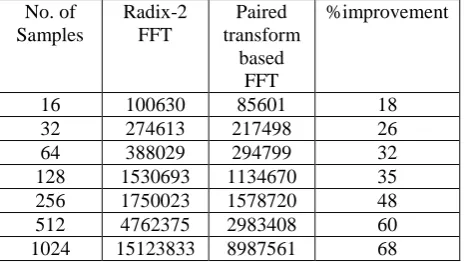
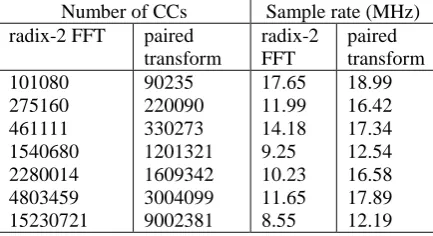
Results obtained on TMS320C6748, and TMS320C5515 digital signal processors: The software used for implementing on the DSP is Texas instruments code composer studio [5]. We used C programming language for implementation. Table 1, 2, 3, 4, 5 and 6 show the implementation results and the comparison between the two algorithms on the three DSP processors.
No. of Samples
Radix-2 FFT
Paired transform
based FFT
%improvement
16 100630 85601 18 32 274613 217498 26 64 388029 294799 32 128 1530693 1134670 35 256 1750023 1578720 48 512 4762375 2983408 60 1024 15123833 8987561 68
Table 1 Performance comparison of the two algorithms on DSP processor TMS320C6748 (fixed point)
processor.
Number of CCs Sample rate (MHz) radix-2 FFT paired
transform
radix-2 FFT
paired transform 100630
274613 488029 1530693 1750023 4762375 15123833
85601 217498 294799 1134670 1578720 2983408 8987561
19.75 12.63 15.08 10.29 12.923 13.56 10.45
21.76 18.41 19.35 14.54 18.81 19.40 14.44
Table 2 Table showing the sampling rate of both the algorithms (starting form N = 16 to N = 1024) for
TMS320C6748.
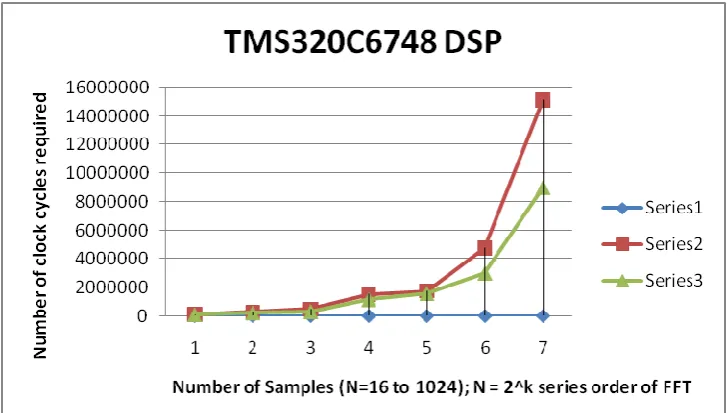
the Cooley-Tukey algorithm. Table 2, 4 show the time required and the sampling rates that the two algorithms can be operated at, which shows that Grigoryan FFT is working at higher sampling rates than Cooley-Tukey FFT. The graph in Fig 2 show the graphical comparison of the number of Clock cycles taken by both the algorithms on TMS320C6748 DSP. Similarly we can draw the graph for TMS320C5515 also. These graphs show that Grigoryan FFT takes less number of clock cycles than Cooley-Tukey FFT.
No. of Samples
Radix-2 FFT
Paired transform
based FFT
%improvement
16 101080 90235 12 32 275160 220090 25.02 64 461111 330273 39.61 128 1540680 1201321 28.25 256 2280014 1609342 41.67 512 4803459 3004099 59.89 1024 15230721 9002381 69.18
Table 3 Performance comparison of the two algorithms on DSP processor TMS320C5515 (fixed point)
processor.
Number of CCs Sample rate (MHz) radix-2 FFT paired
transform
radix-2 FFT
paired transform 101080
275160 461111 1540680 2280014 4803459 15230721
90235 220090 330273 1201321 1609342 3004099 9002381
17.65 11.99 14.18 9.25 10.23 11.65 8.55
18.99 16.42 17.34 12.54 16.58 17.89 12.19
Table 4 Table showing the sampling rate of both the algorithms (starting form N = 16 to N = 1024) for
TMS320C5515.
Form these results we can see that paired transform (Grigoryan FFT) is always faster than the radix-2 (Cooley-Tukey FFT) algorithm. Thus paired-transform based algorithm can be used for higher sampling rate applications. In military applications, while doing the process, only some of the DFT coefficients are needed at a time. For this type of applications paired transform can be used as it generates some of the coefficients earlier, and also it is very fast.
V.
CONCLUSION
In this paper we have shown that both on TMS320C6748, and TMS320C5515 DSPs the paired transform based Grigoryan FFT algorithm is faster and can be used at higher sampling rates than the Cooley-Tukey FFT. We are sure that this Grigoryan FFT is highly efficient than Cooley-Cooley-Tukey FFT for some particular military applications.
1) In the implementations on the DSP if the MAC engines are used explicitly, then there may be a possibility of better comparison between the algorithms. Also one can see some more speed improvement in the DFT processes.
2) We would like to implement & apply this Grigoryan FFT to real time applications, even by using MAC engines, and would like to Standardize this Grigoryan FFT as an industrial standard.
ACKNOWLEDGMENT
REFERENCES
[1]. James W. Cooley and John W. Tukey, “An algorithm for the machine calculation of complex Fourier
Series”, Math. comput. 19, 297-301 (1965).
[2]. Artyom M. Grigoryan and Sos S. Agaian, “Split Manageable Efficient Algorithm for Fourier and
Hadamard transforms”, IEEE Transactions on Signal Processing, Volume: 48, Issue: 1, Pages: 172 – 183, Jan.2000.
[3]. TMS320C6748 development kit & data sheet.
[4]. TMS320C5416 development kit & data sheet.
[5]. CC Studio getting started guide, for C/C++, IDE.
[6]. The scientist and engineer’s guide to Digital Signal Processing, Dr. Steven W. Smith.
[7]. N. Ranganadh, P. Patel, and A.M. Grigoryan, "Implementation of the DFT using radix-2 and paired transform algorithms," 17th International Conference on Computer Applications in Industry and Engineering, CAINE-2004, Orlando, Florida USA, Nov. 17-19, 2004.
[8]. N. Ranganadh, P. Patel, and A.M. Grigoryan, “performances of Texas instruments DSP and Xilinx
FPGAs for Cooley-Tukey and Grigoryan FFT algorithms”, Wolters Kluwer and Medknow International Journal of Engineering and Technology, Jul-Dec 2011,Vol 1,Issue 2.
[9]. N. Ranganadh, P. Patel, and A.M. Grigoryan, “Case study of Grigoryan FFT onto FPGAs and DSPs” ,
IEEE proceedings, IEEE ICECT 2012, 2012 4th International Conference on Electronics Computer Technology (ICECT 2012), kanya kumari – 2012.
[10]. TMS320C5416 development kit & data sheet.
x1,0
x1,1
x1,2
x1,3
x2,0
x2,2
x4,0
x0,0
x(0)
x(1)
x(2)
x(3)
x(4)
x(5)
x(6)
x(7)
add operation
subtract operation
Fig 1. Showing the addition part of the 8-point paired transform based DFT.
Fig 2. For TMS320C6748 DSP. On Y-axis the number of clock cycles taken to process the FFT of size N =
16,32,64,128,256,512,1024. N on X-axis. Series 2,3 are for the number of clock cycles taken for the Cooley-Tukey FFT and Grigoryan FFT respectively, it is clear that Grigoryan FFT is going faster than Cooley-Cooley-Tukey
Authors’ Biographies
Ranganadh Narayanam: Mr. Ranganadh Narayanam is an Assistant professor in the department of
Electronics & Communications Engineering in Bharat Institute of Engineering & Technology (BIET). This research is continuation of the research done in the Univeristy of Texas at San Antonio under the guidance of Dr. Parimal A. Patel, Dr. Artyom M. Grigoryan, as my master’s thesis. This current research was partly funded by BIET. Mr.Narayanam, a research student in the area of “Brain Stem Speech Evoked Potentials” under the guidance of Dr. Hilmi Dajnai of University of Ottawa,Canada. He was also a research student in The University of Texas at San Antonio under Dr. Parimal A Patel,Dr. Artyom M. Grigoryan, Dr Sos Again, Dr. CJ Qian,. in the areas of signal processing and digital systems, control systems. He worked in the area of Brain Imaging in University of California Berkeley. Mr. Narayanam is having around 5+2 years of full time teaching & research experiences respectively; and more than 5 years of entry level research experience and more than 10 publications. Mr. Narayanam’s research interests include neurological Signal & Image processing, DSP software & Hardware design and implementations, neurotechnologies.
Vangala Rekha Andal: Mrs. Rekha is working as an Assistant Professor at BIET. She has 6 years of teaching