https://doi.org/10.26637/MJM0801/0002
Isolated signed dominating function of graphs
S. Rishitha Dayana
1* and S. Chandra Kumar
2Abstract
An isolated signed dominating function(ISDF) of a graphGis a signed dominating function(SDF) f :V(G)→ {−1,+1}such that f(N[w]) = +1for at least one vertex ofw∈V(G). An isolated signed domination number ofG, denoted byγis(G), is the minimum weight of an ISDF ofG. In this paper, we study some properties of ISDF and we give isolated signed domination number of disconnected graphs, cycles and paths.
Keywords
Isolated domination, signed dominating function, isolated signed dominating function.
AMS Subject Classification
05C69.
1Research Scholar, Reg No-17223162092029, Department of Mathematics, Scott Christian College, Nagercoil-629003, Tamil Nadu, India. 2Department of Mathematics, Scott Christian College, Nagercoil-629003, Tamil Nadu, India.
*Corresponding author:1[email protected]
Article History: Received07August2019; Accepted09December2019 c2020 MJM.
Contents
1 Introduction. . . 7 2 Main Results. . . 8
References. . . 10
1. Introduction
Throughout this paper, we consider only finite, simple and undirected graphs. The set of vertices and edges of a graphG(p,q)will be denoted byV(G)andE(G)respectively,
p=|V(G)|andq=|E(G)|. For graph theoretic terminology, we follow [7].
For v∈V(G), the open neighborhood of visNG(v) =
{u∈V(G):uv∈E(G)}and the closed neighborhood ofvis
NG[v] ={v} ∪N(v). The degree of visdegG(v) =|NG(v)|.
The minimum and maximum degree ofGis defined byδ(G) = min
v∈V(G){deg(v)}and∆(G) =vmax∈V(G)
{deg(v)}respectively. A
vertex of degree one is called a pendent vertex. A vertex which is adjacent to a pendent vertex is called a stem.
A function f :V(G)→ {0,1}is called a dominating func-tion if for every vertexv∈V(G), f(N[v])≥1 [8].
Various domination functions has been defined from the definition of dominating function by replacing the co-domain {0,1}as one of the sets{−1,0,1},{−1,+1}and etc. One of such example is signed dominating function [3,4].
In 1995, J.E.Dunbar et al. [4] defined signed dominating function. A function f :V(G)→ {−1,+1}is a signed
domi-nating function ofG, if for every vertexv∈V(G),f(N[v])≥1. The signed domination number, denoted byγs(G), is the
min-imum weight of a signed dominating function onG[4]. The signed dominating function has been studied by several au-thors including [1,2,5,6,9,11].
A subsetS of vertices of a graphGis a dominating set ofGif every vertex inV(G)−Shas a neighbor inS. The minimum cardinality of a dominating set ofGis called the domination number and is denoted byγ(G).
In 2016, Hameed and Balamurugan [10] introduced the concept of isolate domination in graphs. A dominating setS
of a graphGis said to be an isolate dominating set, if<S>
has at least one isolated vertex [10]. An isolate dominating setSis said to be minimal if no proper subset ofSis an isolate dominating set. The minimum and maximum cardinality of a minimal isolate dominating set ofGare called the isolate domination numberγ0(G)and the upper isolate domination
numberΓ0(G)respectively.
By using the definition of signed dominating function and isolate domination, we introduced the concept of isolated signed dominating function. An isolated signed dominat-ing function (ISDF) of a graphGis a function f :V(G)→
{−1,+1}such that ∑
u∈N[v]
f(u)≥1 for every vertexv∈V(G)
and for at least one vertex ofw∈V(G), f(N[w]) = +1. The weight of f, denoted byw(f)is the sum of the values f(v) for allv∈V(G). An isolated signed domination number ofG, denoted byγis(G), is the minimum weight of an ISDF ofG.
isolated signed domination number of disconnected graphs, cycles and paths.
2. Main Results
Lemma 2.1. If a graph G admits ISDF, thenγs(G)≤γis(G).
Proof. Since every ISDF is a SDF, we haveγs(G)≤γis(G).
Theorem 2.2. Let n≥2 be an integer and let G be a dis-connected graph with n components G1,G2, . . . ,Gnsuch that the first r(≥1)components G1,G2, . . . ,Gradmit ISDF. Then
γis(G) = min
1≤i≤r{ti}, where ti=γis(Gi) + n ∑ j=1,j6=i
γs(Gj).
Proof. With out loss of generality, we assume that
t1= min
1≤i≤r{ti}. Let f1 be an minimum ISDF ofG1and fi
be a minimum SDF ofGi for eachiwith 2≤i≤n. Then
f :V(G)→ {−1,+1}defined by f(x) = fi(x),x∈V(Gi), is
an ISDF ofGwith weightγis(G1) + n ∑ i=2
γs(Gi)and soγis(G)≤
γis(G1) + n ∑ i=2
γs(Gi) =t1.
Letgbe a minimum ISDF ofG. Then there exists an integer j
such thatg|Gj is a minimum ISDF ofGjfor some jwith 1≤ j≤r. Also for eachiwith 1≤i≤n(i6=j),g|Giis a minimum
SDF ofGi. Thereforew(g)≥γis(Gj) + n ∑ i=1,i6=j
γs(Gi) =tj≥t1
and henceγis(G) = min 1≤i≤r{ti}.
Corollary 2.3. Let H be any graph which does not admit ISDF. Then G=H∪rK1(r≥1)admits ISDF withγis(G) = r+γs(H)
Proof. By taking Gi ∼=K1 for 1≤i≤r and Gr+1∼=H in
Theorem2.2, we can prove the result.
Lemma 2.4. Any odd regular graph does not admit ISDF.
Proof. Since|N[v]|is even, f(N[v])6=1 for any SDFf :V→ {−1,+1}.
Lemma 2.5. Let f be an ISDF of G and let S⊂V . Then f(S) =|S|(mod2).
Proof. Let S+={v|f(v) =1,v∈S} and S−={v|f(v) = −1,v∈S}. Then |S+|+|S−|=|S|and|S+| − |S−|= f(S). Thereforef(S) =|S| −2|S−|.
Lemma 2.6. Let G be a graph of order n. Then2γ2(G)−n≤
γis(G).
Proof. Letfbe a minimum ISDF ofG. LetV+={u∈V(G):
f(u) = +1}andV−={v∈V(G): f(v) =−1}. IfV−=φ, then the proof is clear.
Ifv∈V−since f(N[v])≥1, thenvhas at least two neighbor inV+. ThereforeV+is a 2-dominating set forGand|V+| ≥ γ2(G). Sinceγis(G) =|V+| − |V−|andn=|V+|+|V−|, then
γis(G) =2|V+| −nand finally we haveγis(G)≥2γ2(G)− n.
Theorem 2.7. For any graph G with maximum degree∆and minimum degreeδ, we haveγis(G)≥2+(δ
−∆)n ∆+δ+2 .
Proof. Let f be a minimum isolated signed domination func-tion ofG. Then|V+|+|V−|=nand|V+| − |V−|=γis(G).
We have|V+|=n+γis(G)2 and|V−|=n−γis(G)2 .
By definition of ISDF ofG, atleast one vertexv∈V(G), we have f(N[v]) =1. Then ∑
v∈V(G)
(d(v) +1)f(v)≥1. Therefore
∑ v∈V+
(d(v))f(v) + ∑ v∈V−
(d(v))f(v) +γis(G)≥1. So∆|V+| −
δ|V−|+γis(G)≥1, thus(n+γis2(G))∆−(n−γis2(G))δ +γis(G)≥1,
we haveγis(G)≥2+(δ∆+δ−+2∆)n.
Theorem 2.8. For given integer k≥1, there exists a graph G such thatγs(G) =γis(G) =k.
Proof. LetG=C3kbe a cycle of order 3ksuch thatV(G) =
{a1,a2, . . . ,a3k}andE(G) ={aiai+1: 1≤i≤3k−1}
∪{a3ka1}. Letf be a SDF ofG. SinceN[ai] ={ai−1,ai,ai+1}
and f(N[ai])≥1, any three consecutive vertices must have
at least two+1 signs. Thus f(V(G))≥k. Define a function
f :V(G)→ {−1,+1}by
f(ai) =
−1 when i=3`, `≥1 +1 otherwise.
From the above labeling it is easy to observe that f is SDF andw(f) =k. Thusγs(G)≤k. The graphGadmits ISDF and
γis(G) =k(already proved in Theorem2.18).
Theorem 2.9. Let G be a connected graph of order n≥2in which every vertex is a pendent vertex or stem(we call such graphs as category 1 graph). Then G does not admit ISDF.
Proof. Suppose there exists a SDF of G, say0f0. Letu∈
V(G).
Case 1: Ifuis pendent vertex, then f(u) = +1 (otherwise
f([u])≤0).
Case 2:Ifuis a stem, thenuis adjacent with some pendent vertex, sayw. By Case 1, f(w) = +1. If f(u) =−1, then
f(N[w]) =0. Thus f(u) = +1.
Hencef is a constant function with constant+1. SinceGis connected graph of order greater than or equal to 2, f(N[v])≥ 2 forv∈V(G). Thus there exist no vertexvofGsuch that
f(N[v]) =1, a contradiction.
Corollary 2.10. Let H be any graph and G=H◦K1, then G does not admit ISDF.
Proof. Since every vertex ofGis a stem or pendent, the proof follows from Theorem2.9.
Lemma 2.11. If G=mK1∪B, where B is an union of some graphs from category 1 (m≥1and B may be empty), then
Proof. Let f be an ISDF ofGandu∈V(G).
Case 1: Ifu∈V(mK1), thenuis an isolated vertex ans so
f(u) = +1.
Case 2: Ifu∈V(B)then f(u) = +1(as discussed in Theo-rem2.9).
Thusw(f) =nand soγis(G)≥n. But alwaysγis(G)≤nand
soγis(G) =n.
Lemma 2.12. Suppose G admits ISDF andγis(G) =n. Then G=mK1∪B, where B is an union of some graphs from cate-gory 1 (m≥1and B may be empty).
Proof. Let f be an ISDF ofG. Sinceγis(G) =n, f(v) = +1
for everyv∈V(G).
Suppose there exists no isolated vertex inG, then f(N[v])≥2 for everyv∈V(G), a contradiction to f is an ISDF. ThusG
must have an isolated vertex, sayw. Then f(N[w]) =1. LetHbe any connected component ofGsuch that|V(H)| ≥2. SupposeH∈/category 1, then there exists a vertexv∈V(H) such thatvis neither pendent nor stem. Then by relabeling the vertices ofV(H)by f(v) =−1 and f(w) =1 for every
w(6=v)∈V(H), we can get a SDF ofHsuch that f(V(H))<
|V(H)|. Then by Theorem2.2,γis(G)<n, a contradiction.
ThusH∈category 1.
From Lemma2.11and Lemma2.12, we have the
follow-ing theorem.
Theorem 2.13. Let G be any graph. Thenγis(G) =n if and only if G∼=mK1∪B, where B is an union of some graphs from category 1 (m≥1and B may be empty).
Remark 2.14. Let G be a graph of order n which admits ISDF. Thenγis(G)6=n−1.
Proof. Let f be a minimum ISDF ofG. Suppose f(u) = +1 for allu∈V(G), thenγis(G) =n. Suppose f(u) =−1 for
someu∈V(G), thenγis(G)≤n−2.
Lemma 2.15. Let G be a connected graph of order n≥3
obtained from Pnor Cnby adding so many pendent vertices except one vertex of degree two(say u), thenγis(G) =n−2.
Proof. Note that except the vertexuall the vertices are either pendent or stem. As discussed in the proof of Theorem2.9, we must have f(v) = +1 for allv(6=u)∈V(G)and for any ISDF f ofG. Thusγis(G)≥n−2.
Define a functiong:V(G)→ {−1,+1} byg(u) =−1 and
g(v) = +1 for all v(6=u). Since deg(u) =2, f(N[u]) =1. Also f(N[v])≥1 for allv(6=u). Thusγis(G)≤n−2.
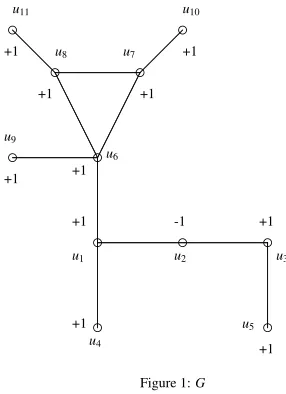
Example 2.16. The converse part of the above lemma is not true. Consider the following graphG. LetV(G) ={ui:
1≤i≤11}(as given in Figure 1). As discussed in
Theo-rem2.9, f(ui) = +1 for alli6=2 and for any ISDFf. Suppose
f(u) = +1, thenf is constant function with constant+1 and so f(N[v])≥2 for everyv∈V(G). Thus f(u) =−1 and so
w(f) =n−2. Thusγis(G) =n−2.
c c c
u1 u2 u3
+1 -1 +1
c
u4
+1 cu6
+1
c c
u8
+1
u7
+1
c
u9
+1
c c
u11
+1
u10
+1
c
u5
+1
Figure 1:G
A MobMn(n≥1)is a tree which is obtained fromP4, a
path on 4 vertices by addingnpendant edges with one end of
P4.
d d d d
.. . d d
d
v1 v2 v3 v4
u1
u2
un Figure 2:Mn
Lemma 2.17. Let G=Mnbe a connected graph of order n≥1which admits ISDF, thenγis(G) =n+2.
Proof. LetV(G) ={v1,v2,v3,v4,ui: 1≤i≤n}. Note that except the vertexv3all the verticesGare either pendent or stem. As discussed in the proof of Theorem2.9, we must have
f(u) = +1 for allu(6=v3)∈V(G)and for any ISDF f ofG.
Thusγis(G)≥n−2.
Define a functiong:V(G)→ {−1,+1}byg(v3) =−1 and g(u) = +1 for allu(6=v3). Sincedeg(v3) =2, f(N[v3]) =1.
Also f(N[u])≥1 for allu(6=v3). Thusγis(G)≤n+2.
Lemma 2.18. Let n≥3 be an integer. Then the cycle Cn admits ISDF with ISDN
(1)γis(Cn) =k when n=3k. (2)γis(Cn) =k+1when n=3k+1. (3)γis(Cn) =k+2when n=3k+2.
Proof. Letn≥3 be an integer. LetV(Cn) ={ai/1≤i≤n}
andE(Cn) ={aiai+1/1≤i≤n−1} ∪ {ana1}. Let f be an
ISDF. SinceN[ai] ={ai−1,ai,ai+1} and f(N[ai])≥1, any
three consecutive vertices must have at least two+1 signs. —– (1)
Case 1:Supposen=3k. Then by (1),f(V(G))≥k. Case 2:Supposen=3k+1. Supposef(a3k+1) =−1. Then
f({a6,a7,a8})≥1,. . ., f({a3(k−1),a3k−2,a3k−1})≥1.
Sup-pose f(a3k) =−1 then f({a3k,a3k+1,a1})≤ −1, a
contradic-tion to (1). Thus f(a3k) =−1 and sof(V(G))≥k+1.
Similarly, we can get f(V(G))≥k+1 when f(a3k+1) = +1.
Case 3: Suppose n=3k+2. By (1) both f(a3k+1) and f(a3k+2)are not simultaneously equal to−1.
Suppose f(a3k+1) = +1 and f(a3k+2) = +1, then by (1) we
can get f(V(G))≥k+2.
Supposef(a3k+2) =−1. Then by (1), we getf({a3k+2,a1,a2}
)≥1, f({a3,a4,a5})≥1, f({a6,a7,a8})≥1, . . . ,f({a3(k−1), a3k−2,a3k−1})≥1. Suppose f(a3k) =−1 or f(a3k+1) =
−1 thenf({a(3k),a3k+1,a3k+2})≤ −1, a contradiction to (1).
Thus f(a3k) =−1 and so f(V(G))≥k+2. Similarly, we can
get f(V(G))≥k+2 when f(a3k+2) = +1. Define a function f :V(Cn)→ {−1,+1}by
f(ai) =
−1 when i=3`, `≥1 +1 otherwise.
Define From the above labeling it is easy to observe that f is ISDF. Alsoγis(C3k)≤k,γis(C3k+1)≤k+1 andγis(C3k+2)≤ k+2.
Lemma 2.19. Let n≥6and k≥2be an integers. Then the path Pnadmits ISDF with ISDN
(1)γis(Pn) =k+2when n=3k.
(2)γis(Pn) =4+ (k−1)when n=3k+1. (3)γis(Pn) =2+k when n=3k+2.
Proof. Letn≥6 be an integers. LetV(Pn) ={ai/1≤i≤n}
andE(Pn) ={aiai+1/1≤i≤n−1}.
Claim 1:If f(a1) = +1, then f(a2) = +1.
Suppose f(a2) =−1, then f(N[a1])≤0, a contradiction to f
is ISDF.
Similarly, we can prove that f(an−1) = +1, then f(an) = +1.
Let f be an ISDF. SinceN[ai] ={ai−1,ai,ai+1}for 2≤i≤ n−1 andf(N[ai])≥1, any three consecutive vertices must
have at least two+1 signs. —– (1)
Case 1:Supposen=3k. Then by Claim 1, we get f(a1) =
f(a2) = f(a3k−1) = f(a3k) = +1. Supposef(a3i) =−1 for
some i=1,2, . . . ,k. Choose j be the largest integer there existsi,f(a3j) =−1 for 1≤j≤k−1. Since f(N[a3j])≥1,
we have f(a3j+1) = f(a3j+2) = +1. By the definition of j, f(a3j+3) = +1. Nowf({a1,a2,a3})≥1,f({a4,a5,a6})≥1, . . ., f({a3j−2,a3j−1,a3j})≥1, f({a3j+1,a3j+2,a3(j+1)})≥
3,f({a3(j+1)+1,a3(j+1)+2,a3(j+2)})≥1,. . .,f({a3k−2,a3k−1, a3k})≥1. Thus f(V(G))≥ j+3+ (k−j−1)and hence
f(V(G))≥k+2.
Case 2: Supposen=3k+1. Then by Claim 1, we get
f(a1) = f(a2) =f(a3k) = f(a3k+1) = +1. Suppose f(a3i) =
−1 for somei=1,2, . . . ,k. Choose j be the largest inte-ger there exists i, f(a3j) =−1 for 1≤ j≤k−1. Since
f(N[a3j])≥1, we have f(a3j+1) = f(a3j+2) = +1. By the definition of j, f(a3j+3) = +1. Now f({a1,a2,a3})≥1,
f({a4,a5,a6})≥1, . . . ,f({a3j−2,a3j−1,a3j})≥1, f({a3j+1,a3j+2,a3(j+1)})≥3, f({a3(j+1)+1,a3(j+1)+2, a3(j+2)})≥1,. . .,f({a3k−1,a3k,a3k+1})≥1. Thusf(V(G))≥
j+3+ (k+1−j−1)and hence f(V(G))≥k+3. Define a functionf :V(Pn)→ {−1,+1}by
f(ai) =
−1 when i=3`,1≤`≤k−1,
+1 otherwise.
From the above labeling it is easy to observe that f is ISDF. Alsoγis(P3k)≤k+2 andγis(P3k+1)≥k+3.
Case 3: supposen=3k+2 fork≥2. Then by Claim 1, we get f(a1) = f(a2) = f(a3k+1) = f(a3k+2) = +1 and by
(1), we get f(V(G))≥k+2. Define a function f :V(Pn)→ {−1,+1}by
f(ai) =
−1 i=3`,1≤`≤k
+1 otherwise.
From the above labeling it is easy to observe that f is ISDF. Alsoγis(P3k+2)≤k+2.
References
[1] G. J. Chang, S. C. Liaw, H. G. Yeh,k-Subdomination in
graphs, Discrete Appl. Math.120(2002), 44-60. [2] E. J. Cockayne and C. M. Mynhardt,On a generalization
of signed dominating functions of graphs, Ars Combin., 43(1996), 235-245.
[3] J. E. Dunbar, S. T. Hedetniemi, M. A. Henning, and A.
A. McRae. Minus domination in regular graphs. Discrete Math.,149(1996), 311-312.
[4] J. E. Dunbar, S. T. Hedetniemi, M. A. Henning and P. J.
Slater,Signed domination in graphs. In: Graph Theory, Combinatorics and Applications. Proc. 7th Internat. conf. Combinatorics, Graph Theory, Applications, (Y. Alavi, A. J. Schwenk, eds.). John Wiley & Sons, Inc.,1(1995), 311-322.
[5] O. Favaron,Signed domination in regular graphs,
Dis-crete Math.,158(1996), 287-293.
[6] Z. F¨uredi and D. Mubayi,Signed domination in regular
graphs and set-systems, J. Combin. Theory Series B,76 (1999), 223-239.
[7] F. Harary,Graph Theory, Addison-Wesley, (1969).
[8] T. W. Haynes, S. T. Hedetniemi and P. J. Slater
”Funda-mental of domination in graphs”. Marcel Dekker inc... New York-Basel-Hong Kong, (1998).
[9] Huaming Xing, Langfang, Liang Sun, Beijing, and
Xue-gang Chen, Taian, On signed distance-k-domination
in graphs, Czechoslovak Mathematical Journal,56(131) (2006), 229-238.
[10] I. Sahul Hameed, S. Balamurugan,Isolate domination in
[11] Z. Zhang, B. Xu, Y. Li and L. Liu,A note on the lower
bounds of signed domination number of a graph, Discrete Math.,195(1999), 295-298.
? ? ? ? ? ? ? ? ? ISSN(P):2319−3786
Malaya Journal of Matematik