(UDC: 531.1/.3)
Heat and mass transfer in a hydromagnetic flow of a micropolar power law
fluid with hall effect in the presence of chemical reaction and thermal
diffusion
B.I Olajuwon1
1
Department of Mathematics, Federal University of Agriculture, Abeokuta, Nigeria. [email protected]
Abstract
This work presents the mathematical modelling of heat and mass transfer flow in an electrically conducting micropolar power law fluid past a horizontal porous plate in the x - direction in presence of a transverse magnetic field, Hall Effect, chemical reaction thermal radiation and thermal diffusion. The non – linear partial differential equations governing the flow are transformed into ordinary differential equations using the usual similarity method and the resulting similarity equations are solved numerically using Runge – Kutta shooting method. The results are presented as velocity, temperature and concentration profiles for pseudoplastic and dilatant fluids and for different values of parameters governing the problem. The effects of magnetic field, thermal radiation and thermal diffusion on the skin friction, heat transfer and mass transfer rates are presented numerically in tabular form.
Keywords: power law fluid, pseudoplastic fluid, heat transfer, mass transfer, thermal radiation, thermal diffusion
1. Introduction
In recent time, a lot of researchers have concentrated their contributions in the study of theory of micropolar fluid on fluids which the apparent viscosity do not depend on shear rate. This may be due to the fact that factors which determine the non-Newtonian behaviours of these fluids (fluids which apparent viscosity depend on shear rate) are highly complex and their study requires a high level of calculations. The study of these fluids (fluids which apparent viscosity depend on shear rate) is important due to its extremely broad and diverse area of application which will be of great advantages to chemical and process engineers, by virtue of their roles in handling and processing complex materials (such as foams, slurries, emulsions, polymer melts and solutions, e.t.c.). Also, a thorough understanding the flow problems concerning non – Newtonian of this type is highly important in manufacturing and processing industries because the nature of the flow influences, not only the drag at a surface or immersed object, but also, the rate of heat and mass transfer when the temperature or concentration gradient exist.
that exhibit certain microscopic effects arising from the local structure and micromotions of the fluid elements. These fluids contain dilute suspensions of rigid macromolecules with individual motions that support stress and body moments and are influence by spin inerta.
[Aboeldahab and Elbarbary 2001] presented the numerical investigation of a steady magnectohdydrodynamic free convection flow past infinte plate in the presence of Hall current effect. [Ahmadi 1976] examined the fluid flow characteristics of the boundary-layer flow of a micropolar fluid over a semi-infinite plate, using a Runge-Kutta shooting method with Newtonian iteration. [Aissa and Mohammedein 2005] studied the effects of the magnetic parameter; suction parameter, Eckert number and microrotation parameter on the wall jet flow of a laminar micropolar fluid past a linearly stretching, continuous sheet. Their result showed that the velocity decreases with increasing magnetic parameter, and increases with increasing microrotation parameter.
[Attia 2006] developed a new mathematical model for steady laminar flow with heat generation of an incompressible non-Newtonian micropolar fluid impinging on a porous flat plate He examined effect of the uniform suction or blowing and the characteristics of the non-Newtonian fluid on both the flow and heat transfer. [Bhargava and Rani 1985] discussed the heat transfer in a micropolar fluid near a stagnation point. [Bird 1959] examined unsteady pseudoplastic flow near a moving wall. The power law index ranges from n = 1/3 to n = 5/6. He estimated for each n the similarity value r 1 for which the fluid velocity has fallen off to 1% of the velocity of the moving wall. [Elbarbary and Elgazery 2004] studied the effects of variable viscosity and variable thermal conductivity on the heat transfer from moving surfaces in a micropolar fluid through a porous medium with radiation. When the fluid viscosity is assumed to vary as an inverse linear function of temperature and the thermal conductivity is assumed to vary as a linear function of temperature.
The theory of micropolar fluids initiated by [Eringen 1966, 1972] exhibits some microscopic effects arising from the local structure and micro motion of the fluid elements. Further, they can sustain couple stresses and include classical Newtonian fluid as a special case. The model of micropolar fluid represents fluids consisting of rigid randomly oriented (or spherical) particles suspended in a viscous medium where the deformation of the particles is ignored. The fluids containing certain additives, some polymeric fluids and animal blood are examples of micropolar fluids. [Gorla et al. 1995] analyzed the heat transfer characteristics of a micropolar fluid over a flat plate. [Hassanien and Gorla 1992] studied the mixed convection in stagnation flow of micropolar fluid over a vertical surface with variable surface temperature and uniform surface heat flux.
[Ibrahim et. al. 2004] discussed the effects of a temperature-dependent heat source on the hydromagnetic free-convective flow (set up due to temperature as well as species concentration) of an electrically conducting micropolar fluid past a steady vertical porous plate through a highly porous medium, when the free stream oscillates in magnitude. [Ishak et. al. 2006] presented a theoretical study of a steady boundary layer flow and heat transfer of a micropolar fluid on an isothermal continuously moving plane surface, where It is assumed that the microinertia density is variable and not constant, in the presence viscous dissipation effect. [Ishak et. al 2008] examind the steady stagnation flow towards a permeable vertical surface immersed in a micropolar fluid and showed that dual solutions exist in the opposing flow regime and these also continued into that of the assisting flow regime, where the buoyancy force acts in the same direction as the inertia force.
an approximate numerical solution for nonlinear MHD flow with heat and mass transfer characteristics of an incompressible, viscous, electrically conducting and Boussinesq fluid on a vertical stretching surface with chemical reaction and thermal stratification effects. [Khedr et. al. 2009] presented the numerical solution of a steady, laminar, MHD flow of a micropolar fluid past a stretched semi-infinite, vertical and permeable surface in the presence of temperature dependent heat generation or absorption, magnetic field and thermal radiation effects. [Mahmoud 2007] investigated the influence of radiation and temperature-dependent viscosity on the problem of unsteady MHD flow and heat transfer of an electrically conducting fluid past an infinite vertical porous plate taking into account the effect of viscous dissipation. Their results showed that increasing the Eckert number and decreasing in the viscosity of air leads to a rise in the velocity, while increasing in the magnetic and the radiation parameters resulted in a decrease in the velocity.
[Olajuwon 2010,2009,2008,2008,2007] studied the convection heat and mass transfer in a non – Newtonian power law fluid with heat generation, thermal diffusion, thermo diffusion and thermal radiation past vertical plate. The analysis of results obtained showed that these parameters have significant influences on the flow, heat and mass transfer. [Rahman and Sultana 2008] investigated a two-dimensional steady convective flow of a micropolar fluid past a vertical porous flat plate in the presence of radiation with variable heat flux . The effects of the pertinent parameters on the local skin friction coefficient, plate couple stress and the heat transfer are calculated. And the results showed that large Darcy parameter leads to decrease the velocity while it increases the angular velocity as well as temperature of the micropolar fluids. The rate of heat transfer in weakly concentrated micropolar fluids is higher than strongly concentrated micropolar fluids. [Stanislaw 2004] considered single-phase and multiphase disequilibrium processes in presence of nonlinear heat and mass transfer as well as chemical or electrochemical reactions.
The objective of the present study is to examine the combined effects of a transverse magnetic field, Hall Effect, chemical reaction thermal radiation and thermal diffusion on the heat and mass transfer flow in an electrically conducting micropolar non – Newtonian power law fluid past a horizontal porous plate in the x – direction. To the best of our knowledge, investigation on the combined effects of a transverse magnetic field, Hall Effect, chemical reaction, thermal radiation and thermal diffusion on the heat and mass transfer flow in an electrically conducting micropolar non – Newtonian power law fluid past a horizontal porous plate has not been done. Infact, most works concentrated on fluid which has their apparent viscosity do not depend on the shear rate. But when heat and mass transfer occur simultaneously in a moving fluid, the relationship between the fluxes and the driving potential are important. The energy flux is generated not only by temperature gradients but by the composition gradient as well. The energy flux caused by a composition flux is provided the thermal radiation effect. The mass fluxes can also be created the composition gradient and this is the Soret or the thermal diffusion effect.
2. Mathematical Formulation
Consider a steady, laminar, coupled heat and mass transfer by hydromagnetic flow of a magneto-micropolar and electrically conducting power law fluid flowing past a horizontal porous plate in the x - direction in presence of a transverse magnetic field, Hall effect, chemical reaction thermal radiation and thermal diffusion.
| | (1)
The two parameter rheological equation (1) is also known as the power law model. When n=1, the equation represents a Newtonian fluid with a dynamic coefficient of viscosity m. Therefore, deviation of n from a unity indicates the degree of deviation from Newtonian behaviour. For n < 1, the fluid is pseudoplastic and for n > 1, the fluid is dilatant. n, is power law exponent and m is the consistency coefficient.
Suppose is everywhere negative, then, equation (1) becomes ( )
(see Bird [6]) and the apparent viscosity is given by ( )
The flow is subjected to a strong transverse magnetic field with a constant intensity along the y-axis; ( for an electrically conducting fluid, Hall and ion-slip currents affect the flow in the presence of a strong magnetic field. The effect of Hall current gives rise to force in the z-direction, which induces a cross flow in that direction and hence the flow becomes three-dimensional). Let u, v and w be the velocity component along the x, y and z directions, respectively. The surface is maintained at a constant temperature Tw which is higher than the constant temperature of the surrounding and concentration Cw is greater than the constant concentration C . The fluid properties are assumed to be constant. Also, it is assumed that there is a first and higher order chemical reaction between the diffusing species and the fluid. The electron–atom collision frequency is assumed to be relatively high, so that the Hall effect cannot be neglected. Assuming that there is no variation of flow, heat and mass transfer quantities in the z – direction, which is valid if the plate would be of infinite width in this direction.
The generalized ohm‘s law consisting Hall current is given in the form:
̅
( ) ( ̅ ̅ ̅ ̅ ̅)
̅, is the electric current vector, is the electrical conductivity, ̅ is the intensity vector of the electric field , ̅ is the velocity vector, ̅ is the magnetic induction vector, is the Hall
parameter , is the number density of the electrons, is the Hall factor. The equation of
conservation of electric charge ̅ gives . This constant is zero at the plate which electrically non–conducting, hence, everywhere in the flow. Thus, under the above assumptions the equations that the describe the physical situation with the usual Boussinesq approximations are given by;
(7)
Where u, , are the velocity components in the x– and y– directions respectively, , m is
the flow index, is the density, is the coefficient of thermal diffusivity, , and are the temperature of the fluid inside the boundary layer, the plate, and the fluid temperature in the free stream, respectively, while C , and are the corresponding concentrations, k is the thermal conductivity, c is the specific heat capacity, is the Hall effect and ∗ is the permeability.
Where, the radiative heat flux term is simplified by making use of the Rosseland approximation as
∗
(8)
And the last term on the right-hand side of the concentration equation (7) signifies the thermal diffusion effect. The appropriate boundary conditions are;
(10)
(11)
where U (at the time t = 0 the plate is impulsively set into motion with the velocity U ) is the plate characteristics velocity.
3. Method of Solution
Introduce the stream function formulation,
(12)
The continuity equation (2) is automatically satisfied.
Define a similarity variable,
(13)
Such that,
(14)
Using (9) – (11) in equations (4) – (6), the momentum, energy and concentration equations become ( ) ( ) (16) ( ) (17) (18) ( ) (19) (20)
Subject to the boundary conditions
(21)
Where, is the coupling constant, is the Prandtl number, is the Schmidt number, is the Soret number, M is the magnetic field parameter, G is the micro rotation parameter, is the material parameter, is thermal radiation parameter, is the permeability parameter, is the Eckert number and is the Hall effect.
4. Numerical Solution
The resulting coupled non linear ordinary differential equations (16) to (20) together with the boundary conditions (21) are solved simultaneously using the method of the Runge Kutta shooting method;
Let,
. Then we obtain the following system;
( ) ( ( ) ( ) ( ) ( ) ( ) ( ) ( ) ) (22)
(
) ( )
(23)
Equation (22) together with the initial condition (23) is solved using Runge – Kutta shooting method. The values of and are obtained such that the boundary conditions (21) are satisfied. is the suction.
In a shooting method, the missing (unspecified) initial condition at the initial point of the interval is assumed, and the differential equation is then integrated numerically as an initial valued problem to the terminal point. The accuracy of the assumed missing initial condition is then checked by comparing the calculated value of the dependent variable at the terminal point with its given value there. If a difference exists, another value of the missing initial condition must be assumed and the process is repeated. This process is continued until the agreement between the calculated and the given condition at the terminal point is within the specified degree of accuracy.
In fact, the essence of this method is to reduce the boundary value problem to an initial value problem and then solved using the fourth order Runge – Kutta shooting technique to find
. It is observed from (21)
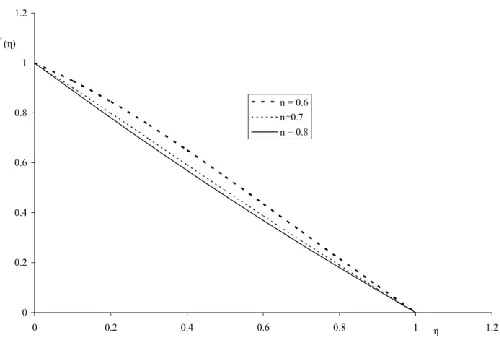
Fig. 1. Velocity profile for power law exponents 0<n<0.5
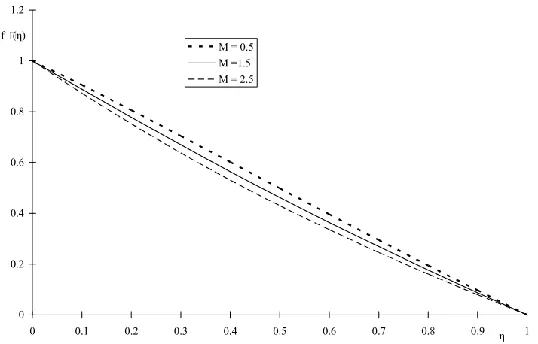
Fig. 3. Velocity profile for different values of magnetic field parameter, M when n=0.3
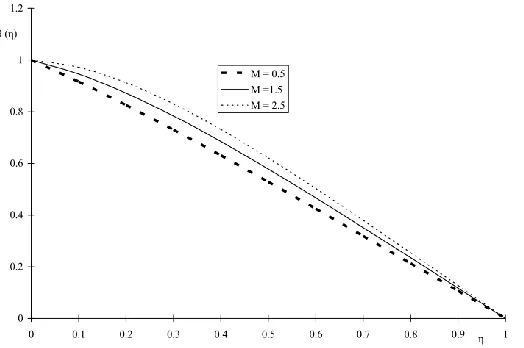
Fig. 5. Temperature profile for various values of the magnetic parameter, M when n=0.3
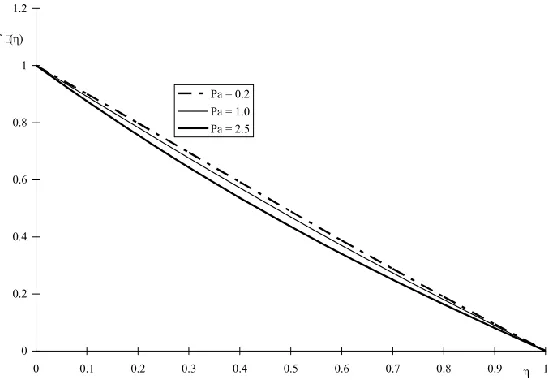
Fig. 7. Effect of the permeability parameter Pa, on the velocity profile when n=0.3
Fig. 9. Effect of thermal radiation on the temperature profile when n=0.3
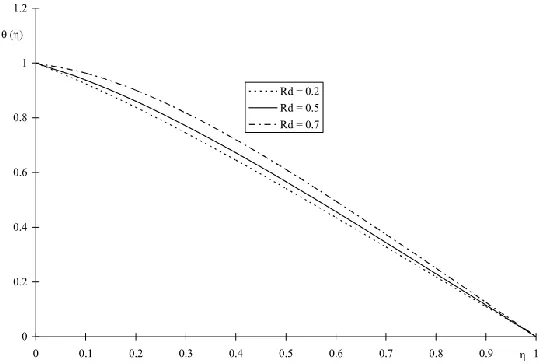
Fig. 11. Effect of the chemical reaction parameter Rd, on the concentration profile for value of n=0.3
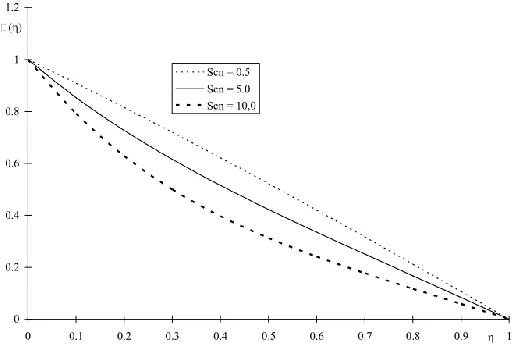
Fig. 13. Concentration profile for various values of the Schmidt number, Sc with value of n=0.3
Fig. 15. Concentration profile for various values of the Soret number, Srn with value of n=0.3
Fig. 16. Concentration profile for various values of the Soret number, Srn with value of n=0.7
5. Skin friction, rate of heat and mass transfer
We will now calculate the physical quantities of engineering primary interests, which are the local wall shear stress, local surface heat flux and the local mass flux respectively from the following definitions
The local wall shear stress is defined as
( | | )
(24)
And the skin-friction coefficient, is given by,
Where
is the Reynolds number
The heat flux, at the qall is given by,
( )
(26)
And the Nusselt number is given by
(27)
where,
The mass flux at the wall are given by,
( )
(28)
And the Sherwood number is given by
(29)
Where, . The skin friction coefficient, Nusselt number and the Sherwood number are obtained numerically and the result is presented in tabular form in Tables 2 – 10.
6. Discusion of result
The present study has investigated the combined effects of a transverse magnetic field, Hall effect, chemical reaction, thermal radiation and thermal diffusion on the heat and mass transfer flow in an electrically conducting micropolar non – Newtonian power law fluid past a horizontal porous plate. It is interesting to note that for a pseudoplastic fluid with n = 0.5, the fluid flow has constant velocity. Thus, we discuss the heat and mass transfer for pseudoplastic power law fluid with power law exponents 0 < n < 0.5 and 0 < n < 1. The numerical computations were carried out with values of
.The numerical result is presented in Table 1 and Figures 1 - 16.
Figures 1 and 2, show the effect of the power law exponents on the velocity field of the fluid flow for the cases 0 < n < 0.5 and 0.5 < n < 1. It is observed that the behavior of the velocity profile is same for both cases. The fluid flow velocity decreases as the power law exponent is increasing. Physically, this is caused by the shear thinning property of the fluid. It indicates the effective viscosity distribution of the flow field which reduces distinctly with high shearing rate.
In Figures 5 and 6, the temperature of the fluid increases with increase in the magnetic field for both pseudoplastic fluid n = 0.3 and n = 0.7. Thus, the rate at which temperature of the fluid goes to zero reduces as the magnetic field parameter increases. Hence, the rate of convective heat transfer decreases with increase in the magnetic field in the magnetic field parameter.
Figures 7 and 8 show that as the permeability parameter increases the velocity of the fluid flow decreases for both n = 0.3 and n = 0.7. This is because increase in the permeability parameter causes the boundary layer near the plate to become thinner.
Figures 9 and 10, depicts the effect of the thermal radiation on the temperature of the fluid flow. It is observed that for both n = 0.3 and n = 0.7, the temperature of the fluid flow increases with increase in the thermal radiation parameter.
Figures 11 and 12 show that the concentration of the fluid increases with increase in the chemical reaction for both n = 0.3 and n = 0.7. The concentration of the fluid also increases with increase in the Schmidt and Soret numbers [Figures 13 - 16].
The important physical quantities, the local shear stress, local rate of heat transfer and local mass transfer rate are respectively measured in terms of the local skin friction, and the local Nusselt number, and Sherwood number, and the numerical results are as shown in Tables 2 – 10 for value of
Table 2. Effect of the power law exponents
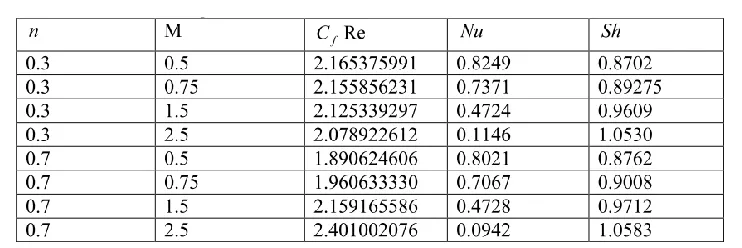
Table 3. Effect of Magnetic field
Table 3 shows the effect of the magnetic field on the skin friction, Nusselt number and Sherwood number for both n = 0.3 and n = 0.7. It is observed that for pseudoplastic fluid with the power law exponent n = 0.3, the skin friction reduces with increase in the magnetic field parameter while the skin friction increases with increase in the magnetic field parameter. This implies that fluid with power exponent 0 < n < 0.5 flows better in the presence of an applied magnetic field. For both n = 0.3 and n = 0.7, the Nusselt number decreases with increase in the magnetic field parameter. But, the Sherwood number increases with increase in the magnetic field parameter. Hence, in the presence of applied magnetic field, the pseudoplastic fluid with power exponent 0 < n < 0.5, seem to be a better fluid for high fluid flow, heat transfer and mass transfer.
Table 4. Effect of Hall Effect parameter
From Table 4, it is observed that the skin friction and the Nusselt number increase with increase in the Hall effect parameter for both n = 0.3 and n = 0.7. While the Sherwood number decreases with increase in the Hall effect parameter for both n = 0.3 and n = 0.7. Therefore, with increase in the hall effect parameter, the fluid flow and the rate of mass transfer reduces but, the rate of heat transfer increases with increase in the Hall effect parameter for both n = 0.3 and n = 0.7.
It is clearly seen from Table 5 that the skin friction and the Nusselt number increase with increase in the permeability parameter, but, the Sherwood number decreases with increase in the permeability parameter. Thus, the fluid flow and the rate of mass transfer decreases with increase in the permeability parameter, while the rate of heat transfer increases with increase in the permeability parameter.
Table 6. Effect of thermal radiation
Table 6 depicts the effect of the thermal radiation on the skin friction, Nusselt number and the Sherwood number for both n = 0.3 and n = 0.7. The skin friction and the Nusselt number decrease as the thermal radiation parameter increases. The decrease in the Nusselt number suggests that some heat have been released out through radiation, therefore reducing the rate of the convective heat transfer in the system. The Sherwood number increases with in the thermal radiation parameter. Therefore, increase in thermal radiation parameter enhanced increase in the fluid flow rate and rate of mass transfer, but, causes decrease in the rate of convective heat transfer.
Table 7. Effect of the Eckert number
Table 8. Effect of thermal diffusion
The effect thermal diffusion on the skin friction, Nusselt number and the Sherwood number for both n = 0.3 and n = 0.7 is shown in Table 8. It is clear from the table that the skin friction and Nusselt number are invariant with increase in the thermal diffusion parameter but the Sherwood number increases with increase in the thermal diffusion parameter. Hence, increase in the thermal diffusion leads to increase in the rate of mass transfer.
Table 9. Effect of Chemical reaction
Table 9 show the effect of the chemical reaction on the skin friction, Nusselt number and the Sherwood number for both n = 0.3 and n = 0.7. It is obvious from the table that the skin friction and Nusselt number are invariant with increase in the chemical reaction parameter. The Sherwood number decreases with increase in the chemical reaction parameter. The decrease in the Sherwood number is as a result of the fact that for most chemical reactions, the rate of chemical reaction decrease as the percent completion increases until the point where the system reaches dynamic equilibrium. Thus, increase in chemical reaction causes decrease in the mass transfer.
Table 10 show the effect of the Schmidt number on the skin friction, Nusselt number and the Sherwood number for both n = 0.3 and n = 0.7. As the Schmidt number increases, the Sherwood number increases. Therefore, the rate of mass transfer increases with increase in the Schmidt number. The table also show that the skin friction and Nusselt number are invariant with increase in the Schmidt number.
7. Conclusion
The paper has investigated numerically the combined effects of a transverse magnetic field, Hall effect, chemical reaction, thermal radiation and thermal diffusion on the heat and mass transfer flow in an electrically conducting micropolar non – Newtonian power law fluid past a horizontal porous plate. And the following conclusions are drawn;
1. The fluid flow and rate of mass transfer decrease with increases in the power law exponents, while the rate of heat transfer increases with increases in the power law exponents.
2. In the presence of applied magnetic field, the pseudoplastic fluid with power exponent 0 < n < 0.5, seem to be a better fluid for high fluid flow, heat transfer and mass transfer.
3. With increase in the hall effect parameter, the fluid flow and the rate of mass transfer reduces but, the rate of heat transfer increases with increase in the Hall effect parameter for both n = 0.3 and n = 0.7.
4. The fluid flow and the rate of mass transfer decreases with increase in the permeability parameter, while the rate of heat transfer increases with increase in the permeability parameter.
5. Increase in thermal radiation parameter enhanced increase in the fluid flow rate and rate of mass transfer, but, causes decrease in the rate of convective heat transfer.
6. With increase in the Eckert number the rate of heat transfer decreases and rate of mass transfer increases.
7. Increase in the thermal diffusion leads to increase in the rate of mass transfer.
8. Increase in chemical reaction causes decrease in the mass transfer
Извод
Проток топлоте и материје у електрично проводном микрополарном
флуиду са Холовим ефектом у присуству хемијске реакције и
термалне дифузије
B.I Olajuwon1
1
Department of Mathematics, Federal University of Agriculture, Abeokuta, Nigeria. [email protected]
Резиме
Овај рад представља математичко моделирање протока топлоте и материје у електрично проводном микрополарном флуиду који струјни преко хоризонталне порозне плоче у X правцу у присуству попречног магнетног поља, Холовог ефекта, хемијске реакције термалне радијације и термалне дифузије. Нелинеарне парцијалне диференцијалне једначине које одређују струјање су трансформисане у обичне диференцијалне једначине користећи уобичајени метод сличности и решавање једначина сличности је решено нумерички коришћењем Runge – Kutta shooting методом. Резултати су представљени као профили брзина, температура и концентрације за псеудопластичне и дилатантне флуиде и за различите вредности параметара који одређују проблем. Ефекти магнетног поља, термална радијација и термална дифузија на кожи, проток топлоте и протока масе су представљени нумерички у табеларном облику. Кључне речи: Псеудопластичан флуид, проток топлоте, проток масе, термална радијација термална дифузија References
A. Ishak, R. Nazar and I. Pop (2008), Stagnation flow of a micropolar fluid towards a vertical permeable surface, Int. Comm. in Heat and Mass Transfer 35 (2008) 276– 281.
A. C Eringen Theory of thermo-micro fluids. J Math Anal Appl 1972;38:480–96. A. C. Eringen Theory of micropolar fluid. J Math Mech 1966;16:1–18.
A. Ishak, R. Nazar and I. Pop (2006), Flow of a micropolar fluid on a continuous moving surface, Arch. Mech., 58, 6, 529–541.
B.I Olajuwon, Convection heat and Mass Transfer in an electrically conducting power law flow over a heated vertical porous plate, International Journal of Computational Methods in Engineering Science and Mechanics, Vol. 11: 2, (2010) 100 — 108.
Bird R.B, Unsteady Pseudoplastic flow near a moving wall, A.I.Ch.E. Journal, 5:565, 6D. (1959).
E. M. E Elbarbary, N. S Elgazery. Chebyshev finite difference method for the effects of variable viscosity and variable thermal conductivity on heat transfer from moving surfaces with radiation. Int J Therm Sci 2004;43:889–99.
F. S. Ibrahim, I. A. Hassanien, and A. A. Bakr (2004) Unsteady magnetohydrodynamic micropolar fluid flow and heat transfer over a vertical porous plate through a porous medium in the presence of thermal and mass diffusion with a constant heat source, Can. J. Phys. 82(10): 775–790.
G. Ahmadi (1976), Self-similar solution of incompressible micropolar boundary layer flow over a semi infinite plate, Int. J. Engin. Sci. 14, 639–646.
G.W. Sutton, A. Sherman, Engineering Magnetohydrodynamics, McGraw-Hill, New York. USA, 1965.
H. A Attia (2006), Investigation of Non-Newtonian Micropolar Fluid Flow with Uniform Suction/Blowing and Heat Generation, Turkish J. Eng. Env. Sci. 30,359 - 365. I. Hassanien and R. Gorla,(1992), Mixed convection in stagnation flow of micropolar
fluid over vertical surfaces with uniform surface heat flux, Int. J. of Fluid Eng. Mech. 5, no. 3, 391–412.
M. A. A Mahmoud. Thermal radiation effects on MHD flow of a micropolar fluid over a stretching surface with variable thermal conductivity. Physica A 2007;375:401–10.
M. E.M. Khedr, A. J. Chamkha, M. Bayomi (2009),MHD Flow of a Micropolar Fluid past a Stretched Permeable Surface with Heat Generation or Absorption, Nonlinear Analysis: Modelling and Control, Vol. 14, No. 1, 27–40.
M.M. Rahman, T. Sultana (2008), Radiative Heat Transfer Flow of Micropolar Fluid with Variable Heat Flux in a Porous Medium, Nonlinear Analysis: Modelling and Control, 2008, Vol. 13, No. 1, 71–87.
Olajuwon B. I, Convection heat and mass transfer in power law fluid with thermal radiation past a moving porous plate, Progress in Computational fluid Dynamics: An International Journal Vol. 8, no. 6, (2008), pp 372 – 378.
Olajuwon B. I, Convection Heat and Mass Transfer in a power law fluid with Heat generation and Thermal diffusion past a vertical Plate, Journal of Energy, Heat and Mass Transfer, Vol. 30 (1) , (2008) pp 1 – 19.
Olajuwon B. I, Flow and Natural Convection Heat Transfer in a power law fluid past a vertical plate with Heat generation, International Journal of nonlinear Sciences, Vol.7,No.1 (2009),pp 50 – 56.
Olajuwon B.I (2007), Thermal Radiation interaction with convection in a power law flow past a vertical plate with variable suction, International Journal of Heat and Technology,vol.25(2), pp 57 – 65, (2007).
R. Kandasamy, K.Periasamy, K. K Sivagnana Prabhu, Effects of chemical reaction, heat and mass transfer along a wedge with heat source and concentration in the presence of suction or injection. Int J Heat Mass Transfer 2005;48(7):1388–94.
R. S. Gorla, A.Mohammedan, M.Mansour, and I. Hussein (1995), Unsteady natural convection from a heated vertical plate in micropolar fluid, Numerical Heat Transfer, Part A 28, 253–262.
R. Bhargava and M. Rani(1985), Heat transfer in micropolar boundary layer flow near a stagnation point, Int. J. Enging. Sci. 23, 1331–1335.
R. Kandasamy, K. Periasamy, K. K Sivagnana Prabhu, Chemical reaction, heat and mass transfer on MHD flow over a vertical stretching surface with heat source and thermal stratification effects. Int J Heat Mass Transfer 2005;48(21–22):4557–61.
Schlichting H. Boundary layer theory. New York: McGraw-Hill; 1968.