Ecclesiology
Today
Issue 38
C
o n t e n t s
Ecclesiology
Today
Issue 38 May 2007
Guest Editor Andrew Derrick
ISSN: 1460–4213
The Ecclesiological Society 2007
All rights reserved
Society website: www.ecclsoc.org
Charity No: 210501
Journal of the
Ecclesiological Society
Front cover illustration:
St Giles, Cheadle, Staffordshire (A.W. N. Pugin, 1841–6),
Blessed Sacrament chapel. [photo: Alex Ramsay]
Articles
Editorial
Andrew Derrick 3
Catholic church building in England
Sarah Brown 7
Pious bachelors, converts, fathers and sons: English Catholic architects 1791–1939
Roderick O’Donnell 25 ‘In a great tradition’:
the building of Stanbrook Abbey church
Peter Howell 37
Liturgy and architecture:
Catholic church building in the Twentieth Century
Paul Walker 43
VIEWPOINT: Recent refurbishment and reordering
at Leeds Cathedral
Kenneth Powell 55
‘A Catholic church in which everything is genuine and good’: the Roman Catholic parish churches of Sir Giles Gilbert Scott
Gavin Stamp 63
Regular Features
Chairman’s Letter 2
Book Reviews 81
Dear Fellow Member
About this issue . . .
Andrew Derrick is our guest editor for this issue of Ecclesiology Today.As you will see, it is dedicated to Catholic churches.
This topic has not in the past received the attention it deserves, and we are very grateful to Andrew for conceiving of, commissioning and seeing through to fruition such an interesting set of papers. I suspect that much here will be new to many members. We are also very grateful to Alex Ramsay for allowing use of his exceptionally fine photographs.
The next issue of Ecclesiology Todayis pencilled in for late Autumn this year.That will be the second of the two issues for 2007.
Comper
As members will know, in September last year the Society published a book about the church architect and designer, Sir Ninian Comper.This was issued free to those who were members at the time. A few members seemed to have slipped through the net – if you did not receive a copy and feel you should have, please let me know.
If you have access to email . . .
Now for a plea, albeit of a minor nature. Many of you will have been receiving occasional email notices from the Society, and we are keen to increase the number of members on our emailing list.
In fact, based on various pieces of evidence, we believe that about half of our members have access to email. But although we systematically collect the email addresses of new members, we lack a good many, especially of those who joined the Society more than a few years ago.
So unless you are quite sure that we have your email address, could you send it to us at [email protected]. As with all the personal information held by the Society, we shall treat this in confidence, and use it only for Society purposes, and – I need hardly say – will not pass it onto any third party.We send out only a few emails per year, so you will not get bombarded, and as a matter of principle we do not include attachments or embedded pictures.
Those without access to email need not worry that they will miss out on any Society business or events.All Society matters will continue to be communicated via our normal mailings.
Trevor Cooper Chairman of Council
Andrew Derrick is a member of the RC Patrimony Committee and the Historic Churches Committee for the diocese of East Anglia. He is a Director of the Architectural History Practice (www.architecturalhistory.co.uk) which, following a successful pilot in the Diocese of Lancaster, is currently undertaking a review of churches in the Roman Catholic Diocese of Portsmouth.
THIS ISSUE OF Ecclesiology Today is devoted to Roman Catholic churches. It comes after the 2006 publication by English Heritage and the Catholic Bishops’ Conference of England and Wales of Christopher Martin's A Glimpse of Heaven (reviewed here by Paul Velluet), the first general study of the subject since Bryan Little’s Catholic Churches since 1623
appeared forty years ago. The book is sumptuously illustrated with Alex Ramsay’s colour photographs, and particular thanks must go to Alex for his agreeing to the use of many of his photographs (albeit in monochrome) here.
The essays that follow cover only a small part of this fertile but relatively unexplored territory. Nearly all the buildings illustrated and discussed are in England, and I can only apologise to Welsh, Scottish and Irish readers for this Anglocentric perspective. Equally, the emphasis is on parish churches and cathedrals, although abbeys and convents are represented. That other great Catholic building enterprise, the school, is mentioned only in passing, although it should be noted that school building has invariably been given a higher priority than church building. While this therefore covers much ground, it remains only a taster; for those whose curiosity has not been sapped, pointers to other literature are given in the notes. I am most grateful to those who have contributed to a collection of essays which will, I hope, generate greater understanding and appreciation of this often unregarded building type. Needless to say, the views expressed are those of the various authors, and should not be taken necessarily to represent the views of the Society (or even the guest editor).
v v v
With the exception of a small number of medieval churches which remained in private Catholic use, and some others which have been returned to Catholic use, modern Catholic church building largely begins in 1791. The story of post-Reformation English Catholicism can be read in its buildings, and is recounted here by Sarah Brown. It starts with the dangerous and furtive observance of the Penal years, through the first tentative steps after the Second Relief Act, when Catholic Churches were barely distinguishable from Nonconformist chapels, then the rising confidence of the
post-Editorial
Emancipation years, to the full-blown triumphalism (as it was certainly perceived) of the years after the restoration of the hierarchy.
The nineteenth century also saw the transformation of English Catholicism from a mainly rural phenomenon, overseen by the recusant gentry, to a clerically-controlled and essentially urban, working class phenomenon.This necessitated a major building programme, and the establishment of a distinctive subspecies of architect, the Catholic Architect. The complex web of relationships that characterised this subspecies is here disentangled by Dr Rory O’Donnell.
While this issue focuses on parish churches and cathedrals, the importance of the religious orders should not be overlooked. Driven from the Continent by Revolution and anti-clerical legislation, they found safe harbour in a country where fear of Romanism was increasingly outweighed by respect for liberty. The religious orders assumed an important role, serving the missions and subsequent parishes, and taking a leading role in the educational field. In more recent years there has been a general decline in vocations to the religious life, and the fate of the substantial architectural legacy of the orders is in the balance. Stanbrook Abbey in Worcestershire, from which the nuns have decided to relocate to smaller premises in Yorkshire, is a case in point. E.W. Pugin’s magnificent abbey church is here described by Peter Howell.
In the twentieth century, as residual hostility waned and secular indifference increased, Catholicism became more absorbed into the mainstream of society. While there were many firms of architects which continued to work mainly for Catholic clients, as Dr O’Donnell demonstrates, increasingly this work did not define the profile of those practices. Sir Giles Gilbert Scott, while a Catholic, was equally at home designing churches (and cathedrals) for both Anglican and Catholic clients. Furthermore, there was increasing cross-fertilisation in thinking about church design, with the Liturgical Movement influencing Catholic, Anglican and to a lesser extent Nonconformist church design. This was driven by what Dr Paul Walker describes here as a desire for the primitive, to clear away what were perceived to be irrelevant accretions in favour of a return to an ideal of simplicity, as revealed by liturgists, archaeologists and biblical scholars.
EDITORIAL
side to the coin.Any objective assessment must now accept that a great deal of unnecessary and iconoclastic destruction was carried out in the name of the reforms, and much subsequent effort has gone into making good this damage.This can perhaps be best seen in the reordering, and indeed the re-reordering of cathedrals. Dr Walker refers to some of these, and Ken Powell describes in greater detail the work recently completed at Leeds Cathedral.
Since the establishment of the national Patrimony Committee and the diocesan Historic Churches Committees in 1994, the Catholic church in England and Wales has made enormous strides in the care of its heritage. Symptomatic of this sea change is the fate of Charles Day’s neo-Classical church of St Francis Xavier, Hereford, much loathed by Pugin but now quite properly listed grade II*. In 1995 this was closed by the diocese and a For Sale sign put up outside. Now it has been beautifully restored (with English Heritage and Heritage Lottery Fund support) and is a much-loved and used town centre church.
The Catholic Bishops’ Conference of England and Wales
has recently issued a booklet, Consecrated for Worship (reviewed
here by Fr James Walsh) which provides practical guidance on the building of new churches and the reordering of existing ones. It specifically counsels care in the re-ordering of existing churches which are listed for their architectural and historic interest.
So what is the current picture facing Catholic churches in England and Wales? They were not greatly affected by the post-war decline in church attendance experienced by most other denominations; indeed, the 1950s and 1960s were decades of considerable expansion and confidence, as the post-war population shift from bombed and crowded inner cities led to a major church building programme in new towns, council estates and suburbs. When from the 1970s the decline in congregations (and, perhaps more importantly, the decline in priestly vocations) began to bite, it was all the more traumatic, as the means of serving this ambitious new network of parishes became increasingly difficult.
The Church is now showing an increasing readiness to take heritage into account in its future planning, reflected not least in the recent diocesan surveys, funded by English Heritage and described at the end of Sarah Brown’s article.
It would be wrong to see the current picture simply as one of managed retreat and decline. Recent years have seen a huge new influx of migrant workers, mainly from Eastern Europe. Many of these workers are Catholics, who look naturally to the Church as a provider of social services as well as spiritual care. Is this influx bringing priests, or potential priests, as well as plumbers? While it is certainly imposing great burdens on some parishes, it may yet result in a renaissance in areas once thought to be in terminal decline.And then there are the converts.They still come, although received with less trumpeting than might have been the case in the past. Catholicism in this country continues to be renewed and transformed in much the same way as it was in the nineteenth and twentieth centuries, and there can be little doubt that the latest transformations will beget their own architectural legacy.
THE STUDY OF THE ARCHITECTURAL HERITAGE of the Catholic Church in England is in its infancy. With the exception of the Pugin family, monographic studies of the work of individual architects are generally lacking, despite the fact that, as Roderick O’Donnell recounts elsewhere in this issue, a number of prolific Catholic architectural dynasties emerged in the nineteenth century.1 The standard work of reference work on
Catholic church-building has been Bryan Little’s 1966 Catholic Churches since 1623, now out of print and scarce.This remains an invaluable source, to be augmented by publications on individual towns and their buildings.2The recent publication of Christopher
Martin’s A Glimpse of Heaven, with sumptuous photography by Alex Ramsay (reviewed elsewhere in this issue), is therefore a welcome addition to the literature and will do a great deal to promote a wider appreciation of Catholic architecture in England and Wales.
The Penal Years
Public Catholic worship was illegal in England from the accession of Queen Elizabeth I until the passing of the second Catholic Relief Act in 1791. Penalties for failure to attend Church of England services in the parish church were severe; 12d per Sunday missed and £20 for those persons over the age of 16 missing church for more than a month. Mass celebration and attendance risked even more severe penalties, including imprisonment and death. Nonetheless, adherence to Catholicism remained strong in certain parts of the country, notably in Yorkshire, Cheshire and Lancashire. Recusant households continued to hold clandestine Masses, celebrated by priests trained in Catholic seminaries on the Continent. A significant number of priests and lay men and women suffered martyrdom in this period. Their relics and the sites associated with them remain revered to this day (e.g. relics of St Edmund Arrowsmith preserved at St Oswald and St Edmund, Ashton in Makerfield, Cheshire). Hopes of some measure of toleration were kindled in the reigns of the sympathetic King Charles II (1660–85) and his ill-fated brother the Catholic King James II (1685–8, d.1701); these were extinguished in 1688 when James fled in the face of a Protestant invasion led by William of Orange. Together with Unitarians, Catholics were excluded from the benefits of the 1689 Act of Toleration that followed the accession of William and Mary, and faced with what appeared to be permanent exclusion from
Sarah Brown is Head of Research Policy for Places of Worship in English Heritage, and is a member of Council of the Ecclesiological Society.
Catholic Church Building in England
society, the years around 1700 witnessed the evaporation of many aristocratic Catholic adherents and their dependents.The Catholic population of England is estimated to have fallen from 115,000 in 1720 to 69,376 in 1780.3
Ejected from the parish church, the memory and physical environment of pre-Reformation Mass observance was preserved throughout the penal period in the rooms of private houses, and in the surviving pre-Reformation chapels on the estates of Catholic gentry. The accessories of the Mass were of necessity modest and portable, easy to conceal or disguise among household objects. The small horse-hide covered travelling chest containing vestments, an altar frontal, a rosary bracelet and small chalice that once belonged to Jesuit priest and martyr St Edmund Arrowsmith (d.1628) is a poignant reminder of this secretive world.4A small
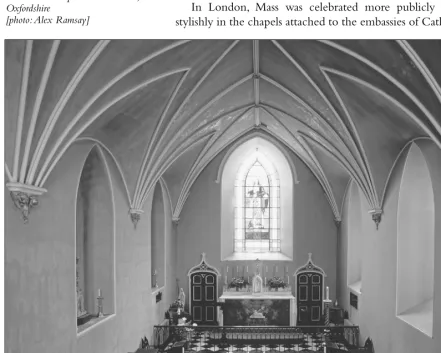
number of these mass rooms and estate chapels survive (e.g. St Amand’s chapel, East Hendred, and the chapel at Stonor Park, Fig. 1, both in Oxfordshire).
In London, Mass was celebrated more publicly and more stylishly in the chapels attached to the embassies of Catholic states
Fig. 1: The Regency Gothic interior of the medieval chapel at Stonor Park, Oxfordshire
and these services could be witnessed by discreet but curious Englishmen and women. In the royal households of Charles I, Charles II and James II, provision on an appropriately sumptuous scale was made for the Catholic consort and her entourage.These buildings were classical in inspiration, the sole survivor being also the most important, Inigo Jones’s Queen’s chapel of 1623, built for the anticipated Spanish bride of Charles I, but finished in 1625 to serve the household of Henrietta Maria, Charles’s French queen.5
Outside the capital, many English towns had Catholic chapels, some of which had been targeted by anti-Catholic rioters. Liverpool’s first Catholic chapel in Edmund Street, for example, was destroyed by rioters in 1746. Its replacement was disguised as warehouse with lumber stored on the ground floor, only to be destroyed again in 1759.6
In the second half of the eighteenth century, circumstances became more favourable for English Catholics.At the death of the ‘Old Pretender’ in 1760, the papacy and the European Catholic powers declined to recognise the claim to the throne of his son, Charles Edward Stuart, considerably reducing the risk represented by Jacobitism and creating an atmosphere in which a degree of toleration of Catholicism became more acceptable. The decisive suppression of the Gordon Riots of 1780, a violent response to the first Catholic Relief Act of 1778, and the last major national expression of violent anti-Catholic feeling, indicated a significant change in official attitudes. Some aristocratic Catholic families felt sufficiently confident to build ambitious new chapels in the relative seclusion of their estates (e.g. the Arundells’ chapel at Wardour Castle,Wilts. of 1776 and 1789–90 and the Weld’s chapel at Lulworth Castle, Dorset, of 1786–7, Fig. 2).
Fig. 2: Lulworth Castle chapel, Dorset (John Tasker, 1786–7).
[photo: Alex Ramsay]
The French Revolution, with its strong anti-clerical ethos, contributed to the gradual shift in public opinion. Many émigré French clergy and religious were given sanctuary, especially in the south of England, swelling the ranks of Catholic clergy serving English chapels. Sympathy for their suffering and alarm at the political implications of Revolution contributed to the warmth of their welcome, at least among the political classes. In 1794, the pupils and priests of the Jesuit Seminary and Academy in Liège was offered sanctuary by Thomas Weld at his unoccupied Lancashire mansion at Stonyhurst, which opened its doors as Stonyhurst College on 21 October 1794.7
The aftermath of the Second Relief Act
The Second Catholic Relief Act of 1791 legalised public worship and sanctioned church building, as long as the building had no steeple or bell.This heralded a period of Catholic church and chapel building on a significant scale. Many of the new chapels were built on sites of earlier devotion, sometimes preserving relics associated with the martyrs of penal times. Aristocratic and landowning patrons were in the vanguard, although in larger towns, well-to-do laymen established societies devoted to fundraising and church building. These chapels consequently tended to follow the trend for ‘privatised’ proprietary churches common in both Anglican and Nonconformist circles, where pew rents secured the best seats and the poor were pushed to the margins. Most chapels of this period were barely distinguishable from Nonconformist chapels and, in the absence of a Catholic architectural profession, many were built by the same surveyors and contractors.
The vast majority of these post-1791 chapels continued to be built in a simple classical style, unpretentious galleried boxes closley resembling Nonconformist chapels of the period (e.g. St Thomas of Canterbury, Newport, Isle of Wight, 1792, Fig. 3). For the most part, their exteriors remained understated, as old habits died hard; architectural discretion was to be a defining characteristic of Catholic churches until well into the nineteenth century. Chapels could be tucked away behind the presbytery, which presented a discreet and domestic face to the world (e.g. St Benet’s, Netherton, Lancs., 1793, now vested in the Historic Chapels Trust). As Christopher Martin and Alex Ramsay have reminded us, these modest facades often belie the glories within.
From Emancipation to building boom, 1829—1880
Catholic education system. From 1840 students of Stonyhurst, for example, could graduate with a degree from London University, which unlike Oxford and Cambridge, did not exclude Catholics. Only in 1871 were all religious restrictions on entry to the Universities of Oxford and Cambridge finally lifted. This created a social milieu in which an educated Catholic professional class could emerge, and Catholic architects could confess their faith and earn a living working for Catholic patrons. A Catholic adherence remained a hindrance outside Catholic circles for rather longer. When Henry Clutton converted to Catholicism in 1857, he was obliged to relinquish his post as Surveyor to Salisbury Cathedral and commissions for the Established Church ceased. The restoration of the episcopal hierarchy in 1850 was a major watershed and coincided with a period of enormous expansion in the Catholic population of England as a result of the influx from Ireland. This phenomenon had begun in the later eighteenth century, with the arrival of seasonal agricultural workers. The trickle became a flood with the arrival of those fleeing the famine and destitution of the 1840s. The new arrivals were predominantly, albeit not exclusively, Catholic. Those who settled in England’s ports and industrial cities shifted the dominant
Fig. 3: St Thomas of Canterbury, Newport, Isle of Wight (Fr Thomas Gabb, 1792).
[photo: Alex Ramsay]
demography of Catholicism in England from the rural estate to the urban centre. By the 1851 census there were 900,000 Catholics in England and Wales, worshipping in 597 chapels, a population that had grown to 1,793,000 (worshipping in 1,845 chapels) by the eve of the First World War.8
These new arrivals were not in thrall to the Recusant aristocracy and as only a tiny proportion could be accommodated in existing churches and chapels, the newly-established Catholic bishops made church provision for these impoverished urban immigrants a high priority. There were also fears that non-Catholic education and poor relief would seduce the faithful. As a consequence, the teaching and nursing orders of religious became a significant force in many English towns and cities from the middle of the nineteenth century, reversing the flow that had once taken English men and women with a monastic vocation to the Continent.
Clergy, not laymen, were now in control of the building campaigns.The penny contributions of the poor were a significant aspect of the funding of this enormous school and church-building initiative, and created a strong sense of ‘ownership’ which continues to have resonance to this day. In many Catholic parishes the school preceded the church, while the hard and fast division of sacred and secular space meant that the majority of churches were also endowed with a building suitable for social activities. The complex of church, presbytery, school and social hall is consequently characteristic of many Catholic urban parishes.
In the 1850s and 1860s Catholic churches began to match those of the Established Church in terms of scale and architectural pretension. Many of the same stylistic debates conducted in the architectural mainstream were echoed in the Catholic context. In the vanguard, of course, was A. W. N. Pugin (1812–52). Although his influence was perhaps even stronger in Anglican Ecclesiological circles, he was responsible for a large number of Catholic churches in his short career.9 Much of his work was
compromised by the relative poverty of his patrons, but at St Giles, Cheadle, Staffordshire (1841–6, Fig. 4), the patronage of the Earl of Shrewsbury provided him with an opportunity to express his ideals. Here he recreated the perfect English medieval country church, the architectural inheritance denied to Catholics since the Reformation.
Fig. 4: St Giles, Cheadle, Staffordshire (A.W. N. Pugin, 1841–6), Blessed Sacrament chapel. [photo: Alex Ramsay]
confined to rows of fixed benches filling nave and aisles, usually resulting in poor visibility of the celebration of the Mass for those seated in the aisles. For many nineteenth-century Catholic clergy, including Cardinal Newman, the classical architecture of Rome was perceived to be a more appropriate architectural idiom for the English Catholic Church resurgent. For the Oratorians, the church of the Order’s founder, the Gésu in Rome, provided an architectural ideal (Fig. 5).
The evolution of a more flexible spatial formula that overcame some of the problems that a rigid adherence to medieval principles could cause was left to other architects. Pugin’s son Edward, together with the Hansom and Scoles practices, perfected a Gothic ‘town church’ with a tall arcade and roof that encompassed nave and wide aisles, providing ample space for a large congregation, while at the same time ensuring visibility of the altars for all (e.g. E.W. Pugin’s Our Lady of Reconciliation de la Salette, Liverpool, 1859–60 or J. A. Hansom’s St Walburge, Preston, 1850–54, Fig. 6). Economy remained a consideration and many hundreds of these majestic barn-like Gothic churches were built.
The late-nineteenth century:
architectural maturity
In the great flood of late-nineteenth century Gothic Revival church building a number of Catholic architects, notably J. F. Bentley (1839–1902), Leonard Stokes (1858–1925), George Gilbert Scott junior (1839–97, converted 1880), his son Giles Gilbert Scott and H. S. Goodhart Rendel (1887–1959, converted 1924), stand out.Their work was no longer confined to Catholic patronage, but had crossed the divide into the British architectural mainstream; despite his extreme youth and Catholic faith Giles Gilbert Scott was to design Liverpool’s Anglican Cathedral. In common with architects of all denominations, they drew inspiration for their church buildings from a growing familiarity with the buildings of the early Christian and Byzantine church and an understanding of the liturgical practices of early Christians informed by archaeological discovery.
Church design in England in the last quarter of the nineteenth century and first quarter of the twentieth was dominated by the search for a plan form that achieved the unification of chancel and nave in a single space. This explains interest in the thirteenth century French cathedral of Albi and the European churches of the medieval mendicant orders.10 New churches were
CATHOLICCHURCHBUILDING INENGLAND
Liverpool (1888–90, Fig. 7), for example, derived its narrow aisles tucked under the internal buttresses from Albi, although its refined detailing is entirely in the English Arts and Crafts tradition. J. F. Bentley, architect of Westminster Cathedral (1895–1903, Fig. 8), chose a style that was consciously and confidently different from the High Gothic of nearby Westminster Abbey and looked to Byzantium for inspiration.Where modern building materials were used, they were usually disguised under a traditional cladding.
The twentieth century:
architecture, Modernity and liturgical reform
All the major denominations had experienced modest growth until the very eve of the First World War.The carnage of the war shook religious certainties through the trauma of slaughter on an industrial scale. In contrast to other denominations, and thanks to continuing Irish Immigration, Catholic church attendances bucked the trend and continued to rise throughout the interwar years. Numbers were further swelled in the years after the Second World War by new arrivals from Continental Europe, notably
Fig. 7: St Clare, Sefton Park, Liverpool (Leonard Stokes, 1888–90), interior. [photo: Alex Ramsay]
CATHOLICCHURCHBUILDING INENGLAND
from Poland and the Ukraine.This was a young population and in 1961 nearly two and a half times as many babies were baptised in Catholic churches as fifty years earlier.11Older urban centres were
affected by the drift to the suburbs, where new churches were built in considerable numbers. In the years after the Second World War this trend accelerated and church building was boosted by the replacement of war damaged buildings. In recent decades, however, the trend of church attendance has turned downwards and has begun to have its impact on church buildings. New build is now being overtaken by the rationalisation of older building stock.
Between the Wars
in England.12The Liturgical Movement had its roots in progressive
Catholic theological circles in pre-First World War Belgium. A return to biblical sources and a deepening understanding of the worship of the early Church promoted a new concept of liturgy, in which laity and clergy joined in active participation, with the Eucharist at the heart of a corporate act of worship. New churches like Auguste Perret’s Notre-Dame de Raincy (1922–3) and Dominikus Böhm’s St Engelbert, Cologne-Riehl (1930–32) were an architectural response to this new liturgical inclusivity.13The
publication in 1935 of Father Gabriel Herbert’s Liturgy and Society brought these ideas to a wider English audience.
Church building in 1930s England remained largely faithful to the rectangular plan, although a number of architects experimented with a forward altar as a means of bringing the Eucharist closer to the congregation (e.g. Giles Gilbert Scott’s St Alphege, Bath, 1925–54, with nave and sanctuary in a single basilican space, with a forward altar under a baldacchino) or freed up space near the altar by relocating the choir to the once-discredited western gallery (e.g. St Wilfred, Brighton, H. S. Goodhart-Rendel, 1932–4). The two most daring English churches of the interwar years were built for Catholics, both of
Fig. 9: St Peter, Gorleston-on-Sea, Norfolk (Eric Gill with J. Edmund Farrell, 1938–9), interior. [photo: Alex Ramsay]
them centrally planned: the Church of the First Martyrs, Bradford by J. H. Langtry Langton (1935) and St Peter, Gorleston, Norfolk by Eric Gill (1938–9, Fig. 9). The clean, white angularity of European modernism was, however, largely eschewed in favour of large planes of exposed brick, notably in the work of F. X.Velarde (1897–1960).
Post-War churches
The bomb damage of the Second World War, the creation of new residential suburbs on the edges of many cities and most recently demographic change in older urban centres, has sustained a demand for new churches.While the traditional rectilinear plan continued to have its adherents (perhaps most prominently in Sir Basil Spence’s prize-winning design for the new Coventry cathedral, 1962), innovative post-War church building has been dominated by the search for a unified worship space, and in particular by the exploration of plan forms that place the Eucharist literally as well as spiritually at the centre of worship. These include variations of the Greek cross, with a free-standing altar placed under the crossing (e.g. the Church of St Mary and St Joseph, Lansbury, London Borough of Tower Hamlets by
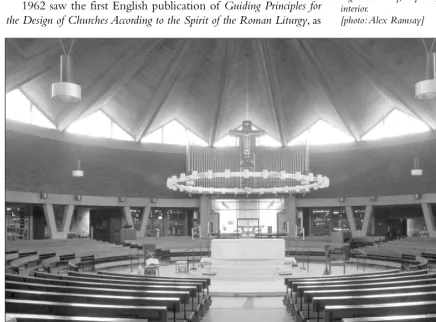
Adrian Gilbert Scott, 1950–54;T-plans (e.g. Our Lady of Fatima, Harlow, Essex by Gerard Goalen, 1954–60); square plans with circulation space around a centrally placed altar (e.g. the Anglican church of St Paul’s, Bow Common, London Borough of Tower Hamlets by Robert Maguire and Keith Murray, 1958–60, where the altar is placed slightly off centre) and churches in the round (e.g. St Mary, Leyland, Lancashire, by Jerzy Faczynski of Weightman and Bullen, 1962–4; Frederick Gibberd’s Liverpool Metropolitan Cathedral, 1962–7 and Francis Pollen’s Church of Our Lady Help of Christians at Worth Abbey, West Sussex, 1964–89, Fig. 10). Recognising that forward-facing celebration of the Eucharist could not be satisfactorily achieved with the altar placed at the centre of a circular or octagonal plan, plans that allowed for fan-shaped seating arrangements have enjoyed considerable popularity (e.g. Richard Gilbert Scott’s Our Lady Help of Christian, Kitts Green, Birmingham, 1966–7 and Clifton Cathedral, Bristol by Ronald Weeks of the Percy Thomas Partnership, 1965–73, Fig. 11).
Fig. 11: Cathedral church of St Peter and St Paul, Clifton, Bristol (Ronald Weeks of the Sir Percy Thomas Partnership, 1973), interior. [photo: Alex Ramsay]
The liturgical furnishing and decoration of the twentieth century church and chapel was of critical importance and in many cases was designed or commissioned by the architect. If church building ceased during the Second World War, thinking about churches did not and exhibitions of church art sponsored by the Central Council for the Care of Churches, with guest curators of the calibre of John Piper, promoted the concept of art in the service of the Church. The post-war cathedrals of Coventry and Liverpool Metropolitan became a showcase for contemporary art and craft, with work by Graham Sutherland, Jacob Epstein, John Piper and Patrick Reyntiens, Margaret Traherne and Ceri Richards. St Mary, Leyland is unthinkable without the impact of work by artists Jerzy Faczynski, Patrick Reyntiens, Arthur Dooley and Adam Kossowski (Fig. 12). The architectural and historical character of a twentieth century church can be diminished by the loss or careless re-siting of original furnishings and art works, or by their dilution through the accretive impact of undistinguished additions: to some extent this has already happened in Liverpool Cathedral.
Taking stock:
the future management of historic Catholic churches
In common with other Christian denominations, Catholic congregations are now experiencing the pressures of declining congregations, diminishing clergy numbers and the pressures of maintaining a large, and in many cases an ageing and increasingly infirm, building stock. Demographic change and suburbanisation means that in many towns and cities churches built to serve a large
Fig. 12: St Mary, Leyland, Lancashire (Weightman and Bullen, 1964), glass by Patrick Reyntiens.
nineteenth century Catholic population are no longer best placed to serve their twenty-first century successors. A number of dioceses are implementing strategic reviews of their pastoral and mission needs, a procedure that inevitably will have implications for a number of churches and chapels. English Heritage believes that it is highly desirable that any pastoral review of a diocese is informed by, among many other factors, a complementary evaluation of its church buildings, in order to establish their architectural and historical significance in both a local and a national context. Dioceses can then be fully informed of both the opportunities and possible constraints in terms of alternative uses for buildings or sites which may not be required for worship in the future.
Following successful pilot projects in the dioceses of Lancaster and Arundel and Brighton in 2005, English Heritage is helping to fund a series of historical, architectural and archaeological assessments of churches in a number of Catholic dioceses. These projects are all about partnership, and the active cooperation and support of the individual Dioceses and their Historic Churches Committee and the Patrimony Committee of the Bishops’ Conference of England and Wales is absolutely critical to success. A project in the diocese of Portsmouth got under way in January 2007 and it is hoped that work in Liverpool, Middlesbrough, Leeds and Clifton will soon follow.
Acknowledgements
This text began life as part of a guide to the principles of selection for historic places of worship, part of a suite of documents to elucidate the new designation regime anticipated in the Government’s White Paper ‘Heritage Protection for the 21st Century’. (See http://www.Culture.gov.uk/ Reference_library/Consultations/2007_current_consultations/hpr_white paper07.htm. The Principles of Selection may be consulted at http://www.english-heritage.org.uk/principlesofselection.) I am grateful to colleagues Dr Roger Bowdler, Dr Martin Cherry, Andrew Derrick, Elain Harwood and Dr Rory O’Donnell for comment and criticism.Any faults that remain are entirely my own.
Notes
1 See also the entries on Charles Francis Hansom (1817–88), Joseph John Scoles (1798–1863) and the Hardman family in the new edition of the Oxford Dictionary of National Biography, www.oxforddnb.com.
2 E.g. Catriona Blaker,Edward Pugin and Kent (The Pugin Society, Ramsgate, 2003), and Denis Evinson,The Lord’s House: A History of Sheffield’s Roman Catholic Buildings 1570–1990 (Sheffield, 1991) and the same author’sCatholic Churches of London (London, 1997).
3 Alan D. Gilbert,Religion and Society in Industrial England (London and New York, 1976), 46.
4 The chest was found at Samlesbury Hall and is now preserved at Stonyhurst College in Lancashire. See Virginia C. Raguin (ed.) Catholic Collecting Catholic Reflection 1538–1850 (Worcester, Mass., 2006), 15–20, 54–9.
5 See Simon Bradley and Nikolaus Pevsner, The Buildings of England. London 6:Westminster (New Haven and London) 587–8.
6 Thomas Burke,The Catholic History of Liverpool (Liverpool, 1910), 11–13. 7 Janet Graffius, ‘St Omer to Stonyhurst: Jesuit Education of English Catholics
1593–1900’ in Raguin, op. cit., 161–8. 8 Gilbert, op. cit. note 3.
9 For Pugin and the Ecclesiological movement see Roderick O’Donnell,‘“Blink by [him] in silence”? The Cambridge Camden Society and A. W. N. Pugin’ in Christopher Webster and John Elliott (eds.), ‘A Church as it Should Be.’ The Cambridge Camden Society and its Influence (Donnington, 2000), 98–120.
10 John Thomas,Albi Cathedral and British Church Architecture (The Ecclesiological Society, 2002).
11 Doreen Rosman,The Evolution of the English Churches 1500–2000 (Cambridge, 2003), 306.
12 For the best recent account of this phenomenon see Elain Harwood,‘Liturgy and architecture: the development of the centralised eucharistic space’,The Twentieth-Century Church.The Journal of the Twentieth Century Society 3 (1998), 50–74. 13 For plans and photos of both see Robert Maguire and Keith Murray, Modern
RECRUITMENT INTO Catholic architectural practice has been extraordinarily varied, drawing men from the building trades, converts from Protestantism, a number of architect-priests and even the brother-in-law of a cardinal. But the most striking aspect is the family dynasties which built up in the nineteenth century, perhaps no different from the many professions that formalised themselves in this way at that time. Moreover, with the Gothic Revival such dynasties embody a sort of apostolic succession, exploited by sons and grandsons over many generations. Most well-known is the Pugin family, in various sorts of architectural practice from about 1800 to 1958.
The repetition of family names and the formation and breaking of partnerships together make for a minefield. When I began my research in the late 1970s, a former Victorian Society secretary told me with great confidence that Salford Cathedral (M. E. Hadfield & J. G. Weightman of Sheffield, 1844–8) was by architect ‘x’ ‘because Betjeman had told me’. However, while a sympathetic advocate for Nonconformity, Betjeman in fact completely ignored Catholic architecture. I have dedicated much of my life since to disentangling these dynastic networks.1
Only a handful of figures – A. W. N. Pugin, J. H. Pollen, J. F. Bentley – have been subject of biographies, with recent monographs on G. G. Scott junior and Francis Pollen.2 For new
research, the deposited papers of practices or family members are the most important primary sources, both in local record offices and at the RIBA.3As far as published sources go, references to
Catholic architecture in The Builder and other journals were extracted by Prof. Stephen Welsh of Sheffield, and are held at the RIBA. But these need to be related to the buildings so as to build up a connoisseurship: St Wilfrid Ripon (1862, Fig. 1), built during the brief and unhappy partnership between E. W. Pugin and J. A. Hansom, is often given to Hansom but from internal stylistic evidence is clearly E.W. Pugin’s alone. More can be found in the Catholic press, notably The Tablet (from 1840). Much recent reassessment is reflected in the entries inThe Grove Dictionary of Art, ed. Jane Turner (London and New York, 1996) and The Oxford Dictionary of National Biography(Oxford, 2004).
While Catholic church building was proscribed for most of the eighteenth century, Catholic architects are known at this time. James Gibbs was born a Catholic and trained in Rome; Thomas Atkinson of York (1729–98) was a convert; Thomas Gabb
Dr O’Donnell, an insufficiently pious bachelor, has been fascinated by Catholic architecture since childhood. He is the author of ‘A. W. Pugin’ in ‘Catholic Heroes’ (Gracewing, forthcoming).
Pious bachelors, converts, fathers and sons:
English Catholic architects 1791–1939
(1742–1817) was a priest ordained at Douai before the French Revolution and the architect of his own church at East Cowes, Isle of Wight (1796–7) as well as probably that of St Thomas of Canterbury, Newport (1791), both paid for by Mrs Elizabeth Heneage. John Tasker (1738–1816) is known above all as architect of the chapel at Lulworth (1786–7), the first free-standing church built before the 1791 Relief Act. Another might be John Carter, whose church for Bishop John Milner at Winchester (1792) is sometimes cited as the occasion of his conversion (which he later denied).
Perhaps the first sign of an emerging dynastic Catholic practice comes with Joseph and Ignatius Bonomi. The Roman-born Joseph rebuilt two of the London Catholic embassy chapels, the Bavarian (1789–90) and the Spanish (1793), while his son Ignatius was designing Catholic churches until about 1840. Joseph Ireland (1780–1841) may have been a pupil of Joseph Bonomi; like Tasker, Ireland specialised in country house chapels such as Hassop (1816–19, Fig. 2). Among his pupils was John Joseph Scoles (1798–1864), to whom he was related through his mother, and who was the most substantial specialist Catholic church architect before Pugin, particularly with the Jesuits.
Two of J. J. Scoles’ sons were first architects and later priest-architects: Ignatius (1834–96) was a Jesuit who in partnership with S. J. Nicholl (1826–1905, and J. J.’s pupil and godson) rebuilt the Jesuit church of St Wilfrid, Preston (1878–80). Alexander J. C. Scoles (1844–1920) was eventually a canon of the diocese of Portsmouth and built his own church (Holy Ghost, Basingstoke,
1902). J. J. Scoles’ other pupils included T. J. Wilson (1824–1903), the son of the Lincoln architect and antiquary E. J. Wilson (1787–1854), himself a link with John Carter and a mentor of A.W. N. Pugin.
A. W. N. Pugin had become a Catholic in 1835, having made an architectural tour d’horizonbeforehand; it was Scoles’s church at Stonyhurst which is usually taken as the ‘big chapel now building in the north’, cited by Pugin as the occasion of his conversion. Pugin’s rise challenged not only established men like Scoles but also cut the ground from classical architects such as Charles Day, who simply disappear from Catholic view. So too do those Protestant architects who had previously picked up Catholic work local to their practices, such as that in the Midlands by (the Unitarian) Thomas Rickman. After 1840 only very occasionally do Anglican architects get Catholic commissions (or vice-versa).
A. W. N. Pugin (d.1852, Fig. 3) produced no fewer than three sons and one son-in-law as architects, and dominated Catholic church practice from 1838–48. His prolific output was matched by his son Edward Welby (1834–75, Fig. 4), who took over the practice at the age of eighteen, under his own name; unlike his father he had a bewildering series of partnerships and many pupils, with offices in Ramsgate, London, Dublin and Liverpool. Notable amongst his works is the Franciscan church at Gorton (1863–6 and 1875–8, completed by his brothers), now redundant and undergoing conversion to secular use.
Fig. 2: J. Ireland, All Saints, Hassop, Derbyshire: front portico.
[photo: Alex Ramsay]
Fig. 4: Owen Hale’s bust of E.W. Pugin, in front of Pugin’s Granville Hotel, Ramsgate.
[photo: Roderick O’Donnell]
PIOUS BACHELORS, CONVERTS, FATHERS AND SONS: ENGLISHCATHOLIC ARCHITECTS1791-1939
Fig. 3: A.W. N. Pugin’s tomb chest at St Augustine’s, Ramsgate, by E.W. Pugin.
PIOUS BACHELORS, CONVERTS, FATHERS AND SONS: ENGLISHCATHOLIC ARCHITECTS1791-1939
Fig. 7: A.W. N. Pugin, St Mary’s Cathedral, Newcastle, exterior view from the east.
[photo: Alex Ramsay]
A.W. N. Pugin’s immediate influence or example was claimed for the conversion of W. W. Wardell (1823–99) and C. A. Buckler (1825–90), who set up The Catholic Wykeham Brotherhood, a guild to propagate Catholic and Gothic Revival teachings, which, typically, lasted only a few years. Wardell was a highly competent Puginite, but he left for a remarkable second career in Australia in 1858, his practice falling to Hadfield and Goldie. Buckler was the son and grandson of architects, and was stylistically more independent and thoughtful, as seen in his Flemish–inspired London Dominican church.
Both ‘cradle’ Catholics and converts founded architectural dynasties, and together they tended to see off the opposition. Cradle Catholic architects such as Gilbert Blount (1819–76) were much employed by the gentry. He was succeeded in practice by A. E. Purdie (1843–1920) and then by the fashionable architect W. H. Romaine Walker (1854–1940), who was a convert. Other born Catholics included M. E. Hadfield (1812–85, Fig. 5), the nephew of the Duke of Norfolk’s agent on the Glossop estate in Yorkshire, father of Charles (1840–1916) and founder of the still-extant Sheffield practice.4The Hansom brothers, Joseph Aloysius
Angelica Kauffman. He was recommended by Pugin as a pupil to Hadfield, whose partner he became (1850–58) before setting up with Child and later with his son Edward. Archibald Matthew Dunn (1834–1917) came from a Newcastle business and legal background and his family had been almost the founders of A. W. N. Pugin’s Newcastle Cathedral (1842–4, Fig. 7). He inherited a fortune of £70,000 in 1870, and found a partner in C. F. Hansom’s son Edward Joseph (1842–1900), who made up the busy partnership (1871–93) responsible for such churches as Our Lady and the English Martyrs, Cambridge (Fig.. 8).
Other converts came from within the building trades; J. F. Bentley (1839–1902) joined Henry Clutton (1819–93) via the London building trades as an improver and became a Catholic in 1862 (Clutton was himself a convert and Cardinal Manning’s brother-in-law). Herbert Gribble (1847–94) was a Plymouth tradesman who trained at the South Kensington schools and joined J. A. Hansom as a draughtsman in 1867, setting up with T. J. Walford for the Brompton Oratory (Fig. 9), very much a ‘command’ commission from the Oratory Fathers. From a more socially elevated Oxford Movement milieu came in 1852 the clergyman and don J. Hungerford Pollen (1820–1902), who designed a handful of Catholic churches; he was the great-grandfather of the architect Francis Pollen (1926–87), architect of Worth Abbey church (1965–75). G. G. Scott junior (1837–97) became a Catholic in 1880 and Thomas Garner (1839–1906) in 1890, in both cases after distinguished Anglican church practice.
Such conversions from Protestantism tended to be the result of ructions on the High Church wing of the Church of England, such as Newman’s conversion in 1845, the Privy Council’s Gorham judgement in 1854 (overruling the highest Anglican church court) or, on the Catholic side, the Papal Bull Apostolicae Curae (1896), condemning Anglican Orders. Many such ‘verts’, as
PIOUS BACHELORS, CONVERTS, FATHERS AND SONS: ENGLISHCATHOLIC ARCHITECTS1791-1939
Fig. 10: St Etheldreda’s, Ely Place, Holborn, interior.
[photo: Alex Ramsay]
PIOUS BACHELORS, CONVERTS, FATHERS AND SONS: ENGLISHCATHOLIC ARCHITECTS1791-1939
the Catholic press called them, faced lean times as Catholic architects. Pugin of course had had a fraught relationship with the Cambridge Camden Society5 and when S. N. Stokes, a founder
member of the Society, became a Catholic in 1846, he was expelled (Stokes incidentally was the father of Leonard Stokes, who was briefly in S. J. Nicholl’s office). On their conversions, Clutton split with Burges, Scott junior with his brother, and Garner with Bodley (although amicably), as denominational and professional rivalries became hotly contested. Other conversions or partnerships were less fraught. Edward Ingress Bell (1837–1914) became a Catholic in 1884, but continued with Aston Webb. J. A. and C. F. Hansom, Hadfield and Goldie all had non-Catholic partners.6
probably set up for the purpose, of Bernard Whelan (a figure on the edge of the Rosminian order, the patrons) and John Young junior (1829–92).
John Young senior (1797–1877), also a Catholic, had been a district surveyor in the City of London. From 1862–6 he was in partnership with Frederick Hyde Pownall, and it was probably during this time that Pownall became a Catholic. Pownall’s independent church practice continued along with his post as Middlesex County Surveyor. His son, the artist Gilbert Pownall was responsible for many of the mosaics at Westminster Cathedral, notably those in the Lady Chapel (1931–2). The Pownalls, the Youngs and F. W. Tasker (the great-nephew of John Tasker) were all minor London Catholic practitioners, and did not appear on the national stage.
Then there are the properly provincial practices, on which much local research needs to done. In Liverpool, E. W. Pugin’s branch office seems to have been a crucial seedbed, producing amongst others Edmund Kirby (1838–1920), the brothers James and Bernard Sinnott and Daniel Powell, as Sinnott, Sinnott and Powell (1888–98), and James J. O’Byrne (1836–97). O’Byrne was Irish-born but trained in England under J. A. Hansom. He was a bachelor who left his £100,000 fortune to St Joseph’s College, Upholland, begun to his designs in 1880–83. He also left his collection, which made up the bulk of the museum at Upholland (until its sale before the closure of the college in 1999). Manchester was the base of the convert H. J.Tijou (1832–85) and William Nicholson,West Yorkshire that of the practice of Edward Simpson (1844–1937), which continued as Simpson and Son until 1939, and Newcastle that of Charles Walker (b.1860). Other architects began in the regions before setting up London offices. An example is John Kelly (1840–1904) a Yorkshire Irishman with a Leeds practice, who with his son Claude and E. Birchall moved to London; his St Patrick’s, Soho Square (1893) is typical of the firm’s Italianate brick churches. There were others in Glasgow, Edinburgh, Dublin (with a Pugin son-in-law, G. C. Ashlin), Cork and Belfast.
Fig. 11: Richard Gilbert Scott, Our Lady Help of Christians, Kitts Green, Birmingham, interior.
[photo: Alex Ramsay]
PIOUS BACHELORS, CONVERTS, FATHERS AND SONS: ENGLISHCATHOLIC ARCHITECTS1791-1939
Cuthbert Welby (1848–1928) a sleeping partner.The practice was continued by their nephews Sebastian Pugin Powell (1866–1949) and his cousin Charles Henry Cuthbert Purcell (1874–1958).
architectural essay) and the bachelor architect and critic H. S. Goodhart-Rendel in 1924 (Prinknash Abbey church, his megalomaniac scheme reduced after 1960 by F. G. Broadbent).
By 1939 many of the old ‘dynastic’ practices were closing. Neither Cuthbert Pugin nor Sebastian Pugin Powell married, and the practice closed in 1958. C. M. Hadfield retired in 1937, and while the practice continued, its church work fell off. An exception was Holy Apostles, Pimlico (1956–7), built for Canon Edmund Hadfield (1910–82), a great-grandson of the founder of the practice. There have been further conversions, including Donovan Purcell (the founder of Purcell Miller Tritton) and Norman Phillips, surveyor emeritus to Carlisle Cathedral; both of whom had had harrowing Second World War experiences as prisoners of war. However, for neither of these did conversion define their architectural practice.
Despite the leading role awarded to the architect and artist in the documents implementing the liturgical reforms of Vatican II, the ‘Catholic Architect’ became less in evidence, except in the many controversial reorderings. Indeed, all three major post-war cathedral commissions went to non-Catholic architects, Liverpool through competition, Clifton and Brentwood through episcopal fiat. However, the prolific Scott dynasty endured in the post-war years under Sir Giles (1880–1960), Adrian Gilbert (1882–1963), and most recently Richard Gilbert (son of Giles, b.1923), architect of the now listed church of Our Lady Help of Christians, Kitts Green, Birmingham (1966–7, Fig. 11). Moreover, the dynastic tradition continued in parvo with Gerard Goalen (b.1918) and his son Martin.
Notes
1 Particularly in my unpublished PhD thesis,Roman Catholic Church Architecture in Great Britain and Ireland,1829–1878 (1983) and subsequent publications e.g.The Pugins and the Catholic Midlands(Gracewing, Leominster, 2002).
2 Gavin Stamp,An Architect of Promise: George Gilbert Scott Junior and the late Gothic Revival(Donington, 2002) and Alan Powers, Francis Pollen: Architect 1926–1987 (Robert Dugdale, Oxford, 1999).
3 Joanne Heseltine (ed.) Catalogue of the Drawings Collection of the RIBA, the Scott Family (Amersham, Bucks 1981) and Alexandra Wedgwood, Catalogue of the Drawings Collection of the RIBA, the Pugin Family(Farnborough, 1977).
4 Hadfield, Caukwell and Davidson:150 years of Architectural Drawings Hadfield, Caukwell and Davidson, Sheffield 1834–1984(Chesterfield, 1984).
5 R. O’Donnell ‘“Blink by [him] in silence”? The Cambridge Camden Society and A. W. N. Pugin’ in Christopher Webster and John Elliott (eds.),‘A Church as it Should Be.’ The Cambridge Camden Society and its Influence (Donnington 2000), 98–120.
THE COMMUNITY of English Benedictine nuns which had been established at Cambrai in 1625 had to move to England in 1795. After spending a number of years at Woolton, near Liverpool, and at Salford Hall, Warwickshire, they settled in 1838 at Stanbrook Hall, Powick, a few miles south of Worcester. Built in about 1755, this was a plain brick house, consisting of a two-storey main front, facing west, and, at right angles to it, a wing of two storeys, with a three-storey part beyond. The nuns added a small chapter room, a refectory, and some cells, continuing this wing, and a chapel at right angles to it, to correspond to the first part. Behind the chapel a wing running southwest contained the school (discontinued in 1918). The nuns’ architect was Charles Day, brother of one of them and best known for his churches at Hereford and Bury St Edmunds, and for the Shire Hall at Worcester.
The chapel was not recognisable as such on the outside, but its interior is a handsome example of its type.The narrow sanctuary bay is top-lit by a glazed dome, and retains its large painting of the Deposition from the Cross, whose arched frame echoes the arch to the bay.The flanking walls are canted in. At the opposite end is a corresponding arched recess which contained the organ.
In 1863 Dom Laurence Shepherd, of Ampleforth, became Vicarius (or chaplain). He was a fine liturgist and advocate of plainsong, and considered that a new church was essential. There were by then twenty professed choir nuns and lay sisters. Edward Welby Pugin (whose father had visited Stanbrook in 1840) was already thought of as architect in 1866, when Dom Anselm Cockshoot, of Ampleforth, chaplain to the Convent of Our Lady of Charity at Bartestree, near Hereford, which Pugin had built in 1862–3, warned that he would not give enough attention to the work. However, a year later Dom Wilfrid Alcock, of St Augustine’s, Ramsgate (built by Pugin in 1860), wrote warmly to recommend him. In the same year the Abbess and the Benedictine Provincial went to Staffordshire to see the new churches of the Dominican Convent at Stone (C. F. Hansom, 1852–4, and G. Blount, 1861–3), and the Benedictine Convent at Oulton (E. W. Pugin, 1853–4), and decided on Pugin.
By May 1868 Pugin was sending ‘a new design’ (Fig. 1). This was for a large, tall church, of which the body would form the nuns’ choir, with an apsidal sanctuary, gabled ‘extern chapel’ (for the public) projecting to the south, and a western tower with an
The author is a former Chairman of the Victorian Society and is a member of the Historic Churches Committee for Wales and Herefordshire
‘In a great tradition’:
the building of Stanbrook Abbey church
octagonal top stage. However, the lowest tender he could recommend was for £4,250, and so the cost was scaled down to £3,000: the church was lower, with a square-ended sanctuary, and a tall bellcote over the west end. At least, said Pugin, all the mouldings would be in stone, not plaster.
By 1869 building was underway, but there were endless problems, with poor foundations, inefficient builders and inadequate supervision. Poor Pugin was continually criticised for being dilatory, but pleaded ill health, the incompetence of his assistants and the constant pressure from other frustrated clients. In fact, he was so unwell in 1870 that he had to take a three-day cruise. He was said in 1872 to be ‘sometimes attacked with complete prostration which lasted for about twenty-four hours’, and he took chloral hydrate as a sedative. Matters were not helped by the fact that the builder was John Barnet Hodgson, the partner in his Ramsgate speculations with whom he spectacularly fell out. Pugin also had to deal with the changes requested by Dom Laurence, including the substitution of a ‘circular’ roof for an open timber one (no doubt for acoustic reasons), and—most problematic of all—the decision in 1870 to have a tower after all, to house the bells and clock on which Dom Laurence was so keen, and for which he paid (Fig. 2). Pugin was particularly unhappy about the spiral staircase.
The correspondence shows that Pugin took great care over the ornamentation and fittings (Fig. 3). He considered that the stone-carver R. L. Boulton ‘can do angels to perfection’, but much disliked his ‘pretty and flimsy’ foliage carving. Some carving (apparently in the extern chapel) was done for Boulton by the young H. H. Martyn, and this must surely be the convent where Martyn recalled ‘being slated by the mad architect’. The wood-carving was done by John Farmer of Farmer and Brindley.
Fig. 2: Late nineteenth century view of the exterior of the church from the south.
Fig. 3: The interior of the church in the late nineteenth century.
Although Dom Laurence had written about the stalls ‘Now mind, dear Mr Pugin, we won’t have extravagance’, Pugin was rightly delighted with their carving (‘simply admirable’) and the Kauri pine timber (‘the best of the kind I have ever seen and looks like satinwood’). The design for the organ case was, at Pugin’s suggestion, based on his design for the case at Meanwood Towers, Leeds (‘the first thing of the kind done in modern times’). The organ was built by John Nicholson of Worcester. The superb tile floor was designed by Pugin and John Hardman Powell, and made by R. Minton Taylor and Co. The Benedictine symbols in the sanctuary were suggested by Dom Laurence.
The magnificently elaborate high altar, tabernacle and exposition throne (Fig. 4) were carved, in stone and alabaster, at Pugin’s own ‘South Eastern Works’ at Ramsgate and by Farmer and Brindley. ‘A more magnificent canopy has never yet been executed all in one stone’, wrote Pugin. The tabernacle doors, with enamels and crystals, were made by Hardman.That firm did all the other metalwork, including the superb iron screen between the sanctuary and the nuns’ choir. The stained glass in the great rose window at the east end was also by Hardman. The extern chapel, which opens into the sanctuary on the south, had another richly carved altar.
Remarkable features of the exterior include the stone and brick banding of the tower and the unusual roof tiles, to a design patented by J. P. Seddon, based on Roman examples from Trier. The church was reached from the old convent by a cloister attached to its western end: in this are Stations of the Cross carved by Boulton. The new church was consecrated on 6 September 1871 by Dom Bernard Ullathorne, Bishop of Birmingham. By then the nuns had spent at least £9,000.
Further enrichment of the church included lavish painted decoration on the sanctuary walls and roof, including scenes such
as the Last Supper and the Death of Our Lady, executed by Clayton and Bell in 1877–8 (they probably received the commission because of Hardman’s ‘uncivil behaviour’ in taking almost two years to produce the Resurrection window, ordered in 1873). Their foreman, John Noah Pearce, became a Catholic, and married a local girl. He carried out attractive stained glass in the Holy Thorn Chapel, added west of the extern chapel in 1885 to the design of Peter Paul Pugin, to house a treasured relic. It was erected in memory of Dom Laurence Shepherd, who is buried beneath a tomb with effigy carved by Boulton. It also contains the tomb of Dame Gertrude d’Aurillac Dubois, abbess from 1872 to 1897. The alabaster effigy was carved by Dame Beatrice Brown. In 1894–5 the abbess’s throne, designed by P. P. Pugin, was set up at the west end (Fig. 5). New sacristies were added at the east end in 1899.
It was P. P. Pugin (with Cuthbert Welby Pugin and George C. Ashlin) who designed the east and north wings of the abbey, erected in 1878–80 and 1895–8. Plans had been drawn up in 1876–7 by Dom Laurence and the Belgian Dom Hildebrand de Hemptinne.The great advantage of the erection of the first wing was that it made possible the enclosure of the convent, which had been seen by Dom Laurence and the community as equally important with the building of the church.The western wing, to complete the courtyard, was never built.
The subsequent history of the church can be briefly summarised. In 1937 the high altar was drastically simplified, under the supervision of Geoffrey Webb. The canopy work was removed, and the throne was filled with a sculpture of Christ the King by Philip Lindsey Clark. Most of the painted decoration was covered up. In 1971 the high altar was entirely removed, together with the statues of Saint Benedict and Scholastica in niches on
Fig. 5: The interior of the church today, looking west.
either side. What was left of the painted decoration was covered over. The tile floor of the sanctuary was taken up, and the iron screen went to the Birmingham Art Gallery. The altar in the extern chapel also went. A new high altar, and a new screen, now cutting off the extern chapel from the sanctuary, were designed by Anthony Thompson, of Peter Falconer and Partners.
The community has decided to move to Yorkshire, and the future of the listed Stanbrook buildings is uncertain.
Acknowledgements
OVER TWENTY-FIVE years ago, when most of the following was written,1the outlook for the Catholic Church in England and
Wales was dynamic and optimistic. The National Pastoral Congress had taken place in Liverpool the year before, and a papal visit was expected in 1982.Yet there were signs that the post-war boom in church-building was ending, and even losing its way in design thinking. Also, heritage concerns were growing, prompted by the belief that after Vatican II, too much had been lost in the widespread promotion of ‘reordering.’
Throughout nineteenth century Europe there had been a persistent search for theprimitif,rooted in the cultural crisis at the end of the preceding century. In the Church, via the Benedictine abbeys of Solesmes, Beuron and Maria Laach, an architectural aesthetic developed, the ‘primitive’ intention of which was to place ‘at the service of great theological ideas the basic shapes of a geometric and aesthetic nature of which God made use in creating his universe’,2and which was regarded as ‘being parallel
to the reform effected in music by the Gregorian chant’.3
So it was apt that Cardinal Vaughan should think that ‘to build the principal Catholic church in England in a style which was absolutely primitive Christian, which was not confined to Italy, England, or any other nation, but was, up to the ninth century, spread over many countries, would be the wisest thing to do’.4
Bentley’s design for Westminster Cathedral (completed in 1903, Fig. 1) was clearly intended to stand as an embodiment of the primitive ideal, but one with an imperial overtone. It was also intended as a conciliatory solution to the factious competition between ‘indigenous Gothic’ and ‘Ultramontane Classicism’.
A Byzantine-cum-Romanesque aesthetic persisted well into the twentieth century via such a fine inter-war example as St John, Rochdale (1924, by E. Bower Norris) and then in more vestigial post-war form as at Our Lady of Lourdes,Yardley Wood, Birmingham (1967, by Harrison and Cox). Pevsner berated the style as ‘one of the deadest ends in mid-twentieth century ecclesiastical architecture’, produced mainly by ‘Catholic architects without much courage or creative ability […] all over England’.5
Dominating the church building scene of the 1930s was the ‘gargantuan joke’ of Lutyens’ design for Liverpool Cathedral (begun 1933, Fig. 2). Even more than Bentley’s design for Westminster, it displayed imperial pretensions with eclectic detail
Dr Walker is a commentator on church design. He sits on the Historic Churches Committee for the Diocese of Hallam and the Fabric Advisory Committee for Sheffield Cathedral.
Liturgy and architecture:
Catholic church building in the Twentieth Century
and form redolent of London and Rome, if not also of Constantinople and Delhi, embellishing a sawn-off, planed-down Beaux-Arts monumentalism. In its plan it seriously sought to embody architecturally the Christocentric nature of the Church, an intention implicit in its dedication. In 1925, Pope Pius XI had inaugurated the Feast of Christ the King as the focus of his pontificate’s main objective ‘to reconcile all things in Christ’. Liturgically, the centrality of the altar, as a prime signification of Christ, was emphasised by making it more clearly free-standing, and honouring its regality with a ciborium. Archaeological evidence was quoted in support of such measures, in particular Der Christliche Altar (1924) by J. Braun S.J., and there was a growing desire to be true to primitive practice as then understood.
In 1928,Divini Cultus endorsed Pius X’sMotu Proprio of 1903 encouraging the greater use of Gregorian chant in the liturgy. 1929 saw the foundation of the Society of St Gregory by Dom McElligott of Ampleforth Abbey, and of the Guild of Catholic Artists and Craftsmen. McElligott was also chaplain to the Eric
Fig. 1: Metropolitan Cathedral of the Most Precious Blood,Westminster: interior.
Gills, but Gill believed that not ‘a single atom of good will be done by teaching the people the chant’6 until the altar had been given
‘back to the people’.7 What Chesterton’s friend Mgr John
O’Connor had done at First Martyrs, Bradford (1935, with J. H. Langtry-Langton) provided Gill with an ideal that he wished to see everywhere. Not only had the Bradford church a central altar in an octagonal plan, but one that was originally intended to be moved in order to make the building all-purpose. Shortly before his death, Gill finally succeeded in building the less innovatory church of St Peter, Gorleston (1939, with J. Edmund Farrell).
In 1943, the later doyenne of liturgical commentary, (Mgr) J. D. Crichton published a hypothetical scheme for a centralised altar in a circular church with four radial arms. Surrounding the sanctuary there was a sort of liturgical ‘ha-ha’, so that altar predella and congregational area were on the same floor level, but separated by a three-step depression.8
After the 1939–45 war, Government priorities for allocating scarce materials caused delays in starting new public buildings, including churches, and even repairing war damage. As a measure of the rise in costs, Lutyens’ design for Liverpool Cathedral was completely scaled-down by A. G. Scott. But by 1959 the original 1930s estimate of £3m had risen to £27m, and even Scott’s scheme had to be abandoned, and a competition for a modest £1m building promoted instead.
Fig. 2. ‘Liverpool of the future’. An aerial view showing the two proposed cathedals in context. [From the Illustrated London News, 13 October 1934]
From 1954 to 1960 the completion of Northampton Cathedral was undertaken by A. Herbert, who had also been responsible for Mount St Bernard, Leicestershire (1945). Both were in a pared-down Gothic, a style which seemed all set for a revival. Other examples included the parish churches of St Edmund, Liverpool (1955, by A. Ellis), Sacred Heart, Moreton (1957, by Reynolds and Scott), St Ninian, Glasgow (1959, Pugin and Pugin), Christ the King, Plymouth (1962, Sir G. G. Scott), St Martin and St Ninian, Whithorn (1960, H. S. Goodhart-Rendel) and Our Lady of Victories, Kensington (1958, by A. G. Scott).
However, the rise in building costs forced the thinking on innovations in structural design. Already, before the war, there had been the bold concrete shells of St John, Rochdale (1924) and SS Peter and Paul, New Brighton (1935) by E. Bower Norris and the parabolic concrete portal frame and shell of Our Lady Star of the Sea,Amlwch (1935, by G. Rinvolucri, Fig. 3).After the war the portal frame in concrete and steel became widely used, as at St Maria Goretti, Preston (1956, by W. C. Mangan). Another technique was the reinforced concrete frame, used to great effect by Weightman and Bullen at St Ambrose, Speke (1960).The move towards ‘structural honesty’ was also pursued in Glasgow at Immaculate Conception, Maryhill (1957, by T. Cordiner), displaying a bold use of the reinforced concrete ‘A’ frame.
This pursuit culminated in the competition-winning design for the Metropolitan Cathedral at Liverpool (1957/67, by Sir F. Gibberd, Fig. 4), with its reinforced concrete cantilevered frames set in a circle and held by massive ring beams to support the lantern.9 But perhaps its true apotheosis was in the
hyperbolic-paraboloid roof of St Agnes, Huyton (1963, by L. A. G. Pritchard), the technique proposed in Peter and Alison Smithson’s competition entry for the rebuilding of Coventry Cathedral.
The heated discussion generated by the Coventry competition acted as the catalyst to a more critical approach to church building design generally. It began after Sir Giles Gilbert Scott withdrew his design in 1944, following reservations by the Royal Fine Art Commission. Simply stated, the criticism derived from whether the environment of worship should be informed by art or by liturgy; by modernity or history; by what was happening in France or in Germany.
![Fig. 2: Lulworth Castle chapel, Dorset(John Tasker, 1786–7).[photo:Alex Ramsay]](https://thumb-us.123doks.com/thumbv2/123dok_us/8370977.1675189/11.595.59.344.439.643/lulworth-castle-chapel-dorset-john-tasker-photo-ramsay.webp)
![Fig. 8: Metropolitan Cathedral of the Most Precious Blood,Westminster (J.F. Bentley, 1895–1903), exterior.[photo:Alex Ramsay]](https://thumb-us.123doks.com/thumbv2/123dok_us/8370977.1675189/20.595.73.447.39.622/metropolitan-cathedral-precious-blood-westminster-bentley-exterior-ramsay.webp)

![Fig. 4: Owen Hale’s bust of E.W.Pugin, in front of Pugin’s GranvilleHotel, Ramsgate.[photo: Roderick O’Donnell]](https://thumb-us.123doks.com/thumbv2/123dok_us/8370977.1675189/29.595.90.310.41.306/hale-pugin-pugin-granvillehotel-ramsgate-photo-roderick-donnell.webp)
![Fig. 1: Metropolitan Cathedral of theMost Precious Blood,Westminster:interior.[photo:Alex Ramsay]](https://thumb-us.123doks.com/thumbv2/123dok_us/8370977.1675189/46.595.39.484.42.387/metropolitan-cathedral-themost-precious-blood-westminster-interior-ramsay.webp)
![Fig. 2. ‘Liverpool of the future’.An aerial view showing the twoproposed cathedals in context.[From the Illustrated London News,13 October 1934]](https://thumb-us.123doks.com/thumbv2/123dok_us/8370977.1675189/47.595.60.498.43.309/liverpool-showing-twoproposed-cathedals-context-illustrated-london-october.webp)
![Fig. 3: Our Lady Star of the Sea,Amlwch,Anglesey: interior.[photo:Alex Ramsay]](https://thumb-us.123doks.com/thumbv2/123dok_us/8370977.1675189/49.595.58.345.40.445/lady-star-amlwch-anglesey-interior-photo-alex-ramsay.webp)
![Fig. 4: Cathedral of Christ the King,Liverpool: interior.[photo:Alex Ramsay]](https://thumb-us.123doks.com/thumbv2/123dok_us/8370977.1675189/50.595.44.482.42.389/cathedral-christ-king-liverpool-interior-photo-alex-ramsay.webp)