Volume-7 Issue-1
International Journal of Intellectual Advancements
and Research in Engineering Computations
Smart farming using IOT
V.Parameshwari
1,R.Elangavin1
2,N.Karthikeyan
2,B.Kowsalya
2,N.Logeshwaran
2 1Professor, Department of ECE, Nandha Engineering College(Autonomous),Erode-52,Tamil Nadu
2
UG Students Department of ECE, Nandha Engineering College(Autonomous),Erode-52,Tamil Nadu
ABSTRACT
The Internet of things (IoT) is the network of devices such as vehicles, home appliances and automation that contain electronics, software, sensors and connectivity which allows these things to connect, interact and exchange data. At present, farmer manually irrigates land at regular interval. This process sometimes consumes more water or sometimes the water reaches late due to which the crops get dried.The economy of a developing country mainly depends on agriculture and farms in rural areas and applying traditional approaches is not sufficient. Use of modern technologies like IoT with low cost and scalable solutions is very important. Smart farming irrigation system not only overcomes this problem but also provide clean source of energy. The main objective of proposed system is providing automatic irrigation system that switches a motor pump ON -OFF by sensing moisture content of the soil through application of Internet of Things (IoT).The proposed sysem getsLive Data feeds, various devices like Smart Phones, Tablets are used. The data generated via sensors can be easily shared and viewed by agriculture field owner (farmer) anywhere remotely via Cloud Computing technology integration. IoT stick also enables analysis of various sorts of data via Big Data Ana lytics from time to time. To see the field data (moisture, temperature) collected in database through cloud computing the farmers can give the unique login id and password in the website. So the unauthorized person can’t view or access that field data without the user permission.
Keywords:
Smart Agriculture, Internet of Things, ESP8266, Cloud computing, monitoring sensors.INTRODUCTION
Farming and agriculture is the basis of human life which gives food, grains, and other raw materials. In agriculture there are many problems include inefficient agricultural methods due to absence of technological interface leads to large manpower & high cost and absence of proper crop monitoring process doesn’t leads to extra manpower. Internet of Things (IoT) has opened up a suitable solution for smart farming and agricultureenhancement in crop output efficiency. Technology holds atremendous role in increasing production and decreasing, reached to rural areas. TheWiFi-based Long Distance (WiLD) network is successfully been used to connect the rural regions with low cost. With the extended range, for better
and efficient IoTin such region, fog computing and cloud computing solutionscan be incorporated in Wi-Fidevices [1-5]. Wireless Sensor Network (WSN) is proven to be an economicallyviable solution for the farming domain. Features like the integration of sensors/actuators.
Digitaltransmission, low power consumption, scalability, and securityof WSN enable us to use in different IoT applications. Irrigation,farm monitoring, control use of fertilizer, soil monitoring,intruder detection, and water quality monitoring, etc., operationscan be supported using WSN.To connect microcontroller with WiFi ESP8266EX is used.It delivers highly integrated Wi-Fi SoC solution to meet users’continuous demands for efficient power usage, compact design
and reliable performance in the Internet of Things industry. With the complete and self-contained Wi-Fi networking capabilities, ESP8266EX can perform either as a standalone application or as the slave to a host MCU. When ESP8266EX hosts the application, it promptly boots up from the flash. The integrated high speed cache helps to increase the system performance and optimize the system memory.Also, ESP8266EX can be applied to any microcontroller design as a Wi-Fi adaptor through SPI / SDIO or I2C / UART interfaces. ESP8266EX integrates antenna switches, RF balun, power amplifier, low noise receive amplifier, filters and power management modules. The compact design minimizes the PCBsize and requires minimal external circuitries. Besides the Wi-Fi
functionalities, ESP8266EX also integrates an enhanced version of Tensilica’s L106 Diamond series 32-bit processor and on-chip SRAM. It can be interfaced with external sensors and other devices through the GPIOs. Software Development Kit (SDK) provides sample codes for various applications.Espressif Systems Smart Connectivity Platform (ESCP) enables sophisticated features including fast switch between sleep and wakeup mode for energy-efficient purpose, adaptive radio biasing for low-power operation, advance signal processing, spurCancellation and radio co-existence mechanisms for common cellular, Bluetooth, DDR,LVDS, LCD interference mitigation.
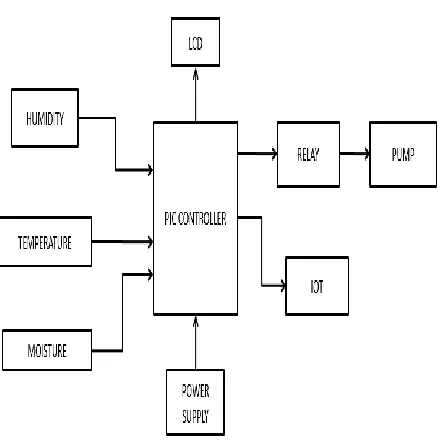
PROPOSED SYSTEM ARCHITECTURE
Fig 1.1: Block diagram
TOOLS USED
Humidity sensor
A humidity sensor (or hygrometer) senses, measures and reports both moisture and air temperature. The ratio of moisture in the air to the highest amount of moisture at a particular air
physical, chemical, and biological processes. Humidity measurement in industries is critical because it may affect the business cost of the product and the health and safety of the
personnel. Hence, humidity sensing is very important, especially in the control systems for industrial processes and human comfort.
Fig 3.1:Humidity sensor
Temperature Sensors
Fig 3.2:Temperature sensors
Temperature sensors are found in many items, from commonplace items inside any home to more sophisticated applications. It is vital for processors to stay within the temperature range specification to perform reliably and for the processor to run at its expected speed performance [6-10]. One well-known thermal sensor is a mercury or alcohol thermometer. It uses thevolume of mercury or dyed ethanol, which expands when temperature
increases, to measure temperature in a tube with a temperature scale.
Moisture sensor
This moisture sensor can read the amount of moisture present in the soil surrounding it. It's a low tech sensor, but ideal for monitoring an urban garden, or pet plant's water level.
Fig 3.3: Moisture Sensor This sensor uses the two probes to pass current
through the soil, and then it reads that resistance to get the moisture level. More water makes the soil
in indoor plants or to monitor the soil moisture in garden.
Regulator 7805
Voltage sources in a circuit may have fluctuations resulting in not providing fixed voltage outputs. A voltage regulator IC maintains the output voltage at a constant value. 7805 IC, a member of 78xx series of fixed linear voltage regulators used to maintain such fluctuations, is a popular voltage regulator integrated circuit (IC). The xx in 78xx indicates the output voltage it provides. 7805 IC provides +5 volts regulated power supply with provisions to add a heat sink. All voltage sources cannot able to give fixed output due to fluctuations in the circuit. For getting constant and steady output, the voltage regulators are implemented. The integrated circuits which are used for the regulation of voltage are termed as voltage regulator ICs. Here, we can discuss about IC 7805.The voltage regulator IC 7805 is actually a member of 78xx series of voltage regulator ICs. It is a fixed linear voltage regulator. The xx present in 78xx represents the value of the fixed output voltage that the particular IC provides. For 7805 IC, it is +5V DC regulated power supply. This regulator IC also adds a provision for a heat sink. The input voltage to this voltage regulator can be up to 35V, and this IC can give a constant 5V for any value of input less than or equal to 35V which is the threshold limit.
Applications
Regulated dual supply
Building circuits for Phone charger, UPS power supply circuits, portable CD player etc
Fixed output regulator
Adjustable output regulator etc.
Role of iot in proposed system
The IoT involves extending Internet connectivity beyond standard devices, Embedded with technology, these devices can communicate and interact over the Internet, and they can be remotely monitored and controlled. Smart Farming Based Agriculture IoT is regarded as IoT gadget focusing on Live Monitoring of Environmental data in terms of Temperature, Moisture and other types depending on the sensors integrated with it. Agricultural IoT stick provides the concept of “Plug & Sense” in which farmers can directly implement smart farming by putting the stick on the field. To get Live Data feeds, various devices like Smart Phones, Tablets are used. The data generated via sensors can be easily shared and viewed by agriculture field owner (farmer) anywhere remotely via Cloud Computing technology integration [11-15]. IoT stick also enables analysis of various sorts of data via Big Data Analytics from time to time. To see the field data (moisture, temperature) collected in database through cloud computing the farmers can give the unique login id and password in the website. So the unauthorized person can’t view or access that field data without the user permission.
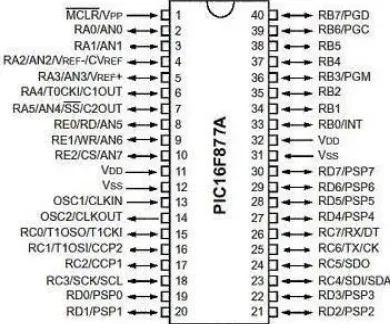
Pic microconroller
PIC16F877Aisapowerful(200nanosecondinstru
ctionexecution)yeteasy-to-program(only35singlewordinstructions)CMOS(CoI mplementary metal oxide semiconductor)FLASH-based8-bit
Fig 3.4:PIC Microcontroller
The
IC16F877Afeatures256bytesofEEPROMdata
memory,self-programming,anICD,2Comparators,8
channelsof10-bitAnalog-to-Digital(A/D)converter,2compare/PWMfunction s,thesynchronousserialportcanbeconfiguredaseit
her3- wireSerialPeripheralInterface(SPI™)orthe2-wireInter-
IntegratedCircuit(I²C™)busandaUniversal AsynchronousReceiverTransmitter(USART).Al lof these features make it ideal for
moreadvanced level
A/Dapplicationsinautomotive,industrial,applian ces andconsumerapplications.
Features
2PWM10-bit
256BytesofEEPROM DatamemoryLCD25mA Sink/sourceperI/O
SelfProgrammingParallelSlavePort. Parameters
ProgramMemoryType:Flash ProgramMemory(KB):14 CPUSpeed(MIPS):5 RAMBytes:368
DataEEPROM(bytes):256
DigitalCommunicationPeripherals: 1-UART,1-SPI,1-I2CMSSP(SPI/I2C) ADC:8ch,10-bit
Comparators:2
Temperature Range(C):-40to125 Operating Voltage Range(V):2to5.
RESULTS AND DISSCUSSION
C++ compiler
The compilers generate optimized code for IA-32 and Intel 64 architectures, and non-optimized code for non-Intel but compatible processors, such as certain AMD processors. A specific release of the compiler is available for development of Linux-based applications for IA-64 (Itanium 2) processors. The Intel C++ Compiler supports three separate high-level techniques for optimizing the compiled program: interprocedural
optimization (IPO), profile-guided
SIM
U
LATION OUTPUT FOR MOISTURE SENSOR
Fig 3.5:Moisture sensor output
Simulation output for temperature sensor
Fig 3.6: Temperature sensor output
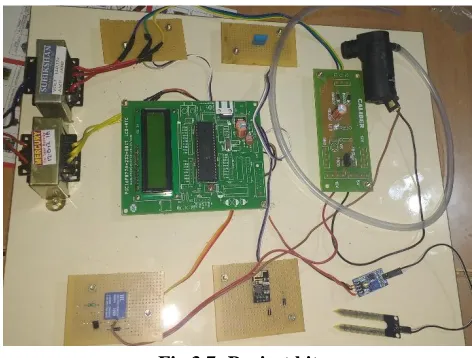
Over view ofour project kit
CONCLUSION
The proposed system will be highly beneficial to farmers as farming accounts to more than 60% of occupation in our country. Also crop production will be increased if our system is used as it uses IoT & different sensors to gather information
regarding irrigation outputs & also provides protection to farms. Also farmers can use remote technology to activate/deactivate water pumps which are powered by clean sources of energy thus keeping the environment clean.
REFERENCE
[1]. P.Bhagwat, B.Raman, and D.Sanghi, “Turning 802.11 inside-out,” ACM SIGCOMM Computer Communication Review, 34(1), 33–38, 2004.
[2]. K.Chebrolu and B. Raman, “FRACTEL: A fresh perspective on (rural) mesh networks,” in Workshop on Networked systems for developing regions, ACM, 2007, 8:1–8:6.
[3]. M. I. Hussain, Z. I. Ahmed, N. Sarma, and D. Saikia, “An Efficient TDMA MAC Protocol for Multi -hop WiFi-Based Long Distance Networks, “Wireless Personal Communications, 86(4), 2016, 1971–1994. [4]. E.M.Tordera,X.Masip-Bruin,J.Garcia Alminana,A.Jukan,G.-J.Ren, J. Zhu, and J. Farre, “What is a fog
node? a tutorial on current concepts towards a common definition,” arXiv preprint arXiv:1611.09193, 2016.
[5]. M.Armbrust, A. Fox, R. Griffith, A. D. Joseph, R. Katz, A.Konwinski, G. Lee, D. Patterson, A. Rabkin, I. Stoica, et al., “A view of Cloud computing,” Communications of the ACM, 53(4), 2010, 50–58.
[6]. M. R. M. Kassim, I. Mat, and A. N. Harun, “Wireless Sensor Network in precision agriculture application,” in International Conference on Computer, Information and Telecommunication Systems (CITS), IEEE, 2014, 1–5.
[7]. Y.Zhu, J. Song, and F. Dong, “Applications of wireless sensor network in the agriculture environment monitoring,” Procedia Engineering, 16, 2011, 608–614.
[8]. T. Ojha, S. Misra, and N. S. Raghuwanshi, “Wireless sensor networks for agriculture: The state-of-the-art in practice and future challenges,” Computers and Electronics in Agriculture, 118, 2015, 66–84.
[9]. D. Culler and S. Chakrabarti, “6LoWPAN: Incorporating IEEE 802.15. 4 into the IP architecture,” IPSO Alliance, White paper, 2009.
[10].L. Mainetti, L. Patrono, and A. Vilei, “Evolution of wireless sensor networks towards the internet of things: A survey,” in 19th International Conference on Software, Telecommunications and Computer Networks (SoftCOM), IEEE, 1–6, 2011.
[11].B.Ramanand,K.Chebrolu,“ExperiencesinusingWiFiforruralInternet in India,” IE EE Communications Magazine, 45(1), 2007, 104–110.
[12].“The Internet of Things: Extend the Cloud to Where the Things Are,” CISCO, White paper, 2016. [13].P.Lerdsuwan and P. Phunchongharn, “An Energy-Efficient Transmission Framework for IoT Monitoring
Systems in Precision Agriculture,” in International Conference on Informati on Science and Applications, 2017, 714–721.
[14]. J. Guti´errez, J. F. Villa-Medina, A. Nieto-Garibay, and M.A.PortaG´andara, “Automated irrigation system using a wireless sensor network and GPRS module,” IEEE transactions on instru mentation and measurement, 63(1), 2014, 166–176.