A Survey on Mobile Sensing Technology and its
Platform
Manpreet Kaur
Department of Computer Science, Mata Gujri College, Fatehgarh Sahib Email: [email protected]
Lovejeet Singh
Training & Placement Cell, Baba Banda Singh Bahadur Engg College, Fatehgarh Sahib Email: [email protected]
---ABSTRACT--- Now a days, mobile networks is increasingly becoming important part of everyday life due which there is a rapid evolution mobile phone. Mobile phone comes into a powerful sensing platform. There are many scientists which are engaged in the emerging field of mobile sensing from a variety of existing communities, such as, mobile systems, machine learning and human computer interaction. The research and development in this field is rapid resulting in indispensable carry-on of daily life. But with the increase in development, data integrity and security has also become an important factor to take into consideration. Importantly, today’s smart phones are programmable and come with a growing set of cheap powerful embedded sensors, which are enabling the emergence of personal, group, and community scale sensing applications. The mobile sensing platform provides many facilities like, it helps to communicate to Wireless sensor networks through a mobile sensor router Which attached to a users mobile phone. It helps in analysis of the sensed data which is derived from networks by cooperating with sensor middle- ware on a remote server to capture ones contexts. It also helps in providing context aware services for mobile users of cellular telephones. In this paper, we will discuss about different mobile sensing platforms that provides context-aware services for mobile users by accessing the surrounding wireless sensor networks. Along with this, we will briefly discuss some of the emerging sensing paradigms.
Keywords – Mobile Sensing, Wireless Sensing, Mobile Sensing platform, applications, challenges
--- Date of Submission: Jan 29, 2018 Date of Acceptance: Feb 12, 2018 ---
I.
INTRODUCTIONM
obile Wireless networks are the networks that are increasingly used by the civilians and military sectors for the purpose of environmental monitoring as well as tracking. There are many more purposes of the wireless networks that include seismic monitoring, pollution monitoring, disaster management etc. In the wireless sensor networks the sensor nodes are mobile in nature as the name suggests. The wireless sensor networks are the upcoming research field that attracts most of the researchers. The mobile wireless sensor networks are quite versatile in nature in comparison to that of static wireless sensor networks especially in the scenario where the topology keeps on changing.In Today’s life, smart phones which are wireless sensor net-works not only works as communication mobile and key computing device but it has many embedded sensors also such as accelerator, gyroscope, GPS, microphone, digital compass and camera. This all changes are because of important technological advances. First reason is accessibility of cheap embedded sensors which is included in phones so that it can drive the user experience. Second reason is that the smart phones are open and programmable these days. Smart phones, comes with computing and communication process that offers a low-barrier of entry for third party programmers. Now, each phone also offers an app store which helps to allow the
developers to deliver the new applications to all over the world. It also transforms the deployment of new applications and allows the collection and analysis of data on the basis of what was previously possible. In this, the mobile computing feature which introduced few years ago, enables the developers to deploy the mobile services to back-end servers, which provides unprecedented scale and additional resources for computing on collections of large-scale sensor data and supporting advanced features. This shows that the advantages in the mobile sensing enable the users to track emotional state, or even compute the time span they have spent queuing in retail stores. [1] Now, lets come onto the comparison between the mobile and static wireless sensing networks: There are many advantages of the mobile wireless sensing networks over the static ones and that includes:
• Improved coverage area • Enhanced target tracking
A sensor network is constructed with number of nodes which can be on the scale of tens of sensor to ten thousand of sensors for complex network. Sensors are connected to nodes and some-time each node can be connected to multiple sensors. Sensor node consist an electronic circuit and interfacing devices such as receiver antenna, transmitting antenna, microcontroller for data processing and a small power source. Poser source or battery generally having as much as possible long battery life thus node failure issue will not occur. The sensor network is built with nodes that can be available in variety of size ranging from a size of the cricket ball to a size of a pen point. But the small size node has not been developed yet or it is only under the research topic.
Sensors are classified into variety of costs according to its use and its architecture. The complex and small sensors are usually coming in higher cost. Sensor cost is also depending upon its computational efficiency, memory capacity transmission speed, transmission range and channel bandwidth. Scientists from the research area of engineering and science are working on the health monitoring of engineering machineries and equipment. This work consists the continuous verification of the structural health of the devices and hence the system employed can be called as the (SHM) structural health monitoring system. In various cases, SHM is used for structural vibration monitoring and analysis. The process of SHM comprises of observing the device or system with time by the use of various measurements from an stack of sensors that provides the dynamic response .
A Wireless sensor network can be made with several numbers of nodes which can be further used to handle environmental as well as physical conditions for example pressure, light, heat, temperature and aid to transmit detail information via communication channel to a main base station. The main aim on which the mobile sensing focus on are the three main key issues: Accuracy, Feasibility, Scalability. There are many mobile applications which benefit the brand-mobile sensing capabilities in different time span and different areas from healthcare to homecare, from safety to environmental and smart grids monitoring. There are several issues which needs to be resolved in designing mobile sensing applications and supports to the mobile market, mainly because there are still several open issues under technical aspects that affect the mobile sensing practice. Firstly, There are currently available solutions which are considered vertical ones and make it difficult to reuse specific components. Secondly, by concluding the user activity is a CPU-intensive task which requires retrieving raw data from sensors, pre-processing them to extract some synthetic assumption of sampled signal periods and using these particular periods to evaluate and infer actual activity.
II. OVERVIEW OF SENSOR NETWORKS
This section is devoted in reviewing the past work and research work done in the field of sensor networks. Mobile
sensor network is an emerging topic in the field of communication and computing and hence there are numbers of research papers available worldwide. Here some reviews are outlined for understanding ongoing research and present technology. Huiyu Zhouet.al introduced a human arm development 2 following framework that need been formed should help the restoration about stroke patients. A versatile 3 hub inertial sensor will be used to catch those developments of the arm over space 3D progressively. The following calculation may be in light of A kinematics model that takes under account the upper and down lower arm. On enhance precision Furthermore consistency, A separated more level weighted square method [3] might have been embraced. Computed trajectory of development relative of the utilization of a observing framework Qualisys, which will be economically accessible. [16]
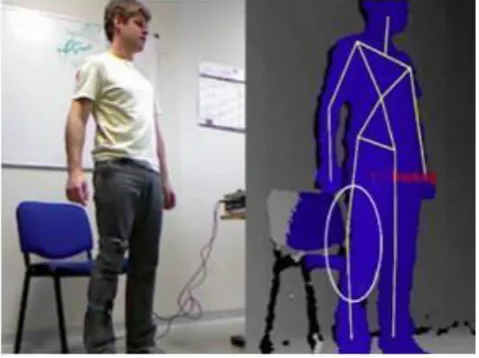
using a number of cameras. [2] [18] The less power usage of sensor nodes also allows the long-term monitoring. JurgenSiecket.al. exhibited a paper on data systems - sensor systems, visualization and virtual reality and furthermore depicts Different specialized foul parts for versatile mobile devices, sensor networks, web technologies, media applications, benefits adjusted of the setting to frameworks majority of the data to museums created in the university of the writer [5]. It depicts those principle Characteristics of the technology and system frameworks are reviewed, demonstrating distinctive routines of utilization of majority of the data systems, sensor networks and multimedia, and in addition examination under future possibility. [17] Antonio PadilhaLanari Bo et.al. displayed a model with respect to Joint point estimation Previously, restoration with inertial Sensors and its coordination for Kinect. This article investigates those joined utilization of inertial sensors and the Kinect for requisition with robotics restoration and technical aids. Provided for the Shortcomings of each system, another strategy dependent upon those Kalman filter might have been created so as to perform on the web alignment of sensor errors naturally at whatever point Kinect measures are accessible [20]. The method was evaluated in experiments with healthy subjects performing various tasks DOF. In the figure 2.1 a white ellipse showed a defined error initiated from the depth-based skeleton reconstruction. Also, it can be seen that a chair is being identified as the part of left leg [6]. Zhi Li et al. Introduced an article on a Gait Recognition System designed for Rehabilitation Based on the Wearable Micro Inertial Measurement Unit. Gait Recognition of versatile MEMS -based inertial sensors travel to medicinal restoration for the physical Activities Healthcare System (PATHS) may be recommended herein.
Fig. 2. Estimation of 3D joint positions using Kinect They use energy waves as compared with the characteristics of model support vector machine algorithm (SVM) for discriminating operation of recognition by other types of movement. [7]. This system has been indicated skilled about recognizing walk the path of the
different standard physical action through our test validation.
H.P. Bruckner et. al. exhibited an article on Evaluation of Inertial Sensor Fusion Algorithms in Grasping Tasks Using Real Input Data and described the probe melting is a step of calculating important to acquire information in a reliable guide to the inertial sensors. These sensors would be very pleasing, for a mobile capture human movement if you need to practice sport and rehabilitation. Business inertial sensors with little type factors and low power utilization might use to catch without any obstruction. There are fewer basic systems for figuring those orientation data of raw sensor data. This record gives a review for computational exertion and more precision time permits mix algorithms, calculations perception vectors Also Kalman channel calculations to fusing inertial sensors. Those sensor information is compared with an arrangement optical movement catch [8]. The requisition will be acknowledged the captured for arm developments during the writing tasks stroke restoration. Thus, the assessment of those calculations are is based on those data information clinched in reality which corresponds.
K. Lee et. al proposed a model on A Pilot Study of Activity Analization on Rehabilitation Exercise of Frozen Shoulder by the use of Wireless Inertial Sensor Node. This study establishes a network wire without sensors (WSN) nodes inertial sensors (ISN) that make up the unit micro-controller, radio Zig Bee rate compatible with the chip, tri-axial accelerometer, gyroscope two tri-axial shafts single gyroscope and plan F inverted type antenna on a printed circuit board with four layers a size 40mm x 37 mm x 2 mm. Two wirelesses ISN would altered on the arm and wrist with measure the execution for frozen shoulder restoration. Those measured information is transmitted remotely to A build hub clinched alongside which an arrangement dependent upon MATLAB system will be outlined on recuperate the packets, bundle analysis, and distinguish from motion data in view of Artificial neural system (ANN) simulated calculation. Six restoration activities to solidified shoulder are measured for two hubs of the wrist and arm. Accelerations to three axes and the state vector point subordinate 4-tuple Concerning illustration as engine characteristic recognition algorithm utilized [9]. Concerning illustration, a result, five of the six activities need aid distinguished effectively for precision rate about 85 on 90%, yet the intricate (for example, the revolution of the winding conducting) arrived at best 60%. Lu Baiet.al. presented a paper on Application of Low Cost Inertial Sensors to Human Motion Analysis. In this article, the use of inertia sensors at low cost for the analysis of human movement occurs. The XsensMTx sensor may be utilized as an illustration and standard for correlation for those developments about Sony and Nintendo's Wii (Wii remote with WiiMotionPlus).
Beginning estimations utilizing those kinematic demonstrating demonstrates that MTX, static point exactness would 0. 3 , could measure A development about 10 cm with a slip for under 0. 05 cm [10]. Inertial sensors in low expense need aid skilled from claiming measuring those reach about movement for elbow flexion with an ordinary reach will be 150 with an error not surpassing 1 and Sony development can take after those developments for 10 cm for an error of slightest 0. 2 cm. To track the position of the system should include triaxial accelerometers, magnetometers and gyroscopes.
Hans subside bruckner et. Al. Exhibited A paper ahead Mobile and remote inertial sensor stage to movement catching on stroke restoration Sessions. In this article, A sage of inertial sensors would have utilized within provisions for example, examining preparation sessions Previously, Sports and rehabilitation, furthermore on permit unhindered movement catch. Ascertaining dependable estimation obliged introduction in light of the inertial sensor crude information will be A requesting errand count. Exceedingly customize and compact registering platforms low energy Hence obliges low-level correspondence conventions autonomous of the stage and connectivity [11]. Hans Peter Bruckner et. al. Presented a paper on Mobile and Wireless Inertial Sensor Platform for Motion Capturing in stroke Rehabilitation Sessions. [15][16] In this article a platform of inertial sensors is used in applications. Such as analyzing training sessions in sports and rehabilitation, and to allow unrestricted motion capture. Calculating reliable estimation needs orientation based on the inertial sensor. RAW data is most demanding task calculation. Highly personalized and portable computing platforms low power therefore requires low-level communication protocols independent of the platform and connectivity [11].
In the area of Rehabilitation Applications Lee Morton et. al. exhibited a article for Inertial Sensors on Pose Calibrations. It depicts those acceptance methods, pose alignment are performed utilizing a optical movement catch framework. The exactness of the alignment poses tested over Different useful varieties of the technique, they quantify those estimated errors that may be characterized by changes in the application and choice of the installation used [12]. Finally, they settle on proposals on how will actualize all an establishment of improved framework. Lee, Wang Wei, etal . presented a paper on A Smartphone-Centric System meant for the detection of Range of Motion estimation in Stroke Patients. This paper presents the implementation and design of a smart phone based on the evaluation system for automated engine at low cost using off-the -Shelf inertial sensors. The system was used to automate part of the upper end Fugl -Meyer assessment (FMA), which is widely used to quantify the motor deficits in stroke survivors. [13] The system has the ability to automatically identify the evaluation point was carried out, and calculating the joint of respective maximum angle reached. Preliminary results shows the ability of this
system to obtain measurements comparable results goniometer while dramatically reduces the time needed to conduct assessments.
III. TYPES OF SENSOR NETWORK
Based on the environmental requirements, the decision regarding the network types is taken so that these can be done underwater, underground, on the ground, and so on. Different types of wireless sensor networks include: Deployment of wireless sensor network for particular operation is depends upon the environmental circumstances. The kind of network can be selected by considering the different physical condition and hence the varieties of WSNs are available which are as follows: Multimedia WSNs
Underground WSNs Terrestrial WSNs Mobile WSNs Under water WSNs A. Multimedia WSNs
Sensors, which are responsible to capture audio, video or image information are comes under the class of multimedia sensors. It consist of major four components: wireless multi-media node, wireless cluster head, wireless network node and base station. flow of information is higher at the sensor node as compared to base station. The main function of the upper part of the network is on the information processing and the focus of the lower part is on the wireless network communication. The Sensor nodes are connected to a base station and their associate nodes distributed over the field which is under monitoring. These nodes comprise with audio, video and image sensors such as small cameras and microphone. They are highly sensitive sensors connected to advanced processor for multimedia processing. Multimedia WSNs needs higher bandwidth for communication this tends to increased power consumption. Communication nodes comprises with high definition multimedia processing and communication circuitry. It also consists advanced transmission and reception system.
B. Underground WSNs
surface to deliver the information from the underground sensors to base station.
C. Terrestrial WSNs
Terrestrial WSNs are able to communicate effectively base stations, and are composed of hundreds of thousands of wireless sensors nodes deployed either unstructured (ad hoc) or structured (pre - planned). In structured mode, the sensor nodes are randomly distributed in the target area that is dropped from a fixed plan. The method provided pre- or structured considers optimal placement, the placement of the grid, and models of 2D, 3D investment. In this WSN, whether the battery is equipped with solar cells as a source of secondary energy even then the battery power is limited. The WSNs energy saving is accomplished by using minimizing delays, low duty cycle operations and optimal routing, and so on. Energy management and power saving can be gained by employing optimal routing, minimum duty cycle and reduced delay. [5]
In a traditional sensor network, the data is being gathered by individual sensors and after the data collection it is send to fusion nodes for processing. The bandwidth of the wireless sensor network is lower than the wired network. In the mobile-agent based DSN, the data tray at each local site or sensor. During the integration, the fusion code is moved to data. The communication bandwidth can be reduced if the agent is smaller in size than the data. If the sensors are increased in the it should not alter the network and it should be more scalable It has the capability to adapt the network load and programming of the agents can be done to carry specific fusion processes.
D. Mobile WSNs
Mobile WSNs network made up specially arranged sensor nodes, which are having the ability to rearrange themselves in accordance to the feedback of environment. The flexibility and capability of the system increases with the installation of mobility to the nods. These types of sensors can interact with their surrounding environment and can sense minor change in the environmental conditions. Mobile wireless sensors have ability to process the acquired signal rather they can compute it for change in network condition itself. These networks are advantageous in case of transmission capacity, energy efficiency and signal coverage in compared to other static networks.
E. Under water WSNs
A huge part of earths surface is covered with water. This water area comes under the path of the transportation system. It involves above the water transportation along with under-water transportation. Under water vehicle inbuilt with number of wired and wireless sensors. In this case, wireless sensors suffer from many undesirable environment conditions. A main issue of underwater WSNs system is communication channel bandwidth. it also suffers with path delay and channel frequency related
issues. The system which is going to be installed for a long time is also affected by lack of power supply inside the water. It needs sufficient battery backup because recharging of battery is almost impossible if it gets discharged.
IV. ARCHITECTURE OF SENSOR NETWORK
NODE
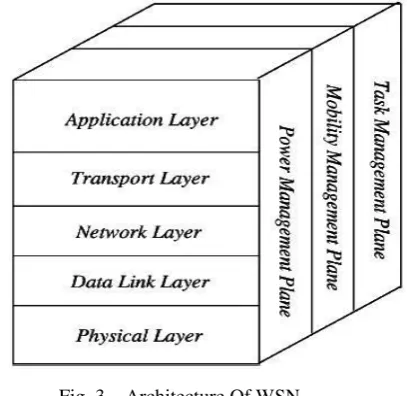
The architectural layout of wireless sensor nodes follow OSI model. From the seven layers of OSI model , we need only five layers: application layer, transport layer, network layer, data link layer and physical layer in sensor network . Along with this there are three core layer which are added and give functionality to all layers of OSI model. The three layers or cross planes are: mobility management plane, task management plane and power management plane. The function of these layers includes to manage the network. They also bind the sensors work together to increase the overall efficiency of the network. There are many network layer architecture models has been defined in the research. Akkaya and Younis [51] over looked the architectural field of WSN and grouped them to hierarchical, data-centric, location-based network and QoS flow. 5
Fig. 3. Architecture Of WSN
Yang and Mohammed [52] define the architectural groups same as Akkaya and Younis did but add additional architectures to each group. Singh et al. [53] added three architectural groups: multi-path- based architectures, mobility-based architectures and heterogeneity-based architectures. Finally, Yick et al. [54] add anchor location service (ALS) and geographical routing to the location-based architectures and security routing (SecRout) plus secure cell relay (SCR) to the hierarchical group. Almir and Hwa also surveyed already existed network architectures and they classify and group the architectures as
Quality of Service (QoS) architectures
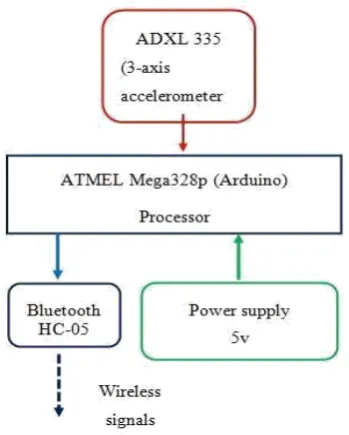
Other Architectures they define are: Network flow architectures, Multipath-based architectures, Heterogeneity-based architecture. Development of sensor is done by considering the fundamental needs of user as well as researchers. Wearable wireless/mobile sensor networks are one of latest invocation in the area of sensor nodes. These kind of wearable sensor nodes are used in healthcare monitoring and other activities. Here, we are discussing the basic architecture if wearable mobile sensor node. The components used in the architecture are as following: Other Architectures they define are: Network flow architectures, Multipath-based architectures, Heterogeneity-based architecture. Development of sensor is done by considering the basic requirements of user as well as researchers. We have used ADXL 335 (3 axis accelerometer) for detection of movements in the all three direction. Basic block diagram with other interfacing devices are shown in Figure. In this model, we have used 3-axis accelerometer, ATMEL atmega-328p with Arduino microprocessor and Bluetooth HC-05 are interfaced with each other for further processing of signals. 3-axis accelerometer
Fig. 4. Block diagram of wearable wireless sensor gives voltage variation on its three output pins (x, y and z ) according to motion of sensor in the respective direction. These voltage variations are fed to analog pins of microprocessor and converted to angular data with the help of an algorithm. Signals are now ready to transmit for base station, wherein it will be used for different application. Bluetooth wireless link is used to create wireless network and it is created with the help of Bluetooth HC-05 chip. [19]
To run this device in proper active mode, 5 v power supplies is needed, thus we have used battery with power rating of 2800mah and 5v. This system can transmit the signal properly under the range of 5 to 10 meter, thus user
have to maintain his distance accordingly. Base station for this device can be computer or handheld mobile device. The above figures are the prior development of wireless sensor systems which are intends to make a module for lab testing. After certain successful hardware as well as software testing, it gets ready to develop as in its actual shape and size for wearable module.
A. Microcontroller
Microcontroller is a device which comprises with input output buses, memory unit, and arithmetic and logic unit, random access memory as well as read only memory. It is responsible for significant computational task in the electronic circuit. It also used to interface different circuit components to form a proper functional device. Microcontroller comes in various types of bit configuration; its speed of operation varies according to bits. Size of random access memory (RAM) also affects microcontrollers operating speed. In this work, Arduino Nano microcontroller is used which is having configuration given in the above table. It has 30 pins, pin number A0 to A7 are used for analogue inputs. Thus, eight analogue inputs can be interfaced with this microcontroller at the same time. In other side, it has 11 digital I/O pins from D2 to D12. [19] Inertial this device can be powered up with USB connection or by providing power supply of 5-volt on its Vin pin.
B. Sensor (inertial sensor)
Inertial sensor works in the principal of inertia. It consists MEMS (micro electromechanical system) chip sensor. The size of MEMS very small and it comes in the range of some square millimeter. In the 3 axis ADXL 335, spring-load based inertial sensor is employed. The spring mass systems can move inside the chip according to the movement of chip. The motion of spring load inside the MEMS chip is depends upon motion of overall device. It provides analogue output to its output terminal, which also varies according to motion of the device in the x, y and z direction. It requires essential calibration because the MEMS chip contains spring loaded mechanical system inside of it. The ADXL 335 is a tiny electronic chip which has smaller width and length. The power consumption of this device is very low. These inertial sensor chips can measure acceleration in all the three direction.[19][20] It also has the facility of signal conditioning for output voltage. As it is already calculated that, this chip can provide measurement for 3 g. The change of gravitational force on the device while tilting can be measured. It can also measure the statistical acceleration while it is used as an application for jerk sensing.
C. Wireless device
wireless link has the following specification. This is a class 2, module with Bluetooth Serial Port Profile, that can be configured as a master or a slave. You can just use a replacement for the serial port to connect between the MCU, PC for the integrated project and etc.
V. ARCHITECTURE OF MOBILE PHONE
SENSING
In this section, we will discuss the architecture and hardware implementations of mobile phone sensing. Duo to the mobility of the node in wireless sensing network, the topology is more dynamic one in comparison to the static wireless sensing network. The dynamic nature is also reflected in the other factors like topology selection, protocol selection and other architecture selection.
Mobile Wireless Sensor networks are classified as 1) Cluster architecture
2) Layered architecture
3) Sensor nodes with mobile sink node architecture. [21] [22]
Basically, Existing cluster based networks developments, is based on only one type of nodes. The architecture of a Cluster comprises of sensor nodes clusters each directed by cluster head. The cluster head receives messages from nodes in each cluster and the same cluster head forwards the messages to the sink node.
The architecture of WSNs consists of a sink node along with multiple sensor nodes that sends data to the sink node with the help of one hop, two hop etc. The whole information is gathered only by sink node. Mobile sink node architecture consists of mobile sink travels in the sensing area and collects the data from sensors nodes. It consists of a Sensor Node and a Mobile Sink Node, occasionally the Data collector that is installed within sensing area. Now a day, it has been seen that the existing mobile devises use deep learning. It is able to even use the speech recognition models which use deep learning techniques. Some existing application domain of deep learning are very similar to requirements of mobile sending and should be able to be adapted for sensors app purposes.
There are many open source tools which are being used for mobile phone sensing. Here are different frameworks which are used:
AWARE: It is a framework which is being used by the android developers. AWARE is an open-sourced under GPLv3.In AWARE, there are both clients and servers. The clients do not need programming skills. It provides context dashboard that grants the user to enable and disable context information. Then the data will be save don the users phone locally. [24] The client usually collects the list of data and the
Fig.5. AWARE architecture
server lets collect the data in a centralized database. These are two versions Aware server MQTT and AWARE server with web services. The MQTT client only lets share information in real-time with other AWARE clients and AWARE servers. It allows the servers and clients to push information using a publish-subscribe approach. [3] The Funf is the other open sensing framework which is an open data processing and sensing framework for various mobile devices. It provides a reusable user of functionalities, which enables the compilation, uploading and configuration of wide range of data signals by making accessible through mobile phones. Funf collects rich sets of data. The whole list consists location and wireless info. [4] The other open-source framework is the ODK. ODK consists of so-called ODK build which helps the author to manage solutions for mobile data collection . It builds a HTML5 web application and attempts best for designing simple forms. It provides solution for users to: It helps to build a data collection form. It also collects the data from mobile device and commits it to server. Then accumulate the processed data on a server and extract it into useful formats.
A. Mobile phone as a sensor Accelerometers have become common after being initially introduced to enhance the user interface and use of the camera. [27] They are used to automatically determine the orientation in which the user is holding the phone and use
Presentation Layer
Plu
g
-in
s
Visualization Adaptation
Context Layer Traceability layer Abstraction Model’s Patterns Relationships Classifications Dependencies
Perspectives
Communication Layer Concerns Layer Protocols formats Encryption Security parallelization process Privacy
Sen
so
rs
Offload
Data Layer
Mining Storage Clustering
Sensing Layer Social Layer Hardware sensors Social networks Software Sensors Human Profiles Sensors
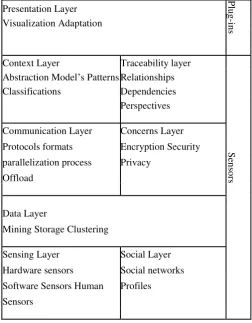
Fig. 6. Sensors in aware
more sensors are being incorporated into phones.[37] An interesting question is what new sensors are we likely to see over the next few years? Non-phone- based mobile sensing devices such as the Intel/University of Washington Mobile Sensing Platform (MSP) [38] have shown value from using other sensors not found in phones today (e.g., barometer, temperature, humidity sensors) for activity recognition; for example, the accelerometer and barometer make it easy to identify not only when someone is walking, but when they are climbing stairs and in which direction. New classes of applications, which can take advantage of both the low-level sensor data and high- level events, context, and activities inferred from mobile phone sensor data, are being explored not only in academic and industrial research laboratories [39,40] but also within start-up companies and large corporations. One such example is Sense Networks, a recent U.S.- based start-up company, which uses millions of GPS estimates sourced from mobile phones within a city to predict, for instance, which subpopulation or tribe might be interested in a specific type of nightclub or bar (e.g., a jazz club). Remarkably, it has only taken a few years for this type of analysis of large-scale location information and mobility patterns to migrate from the research laboratory into commercial usage.
B. Mobile sensing platform
The Mobile Sensing Platform (MSP) is a small-form- factor wearable device designed for embedded activity recognition. The MSP aims broadly to support context-aware ubiquitous computing applications. It incorporates multi-modal sensing, data processing and inference, storage, all-day battery life, and wireless connectivity into a single wearable unit. Several design iterations and real-world deployments over the last four years have identified a set of core hardware and software requirements for a mobile inference system. NXP- one of the latest mobile sensing platform. The NXPCRTouch is a capacitive and resistive touch-sensing platform and a Ready PlaySolution that integrates different functionality to existing applications, by simplifying and integrating the design cycle and helps to provide scalability in applications and systems.
Add features while reducing development cost
Enables resistive touch screens to handle basic gesture recognition
Allows also the addition of up to four capacitive electrodes to a system
Supports 4- and 5-wire touch screens and communicates over UART and IIC communication protocols
It reduces space, the software development cost and time to market. An Embedded activity recognition system was developed based on mobile sensing platform in 2008 [26]
An Embedded activity recognition system was developed based on mobile sensing platform in 2008 [26] There are lots of projects undergone this platform, one project
involves devel-oping algorithms to compute accurate caloric expenditure from user activities, which will be used to build an ambient personal-fuel gauge. Another involved targeting Type I diabetics to adjust insulin dosages on the basis of real- time activity infor-mation and thus prevent dangerous hypoglycemic episodes. Moreover, A third one attaches MSP with GPS information to better understand how urban planning affects public health by measuring outdoor physical activity levels in different types of built environments. [13][25]
Current MSP Implementations
In the table 1, summarizes of the current Mobile Sensing Plat-forms (MSP) implementation status is shown. With the partial support for the temporal models, the installed software runs inference version 1.0. The versions 2.0 and 3.0 of interference will be introduced in the future. These models require computational resources. These requirements are within the MSPs Capabilities. However, the offline trainings are done and the embedded systems runs the interference using the parameters based on the trained model. The softwares are used to process the sensor streams and applies the trained models to classify activities. With the complete support of multi-tasking, IP networking and flash file system, the Mobile Sensing Platforms usually runs on the Linux. It develops a flexible trait extraction along with runtime library that uses a simple XML configuration file for specifying a sensor set. It can stream the resulting computations to store over the network on the MSP.
It started configuration Linux VMware image with the MSP cross-development environment, to improve the MSP program development. In the real-world deployments and applications, MSP version 2.0 is being used. During the layout iterations, these deployments have rein-forced some of the knowledge gained. Berkeley motes, which are professionally made by Crossbow, are till date the best-known sensor node hardware implementation, which are being used by more than 90 research organizations [27].
Table1. MSP Implementation
Components MSP hardware MSP hardware
v1.0 v2.0
Processor ATMega 128 ATMega 128
microcontroller on microcontroller on sensor board sensor board ARM7 processor PXA271 Xscale on iMote Processor on iMote Storage No on board Mini SD card slot
storage (current storage 2G Bytes)
Communication Bluetooth radio Bluetooth radio, RIFCOMM plus ZigBee radio Battery Life 200 mAH Li- 1800 mAH Li-
Polymer battery Polymer battery
Inference No on board Embedded
They basically comprise of an embedded hybrid microcontroller, low-power radio, and very less memory, and they are powered by two AA batteries. The most successful categories of Berkeley motes are MICA and MICA2 . Till date, a number of platforms have been developed for the use of Berkeley motes in mobile sensor networks to manage systematic study into controlled mobility, which facilitates deployment and network repair and provides possibilities for the implementation of energy-harvesting. UCLAs RoboMote [28], Notre Dames MicaBot and UC Berkeleys CotsBots are examples of efforts in this direction. Particle Computers have been developed at University of Karlsruhe, Germany. As similar, to DIY platform, the basis of Particle Smart are a core board equipped with Microchip PIC; that are upgraded for energy efficiency, scalable communication and small scale (17 mm 30 mm). Particles communicate in an ad hoc fashion: as two Particles come close to one another. they are able to talk. Additionally, if Particles come near a gateway device, they can be connected to Internet-enabled devices and access services and information on the Internet as well as provide information.[29] At University of Lancaster, surfaces provide power and net- work connectivity in the Pin and Play project Network nodes basically comes in distinct form factors, but they all share the Pin and Play connector, a custom component that allows physical connection and networking through conductive sheets which are embedded in surfaces such as a wall or a bulletin board. Pin and Play falls in between the wired and wireless technologies as it provides network access and power across 2D surfaces. Wall-mounted objects are exclusively suited to be augmented to become Pin and Play objects. In a demonstration, a wall switch was augmented and freely placed anywhere on a wall with a Pin and play surface as wallpaper. [30]. Due to the frequent use of the regular sensing, it is likely that additional processing support will emerge. As an instance, Microsoft Research has undergone the Little Rock project which is developing a required hardware support for the continuous sensing where the primary CPU frequently sleeps, while the digital signal processors (DSPs) assists the duty cycle management, sensor sampling models that may or may not fail to generalize under unexpected environments.
The background environment or actions of the user (e.g., the phone could be in the pocket) will also affect the quality of the sensor data that is captured. Phones might have the chance to expose to events for a very small time span, if the user is traveling speedily (e.g., in a car), if the event is localized (e.g: a sound) or the sensor needs more time than is required to collect a sample (e.g., air quality sensor). The other forms that interferes the context includes a person making use of his phone to make a call, which obstructs with the strength of accelerometer to interpret the physical actions of the person. They collectively describe these issues as the context problem. Many issues remain open in this area. [50] Some researchers offers to leverage collocated mobile phones to deal with some of these issues; for example, sharing
sensors temporarily if they are better able to capture the data [32] [34]. To oppose the context challenges researchers recommends super-sampling [33]where data from adjescent phones are collectively used to lower the aggregate noise in the reading. Alternatively, an effective measure for some systems have been sensor sampling routines with admission control stages that do not process data that is low-quality, saving resources, and reducing errors. (e.g. Sound Sense [35]).
VI. MOBILE ROBOTS
Another invocation in the research area of mobile sensing is mobile robots. In Mobile robots, its main aim is to enable embodied research in large-scale distributed robotics and sensor networks. These are not fixed at one physical location. A spying robot serves as an example of mobile robot as they act according to the environmental conditions. They are competent enough of moving around that is why they are also capable of locomotion. They are efficient for navigating or handling an uncontrolled situation without the requirement of electro-mechanical or physical guidance devices. Alternatively, reliability of mobile robots depends upon guidance devices that permit them to drive through a pre-determined navigation path in relatively controlled space. Robomote is mobile robot platform, which is used to investigate the robotics problems in sensor networking. It is 1330 times smaller in size as compared to the Pioneer and 26 times cheaper than Khepera, both are the standard robots used for the research work in laboratories throughout the world. Here is the design of the mobile robots in detail:
Hardware:
It comprises of a single printed circuit board having dimensions 3.81cm x 2.23cm which is based on an Atmel AT9OS8535L and bit micro controller [12]. It is completely based on the media access mechanism with listen-before feature like Aloha. So, it is a contention based Aloha type scheme which means it listen before transmission and random back-off. Transmission range in software is from 20cm to 55m. It also depends upon some environment based parameters such as multi-path and reflection. It has intra-red transmitter which is mounted to face backward to facilitate following behaviors. There are four bump sensors also along with the infra-red. It has five infra-red transmitters in which two are at the front, one for each optical encoder and one facing back. All these transmitters require 20mA operating current each.
Software: In the design of robots, there are eight serials commands the Robomote offers to the host controller. These serial commands allow the host to control motion to react to detected objects. There are two prime components of the software which are the lower level platform control loop on the robot and the master, or host. The robot platform software implements a control loop that runs at 100 Hz. The main work of the controller is to retain a constant velocity based on a lookup pulse width modulation value. It is basic on off controller. It also has a compass which evaluate the East, West, North and South. The accuracy of the compass is approximately 6 degrees. It has interrupts which activates the touch screen s that cause the control loop to send an OBJECTDETECT message to the controlling host.
It has infra-red sensor which causes spurious interrupts. It must be smoothed through filtering and integration. It has a control loop which sends the host an OBJECTDETECT message. The software and hardware design allow the robot platform be used in mobile sensor networks. [28, 36] Control software components are cleanly separated by the serial interface. Car-Like Robots: Car-like robots equipped with wheels for locomotion are popular mobile platforms for sensors. They can move on a 2D plane and detect nearby obstacles to avoid collision. However, it is critical to navigate the robots, so we will introduce three common navigation techniques.
Robotic Fish: Mobile underwater WSN is an emerging networking paradigm to monitor water bodies such as lakes or seas. Several efforts done in research have developed prototypes of robotic fish to implement mobile under-water WSNs. However, RF signals cannot travel over long distances in an underwater atmosphere [Cui et al.2006]. In this case, conventional positioning techniques such as GPS or RF-based trilateration may not be applied to localize robotic fish.
MAVs are emerging as a novel category of mobile sensor networks capable of navigating semi automatically in unknown environments. Each MAV can move or even fly in 3D space but carry less weight due to its small size. Flying with a swinging load is a challenging task since the load changes the MAVs flight characteristics.
VII. CHARACTERISTICS
OF
MOBILE
SENSOR NETWORKS
Sensor network a freshly technology for contain data with autonomous task oriental sensors. Not long ago, this technology became additional attractive. Currently being used for the real- world abandoned physical environment to measure parameters. So, the characteristics of this must be considered for efficient deployment of network. Ideally, sensor network must be flexible, promote data collection and decrease the need for maintenance. [11]
Flexibility: Mobile Sensor networks should be extensible, and they should be capable to dynamically adjust to
changes occurs in node density and topology Sensor networks should also be robust to changes in their topology, for instance due to the failure of individual nodes. In particular, connectivity and coverage should always be guaranteed. Connectivity is achieved if the base station can be reached from any node.
Maintenance: The only desired form of maintenance in a sensor network is the complete or partial update of the program code in the sensor nodes over the wireless channel. It is quite often the case that all data is broadcasted to a base station, but this form of centralized data collection may shorten network lifetime.
Communication: WSN typically communicate through radio waves over a wireless channel. It has the property of communicating in short range, with narrow and dynamic bandwidth. The communication channel can either be unidirectional or bidirectional. With an hostile and unattended operational environment, its quite challenging to run WSN fluently. So, the hardware and software for communication must have to take into consideration the robustness, security and resiliency.
Low Cost: There is high count of nodes in WSNs, and when the batteries of the nodes got drained the same are being replaced by the new ones. Further, WSNs are visualized to be everywhere. Thus, the cost of the nodes must be extremely low to make the deployments feasible. Security and Privacy: Security parameters which are already available in wireless sensor networks that is based on some specific hypothesis about the nodes and the network environment that are tied to particular usage scenarios. Each sensor node must support sufficient security measures in order to avoid attacks, unauthorized access and un intended damage of the information inside of the sensor node. Furthermore, in addition to this specific privacy tools must also be involved.
VIII. APPLICATIONS OF MOBILE SENSOR
NETWORK
of sensors for detecting the spy intrusion; a civilian example is the geo- fencing of oil or gas pipelines.
Health Care Monitoring: The medical applications are categorized in two types: implanted and wearable. The wearable devices are basically used on the human body surface or just very close to the user. The implantable devices are those medical devices which are being inserted inside the human body. There are many other applications too e.g. the location and body position measurement of the person, along with overall monitoring of sick patients at homes and in hospitals. Body-area networks are meant to collect data regarding an individual's health, energy expenditure and fitness. In the past, few years, health monitoring using mobile phones alone or in conjunction with wearable devices has gained increasing interest of both research and academia Mobile Health Monitoring has applications areas where patients health needs to be accessed and monitored on continuous basis such as old age, and handicap population.
Environmental Sensing: There are various applications in monitoring the environmental parameters some examples have been listed further. They supports the extra challenges of reduced power supply and harsh environments. Environmental pollution monitoring is one of the applications of mobile sensing. As a result of environmental pollution major harm can be caused to plants, humans, animals and trees. In humans, environmental pollution cannot only cause the physical disabilities but also physiological and behavioral disorder. A mobile phone has certain amazing characteristics such as co-located with a user, being in environment, and sensing and communicating contextual data etc.
Road and Transportation Monitoring: Roads and transportation monitoring has been of prime importance for both developing and developed countries since long. Using mobile phones sensing capabilities for providing real-time road and traffic information can be effectively used in reducing congestion in a number of ways such as information describing road condition can be forwarded to road drivers to avoid congested or bad roads to save the travelling time.
• Commerce Monitoring: Prices of the homogenous products from the different vendors vary even in the same vicinity and are called price dispersion in economics. Online Social Network Reciprocation: Online Social Networks are computer based networks aimed to bond inhabitants and organizations. During the previous, time period the energetic growth of online social networking applications has facilitated people in forming friends and keeping in contact with their colleagues and old friends. Air Pollution Monitoring: Wireless sensor networks are being deployed in various cities such as (Stockholm, London, and Brisbane) to listen the concentration of deadly gases for citizens. These make use of the ad hoc
wireless links in comparison with wired installations. That also make them more compatible and mobile for testing readings in different areas.
Forest Fire Detection: The installation of Sensor Nodes Network can be done in a forest to check the initiation if fire. The nodes are be made up of sensors to measure temperature, humidity and gases which are produced by fire in the trees and vegetation. The early detection is supportive for a successful action of the fire fighters; thanks to Wireless Sensor Networks, the fire brigade will be able to know when a fire is started and how it is spreading.
Industrial Monitoring: Wireless sensor networks have been developed for machinery condition-based maintenance (CBM) as they offer significant cost savings and enable new functionality.
IX. CHALLENGES IN MOBILE SENSOR
NETWORKS
Mobile sensor networks proves as a key enabler for several new applications including smart objects interacting with the physical environment. Its also a challenging and attracting research area. Examples of such applications includes building automation, facility management, environmental monitoring and intelligent agriculture. Wireless sensor networks have extra ordinary and unique properties that makes the architectural design of protocols and applications quite challenging. A finite energy budget, limited processing capabilities, scaling requirements coming from high node densities, the need for intelligent local collaboration, in-network processing and many more.
Privacy and Trust: Mobile sensor networks are based on wearable and carrying devices which are being implemented in a large number of different applications. Lots of them are with strict privacy requirements including: medical, surveillance, e-Health, and so forth. Since private data is being shared (physiological measures, medical records, etc.), implementing security mechanisms in these networks has become a major challenge. In mobile networks users, which are not willing to disclose all or some sensor information should be given hard guarantees on privacy. Trust on the quality of the information provided by such crowd sourced information [41] [42] .
For example, sometimes authors provide the power over-head for every sensor and is expresses as the percentage of the power consumed by the HTC phone [45] Accelerometer: 7.4%
Temperature: 2.78% Barometer: 22.2% Compass: 29.63% These challenges are important to be keep in mind while forming basic requirements for software development tools in mobile sensing. [48]
Architectural Issues: At the top level, an architecture decomposes a problem domain into a set of services which are functional components, their mechanisms and their responsibilities. [47] An architectural design can also define a set of interfaces to its services, which are the structures and functions services expose their mechanisms with. Finally, at the base level, an architecture can define its protocols, that includes packet formats, communication exchanges, and state machines. So, which architecture to go for either Centralized or decentralized processing is a challenging task. (can also have privacy implications). The large number of sensor nodes mandates that in general distributed algorithms and protocols should be preferred over centralized ones whenever possible. Otherwise, traffic hot spots will appear around centralized servers and all the traffic heading to coming from those servers would have to go over the sensor nodes in their vicinity. [48] As a result, these nodes would quickly run out of energy. It depends on several factors how pronounced this problem is for the special case of sink nodes. When the sink is mobile, sensor nodes are part of a hot spot only for a short time. [49] In networks where the event- notification or the one-shot-query patterns are predominant, the problem is not as pronounced as it would be for the periodic pattern. So, architectural issues are required to be handled carefully.
CONCLUSION
Sensors are the key factors of developing more and more interesting applications on the smart phones, and the sensors make the smart phone different from traditional computing devices like computer. Mobile phone sensing systems will finally provide both micro as well as macroscopic views of various communities, cities, and individuals that helps to improve how society functions as a whole. It is believed that camera and pattern recognition will be used more and more in the future. The concept of DSN in the mobile sensing is being introduced more than two decades ago. Earlier, the researchers in DSN were completely handicapped by the state of the art structure in sensors, computers, and communication networks. Technological advancement in the past decade have completely changed the situation. These mobile sensor network nodes can be used in many applications which can also adapt the environmental changes now. The sensors range from environmental monitoring to industrial sensing, as well as traditional military applications. The networks like microscopic sensors are embedded in the
fabric of society such as in buildings and machinery, and even on people which could drastically enhance our understanding of our physical environment.
REFERENCES
[1] Forster, A., Forster, A., K.G.D.P.S.G., Gambardella, L.: Motel: A mobile robotic-assisted wireless sensor networks testbed. In: 9th European Conference on Wireless Sensor Networks (EWSN), Italy (2012).
[2] Hail, M.A., Pinkowski, J., Teubler, T., Danckwardt, M., Pfisterer, D., Hellbrck, H.: Roombanet - testbed for mobile networks. In: Electronic Communications of the EASST, vol. 37, 2011.
[3] Lane, N.D., et al.: A survey of mobile phone sensing. IEEE Communi cations Magazine.
[4] Shelby, Z.: Embedded web services. IEEE Wireless Communications. Volume: 17(6), December 2010
[5] Lane, N.D., Miluzzo, E., Lu, H., Peebles, D., Choudhury, T., Campbell, A.T.: A Survey of Mobile Phone Sensing. Comm. Mag.48, 140150 (2010).
[6] Siewiorek, D., Smailagic, A., Furukawa, J., Krause, A., Moraveji, N., Reiger, K., Shaffer, J., Wong, F.L.: SenSay: A Context-Aware Mobile Phone. In: Seventh IEEE International Symposium on Wearable Com puters (2003), New York, pp-248-249.
[7] Zhi Li et.al. A Gait Recognition System for Rehabilitation Based on Wearable Micro Inertial Measurement Unit, IEEE International Conference on Robotics and Biometrics December 7-11, 2011, Phuket, Thailan, pp-1678.
[8] H.P. Bruckner et. al. Evaluation of Inertial Sensor Fusion Algorithms in Grasping Tasks Using Real Input Data IEEE, International Conference on Wearable and Implantable Body Sensor Networks, 2012.
[9] Kumar, S., Lai, T.H., Balogh, J.: On k-coverage in a mostly sleeping sensor network September 26 - October 01, 2004, New York, pp-144-158.
[10] J. J. Craig Introduction to Robotics: Mechanics and Control MA Reading:Addison-Wesley 1989 .
[11] Y. Bar-Shalom T. E. Fortmann Tracking and Data Association New York:Academic Press 1988. [12] S. Priya D. J. Inman, Energy Harvesting Technologies Springer 2009.
[14] Huiyu Zhou et.al. “Application of wearable inertial sensors in stroke rehabilitation”: IEEE, Engineering in Medicine and Biology 27th Annual Conference Shanghai, China, September 1-4, 2005. pp-6825 - 6828
[15] Huiyu Zhou et.al. Inertial motion tracking of human arm movements in stroke rehabilitation, IEEE International Conference on Mechatronics Automation Niagara Falls, Canada. July 2005, pp-1306-1311.
[16] Nuri F. Ince, et.al. Integration of Wearable Wireless Sensors and Non- Intrusive Wireless In-Home Monitoring System to Collect and Label the Data from Activities of Daily Living IEEE-EMBS International Summer School and Symposium on Medical Devices and Biosensors MIT, Boston, USA, Sept. 2006.
[17] K S Low et.al A Wearable Wireless Sensor Network for Human Limbs Monitoring International Instrumentation and Measurement Technology Conference Singapore, 5-7 May 2009. Mobile Phone. In: Seventh IEEE International Symposium on Wearable Computers (2003), pp-1332-1336.
[18] Siewiorek, D., Smailagic, A., Furukawa, J., Krause, A., Moraveji, N., Reiger, K., Shaffer, J., Wong, F.L.: SenSay: A Context-Aware Mobile Phone. In: Seventh IEEE International Symposium on Wearable Computers (2003), pp-248-249.
[19] Du, J., Liu, H., Shangguan, L., Mai, L., Wang, K., Li, S.: Rendezvous data collection using a mobile element in heterogeneous sensor networks. International Journal of Distributed Sensor Networks. Vol 8, 2011.
[20] Antonio PadilhaLanari Bo et.al. “Joint Angle Estimation in Rehabilitation with Inertial Sensors and its Integration with Kinect” International Conference of the IEEE EMBS Boston, Massachusetts USA, August 30 - September 3, 2011, pp. 3479-3483
[21] Suchita R.Wankhade1 and Nekita A.Chavhan, “A Review On Data Collection Method With Sink Node In Wireless Sensor Network”, International Journal of Distributed and Parallel Systems (IJDPS) Vol.4, No.1, January 2013 ,pp. 67-74
[22] Hu, C.-C.2008. Efficient placement and dispatch of sensors in a wireless sensor network. IEEE Transactions on Mobile Computing 7,2, pp. 262–274.
[23] Namiot, D., Sneps-Sneppe, M.:Geofence and Network Proximity. In: Balandin, S., Andreev, S., Koucheryavy, Y. (eds.) NEW2AN 2013 and ruSMART 2013. LNCS vol. 8121 Springer, Heidelberg (2013), pp-117-127
[24] Venkitasubramaniam, P.,A direddy, S.,and Tong, L.2004. Sensor networks with mobile access: Optimal
random access and coding. IEEE Journal on Selected Areas in Communications 22, 6 (August), pp. 1058–1068.
[25] Wireless Sensor Networks: Applications and Challenges of Ubiquitous Sensing: Daniele Puccinelli and Martin Haenggi, IEEE CIRCUITS AND SYSTEMS MAGA, 2005, pp. 11-29
[26] Nicholas D. Lane, EmilianoMiluzzo, Hong Lu, Daniel Peebles, Tanzeem Choudhury, and Andrew T. Campbell: A Survey of Mobile Phone Sensor Networks, IEEE Communications Magazine, Volume 48 Issue 9, 2010, pp. 140-150.
[27] Gabriel T. Sibley, Mohammad H. Rahimi And Gaurav S. Sukhatme: A Robomote: A tiny mobile Robot platform for large scale ad-hoc sensor networks, In Proceedings of IEEE international conference on Robotics and Automation, ICRA, Washington DC, 2002, pp. 1143-1148
[28] W. Sherchan ; P. P. Jayaraman ; S. Krishnaswamy; A. Zaslavsky; S. Loke; A. Sinha: Using On-the-Move Mining for Mobile Crowdsensing, In Proceedings of the 2012 IEEE 13th International Conference on Mobile Data Management (mdm 2012), USA 2012, pp. 115-124 [29] S. Reddy D. Estrin M. Srivastava: Recruitment Framework for Participatory Sensing Data Collections, In Proceedings of the 8th international conference on Pervasive Computing, Finland 2010, pp. 138-155.
[30] H. Lu et al., Sound-Sense: Scalable Sound Sensing for People-Centric Applications on Mobile Phones, Proc. 7th ACM MobiSys, 2009, pp. 16578. [31] C. Aggarwal, T. Abdelzaher : “Integrating sensors and social networks in Social Network Data Analytics”, ch. 14 USA, Springer (2011).
[32] N. Lathia., V. Pejovic, K.K. Rachuri, M. Mascolo, C. Musolesi, M. Rent-frow : Smartphones for Large-Scale Behaviour Change Interventions, IEEE Pervasive Computing (May 2013).
[33] L. Wang D. Zhang H. Xiong,: Effsense: Energy-Efficient and Cost-Effective Data Uploading in Mobile Crowd-sensing, Zurich (September 2011), pp. 1075-1086. [34] Lu Baiet. al. : Application of Low Cost Inertial Sensors to Human Motion Analysis, IEEE International conference, Instrumentation and Measurement Technology Conference (I2MTC), Austria, May 2012.
determine transportation modes”, In: ACM Transactions on Sensor Networks (TOSN), Volume 6 Issue 2, Article No. 13, Feb 2010.
[37] JurgenSieck et.al.: Information Systems-Sensor Systems, Visualization and Virtual Reality. In: Second International Conference on Computational Intelligence, Modelling and Simulation, Sept 2010, pp.129-133. [38] Lu Baiet. al. Application of Low Cost Inertial Sensors to Human Motion Analysis, IEEE International Conference, Instrumentation and Measurement Technology Conference (I2MTC), Austria, May 2012. [39] J. Lester, T. Choudhury, G. Borriello, “A practical approach to recog-nizing physical activities”, In: Proc. Fourth International Conference on Pervasive Computing, Ireland, May 2006, pp. 1-16.
[40]R.A.Shaikh,H.Jameel,B.J.d’Auriol,H.Lee,S.Lee,andY. -J. Song, “Group-based trust management scheme for clustered wireless sensor networks,”IEEE Transactions on Parallel and Distributed Systems, vol. 20, no. 11, pp. 1698–1712, 2009.
[41] F. Bao, I.-R. Chen, M. Chang, and J.-H. Cho, “Hierarchical trust management for wireless sensor networks and its applications to trust-based routing and intrusion detection”, IEEE Transactions, On Network And Service Management, Vol. 9, No. 2, June 2012, pp. 169-183
[42] Y. K. Tan, K. Y. Hoe, and S. K. Panda, ”Energy Harvesting using Piezoelectric Igniter for Self-Powered Radio Frequency (RF) Wireless Sensors,” in Proc. of IEEE International Conference on Industrial Technology, 2006, pp. 1711-1716.
[43] Nguyen, D.T.; Zhou, G.; Qi, X.; Peng, G.; Zhao, J.; Nguyen, T.; Le, D. Storage-Aware Smartphone Energy Savings. In Proceedings of the 2013 ACM International Joint Conference on Pervasive and Ubiquitous Computing (UbiComp13), Zurich, Switzerland, 812 September 2013; pp. 677686.
[44] Lathia, N., Pejovic, V., Rachuri, K., Mascolo, C., Musolesi, M., Rent-frow, P.: Smartphones for Large-Scale Behaviour Change Interventions. IEEE Pervasive Computing (May 2013).
[45] D. Garlan, D. P. Siewiorek, P. Steenkiste, Project aura: Toward distraction- free pervasive computing, Vol 1, Issue 2, August 2002, pp.22-31
[46] T.Choudhury et al., The Mobile Sensing Platform: An Embedded System for Activity Recognition, IEEE Pervasive Comp., vol. 7, no. 2, 2008, pp. 3241.
[47] Heinzelman, W. R., Chandrakasan, A. P.Balakrishnan, H. (2002): An application-specific
protocol architecture for wireless microsensor networks. IEEE Transactions on Wireless Comm., 1 (4), pp.660670. [48] Schurgers, C., Tsiatsis, V., Ganeriwal, S., Srivastava, M. B. (2002): Optimizing sensor networks in the energy-latency-density design space. IEEE Transactions on Mobile Computing, Vol:1 (1), January 2002, pp. 7080. [49] Antonio PadilhaLanari Bo et.al. “Joint Angle Estimation in Rehabilita-tion with Inertial Sensors and its Integration with Kinect” In: International Conference of the IEEE EMBS Boston, Massachusetts USA, August 30 - September 2011, pp.3479-3483.
[50] K. Lee et. al., A Pilot Study of Activity Recognition on Rehabilitation Exercise of Frozen Shoulder Using Wireless Inertial Sensor Node, In: IEEE, International Symposium on Medical Information and Communication Technology (ISMICT), 2013, pp-117-120.
[51] K Akkaya and M. Younis, and quot;A survey on routing protocols for wireless sensor networks,and quot; Elsevier - Ad Hoc Networks, vol.3, no. 3, pp. 325-349, May 2005.
[52] Z. Yang and Mohammed A., and quot; A Survey of Routing Protocols of Wireless Sensor Networks,and quot; Blekinge Institute of Technology, Sweden, White Paper 2010.
[53] S.K. Singh, M.P. Singh, and D.K Singh, and quot;RoutingProtocols in Wireless Sensor Networks A Survey,and quot; International Journal of Computer Science and amp; Engineering Survey (IJCSES), vol. 1, no.2, November 2010, pp. 63-83.