The Continued Struggle with Strategy Execution
Lynne Patten,
MBA, PhDClark Atlanta University, Atlanta, GA [email protected]
Abstract
In today’s fast paced, global marketplace, it is important for companies to have a well- developed and executed strategy. While many organizations have become adept at strategy formation, many of these same organizations get lost in the complex nature of effective strategy execution. Too often, companies take the time to develop strategic plans, but fail to provide a structure and the adequate processes that allow for effective implementation of those plans.
This paper posits that knowledgeable and flexible leadership, organizational alignment, adequate technology, and performance measurements are critical factors necessary for effective strategy execution. This perspective draws on current literature to explore these factors, discuss how each factor impacts strategy execution, and presents a framework on how these combined factors work together for effective strategy execution.
Keywords: Strategy Execution, Implementation, Strategic Management
1.
I
NTRODUCTIONThere is little argument that a company with a well-developed and executed strategy tends to do better in the marketplace (Cesnovar, 2006; Shirley, 2011; Watson, 2005; Zogatta & Robinson, 2002). Cesnovar (2006) states, “Empirical research reveals that those companies systematically applying strategic management achieved better business results than those that did not” (p. 227). Typically, more successful companies have a better understanding of strategic management and are actively utilizing some type of strategic management process. Watson (2005) notes, “Organizations that achieve their goals in the long term plan their work and work their plan. Realization of strategy – the long term vision of an organization is achieved by a disciplined approach to setting direction and then executing that direction through effective use of an organization’s resources – it’s processes, capital, and people” (p. 4).
However, it seems that many organizations get lost in the complex nature of strategy execution. Often, organizations put forth a tremendous amount of resources for strategic planning, but again and again there is something lost during the strategy execution phase. Why and where does the failure or break-down occur? This paper argues that organizations in this situation lack the necessary organizational structures and processes to effectively manage the strategy execution process. This discussion posits that effective leadership, organizational alignment, adequate technology, and performance measurements are critical factors that lead to effective strategy execution and that not having these attributes in place can put the strategy execution in jeopardy and potentially have a negative impact on an organization’s ability to achieve its objectives.
2.
O
VERVIEWO
FS
TRATEGYE
XECUTIONwas published in the Journal of Business Policy (Hussey, 1999; Strategic Change, 2002). In that article, Ansoff (1972) states,
“The strategic management activity is concerned with establishing and maintaining a set of relationships between the organization and the environment which (a) enable it to pursue its objectives, (b) are consistent with the organizational capabilities, and (c) continue to be responsive to environmental demands.” (p. 5)
Like many other areas in management, the perspectives in the field of strategic management are diverse. There is a mix of disciplines, focus areas, and terms that help to complicate the core definition and history of strategic management. Quinn, Mintzberg, and James (1988) stated, “What is strategy anyway? There is no single, universally accepted definition. Different authors and managers use the term differently; for example, some include goals and objectives as part of strategy while others make firm distinctions between them” (p.1). Shannassy (2003) suggests that the terminology in the field of strategic management is a contentious issue with different writers using similar terminology in different ways. While there is divergence among scholars on some aspects of the definition, there seems to be some agreement on the core definition that strategic management can be defined as the systematic process that enables an organization to attain its goals and objectives (Mintzberg, 1985; Lumby, 1999; Tapinos, Dyson, & Meadows, 2005; Kettunen, 2005; Watson, 2005; Thibodeaux & Favilla, 2006).
The dialogue has evolved into emphasizing two separate processes during strategic management, strategy formation and strategy execution. Manderscheld and Kusy (2005) state, “Strategy formation is defined as a set of processes involved in creating or determining the strategies in the organization; strategy implementation is defined as the methods by which strategies are operationalized or executed” (p. 62). Zogatta and Robinson (2002) note that, “Successful CEOs understand the need for a sound business strategy and invest significant time, effort, and money in strategy development. But the real value of strategy can only be recognized through execution” (p. 30). Furthermore, Shirley (2011) believes that effective sustainable organizational change happens when leaders give equal attention to formulating a business strategy and execution of that strategy.
The focus of much of the traditional dialogue regarding strategic management has been on strategy formation or development, but the more contemporary literature is shifting to better understanding the impact of strategy execution on a firm’s performance (Al-Khouri, 2014; Walker, 2011; Andrews, Boyne, Law & Walker, 2011; Pella, Sumarwan, Daryanto, & Kirbrandoko, 2013). Al-Khouri (2014) states, “Unfortunately, current research shows that more attention is given to strategy development phases, but less to strategy implementation” (p.61). Andrews, Boyne, Law, and Walker (2011) suggest that much of the literature focuses on the effects of strategy formulation, but there is little evidence on the processes that organizations use when implementing their strategies and the consequences for performance. Pella, Sumarwan, Daryanto, and Kirbrandoko (2013) suggest that research on strategy implementation has been developed for three decades, yet only a few studies focus on factors affecting poor strategy implementation. However, there is progress being made, as the area of strategic management continues to be explored and is well on its way to establishing the linkages between effective strategy execution and its impact on an organization’s performance.
With more technology, a highly dynamic global environment, and an ever differing customer base, many organizations have gotten lost in the complex nature of managing an effective strategy execution process. The need to better understand the organizational factors that can impact an organization’s ability to optimize its strategy execution is becoming more important every day. Schneier, Shaw, and Beatty (1991) state, “As business strategies become increasingly generic (e.g., customer service; penetration of global-markets), the execution of strategy distinguishes high-performing from average companies” (p. 279). Organizations that continue to use a traditional strategic management approach, which primarily focuses on strategy development, will find it increasingly more difficult to create a competitive advantage, satisfy consumer needs, and keep pace with changing market dynamics.
3.
E
FFECTIVES
TRATEGYE
XECUTIONbecause this approach has the fatal flaw of hindering people from incorporating new information into action. To be more competitive and achieve long-term sustainable success, it is important to effectively navigate the entire strategic management process from strategy formation through strategy execution.
As noted earlier, there is a lack of well established research and differing perspectives regarding the critical factors that lead to effective of strategy execution. Fortunately, there is some agreement in the literature on the most relevant factors that would likely lead to effective strategy execution. Bourgeois and Brodwin (1984) discussed five approaches to successful implementation, one of which was called “The Change Model”, which focused on the need to have strong leadership in place to help develop the strategy and then provide the organizational alignment to implement the strategy. Shirley (2011) suggests that the challenges with strategy execution can be categorized into 3 major areas, which include leadership roles, execution intricacies, and organizational levels. Pella, Sumarwan, Daryanto, and Kirbrandoko (2013) conducted research in Indonesia that studied sixty companies regarding poor strategy execution and found seven major obstacles that have an impact on poor strategy implementation. These problems were related to corporate scorecard, key performance indicators, information technology, competence, performance appraisal, strategic management office, and financial support. Similarly, Bigler and Williams (2013) suggest that there are four elements associated with world-class strategy execution, including speed, internal alignment, innovation, and executive behavior.
While there are numerous ways to approach strategy executions, as evidenced by the literature, there are some similarities with these approaches. These similarities include the need to have effective leadership, organizational alignment, adequate technology, and a process to measure performance. Without some form of these elements during the strategy execution, it will be challenging to optimization the entire strategic management process and achieve the desired organizational objectives.
3.1 Leadership
As well noted in the literature, leadership is a critical factor in the success of an organization. The need for effective leadership is also a critical factor during strategy execution. During strategy execution, it is important for a leader to have relevant company and industry knowledge, be flexible and able to quickly adapt to dynamics conditions, and foster a culture of leadership and employee empowerment at all levels in the organization. While some leaders may have good leadership experience, during the strategy execution process, it is important that the leader be a good fit for the organization, understands the culture, and is able to react appropriately to the dynamics in the marketplace. The speed of change is rapid in today’s marketplace and a lot of the market dynamics are dealt with during the strategy execution phase. As a result, it is often necessary to change or revise an agreed upon strategic plan. Therefore, the leadership needs to be able to quickly assess the situation, analyze the relevant data, and make a strategic decision that doesn’t negatively impact the current strategy execution or the organization’s ability to achieve its objectives. While this may be tricky, it’s necessary in order to keep pace with rapidly changing market dynamics. Similarly, the leadership needs to foster a culture where employees are encouraged to be leaders and empowered to make decisions at all levels in the organization. This is particularly true during strategy execution. Not only should employees be encouraged to achieve and be held accountable for organizational objectives, they should also be given the latitude to make decisions that will help to achieve those organizational objectives.
execution, it is essential to have effective leadership that is knowledgeable, able to adapt quickly, and foster a culture of leadership and employee empowerment.
3.2 Organizational Alignment
To maximize strategy execution, the process begins with effective leadership and then it is important to have the necessary organizational alignment. Floyd and Wooldridge (1992) suggest that unsuccessful strategy executions are typically caused by middle and operating level managers who are either ill informed or unsupportive of the chosen direction. Organizational alignment is necessary for an organization to quickly adapt to market changes during strategy execution. Higgins (2005) posits that much of successful strategy execution revolves around aligning key organizational factors with strategy. This means the appropriate staffing and organizational flexibility is needed to quickly adapt to market fluctuations, global dynamics, and shifting consumer trends. Some other critical elements of organizational alignment include having an adaptive culture and ensuring that there are adequate organizational resources being shifting to support the strategy execution.
Semler (1997) states, “Organizational alignment is the degree to which an organization's design, strategy, and culture are cooperating to achieve the same desired goals. It is a measurement of the agreement or relative distance between several ideal and real elements of organizational life” (p. 23). Often, organizations will put forth the necessary resources to develop strategic plans, but are unable to execute the plan because of the lack of organization alignment. Quiros (2009) notes that, “The organization and its components are a means to implement strategy, the interactions between components imply a mutual influence on each other, and the necessity exists to adapt them to achieve adequate results” (pg. 285). Semler (1997) suggests that having organizational agreement creates an internal environment that facilitates achievement of the organization's strategic goals by removing internal barriers to cooperation and performance that would otherwise reduce the efficiency and effectiveness of work toward those goals. Srinivasan (2014) supports this perspective and posits that building organizational agreement requires an organizational structure where information flows freely across the organization without any fetters created by hierarchy or divisions. Without adequate organizational alignment, the organization can fail to react quickly enough to market changes and get focused on internally driven dynamics that can inhibit strategy execution.
Culture is an important aspect of organizational alignment during the strategy execution phase (Pella, Sumarwan, Daryanto, & Kirbrandoko, 2013; Quiros, 2009; Srinivasan, 2014) Pella, Sumarwan, Daryanto, and Kirbrandoko (2013) note that organizational culture is another important organizational capability that is necessary to drive strategy execution and that unclear or negative corporate cultures may lead to poor strategy implementation. Quiros (2009) suggests that culture, structure, and strategy must be congruent for effective organizational alignment. Srinivasan (2014) suggests that a practice that can enhance strategy execution excellence is a culture of collecting and sharing best-practices within and across the organization. Similarly, Higgins (2005) suggests that misalignments can lead to strategy execution failure. Without an adaptive and supportive culture, is it challenging for an organization to have or maintain organizational alignment.
Another critical aspect of organizational alignment is ensuring that adequate resources are available and these resources can be shifted to support the strategy execution. Rothschild, Balaban, and Duggal (2004) quote Lou Gerstner, the former CEO of IBM, who states, "Making sure that resources are applied to the most important elements of the strategy is perhaps the hardest thing for companies to do" (p. 37). There needs to be a willingness to shift funding, personnel, and other organization resources to support critical activities during strategy execution. Pella, Sumarwan, Daryanto, and Kirbrandoko (2013) conducted a study among 60 Indonesian companies and found that the lack of financial support emerged as one of the major problems inhibiting strategy execution. Higgins (2005) suggests that an organization cannot successfully execute strategy without shifting additional resources such as money, information, technology, and the time required of top management to critical strategy execution activities. Without the adequate resources to support the most critical aspects of strategy execution, some organizations will be at a disadvantage and not be able to effectively react to increased pressures from the market, strong competition, changes in market dynamics, or quickly changing consumer trends.
3.3 Information Technology
While information technology (IT) can be considered a part of organizational alignment, the impact of having adequate IT structures and processes has become more important in modern organizations and needs to have more significant consideration. Porter (1985) states,
“Technological change is one of the principal drivers in competition. It plays a major role in industry structural change, as well as in creating new industries. It is also the great equalizer, eroding the competitive advantage of even well-entrenched firms and propelling others to the forefront” (p. 60). It is important for companies to not only manage technology, but have a technology strategy that is well-matched to the company’s overall strategy and competitive environment. Salmela and Spil (2002) suggest that with the continual innovation in new technologies, alignment between the IT strategy and corporate strategy has become more important than before. Modern organizations need to be more aggressive regarding IT. Lagging behind competition can be costly in the long-term. Unfortunately, given the complexity, fast-paced nature, and capital investments associated with IT, many companies struggle with effectively managing this aspect of the organization. The lack of relevant and adequate IT support can hinder an organization from maximizing strategy execution (Chin-Fu, 1996; Li-Hua & Lu, 2013; Kalakota & Robinson, 1999). Kalakota and Robinson (1999) note that many firms have solid plans for technology, but that few are able to convert these plans into action. Li-Hua and Lu (2013) propose that IT management is a very important issue which should rank alongside other management areas, like human resources and financial management, but that it is under-represented mainly because of the leadership’s lack of knowledge. Chin-Fu (1996) posits that in many organizations, such as manufacturing firms, over half of a firm's capital expenditures involve IT, but that significant difficulties often plague IT implementation. Organizations in this situation often lag behind in IT and lack a proactive comprehensive approach to technology. As such, much of the IT efforts become reactive, inefficient, and are not adequate to help create or sustain a competitive advantage.
While managing IT structures and processes can be challenging, it is important to have a technology strategy that addresses the needs of the organization, is well-matched to the corporate strategy, and is sufficient to support the organization’s competitive efforts. Without the adequate IT in place during strategy execution, an organization can lag in dealing with rapidly changing marketplace dynamics, competitive pressures, or fickle consumer trends.
3.4 Performance Measurements
In combination with having effective leadership, organizational alignment, and adequate technology, it is important to measure the efforts of the strategy execution. Without the appropriate performance measurements, the strategy execution can be in jeopardy (Schneier, Shaw, & Beatty, 1991; Hanley, 2007; Srivastava & Sushil, 2013; Guerra-Lopez & Hutchinson, 2013). It is important to have the appropriate measures and ensure these measures are 1) clearly linked to the most critical aspects of the strategy execution and 2) well communicated throughout the organization. Hanley (2007) states, “Measurement, tracking and reporting are fundamental to realizing expected financial results and establishing accountability within an organization for achieving those results” (p. 18). While companies have differing performance measures to consider, strategic performance measures that lead to long-term sustainability should not be ignored (Srivastava & Sushil, 2013). Furthermore, Hanley (2007) states, “Strategic initiatives often fail to achieve results because of problems in execution communication breakdowns, corporate culture and failure to track and measure results” (p. 17). Schneier, Shaw, and Beatty (1991) suggest that a company’s performance measurement and management systems should include the most critical aspects to measure, determine the appropriate ways to measure, and include accountability for the performance measures.
However, it is not enough to just collect data. It is equally important to ensure that the data is being used to improve future strategy execution efforts. Guerra-Lopez and Hutchinson (2013) state, “Of course, monitoring the data alone will not result in any improvement if it is not continuously communicated to those who are accountable for the performance results in question, and used to measurably and continuously improve performance” (p. 166). Jagersma (2009) interviewed 48 executives and senior managers regarding continuous improvement and noted that it was important for management to make efforts to continually improve the strategy execution because many were faced with what seemed like a perpetual state of reassessment and change. Swartling and Olausson (2011) suggest that continuous improvement is a fundamental part of total quality management and is also used as a common approach to improve organizational performance. Not only is it important to measure performance on a regular basis, but it is also important to analyze and use the data for continuous improvement of the strategy execution.
4.
D
ISCUSSIONUnfortunately, many companies struggle with managing the entire strategic management process, particularly the strategy execution phase. As noted earlier, there tends to be more focus on strategy formation versus strategy execution. Zogatta and Robinson (2002) suggest that many companies have the know-how and insight to create the right strategy, but lack the tools for turning strategy into an execution process that is accountable and adaptable to change. In today’s business environment, companies are faced with effectively navigating the entire strategic management process in a faced paced, highly technical, dynamic global environment. The importance of effective strategy execution is more important now than ever before. That’s because there are wavering product costs, increased competition, fickle consumers, and rapidly changing industry and technology trends. While some companies are able to grow and adapt, other companies continue to struggle, fall further behind, and become less and less competitive.
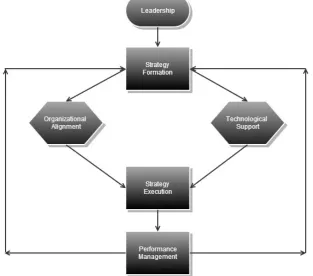
There are numerous factors that can impact a company’s ability to efficiently and effectively manage strategy execution. However, the literature suggests that some factors play a more critical role than others. As noted in the earlier discussion, some of these factors include effective leadership, organizational alignment, adequate technological support, and performance measurements. Figure 1 provides a framework for these factors and visualizes how each one works within that framework to contribute to effective strategy execution.
While there has not been a plethora of research conducted on strategy execution, the earlier discussions clearly established the importance of these factors during strategy execution. This discussion seeks to bring those factors together to help provide a more insightful perspective how to effectively manage strategy execution. The leadership should be knowledgeable, able to adjust quickly to changing market dynamics, and foster a culture of leadership and empowerment at all levels in the organization. Having the necessary organizational alignment is also important. Without adequate organizational alignment during strategy execution, the likelihood of maximizing this phase becomes more challenging. To have strong organizational alignment during strategy execution includes having a supportive organizational culture, being able to shift funds to critical areas, and having departments that are collaborative and flexible. Additionally, a major part of organizational alignment in today’s fast-paced, highly technological marketplace is to ensure that there is adequate technology to support the strategy execution. This includes having a technology strategy that is well-matched to the corporate strategy and competitive landscape. Finally, there should be a continuous improvement process in place that is used to improve future strategy execution efforts.
5.
C
ONCLUSIONThere are many factors that can contribute to a company’s success or lack of success during strategy execution. As noted in the discussion above, some factors can have a greater impact than others. The lack of effective leadership, appropriate organizational alignment, and adequate technology are factors that can significantly impact an organization’s ability to maximize strategy execution. Furthermore, the lack of performance measurement that lead to continuous improvement can also hinder this phase. However, ensuring that these factors are in place can help improve strategy execution, which in turn, can help maximize the entire strategic management process and increase the likelihood of the organization achieving its objectives.
R
EFERENCESAl-Khouri, A. (2014). Strategy and execution: Lessons learned from the public sector. International Business Research, 7(10), 61-73.
Andrews, R., Boyne, G., Law, J. and Walker, R. (2011). Strategy Implementation and Public Service Performance. Administration & Society, 43(6), 643–671.
Ansoff, I. (1972). The Concept of Strategic Management. Journal of Business Policy, 2(4), 1-9.
Bigler, W. & Williams, F. (2013). World-Class Strategy Execution Through ‘On The Job’ Leadership Development. Business Studies Journal, 5(1), 95-112.
Bourgeois, L. and Brodwin, D. (1984). Strategic Implementation: Five Approaches to an Elusive Phenomenon, Strategic Management Journal, 5, 241-264.
Cesnovar, T. (2006). The Impact of Strategic Management On Business Outcomes – Empirical Research. Journal for Far East
European Management Studies, 11(3), 227-243.
Chin-Fu, H. (1996). Information Technology Implementation Strategies For Manufacturing Organizations a Strategic Alignment Approach. International Journal of Operations & Production Management, 16(7), 77-100.
Floyd, S. and Wooldridge, B. (1992). Managing Strategic Consensus: The Foundation of Effective Implementation, Academy of Management Executive, 6(4), 27-39.
Guerra-Lopez, I., & Hutchinson, A. (2013). Measurable and Continuous Performance Improvement: The Development of a Performance Measurement, Management, and Improvement System. Performance Improvement Quarterly, 26(2), 159-173.
Hanley, C. A. (2007). The Execution Challenge: Translating Strategy into Action. Bank Accounting & Finance, 20(6), 17-20. Higgins, J.M. (2005). The Eight ‘S’s of Successful Strategy Execution. Journal of Change Management, 5(1), 3-13.
Hussey, D. (1999). Igor Ansoff’s Continuing Contribution to Strategic Management. Strategic Change, 8, 375-392.
Jagersma, P. K. (2009). Success Beyond Success: The "Golden Triangle" Of Continuous Performance Improvement. Business Strategy Series, 10(5), 239-247.
Johns, R. H., & Bigler, W. R. (1998). Speed Driven, Results-Based Change: How Incumbents Can Meet The Entrepreneurial Challenge. Strategy and Leadership Journal, July-August, 18-23.
Kalakota, R. and Robinson, M. (1999). E-Business: Roadmap for Success, Addison-Wesley, Reading, MA.
Kettunen, J. (2005). Implementation of Strategies in Continuing Education. The International Journal of Educational Management, 19(3), 207-217.
Lumby, J. (1999). Strategic Planning in Further Education. Educational Management & Administration, 27(1), 71-83.
Manderscheld, S. & Kusy, M. (2005). How to Design Strategy with No Dust – Just Results! Organization Development Journal, 23(2), 62-69.
McKnight, R. (2009). Top Team Alignment: The Epicenter of Strategy Execution. OD Practitioner, 41(2), 30-36. Mintzberg, H. (1985). Of Strategies, Deliberate and Emergent. Strategic Management Journal, 6(3), 257-271.
Pella, M., Sumarwan, U., Daryanto, A. & Kirbrandoko. (2013). Factors Affecting Poor Strategy Implementation. Gadjah Mada International Journal of Business, 15(2), 183 – 204.
Porter, M. E. (1985). Technology and Competitive Advantage. Journal of Business Strategy, 5(6), 60-79.
Quinn, J., Mintzberg, H. & James, R. (1988). The Strategy Process: Concepts, Contexts, and Cases. Prentice Hall. Englewood Cliffs, New Jersey.
Quiros, I. (2009). Organizational alignment: A Model to Explain the Relationships Between Organizational Relevant Variables. International Journal of Organizational Analysis, 17(4), 285-305.
Rothschild, P., Balaban, R., and Duggal, J. (2004). Linking Strategic Planning To Funding And Execution. Strategy & Leadership, 32(3), 36-40.
Salmela, H. and Spil, T.A.M. (2002). Dynamic and Emergent Information Systems Strategic Formulation and Implementation, International Journal of Information Management, 22(6), 441‐60.
Schendel, D., Ansoff, I., & Channon, D. (1980). Statement of Editorial Policy. Strategic Management Journal,1(1), 1-5.
Schneier, C. E., Shaw, D. G. and Beatty, R. W. (1991). Performance Measurement and Management: A Tool for Strategy Execution. Human Resource Management, 30(3), 279-301.
Semler, S. (1997). Systematic Agreement: A Theory of Organizational Alignment. Human Resource Development Quarterly, 8(1), 23-40.
Shannassy, T. (2003). Modern Strategic Management: Balancing Strategic Thinking and Strategic Planning for Internal and External Stakeholders. Singapore Management Review, 25(1), 53-67.
Shaw, R. B. (2014).[B] Leadership Blindspots: How Successful Leaders Identify and Overcome the Weaknesses That Matter. San Francisco, CA: John Wiley & Sons, Inc.
Shirley, M. (2011). Addressing Strategy Execution Challenges to Lead Sustainable Change. Journal of Nursing Administration, 41(1), 1-4.
Strategic Change. (2002). Obituary: Igor Ansoff, the father of strategic management. Strategic Change, 11, 437-438. (Check for APA formatting.)
Srinivasan, M.S. (2014). The Challenge of Execution in a Changing World. XIMB Journal of Management, 11(1), 135-142, Srivastava, A. and Sushil. (2013). Modeling Strategic Performance Factors for Effective Strategy Execution. International
Journal of Productivity and Performance Management, 62(6), 554-582.
Sull, D. (2007). Closing the Gap Between Strategy and Execution. MIT Sloan Review, 48(4), 30-38.
Swartling, D. and Olausson, D. (2011). Continuous Improvement Put into Practice. International Journal of Quality and Service Sciences, 3(3), 337-351.
Tapinos, E., Dyson, R., & Meadows, M. (2005). The Impact of Performance Measurement in Strategic Planning. International Journal of Productivity and Performance Management, 54(5/6), 370-384.
Thibodeaux, M., & Favilla, E. (2006). Strategic Management & Organizational Effectiveness in Colleges of Business. Journal of Education for Business, 70(4), 189-199.