© 2016 IJSRSET | Volume 2 | Issue 3 | Print ISSN : 2395-1990 | Online ISSN : 2394-4099 Themed Section: Engineering and Technology
32-bit Signed and Unsigned Advanced Modified Booth Multiplication using
Radix-4 Encoding Algorithm
Ashwini R. Bhajantri, Mahendra M. Dixit
Department of E & C E, SDM College of Engineering and Technology, Dharwad, Karnataka, India
ABSTRACT
This paper presents the design and implementation of Modified Booth encoding multiplier for both signed and unsigned 32 - bit numbers multiplication. The already existed Modified Booth Encoding multiplier and the Baugh-Wooley multiplier perform multiplication operation on signed numbers only. Whereas the array multiplier and Braun array multipliers perform multiplication operation on unsigned numbers only. Thus, the requirement of the modern computer system is a dedicated and very high speed unique multiplier unit for signed and unsigned numbers. Therefore, this paper presents the design and implementation of Booth multiplier. The modified Booth Encoder circuit generates half the partial products in parallel. By extending sign bit of the operands and generating an additional partial product the SUMBE multiplier is obtained. The Carry Save Adder (CSA) tree and the final Carry Look ahead (CLA) adder used to speed up the multiplier operation. Since signed and unsigned multiplication operation is performed by the same multiplier unit the required hardware and the chip area reduces and this in turn reduces power dissipation and cost of a system.
Keywords: Modified Booth Encoding multiplier, Radix-4 algorithm, CSA, CLA Partial product, Signed-unsigned.
I.
INTRODUCTION
Multipliers are essential components widely used in multimedia and Digital Signal Processing chips. These are used to give raise to the power and performance of the Chip. Parallel multipliers are predominantly used to increase the speed and reduce the cost of high area complexity. Many multiplication architectures are used to increase the speed and performance of the chips used in multimedia and digital signal processing. In these architectures predominantly modified booth algorithms have implemented significant multiplication in DSP and other multimedia applications. The important and significant Multipliers used in DSP and other multimedia applications are modified booth multipliers with the combination of low error width, fixed-width, high-accuracy error compensation circuit and low-error reduced-width architectures. All these combinations of architectures with Booth Encoder Multiplier have reduced remarkably the cost of systems and enhanced the speed of the multiplication operations.
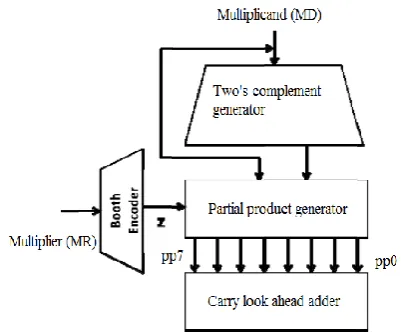
Figure 1. Architecture of Booth Multiplier
conventional modified Booth encoding (MBE) generates an irregular partial product array because of the extra partial product bit at the least significant bit position of each partial product row.
II.
METHODS AND MATERIAL
Implementation
A. Proposed System
Figure 2. Architecture of the 32-bit Booth Encoder Multiplier
The proposed Booth Encoder Multiplier using Carry Select Adder is designed and developed with improved architecture and more powerful algorithms. In this architecture X is used as multiplicand and Y is used as Multiplier. The Booth Encoder which is going to be implemented encodes the input Y and extracts the encoded signals. The detailed architecture is shown in Figure 2.
B. Sign Converter
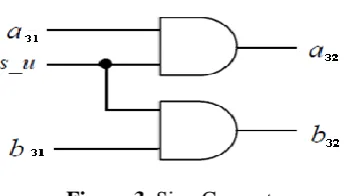
Figure 3. Sign Converter
follows. One bit control signal called signed-unsigned (MSB) bit is used to indicate whether the multiplication operation is signed number or unsigned number. When MSB = 0, it indicates unsigned number multiplication, and when MSB = 1, it indicates signed number multiplication. It is required that when the operation is unsigned multiplication the sign extended bit of both multiplicand and multiplier should be extended with 0, that is a32= a33= b32= b33= 0. It is required that when the operation is signed multiplication the sign extended bit depends on whether the multiplicand is negative or the multiplier is negative or both the operands are negative. For this when the multiplicand operand is negative and multiplier operand is positive the sign extended bits should be generated are MSB = 1, a31=1, b31= 0, a32= a33 =1, and b32= b33=0.
B. Radix-4 Booth Encoder
Booth algorithm is a powerful algorithm for signed number multiplication, which treats both positive and negative numbers uniformly. Since a k-bit binary number can be interpreted as k/2-digit Radix-4 number, a k/3-digit Radix-8number and so on, it can deal with more than one bit of the multiplier in each cycle by using high radix multiplication. The major disadvantage of the Radix-2 algorithm was that the process required n shifts and an average of n/2 additions for an n bit multiplier. This variable number of shift and add operations is inconvenient for designing parallel multipliers .Also the Radix-2 algorithm becomes inefficient when there are isolated 1’s.
Figure 4. Grouping of 3 bits in Radix-4 method
advantageous to begin the examination of the multiplier with the least significant bit.
Table 1: Booth recoding table for radix-4.
C. Partial Product Reduction
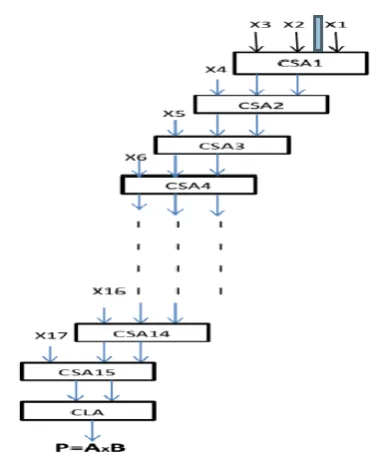
Traditionally, half and full adders, organized in a carry save adder format, have been used in the partial product reduction process. However, since their inception by Weinberger, [4:2] adders have become a topic of significant research in the arithmetic community. It has transformed the standard frame of mind of counter for partial product reduction by introducing the notion of horizontal data paths within stages of reduction. Furthermore, optimized [5:2], [6:2], [7:2] adders are proposed to improve the architecture of partial product reduction process. The MBE algorithm typically generates n/2+1 PPRs instead of n/2 due to the extra partial product bit (Neg bit) . One more PPR is needed for signed/unsigned configurations in our multiplier. Instead of using to reduce the number of PPRs, all the MSBs of PPR for sign-protection scheme are grouped with the Neg bit to form one more PPR, As a result, there are 18 PPRs in the 32-bit multiplier presented in this paper. The 18 PPRs are reduced to two rows, as shown in Fig 5.
Figure 5. Tree-base compression scheme
D. Partial product addition
Figure 6. Partial product adder logic
III.
RESULTS AND DISCUSSION
1. Simulation Results
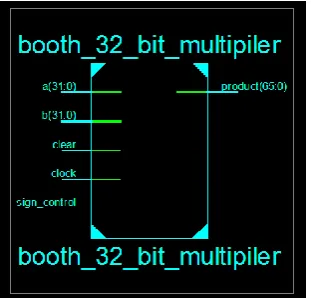
A. RTL Schematic of 32-bit Booth multiplier
The modified AMBE with the mechanisms have been included for the Xilinx ISE14.5 and simulated with the ISIM for this 32-bit Multiplication logic.
Figure 7. RTL Schematic of 32-bit Booth multiplier.
B. Simulation result for 32-bit unsigned number multiplication
Figure 8. 32-bit unsigned number multiplication in Hexadecimal representation.
C. Simulation Result 32-bit Signed Number Multiplication
D. Simulation result for 32-bit signed by unsigned numbers multiplication
Figure 10. 32-bit signed by unsigned numbers multiplication in Hexadecimal representation
IV.
CONCLUSION
The paper proposes the new CLA tree structure for the AMBE which provides the less power efficient and less area computations. The designed AMBE can be used for the high speed networks solutions. In this paper, I present a 32-bit×32-bit advanced multiplier capable of carrying out both signed and unsigned operations. The proposed novel unified signed/unsigned multiplier was optimized in terms of speed, power consumption and silicon area by exploiting more regular partial product array, developing more efficient compression methods and combining several types of fast adders.
V.
REFERENCES
[1] Sukhmeet Kaur1, Suman2 and Manpreet Signh
Manna3 “Implementation of Modified Booth Algorithm (Radix 4) and its Comparison with
Booth Algorithm (Radix-2)” Advance in
Electronic and Electric Engineering. ISSN 2231-1297, Volume 3, Number 6 (2013), pp. 683-690.
[2] Udari Naresh , 2G.Ravi, 3K.Srinivasa Reddy
“Implementation of Modified Booth Encoding Multiplier for signed and unsigned 32 bit numbers” IOSR Journal of Electronics and
Communication Engineering (IOSR-JECE)
8735.Volume 9, Issue 4, Ver. V (Jul - Aug. 2014), PP 50-58.
[3] Amine BERMAK, Senior Member, IEEE 2010
[4] Nallapeta.anil (1), w.yasmeen (2) “High speed multi operand redundant adders using compressor trees” International Journal of Advance Engineering and Research Development Volume 2,Issue 3, March -2015 Scientific Journal of Impact Factor(SJIF).
[5] Manthan J. Trivedi, 2Vimal H. Nayak,
3Mohmmed G. Vayada “ Implementation of Parallel Multiplier using Advanced Modified Booth Encoding Algorithm” 2015 IJEDR | Volume 3, Issue 2 | ISSN: 2321-9939.
[6] Sukhmeet Kaur1, Suman2 and Manpreet Signh
Manna3 Implementation of Modified Booth Algorithm (Radix 4) and its Comparison with
Booth Algorithm (Radix-2) Advance in
Electronic and Electric Engineering. ISSN 2231-1297, Volume 3, Number 6 (2013), pp. 683-690 © Research India Publications.
[7] Design and Implementation of Advanced
Modified Booth Encoding Multiplier
Shaik.Kalisha Baba1, D.Rajaramesh2
International Journal of Engineering Science Invention ISSN Volume 2 Issue 8 ǁ August. 2013 ǁ PP.60-68.
[8] P. Nithiyanandham1 and v. Balamurgan2
“Design of modified 32 bit booth multiplier for high speed Digital circuits” 1m.tech vlsi design, sathyabama university, chennai, india Arpn journal of engineering and applied sciences.
[9] K. Jeswanth Singh, B. Vamsi Krishna “Design
and Implementation of Modified Booth Encoder
Multiplier using Carry Select Adder”
International Journal of Recent Technology and Engineering (IJRTE) ISSN: 2277-3878, Volume-3 Issue-5, November 2014.
[10] Prabhat Shukla, 2Naveen Kr. Gahlan, 3Jasbir