71 | P a g e
PRIORITY BASED ADVANCED TRAFFIC CONTROL
SYSTEM WITH THEFT VEHICLE INTIMATION
K Kavitha
1, G.Bhargavi
2, G. Ravindranath Kumar
31
Pursuing M.Tech (ES),
2
Assistant Professor ,
3professor
1,2,3
Visvesvaraya College of Engineering and Technology
Patelguda, Ibrahimpatnam, Ranga Reddy, Dist. Telangana, (India)
ABSTRACT
Traffic congestion represents a major problem for most urban areas. This paper presents an intelligent traffic
control system to pass emergency vehicles smoothly.In these days we know the traffic is more in the rush hours
and we may strike in the traffic for a while. Where coming to the point in the case of emergency vehicles like
ambulances, VIP vehicles also may wait in the signal for a long time until the red signal turns into green signal.
This may also leads to loss of human lives because of not reaching their destinations in proper time. To
overcome this problems we are implementing a new trend technology by categorizing the vehicles mainly into
three type’s namely High priority, Normal, Stolen vehicles we may also increase the category depending up on
the priorities. These technologies represent an easy way to make the user aware about a traffic jam in a specific
road. The purpose of this paper is to fill-up this gap and contribute to reducing traffic congestion in big cities by
proposing a sequential approach intended to identify, control, and manage traffic congestion. The suggested
system considers active Radio Frequency Identification (RFID), and smartphone application technologies.
Each individual vehicle is equipped with special radio frequency identification (RFID) tag, which makes it not
easy to remove. We use RFID reader, ARM system-on-chip to read the RFID tags of the vehicle. It counts
number of vehicles that passes on a particular path during a specified duration. It also determines the network
congestion, and hence the green light duration for that path. If the RFID-tag-read belongs to the stolen vehicle,
then a alarm is raised and then the nearby polices will get alerted. In addition, when an ambulance is
approaching the junction, it will communicate to the traffic controller in the junction to turn ON the green light.
We also had traffic control for the VIP vehicles. Here we are making a setup of Green signal by identifying the
which type of vehicle is in the traffic if the vehicle is a high priority one and then if the signal is in red it
automatically turns into green by giving way to that vehicle here we are making an arrangement at every traffic
signal for monitoring the high priority vehicle. Thus we implement this setup for both the emergency vehicles
and stolen vehicles
Keywords: Lpc2148Microcontroller, RFID Reader and TAGS, Buzzer, LEDs (Red, green, orange
).
I. INTRODUCTION
Traffic congestion represents a major problem for most urban areas. This paper presents an intelligent traffic
control system to pass emergency vehicles smoothly.In these days we know the traffic is more in the rush hours
72 | P a g e
ambulances, VIP vehicles also may wait in the signal for a long time until the red signal turns into green signal.This may also leads to loss of human lives because of not reaching their destinations in proper time. To
overcome this problems we are implementing a new trend technology by categorizing the vehicles mainly into
three type‟s namely High priority, Normal, Stolen vehicles we may also increase the category depending up on
the priorities. These technologies represent an easy way to make the user aware about a traffic jam in a specific
road. The purpose of this paper is to fill-up this gap and contribute to reducing traffic congestion in big cities by
proposing a sequential approach intended to identify, control, and manage traffic congestion. The suggested
system considers active Radio Frequency Identification (RFID), and smartphone application technologies.
II. LITERATUREREVIEW
2.1 Existing system
A system has been investigated for the detection of incoming direction of an emergencyvehicle. Acoustic
detection methods based on a cross microphone array have been implemented. It is shown that source detection
based on time delay estimation outperforms sound intensity techniques, although both techniques perform well
for the application. The relaying of information to the driver as a warning signal has been investigated through
the use of ambi-sonic technology and a 4 speaker array which is ubiquitous in most modern vehicles.
Simulations show that accurate warning information may be relayed to the driver and afford correct action.
2.2 Proposed system
The block diagram of the project is shown below, consists of RFID reader, RFID tag, buzzer. Here we are using
a high frequency RFID reader to cover a wide area of the traffic. The RFID Tag is embedded into the dash board
of the vehicle. During the registration of the vehicle the RFID Tag is provided with the details of the vehicle
model, unique ID number and its category is stored. The priority of the vehicle is categorized with the help of
the alphabetic character suppose for a stolen vehicle the character is „T‟ and the RFID readers are fixed at every
junctions on top of the road. The reader read the data of the Tags and checks the appropriate Tag with the data
base present in the main system. The main system is connected to the police to update about the stolen vehicle to
change its priority from normal to stolen.
BLOCK DIAGRAM
TRAFFIC SIGNAL CONTROL CENTER
DATA BASE
RTO DATA BASE
73 | P a g e
III.
HARDWARE
R EQUPIREMENTS
3.1 LPC2148 microcontroller
The ARM7 (advanced RISC machine) pressers board primarily based whole on a 16/32-bit ARM7
its method of 16/32-bit ARM7 TDMI-S microcontroller, 8 computer memory unit to forty computer memory
unit of on-chip static RAM and 32 computer memory unit to 512computer memory unit on-chip flash memory;
128-bit In- system Programming (ISP). 32-bit timers/outside event counters, PWM pulse width modulation unit
(six outputs) and watchdog, Low strength of actual-Time Clock (RTC), more than one serial interfaces which
has 2 UARTs , rapid I2C-bus (400kbit/. There are sixty four pins of ARM7 processer and 2 ports (port0, port1)
45 pins are input/output.
Fig2:-LPC2148 board
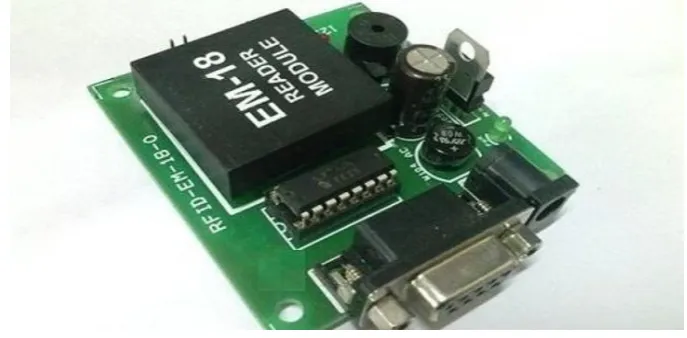
3.2 RFID
We have the two types of RFID reader active and passive. In the RFID reader we have the one magnet, in the
RFID reader also have the one magnet, whenever we place the card on the reader the magnetic flux will be
generate and card number will be read by the reader. We are using the 5 v power supply. the RFID have the
two types one is active and another one is passive. For the active one we have the sometime limit , so we need
to complete the work within the time only , but in case passive reader we can don‟t have any time limit we can
74 | P a g e
Fig3:
RFID reader
3.3 RFID Tags
The RFID cards are two types active and passive . the rf tags contains the one number which is there inside the
card we can‟t visible that card number, and it will have one magnetic coil in the card when we place the tag on
the reader it will generates a magnetic flux and reads the card number. This card will with the owner and the
reader with that particular application. This is used for the security purpose.
Fig 4: RFID cards
IV. SOFTWARE DESIGN
In this proposed contrivance, as we tend to used LPC2148 we wish to use following software package
instrumentation to program for it.
1. Keil4 Vision
2. Flash Magic
The Keil4 Vision an IDE for Embedded c language. In this IDE, we wish to import the utilities and libraries
consistent with the controller. This IDE is very more easily and in user friendly thanks to apply, assemblers,
and debuggers in it. It simplifies the manner of embedded simulation and trying entering conjunction with Hex
75 | P a g e
processed into Hex document i.e. in .hex layout. By using hex file we tend to merchandise the code intomicrocontroller and perform application
V. WORKING PROCEDURE
Traffic congestion represents a major problem for most urban areas. This paper presents an intelligent traffic
control system to pass emergency vehicles smoothly.In these days we know the traffic is more in the rush hours
and we may strike in the traffic for a while. Where coming to the point in the case of emergency vehicles like
ambulances, VIP vehicles also may wait in the signal for a long time until the red signal turns into green signal.
This may also leads to loss of human lives because of not reaching their destinations in proper time. To
overcome this problems we are implementing a new trend technology by categorizing the vehicles mainly into
three type‟s namely High priority, Normal, Stolen vehicles we may also increase the category depending up on
the priorities. These technologies represent an easy way to make the user aware about a traffic jam in a specific
road. The purpose of this paper is to fill-up this gap and contribute to reducing traffic congestion in big cities by
proposing a sequential approach intended to identify, control, and manage traffic congestion. The suggested
system considers active Radio Frequency Identification (RFID), and smartphone application technologies.
Each individual vehicle is equipped with special radio frequency identification (RFID) tag, which makes it not
easy to remove. We use RFID reader, ARM system-on-chip to read the RFID tags of the vehicle. It counts
number of vehicles that passes on a particular path during a specified duration. It also determines the network
congestion, and hence the green light duration for that path. If the RFID-tag-read belongs to the stolen vehicle,
then a alarm is raised and then the nearby polices will get alerted. In addition, when an ambulance is
approaching the junction, it will communicate to the traffic controller in the junction to turn ON the green light.
We also had traffic control for the VIP vehicles. Here we are making a setup of Green signal by identifying the
which type of vehicle is in the traffic if the vehicle is a high priority one and then if the signal is in red it
automatically turns into green by giving way to that vehicle here we are making an arrangement at every traffic
signal for monitoring the high priority vehicle. Thus we implement this setup for both the emergency vehicles
and stolen vehicles
.
VI. RESULT
Here we shown the output of the project “ Priority Based Advanced traffic control system with theft vehicle
intimation”was successfully completed whenever any emergency vehicle or VIP vehicle will come the RFID
76 | P a g e
VII. CONCLUSION
By using this project we can conclude that we can use the a rfid based technology for traffic for emergency
vehicle and VIP vehicle during in the rush hours.by using this technology we can saves human lives from traffic
jams in emergency cases ,the vehicle contains the rfid tag and at the signal we have the reader if the card is
authorized than the red lights will turns into the yellow than the emergency vehicles and VIP will go very easily.
REFERENCES
[1] www.researchmanuscripts.com/isociety2012/13.pdf
[2] www.slideshare.net/rameshchatty/rfid-based-traffic-control-system-by-using-gsm.
[3] www.ncbi.nlm.nih.gov › NCBI › Literature › PubMed Central (PMC).
[4] www.ijircce.com/upload/2015/august/16_Smart.pdf.
[5] research.ijcaonline.org/volume75/number7/pxc3890473.pdf
[6] www.onlinejournal.in/IJIRV2I4/197.pdf
[7] www.ijesit.com/Volume%203/Issue%204/IJESIT201404_92.pdf
[8] www.iiste.org/Journals/index.php/ISDE/article/viewFile/1837/1852
[9] www.ijareeie.com/upload/april/42_Automatic.pdf
77 | P a g e
AUTHOR DETAILS
K KAVITHAPursuingM.Tech (ES) from, visvesvaraya college of engineering and
technology, Patelguda, Ibrahimpatnam, Rangareddy dist., Telangana, INDIA.
G.BHARGAVI, working as assistantprofessor, from visvesvaraya college of engineering
and technology, patelguda, Ibrahimpatnam, Rangareddy dis., Telangana, INDIA
G.RAVINDRANATH KUMAR (HOD) , working as Professor from Visvesvaraya
College Of Engineering And Technology, Patelguda, Ibrahimpatnam, RangaReddy dist.,