317 | P a g e
FUZZY ADAPTIVE CODED MODULATION IN
WIRELESS NETWORK USING BIT ERROR RATE.
R.Srihari
1, K.Hymavathi
2.K.Shiva
31
Associate Professor, Department of ECE, SRTIST, Nalgonda (India)
2
Associate Professor, Department of ECE, SRTIST, Nalgonda (India)
3
Assistant Professor, Department of ECE, SRTIST, Nalgonda (India)
ABSTRACT
Spectrally efficient transmission schemes are becoming a more common requirement for digital communication
systems. Especially in wireless communication since the bandwidth of available frequencies is a shared
resource. Adaptive coded modulation (ACM) has been suggested as a bandwidth-efficient transmission
technique in wireless fading environments. The use of ACM is motivated by its ability to improve spectral
efficiency (SE) by adapting the transmission rates to the variations in channel signal-to-noise ratio. Any ACM
scheme relies on being able to predict future states of the transmission medium. Under idealized conditions,
such as the prediction being perfect, an ACM scheme can be configured to maximize the SE under the condition
of the bit error rate (BER) being below a specified target BER. In this paper, a simulation considering an
example system shows that such systems in some cases fail to achieve the target BER, since the idealized
conditions used in the design process do not hold in a realistic setup. By limiting the number of transmission
modes, introducing imperfect prediction, and other practical conditions such as delay in the communication
system and probability of outage, a more practical ACM scheme can be considered. We show that it is still
possible to optimize the performance of such schemes.
Keywords: Transmission; Adaptive; BER.
I. NTRODUCTION
Any new electronic device which includes sufficiently new or improved technology is often adopted by a high
number of users. To become popular, electronic devices must process larger amounts of information at higher
information rates to satisfy new and “greedier” applications. The increased mobility among user’s results in an
increased popularity for wireless applications where the information processed by the device can be updated
(downloaded) on the fly. Popular devices are also usually very small and with a low weight, and it is commonly
required that the battery life-time (between recharging) is long. Examples of popular portable devices are
personal computers, game consoles, music players, and mobile (cellular or satellite) phones. As a result, the
radio spectrum is being used by an increasing number of systems and users. The available radio spectrum is a
finite resource that is shared between all users. In order to avoid in-band interference, the power consumption
should be kept to a minimum (allowing the use of small long-life batteries). Keeping both the bandwidth and
318 | P a g e
increasing use of wireless transmission media therefore calls for more spectrally efficient transmission schemes,where spectral efficiency (SE) can be defined as the amount of information bits transmitted per time unit per
Hertz available bandwidth. Evidently, SE or information throughput is a measurement of the performance of a
wireless transmission scheme. In addition, the amount of information that is received in error may reduce the
quality of the communication. For applications such as voice communication relatively large amounts of errors
can be tolerated. For some pure data communication applications, such as downloading a text document to a
computer, no errors can be tolerated since one error may affect the entire amount of information transmitted.
However, voice communication and other applications, such as streaming media, often require constant
transmission of information, thus putting a very strong demand on the so called outage probability, which is the
probability that no reliable communication is possible. Thus, outage probability is another performance measure
for a wireless communication system. A technique commonly referred to as rate-adaptive modulation or
adaptive coding and modulation (ACM) can be used to improve the SE in wireless communications. In
traditional investigation of ACM schemes an idealized channel model is assumed and the technique promises
the user the highest possible average spectral efficiency (ASE). In this thesis the practical limitations and
possibilities of ACM schemes are investigated by removing some of the idealized assumptions.\
OFDM is a multicarrier transmission technique, which divides the bandwidth into many subcarriers; each one
sub-carrier is modulated by a low rate data stream. It is very similar to the well known and used technique of
Frequency Division Multiplexing (FDM). OFDM uses the principles of FDM to allow multiple messages to be
sent over a single radio channel. It is, however, in a much more controlled manner, allowing an improved
spectral efficiency [11]. In FDM transmission the signals need to have a large guard-band between channels to
prevent interference. For instance, in Frequency Division Multiple Access (FDMA) each user is typically
allocated a single channel, which is used to transmit all the user information. The bandwidth of each channel is
typically 10 kHz-30 kHz for voice communications. However, the minimum required bandwidth for speech is
only 3 kHz. This extra bandwidth is to allow for signals from neighboring channels to be filtered out, and to
allow for any drift in the center frequency of the transmitter or receiver. In a typical system, up to 50% of the
total spectrum is wasted due to the extra spacing between channels. This lowers the overall spectral efficiency.
Time Division Multiple Access (TDMA) partly overcomes this problem by using wider bandwidth channels,
which are used by several users. Multiple users access the same channel by transmitting their data in time slots.
Thus, many low data rate users can be combined together to transmit in a single channel which has a bandwidth
sufficient so that the spectrum can be used efficiently
1.1 Spectrally Efficient Transmission Techniques
In this subsection a selection of established techniques that can be used in the design of spectrally efficient
communication systems are described. The “classical” transmission system in Figure 1.1 shows how (possibly no redundant) information is coded into a redundant bit stream. The coded information is subsequently
modulated onto the (communication) channel by performing a mapping of coded information and filtering the
resulting symbols. The receive filter is usually built as a matched filter taking into account the stationary
characteristics of the channel. After filtering the received information carrying signal, the information is
319 | P a g e
transmitter. Subsequently, the demapper produces a detected version of the coded information bits which is thendecoded producing the decoded source bits. The system in Figure 1.1 outlines the use of a so called “hard”
decoder, i.e. decisions are made before decoding. If a “soft” decoder is used the received information from the channel is employed directly in the decoding process.
1.2 Non-Adaptive Techniques
Spectrally efficient transmission techniques, using modulation constellations with a high number, S, of different
channel symbols, and thus many information bits per symbol (log2S in the uncoded case), can be shown to be
very effective as long as the channel signal-to-noise ratio (CSNR) is sufficiently high and constant. Also,
employing error correcting codes may help reduce the amount of errors introduced by the communication
channel by adding redundant information to the information signal to be transmitted. The expenses paid using
an error correcting code are reduced SE and increased processing delay, complexity, and power consumption in
both transmitter and receiver. The error correcting properties of such codes are also dependent on the CSNR.
However, fluctuations in the CSNR are among the most severe restrictions in wireless communication systems.
II. LITERATURE SURVEY
[1] Geir Egil øien et al. in 2004 had investigated the effects of predicting the CSI using a linear fading-envelope
predictor in order to enhance the performance of an ACM system.[2] Birla et al. in 2012 presented capacity
enhancement of WiMAX system using adaptive modulation and code rate in MATLAB. This paper focusing on
the physical layer design that is modulation (BPSK, QPSK, 8QAM, 16QAM, 32QAM,64QAM are used in this
work) and convolution codes(CC) with ½, ⅔ codes. . Simulation result also show the flexibility of the adaptive
system to operate with different desired BER. [3]Faezah et al. in 2009 first investigated the OFDM system
performanceThe obtained results show that a significant improvements in terms of bit error rate (BER) and
throughput can be achieved demonstrating the superiority of the adaptive modulation schemes compared to
fixed transmission schemes.[4] Sharma et al. in 2012 discussed various digital modulation techniques such as
BPSK (2bits), QPSK (4 bits), QAM, 16 QAM and 64 QAM. Authors have studied existing configurations with
analog and digital modulation techniques and compared the results. [10],[11] Sohaib et al. in 2006 simulated
single-channel transmission through long-haul fiber systems with or without inline chromatic dispersion
compensation, incorporating numerous optical switches, evaluating the impact of fiber nonlinearity and
bandwidth narrowing. With zero SNR margin, we achieve bit rates of 200/100/50 Gb/s over distances of
transmission, showing that interchannel nonlinearities decrease achievable distances by about 10% and 7% for
dispersion-compensated. Harivikram et al. in 2013 provided a background of the High Speed Downlink Packet
Access (HSDPA) concept;
III. OBJECTIVE FUNCTION
Traditional theoretical analysis of adaptive communication systems assumes perfect knowledge of the CSI and a
320 | P a g e
fading estimates was considered, and it was shown that information on the fading process should be included inthe system design since variations in the channel characteristics highly affects the BER performance of an ACM
scheme. The combined power and bandwidth requirements suggest that the adaptive modulation schemes can
provide reliability when deployed in a real time channel, resulting in improved system performance & Focus on
the modulation aspects of the optical wireless communication, this thesis try to improve the channel immunity
by utilising optimized modulation to the channel. Modulation schemes such as all types of phase shift keying
modulation have been validated.
3.1 Time-Domain Orthogonally
Signals are orthogonal if they are mutually independent of each other. Orthogonally is a property that allows
multiple information signals to be transmitted over a common channel and detected, without interference. Loss
of orthogonally results in blurring between these information signals and degradation in communications. TDM
allows transmission of multiple information signals over a single channel by assigning unique time slots to each
separate information signal. During each time slot only the signal from a single source is transmitted preventing
any interference between the multiple information sources. Because of this TDM is orthogonal in nature. In the
frequency-domain most FDM systems are orthogonal as each of the separate transmission signals are well
spaced out in frequency preventing interference. Although these methods are orthogonal, the term OFDM has
been reserved for a special form of FDM. OFDM signals are made up from a sum of sinusoids, with each
corresponding to a subcarrier. The baseband frequency of each subcarrier is chosen to be an integer multiple of
the inverse of the symbol time, resulting in all subcarriers having an integer number of cycles per symbol. As a
consequence the subcarriers are orthogonal to each other. Two continuous and discrete time periodic signals are
orthogonal to each other if they match the conditions in Equations (2.1) and (2.2), respectively.
(2.1)
=0 (2.2)
3.2 Frequency-Domain Orthogonally
Another way to view the orthogonally property of OFDM signal is to look at its spectrum. In the
frequency-domain each OFDM subcarrier has a sinc function frequency response, as shown in Figure 2.1. This is a result
of the symbol time corresponding to the inverse of the carrier spacing. As far as the receiver is concerned, each
OFDM symbol transmitted for a fixed time TFFT with no reduction at the ends of the symbol. This symbol time
corresponds to the inverse of the subcarrier spacing of 1/TFFTHz. The sinc shape has a narrow main lobe, with
many side-lobes that decay slowly with the magnitude of the frequency difference away from the center. Each
carrier has a peak at the center frequency and nulls evenly spaced with a frequency gap equal to the carrier
spacing [11].
3.3 Generation of OFDM Symbols
A baseband OFDM symbol can be generated in the digital domain before modulating on a carrier for
321 | P a g e
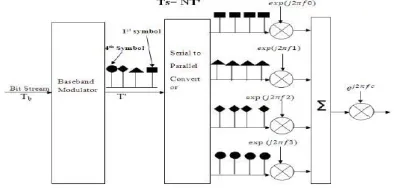
common modulation schemes such as the phase shift keying (PSK) or Quadrature amplitude modulation(QAM). These data symbols are then converted from serial-to parallel (S/P) before modulating subcarriers.
Subcarriers are
Figure 2.2 a 4-Subcarrier OFDM Transmitter.
Sampled with sampling rate N/Ts, where N is the number of subcarriers and Ts is the OFDM symbol duration.
Finally, samples on each subcarrier are summed together to form an OFDM symbol. An OFDM symbol
generated by an N-subcarrier OFDM system consists of N samples and the mth sample of an OFDM symbol is
given as
(2.3)
Where, Xn is the transmitted data symbol on the nth subcarrier. Equation 2.3 is equivalent to the N-point IDFT
operation on the data sequence with the omission of a scaling factor. It is well known that IDFT can be
implemented efficiently using IFFT. Therefore, in practice, the IFFT is performed on the data sequence at an
OFDM transmitter for baseband modulation and the FFT is performed at an OFDM receiver for baseband
demodulation. Finally, a baseband OFDM symbol is modulated by a carrier to become a bandpass signal and
transmitted to the receiverFigure 2.2 shows a 4-subcarrier OFDM transmitter and the process of generating one
OFDM symbol. In the figure the sub carrier frequency is given as
Where and are the subcarrier frequency and spacing respectively and are the signal and OFDM symbol period respectively.
3.4 OFDM System Model
In this section, we look at the basic OFDM system model components. Since our objective is to investigate the
OFDM system performance in terms of BER and spectral efficiency and to enhance the system throughput using
AMTW over doubly selective fading channel.
IV. RESULTS
Our work uses MATLAB as a tool as it provides a wide range of toolboxes which avoids us to develop the
simulation from the scratch level. In this work MATLAB’s communication and signal processing toolbox is used. We have developed a graphical user interface (GUI) using MATLAB which makes user easy to interact
with the adaptive ACM simulation. A comparison with simple conditions based ACM and fuzzy adaptive ACM
322 | P a g e
Figure 4.1: GUI Constructed for the Proposed Work
We have used 1-256 QAM modulation and results have been shown in graphical form between bit error rate and
SNR. Parameters used for the simulation of quadrature amplitude modulation (QAM) are shown in table 4.1.
Table 4.1: Input Parameters for Simulation of QAM
FFT size 64
Number of data subcarriers 512
OFDM symbols 10^4
number of bits per OFDM symbol 52 Signal to noise ratio 0-33
Modulation scheme QPSK, 16QAM,
64QAM, 256QAM
Channel AWGN
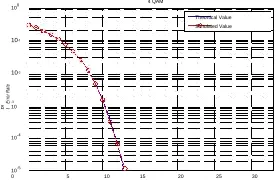
We have tested results of every BER-SNR graph with theoretical results too. It has been noticed that simulation
results overlapped with the theoretical results as shown in figure 4.2 for 4 QAM. Graph is in logarithmic scale.
The bit error rate is continuously decreasing with increase in signal to noise ratio. Signal to noise ration
increases due to decrease in noise. If noise decreases then bit error rate also decreases as it represents the ratio of
wrong bits received.
100 4 QAM
Theortical Value
Simulated Value
10-1
10-2
E
rr
o
r
R
a
te
-3
Bit10
10-4
10-5
0 5 10 15 20 25 30
SNR, dB
Figure 4.2: BER vs SNR for 4 QAM
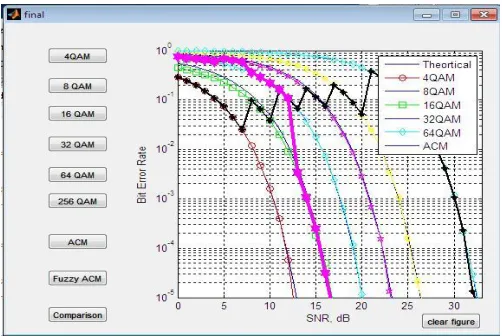
Fuzzy logic rules target the decrease of BER even in condition when SNR increases. A comparative curve is
shown in figure 4.3. Magenta color graph line shows the BER vs SNR curve for fuzzy ACM. It shows that
where simple ACM switches to multiple modulation techniques with SNR condition, fuzzy ACM manage that
323 | P a g e
more than simple conditions based ACM. Table 4.3 shows the BER values for both cases with correspondingSNR. Table shows that fuzzy based ACM decreases the BER to zero at 18 dB SNR whereas conditions based
ACM reduces to BER upto minimum error value but not to zero. This proves proposed work reduces the BER at
high SNR to zero whereas simple conditions based ACM.
Figure 4.3: Comparison of Fuzzy ACM and Conditions Based ACM
Table 4.3: BER Comparison of fuzzy ACM and Conditions Based ACM
SNR Conditions based ACM Fuzzy rules based ACM
0 0.292815384615385 0.742425000000000
1 0.244390384615385 0.710198076923077
2 0.196728846153846 0.675805769230769
3 0.151523076923077 0.634598076923077
4 0.109969230769231 0.589432692307692
5 0.0745692307692308 0.680878846153846
6 0.0449884615384615 0.641473076923077
7 0.0252557692307692 0.595915384615385
8 0.0974788461538462 0.353544230769231
9 0.0639538461538462 0.287613461538462
10 0.0379961538461538 0.222473076923077
11 0.162178846153846 0.161682692307692
12 0.109521153846154 0.109682692307692
13 0.0677480769230769 0.00347115384615385
14 0.168998076923077 0.00101346153846154
15 0.116588461538462 0.000242307692307692
16 0.0733038461538462 1.34615384615385e-05
17 0.202498076923077 1.92307692307692e-06
18 0.139690384615385 0
19 0.0890538461538462 0
20 0.0505269230769231 0
21 0.374348076923077 0
324 | P a g e
23 0.221496153846154 0
24 0.153303846153846 0
25 0.0985538461538462 0
26 0.0564019230769231 0
27 0.0281538461538462 0
28 0.0120134615384615 0
29 0.00414423076923077 0
30 0.00108269230769231 0
31 0.00023076923076923 0
32 1.34615384615385e-05 0
33 3.84615384615385e-06 0
V. CONCLUSION
The possibility of the adaptive modulation can indeed be further explored. As the discussions were based on
utilizing the QAM in the modulation scheme. Yet using the same analytical model, other modulation schemes,
such as the PAPM and throughput improving DAPPM can also be investigated in terms of adaptability under
channel uncertainty. The fuzzy logic control algorithm developed in this thesis can be further investigated. As
the efficient control mechanism will provide the communication system with more accurate instructions for
adapting system parameters.
REFERENCES
[1]. Geir Egil øien, member, IEEE,” impact of channel prediction on adaptive coded modulation performance
in rayleigh fading” IEEE transactions on vehicular technology, vol. 53, no. 3, may 2004
[2]. Varsha Birla, Prof. Rupesh Dubey,” Capacity Enhancement of WiMAX System Using Adaptive
Modulation and Code Rate” International Journal of Emerging Technology and Advanced Engineering
(ISSN 2250-2459, Volume 2, Issue 8, August 2012)
[3]. J.Faezah, and K.Sabira,” Adaptive Modulation for OFDM Systems” International Journal of
Communication Networks and Information Security (IJCNIS) Vol. 1, No. 2, August 2009
[4]. Umesh Sharma,” Comparative Study of Digital Modulation Techniques in WIMAX” International Journal
of Engineering and Innovative Technology (IJEIT) Volume 2, Issue 2, August 2012
[5]. Anders Gjendemsj, Geir E. Øien,” Optimal Discrete-Level Power Control for Adaptive Coded Modulation
Schemes with Capacity-Approaching Component Codes”
[6]. Sasikanth Munagala, Raju Muchanthula, Yannick le Moullec,” HSDPA-Adaptive Modulation and
Coding: Simulation and Implementation” Proceedings of the 6th WSEAS International Conference on
Applied Computer Science, Tenerife, Canary Islands, Spain, December 16-18, 2006
[7]. Nestor D. Chatzidiamantis,, Athanasios S. Lioumpas, George K. Karagiannidis, and Shlomi Arnon,”
Optical Wireless Communications with Adaptive Subcarrier PSK Intensity Modulation” JOURNAL OF
325 | P a g e
[8]. Gwang-Hyun Gho and Joseph M. Kahn, Fellow, IEEE,” Rate-Adaptive Modulation and Coding forOptical Fiber Transmission Systems” JOURNAL OF LIGHTWAVE TECHNOLOGY, VOL. 30, NO. 12,
JUNE 15, 2012
[9]. Khan Sohaib, Nguyen Kim Cuong and Jorgen Nordberg, “HSDPA System Simulation,” in Proc.
IEEE-EURASIP International Symposium on Control, Communications, and Signal Processing (ISCCSP),
Morocco, Mar. 2006.
[10].T.S.Harivikram, Dr. R.Harikumar, Dr. C.Ganesh Babu, P.Murugamanickam,” Adaptive Modulation and
Coding Rate for OFDM Systems” International Journal of Emerging Technology and Advanced
Engineering, Volume 3, Issue 2, February 2013
[11].Islam M.A., Mondal R.U. and Hasan M.Z., “ Performance Evaluation of Wimax Physical Layer under
Adaptive Modulation Techniques and Communication Channels,” (IJCSIS) International Journal of
Computer Science and Information Security, Vol. 5,pp.111-114, 2009.
[12].Mohamed M. A., Zaki1 F.W. and Mosbeh R. H.,“ Simulation of Wimax Physical Layer,” Ieee
International journals of computer science and Technology and Network system,Vol.10,pp. 49-55,2010.
[13].Nagar K.K., and Sharma K., “ Adaptive OFDM Implementation Using Fuzzy Inference System”,
International Journal of Advanced Research in Computer Science and Software Engineering, Vol. 3, pp.
193-1906,July 2013.
[14].Rao A. and Alouini M. S., “Multiuser Diversity with Adaptive Modulation in Non Identically Distributed
Nkagami Fading Environment,” IEEE Transaction on vehicular Techonology, Vol.61, pp.1439-1444,
2012.
[15].Sastry K.S. and Dr. Babu M.S.P., “ Fuzzy logic based Adaptive Modulation Using Non Data Aided SNR
Estimation for OFDM system,” International Journal of Engineering Science and Technology Vol. 2,pp.
2384-2392,2010.
[16]. Sharma U., “Comparative Study of Digital Modulation Techniques in WIMAX,” International Journal of
Engineering and Innovative Technology (IJEIT) Volume 2, Issue 2, pp. 38-41, 2012.
[17].Sharma A. and De S., “Exploiting Fading Dynamics along with AMC for Energy-Efficient Transmission
over Fading Channels,” IEEE Communications Letters, Vol.15, pp.1218-1220,2011
[18].Sharma A. and Garhwal A.,“ Performance Analysis Physical Layer of Wimax System Using Simulink,”
International Journals of Computer Science and Research,Vol.2, pp.203-207,2013.
[19].Faezah J. and Sabira K., “ Adaptive Modulation for OFDM Systems,” International Journal of
Communication Network and Information, Vol. 1, pp. 1-8,2009.
[20].Harivikram T.S., Dr. Harikum R., Dr. C.G.B. and P. M , “Adaptive Modulation and Coding Rate for