STUDY BASED PERFORMANCE ANALYSIS OF
CONTENT BASED IMAGE RETRIEVAL
TECHNIQUES BASED ON VISUAL FEATURES
Ms. Jaimala Jha
1,
Prof. Sarita Singh Bhadauria
2 1Research Scholar, Dept. of CSE/IT, MITS College Gwalior, (India)
2
Department of Electronic Engg. MITS College Gwalior, (India)
ABSTRACT
The area of multimedia contents increases online day by day. Therefore image data availability search has
become a feasible way of retrieving relevant images. Content-Based Image Retrieval has emerged as an
important area in computer vision and multimedia computing. The objectives of this research are to give the
various theoretical and practical side that are exist in the literature. This paper consists of detail knowledge of
CBIR system with feature extraction methods and analysis with performance parameter of their pros & cons.
Keywords:
CBIR, Color, Image retrieval,Feature Extraction,Performance parameter, Texture,
Shape.
I.
INTRODUCTION
Fig 1 General block diagram of CBIR system.
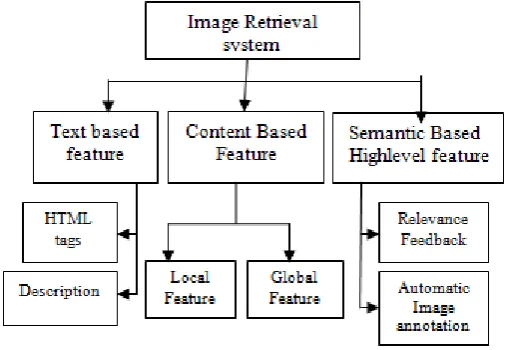
A central issue of this approaches are the feature vector extraction. Grouping images into (semantically) meaningful categories using low-level visual features is a challenging and important problem in content-based image retrieval. Feature extraction is the methodology of creating elements to be utilized as a part of the selection and classification tasks. Feature selection declines the quantity of features gave to the classification task. Those features which are prone to help in inclination are chosen and utilized as a part of the classification task. Features which are not choose are discarded. The final consequence of the extraction assignment is an arrangement of components, regularly called an feature vector, which constitutes a representation of the image.Figure 1.2 show the classification of the Image retrieval system.
Figure 1.2 Image retrieval classification .
II.
FEATURE
EXTRACTION
CATEGORIES
recognition.Content
-
based image retrieval,
usesthe visual contents of an image such as color, shape, texture, and spatial layout to represents and indexed the image. The low level visual features are-:Color Feature Extraction-
The aim of finding color feature indexing is to retrieve all the images whose color configurations are related to the color configuration of the query image. The color content is widely used important feature for image representation. Color histrogram, color correlation, color space, color quatisation and relationship measurement are the key components of color feature extraction. Color feature is not conditional for shape and size of image. The color models can be classified such as RGB and LUV, HSV, YCBCR etc.
Texture Feature Extraction-
Texture is used to get the multiresolution attributes of an image. It refers to innate surface properties of an object and their relationship to the surrounding environment. Texture feature arises where regularity and coarseness is presents. Texture feature describes spectral features which are taken using wavelet transform, statistical features, tamura texture features etc. Tamura explored the texture representation from a different viewpoint. [6]Texture and color queries can be formulated in similar way, by selecting desired textures or by supplying an query image.
Shape Feature Extraction-
Shape is one of the important features and contains the most attractive visual information for human perception. Basically shape refer to the information that can be deduced directly from images shape extracted from the image only in part represents the projected object. It creates problem even more difficult, shape is often degraded with noise, arbitrary distortion and occlusion. Shape features is categories into two types contour based and region based. Contour based shape features uses only boundary of the shape whereas region-based shape features uses entire shape region[5].
Shape features are known as geometric features. shape feature are commonly used – global features such as aspect ratio, circularity and moment invariants and localfeatures[7].
III. RELATED REVIEWS
Based on the reviews of the various existin contents based image retrival techniques it can be categorise In three different types.
1. Retrieval is based upon the color contents. 2. Retrieval is based upon the texture contents. 3 Retrieval is based upon the shapecontents. 4. Retrieval is based upon Mixed contents.
3.1 Color contents based
Kinnareea, Pattanasethanonb, Boonthoa Thanaputtiwirota, et. al. provides “RGB Color Correlation Index for Image Retrieval” Elsevier 2011. The main focus of this paper is on an image retrieval scheme that is based on the concept of maximum RGB color correlation index between images. The proposed method retrieves the images on the basis of maximum color correlation so that the images with more similarities and, hence, exhibiting maximum correlation with each image is the index for retrieved accordingly. The RGB correlation index method has a maximum precision and recall rate. The propose image retrieval system has a high detection rate with RGB correlation index [20].
Kousalya,Thanamani, et al. provides the “Image Color Extraction And Retrieval Using Classification Techniques” 2013. This paper provides color features concepts for retrieving similar images. CBIR aim at measuring color for specific images that are similar to a given query color. This approaches include color features are usually represented as a histograms of intensity of the pixel colors. The Objective is to extracting color from specific images and retrieving the similar pixels using Euclidean distance measures[15].
3.2 Texture Content Based
K.P, Mary, Vasuki, et al. gave “An Image Retrival Techniques Based On Texture Feature Using Semantic Properties” IEEE pattern Recogntion 2013. The main focus of this paper is on the semantic based image retrieval system based on the texture feature. GLMC method is used for texture feature extraction which gives semantic interpretation of images .The paper works for reducing the semantic gap between the low level feature and high level feature. The extracted features are assigned into semantics [14].
Divakar Singh Anju Singh provide “A New Frame Work For Texure Based Image Content With Comparative Analysis of Clustering Techniques” IEEE 2012. The paper show the comparative study of two clustering algorithm for image retrival system . for this comparison the more appropriate feature of image is texture visual feature for improving the retrieval efficiency.[17]
3.3 Shape Content Based
Sheikh, Mansor,.Lye,Fauzi, et al. give the “Content Based Image Retrival System For Marine Life Images Using Gradient Vector Flow” IEEE 2013.This paper focus on marine life
images and also emphasis on
shape
matching.The aim of this research is to recognize marine species without huge amount of man power in malaysia. The objective of this work is to compare automated segmentation and manual segmentation with without segmentation. It uses two feature extraction techniques color & shape for indexing and recognition[16].Acharya, Devi, et al. focuese on “Image Retrieval Based on Visual attention Model” Elsevier 2012. It proposes a new technique of incorporating visual attention model to segment and extract the ROI from an image and then use the result for image retrieval purposes. The main advantage of this concept lies in the improvement of the performance of the retrieval scheme in terms of two parameters Precision and Recall[19].
3.4 Mixed(combination of color, texture, shape) Content Based
system. The objective of this approach is to reduce loss of information in images and extracting meaningful features [21].
Maheshwari, Silakari, Motwani, et al. focuses on “Image Clustering using Color and Texture” IEEE 2009. This paper is focuses on image clustering based on color and texture features. For extracting the information from the image dataset used Color moment and Gabor filter. For image data clustering used K-means andhierarchical data mining clustering algorithm of the image dataset. This approach provides a group of image data set into various clusters[22].
WangXing-yuan , ChenZhi-feng, YunJiao-jiao, “An effective method for color image retrieval based on texture”, 2012. The paper presents a effective color image retrieval method based on texture, which uses the color co-occurrence matrix to extract the texture feature and measure the similarity of two color images. But proposed method is superior to the gray-level co-occurrence matrix method and color histogram method[18]. Datta, Joshi Li, Z. Wang, Acm “Image Retrieval: Ideas, Influences, and Trends of the New Age” Computing Surveys, April 2008. The article contribute the theoretical study and analysis related to image retrieval and automatic image annotation also discuss significant challenges involved in the Image retrieval system. The article show the concepts adaptation of existing image retrieval techniques to build new systems that can be useful in the real world. It also gives the future research aspects for image retrieval[23]
IV. COMPARISION ANALYSIS CHART BETWEEN LOW LEVEL FEATURES BASED
TECHNIQUES :
Visual contents
categories
Techniques
Accuracy
Benefits
Drawback
Color Feature Color Moment low Overcome the quantization problem
Precision is low
Fuzzy color histogram
High Fast computation
More computation
Color Correlogram High Provide spatial color information
Very slow computation
Texture Feature Gabor Filter High Get maximum retrieval results
Computationally intensive
Gray level cooccurrence matrix
High Texture classification High Dimensionality
Shape Feature Moment Invariant High Invariant to orientation and size,statistical feature
Limited recognition power
Zernike moments High Shape analysis Computational
Complexity is High
Table 1. Comparison of the various features based technique
s
[9]V.
PERFORMANCE
MEASUREMENT
5.1 Euclidean Distance
It is defined as the displacement of a pixel from the nearest background point. The equation[14] of Euclidean Distance is:
(1)
5.2 Chi Square Distance
The ED between the components of profiles, on which weighting is defined (weight means the inverse of its frequency), is called the chi-square distance[14]. The equation is :
(2)
5.3Weighted Euclidean Distance
Multiply squared differences by corresponding weights are known as Weighted Euclidean Distance. The formula of W.E.D is[14]
VI. PERFORMANCE PARAMETER
Evaluation of retrieval process is a crucial problem in CBIR. Different methods are used for measuring performance of retrieval system. The most common performance parameters are Precision and Recall .
6.1 Precision
Precision rate is defined as a ratio of number of retrieve relevant images similar to the query to the total number of retrieved images in response to query[1][10[11].
6.2 Recall
Recall rate is defined as a ratio of number of retrieve relevant images similar to the query to the total number of relevant images available in the database[1][10][11].
VII. APPLICATION FIELDS OF IMAGE RETRIEVAL
system
The application fields of the image retrieval system are wide spread on the world wide web. Due to the improve techniques in the retrival system the applicability ratio is increased for the users and the professionals.following broad fields used the application of the image retrival.
1. Object/image recognition in crime prevention. 2. Disease Pattern findings for Medical diagnosis
3. Architectural and Structural design using shape based measure. 4. Commercial application like Fashion designing and publishing. 5. Geographical information and remote sensing system.
VIII. CONCLUSION
This paper focuses on various aspects regarding retrival system and their performance analysis perameters. The paper inclue the comparision with different color, texture and shape feature extraction methods that are most popularly used in image understanding studies.The comparison shows the considerable possibility of performance variability between the various feature extraction methods.This paper also gives the detailed mathematical expression for performance evaluation between input images and query images.
REFERENCES
[1] Kenneth R. Castleman, (1996)“Digital Image Processing” . Prentice Hall.
[3] Nitish Barya, Himanshu Jaiswal “ “Survey on Content based Image Retrieval to Deal with Rapid Growth of Digital Images”International Journal of Computer Applications (0975 – 8887) Volume 124 – No.12, August 2015.
[4] Jaimala Jha, Sarita Singh Bhaduaria “Reviewof Various Shape Retrieval Measures for Image Content Based Retrieval” International Journal of computer communication engineering and research vol 3 Nov 2015.
[5] Henning Müller, Nicolas Michoux, David Bandon, Antoine Geissbuhler (2004), “A review of content- based image retrieval systems in medical applications–clinical benefits and future directions”, International Journal of Medical Informatics 73, 1-23.
[6] Chiu, C.Y., Yang, S. and Lin, H.C.(2002), “Learning human perceptual concepts in a fuzzy content based image retrieval system”, 5th International Conference on Computational intelligence and Multimedia Applications, pp. 330-335.
[7] Ying Liu, Dengsheng Zhang, Guojun Lu, Wei-Ying Ma.(2007), “A survey of content-based image retrieval with high-level semantics” The Journal of the pattern recognition society. (2007)262 – 282. [8] Jayant Mishra, Anubhav Sharma and Kapil Chaturvedi(2011), “An Unsupervised Cluster-based Image
Retrieval Algorithm using Relevance Feedback” International Journal of Managing Information Technology (IJMIT) Vol.3, No.2, May 2011
[9] Dr. Anna Saro Vijendran and S. Vinod Kumar “A New Content Based Image Retrieval System by HOG of Wavelet Sub Bands” International Journal of Signal Processing, Image Processing and Pattern Recognition Vol. 8, No. 4 (2015), pp. 297-306.
[10] Keyuri M. Zinzuvadia, Prof. Bhavesh A. Tanawala, Prof. KeyurN.Brahmbhatt,” A Survey on Feature Based Image Retrieval Using Classification and Relevance Feedback Techniques”, International Journal of Innovative Research in Computer & Communication Engineering, Vol.3, Issue 1, January 2015, pp: 508-513.
[11] Mohd. Danish, Ritika Rawat , Ratika Sharma “ A Survey: Content Based Image Retrieval Based On Color,Texture,Shape & Neuro Fuzzy” Journal Of Engineering Research And Applications ISSN 2248-9622, Vol. 3, Issue 5,Sep-Oct2013,Pp. 839-844.
[12] P. S. Hiremath , Jagadeesh Pujari, “Content Based Image Retrieval using Colour, Texture and Shapefeatures”, 15th International Conference on Advanced Computing and Communications,2007. [13] Nishant Shrivastav, Vipin Tygi “An Efficient Techniques For Image Retrival Of Color Images In Large
Data Base” Elsevier Computer And Electrical Engineering Nov. 2014.
[14] Jisha K.P,Thusnavis Bella Mary. I,dr. A. Vasuki, “An Image Retrival Techniques Based On Texture Feature Using Semantic Properties” IEEE International Conference On Signal Processing and pattern Recogntion 2013.
[16] AhsanRaza Sheikh, Sarina Mansor, Mohd.H.Lye, Mohd.F. A. Fauzi, “Content Based Image Retrival System For Marine Life Images Using Gradient Vector Flow” IEEE International Conference On Signal And Image Processing Apllication 2013.
[17] Divakar Singh Anju Singh “A New Frame Work For Texure Based Image Content With Comparative Analysis of Clustering Techniques” IEEE International Conference On Computational Intelligence And Communication Network 2012.
[18] WangXing-yuan , ChenZhi-feng, YunJiao-jiao, “An effective method for color image retrieval based on texture”, Computer Standards & Interfaces Volume 34, 2012.method[16].
[19] Satrajit Acharya, M.R.Vimala Devi, “Image Retrieval Based on Visual attention Model” Elsevier Procedia Engineering International Conference on Communication Technology and System Design 2011 30 (2012) 542 – 545.
[20] Parichat Kinnareea, Singthong Pattanasethanonb, Somsak Thanaputtiwirota, Somchat Boonthoa “RGB Color Correlation Index for Image Retrieval” 2nd International Science, Social-Science, Engineering and Energy Conference, Elsevier Procedia Engineering 8 (2011) pp no.36–41.
[21] A.Kannan,Dr.V.Mohan, Dr.N.Anbazhagan “Image Clustering and Retrieval using Image Mining Techniques” 2010.
[22] Manish Maheshwari Dr. Sanjay Silakari Dr. Mahesh Motwani, “Image Clustering using Color and Texture” IEEE First International Conference on Computational Intelligence, Communication Systems and Networks 2009.