University of Pennsylvania
ScholarlyCommons
Publicly Accessible Penn Dissertations
2018
Learning, Moving, And Predicting With Global
Motion Representations
Andrew Coulter Jaegle
University of Pennsylvania, [email protected]
Follow this and additional works at:
https://repository.upenn.edu/edissertations
Part of the
Artificial Intelligence and Robotics Commons
, and the
Neuroscience and
Neurobiology Commons
This paper is posted at ScholarlyCommons.https://repository.upenn.edu/edissertations/2877
For more information, please [email protected].
Recommended Citation
Jaegle, Andrew Coulter, "Learning, Moving, And Predicting With Global Motion Representations" (2018).Publicly Accessible Penn Dissertations. 2877.
Learning, Moving, And Predicting With Global Motion Representations
Abstract
In order to effectively respond to and influence the world they inhabit, animals and other intelligent agents must understand and predict the state of the world and its dynamics. An agent that can characterize how the world moves is better equipped to engage it. Current methods of motion computation rely on local
representations of motion (such as optical flow) or simple, rigid global representations (such as camera motion). These methods are useful, but they are difficult to estimate reliably and limited in their applicability to real-world settings, where agents frequently must reason about complex, highly nonrigid motion over long time horizons. In this dissertation, I present methods developed with the goal of building more flexible and powerful notions of motion needed by agents facing the challenges of a dynamic, nonrigid world. This work is organized around a view of motion as a global phenomenon that is not adequately addressed by local or low-level descriptions, but that is best understood when analyzed at the low-level of whole images and scenes. I develop methods to: (i) robustly estimate camera motion from noisy optical flow estimates by exploiting the global, statistical relationship between the optical flow field and camera motion under projective geometry; (ii) learn representations of visual motion directly from unlabeled image sequences using learning rules derived from a formulation of image transformation in terms of its group properties; (iii) predict future frames of a video by learning a joint representation of the instantaneous state of the visual world and its motion, using a view of motion as transformations of world state. I situate this work in the broader context of ongoing computational and biological investigations into the problem of estimating motion for intelligent perception and action.
Degree Type
Dissertation
Degree Name
Doctor of Philosophy (PhD)
Graduate Group
Neuroscience
First Advisor
Kostas Daniilidis
Keywords
Computational neuroscience, Computer vision, Deep learning, Machine learning, Motion, Vision
Subject Categories
LEARNING, MOVING, AND PREDICTING WITH GLOBAL MOTION REPRESENTATIONS
Andrew Jaegle
A DISSERTATION
in
Neuroscience
Presented to the Faculties of the University of Pennsylvania
in
Partial Fulfillment of the Requirements for the
Degree of Doctor of Philosophy
2018
Supervisor of Dissertation
Kostas Daniilidis, Ruth Yalom Stone Professor of Computer and Information Science
Graduate Group Chairperson
Joshua I. Gold, Professor of Neuroscience
Dissertation Committee:
Johannes Burge, Assistant Professor of Psychology (Chair)
Diego Contreras, Professor of Neuroscience
Nicole Rust, Associate Professor of Psychology
Jianbo Shi, Professor of Computer and Information Science
ACKNOWLEDGEMENT
I have been privileged to have the support of a fantastic group of colleagues in neuroscience and
computer science during my doctoral studies. I would like to thank my advisor, Kostas Daniilidis,
for his mentorship and encouragement. His intuitions and rigor have been crucial to the development
of the ideas in this dissertation. I would also like to thank Diego Contreras who provided mentorship
and scientific guidance, especially in my first few years at Penn.
I am grateful to the members of both the Daniilidis and Contreras labs. Among many others, Morgan
Taylor, Madineh Sarvestani, Iv´an Fern´andez de Lamo, Stephen Phillips, Daphne Ippolito, Oleh
Rybkin, and Karl Pertsch were the source of countless discussions and inspiration. Thanks to
Ken Chaney and Nikos Kolotouros for computing support. Special thanks to Kosta Derpanis for
consistently providing structure for our discussions and work.
Thanks to the members of my committee, Johannes Burge, Nicole Rust, Jianbo Shi, and Katerina
Fragkiadaki for their advice and encouragement. Thanks to David Brainard and the faculty and staff
associated with the IGERT Complex Scene Perception training grant for creating a space of genuine
interdisciplinary focus. I’m grateful to the members of the Neuroscience Graduate Group, and for
the collaborative and supportive atmosphere the students, faculty, and staff have built.
I had the privilege to spend summers at the Max Planck Institute for Intelligent Systems in T¨ubingen
and at DeepMind in London. I am grateful to my collaborators there, and especially to my hosts:
Michael Black and Javier Romero at the MPI and Greg Wayne at DeepMind. I am grateful to them
for their intellectual generosity.
I am incredibly grateful to my friends and family for providing my life with the structure and
support needed to follow this work through. Thanks to Dave Barack for many fruitful discussions
at the interface of philosophy, neuroscience, and artificial intelligence. Thanks to my bandmate,
John McMillin, for providing me with an outlet for musical creativity. Thanks to my parents and
challenged me to be my best.
This work would not have been possible without the invaluable contributions of collaborators. The
work presented in Chapter 2 was done jointly with Stephen Phillips and Kostas Daniilidis; the
work presented in Chapter 3 was done jointly with Stephen Phillips, Daphne Ippolito, and Kostas
Daniilidis; and the work presented in Chapter 4 was done jointly with Oleh Rybkin, Kosta Derpanis,
ABSTRACT
LEARNING, MOVING, AND PREDICTING WITH GLOBAL MOTION REPRESENTATIONS
Andrew Jaegle
Kostas Daniilidis
In order to effectively respond to and influence the world they inhabit, animals and other intelligent
agents must understand and predict the state of the world and its dynamics. An agent that can
characterize how the worldmoves is better equipped to engage it. Current methods of motion
computation rely on local representations of motion (such as optical flow) or simple, rigid global
representations (such as camera motion). These methods are useful, but they are difficult to estimate
reliably and limited in their applicability to real-world settings, where agents frequently must reason
about complex, highly nonrigid motion over long time horizons. In this dissertation, I present
methods developed with the goal of building more flexible and powerful notions of motion needed by
agents facing the challenges of a dynamic, nonrigid world. This work is organized around a view of
motion as a global phenomenon that is not adequately addressed by local or low-level descriptions,
but that is best understood when analyzed at the level of whole images and scenes. I develop methods
to: (i) robustly estimate camera motion from noisy optical flow estimates by exploiting the global,
statistical relationship between the optical flow field and camera motion under projective geometry;
(ii) learn representations of visual motion directly from unlabeled image sequences using learning
rules derived from a formulation of image transformation in terms of its group properties; (iii) predict
future frames of a video by learning a joint representation of the instantaneous state of the visual
world and its motion, using a view of motion as transformations of world state. I situate this work
in the broader context of ongoing computational and biological investigations into the problem of
Contents
ACKNOWLEDGEMENT . . . iv
ABSTRACT . . . vi
LIST OF TABLES . . . x
LIST OF ILLUSTRATIONS . . . xviii
CHAPTER 1 : Introduction . . . 1
1.1 Overview . . . 1
1.2 Visual motion analysis: local, global, and beyond . . . 2
1.2.1 From local to global motion . . . 3
1.2.2 Motion, representation, and spatiotemporal invariances . . . 7
1.2.3 Designing and learning dynamic representations . . . 10
1.2.4 Motion and prediction . . . 12
1.3 Summary of contents . . . 13
CHAPTER 2 : Fast, robust, continuous monocular egomotion computation . . . 16
2.1 Introduction . . . 16
2.2 Related work . . . 19
2.2.1 Egomotion/visual odometry . . . 19
2.2.2 Continuous, monocular approaches . . . 19
2.2.3 Robust optimization . . . 21
2.3 Problem formulation and approach . . . 22
2.3.1 Visual egomotion computation and the motion field . . . 22
2.3.2 Robust formulation . . . 25
2.3.4 Robust estimation using a lifted kernel . . . 29
2.4 Experiments . . . 31
2.4.1 Evaluation on KITTI . . . 32
2.4.2 Synthetic sequences . . . 34
2.5 Conclusions . . . 35
CHAPTER 3 : Understanding image motion with group representations . . . 37
3.1 Introduction . . . 37
3.2 Related work . . . 39
3.2.1 Motion representations . . . 39
3.2.2 Learning representations using visual structure . . . 40
3.3 Approach . . . 41
3.3.1 Group properties of motion . . . 41
3.3.2 Learning motion by group properties . . . 42
3.3.3 Sequence learning with neural networks . . . 44
3.4 Experiments . . . 45
3.4.1 Rigid motion in 2D . . . 46
3.4.2 Real-world motion in 3D . . . 47
3.5 Conclusion . . . 51
CHAPTER 4 : Predicting the future with transformational states . . . 52
4.1 Introduction . . . 52
4.2 Related work . . . 54
4.3 Approach . . . 57
4.3.1 Transformational states . . . 59
4.3.2 Weighted residual connections . . . 61
4.4 Experiments . . . 63
4.4.1 Datasets . . . 63
4.4.3 Evaluation . . . 67
4.5 Conclusion . . . 69
CHAPTER 5 : Conclusion . . . 71
5.1 Future work . . . 71
5.1.1 Developing functional DNN models of the dorsal stream . . . 71
5.1.2 Long-term prediction for control . . . 73
5.1.3 Discovering degrees of freedom . . . 74
5.1.4 Learning symmetries . . . 75
5.2 Summary . . . 77
APPENDICES . . . 79
A Supplemental material: Fast, robust, continuous monocular egomotion computation 79 A.1 Supplemental experiments . . . 79
A.2 Derivation of linear least squares estimate . . . 82
A.3 Lifted weights formulation . . . 84
A.4 Implementation details of Soatto/Brockett algorithm . . . 84
B Supplemental material: Understanding image motion with group representations . . 90
B.1 Additional Experiments . . . 90
C Supplemental material: Predicting the future with transformational states . . . 94
C.1 Video results . . . 94
C.2 Network architectures . . . 94
C.3 Comparison to other prediction models . . . 99
C.4 Ablation studies . . . 99
List of Tables
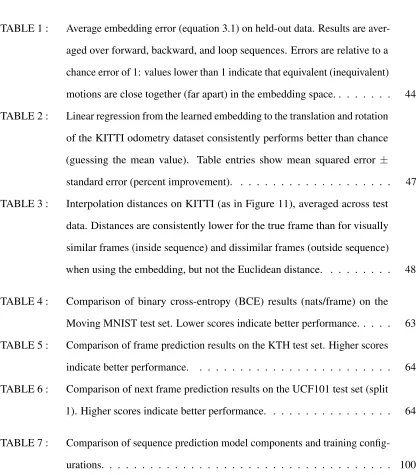
TABLE 1 : Average embedding error (equation 3.1) on held-out data. Results are
aver-aged over forward, backward, and loop sequences. Errors are relative to a
chance error of 1: values lower than 1 indicate that equivalent (inequivalent)
motions are close together (far apart) in the embedding space. . . 44
TABLE 2 : Linear regression from the learned embedding to the translation and rotation
of the KITTI odometry dataset consistently performs better than chance
(guessing the mean value). Table entries show mean squared error ±
standard error (percent improvement). . . 47
TABLE 3 : Interpolation distances on KITTI (as in Figure 11), averaged across test
data. Distances are consistently lower for the true frame than for visually
similar frames (inside sequence) and dissimilar frames (outside sequence)
when using the embedding, but not the Euclidean distance. . . 48
TABLE 4 : Comparison of binary cross-entropy (BCE) results (nats/frame) on the
Moving MNIST test set. Lower scores indicate better performance. . . 63
TABLE 5 : Comparison of frame prediction results on the KTH test set. Higher scores
indicate better performance. . . 64
TABLE 6 : Comparison of next frame prediction results on the UCF101 test set (split
1). Higher scores indicate better performance. . . 64
TABLE 7 : Comparison of sequence prediction model components and training
List of Figures
FIGURE 1 : Schematic depiction of the ERL method for egomotion estimation from
noisy flow fields. Figure best viewed in color. (A) Example optical flow
field from two frames of KITTI odometry (sequence 5, images 2358-2359).
Note the outliers on the grass in the lower right part of the image and
scattered throughout the flow field. (B) We evaluate the flow field under
Mmodels with translation parameters sampled uniformly over the unit
hemisphere. The residuals for the flow field under three counterfactual
models are shown. Each black point indicates the translation direction
used. Residuals are scaled to [0,1] for visualization. (C) We estimate the
likelihood of each observed residual under each of the models by fitting a
Laplacian distribution to each set of residuals. The final confidence weight
for each flow vector is estimated as the expected value of the residual
likelihood over the set of counterfactual models. Likelihood distributions
are shown for the three models above. (D) The weighted flow field is
used to make a final estimate of the true egomotion parameters. The black
point indicates the translation direction estimated using ERL and the green
point indicates ground truth. The unweighted estimate of translation is
not visible as it is outside of the image bounds. . . 17
FIGURE 2 : A 2D line-fitting problem demonstrating how ERL weights inliers and
outliers. Inliers are generated asyi≈2xi+1 with Gaussian noise. Each
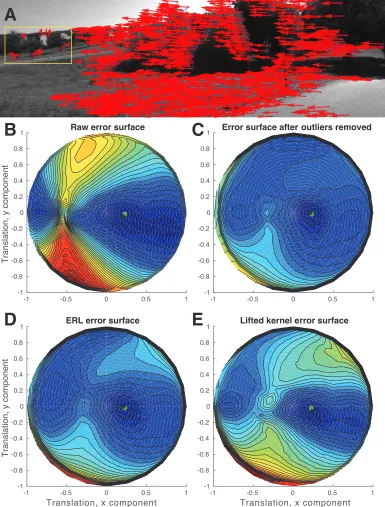
FIGURE 3 : Robust methods recover the error surface of the outlier-free flow field.
(A) Example optical flow field from two frames of KITTI odometry
(sequence 10, images 14-15). Note the prominent outliers indicated by
the yellow box. Error surfaces on this flow field for (A) the raw method
(equation (2.9)) with all flow vectors, (B) with outliers removed by hand,
and (C) with confidence weights estimated by ERL or (D) the lifted
kernel. The green point is the true translational velocity and the black
point the method’s estimate. Blue: low error. Red: high error. Translation
components are given in calibrated coordinates. . . 28
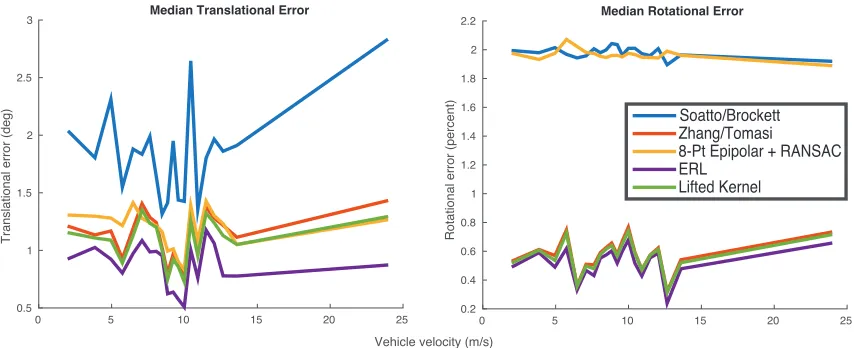
FIGURE 4 : Median translational and rotational errors on the full KITTI odometry
dataset for our methods and baselines. . . 30
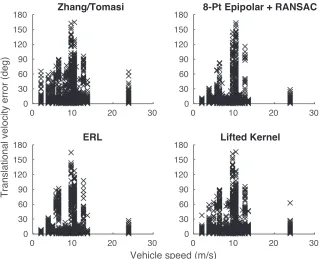
FIGURE 5 : Full distribution of translational velocity errors. . . 33
FIGURE 6 : Full distribution of rotational velocity errors. . . 33
FIGURE 7 : Translation error as a function of percent outliers on synthetic data for our
robust methods and two baseline continuous egomotion methods. . . 35
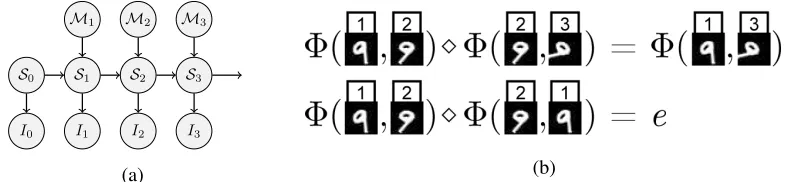
FIGURE 8 : (a)A graphical model describing the relationship between the latent scene
structure{St}, motion{Mt}, and the observed images of a sequence. We
describe a method for learning a representationMof the motion space
Mfrom observed image sequences{It}.(b)By recomposing sequences
of images to satisfy the group properties of associativity and invertibility,
we construct pairs of image sequences with equivalent motion. We use
these properties to learn an approximate group homomorphismΦ∈ M
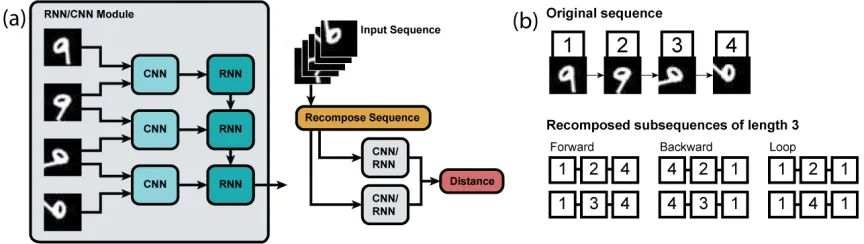
FIGURE 9 : (a)Network structure. The RNN output at the final step of the sequence
is treated as the sequence embedding. During training, the distance
be-tween sequence embeddings is adjusted using an embedding loss.(b)We
recompose sequences to enforce associativity and invertibility. Sequences
with equivalent motion (e.g. 1-2-4 and 1-3-4) serve as positive examples,
while sequences with inequivalent motions (e.g. 1-2-4 and 4-3-1) serve as
negative examples. . . 41
FIGURE 10 : (a)An example test sequence from MNIST and the corresponding saliency
maps. Saliencies show the gradient backpropagated from the final RNN
timestep. Each column represents an image pair passed to one of the
CNNs.(b)-(d)tSNE of the network embedding on the test set, with points
labeled by(b)the magnitude of translation in pixels,(c)the translation
direction in degrees, and(d)the digit label (0-9). The representation
clusters sequences by both translation magnitude and direction but not
FIGURE 11 : (a)Natural image motion is a subspace of the space of all image
trans-formations, and a particular motion can be viewed as a path in the latent
space of natural images. Although [I1,IK,IT] has a total transformation
equivalent to [I1,IT] for any value ofK, only [I1,Im,IT] can be produced
by natural image motion.(b)In interpolation experiments, we compare
the distance between the embedding of [I1, IT] with the embedding of
this sequence after inserting either a true middle frame (Im) or another
frame (IINorIOUT).(c)Images with lowest relative error taken from the
sequence or from the whole dataset, for each distance measure. Errors
are relative to that of the true middle frame in the corresponding measure:
high relative errors ( 1) indicate the distance distinguishes realistic
motion from unrealistic motion. Images other than true middle frame
produce dramatically higher errors when using the embedding but not
when using a Euclidean distance. . . 49
FIGURE 12 : Saliency results on a test sequence from KITTI tracking with both camera
and independent motion. The network focuses on areas that are relevant to
determining motion in 3D, not simply regions with large temporal image
FIGURE 13 : (A) This work is motivated by the observation that image transformations
may be more easily modeled by a network that learns to transform latent
states rather than transform or associate pixel intensities. By learning to
model states,s, along with transformations between states,g, the RNN is
encouraged to model sequences not by memorizing arbitrary transitions
between certain images (static embedding) but by reshaping the
embed-ding so that natural state transformations are predictable (transformational
embedding). Figure best viewed in color. (B) Sample predictions of our
model on sequences from the Moving MNIST and KTH datasets. We show
only the last of 10 input images for visualization purposes. Our model
produces good image predictions using only pixel-wise reconstruction
losses. . . 53
FIGURE 14 : Architecture overview. (A) Our model uses an encoder-decoder
sequence-to-sequence architecture with a factorized latent that captures the image
state,s, and transformation,d. Residual connections are omitted for
clar-ity; see the text and Figure 15 for details. (B) Future states are transformed
from past states using an RNN core that accumulates the transformation
estimategwith a ConvLSTM and applies it to the recursively estimated
FIGURE 15 : Weighted residual connections. (A) To produce high quality images at
multiple time steps in the future without re-encoding images, we use a
residual connection scheme designed to gradually alter image content
from the last observed input image. Residual connections connect the
encoder at timeT (last input) to the decoder at timeT+1 (first output).
At subsequent times, the decoder inherits information about the past from
the decoder at the previous time only. The network has this connectivity
pattern at every layer: we show only two decoder layers and the output
image for easier visualization. (B) We use a retinotopic weighting scheme
to allow each layer of a decoding network to selectively incorporate
skipped input from the past. Weights and feature maps at timet are
functions of the predicted latent state ˆst at timet. . . 60
FIGURE 16 : Example sequences on Moving MNIST. For all three examples, the first
row shows the input sequence (past), the second row shows the ground
truth future, and the third row shows the predicted sequence. Our model
is able to stably predict digits over multiple timesteps, even when digits
overlap for multiple frames. . . 61
FIGURE 17 : Example sequences on KTH. For all three examples, the first row shows
the input sequence (past), the second row shows the ground truth future,
and the third row shows the predicted sequence. The model produces
faith-ful motion in a variety of settings and is able to paint in the background
after dis-occlusion. . . 65
FIGURE 18 : Example sequences on UCF101. For each example, we show two frames
from the past followed by the ground truth third frame and the third frame
FIGURE 19 : Example failure cases on KTH. (a) The model outputs a blurry motion
sequence that does not correspond to the ground truth. (b) The model fails
to correctly predict motion or paint in the background when the moving
object occupies only a small part of the image. (c) The model fails to
correctly paint in the background after the foreground moves, leading to
ghosting artifacts. . . 69
FIGURE 20 : Log likelihoods of Laplacian and Gaussian fits to the optical flow error.
Laplacian fits are consistently better than Gaussian fits. . . 80
FIGURE 21 : Median translational and rotational errors on the full KITTI odometry
dataset for ERL with two candidate distributions. . . 81
FIGURE 22 : Error on egomotion regression from self-supervised flow PCA as a
func-tion of the number of principal components included. Horizontal lines
reflect our method (latent, shown in red) and a chance baseline (show in
green). . . 91
FIGURE 23 : Cumulative percent variance explained of the optical flow in KITTI
odom-etry as a function of the number of principal components included. 67%
of the variance is explained by the first 5 components; 90% of the variance
is explained by the first 40 principal components. . . 92
FIGURE 24 : Representative principal components of optical flow on the KITTI
odom-etry dataset. The first few components capture the dominant motions
(forward and left/right turning) and reflect the stereotypical depth
FIGURE 25 : Comparison of Moving MNIST results on architectures with and without
residual connections. The model labeled “no residuals” has no skip or
residual connections of any kind. The model labeled “w/ residuals” is the
full model described in the paper. The model without weighted residual
connections produces good predictions, but including these connections
produces crisper results, especially at early prediction time steps. Both
architectures reliably capture digit identity, even after the digits overlap. 100
FIGURE 26 : Comparison of KTH results on models with architectural ablations. (i)
“No transformational state”: the RNN core omits the CNNΦand includes
only ConvLSTM components. (ii) “Residuals skipped from last input
image”: each decoder directly receives residual input from the encoder at
the last input time step (t=T) instead of the previous decoder time step.
Weighted residuals are still used. (iii) “No residuals”: no residual or skip
connections of any kind are used. The second sequence shown here is
very challenging for all models. The full model produces better motion
(notice the motion of the legs) and less prominent ghosting artifacts than
ablations. . . 101
FIGURE 27 : Additional comparisons of KTH results on models with architectural
CHAPTER 1 : Introduction
1.1. Overview
The visual world is complex and ever changing, and its complexity extends from local structures to
more extended patterns in space and time. For an intelligent agent to effectively engage the world, it
must learn to reason about how the state of the world is changing, and how local states and changes
reflect the larger patterns and structures of the world.
Visual motion is at the core of these issues, and in this dissertation we develop methods towards the
goal of understanding motion. For an agent to make best use of of motion, it is important that its
representations do not merely reflect the low-level statistics of the world: they should reflect the full
set of properties observable by an agent. Accordingly, I focus on the problem of understanding global
motion. By global motion, I mean the motion of the full image and ultimately the scene, not just
of individual pixels. Understanding motion in this sense will facilitate the development of methods
enabling intelligent agents to use the changes observed in the world to understand it and to act in it.
The body of this dissertation is composed of three works, which develop methods for motion analysis
and motion-based prediction. Before presenting the technical contributions of this dissertation, I
survey the state of motion analysis by reviewing the computational problem of motion analysis, local
approaches to motion and their relationship to global methods, and challenges to the current state of
motion research motivated by the computational goals of prediction and spatiotemporally invariant
representation. In chapters 2, 3, and 4, I present work developed with collaborators that addresses the
limitations of our understanding of the computation and use of motion described above. I conclude
the dissertation by describing promising future avenues of research suggested by the work presented
here.
In this chapter, I describe the broader context of motion analysis in computer vision, neuroscience,
and artificial intelligence and situate the presented work in this context. In particular, I describe (i)
(DNNs) can be used to learn more flexible global representations by allowing learning in more
general motion frameworks and by tying representation learning to tasks, and (iii) how motion and
visual prediction can be used to develop spatiotemporally invariant representations.
1.2. Visual motion analysis: local, global, and beyond
By visual motion, I mean changes over time of the intensity of light in an image (formed by a camera
or a camera-like retina) due to changes in the state of the world. In the settings discussed here, I
will limit the discussion to image sequences produced by contiguous motion: that is, by the motion
induced as the world changes in time around an observer, which may itself moves through the world
smoothly1. These changes may be due to the motion of the camera, to the motion of objects in the
scene, or some combination thereof.
One goal of visual motion analysis is to determine what source of motion in the world led to motion
in the image and to characterize the patterns in this motion. This view leads naturally to local analyses
of motion, which address the proximal cause of motion by estimating the motion of pixels between
pairs of frames. In some settings, such as egomotion estimation, local motion can be used to estimate
motion at the level of the full image. Egomotion estimation uses the optical flow field to estimate
camera rotation and translation (up to a scale). These and other methods can be used to estimate
what motion is due to the camera and what to other objects, to track objects in time, and to reason
about the position of the observer in a static map of its environment.
Fundamentally, these methods are concerned with making correspondences between the world at
subsequent time steps. The goal of making correspondences is just one part of a broader
computa-tional challenge in motion: using motion to understand and make inferences about the structure of
the world not just as it is, but as it changes in time, and how to use these inferences to act in the
dynamic world in a dynamic manner. In this dissertation, I will describe tools and methods directed
at solving this problem.
1I thus avoid any discussion of changes in image sequences produced by cuts, saccades, or other discontinuities.
In the next sections, I summarize the state of motion analysis and the current challenges, working
from low-level to high-level. First, I describe local motion estimation and how it can be used to extract
certain global representations of image motion. The relationship between local and global estimation
is further developed in Chapter 2, where I describe a method for robust estimation of egomotion
from optical flow. Second, I describe the limitations of global motion, and how these limitations can
be used to motivate a view of representations more directly tied to the goals of general perception.
One approach to learning such a representation is developed in Chapter 3, where I describe a method
for unsupervised learning of motion representations. Third, I describe a computational view of
motion representations in terms of the efficient development of spatiotemporal invariants. I use
this to motivate a discussion of the relationship between motion and prediction. Fourth, I describe
how prediction can be used as a task to learn representations of motion and efficiently capture
spatiotemporal invariants of the scene. This material is further developed in Chapter 4, where I
describe how motion can be used in a model for visual prediction to produce naturalistic image
predictions.
1.2.1. From local to global motion
It is informative to first examine how local motion is typically computed, and how this local motion is
brought into relationship with the global motion of an image. Classical approaches to motion typically
analyze motion in terms of spatiotemporally local changes. Perhaps the prototypical example of this
form of analysis is optical flow (Gibson 1950; Horn and Schunck 1981). Optical flow attempts to
find correspondences between pixels inIt, the image at timet, and pixels inIt+1. Many methods
have been proposed to solve this (e.g. Lucas and Kanade 1981; Black and Anandan 1993; Farneb¨ack
2003; Sun et al. 2010; Brox and Malik 2011; Revaud et al. 2015), and indeed recent years have seen
a number of advances in this area (e.g. Fischer et al. 2015; Sevilla-Lara et al. 2016; Ranjan and Black
2017).
Optical flow and other local representations of motion have been hypothesized to be computed in the
retina and early visual system. In primates, there is strong evidence that representations of visual
continuing to medial temporal (MT) and medial superior temporal (MST) areas, as well as later
areas such as the ventral interparietal area (VIP). The outputs of these areas project to areas involved
in decision making (e.g. the lateral interparietal area (LIP)) and guiding motor control (e.g. the
caudal interparietal area (CIP)), as well as to areas such as those in the superior temporal sulcus
(STS), where they are integrated with projections from ventral areas encoding the static content of the
scene (Singer and Sheinberg 2010). The early stages of this pathway contain populations of neurons
highly sensitive to the direction of motion of visual stimuli (Jones and Palmer 1987; Rust et al. 2005).
Motion sensitive neurons in V1 project preferentially to MT (Movshon and Newsome 1996), where
neurons exhibit sensitivity to local motion invariant to other properties of the stimulus (Dubner and
Zeki 1971). Neurons in later areas are selective for stimuli with more complex dependence on motion,
such as egomotion (Gu et al. 2010), object motion (Mineault et al. 2012), action recognition (Giese
and Poggio 2003), motion-based motor planning (Grefkes and Fink 2005), and decision making
(Newsome et al. 1989; Gold and Shadlen 2000; Shadlen and Newsome 2001). The emerging view
is that the dorsal stream computation progressively computes representations of 3D visual motion
(Sanada and DeAngelis 2014; Sunkara et al. 2016; Sasaki et al. 2017; Chen et al. 2018).
Models of local motion estimation in neural systems are exemplified by two approaches: local energy
filters (Adelson and Bergen 1985) and Reichardt detectors (Hassenstein and Reichardt 1956; van
Santen and Sperling 1985). Local energy filters are designed to detect the presence of energy along a
plane in the spatiotemporal spectral domain, while Reichardt detectors are simple delay-line filters
designed to respond when a simple pattern of light moves from one position to another. These two
models are designed to detect motion at a specific velocity, and both have been used as functional
models for motion sensitive neurons. These two frameworks are equivalent in some settings (Adelson
and Bergen 1985), and I will focus the discussion here on energy filters, which are more widely used
in the literature on primate motion processing2.
Models built using energy filter-like computations can be used to obtain good fits to the steady-state
responses of visual cortex neurons implicated in motion processing (Simoncelli and Heeger 1998;
2In contrast, Reichardt detectors and related models are widely used as models and putative explanations of motion
Rust et al. 2006) when combined with other biologically motivated components, such as divisive
normalization (Carandini and Heeger 2011). Energy filters can be used to build estimates of optic
flow with the introduction of mechanisms designed to overcome the local ambiguity known as the
aperture problem3. This ambiguity arises in 2D motion estimation at small windows because, as the
window of estimation becomes small, the spatial structure becomes effectively 1D and the problem of
estimating 2D motion becomes under-constrained. For more detailed descriptions of this ambiguity
and computational perspectives on how to resolve it, see (Horn 1986 Chapter 12, Pack et al. 2003).
Local motion can be used to estimate global motion by introducing simplifying assumptions about
the nature of the motion being observed. In egomotion (or camera motion), the world is assumed to
be rigid (i.e. its motion is given by a single rotation and translation) and the motion given by the
motion of the camera or observer. An analysis of this situation in terms of its projective geometry
gives a simple relationship between the translation and rotation of the camera, the depth at each
observed point, and the optical flow field (the motion field equation, given in equation (2.1)). Given
optical flow, perhaps in the presence of Gaussian noise, this equation can be solved to estimate the
camera translation and rotation, even without knowledge of the depth structure of the scene (Heeger
and Jepson 1992).
Egomotion estimation is quite fragile in real world situations because it relies on optical flow
estima-tion, which is often unreliable and noisy, and because it assumes the world is rigid, which is often
violated in real-world settings due to the presence of independently moving objects. Nonetheless,
stable and reliable egomotion estimation is essential for current navigation and control algorithms.
We present a method for making camera motion estimation more robust by addressing these two
sources of noise in chapter 24. Subsequent methods have used deep neural networks to arrive at better
estimates of egomotion and related quantities (Costante et al. 2016; Zhou et al. 2017; Fragkiadaki
et al. 2017; Costante and Ciarfuglia 2017).
3The mechanisms for achieving flow-like computation in the brain are not sufficient to obtain reasonable performance
on state-of-the-art optical flow benchmarks (Solari et al. 2014; Chessa et al. 2015). This gap in performance is wide enough to suggest that computing optical flow, without qualification, is not an adequate description of the computational role of these areas in the brain.
4We also discuss the related problems of structure from motion (SfM) (Tomasi and Kanade 1992) and simultaneous
Several neural populations have responses that have been described or modeled as coding for
egomotion or object motion5. Because of the well-known geometrical and computational relationship
between egomotion and flow, several groups have proposed models of a dorsal area one synapse
downstream from MT in terms of egomotion or object motion computation (Perrone and Stone 1994;
Grossberg et al. 1999; Hamed et al. 2003; Browning 2012; Mineault et al. 2012). This area, MST,
contains some cells that are driven preferentially by local optical flow patterns of rotation, translation,
divergence, convergence, and other deformations (Tanaka et al. 1986; Graziano et al. 1994; Duffy
and Wurtz 1995), which resemble patterns predicted by models of egomotion estimation from flow
(Heeger and Jepson 1992; Perrone and Stone 1998; Zemel and Sejnowski 1998). MST neurons
project to areas with putative roles in grasp formation (Zhang and Sejnowski 1999), eye movement
(Pack et al. 2001; Takemura et al. 2007), and action recognition (Giese and Poggio 2003; Singer and
Sheinberg 2010).
We can thus see that the standard view of rigid local-to-global motion analysis in computer vision
(from pixels to flow to camera and object motion) has an analogue in the functional properties of
early visual cortical processing (from V1 to MT to MST)6. Models that test this relationship typically
do so by recording the activity of the neurons in question while presenting stimuli with known optical
flow or egomotion. This analysis is only possible because it is possible to regress the responses of
neurons in these areas to known quantities (optical flow, camera motion, and object motion) that are
known and can be easily manipulated. .
This strategy is not generally feasible for motion stimuli more complex than simple camera or
object motion. Visual motion-based methods for solving action recognition, visual prediction, and
other higher-level perceptual and control problems are not typically phrased in terms of known,
analytical relationships between motion representations. Instead, they typically involve optimization
and learning. This makes it difficult to directly compare the methods used by a high performing
5From an algorithmic point of view, purely visual egomotion and object-motion estimation are identical problems if the
motion of the scene is rigid (i.e. given in terms of a rotation and translation), up to a change in coordinates.
6A similar story emerges in dorsal areas of the cat visual system (areas 17 and 18 and the lateral suprasylvian (LS)
artificial system with functionally homologous areas in the brain. The problem is exacerbated by the
high dimensionality associated with the complex spatiotemporal patterns arising in contexts beyond
simple 2D motion. The curse of dimensionality for large, temporally extended motions makes it
infeasible to design parameterized stimuli and experimental protocol to adequately probe the stimulus
space, and hence very difficult to plausibly establish that specific computations are instantiated in a
given neuron or area7. In the next section, I turn to the question of designing representations that
can form the basis for better models of motion analysis and perhaps allow for better understanding of
the full computation of the dorsal stream.
1.2.2. Motion, representation, and spatiotemporal invariances
As we have seen, egomotion and related methods make restrictive assumptions about the world:
typically, that it is rigid or that it contains only object of a known class (as in nonrigid structure from
motion (Bregler et al. 2000)). Because of this, these methods are limited in their applicability to
more general motion analysis, and they cannot be easily made more general, as the methods are
designed to exploit these simplifying assumptions. The strategy at the core of these methods is to
(i) estimate a known metric quantity (such as optical flow), (ii) analyze how it is related to another
metric quantity, such as camera motion, and (iii) estimate the second quantity using estimates of the
first. If this strategy could be extended to compute more complex metric quantities (e.g. to the set of
motions characterizing human locomotion), would it be adequate?
This strategy is adequate if we are content to view the computational modules of a motion analysis
system as black boxes, each of whose input-output mapping is configured separately, and whose
internal computations are inaccessible to other modules. A setup like this is common in systems
for simultaneous localization and mapping (SLAM), for example, where optical flow is computed
using one algorithm, used to estimate camera pose with another algorithm, and then integrated into a
global map using a pipeline relying on these poses (Scaramuzza and Fraundorfer 2011). A black-box
systems view is unsatisfactory from our point of view for several reasons: (i) the neural areas
7The “hypermotion” stimuli used in Mineault et al. 2012 to characterize neural responses in area MST are close to the
instantiating these computations are highly interconnected and exhibit feedback relationships that are
likely to be functionally important (Lamme et al. 1998); (ii) the computational models instantiated
by these black boxes can be improved by incorporating interaction between modules (Hariharan et al.
2015; Newell et al. 2016; Huang et al. 2017; Fragkiadaki et al. 2017); (iii) end-to-end learning (e.g. by
backpropagation) relies on the ability of later results to drive changes in the computational processes
used to produce earlier, intermediate results (Rumelhart et al. 1986). All three of these properties are
exploited in the methods developed in this dissertation, and they are not easily accommodated by the
feed-forward black box view.
Ultimately, the computational goal of motion analysis should be situated in terms of the ethological
demands of behavior and the representations used to guide it, rather than on the computation of
intermediate representations (Churchland et al. 1994). How do the perceptual components of motion
processing, which have so far been the focus of our discussion, relate to this broader picture?
To address this question, It is useful to make a distinction between representations of motion that
are explicit and those that are latent. The kinds of representations discussed so far are explicit
representations: they are the result of motion analysis framed in terms of estimates of predefined
quantities, such as optical flow or egomotion, which often correspond to known metric properties of
the world (the 2D translation of pixels and the 3D translation and rotation of the camera, in the case
of flow and egomotion, respectively). When using explicit representations, any subsequent use of the
motion analysis that has been performed is solely by means of the explicit representation itself: i.e.,
the computation used to produce the representation is typically inaccessible to later stages.
In contrast, latent representations of motion are computed as an intermediate step of a model whose
final computation has a more general perceptual or task-related target. While implicit representations
may correlate with metric targets, this relationship is not typically engineered specifically. This
representational strategy is currently exemplified by deep neural network (DNN) models. DNNs
are machine learning systems built by composing differentiable modules (layers) and trained to
approximate a desired functional mapping (LeCun et al. 2015; Goodfellow et al. 2016). DNNs are
to a target domain by applying a series of elementary differentiable operations (typically additions,
multiplications, spatial pooling, and nonlinearities). DNNs are typically trained by comparing this
output to a target using a differentiable loss function (such as the cross-entropy loss for classification
or the mean-squared error loss for regression) and then minimizing the resulting loss by stochastic
gradient descent (SGD) using the backpropagation algorithm (Rumelhart et al. 1986). In so doing,
the parameters of the neural network are changed so that full system is able to perform the target
task. This results in the development of latent representations in the internal layers of the network.
The output of intermediate layers for DNNs trained in this way on image processing tasks can show
selectivity for useful intermediate features (Zeiler and Fergus 2014; Zhou et al. 2015; Olah et al.
2018), and the resulting latent representations have proved to be useful for transfer to other tasks
and representations (e.g. Long et al. 2015) and as functional explanations of the activity of brain
areas (Yamins and DiCarlo 2016). A DNN trained to perform a task that relies on the perception of
dynamic content, such as action recognition, can learn to represent features similar to those seen in
explicit represntation models without being told about quantities such as optical flow (Karpathy et al.
2014; Varol et al. 2018).
While explicit representations are very useful because they can be analytically manipulated and
understood intuitively in terms of correspondences between pixels and objects between time steps8,
they are fundamentally limited. Rather than extending existing explicit representations, I focus here
on developing better latent representations of motion that do not explicitly target metric flow or
egomotion. In particular, I focus on representations structured so as to learn to use motion in service
of a more general representation with more task relevance. Latent representations developed this way
offer the potential to address the problems with explicit, black-box reasoning as presented above.
These representations can be learned directly in terms of a final task and they can be learned jointly
and interactively with other representations.
8Fortunately, latent representations can be related to more intuitive explicit representations in some settings. Several
In Chapter 3, we show how one latent representation of motion can be learned in an unsupervised
manner by formulating global motion representation in terms of the group properties of motion.
Other groups have proposed methods to learn motion by using the constraints associated with more
local forms of motion, such as optical flow, to induce a loss for DNN training (Yu et al. 2016). While
these approaches have furthered our understanding of how motion can be structured and learned to
work in real world settings, the question of how to structure these representations to capture not only
motion, but how it relates to dynamic structure, remains challenging. We turn to this question in the
next section.
1.2.3. Designing and learning dynamic representations
To understand what form dynamic representations should take, it is useful to contrast them to static
representations, which are more studied and better understood. One useful way to do this is by
comparing the dorsal pathway (V1→ MT → MST and beyond) to a canonical computational
pathway in the ventral stream of the primate brain (V1→V2→V4→IT). While the dorsal stream
is typically characterized as computing properties of visual motion or dynamics, the ventral stream is
typically characterized in terms of its role in computing properties of static features of the visual
world, such as shape, form, and object identity (Goodale and Milner 1992).
Areas of the ventral stream after V1 are selective for spatial patterns building in complexity from
textures (Freeman et al. 2013) to shapes and objects (Kobatake and Tanaka 1994) and faces (Tsao
et al. 2006). That is, the level of abstraction of the representation increases at later stages in the
pathway, and the representations move away from pixels and towards behaviorally relevant objects.
Recently, several groups have presented compelling evidence that the responses of neurons in this
pathway are well modeled by the internal representations in DNNs trained on object recognition
(Yamins and DiCarlo 2016).
The ventral stream and models of object recognition in computer vision can be described in terms of
the progressive construction of task-related invariant representations (DiCarlo et al. 2012; Anselmi
et al. 2016). Aninvariantrepresentation of some input datumxis a function of that datum,Θ(x), that
does not change if an irrelevant transformation (sayt∈T, whereT is the set of irrelevant, or nuisance,
transformations) is applied to the datum: Θ(x) =Θ(tx). For example, an invariant representation
of a particular individual would be the same if that person were facing left or facing right, as this
transformation does not change the person’s identity. Invariant representations are ubiquitous in
computer vision (e.g. Lowe 2004; Laptev 2005): if such a representation can be discovered, it offers
a way to relate images to tasks in a manner that is robust to irrelevant changes in the scene.
A story similar to ventral one can be told about the emergence of invariant representations of dynamic
features in progressively more abstract dorsal computations (Giese and Poggio 2003; Jhuang et al.
2007). As in Giese and Poggio 2003, the computational goal of higher-order motion processing is
often framed in terms of biological motion or action recognition. It is useful to think of these tasks as
exemplars of the larger computational problem of representing the dynamic structure in a scene by
observing how it can move.
In section 110 of his “An Essay Towards A New Theory of Vision,” George Berkeley describes a
similar view of the usefulness of motion for building representations. Here, he contemplates the
problem of how a person, born blind and seeing another’s body for the first time, would recognize
that the parts of the body should be represented as belonging to the same object:
He would not, for Example, make into one complex Idea, and thereby esteem an Unite
all those particular Ideas, which constitute the visible Head or Foot. For there can be no
Reason assigned why he should do so, barely upon his seeing a Man stand upright before
him: There croud into his Mind the Ideas which compose the visible Man, in company
with all the other Ideas of Sight perceiv’d at the same time: But all these Ideas offered at
once to his View, he would not distribute into sundry distinct Combinations, till such
time as by observing the Motion of the Parts of the Man and other Experiences, he
comes to know, which are to be separated, and which to be collected together (Berkeley
Berkeley argues that the relationship between the motions of the parts is what enables efficient
learning of the structure of the body. Motion can play a similar role in guiding representation learning
(Agrawal et al. 2015; Pathak et al. 2017). By learning the motion of objects, we can learn to predict
what will happen as they change in time. We can also distinguish these from other, irrelevant changes,
such as changes in image properties or geometry that do not occur in contiguous time. In the next
section, I will discuss how motion and prediction can be used for learning.
1.2.4. Motion and prediction
The problem of building invariant visual representations is the problem of associating visual images
that contain the same content (Rust and Stocker 2010). One way to learn these sorts of representations
is by exploiting the fact that, over time, the content of the image changes slowly, and accordingly
representations should also change slowly. This is the basic strategy employed by slow feature
analysis (SFA) (Wiskott and Sejnowski 2002), and indeed this method has shown success in the
context of learning representations using DNNs in recent years (Wang and Gupta 2015). However, at
their core, SFA and similar methods posit only that features change slowly. Because of this, they
generally are not flexible enough to accommodate multiple spatial and temporal scales of change,
which are typically important for accounting for all of the change in a scene9.
Visual prediction offers a more general and flexible way to learn representations by learning to
associate visual images. In visual prediction, we want to learn a function f :RN×T→RN×Kmapping
a past image sequence{I1, ...,IT}to a future image sequence{IT+1, ...,IT+K}, where each image
hasNpixels. Such a function, if it can be trained on a dataset, can be said to associate images on
that dataset, as it matches past images to future images. For this strategy to be fully general, it must
also generalize between images of different objects, to reflect the fact that for example, different
dogs under the same setting will tend to move in comparable ways. Fortunately, convolutional neural
network (CNN) representations of images have shown very good generalization properties when
trained on natural images with SGD and other standard techniques (Krizhevsky et al. 2012; Hinton
9For example, see Anandan 1989 for a discussion of how accounting for differences of spatiotemporal scale can
et al. 2012; Yosinski et al. 2014). If we parameterize f with a CNN-based network, we can learn a
function by SGD that can predict and generalize between images of different object instances. See
Chapter 4 for a more in-depth discussion of the problem of visual prediction and a description of
current approaches.
Visual prediction gives us a tool for learning representations that associate images of the same content.
To learn such a representation efficiently, changes in state from time to time should be as simple as
possible. Visual motion offers a way to gain this efficiency: instead of re-describing the world at each
time step, we need only describe the relevant changes10. Several works have shown that using local
motion can lead to reasonable predictions (Brabandere et al. 2016; P˘atr˘aucean et al. 2016; Vondrick
and Torralba 2017), but these methods struggle in the same situations where local representations of
motion typically struggle: when objects become occluded or dis-occluded and when motion is poorly
described in terms of local translation. These situations occur frequently when making predictions
over several time steps, so a more global representation is better suited to such situations. In chapter
4, we show that building a future by incorporating a more abstract, global model of motion, that acts
on latent representations instead of pixels, can lead to good predictions.
1.3. Summary of contents
In this section, I have described the challenges facing motion representation. I have described how
the work in this dissertation addresses the problems of (i) robustly estimating egomotion, (ii) learning
to represent global motion in an unsupervised manner, and (iii) learning a representation of motion
to predict future frames. I now turn to describing the technical contributions of this dissertation in
detail.
The contents of the rest of the dissertation are as follows:
• In chapter 2, I present methods for reasoning about camera motion using noisy estimates of
optical flow. We propose the expected residual likelihood (ERL) method, which robustifies
egomotion inference using likelihood distributions of local motion residuals under
tual parameters of the motion field equation. We show ERL outperforms baselines, including a
novel alternative method using a lifted kernel, while introducing minimal runtime overhead.
We demonstrate that by incorporating confidence weights based on the known relationship
between local and global motion, we can achieve more robust estimates of camera motion
from local estimates. This work was previously published as Jaegle et al. 2016.
• In chapter 3, I present a method for learning image motion directly from unlabeled image
sequences using a learning rule designed to enforce the group properties of visual motion. Our
learning rule is designed to impose the axiomatic properties of groups on a latent representation
learned on a dataset, which encourages the latent space to represent the transformation group
in that setting. This learning rule is general in the sense that it makes no assumptions about the
motion of the camera, structure of the world, or the class of motions seen: all are learned in an
unsupervised manner. We show that a model trained with this method learns representations
capturing key properties of motion in 2D and 3D settings using an inductive bias that is less
restrictive than those based on local motion effects, such as optical flow. This work was
previously published as Jaegle et al. 2018a.
• In chapter 4, I present a method for image sequence prediction using a model that learns
to represent current states and transform them to estimate the future. Methods for image
sequence prediction typically predict a sequence of instantaneous future states and then use
these states to reconstruct future frames. We introduce an architecture that learns to represent
the transformation between states in addition to the state, and we generate future frames by
recursively transforming past states using the estimated transformation. This configuration
leads to predicted future sequences with convincing motion, and qualitative and quantitative
results competitive with the state of the art on several datasets. This work was previously
published in preprint form as Jaegle et al. 2018b.
• In chapter 5, I summarize the presented work and suggest promising directions for future
work. I discuss future applications of the work presented here to developing (i) models of
(iii) methods for unsupervised learning of the spatio-temporal structure of visual scenes (its
CHAPTER 2 : Fast, robust, continuous monocular egomotion computation
2.1. Introduction
Visual odometry in real-world situations has attracted increased attention in the past few years in
large part because of its applications in robotics domains such as autonomous driving and unmanned
aerial vehicle (UAV) navigation. Stereo odometry and simultaneous localization and mapping
(SLAM) methods using recently introduced depth sensors have made dramatic progress on real-world
datasets. Significant advances have also been achieved in the case ofmonocularvisual odometry
when combined with inertial information.
State-of-the-art visual odometry uses either the discrete epipolar constraint to validate feature
correspondences and compute inter-frame motion (Scaramuzza and Fraundorfer 2011) or directly
estimates 3D motion and 3D map alignment from image intensities (Forster et al. 2014). In contrast
to the state of the art, in this paper we revisit thecontinuousformulation of structure from motion
(SfM), which computes the translational and rotational velocities and depths up to a scale from
optical flow measurements. Our motivation lies in several observations:
• UAV control schemes often need to estimate the translational velocity, which is frequently
done using a combination of monocular egomotion computations and single-point depths from
sonar (Bristeau et al. 2011).
• Fast UAV maneuvers require an immediate estimate of the direction of translation (the focus
of expansion) in order to compute a time-to-collision map.
• Continuous SfM computations result in better estimates when the incoming frame rate is high
and the baseline is very small.
However, estimating camera motion and scene parameters from a single camera (monocular
egomo-tion estimaegomo-tion) remains a challenging problem. This problem case arises in many contexts where
sensor weight and cost are at a premium, as is the case for lightweight UAVs and consumer cameras.
A
C
D
0. 1 0. 2 0. 3 0. 4 0.5 0. 6 0. 7 0. 8 0. 9 1B
...
...
E{
}
0 0.002 0.004 0.006 0.0080.01 0.012 0.014 0.016 0.018 0 0.1 0.2 0.3 0.4 0.5 0.6 0.7 0.8 0.9 1
Flow residual under motion model 1
Likelihood under Laplacian fit 00 0.002 0.004 0.006 0.008 0.01 0.012 0.014 0.016 0.018 0.1 0.2 0.3 0.4 0.5 0.6 0.7 0.8 0.9 1
Flow residual under motion model 2
Likelihood under Laplacian fit 00 0.002 0.004 0.006 0.008 0.01 0.012 0.014 0.016 0.018 0.1 0.2 0.3 0.4 0.5 0.6 0.7 0.8 0.9 1
Flow residual under motion model M
Likelihood under Laplacian fit
resources are often very limited and estimates must be made in real time under unusual viewing
conditions (e.g. with a vertically flipped camera, no visible ground plane, and a single pass through a
scene). These contexts present many sources of noise. Real-time flow estimation produces unreliable
data, and the associated noise is often pervasive and non-Gaussian, which makes estimation
diffi-cult and explicit outlier rejection problematic. Furthermore, violations of the assumption of scene
rigidity due to independent motion of objects in the scene can lead to valid flow estimates that are
outliers nonetheless. Even in the noise-free case, camera motion estimation is plagued with many
suboptimal interpretations (illusions) caused by the hilly structure of the cost function. Additionally,
forward motion, which is very common in real-world navigation, is known to be particularly hard for
monocular visual odometry (Oliensis 2005).
We propose an algorithm suitable for the robust estimation of camera egomotion and scene depth
from noisy flow in real-world settings with high-frame-rate video, large images, and a large number
of noisy optical flow estimates. Our method runs in real-time on a single CPU and can estimate
camera motion and scene depth in scenes with noisy optical flow with outliers, making it suitable
for integration with filters for real-time navigation and for deployment on light-weight UAVs. The
technical contributions of this paper are:
• A novel robust estimator based on the expected residual likelihood (ERL) of flow data that
effectively attenuates the influence of outlier flow measurements and runs at 30-40 Hz on a
single CPU.
• A novel robust optimization strategy using a lifted kernel that modifies the shape of the
objective function to enable joint estimation of weights and model parameters, while enabling
2.2. Related work
2.2.1. Egomotion/visual odometry
Many approaches to the problem of visual odometry have been proposed. A distinction is commonly
made between feature-based methods, which use a sparse set of matching feature points to compute
camera motion, and direct methods, which estimate camera motion directly from intensity gradients
in the image sequence. Feature-based approaches can again be roughly divided into two types
of methods: those estimating camera motion from point correspondences between two frames
(discreteapproaches) and those estimating camera motion and scene structure from the optical flow
measurements induced by the motion between the two frames (continuousapproaches). In practice,
point correspondences and optical flow measurements are often obtained using similar descriptor
matching strategies. Nonetheless, the discrete and continuous approaches use different problem
formulations, which reflect differing assumptions about the size of the baseline between the two
camera positions.
The continuous approach is the appropriate choice in situations where the real-world camera motion
is slow relative to the sampling frequency of the camera. Our approach is primarily intended for
situations in which this is the case, e.g. UAVs equipped with high-frame-rate cameras. Accordingly,
we focus our review on continuous, monocular methods. For a more comprehensive discussion, see
Ma et al. 2004.
2.2.2. Continuous, monocular approaches
In the absence of noise, image velocities at 5 or 8 points can be used to give a finite number of
candidate solutions for camera motion (Longuet-Higgins and Prazdny 1980, Hartley and Zisserman
2003, Nist´er 2004). With more velocities, there is a unique optimal solution under typical scene
conditions (Horn 1988). Many methods have been proposed to recover this solution, either by motion
parallax (Longuet-Higgins and Prazdny 1980; Hildreth 1992; Heeger and Jepson 1992; Jepson and
Heeger 1990) or by using the so-called continuous epipolar constraint (Ma et al. 2004). The problem
and speed up estimation (Jepson and Heeger 1991; Zhuang et al. 1988; Kanatani 1993).
Although the problem has a unique optimum, it is characterized by many local minima, which pose
difficulties for linear methods (Chiuso et al. 2000). Furthermore, in the presence of noise, many
methods are biased and inconsistent in the sense that they do not produce correct estimates in the limit
of an unlimited number of image velocity measurements (Zhang and Tomasi 2002). Many methods
also fail under many common viewing conditions or with a limited field of view (Daniilidis and Nagel
1990). Recently, Fredriksson et al. 2014 and Fredriksson et al. 2015 proposed branch-and-bound
methods that estimate translational velocity in real time and effectively handle a large numbers of
outliers. However, these methods deal with the case of pure translational camera motion, while our
approach estimates both translational and rotational motion.
Most directly related to our work is the robust estimation framework presented in Zhang and Tomasi
1999. They propose a method based on a variant of a common algebraic manipulation and show that
this manipulation leads to an unbiased, consistent estimator. They pose monocular egomotion as a
nonlinear least-squares problem in terms of the translational velocity. In this framework, angular
velocity and inverse scene depths are also easily recovered after translational velocity is estimated.
To add robustness, they use a loss function with sub-quadratic growth, which they solve by iteratively
reweighted least squares (IRLS). We use a similar formulation but demonstrate several novel methods
for estimating the parameters of a robust loss formulation. Our methods have properties that are
well-suited for dealing with image sequences containing several thousand flow vectors in real time.
In particular, we demonstrate that the ERL method adds robustness without requiring costly iterative
reweighting, resulting in very little runtime overhead.
Other methods for monocular odometry augment velocity data with planar homography estimates
(Geiger et al. 2011; Song et al. 2013) or depth filters (Forster et al. 2014) to estimate scale. In this
work, we do not rely on ground-plane estimation in order to maintain applicability to cases such
as UAV navigation, where image sequences do not always contain the ground plane. Because we
focus on frame-by-frame motion estimation, we cannot rely on a filtering approach to estimate depth.
Algorithm 1ERL confidence weight estimation
Input: Measured flow{un}N
n=1, sampled translational velocities{tm}Mm=1 Output: Estimated confidence weights{wˆn}N
n=1 for allmdo
Compute scaled residuals:
˜
ru=|A⊥(tm)>(Bωˆm(tm)−u)|
Compute maximum likelihood estimators of residual distribution:
ˆ
µm=median(r˜u)
ˆ
bm=
1
N N
∑
n=1
kr˜un−µˆmk
end for for allndo
Compute confidence weights as expected likelihood under Laplacian fits:
ˆ
wn=
1
M M
∑
m=1
L(r˜un; ˆµm,bˆm)
end for
return{wˆn}N n=1
SLAM system.
2.2.3. Robust optimization
In this work, we propose to increase the robustness of monocular egomotion estimation (i) by
estimating each flow vector’s confidence weight as its expected residual likelihood (ERL) and
(ii) by using a lifted robust kernel to jointly estimate confidence weights and model parameters.
ERL confidence weights are conceptually similar to the weights recovered in the IRLS method for
optimizing robust kernels (Holland and Welsch 1977). Robust kernel methods attempt to minimize
the residuals of observations generated by the target model process (“inliers”) while limiting the
influence of other observations (“outliers”). Such methods have been used very successfully in many
domains of computer vision (Geman and Reynolds 1992; Black and Rangarajan 1996). However,
we are unaware of any previous work that attempts to estimate confidence weights based on the
distribution of residuals at counterfactual model parameters, as we do in the ERL method.
The lifted kernel approach offers another method to design and optimize robust kernels in particularly
desirable ways. Lifted kernels have recently been used in methods for bundle adjustment in SfM