69 | P a g e
VISIBLE WATERMARKING USING MATLAB
SIMULINK
Shamali Vijay Chavan
1, S. S.Patil
21
ME (Electronics) Student, T .K. I .E.T ,Warnanagar Maharashtra,(India)
2
Prof.Department of Electronics,T .K. I .E.T ,Warnanagar Maharashtra, (India)
ABSTRACT
In the present era, the digital information can be easily obtained by the unauthorized users. To avoid this
security must be provided to such digital information in the form of image. Image watermarking is the best
solution to maintain the security of image. In this paper the MATLAB Simulink based model for visible image
watermarking is implemented in frequency domain using Discrete Wavelet Transform and simulation results are
carried out.
Keywords: DiscreteWavelet transform,MATLAB, Simulink
,
Xilinx System Generator tools,
watermarking.
I. INTRODUCTION
The digital communication technology, like internet technology confronts various troubles related to the privacy
and security of the data. Security techniques are required because of illegal access of data without permission.
Therefore, it is necessary to protect data in the internet technology. For providing the security of digital data
various techniques are used like encryption, decryption, cryptography, steganography and digital watermarking.
The digital watermarking is a process of information hiding. There are various techniques for hiding the
information in the form of digital contents like image, text, audio and video[1]. Digital watermarking is used in
the hiding of secret message or information within an ordinary message and its extraction at its
destination[2].The image watermarking method is embedding some watermark image into the original input
image which can later be extracted or detected for various purposes like authentication,content
protection,content protection and copyright protection.Image watermarking is used for security of the
authenticated image from illegal users.The main purpose of imagewatermarking is to increase the robustness of
image. The types of embedding watermark image in the input image may be visible or invisible. In visible
watermarking, watermark image is visible on the the original image.In invisible watermarking, watermark
image is invisible on the original image ,it can only be extracted at the receiver.The extraction of watermark by
illegal user may degrade the quality of original image substantially.The method used in this paper is visible
watermarking.Medical image watermarking is an appropriate method for enhancing security and authentication
of medical data which is crucial and used for further diagnosis and reference[3]. The 2D original image as well
as the watermarked image is converted matrix into array . The technique proposed to convert the image into
70 | P a g e
embedding of watermark image into original image takes place using Xilinx system generator simulink tools.
The output image is displayed using MATLAB.
II. PROPOSED METHOD
The most applicable and accurate method of visible robust watermarking is proposed in this project . The
fundamental steps followed in the project are :
1. Pre-processing of image
2. Embedding watermark using algorithm
3. Post-processing of image
The pre-processing of image involves the conversion of original 2D gray scale image as well as the watermark
image into an array of data. This array of data is to be converted into frequency domain using Discrete Wavelet
Transform(DWT).The Discrete Wavelet Transform(DWT) technique is preferred because it is more
advantageous compared to the Discrete Cosine Transform(DCT) technique[5].The DWT of a signal x is
calculated by passing it through a series of filters .First the samples are passed through a low pass filter with
impulse response g resulting in a convolution of the two:
………(1)
The signal is also decomposed simultaneously using a high-pass filter h. The outputs giving the detail
coefficients (from the high-pass filter) and approximation coefficients (from the low-pass). It is easy to
implement and reduces the computation time and resources required.
Fig. 1: Wavelet Transform[4].
The Fig 1. shows the decomposition of image in different level using DWT method. The Discrete Wavelet
Transform analyzes the signal at different frequency bands with different resolutions by decomposing the signal
into an approximation and detail information. The decomposition of the signal into different frequency bands
obtained by successive high pass g[n] and low pass h[n] filtering of the time domain signal. The combination of
high pass g[n] and low pass filter h[n] comprise a pair of analyzing filters. The output of each filter contains half
the frequency content, but an equal amount of samples as the input signal. The two outputs together contain the
same frequency content as the input signal; however the amount of data is doubled. Therefore down sampling
by a factor two, denoted by 2, is applied to the outputs of the filters in the analysis bank[2] .As per the proposed
algorithm, after the DWT decomposition of both, watermark image and original image,the DWT of watermark
image is added to the DWT of original image.The obtained output is passed through the Inverse Discrete
Wavelet transform ,to obtain the array form of image. This process completes the watermark embedding in
71 | P a g e
steps are carried out using Xilinx system generator tools.Lastly,the output images are displayed using
MATLAB.
III. SIMULATION AND RESULTS
As mentioned above the processing of images that is the preprocessing, watermark embedding and post
processing are done using xilinx system generator simulink tools.And MATLAB is used just to display the
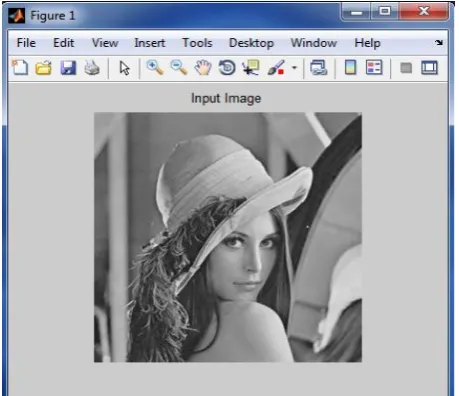
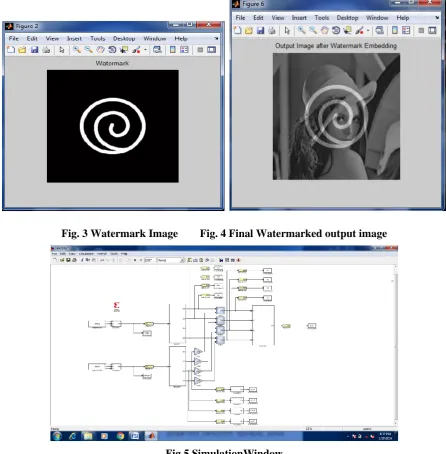
output image. The input image is shown in Fig. 2 and the watermark image to be added is shown in Fig. 3. In
the first step both the images fed as input are converted into array form for further processing.These arrays are
converted into frequency domain using DWT of both the images seperately. The detail explanation of Discrete
Wavelet Transform is given in the above section,this DWT is implemented using Xilinx System generator tools.
This objective lead to the use of Xilinx System Generator tool with a high level graphical interface i.e. Simulink,
based on blocks which makes it very easy to handle with respect to other softwares for the hardware design and
implementation[6]. The output of this step gives decomposition of both the images in the form of
LLIN,HLIN,LHIN and HHIN of input image while,LLWAT,HLWAT,LHWAT and HHWAT of watermark
image.In the next step, the DWT of both the images are added to get the watermarked image DWT.This is then
converted to array of image by using Inverse Discrete Wavelet Transform(IDWT).In the final step, this array
form of image is converted into matrix form. The final watermarked image is displayed using MATLAB
program execution. The various intermediate stages of the model are also displayed using MATLAB. The final
output consists of six images namely, input image, watermark image, DWT decomposition of input image,DWT
decomposition of watermark image, input to the Inverse Discrete Wavelet Transform block and output
watermarked image.
72 | P a g e
Fig. 3 Watermark Image Fig. 4 Final Watermarked output image
Fig.5 SimulationWindow
Fig 5. Shows the simulation window of the proposed model.The Xilinx System Generator tools used for
building the model, whose output at each stage is displayed using MATLAB program. The Fig. 4 shows the
final output image of the project.The visible watermark data added to the input image is the final output image.
IV. CONCLUSION
With the proposed method we can maintain the security of original image by addition of watermark
image,which is visible. In the future scope, we can run this software simulation on the suitable FPGA which will
replace the use of computer and increase the portability of the system. Further we can also try implementing
73 | P a g e
REFERENCES
[1] Preeti Parashar, Rajeev Kumar Singh ,A Survey: Digital Image Watermarking Techniques, International
Journal of Signal Processing and Pattern Recognition Vol. 7, No. 6,pp.114-124,2014.
[2] Mustafa Osman ali, Rameshwar Rao , An Overview of Hardware Implementation for Digital Image
Watermarking, International Conference on Signal, Image Processing and
Applications,Vol.21,Singapore,2011.
[3] Sonika .C.Rathi,Vandana.S.Inamdar , Medical images authentication through watermarking preserving,
Health Informatics - An International Journal (HIIJ) Vol.1, No.1, August 2012.
[4] P Karthigaikumar, Anumol, K Baskaran, FPGA Implementation of High Speed Low Area DWT Based
Invisible Image Watermarking Algorithm, International conference on Communication technology and
System design, Page No. 266 – 273,2012.
[5] SangeetaYadav,Priyanka Anand, DCT Based Digital Video Watermarking Using
MATLAB/Simulink,International Journal of Advanced Research in Computer Engineering &
Technology (IJARCET), ISSN: 2278 – 1323 ,Volume 4, Issue 2, Month-February 2015,Page No.
249-232.
[6] Korrapati Rajitha, Usha Rani.Nelakuditi, Venkata Naresh Mandhala, Tai-hoon Kim ,FPGA
implementation of Watermarking scheme using XSG,International Journal of Security and Its
Applications Vol.9, No.1 , pp.89-96,2015.
[7] Prabhishek Singh, R S Chadha ,A survey of digital watermarking techniques,applications and
attacks,International Journal of Engineering and Innovative Technology (IJEIT) Volume 2, Issue 9,
![Fig. 1: Wavelet Transform[4].](https://thumb-us.123doks.com/thumbv2/123dok_us/9249644.1461542/2.595.170.421.444.537/fig-wavelet-transform.webp)