Big Data: Deep Learning for financial
sentiment analysis
Sahar Sohangir
1*, Dingding Wang
1, Anna Pomeranets
2and Taghi M. Khoshgoftaar
1Introduction
The Internet, as a global system of interconnection, provides a link between billions of devices and people around the world. The rapid development of social networks causes the tremendous growth of users and digital content [1]. It opens opportunities for peo-ple with various skills and knowledge to share their experiences and wisdom with each other. There are many websites like Yelp, Wikipedia, Flickr, etc. that use the power of the Internet to help their users make optimal decisions.
Furthermore, there are websites that give users the ability to consult with profession-als, and one topic that is always popular is investment. Companies like Goldman Sachs
Abstract
Deep Learning and Big Data analytics are two focal points of data science. Deep Learn-ing models have achieved remarkable results in speech recognition and computer vision in recent years. Big Data is important for organizations that need to collect a huge amount of data like a social network and one of the greatest assets to use Deep Learning is analyzing a massive amount of data (Big Data). This advantage makes Deep Learning as a valuable tool for Big Data. Deep Learning can be used to extract incred-ible information that buried in a Big Data. The modern stock market is an example of these social networks. They are a popular place to increase wealth and generate income, but the fundamental problem of when to buy or sell shares, or which stocks to buy has not been solved. It is very common among investors to have professional financial advisors, but what is the best resource to support the decisions these peo-ple make? Investment banks such as Goldman Sachs, Lehman Brothers, and Salomon Brothers dominated the world of financial advice for more than a decade. However, via the popularity of the Internet and financial social networks such as StockTwits and SeekingAlpha, investors around the world have new opportunity to gather and share their experiences. Individual experts can predict the movement of the stock market in financial social networks with the reasonable accuracy, but what is the sentiment of a mass group of these expert authors towards various stocks? In this paper, we seek to determine if Deep Learning models can be adapted to improve the performance of sentiment analysis for StockTwits. We applied several neural network models such as long short-term memory, doc2vec, and convolutional neural networks, to stock market opinions posted in StockTwits. Our results show that Deep Learning model can be used effectively for financial sentiment analysis and a convolutional neural network is the best model to predict sentiment of authors in StockTwits dataset.
Keywords: Deep Learning, Big Data, Sentiment analysis, Information retrieval
Open Access
© The Author(s) 2018. This article is distributed under the terms of the Creative Commons Attribution 4.0 International License (http://creativecommons.org/licenses/by/4.0/), which permits unrestricted use, distribution, and reproduction in any medium, provided you give appropriate credit to the original author(s) and the source, provide a link to the Creative Commons license, and indicate if changes were made.
RESEARCH
and Lehman Brothers have more than 150 years of investment advice. In the Internet age, independent analysts and retail investors around the world can collaborate with each other through the web. Seeking Alpha and StockTwits are two examples of com-mon financial social media platforms focused on the stock market, giving their users a way to connect with information and each other and grow their investments [2].
Financial social media brings people, companies, and organizations together so that they can generate ideas and share information with others. It is this media that provides a huge amount of unstructured data (Big Data) that can be integrated into the decision-making process. Such a Big Data can be considered as a great source of real-time estima-tion because of its high frequency of creaestima-tion and low-cost acquisiestima-tion.
Sentiment analysis (SA) is a common method which is increasingly used to assess the feelings of social media users towards a subject. The most popular approach performing sentiment analysis is using data mining. Our central idea is to adopt Deep Learning to determine investors’ expectations about the price of stocks and the overall market based on their messages. The reason why we select Deep Learning methodology rather than data mining is that in data mining, identifying features and selecting the best of those features is the most challenging task to undertake especially in a Big Data.
In contrast to data mining, a Deep Learning model, learns features during the pro-cess of learning. Deep Learning algorithms lead to abstract representation, as a result, they can be invariant to the local change in the input data. In addition, Big Data prob-lems including semantic indexing, data tagging, and fast information retrieval can be addressed better with the aid of Deep Learning. Deep Learning provides the opportunity to use a simpler model to accomplish complicated Artificial Intelligence tasks. Although Deep Learning algorithms have been used for some Big Data domain like computer vision [3–5, 17, 18, 22] and speech recognition [6–10, 11] it is still intact in the context of Big Data analysis. In this paper, we evaluate the adoption of Deep Learning for sentiment analysis of financial data.
Deep Learning algorithms provide the opportunity to extract complex data at a high level of abstraction in a way that high-level features with more abstraction are defined in terms of lower-level features with less abstraction [12]. A different source of variation in data (like light, object shapes, and object materials in an image) can be separated by using Deep Learning. The idea of hierarchical learning in Deep Learning coming from the primary sensorial areas of the neocortex in the human brain [13].
Convolutional neural network (CNN) [14] is an example of a various number of Deep Learning models. This model which is popularly used for image analysis can make use of the internal structure of data through convolution layers. Because of the inter-nal structure that exists inside the text documents CNN has been gaining attention on text data as well. CNN is used in systems for tagging, entity search, sentence modeling, etc. [15–23].
Deep Learning algorithms which usually learn data representations in a greedy fash-ion, look more useful to learn from Big Data [24, 25]. Deep Learning can be used to extract nonlinear complicated features in Big Data analytics, then extracted features are used as input to a linear model.
Learning to enable searching of audio and video file with speech. Deep Learning ability to extract high-level, complex abstractions from large volumes of unsupervised data (Big Data) make it desirable for Big Data analytics. High-level features can be extracted from unlabeled images by using Deep Learning. For instance, Google provides a deep neu-ral network that can learn high-level features from unlabeled data [27, 28]. Their work clearly shows how Deep Learning methods can extract high-level features from unsu-pervised data and demonstrates the advantages of using Deep Learning with unsuper-vised data (Big Data).
The remainder of this paper is organized as follows: “Related work” section we look at previous work on financial sentiment analysis and the methods employed therein; “Big Data” section contains an overview of Big Data analytics. In this section, we discuss some Big Data characteristics and specify main problems that faced Big Data in data analysis; “Sentiment analysis” section we briefly talk about sentiment analysis methods and advantages of using Deep Learning in sentiment analysis; in “Sentiment analysis with data mining approaches” section we explore other works that use data mining to do sentiment analysis on StockTwits dataset. After that, we discuss some feature selection methods. In “Deep Learning in Big Data analytics” section we explore how Deep ing can be used for Big Data analysis also we discuss some challenges that Deep Learn-ing needs to overcome to do analysis in the Big Data domain; “Results and discussion” section explains our experiments, and goes into depth about how we can apply Deep Learning to financial sentiment analysis. Our primary findings and conclusions are pre-sented in “Conclusions” section.
Related work
Specific Big Data domains including computer vision [29] and speech recognition [30], have seen the advantages of using Deep Learning to improve classification modeling results but, there are a few works on Deep Learning architecture for sentiment analy-sis. In 2006 Alexandrescu et al. [31] present a model where each word is represented as a vector of features. A single embedding matrix is used to look up all of these fea-tures. Luong et al. [32] use a recursive neural network (RNN) to model the morpho-logical structures of words and learn morphomorpho-logically-aware embeddings. In 2013 Lazaridou et al. [33] try to learn meanings of a phrase by using compositional distribu-tional semantic models. In 2013 Chrupala use a simple recurrent network (SRN) to learn continuous vector representations for sequences of characters. They use their model to solve a character level text segmentation and labeling task. A meaningful search space via Deep Learning can be constructed by using Recurrent Neural Network [34] Socher et al. in 2011 [35], use recursive autoencoders [36–39] for predicting sentiment distribu-tion and proposed a semi-supervised approach model. In 2012 Socher et al. [40] propose a model for semantic compositionality with the ability to learn compositional vector rep-resentation for sentences of arbitrary length. Their proposed model is a matrix-vector recursive neural network model. Recursive Neural Tensor Network (RNTN) architec-ture proposed in [41]. RNTN use word vector and a parse tree to represent a phrase and then use a tensor-based composition function to compute vectors for higher nodes [42]
network. In 2011 Collobert used a similar network architecture for syntactic parsing. In [43] a deep convolutional neural network is proposed that exploits the character-to sentence-level information to perform sentiment analysis of short texts.
The experiments in this paper focus on market sentiment. Based on the definition in [44], market sentiment is the general prevailing attitude of investors as to anticipate price development in a market. This attitude is the combination of various factors such as world events, history, economic reports, seasonal factors, and many others. Mar-ket sentiment is found through sentiment analysis, also known as opinion mining [45], which is the use of natural language processing methods to extract the attitude of a writer from source materials.
Wang and Sambasivan in [2] apply market sentiment on the StockTwits dataset by using supervised sentiment analysis classified messages in StockTwits as “Bullish” or “Bearish”. An investor is considered Bullish if he or she believes that the stock price will increase over time and recommends purchasing shares. Oppositely, if an investor is Bearish he or she expects downward price movement and will recommend selling shares or against buying.
One of the most popular works in this field is by Loughran and McDonald [46]. They used the US Security and Exchange Commission portal from 1994 to 2008 to make a financial lexicon and manually create six-word lists including positive, negative, liti-gious, uncertainty, model strong and model weak. Mao et al. [47] propose an automatic Chinese financial lexicon constructor. His proposed procedure explores many corpora classified as positive or negative and attempts to construct a Chinese financial lexicon automatically.
Supervised classification methods, such as Support Vector Machines [48], Naïve Bayes [49] or ensembles [50, 51] have been deployed to perform sentiment analy-sis in multiple research projects. Machine learning techniques mainly use the bag-of-words [52] model. In the bag-of-words model, a text is represented as the collection of its words, disregarding the order of those words in their sentences. However, the order of the words in a sentence can change the sentiment of a word. For example, consider the word “underestimate”. This word potentially has a negative connotation, but if we consider it beside other words like “underestimated stock” it can become positive.
from a given dataset can be used successfully for a discriminative task on another data-set. Deep Learning is an important aspect of artificial intelligence because it provides a complex representation of Big Data and also makes the machine independent of human knowledge.
Deep Learning constructs complicated representations for image and video data with a high level of abstraction. High-level data representations provided by Deep Learning can be used for simpler linear models for Big Data. This representation can be useful for image indexing and retrieval. In other words, Deep Learning can be used in the dis-criminative task of semantic tagging in the context of Big Data analysis.
Methodology
Dataset
We were fortunate to receive permission from StockTwits Inc. to have access to their datasets. StockTwits is a financial social network which was established in 2009. Infor-mation about the stock market, like the latest stock prices, price movement, stock exchange history, buying or selling recommendations, and so on, are available to StockT-wits users. In addition, as a social network, it provides the opportunity for sharing expe-rience among traders in the stock market. Through the StockTwits website, investors, analysts, and others interested in the market can contribute a short message limited to 140 characters about the stock market. This message will be posted to a public stream visible to all site visitors. Moreover, messages can be labeled Bullish or Bearish by the authors to specify their sentiment about various stocks.
In our experiment, we used messages which were posted in the first six months of 2015. Each message includes a messageID, a userID, the author’s number of followers, a timestamp, the current price of the stock, and other record-keeping attributes. We examined the posts to see if there is any relation between the future stock price and users’ sentiment. In other words, we want to see if we can predict a future stock price based on the current sentiment of many users.
We can use Pearson Correlation Coefficient [6] to see if there is a linear relation between a stock’s future price and the user’s sentiment. Pearson Correlation is one of the most widely-used functions to measure the linear correlation between two variables. It returns one if there is a perfect positive correlation between the two input variables,
−1 if there is a perfect negative correlation, and 0 if there is no correlation. The Pearson
Correlation Coefficient between a stock price and a general user’s sentiment is equal to 0.05, which means that only 53% of the time are users able to predict future stock prices correctly. This is a little bit better than a random guess, so we will examine whether that accuracy improves if the number of predictions is increased.
Knowing the sentiment of top authors, we can predict stock prices with accuracy of 75% but unfortunately, only 10% of messages in StockTwits are labeled. To increase the accuracy of stock price prediction, we need a powerful method for the sentiment analy-sis of top authors. Deep Learning is beneficial in facing a large amount of unsupervised data (Big Data) like data provided in social media. In our paper, we adopt Deep Learning to do sentiment analysis of top authors. We believe that using Deep Learning can vastly improve correct classification in sentiment analysis regarding various stock picks and thus exceed the current accuracy of stock price prediction.
Big Data
The term Big Data has been in use since the 1990s. In 2012 Gartner update his previ-ous definition regarding Big Data and defines it as follows: “Big Data is high-volume, high-velocity and/or high-variety information assets that demand cost-effective, innova-tive forms of information processing that enable enhanced insight, decision-making, and process automation”. Big Data is referred to the growing digital data that are difficult to manage and analyze using traditional software tools and technologies. Big Data often has a large number of samples, a large number of class labels and very high dimension-ality (attributes). The target size of the Big Data moving continually in 2012 was rang-ing around a few dozen terabytes to many petabytes of data. There are four attributes including volume, variety, velocity, and veracity that define Big Data [56] Obviously, data volume is the primary attribute of Big Data. By increasing the volume of the Big Data, the complexity, and the underneath relationships of data increased as well. Raw data in a Big Data system is unsupervised and diverse although it can consist a small quantity of supervised data. Many social media companies including Facebook, Twitter, StockTwits, LinkedIn have a large amount of data. As data become bigger Deep Learning approach become more important to provide Big Data analysis.
The other thing that makes Big Data really big is the variety of data. Big Data coming from a variety of sources than ever before. Web sources including social media, click-streams, and logs are some example of these resources. One of the challenges in Big Data processing is working with a Variety of different data. In order to extract a structured representation of data, Big Data needs to do preprocessing on unstructured data.
Velocity is another feature of Big Data. The frequency of data generation in Big Data is fast. For example, consider the stream of message coming from StockTwits website. Velocity is just as important as the volume and variety characteristics of Big Data. The quickness of processing input into usable information is important to deal with velocity associated with Big Data.
is encouraged, but still analyzing Big Data by using Deep Learning application remain unexplored.
In Big Data environments, it is critical to analyze, decide and act quickly and often. Big Data has the potential to make a huge change in science and all aspects of our society, but extracting information from Big Data is not an easy task. Decentralized control and autonomous data sources are two other important characteristics of Big Data. Each data source can collect information without any centralized control [62]. Big Data technology is still young, there are many technical problems in stream computing, parallel comput-ing, Big Data architecture, Big Data model, and software systems that can support Big Data, etc should be investigated.
Today, machine learning techniques especially Deep Learning models, together with powerful computers play an important role in Big Data analysis. Deep Learning meth-ods can leverage the predictive power of Big Data in fields like search engines, medi-cine, and astronomy. In contrast to conventional datasets used for data ming approach which was noise free, Big Data is often incomplete because of their disparate origins. Big Data brings transformative potential and big opportunities for various fields. Typical data mining algorithms require having all data in main memory this is a clear technical difficulty for Big Data which is spread across different locations. In addition, data min-ing methods need to overcome sparsity, heterogeneity, uncertainty, and incompleteness of Big Data as well. Deep Learning and Big Data are considered as the big deals and the bases for an American innovation and economic revolution. Even in government and society Big Data emerge as a useful remedy to solve some problems. In 2012 the Obama Administration announced a “Big Data research and development initiative” to help solve some of the Nation’s most pressing challenges.
Sentiment analysis
of data (Big Data) and also they are better at learning complex data patterns. There are other Big Data problems such as domain adoption and streaming data that large-scale Deep Learning models for Big Data analytics have to contend with them. Concepts and methods from sentiment analysis that can help us to extract information from these areas have become increasingly important as businesses, organizations, and individuals seek to make better use of their Big Data. In the following section, we start our investi-gation the performance of sentiment analysis based on data mining approaches for our dataset.
Sentiment analysis with data mining approaches
Wang in [2] uses a supervised data mining approach to find the sentiment of messages in the StockTwits dataset. They removed all stopwords, stock symbols, and company names from the messages. They consider ground-truth messages as training data and test multiple data mining models, including Naïve Bayes, Support Vector Machines (SVM), and Decision Trees. By running tenfold cross validation, they found that the SVM model produces the highest accuracy (76.2%). They used unigrams as features and removed infrequent unigrams that occur less than 300 times over all messages because using n-grams can lead to data sparsity problem. As a result, it is necessary to use lower-order n-grams to address sparsity problem otherwise performance would be decreased. On the other hand, by using lower-order n-grams we lose the order of the words in a sentence. As we know the order of the words in a sentence can help us to better under-standing the sentiment of a document. We believe that using Deep Learning to predict sentiment of authors can help us to overcome these problems and increase the accu-racy of prediction. Deep Learning nonlinear feature extraction can improve data min-ing results and classification modelmin-ing [55]. Logistic regression uses the logistic sigmoid function to weighted input values to classify input data, it is similar to a Deep Learn-ing without hidden layers. Logistic regression is used as a classifier in the final layer of a Deep Learning. In other words, Deep Learning algorithms work as multiple feature learning steps. Logistic regression is very fast and simple so it is used for large datasets.
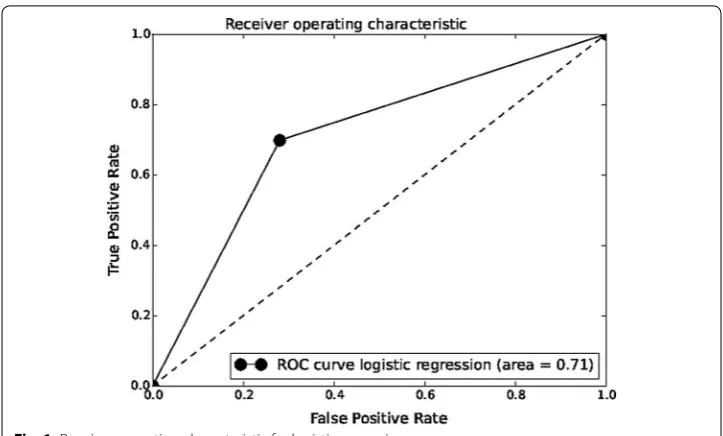
We follow Wang [2] approach and apply logistic regression [3] on the StockTwits data-set. In Table 1, we provide the performance of logistic regression on StockTwits data based on different performance metrics. Also in Fig. 1, we present the ROC curve [66] for this model.
Increase accuracy by using feature selection
One of the problems that prevent us from accurately classifying a Big Data is the noise found within it. Feature selection, including the removal of noisy features and elimina-tion of ineffective vocabulary, makes training and applying a classier more effective [67]. The existing approaches to finding an adequate subset of features fall into two groups: feature filters and feature wrappers [68]. In feature filters, the final set of features is Table 1 Performance of the logistic regression on the StockTwits dataset
Accuracy Precision Recall F-measure AUC
selected based on the statistical properties of those features. With feature wrappers, an iterative search process is applied through a modeling tool’s results. In each iteration, a candidate set of features is used in the modeling tool and the results are recorded. Each step uses the results from the previous step, and so new tentative sets are generated. This process is repeated until some specified convergence criteria are met. In our experiment, we had a huge number of features and instances, and thus, our data was very sparse. We tried several feature selection methods to see how they would affect the accuracy of our sentiment analysis.
From the methods tested, we selected three feature filters which included Chi-squared, ANOVA, and mutual information. The advantages of using these feature selection tech-niques are their speed, scalability and their independence of the classification. Our rea-soning for choosing these methods is their ability to deal with sparse data. On the other hand, these methods have some drawbacks as well, they ignore feature dependencies and also they ignore interaction with the classifier [69]. In this section, we examine these methods and the results of applying them to our dataset.
Chi‑square
Pearson’s Chi-squared [70] test is used for two types of comparison: a test of independ-ence or a test of goodness of fit. We apply the test of independindepend-ence to our dataset to see if the occurrence of a specific feature is independent of the class. Our terms are ranked by their score as determined with Eq. (1). In this equation, ‘O’ stands for observed fre-quency, and ‘E’ stands for expected frequency. A high X2 score rejects the null
hypoth-esis of independence of the term and class.
(1) X2=
n
i=1
(Oi−Ei)2 Ei
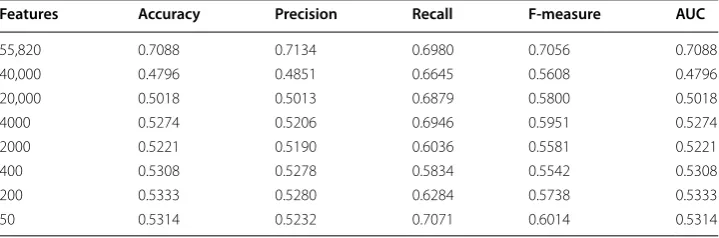
Applying Chi-squared to our dataset and decreasing the number of features gradually allowed us to see how it can affect the performance of logistic regression. Classifier results are provided in Table 2. Reducing the number of features increases accuracy in some cases—for example, by reducing the number of features from 40,000 to 500, accu-racy increases by seven percent. However, this is an irregularity in our dataset and does not mean that Chi-squared is an effective feature selection method to increase the accu-racy of our classier.
Analysis of variance
One of the other feature selection methods that we used was the analysis of variance (ANOVA) feature selection. ANOVA [71] is used to determine if there are any statis-tically significant differences between the arithmetic means of independent groups. By using ANOVA for feature selection in our experiment, we clarify the relevance of terms by assigning a score to each based on an F-test. Top scoring terms are considered as our desired features and sent to the classification models.
The F-test formula is shown in Eq. (2).
In this equation MSB is between-group variability Eq. (3), and MSW is within-group var-iability Eq. (4). In between-group variability ni is the total number of observations of class i, m is the number of classes and x¯ denotes the general mean of the data.
In within-group variability, xij denotes the jth observation in the ith class [72].
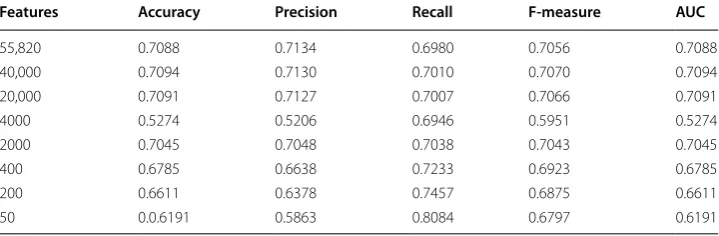
By extracting more effective features based on F-test scores, we examined whether ANOVA feature selection improves the accuracy of the classification methods. Per the results provided in Table 3, accuracy is not improved through ANOVA feature selection, so it will not be used for further testing.
(2)
F= MSB
MSw
(3)
MSB=
ini(x¯i− ¯x)2
m−1
(4) MSW =
ij(xij− ¯xi)2 n−m
Table 2 Performance of the Chi-squared feature selection on the StockTwits dataset
Features Accuracy Precision Recall F-measure AUC
55,820 0.7088 0.7134 0.6980 0.7056 0.7088
40,000 0.4796 0.4851 0.6645 0.5608 0.4796
20,000 0.5018 0.5013 0.6879 0.5800 0.5018
4000 0.5274 0.5206 0.6946 0.5951 0.5274
2000 0.5221 0.5190 0.6036 0.5581 0.5221
400 0.5308 0.5278 0.5834 0.5542 0.5308
200 0.5333 0.5280 0.6284 0.5738 0.5333
Information gain
Our results show that ANOVA and Chi-square feature selection methods cannot con-siderably increase the accuracy of our classification models. In this section, we look at mutual information feature selection, which is one of the most commonly used fea-ture selection methods. Mutual information is defined as the number of dependencies between two random variables. This allows us to determine information gain, which is the amount of information acquired about one random variable through another ran-dom variable. Mutual information between two ranran-dom variables (X and Y) in defined in Eq. (5).
In this equation, if x and y are independent, i.e. (p(x,y)=p(x)×p(y)), their mutual information will be zero. Which, in turn, means that by knowing one of these random variables we cannot gain any information about the other one.
By using mutual information for feature selection, we explore how much information each term provides to making the correct classification decision. This method extracts features with the highest mutual information value. In this way, we will have features that contain the most information about the class. In our experiment, mutual informa-tion for feature selecinforma-tion was also not effective. This is shown by the results provided in Table 4.
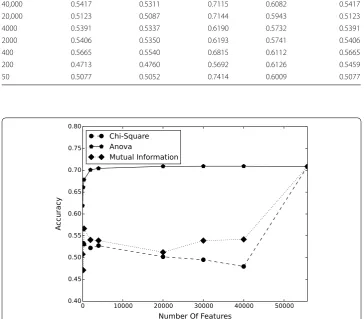
In Fig. 2 we decrease the number of features by applying selection methods contain-ing Chi-square, ANOVA, and information gain and compare the accuracy of logistic regression. As our results demonstrate, feature selection methods cannot considerably improve the accuracy of logistic regression. Data mining algorithms cannot extract the complex and nonlinear patterns that exist in Big Data. Extracting these features, Deep Learning can use simpler linear models for Big Data analysis tasks including classifica-tion and predicclassifica-tion which is important when we deal with the scale of Big Data.
With the result of logistic regression based on the bag-of-words model used as a base-line, we investigate whether Deep Learning methods can improve the accuracy of this logistic regression in Big Data. The bag-of-words model does not consider word order and other words in a sentence, and it has a limited sense of word sentiment. We believe
(5) I(X;Y)=
y∈Y
x∈X
p(x,y)log( p(x,y) p(x)p(y))
Table 3 Performance of the ANOVA F-test feature selection on the StockTwits dataset
Features Accuracy Precision Recall F-measure AUC
55,820 0.7088 0.7134 0.6980 0.7056 0.7088
40,000 0.7094 0.7130 0.7010 0.7070 0.7094
20,000 0.7091 0.7127 0.7007 0.7066 0.7091
4000 0.5274 0.5206 0.6946 0.5951 0.5274
2000 0.7045 0.7048 0.7038 0.7043 0.7045
400 0.6785 0.6638 0.7233 0.6923 0.6785
200 0.6611 0.6378 0.7457 0.6875 0.6611
that using Deep Learning methods instead of the bag-of-words may help us to improve the accuracy of our model. In consecutive layers of deep architectures in Deep Learning, each layer applies a nonlinear transformation on its input and provides a representation of its output. On the other word, Deep Learning can learn representations of the Big Data in a Deep Architecture with multiple levels of representations. It is important to consider that transformations in the layers of Deep Learning are nonlinear and try to extract underlying factors in the Big Data. The output of final layer (the final representa-tion of data which constructed by Deep Learning algorithm) can be used as features for classifiers or other applications. In our paper, we mainly focus to see how Deep Learning can assist with sentiment analysis in StockTwits data and which Deep Learning algo-rithm can be adapted to improve the accuracy of sentiment analysis in StockTwits in compare to data mining models. With respect to the first topic, we explore three Deep Learning algorithms including doc2vec [73–75], LSTM [76] and CNN [77] to see if they can more accurately predict StockTwit’s users’ sentiment.
Table 4 Performance of the mutual information feature selection on the StockTwits data-set
Features Accuracy Precision Recall F-measure AUC
55,820 0.7088 0.7134 0.6980 0.7056 0.7088
40,000 0.5417 0.5311 0.7115 0.6082 0.5417
20,000 0.5123 0.5087 0.7144 0.5943 0.5123
4000 0.5391 0.5337 0.6190 0.5732 0.5391
2000 0.5406 0.5350 0.6193 0.5741 0.5406
400 0.5665 0.5540 0.6815 0.6112 0.5665
200 0.4713 0.4760 0.5692 0.6126 0.5459
50 0.5077 0.5052 0.7414 0.6009 0.5077
Deep Learning in Big Data analytics
In this section, we explore advantages of using Deep Learning algorithms in Big Data analysis. Also, we take a look at some Big Data characteristics that challenges Deep Learning in Big Data analysis.
Big Data analytics, provide the opportunity to develop novel algorithms to address some issues related to Big Data. Deep Learning algorithms are one of these solutions. For instance, the representations extracted by Deep Learning can be used in Big Data analyt-ics approach. In addition, when Big Data is represented in a higher form of abstraction, linear modeling can be considered for Big Data analytics. There are various works that have been performed by using Deep Learning algorithms.
Deep Learning dates back to the 1940s. Its only appears to be new, because Deep Learning was relatively unpopular for several years preceding its current popularity, and because Deep Learning has gone through many different names, only recently being called “deep learning.” Deep Learning has been rebranded many times, reflecting the influence of different researchers and different perspectives. Some basic context of the history of Deep Learning is useful for understanding Deep Learning. Deep Learning is known as cybernetics in the 1940s–1960s, Deep Learning known as connectionism in the 1980s–1990s, and the current resurgence under the name Deep Learning beginning in 2006 [78].
As we mentioned before, Deep Learning algorithms extract an abstract representa-tion of Big Data through multi-level hierarchical learning. Deep Learning is attractive for extracting information from Big Data because it can be used to learn from a massive amount of unlabeled data. Once Deep Learning learned unsupervised data (Big Data) more traditional models can be trained with less amount of labeled data [79–81]. Global relationships in the Big Data can perform better by using Deep Learning.
Some of the advantages of learned abstract representations by Deep Learning include, a simple model can work effectively with the knowledge of more abstract data represen-tation, automation of data representation extraction can lead to a broad application to different data types. These specific characteristics of Deep Learning make it desirable for Big Data analytics.
Deep Learning algorithms can be used to address the problem of volume and variety of Big Data analytics. Effectively using a massive amount of data (volume in Big Data) is one of the advantages of Deep Learning. Since Deep Learning deals with data abstrac-tion it is desirable to work with raw data in different formats and resources (variety in Big Data) and minimize a need for feature selection from new data type observed in Big Data.
network with billions of parameters. Coates et al. [85] suggest using the power of a clus-ter of GPU servers to overcome the problem of Deep Learning in large-scale datasets.
Big Data encompasses a lot of things from medicine, genomic and biological data to call center. To handle huge volumes of input associated with Big Data, large-scale Deep Learning models are desirable. They can illustrate the optimal number of model param-eters and overcome the challenges of Deep Learning for Big Data analysis. There are other Big Data problems like domain adaption and streaming data that large-scale Deep Learning models for Big Data need to handle.
Variety is one of the other characteristics of Big Data, which focuses on the variation of the input domains and data types in Big Data so the problem of domain adoption is another issue that Deep Learning in Big Data analysis need to overcome. There are some studies including [86, 87] that mainly focus on domain adoption during the learning pro-cess. Glorot et al. [86] illustrate that Deep Learning can find intermediate data represen-tations in a hierarchical learning manner and this representation can be used for other domains. Chopra et al. [87] propose a new Deep Learning model for domain adoption. Their new proposed Deep Learning model considers information available from the dis-tribution shift between the train and test data. Our paper mainly focuses on information retrieval so in the following section, we summarize Deep Learning in sentiment analysis.
Sentiment analysis with Deep Learning approaches
methods are related to learning deep non-linear hierarchical features they can also be used to detect very long non-linear time dependencies in sequential data. Long short-term memory (LSTM) and Recurrent Neural Networks are two examples of neural net-works that can increase the accuracy of prediction by picking up on activity hundreds of time steps in the past. One of the main problems in Big Data is storing data effectively and retrieve information from this Big Data. Deep Learning algorithms can be used to generate high-level abstract data representation which will be used for sentiment analy-sis (especially for raw Big Data input). While a vector representation of Big Data provides faster information retrieval, Deep Learning can be used for relational understanding of the Big Data. Using Deep Learning algorithms can help us to extract semantic features from a massive amount of text data in addition to reduce dimensions of the data rep-resentations. Hinton et al. [90, 91] propose a Deep Learning model to learn the binary codes for documents. The word count vector of a document is the lowest layer and the learned binary code of the documents is the highest layer. The binary code can be used for information retrieval in Big Data. we can use some unsupervised data in training a Deep Learning model [92, 93]. Ranzato et al. [94] propose a study in which Deep Learn-ing model learn with supervised and unsupervised Big Data. Deep LearnLearn-ing algorithms provide this opportunity to extract semantic aspect of a document by capture complex nonlinear representations between word occurrences. Using Deep Learning can help us leverage unlabeled document (unsupervised Big Data) to have access to huge amount of data (Big Data). Unlabeled data are often ambled and cheap to collect in Big Data. Since Deep Learning relatively recently becomes popular, additional work needs to be done to use hierarchical learning strategy as a method for sentiment analysis of Big Data.
word2vec
Mikolov in [95], proposed word2vec model. In this model, instead of relying on the number of occurrences of the words, neural network methods (Deep Learning) are used to produce a high-dimensional vector representation of each word or document. Word-2vec uses the location of words relevant to each other in a sentence to find the semantic relationship between them. In contrast to the bag-of-words model, word2vec can cap-ture sentimental similarity among words.
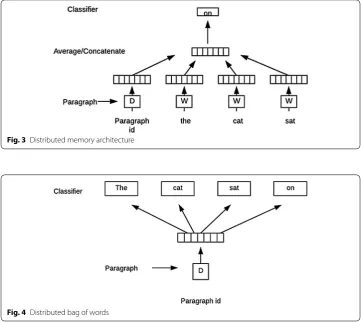
Word2vec is implemented in two different model architectures, continuous bag-of-words and skip-gram. In the continuous bag-of-bag-of-words architecture, we have a sequence of words and we need to predict which word is more likely to be the next word in this sequence. In the skip-gram architecture, with each word, we try to find a more probabil-istic surrounding window of words. The outcome is in a vector space, words with seman-tic similarity are nearby. When using the word2vec model, the order of the words in a sentence is ignored, and only words and their distance from each other are considered. Le and Mikolov [73], describe the doc2vec method. doc2vec generalizes word2vec by adding a paragraph vector. This inclusion means that each paragraph, like each word, is mapped to a vector. The advantage of considering a paragraph as a vector is that it can work as a kind of memory to keep the order of the words in a sentence.
from labeled Big Data they can be used effectively for a task especially when labeled data is limited. The distributed bag-of-words model ignores the word context as input, but rather predicts words by randomly selecting samples from a paragraph. The architec-tures of distributed memory and distributed bag-of-words are provided in Figs. 3 and 4.
To achieve the goal of higher accuracy, in each iteration of stochastic gradient descent, we sample a text window and select some random words from this window. At the end of this process, based on the given paragraph vector, we will form a classification. The distributed bag-of-words model is conceptually simple and does not need to store word vectors, so it needs less memory. Deep Learning algorithms are powerful to extract use-ful representation from various kinds of Big Data and discriminative results provided by Deep Learning can be used for information retrieval [96].
Recurrent Neural Network
The idea behind Recurrent Neural Network (RNN) is that input data are not independent of each other. Knowing the previous iterations’ data will improve our prediction accu-racy. For example, consider that we want to predict the next word in a sequence of words. Having knowledge of the previous words helps us to improve the accuracy of our predic-tion. Recurrent Neural Networks, by considering the previous computation, perform the same task for every element of a sequence. In other words, it has memory to capture information about what has been calculated so far. But in practice, vanishing gradient is
Fig. 3 Distributed memory architecture
a common problem in Deep Learning. Because of the vanishing gradient problem, RNNs look back just a few steps. Although vanishing gradients are not exclusive to RNNs, they limit our network depth to less than the length of the sentence. Thankfully, there are a variety of methods that can help us address the vanishing gradient problem. For exam-ple, instead of using tanh or sigmoid as activation functions, we can use ReLU. However, we chose a more popular solution for our work—Long short-term memory (LSTM).
LSTM was proposed [76] by Hochreiter and Schmidhuber. The main difference
between RNNs and LSTMs is the gated cell. Gated cells in LSTMs help the system store more information in comparison to RNNs. Information can be stored in, written to, or read from a cell. Cells decide whether to remove or store information by opening and closing gates. A cell is composed of four main elements: an input gate, a neuron with a self-recurrent connection, a forget gate, and an output gate. The forget gate is an element which allows the cell to remember or forget its previous state. For example, assume that we want to capture the gender of the subject. In this case, when seeing a new subject, the previous one should be forgotten so that a relevant information can be determined and stored.
Convolutional neural network
One of the most commonly used Deep Learning models is the fully-connected neural network. Although fully-connected neural networks are considered as a good solution in classification tasks, the huge number of connections in these networks may lead to problems. These problems can be further amplified in text processing because of the high number of neurons required. In addition, we believe that words which are close together in a sentence are more to each other when compared to words which never appear close together in any sentence. But fully-connected neural networks treat input words which are far apart the same as words which are close together in a sentence. The hierarchical learning process of Deep Learning makes it expensive for high-dimensional data like image or text. On the other words, these kinds of Deep Learning algorithm can be stalled when dealing with Big Data that shows large Volume (one of the features of Big Data).
Convolutional neural networks offer certain advantages that make them desirable to address these problems. First, each neuron in the first hidden layer, instead of con-necting to all input neurons, is only connected to a small region of them. This reduc-tion in connecreduc-tion complexity works to also reduce potential computareduc-tional problems. Second, using the same weights for each of the hidden neurons provides the opportu-nity to detect the same feature in different locations in the input text. At the end of the network, a pooling layer simplifies the information from the convolutional layers to the output [97]. The convolutional neural network is one of the methods that can be used effectively for Big Data analysis. The convolutional neural network which is one of the powerful models in Deep Learning, use convolutional layers to filter inputs for useful information.
with a large-scale software infrastructure as a training and in [98] video data is used. They use Deep Learning method like stacking and convolution to learn hierarchical representation.
Results and discussion
In this section, we will explain our experiments in applying Deep Learning methods on the StockTwits dataset. We tried to see if Deep Learning models could improve the accuracy of sentiment analysis of StockTwits messages. Deep Learning attempt to mimic the hierarchical learning approach of the human brain. Using Deep Learning in extract features bring non-linearity to the Big Data analysis. The results of applying three com-monly used Deep Learning methods in natural language processing are provided in the following section.
Doc2vec
As our first step, we apply the doc2vec model to the StockTwits dataset to see if it can increase the accuracy of sentiment prediction for stock market writers. This was chosen as the first model because it uses the paragraph as a memory to keep the order of the words in a sentence, and maps paragraphs, as well as words, to a vector.
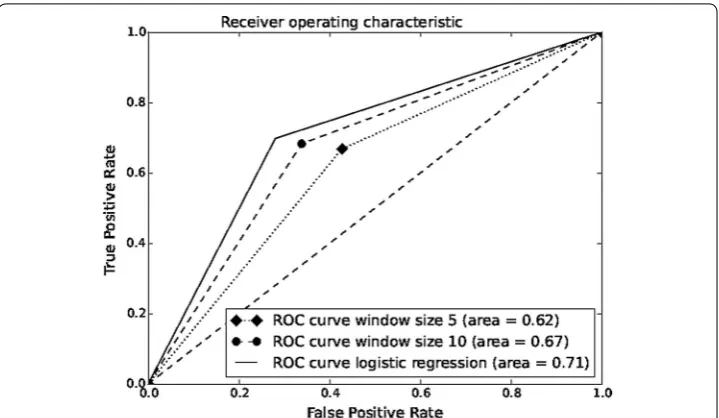
Le in [73] recommends using both doc2vec architectures simultaneously to create a paragraph vector. Following his method in our experiment, each paragraph vector is a combination of two vectors—one learned by distributed memory architecture (DM) and the other learned with distributed bag-of-words (DBOW) architecture. The accu-racy of the doc2vec model is also likely to be affected by window size; with larger win-dows having higher accuracy. In order to evaluate this, we consider winwin-dows of the most commonly-used sizes—5 and 10. The Gensim library in Python was used to implement doc2vec and all words with a total frequency of less than two were ignored. The results are shown in Table 5.
As we expected, the accuracy of applying doc2vec for a window size of 10 is higher than with a window size of 5, but their difference is negligible.
By comparing the results of applying logistic regression as a baseline on the StockTwits dataset in Table 1 with the results of doc2vec in Table 5, we find that doc2vec cannot be an effective model to predict sentiment in the StockTwits dataset. In Fig. 5 we provide the receiver operating characteristic curve for the window sizes of five and ten and com-pare their results with the ROC of the logistic regression.
Long short‑term memory
Based on the findings in the previous section, doc2vec is not a good model for predict-ing sentiment of authors regardpredict-ing the stock market, and so we move on to RNNs. These are some of the other most popular models for use in Natural Language processing Table 5 Performance of doc2vec on the StockTwits dataset
Window Accuracy Precision Recall F-measure AUC
5 0.6202 0.6097 0.6682 0.6376 0.6202
have shown very good results. RNNs were adopted to see if they can help improve the accuracy of StockTwits sentiment analysis. Although an actual RNN was not used for our experiment, LSTM [99–102] could be a viable replacement because it has a deeper memory structure.
In our implementation, we used the Theano [103] library in Python. We use average pooling as our pooling method. For the last step, we fed the result of the pooling to a logistic regression layer to find the target class label associated with the current input sequence. We present the result of our experiments in Table 6. Although using LSTM compared to doc2vec did increase our accuracy, it is still lower than our requirements.
Using logistic regression as the baseline and comparing results in Tables 1 and 6 reveals that LSTM is not an effective model for predicting sentiment in the StockTwits dataset. In Fig. 6, we compare the area under the ROC curve for the results of applying LSTM and logistic regression.
Convolutional neural network
With LSTM being found ineffective, we turn to the CNN. Although CNN is very popular in image processing, the ability to find the internal structures of a Big Data makes it a desirable model for our purposes. We employ CNN to see if it can be used to improve our sentiment analysis task by using the Tensorflow [104] package in Python. The first step of our process is embedding words into low dimensional vectors.
After that, we perform convolutions with different filter sizes over the embedded word vectors. In our experiment, we used filter sizes of 3, 4 and 5. Then we apply max pooling
Fig. 5 Area under the ROC curve for doc2vec with window size of 5 and 10
Table 6 Performance of the LSTM on the StockTwits dataset
Accuracy Precision Recall F-measure AUC
Fig. 6 Area under the ROC curve for long short-term memory
Table 7 Performance of the convolutional neural network on the StockTwits dataset
Steps Accuracy Precision Recall F-measure AUC
100 0.5700 0.6348 0.3294 0.4338 0.5700
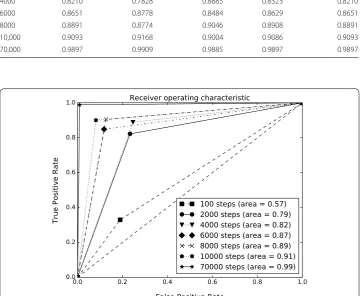
2000 0.7943 0.7787 0.8221 0.7999 0.7943
4000 0.8210 0.7828 0.8885 0.8323 0.8210
6000 0.8651 0.8778 0.8484 0.8629 0.8651
8000 0.8891 0.8774 0.9046 0.8908 0.8891
10,000 0.9093 0.9168 0.9004 0.9086 0.9093
70,000 0.9897 0.9909 0.9885 0.9897 0.9897
on the result of the convolution and add dropout regularization. The process concludes by using a softmax layer to classify our results.
Table 7 shows the results of these operations. By comparing the accuracy of logistic regression as a baseline in Table 1 with the results of applying convolutional neural net-work provided in Table 7, we conclude that CNN outperforms logistic regression after less than 2000 steps. After 6000 steps the accuracy of CNN is around 86% which is con-siderably higher than the other models. Additionally in Fig. 7, we provide the receiver operating characteristic curve for CNN, which compares the area under the roc curve after applying CNN in multiple steps. As evident in Table 7, with proceeding steps in CNN, the ROC curve gets closer to the top left corner of the diagram. This proves that by proceeding stepwise in CNN on the StockTwits dataset, the accuracy of prediction increases gradually. We compare the result of logistic regression, doc2vec, LSTM, and CNN (after 10,000 steps) in Table 8. Based on the results, we find that CNN is an effec-tive model for predicting the sentiment of authors in the StockTwits dataset as it outper-formed all other models in all five performance measurement.
Conclusions
Deep Learning has good performance and promise in many areas, such as natural lan-guage processing. Deep Learning has this opportunity to address the data analysis and learning problems in Big Data. In contrast to data mining approaches with its shallow learning process, Deep Learning algorithms transform inputs through more layers. Hid-den layers in Deep Learning are generally used to extract features or data representa-tions. This hierarchical learning process in Deep Learning provides the opportunity to find word semantics and relations. These attributes make Deep Learning one of the most desirable models for sentiment analysis.
In this paper, based on our results we show that convolutional neural networks can overcome data mining approach in stock sentiment analysis. In standard data mining approach to text categorization, documents represent as bag-of-word vectors. These vectors represent which words appear in a document but do not consider the order of the words in a sentence. It is clear that in some cases, the word order can change the sentiment of a sentence. One remedy to this problem is using bi-grams or n-gram in addition to uni-gram [86, 105, 106]. Unfortunately, using n-grams with n>1 is not
effective [107]. Using CNN provides this opportunity to use n-grams to extract the senti-ment of a docusenti-ment effectively. It benefits from the internal structure of data that exists in a document through convolution layers, where each computation unit responds to a small region of input data. We used logistic regression, which works based on a bag-of-words, as a baseline and compared the result of applying Deep Learning to logistic Table 8 Compare Deep Learning models in financial sentiment analysis
Model Accuracy Precision Recall F-measure AUC
Logistic regression 0.7088 0.7134 0.6980 0.7056 0.7088
Doc2vec 0.6723 0.6687 0.6830 0.6757 0.6723
LSTM 0.6923 0.8515 0.6571 0.7419 0.7109
regression. Based on our results, among different common Deep Learning methods in sentiment analysis, only convolutional neural network outperforms logistic regression. The accuracy of convolutional neural networks, in comparison to the other models, is considerably better. Based on our results we can use CNN to extract the sentiment of authors regarding stocks from their words. There are some people in the financial social network who can correctly predict the stock market. By using CNN to predict their sen-timent we can predict future market movement.
Authors’ contributions
SS is the main author, she did all the research and explored different methods. The idea of doing sentiment analysis and classifying users to bullish and bearish is DW idea. We consult with AP and TMK. AP helps us in financial concepts and we use TMK experience to improve our work. All authors read and approved the final manuscript. All authors read and approved the final manuscript.
Author details
1 Department of Computer & Electrical Engineering and Computer Science, Florida Atlantic University, Boca Raton, FL 33431, USA. 2 College of Business, Florida Atlantic University, Boca Raton, FL 33431, USA.
Acknowledgements
Not applicable.
Competing interests
The authors declare that they have no competing interests.
Availability of data and materials
Not applicable.
Consent for publication
Not applicable.
Ethics approval and consent to participate
Not applicable.
Funding
Not applicable.
Publisher’s Note
Springer Nature remains neutral with regard to jurisdictional claims in published maps and institutional affiliations.
Received: 20 April 2017 Accepted: 28 December 2017
References
1. Ellison NB, et al. Social network sites: definition, history, and scholarship. J Comput Mediat Commun. 2007;13(1):210–30.
2. Wang G, Wang T, Wang B, Sambasivan D, Zhang Z, Zheng H, Zhao BY. Crowds on wall street: extracting value from social investing platforms, foundations and trends in information retrieval. New York: ACM; 2014.
3. Freedman DA. Statistical models: theory and practice. Cambridge: Cambridge University Press; 2009. 4. Krizhevsky A, Sutskever I, Hinton GE. Imagenet classification with deep convolutional neural networks. In:
Advances in neural information processing systems; 2012. p. 1097–105.
5. Socher R, Huang EH, Pennin J, Manning CD, Ng AY. Dynamic pooling and unfolding recursive autoencoders for paraphrase detection. Adv Neural Inf Process Syst. 2011;24:801–9.
6. Pearson K. Notes on regression and inheritance in the case of two parents. Proc R Soc Lond. 1895;58:240–2. 7. Graves A, Mohamed AR, Hinton G. Speech recognition with deep recurrent neural networks. In: 2013 IEEE
interna-tional conference on acoustics, speech and signal processing (ICASSP); 2013.
8. Dahl G, Mohamed AR, Hinton GE. Phone recognition with the mean–covariance restricted Boltzmann machine. Adv Neural Inf Process Sytst. 2010;23:469–77.
9. George E, Yu D, Deng L, Acero A. Context-dependent pre-trained deep neural networks for large-vocabulary speech recognition. IEEE Trans Audio Speech Lang Process. 2012;20(1):30–42.
10. Seide F, Li G, Yu D. Conversational speech transcription using context-dependent deep neural networks. In: Twelfth annual conference of the international speech communication association; 2011.
11. Mohamed A, Dahl GE, Hinton G. Acoustic modeling using deep belief networks. IEEE Trans Audio Speech Lang Process. 2012;20(1):14–22.
13. Najafabadi NM, Villanustre F, Khoshgoftaar TM, Seliya N, Wald R, Muharemagic E. Deep learning applications and challenges in big data analytics. J Big Data. 2015;2:1.
14. LeCun Y, Bottou L, Bengio Y, Haffner P. Gradient-based learning applied to document recognition. Proc IEEE. 1998;86(11):2278–324.
15. Collobert R, Weston J, Bottou L, Karlen M, Kavukcuoglu K, Kuksa P. Natural language processing (almost) from scratch. J Mach Learn Res. 2011;12:2493–537.
16. Collobert R, Weston J. A unified architecture for natural language processing: deep neural networks with multitask learning. In: Proceedings of the 25th international conference on machine learning. London: ACM; 2008. p. 160–7. 17. Gao J, Deng L, Gamon M, He X, Pantel P. Modeling interestingness with deep neural networks. 2014. US Patent
App. 14/304,863.
18. Kalchbrenner N, Grefenstette E, Blunsom P. A convolutional neural network for modelling sentences. arXiv preprint arXiv:1404.2188. 2014.
19. Kim Y. Convolutional neural networks for sentence classification. arXiv preprint arXiv:1408.5882. 2014.
20. Shen Y, He X, Gao J, Deng L, Mesnil G. A latent semantic model with convolutional-pooling structure for informa-tion retrieval. In: Proceedings of the 23rd ACM internainforma-tional conference on informainforma-tion and knowledge manage-ment. New York: ACM; 2014. p. 101–10.
21. Liheng X, Liu K, Lai S, Zhao J, et al. Product feature mining: semantic clues versus syntactic constituents. ACL. 2014;1:336–46.
22. Tang Duyu, Wei Furu, Yang Nan, Zhou Ming, Liu Ting, Qin Bing. Learning sentiment-specific word embedding for twitter sentiment classification. ACL. 2014;1:1555–65.
23. Weston J, Chopra S, Adams K. # tagspace: semantic embeddings from hashtags. 2014.
24. Geoffrey E, Osindero S, Teh YW. A fast learning algorithm for deep belief nets. Neural Comput. 2006;18(7):1527–54. 25. Bengio Y, Lamblin P, Popovici D, Larochelle H. Greedy layer-wise training of deep networks. Adv Neural Inf Process
Syst. 2007;19:153–60.
26. Li G, Zhu H, Cheng G, Thambiratnam K, Chitsaz B, Yu D, Seide F. Context-dependent deep neural networks for audio indexing of real-life data. In: IEEE spoken language technology workshop (SLT). 2012. p. 143–8. 27. Brin S, Page L. Reprint of: the anatomy of a large-scale hypertextual web search engine. Comput Netw.
2012;56(18):3825–33.
28. Mortensen EN, Barrett WA. Interactive segmentation with intelligent scissors. Graph Models Image Process. 1998;60(5):349–84.
29. Krizhevsky A, Sutskever I, Hinton GE. Imagenet classification with deep convolutional neural networks. Adv Neural Inf Process Syst. 2012:1097–105.
30. Hinton G, Deng L, Dong Y, Dahl GE, Mohamed Abdel-rahman, Jaitly Navdeep, Senior Andrew, Vanhoucke Vincent, Nguyen Patrick, Sainath Tara N, et al. Deep neural networks for acoustic modeling in speech recognition: the shared views of four research groups. IEEE Signal Process Mag. 2012;29(6):82–97.
31. Alexandrescu A, Kirchhoff K. Factored neural language models. In: Proceedings of the human language technol-ogy conference of the NAACL, companion, volume: short papers. Association for computational linguistics; 2006. p. 1–4.
32. Luong T, Socher R, Manning CD. Better word representations with recursive neural networks for morphology. Vancouver: CoNLL; 2013. p. 104–13.
33. Lazaridou A, Marelli M, Zamparelli R, Baroni M. Compositionally derived representations of morphologically com-plex words in distributional semantics. ACL. 2013;1:1517–26.
34. Kilgarriff A, Grefenstette G. Introduction to the special issue on the web as corpus. Comput Linguis. 2003;29(3):333–47.
35. Socher R, Pennington J, Huang EH, Ng AY, Manning CD. Semi-supervised recursive autoencoders for predicting sentiment distributions. In: Proceedings of the conference on empirical methods in natural language processing. Association for computational linguistics; 2011. p. 151–61.
36. Hinton GE, Salakhutdinov RR. Reducing the dimensionality of data with neural networks. Science. 2006;313(5786):504–7.
37. Hinton GE, Zemel RS. Autoencoders, minimum description length and helmholtz free energy. Adv Neural Inform Process Syst. 1994:3–10.
38. Smolensky P. Information processing in dynamical systems: foundations of harmony theory. Technical report, Colorado Univ at Boulder Dept of Computer Science; 1986.
39. Hinton GE. Training products of experts by minimizing contrastive divergence. Neural Comput. 2006;14(8):1771–800.
40. Socher R, Huval B, Manning CD, Ng AY. Semantic compositionality through recursive matrix-vector spaces. In: Pro-ceedings of the 2012 joint conference on empirical methods in natural language processing and computational natural language learning. Association for computational linguistics; 2012. p. 1201–11.
41. Socher R, Bauer J, Manning CD, Ng AY. Parsing with compositional vector grammars. ACL. 2013;1:455–65. 42. Socher R, Lin CC, Manning C, Ng AY. Parsing natural scenes and natural language with recursive neural networks.
In: Proceedings of the 28th international conference on machine learning (ICML-11). 2011. p. 129–36. 43. Collobert R. Deep learning for efficient discriminative parsing. In: Proceedings of the fourteenth international
conference on artificial intelligence and statistics. 2011. p. 224–32. 44. Market Sentiment. http://www.investopedia.com/.
45. Pang B, Lee L. Opinion mining and sentiment analysis. Found Trends Inf Retrieval. 2008;2:1–35.
46. Loughran T, McDonald B. When is a liability not a liability? Textual analysis, dictionaries. J Finance. 2011;66:35–65. 47. Mao H, Gao P, Wang Y, Bollen J. Automatic construction of financial semantic orientation lexicon from large scale
Chinese news corpus. In: 7th Financial risks international forum; 2014. 48. Steinwart I, Christmann A. Support vector machine. Berlin: Springer; 2008.
50. Silva N, Hruschka E, Hruschka E. Tweet sentiment analysis with classifier ensembles. Decis Support Syst. 2014;66:170–9.
51. Fersini E, Messina E, Pozzi FA. Automatic construction of financial semantic orientation lexicon from large scale Chinese news corpus. Decis Support Syst. 2014;68:26–38.
52. Potts C, Pearson K. From frequency to meaning: vector space models of semantics. J Artif Intell Res. 2010;37:141–88.
53. Salton G, Buckley C. Term-weighting approaches in automatic text retrieval. Inf Process Manag. 1988;24(5):513–23. 54. Robertson SE, Walker S. Some simple effective approximations to the 2-Poisson model for probabilistic weighted retrieval. In: Proceedings of the 17th annual international ACM SIGIR conference on research and development in information retrieval. New York: Springer Inc.; 1994. p. 232–41.
55. Bengio Y, et al. Learning deep architectures for AI. Found Trends Mach Learn. 2009;2(1):1–127.
56. Chen H, Chiang RHL, Storey VC. Business intelligence and analytics: from big data to big impact. MIS Quart. 2012;36:4.
57. Dalal N, Triggs B. Histograms of oriented gradients for human detection. In: IEEE computer society conference on computer vision and pattern recognition, CVPR 2005, vol. 1. 2005. p. 886–93.
58. Lowe DG. Object recognition from local scale-invariant features. In: The proceedings of the seventh IEEE interna-tional conference on computer vision, vol. 2. 1999. p. 1150–7.
59. Bahdanau D, Cho K, Bengio Y. Neural machine translation by jointly learning to align and translate. arXiv:1409.0473. 2014.
60. Coates A, Ng AY. The importance of encoding versus training with sparse coding and vector quantization. In: Proceedings of the 28th international conference on machine learning (ICML-11). 2011. p. 921–8.
61. Hinton GE, Srivastava N, Krizhevsky A, Sutskever I, Salakhutdinov RR. Improving neural networks by preventing co-adaptation of feature detectors. arXiv:1207.0580. 2012.
62. Fan J, Han F, Liu H. Challenges of big data analysis. Natl Sci Rev. 2014;1(2):293–314.
63. Abadi M, Agarwal A, Barham P, Brevdo E. Thumbs up or thumbs down? Semantic orientation applied to unsuper-vised classification of reviews. Proc Assoc Comput Linguis. 2002;66:417–24.
64. Pang B, Lee L, Vaithyanathan S. Thumbs up? Sentiment classification using machine learning techniques. In: Proceedings of the conference on empirical methods in natural language processing, vol. 66; 2002. p. 79–86. 65. Kiritchenko S, Zhu X, Mohammad S. Sentiment analysis of short informal texts. J Artif Intell Res. 2014;50:723–62. 66. Hanley JA, McNeil BJ. The meaning and use of the area under a receiver operating characteristic (ROC) curve.
Radiology. 1982;143:29–36.
67. Bermingham ML, Pong-Wong R, Spiliopoulou A, Hayward C, Rudan I, Campbell H, Wright AF, Wilson JF, Agakov F, Navarro P, Haley CS. Application of high-dimensional feature selection: evaluation for genomic prediction in man. Sci Rep. 2015;5:10312.
68. Torgo L. Data mining with R. Boca Raton: CRC Press; 2010.
69. Saeys Y, Inza I, Larrañaga P. A review of feature selection techniques in bioinformatics. Bioinformatics. 2007;23(19):2507–17.
70. Pearson K. X. On the criterion that a given system of deviations from the probable in the case of a corsystem of variables is such that it can be reasonably supposed to have arisen from random sampling. Lond Edinburgh Dublin Philos Mag J Sci. 1900;50:157–75.
71. Fisher R. Dispersion on a sphere. Proc R Soc Lond. 1953;217:295–305.
72. Grünauer A, Vincze M. Using dimension reduction to improve the classification of high-dimensional data. arXiv preprint arXiv:1505.06907. 2015.
73. Le Q, Mikolov T. Distributed representations of sentences and documents. In: International conference on machine learning, vol. 31. 2014.
74. Mikolov T, Chen K, Corrado G, Dean J. Efficient estimation of word representations in vector space. In: Workshop at ICLR. 2013.
75. Mikolov T, Sutskever I, Chen K, Corrado GS, Dean J. Distributed representations of words and phrases and their compositionality. In: Workshop at ICLR. 2013.
76. Hochreiter S, Schmidhuber J. Long short-term memory. Neural Comput. 1997;9:1735–80.
77. Chellapilla K, Puri S, Simard P. High performance convolutional neural networks for document processing. In: Tenth international workshop on frontiers in handwriting recognition. Seattle: Suvisoft; 2006.
78. Goodfellow I, Bengio Y, Courville A. Deep learning. MIT Press; 2016. http://www.deeplearningbook.org. 79. Bengio Y, LeCun Y, et al. Scaling learning algorithms towards AI. Large Scale Kernel Mach. 2007;34(5):1–41. 80. Bengio Y, Courville A, Vincent P. Representation learning: a review and new perspectives. IEEE Trans Pattern Anal
Mach Intell. 2013;35(8):1798–828.
81. Bengio Y. Deep learning of representations: looking forward. In: International conference on statistical language and speech processing. Berlin: Springer; 2013. p. 1–37.
82. Calandra R, Raiko T, Deisenroth MP, Pouzols FM. Learning deep belief networks from non-stationary streams. In: International conference on artificial neural networks. Berlin: Springer; 2012. p. 379–86.
83. Zhou G, Sohn K, Lee H. Online incremental feature learning with denoising autoencoders. In: Artificial intelligence and statistics. 2012. p. 1453–61.
84. Dean J, Corrado G, Monga R, Chen K, Devin M, Mao M, Senior A, Tucker P, Yang K, Le QV, et al. Large scale distrib-uted deep networks. In: Advances in neural information processing systems. 2012. p. 1223–31.
85. Coates A, Huval B, Wang T, Wu D, Catanzaro B, Ng A. Deep learning with cots hpc systems. In: International confer-ence on machine learning. 2013. p. 1337–45.
86. Glorot X, Bordes A, Bengio Y. Domain adaptation for large-scale sentiment classification: a deep learning approach. In: Proceedings of the 28th international conference on machine learning (ICML-11); 2011. p. 513–20.
88. Larochelle H, Bengio Y, Louradour J, Lamblin P. Exploring strategies for training deep neural networks. J Mach Learn Res. 2009;10:1–40.
89. Olshausen AB, Field DJ. Sparse coding with an overcomplete basis set: a strategy employed by v1? Vision Res. 1997;37(23):3311–25.
90. Hinton G, Salakhutdinov R. Discovering binary codes for documents by learning deep generative models. Topics Cogn Sci. 2011;3(1):74–91.
91. Salakhutdinov R, Hinton G. Semantic hashing. Int J Approx Reas. 2009;50(7):969–78.
92. Le QV. Building high-level features using large scale unsupervised learning. In: 2013 IEEE international conference on acoustics, speech and signal processing (ICASSP). 2013. p. 8595–8.
93. Vincent P, Larochelle H, Bengio Y, Manzagol PA. Extracting and composing robust features with denoising autoencoders. In: Proceedings of the 25th international conference on Machine learning. New York: ACM; 2008. p. 1096–103.
94. Ranzato M, Szummer M. Semi-supervised learning of compact document representations with deep networks. In: Proceedings of the 25th international conference on machine learning. New York: ACM; 2008. p. 792–9.
95. Mikolov T, Chen K, Corrado G, Dean J. Efficient estimation of word representations in vector space. arXiv preprint arXiv:1301.3781. 2013.
96. Mikolov T, Chen K, Corrado G, Dean J. Efficient estimation of word representations in vector space. arXiv preprint arXiv:1301.3781. 2013.
97. Kim Y. Convolutional neural networks for sentence classification. In: Proceedings of EMNLP. 2014.
98. Le QV, Zou WY, Yeung Sy, Ng AY. Learning hierarchical invariant spatio-temporal features for action recognition with independent subspace analysis. In: 2011 IEEE conference on computer vision and pattern recognition (CVPR). 2011. p. 3361–8.
99. Gers F, Schmidhuber J, Cummins F. Learning to forget: continual prediction with LSTM. Neural Comput. 2000;12:2451–71.
100. Graves A. Supervised sequence labelling with recurrent neural networks. Heidelberg: Springer; 2012.
101. Bastien F, Lamblin P, Pascanu R, Bengio Y. Theano: new features and speed improvements. In: NIPS workshop on deep learning and unsupervised feature learning. 2012.
102. Bergstra J, Breuleux O, Bastien F, Bengio Y. Theano: a CPU and GPU math expression compiler. In: Python for scien-tific computing conference. 2012.
103. Bergstra J, Breuleux O, Bastien F, Lamblin P. Thumbs up? Sentiment classification using machine learning tech-niques, Python in science, vol. 9. 2015.
104. Pang B, Lee L, Vaithyanathan S. TensorFlow: large-scale machine learning on heterogeneous distributed systems. In: Preliminary white paper, vol. 9. 2015.
105. Blitzer J, Dredze M, Pereira F, et al. Biographies, bollywood, boom-boxes and blenders: domain adaptation for sentiment classification. ACL. 2007;7:440–7.
106. Wang S, Manning CD. Baselines and bigrams: simple, good sentiment and topic classification. In: Proceedings of the 50th annual meeting of the association for computational linguistics: short papers, vol. 2. Association for computational linguistics; 2012. p. 90–4.