MULTIPLE EXCITON GENERATION
SOLAR CELLS USING CdSe QUANTUM
DOTS
HAFTOM MESFIN GEBRESELASSIE
Department of Applied Physics, Defence Institute of Advanced Technology, Girinagar, Pune - 411 025, Maharashtra, India
R.B SHARMA
Department of Applied Physics, Defence Institute of Advanced Technology, Girinagar, Pune - 411 025, Maharashtra, India
Abstract:
Experimental and Simulation works of Nano structured Solar Cells Using CdSe Quantum Dots have been analyzed and investigated. CdSe quantum dots have been synthesized from non coordinating and high boiling solvent Octadecene and a series of increasing CdSe particle sizes are produced. The synthesized CdSe quantum dots are highly examined under a Transmission Electron Microscope and four images of different sizes of CdSe quantum dots (5.8 nm, 6.4 nm, 7.0 nm and 7.7 nm) have been obtained. A 1.1x1.1cm2 TiO2 electrode is prepared using indium tin oxide conducting glass and TiO2 nanoparticles.
The CdSe quantum dot (5.8nm) was adsorbed on TiO2 photoelectrode and used as sensitizer. In this
paper work, a sandwich type cell configuration which is made up of TiO2 photoelectrode, graphite coated
counter electrode, an electrolyte of iodine and potassium iodide have been used. This sandwich type cell has been exposed to sun light and we have achieved 0.32 V and 0.2 mA of potential difference and current respectively.
Keywords: Quantum Dot; CdSe; Multiple Exciton Generation Solar Cell; Nanostructured TiO2.
Introduction
Currently there are immense research works on the key applications of quantum dots. Quantum dots such as CdS, PbS, InP, and CdSe have recently been reported for possible use as a photosensitizer absorbing photons on TiO2 [1]. Considerable interest has developed regarding quantum dots because of their unique electronic and
optical properties. When their size is sufficiently small (below the exciton radius), they exhibit a quantum confinement effect leading to a size dependent separation between the valence and conduction band. Thus, their band gap can be widened as their size is increased, permitting the optical and electronic properties of materials to be tailored for specific applications. That is the electronic properties of quantum dots can be tuned by changing the size of the particles without changing their chemical composition [1, 2]. The use of quantum dots as sensitizers has advantage compared to organic dyes that are an adjustable band gap or band edge, effective light harvesting, and their possible stability under sunlight. Additionally, quantum dots exhibit a larger extinction coefficient than conventional dyes making them highly interesting as photosensitizers [1, 3, 4].
1. Theory
Due to the nature of photovoltaics, the light-absorbing material will only absorb certain energy level from photon. Shockley and Queisser have calculated that the maximum thermodynamic efficiency for the single threshold absorber is around 31% [5, 6]. Thus, several approaches to increase the efficiency have been investigated. One of the potential approaches to overcome this limit is carrier multiplication, or multiple excition generation (MEG). In a traditional photon excitation, one phonon can generate only one pair of exciton.
The excess photon energy (hω-Eg) is dissipated as heat via phonon emission as depicted in figure 1. In this case,
the quantum efficiency (QE) of photon-to exciton conversion is zero below Eg, the energy gap, and is 100%
3Eg produce one, two, and three excitons, respectively. The QE is increased by 100% if photon energy is
increased by Eg [7].
Fig.1. Hot carrier relaxation/cooling in semiconductors
In quantum dots the rate of electron relaxation through electron–phonon interactions can be significantly reduced because of the discrete character of the e–-h+ spectra, and the rate of Auger processes, including the
inverse Auger process of exciton multiplication, is greatly enhanced due to carrier confinement and the concomitantly increased e–-h+ Coulomb interaction [8]. Furthermore, crystal momentum need not be conserved because momentum is not a good quantum number for three-dimensionally confined carriers (from the Heisenberg Uncertainty Principle the well-defined location of the electrons and holes in the nanocrystal makes the momentum uncertain). The concept of enhanced MEG in QDs is shown in figure 2.
Fig.2. Multiple Exciton Generation in quantum dots
Estimation of diameter of CdSe quantum dots have been obtained using Effective Mass Model from the absorption spectra by taking the peak absorption wavelength (λmax). From the absorption spectra the x-intercept
of the linear portion of the absorbance is a measure of Eg; where Eg is given by:
E λ C (1)
The Effective Mass Model is given as:
E E π ϵϵ.
(2)
where r is the radius of the nanoparticle and after multiplying by r2, rearranging we have got:
r
.
πϵϵ .
πϵϵ E E
In Multiple Exciton Generation solar cells due to an applied bias voltage V the Fermi level raises in TiO2. When
the Fermi level raises in TiO2, the surface state becomes increasingly charged [9, 10]. This changes the voltage
drop across the dielectric layer Vd which is given as follows:
V ϵϵN
∆E VF
T
(4)
where q is charge of an electron, d is thickness of the dielectric layer, Nss is surface state concentration (per unit
surface), Et is surface state energy difference, VF is the potential related to the displacement of the fermi level
with respect to the conduction band and T is temperature. The external bias potential is the sum of the potential in the dielectric layer and the potential related to the displacement of the fermi level with respect to the conduction band:
V V VF (5)
2. Results and Discussions
Experimental synthesis of CdSe quantum dots, isolation of oleic acid capped CdSe quantum dots from TOPO, dispersion of the isolated quantum dots in chloroform, preparation of TiO2 electrode, adsorption of the dispersed
CdSe quantum dots on TiO2 electrode have been done. The relationship of band gap energy and quantum dot
size, emission wavelength and quantum dot size, the variation of the potential drop in the dielectric layer and the dependence of the external bias voltage on the potential related to the displacement of the fermi level with respect to the conduction band are analyzed and investigated using MATLAB software.
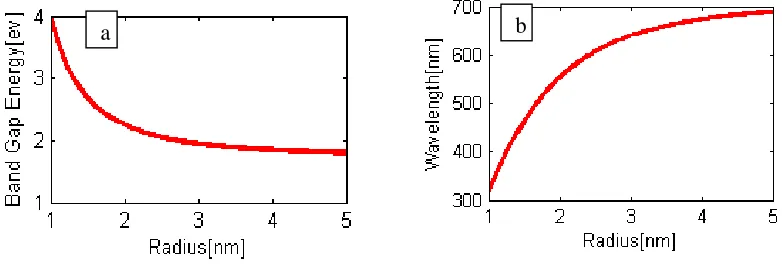
Fig. 3. (a).Different sizes of CdSe quantum dots vs. Bandgap energy (b). Different sizes of CdSe quantum dots with their corresponding
Emission Wavelength
As the size of the CdSe quantum dot decreases the band gap energy increases but lies in the range of the solar spectrum which makes MEG to occur in semiconductor quantum dots due to quantization effect as indicated by figure 3(a). The emission wavelength of CdSe quantum dots is directly proportional to their size and lies in the visible range as well as in the UV range of the solar spectrum as explained by figure 3(b).
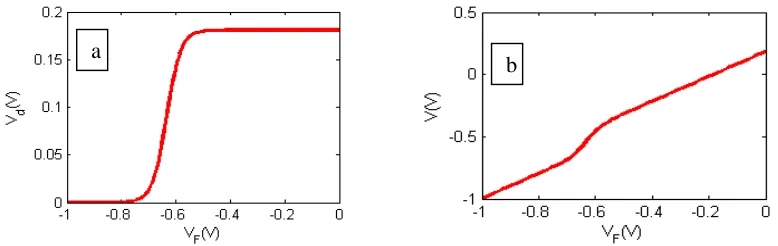
A step of the voltage in the dielectric layer occurs when the Fermi level crosses the energy level of the surface state as shown in figure 4(a) and the dependence of V in VF is depicted by figure 4(b).
Fig.4. (a). Representation of the variation of potential drop in the dielectric with exponential Density of States (b). Representation of the variation of applied potential exponential Density of States
Experimental Analysis and Investigation:-
The CdSe Quantum Dots have been synthesized from Cd and Se precursors. The Se precursor was prepared by adding 60 mg of Se powder and 10 mL ODE to a flask. A 0.8 mL TOP and a magnetic stir bar were added to the flask. Then the solution was stirred and warmed as necessary to completely dissolve the Se powder. The solution then cooled down to room temperature. The Cd precursor was prepared by adding 26 mg of CdO to another flask clamped to a heating mantle. A 1.2 mL OA and 10mL ODE were added to the same flask. The mixture was swirled to mix the liquids and finally the Cd solution was heated. When the temperature reaches 2250C, 2 mL of the room temperature Se solution was quickly transferred to the 225 0C Cd solution. Small aliquots were extracted from the mixture at different reaction times. The extracted aliquots were immediately immersed in dry ice in order to quench further growth of the nanocrystals.
Fig.5. Experimentally synthesized CdSe quantum Dots
These quantum dots are examined under Transmission Electron Microscope and their corresponding images are shown in figure 6.
(a) TEM image of sample 1 (b) TEM image of sample 2
(c) TEM image of sample 3 (d) TEM image of sample 4 Fig. 6. TEM images of CdSe quantum dots
a
From the TEM images effective radius of each samples has been plotted using bar graphs as shown in figure 7.
(a) Effective radius of 5.8nm (b) Effective radius of 6.4nm
(c) Effective radius of 7nm (d) Effective radius of 7.7nm
Fig.7. Effective Radius of CdSe QDs for four samples
The Oleic acid terminated CdSe quantum dots are separated from the octadecene by using 100 % ethanol and centrifuge machine of spin about 3000 rpm until the shaking gave no longer suspension.
Nanocrystalline TiO2 electrode has been prepared using colloidal TiO2 paste and 1.1 x 1.1 cm2 film was
deposited on the conducting surface of an indium tin oxide glass. Colloidal nanocrystalline TiO2 (5ml) were
heated under an IR lamp until a thick white nanocrystalline TiO2 is obtained. This thick nanocrystalline TiO2
(1.3ml) was deposited over ITO and dried under IR lamp for about one hour. Finally we have achieved a 1.1 x1.1cm2 TiO2 electrode.
The precipitated CdSe quantum dots were dispersed in chloroform, and used as sensitizers of TiO2 electrode.
The counter electrode is coated with graphite. An iodine and potassium iodide was used as electrolyte. The Solar cell is then assembled by simply pressing the two electrodes using a clamper. This cell has been tested under natural sunlight conditions and an open circuit voltage of 0.32 V and short circuit current of 0.2 mA cm have been obtained.
3. Conclusions
In this paper work, CdSe quantum dots have been successfully synthesized and TiO2 electrode has been
experimentally prepared. The photovoltaic cell has been exposed to natural sunlight; satisfactory open circuit voltage and short circuit current have been achieved. Much higher results are expected to be attained when the cell is investigated under solar simulator. The expected fill factor (FF) is 35 % to 47 % and efficiency is 0.3 % to 0.42 %.
Acknowledgments
The authors are thankful to Defence Institute of Advanced Technology, Girinagar, Pune-411025, India, for supporting this work.
References
[1] Jun-ho Yum, Sang-Hyun Cho (2007): CdSe Quantum Dots Sensitized TiO2 Electrodes for Photovoltaic Cells, Journal of the Korean Electrochemical Society, Vol. 10, No.4.
[2] Antonio Luque, Antonio Marti, and Arthur J (2007): Solar Cells Based on Quantum Dots, MRS Bulletin, Vol. 32.
[3] Ivan Mora Sero, Sixto Gimenez. (2009): Factors determining the photovoltaic performance of a CdSe quantum dot sensitized solar cell: the role of the linker molecule and of the counter electrode, Nanotechnology, Vol. 19.
[4] Shockley, W. Queisser, H. J. J. Appl. Phys., 32, 510, 1961..
[5] Schaller, R. et al. (2006): Seven excitons at a cost of one: redefining the limits of conversion efficiency of photons into charge carriers. Nano Letters vol. 6, No. 3.
[6] Arthur J. Nozik. (2008): Multiple exciton generation in semiconductor quantum dots. Chemical Physics Letters, Vol.3.
[8] Istvan Robel, Vaidyanathan Subramanian, M. K., J. A. C. S. ChinWon, P.; Leng, J.; Lai, Y.; RWilliams, J.(2006): Quantum Dot Solar Cells. Harvesting Light Energy with CdSe. Vol. 128.
[9] M.C. Hanna, R.J. Ellingson, M. B. P. Y. O. M. and Nozik, A.( 2004): Quantum Dot Solar Cells: High Efficiency through Multiple Exciton Generation.