A CONFIGURABLE SECURED IMAGE
ENCRYPTION TECHNIQUE USING 3D
ARRAY BLOCK ROTATION
G. Lokeshwari, [email protected] Professor CSE, Aurora’s Engineering College, Bhongir
Dr. S. Udaya Kumar, [email protected] Principal, MVSR Engineering College, Nadergul.
G. Aparna, [email protected] Professor ECE, Aurora’s Engineering College, Bhongir
Abstract: Security of the information was the exclusive domain of the multimedia applications and transfer of the data over the insecure mode of communication. A few years after the necessity of information security was invented researchers became aware of encryption/decryption techniques development by various agencies.In this paper a new technique of enciphering data which enables good diffusion for obscuring the redundancies in a plaintext messages. Image encryption is achieved using 3D array block rotation implementation.
Key words: Image encryption, Encoding, Decoding, Block cipher, 3D Array, Confusion-Diffusion.
1. INTRODUCTION
In recent years after the invention of digital data communication and multi -media applications, internet has become an integral part of our lives, making this, the third planet from the sun, a global village. The use of image and video applications has increased dramatically in recent years [4]. When communication bandwidth or storage is limited, data is often compressed. Encryption operation is required to protect information. Security of information has always played a central role while communication. Information that is to be organized in large networks connected to internet and are used in an increasing number of sensitive applications such as online banking and shopping, control of hardware installations and public infra-structure. Data security becomes a matter of first importance; hence the interest of understanding what everyday practical data security needs are [1], [2].
Meanwhile, as more and more critical tasks are delegated to computers. In recent years, a variety of image encryption schemes have been proposed. The typical structure of these schemes has the permutation and the diffusion stages performed alternatively. The confusion and diffusion effect is solely contributed by the permutation and the diffusion stage, respectively. As a result, more overall rounds that necessary are required to achieve a certain level of security. The advances in communication technology have seen strong interest in digital data communication. However, illegal data access has become more easy and prevalent in multimedia applications. Image encryption may offer new quality in secure data transmission. A recently proposed 3D rotation of the plain text can be shown to be unavoidably susceptible to chosen/known-plaintext attacks and cipher text-only attacks [3]. In this paper 3D rotation proposes an enhanced image
security.
2. PROPOSED METHOD
The basic idea behind any cryptographic algorithm is usage of two basic techniques for obscuring the redundancies in the plaintext message are according to Shannon, confusion and diffusion. Confusion obscures the relationship between the plaintext and the cipher text. This frustrates attempts to study the cipher text looking for redundancies and statistical patterns. The easiest way to do this is substitution. Whereas diffusion dissipates the redundancy of the plaintext by spreading it out over the cipher text. A cryptanalyst looking for those redundancies will have a harder time finding them. The simplest way to cause diffusion is through transposition. Complexity theory provides a methodology for analyzing the computational complexity of different cryptographic techniques and algorithms. It compares cryptographic algorithms and techniques and determines their security. In the proposed method of 3D rotation a cipher employs confusion and diffusion to encipher the text and uses a random sequence generator which is capable of producing unique sequence.
Figure 1 Block diagram of the proposed scheme
2.1 The Structure
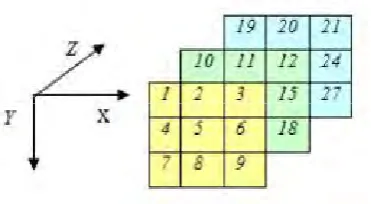
In the process of the proposed scheme implementation a three dimensional matrix is considered to store the initial plaintext. According to the mutual understanding of the sender and receiver the plaintext may be stored as row-major/column major fashion. Considering the three axis as the axis of rotation, X, Y and Z, and each layer as a rotatable plate. In the process of diffusion the text can be rotated in the clockwise rotation of 90/180/270° of particular plate at a particular axis.
Set AxisOfRotation = RAND_AXIS % 3 Set NumberOfRotations = RAND_ROT % 3
Set PlateNumber = (RAND_AXIS+RAND_ROT)%n
2.2 Encryption Process
In the process of encryption the plates can be rotated for number of rounds say n to get the text diffused. In order to collect the cipher text from the structure in the same row-major by column-major fashion as it was stored. The execution of the encryption process was experimented in C language. Random number have applications in statistical sampling, computer simulation, cryptography, completely randomized design, and other areas where producing an unpredictable result is desirable. In general, where unpredictability is paramount — such as in security applications — hardware generators are generally preferred. Random number generators are very useful in developing Monte Carlo-method simulations, as debugging is facilitated by the ability to run the same sequence of random numbers again by starting from the same random seed. They are also used in cryptography - so long as the seed is secret. Sender and receiver can generate the same set of numbers automatically to use as keys. This can be done by using a random number generating function which generates unique sequence of numbers each time. We can generate two random numbers at a time. First one is say RAND_AXIS and other one is RAND_ROT. The two numbers can be used alternatively to determine the plate number to be rotated. Minimum of 16 rotations for a 5x5x5 matrix are required to obtain the text diffusion. To obtain the plain text in the reverse procedure it is compulsory that seed value is to be known along with the cipher text at the receiver.
3. EXPERIMENTAL RESULTS
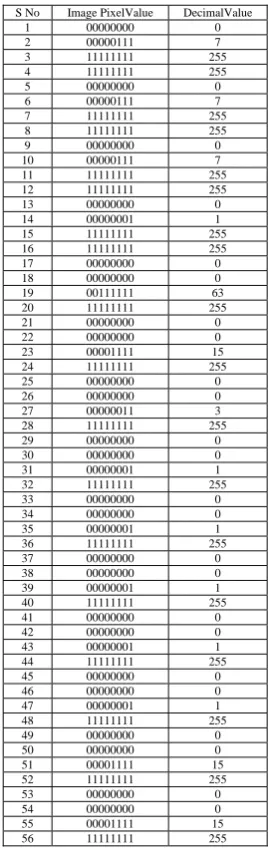
Table below represents the image pixel values calculated for an image of sixe 32 X 32 and their decimal values. The decimal values of the image pixels were depicted on the plates respectively.
S No Image PixelValue DecimalValue
1 00000000 0
2 00000111 7
3 11111111 255
4 11111111 255
5 00000000 0
6 00000111 7
7 11111111 255
8 11111111 255
9 00000000 0
10 00000111 7
11 11111111 255
12 11111111 255
13 00000000 0
14 00000001 1
15 11111111 255
16 11111111 255
17 00000000 0
18 00000000 0
19 00111111 63
20 11111111 255
21 00000000 0
22 00000000 0
23 00001111 15
24 11111111 255
25 00000000 0
26 00000000 0
27 00000011 3
28 11111111 255
29 00000000 0
30 00000000 0
31 00000001 1
32 11111111 255
33 00000000 0
34 00000000 0
35 00000001 1
36 11111111 255
37 00000000 0
38 00000000 0
39 00000001 1
40 11111111 255
41 00000000 0
42 00000000 0
43 00000001 1
44 11111111 255
45 00000000 0
46 00000000 0
47 00000001 1
48 11111111 255
49 00000000 0
50 00000000 0
51 00001111 15
S No Image PixelValue DecimalValue
57 00000000 0
58 00000000 0
59 11111111 255
60 00000011 3
61 00000000 0
62 00000000 0
63 00000101 5
64 11111111 255
65 01100000 96
66 00000000 0
67 00000011 3
68 11111111 255
69 11100000 224
70 00000000 0
71 00011001 25
72 11111111 255
73 11110000 240
74 00000000 0
75 00111101 61
76 11111111 255
77 11110000 240
78 00000000 0
79 00000111 7
80 11111111 255
81 11110000 240
82 00000000 0
83 00001111 15
84 11111111 255
85 11110000 240
86 00000000 0
87 00111111 63
88 11111111 255
89 11111000 248
90 00000000 0
91 00111111 63
92 11111111 255
93 11111100 252
94 00000000 0
95 00111111 63
96 11111111 255
97 11111110 254
98 00000000 0
99 00111111 63
100 11111111 255
101 11111110 254
102 00000000 0
103 00111111 63
104 11111111 255
105 11111110 254
106 00000000 0
107 00011111 31
108 00111111 63
109 11111111 255
110 00000000 0
111 00011111 31
112 11111111 255
113 11111111 255
114 00000000 0
115 00001111 15
116 11111111 255
117 11111111 255
118 00000000 0
119 00001111 15
120 11111111 255
121 11111111 255
122 00000000 0
123 00000111 7
124 11111111 255
125 11111111 255
126 00000000 0
127 00000111 7
CIPHER TEXT:
Location Cipher
Text Location
Cipher
Text Location
Cipher Text
105 254 37 0 79 63
26 0 32 255 118 0
115 15 27 3 67 3
116 255 20 255 64 255
121 255 119 15 39 1
24 255 18 0 8 255
45 0 17 0 117 255
86 0 2 7 82 0
91 63 103 63 69 224
16 255 14 1 44 255
111 31 113 255 9 0
70 0 66 0 46 0
61 0 71 25 107 31
114 0 98 0 74 0
11 255 43 1 49 0
22 0 88 255 10 7
97 254 83 15 25 0
36 255 78 0 102 0
81 240 73 240 123 7
6 7 68 255 124 255
21 0 63 5 125 255
122 0 58 0 100 255
23 15 53 0 31 1
104 255 48 255 90 0
101 254 87 63 85 240
96 255 38 0 80 255
7 255 33 0 75 61
108 63 28 255 112 255
109 255 15 255 65 96
110 0 56 255 60 3
41 0 13 0 55 15
34 0 12 255 50 0
93 252 3 255 77 240
94 0 120 255 40 255
95 63 19 63 35 1
72 255 54 0 30 0
59 255 29 0 1 0
62 0 4 255 106 0
57 0 99 63 51 15
52 255 42 0 76 255
47 1 89 248 5 0
92 255 84 255
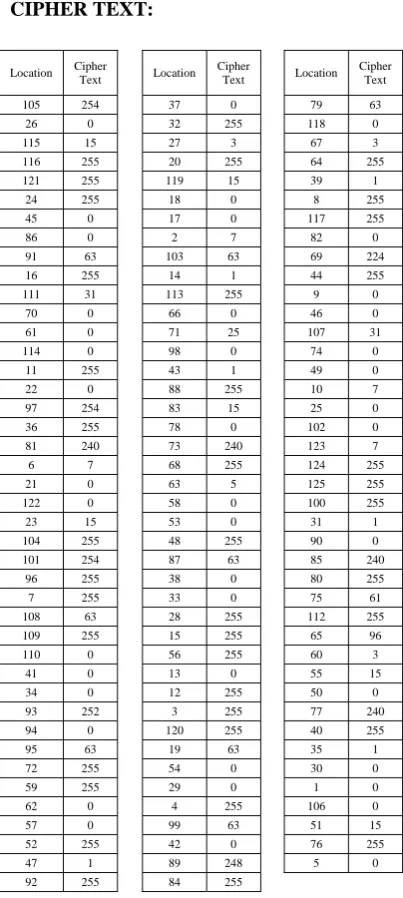
Table above denotes the location of the diffused text and its cipher value.
4. CONCLUSION
The above technique provides high rate of randomness of shuffled bits. It only requires seed value and number of rounds to be applied to send to receiver along with the cipher text to get back the plain text. The evaluation scheme can be extended for images of larger sizes.
5. FUTURE SCOPE
The future of the proposed scheme is that it can be extended for encrypting the video messages as well as sound encryption process.
ACKNOWLEDGEMENTS
REFERENCES
[1] Bruce Schneier, Applied Cryptography, John Wiley & Sons (Asia) Pte Ltd, ISBN 9971-51-348-X
[2] William Stallings, Cryptography and Network Security, Principles and Practices, Fourth Edition, Pearson Education. [3] A Cipher based on 3D array Block Rotation by P.R.Suri and Sukhvinder Singh Deora ; IJCSNS , Vol., no.2, February 2010. [4] Digital Image Processing by Jayaraman, Esakkirajan and Veerakumar Tata McGraw Hill.