RESEARCH ARTICLE
PERFORMANCE ANALYSIS OF RECONFIGURABLE COMMUNICATION SYSTEM BASED ON
DIVERSITY AND SPATIAL MULTIPLEXING
*Poongodi, C., Renuga Devi, M. and Sasireka, N.
Department of Electronic & Communication Engineering, Bannari Amman Institute of Technology,
Sathyamangalam, India
ARTICLE INFO
ABSTRACT
In mobile communication environment, the wireless channel is time varying due to the mobility of the wireless terminal and multi-path propagation. To provide wide area network coverage at true broadband data rates, both WiMAX and future versions of 3GPP must adopt Multiple Input Multiple Output (MIMO) and Adaptive Antenna Systems (AAS) technologies. So an algorithm for reconfigurable communication system based on both MIMO and AAS is proposed. In the proposed algorithm, either MIMO or AAS will used at a time according to the environment and has been experimented with direction of arrival estimation, beamforming techniques and also the performance of MIMO system analysis carried out in high scattering environment. Finally this paper investigates antenna grouping algorithms, which are hybrids of beamforming and spatial multiplexing. The performances of antenna grouping and MIMO systems arrays are evaluated using capacity as the metric.
Copyright©2017,Poongodi et al. This is an open access article distributed under the Creative Commons Attribution License, which permits unrestricted use, distribution, and reproduction in any medium, provided the original work is properly cited.
INTRODUCTION
Wireless is the most suitable means of communication for personal communication. Due to high spectral efficiency and reliable transmission of data, MIMO systems are used in wireless systems. In the last few years wireless services have become more and more important. Likewise the demand for higher network capacity and performance has been increased. In most wireless channels, no direct LOS propagation exists between the transmitter and receiver antennas because of natural and constructed obstacles. The transmitter signal may arrive at the receiver over many paths. This causes multi-path fading at a specific location and strength of the wave changes randomly. This multipath is often detrimental in case of single transmit and receive antennas. This unwanted is instead exploited in MIMO case to increase the channel capacity and quality (Paulraj et al., 2003). In MIMO, both transmitter and receiver are provided with more than one antenna. The wide area network is sometimes limited with only one or two dominant paths. In that case adaptive antenna system is used. The primary goal of adaptive antennas is the automatic generation of beams (beam forming) that track a desired signal and possibly reject interfering sources through linear combining of the signals captured by the different antennas (Waldschmidt et al., 2012).
*Corresponding author:Poongodi, C.,
Department of Electronic & Communication Engineering, Bannari Amman Institute of Technology, Sathyamangalam, India.
The algorithm used in this system is MVDR (Minimum Variance Distortion less Response). The power gain of the receiving signal for only one path (LOS) between transmitter and receiver is given by square root of Nt (number of transmit antennas) and Nr (number of receive antennas). For two dominant paths the power gain is reduced by half, so when the number of paths increases bit error rate (BER) also increases. Besides beam forming another application of antenna arrays is direction of arrival (DOA) estimation for source or target localization purposes (Waldschmidt et al., 2012). It has been shown that MIMO will give multiplexing gain and/or better quality of service. It has also been proved that AAS can provide improved spectral efficiency because AAS uses spatial multiplexing technique (Foschini and Gans, 1998; Paulraj, 2000). For rich scattering environment channel it is possible to increase the data rate by transmitting separate information streams on each antenna. Quality of service is improved through space diversity by transmitting same signal over multiple antennas. In general, good spectral efficiency results in worse BER performance in a spatial multiplexing system, whereas good BER performance leads to lower spectral efficiency in a diversity system. MIMO system with known channel state information at the transmitter improves BER but reduces spectral efficiency. When high spectral efficiency is needed, a hybrid scheme of beam forming and spatial multiplexing is desired. An antenna grouping technique is a combination of beam forming and spatial multiplexing which increases system performance when the number of transmit
ISSN: 0976-3376
Asian Journal of Science and Technology Vol. 08, Issue, 04, pp.4679-4684, April,2017Available Online at http://www.journalajst.com
ASIAN JOURNAL OF
SCIENCE AND TECHNOLOGY
Article History:
Received 19th January, 2017
Received in revised form
25th February, 2017
Accepted 29th March, 2017
Published online 30thApril, 2017
Key words:
antenna is greater than number of receive antennas (Kim et al.,
2007). So the investigation has been carried out on antenna-grouping algorithms, in which the number of transmit antennas are partitioned into several groups and beam forming technique used within the groups and spatial multiplexing between the groups. With antenna grouping, it can be achieved diversity gain through beam forming and spectral efficiency through spatial multiplexing. In this paper, four algorithms are analyzed for antenna grouping technique and channel capacity is calculated for these algorithms. The organization of the paper is as follows. Section II discusses the proposed algorithm for selection MIMO/Adaptive Antenna System. Section III briefly reviews the performance analysis of MIMO systems in terms of channel capacity with mutual coupling and antenna grouping techniques based on spatial correlation matrix. Section IV discusses the results.
An Algorithm for Reconfigurable Communication System
This paper proposes an algorithm for reconfigurable communication system based on both MIMO and AAS systems (Leveraging MIMO in wide-Area Networks, 2005).
Algorithm for Proposed Method
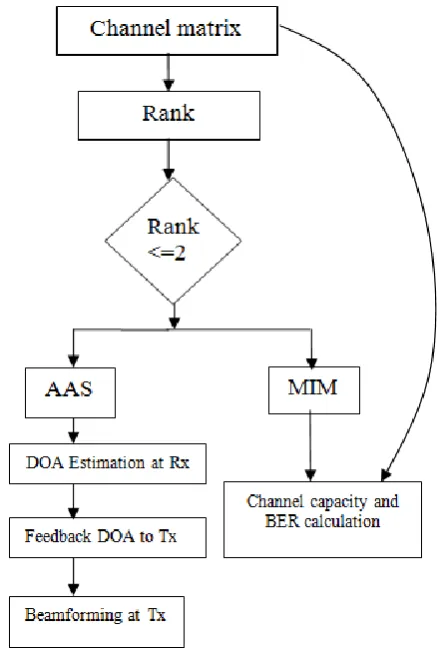
MIMO performs well in scattering rich environment. But AAS performs well, when there are only one or two dominant paths between transmitter and receiver. The transmitter has no knowledge of the channel state. Knowledge of the channel state can be made available to the transmitter by estimating the channel matrix H at the receiver and then sending this estimate to the transmitter via a feedback channel. The received signal contains both direct path and multi-path signals which are from various direction of arrivals (). So the selection of any one system out of MIMO/AAS will be based on number of scattering paths. Flow chart for selection of MIMO/AAS system is shown in figure 1.
Steps in this algorithm are:
Step 1: Channel matrix estimation. Step 2: Rank calculation.
Rank of the matrix depends upon the number of scattering paths, for distinguish path the rank is of full.
For one or two dominant path, rank will be less than or equal to 2, In that case adaptive antenna system is used. The main function of AAS is beam forming.
For beam forming, DOA is estimated at the receiver, and then this information is sent to the transmitter via a feedback signal.
Finally, beam forming is performed at the transmitter which tracks the desired signal and rejects the interference signal.
Step 3: For MIMO system, channel capacity is used to analyze the performance of the system.
MUSIC, ESPRIT and MVDR based DOA Estimation
The estimation of the direction of arrival of a signal is of great importance. There are many DOA estimation algorithms, among them MUSIC, ESPRIT and MVDR are the best. These
algorithms are based on eigen value decomposition of the correlation matrix of noise corrupted signal (Ralph Schmidt, 1986) and estimate the DOA in noise subspace, which is defined by the eigen vectors of covariance matrix of the sampled signal. The angle of DOA values for a typical input signal x(n) is given in Table 1. The direction of arrival for the input signal x(n) using MVDR is shown in figure 2. Finally beamforming is performed at the transmitter to transmit data based on direction of arrival estimation algorithms.
Figure 1. Flow chart for selection of MIMO/AAS system
Figure 2. Spatial spectrum of MVDR based DOA estimation.
Adaptive Beam Forming using LMS Algorithm
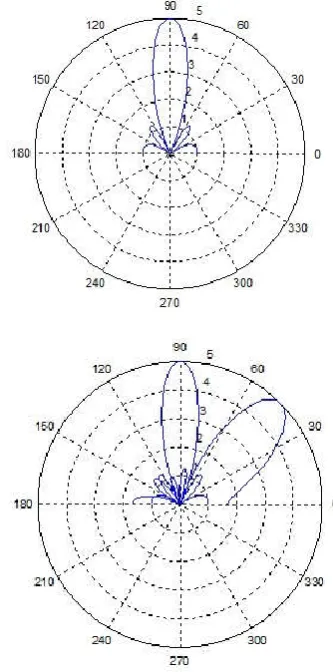
Here MVDR based Least Mean Squares (LMS) algorithm is used for adaptive beamforming. The purpose of beamforming is to form a multiple beams towards desired users while nulling the interferers at the same time, through the adjustment of the beamformer’s weight vectors. If the numbers of paths are greater than two then it selects MIMO system.
Channel capacity of MIMO system based on Antenna Grouping Techniques
MIMO System Model
In MIMO system, multiple antennas are placed within a finite length to form a uniform linear array. The narrowband wireless communication system is built around a flat fading channel with Nt transmit antennas and Nr receive antennas. The number of transmit and receive antennas are placed in uniform linear array of normalized length Lt and Lr respectively. The complex envelope of the received signal at the antenna array after matched filtering is given by
y = Hx + v ………... (1)
Where x is the transmit vector, yis the receive vector, H is the N ×Nt r channel matrix, and
v
is the additive whiteGaussian noise (AWGN) vector at a given instant in time. It is assumed that the channel matrix is random and that the receiver has perfect channel knowledge (Martin et al., 2001). It is also assumed that the channel is memory less, i.e., for each use of the channel an independent realization of H is drawn. A general entry of the channel matrix is denoted by hij.
This represents the complex gain of the channel between the jth transmitter and the ith receiver and channel matrix is written as 11 1 1
n m mnh
h
H
h
h
………... (2)In a rich scattering environment with no LOS, the channel gains are usually independent identically distributed Gaussian random variables.
MIMO channel capacity
For a narrow band MIMO channel, when CSI is not known at the transmitter, the capacity is given by (Svantesson and Ranheim, 2001) N HH I E
C log2 det Nr ………... (3)
Where is the average signal to noise ratio at each receiver and N=min(Nt, Nr), Nt and Nr are the number of transmitting and receiving antennas respectively.
More often each element of H is taken to be i.i.d complex gaussian distributed random variable signifying that each pair of transmit and receive antennas experiences independent fading. But, this is not true in practical situation. Because of spacing and mutual coupling between the elements, independent fading is not a valid assumption. Now the capacity is modified with mutual coupling as
2
log det /
r
N mc mc
C E I H H N
………. (4)
This capacity is computed for a large number of channel realizations. The channel capacity depends upon the number of transmit and receive elements. When the number of elements increases the capacity also increases. But real channels do not satisfy these ideal assumptions, so to include the channel characteristics, the realistic channel models are used in the simulation (Svantesson, 2001). It is a widely used model for outdoor environment. To include the channel characteristics, the one ring channel model proposed in (Ordonez et al., 2009) is used here in the simulation. It is a widely used model for microcell and picocell environment. This scenario has multiple transmit antennas at the mobile and base station and ‘Ns’ number of scatterers around the mobile terminal. Performance of this realistic channel is always less than ideal channel. It is well known that the channel information known at the transmitter improves system performance which requires channel feedback. It is called a closed-loop (CL) system, and beamforming is a type of a CL system. In highly correlated channels, beamforming is known to be the best transmission strategy in terms of BER. However, the spectral efficiency may be low since only one data stream is transmitted from the transmit antennas. In weakly correlated channels, beamforming alone may result in poor overall performance. When higher spectral efficiency is needed, a hybrid scheme of beamforming and spatial multiplexing is desired.
Antenna Grouping Algorithms
In antenna grouping system, transmit antennas are partitioned into small groups. The antennas in each group are used for beamforming, and an independent data stream is transmitted in each group. The criterion used in (Kim et al., 2007) is to maximize the sum capacity of subchannels. For a given channel, a receiver considers all possible cases of grouping, calculates the beamforming vector for each case, and adds up the subchannel capacities. The receiver sends the best beamforming matrix that maximizes the sum capacity of subchannels to the transmitter, which uses the matrix for transmission. The computational complexity of the algorithm is high because the Singular Value Decomposition (SVD) needs to be calculated for every grouping (Ordonez et al.,
2009).
Table 1. DOA estimation using MUSIC, ESPRIT and MVDR algorithms
No. of signals input (deg) MUSIC (deg) ESPRIT (deg) MVDR (deg)
1 30 29.989 30.002 30.001
2 30 & 60 29.806 & 60.12 30.012 & 59.9743 30.004 &60.05
Maximization of the Sum Capacity of Subchannels (MSCS)
The sum capacity of subchannels is approximated by
Nr 1
i i i
H i H i r ,..w w , w w H H w N ρ 1 log
C 1 2 Nr ……… (5)
where ρ is the SNR. To maximize (5), search for the subchannel group that maximizes (6). In this algorithm, beamforming vectors are computed for every possible grouping by finding SVD of Hi. Here only adjacent antennas are grouped to reduce the complexity. Since (Martin et al.,
2001) is approximation, this is not optimal interms of capacity.
r
N
i i i
H i H
i H H w
w
1
……….. (6)
Maximization of the Minimum Euclidean Distance of Receive Constellations (MMED)
The minimum Euclidean distance of receive constellation is calculated (Svantesson, 2001) as
r 2 xj xi X, xj xi, 2 min N xj) HW(xi min
d
………..… (7)
Steps in this algorithm:
Calculate the corresponding beamforming vectors by SVD for all possible sub channel groups.
Compute the effective channel HW.
Calculate the minimum Euclidean distance of receive constellation for every possible HW, and find the best sub channels Hi’s and W that maximize (7).
Here minimum Euclidean distance is calculated for every possible pair wise combination of constellation, it gives best performance at high SNR. But this method is complex if the number of antennas is large or the modulation order is high.
Maximization of the Minimum Singular Value of an Effective Channel (MMSV)
A MIMO channel can be decomposed into multiple single input single output channels by SVD and the received SNR is proportional to the squared singular value of a channel.
Steps in this Algorithm:
Compute an effective channel HW for all possible groups and sub channel weight vectors.
Find the minimum singular value of each HW and select the best W that maximizes the minimum singular value.
Maximization of the Capacity (MC)
This algorithm considers the overall channel capacity. As in other algorithms, for every possible effective channel HW, channel capacity is calculated
w H Hw
N I
C H H
r Nr
det
log ………. (8)
Where ρ=1/σ2n is the SNR and then select the transmit antenna grouping and the beamforming vectors that maximize (8).
RESULTS AND DISCUSSION
An algorithm for reconfigurable communication system based on MIMO/ AAS is simulated using MATLAB software and the results are shown in table 2. This algorithm selects either MIMO or AAS system based on number of scattering paths and also it estimates direction of arrival angles, radiated power half power beamwidth and first null beamwidth for Adaptive antenna system.
Figure 3. transmit beam pattern of AAS system using MVDR based LMS algorithm
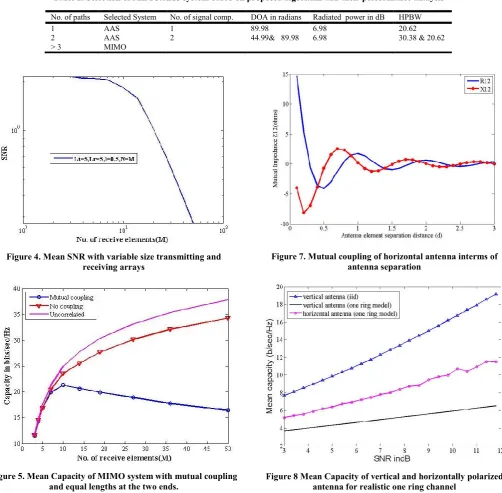
Figure 4. Mean SNR with variable size transmitting and receiving arrays
Figure 5. Mean Capacity of MIMO system with mutual coupling and equal lengths at the two ends.
Figure 6. Mutual coupling of vertical antenna interms of antenna separation
Figure 7. Mutual coupling of horizontal antenna interms of antenna separation
Figure 8 Mean Capacity of vertical and horizontally polarized antenna for realistic one ring channel
Figure 9 Performance analysis of antenna grouping algorithms
for a 4 × 2 MIMO system
Table 2. Selection of MIMO/AAS system based on proposed algorithm and their performance analysis
No. of paths Selected System No. of signal comp. DOA in radians Radiated power in dB HPBW
1 AAS 1 89.98 6.98 20.62
2 AAS 2 44.99& 89.98 6.98 30.38 & 20.62
Figure 5 shows the mean capacity versus number of receive antennas for NT=5, SNR=10db, dt=1.25 λ and Lt =5 λ. The
number of receive antennas are varied from 1 to 50 and the corresponding capacity is plotted for independent identically distributed channel model. It has been observed that if the spacing between antenna elements is less than 0.5 λ then the effect of mutual coupling is more. The effect of mutual coupling in the case of horizontally and vertically polarized antennas are calculated and the results are shown in figure 6 and figure 7. It shows that when the spacing between antenna elements increases, the mutual coupling decreases. The MIMO system capacity of vertical and horizontal polarized antenna has been analyzed for realistic one ring channel model and these results are shown in figure 8. In one ring channel model, the distance between BS and MS are assumed to be 5km. About 40 scatterers are uniformly distributed within a ring of radius 0.5 km. The frequency of operation is 5 GHz. The SNR is varied from 3 to 12 dB and the number of elements on the transmit side and the receive side is taken to be four. The horizontally polarized antennas perform well compared to vertical arrangement. This is possibly due to the fact that the horizontal antenna has very little mutual coupling than the vertical antenna. Figure 9 shows antenna grouping algorithms based on beamforming and spatial multiplexing for a 4 × 2 MIMO system. This antenna grouping techniques are compared with highly correlated MIMO channel with and without mutual coupling and spatial correlation parameters. The capacity values of four different algorithms are clearly shown in figure 10, which indicates that minimum euclidean distance method gives higher results.
Figure 10. Capacity values of four different antenna grouping techniques
Conclusion
This paper proposed an algorithm for reconfigurable communication system based on MIMO and AAS. The performance of the proposed system has been analyzed using DOA estimation algorithms and LMS based beamforming techniques.
In addition to this, MIMO capacity of vertical and horizontally polarized array configurations are evaluated using Monte Carlo simulations which show that horizontal arrangement offer better capacity result than vertical arrangement. The Mean Capacity of MIMO based on antenna grouping algorithms also evaluated using four different algorithms and minimum euclidean distance based algorithm gives better results compare to other algorithms.
REFERENCES
Balanis, C. A. 1997. Antenna Theory: Analysis and Design. New York: Wiley.
Foschini, G.J.and M.J. Gans, 1998. On limits of wireless communications in a fading environment when using multiple antennas. Wireless Pers. Communication, vol.6, pp.311-335.
Kim, I., K. Lee, and J. Chun, 2007. A MIMO antenna structure that combines transmit beamforming and spatial multiplexing. IEEE Trans. Wireless Commun., vol. 6, no. 3, pp. 775–779.
Kyungchul Kim, Jungwoo Lee, and Huaping Liu, 2010. Spatial-Correlation-Based Antenna Grouping for MIMO Systems. IEEE transactions on vehicular technology, vol.59, no. 6,pp.2898-2905.
Leveraging MIMO in wide-Area Networks, 2005. Array Comm. LLC, All Rights Reserved.
Martin. C. C., J. H. Winters and N. R. Sollenberger. 2001. MIMO radio channel measurements: Performance comparison of antenna configurations. in Proc. IEEE 54th Veh. Technol. Conf., vol.2, Atlantic City, NJ, Oct. 7–11, pp. 1225–1229.
Ordonez, L. G., D. P. Palomar, A. Pages-Zamora, and J. R. Fonollosa, 2009. Minimum BER linear MIMO transceivers with adaptive number of substreams. IEEE Trans. Signal Process., vol. 57, no. 6, pp. 2336–2353.
Paulraj, A., R. Nabar and D. Gore, 2003. Introduction to Space-Time Wireless Communications. Cambridge University Press.
Paulraj, A.J. 2000. Smart Antennas for Mobile Communications. Encyclopedia for Electrical Engineering, John Wiley Publishing Cooperation.
Ralph O. Schmidt, 1986. Multiple Emitter Location and Signal Parameter Estimation. IEEE Trans.on Antenna and Propagation, Vol.AP- 34,No.3, Page No. 276- 280.
Svantesson, T. 2001. A physical MIMO radio channel model for multi-element multi-polarized antenna systems. in Proc. IEEE 54th Veh. Technol. Conf., vol. 2, Atlantic City, NJ, Oct. 7–11,pp. 1083–1087.
Svantesson, T. and A. Ranheim, 2001. Mutual coupling effects on the capacity of multielement antenna systems. in Proc. IEEE Int. Conf. Acoustics, Speach, and Signal Processing, vol. 4, Salt Lake City, UT, May 7–11, 2001, pp. 2485– 2488.
Waldschmidt, C., T. Fugen, and W. Wiesbeck, 2002. Spiral and dipole antennas for indoor MIMO-systems. IEEE Antennas Wireless Propagat. Lett., vol. 1, no. 1, pp. 176– 178.