© 2018 IJSRSET | Volume 4 | Issue 7 | Print ISSN: 2395-1990 | Online ISSN : 2394-4099 Themed Section : Engineering and Technology
An IoT Based Digital Notice Display and Announcement system
on Linux Platform with Raspberry pi
Prashant C. Chaudhari, Rishabh G. Sontakke, Rahul Y. Muneshwar, Kiran Gotmare
Computer Science and Engineering, Abha Gaikwad Patil College of Engineering, Nagpur, Maharashtra, India
ABSTRACT
This paper is introducing a new notice system which does not require reaching to the display or any
pinning or pasting of papers anywhere. The system is consists of the voice alert notice which can be
built on single board known as Raspberry Pi which includes ARM8 quad core processor from
Broadcom. So, the entire development will be on the linux based operating system and the hardware
module is selected as Raspberry Pi. The new system is consist of a text to voice feature, also the
message will can be remotely send through email.
Keywords:
ARM8, OS, Raspberry Pi, TTS, speaker, Email
I.
INTRODUCTION
Notice Boards are an important medium for displaying information and keeping people informed. The traditional notice boards involve the pinning up of printed or handwritten information on a board. But this has the disadvantages of dependency on a person for pinning up notices and wastage of paper. Some developments in notice boards, in an attempt to overcome above-mentioned drawbacks, include display of data on a screen using wireless communication. This has been implemented on Liquid Crystal Displays (LCD) and Light Emitting Diode displays. Some of the available methods can display only one message at a time. In the method, 16x2 character LCD has been used. The disadvantage of this system is that in order to view the message, the observer should be very close to the screen. With new day technology there some digital notice boards that are becomes very famous. It includes led display notice boards. But problem is the same that one has to reach to display to take notice on it.
Simple PA systems are often used in small venues such as school auditoriums, churches, and small bars. PA systems with many speakers are widely used to make
announcements in public, institutional and
commercial buildings and locations, such as schools, stadiums and large passenger vessels and aircraft. Intercom systems, installed in many buildings, have
both speakers throughout a building, and
microphones in many rooms allowing the occupants to respond to announcements.
The Raspberry Pi is a low cost, credit-card sized computer that plugs into a computer monitor or TV, and uses a standard keyboard and mouse. It is a capable little device that enables people of all ages to explore computing, and to learn how to program in languages like Scratch and Python. It’s capable of doing everything you’d expect a desktop computer to do, from browsing the internet and playing high-definition video, to making spread sheets, word-processing, and playing games.
What’s more, the Raspberry Pi has the ability to interact with the outside world, and has been used in a wide array of digital maker projects, from music machines and parent detectors to weather stations and tweeting birdhouses with infra-red cameras.
II.
PROPOSED WORK
2.1. Overview
The proposed system is aimed at designing and development of voice alert notice or a notice announcement system which can be solve the problems as mentioned in the above chapter. The system will built on single board known as Raspberry Pi which includes ARM8 quad core processor from Broadcom which satisfy the size and also low cost. The notices will directly receive to the system by a wireless mean of SMS or an Email. So the user can send any notice to the system from the remote place.
2.2. Proposed System
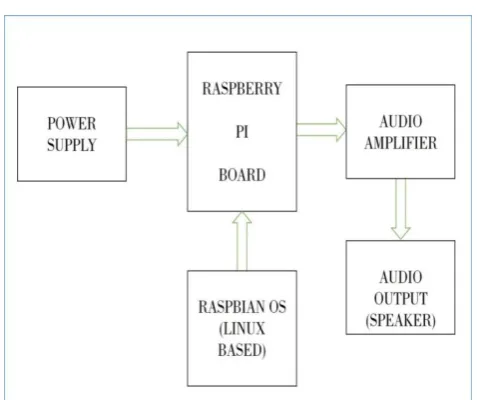
Figure 2.1: Proposed Block Diagram
Proposed system includes the raspberry pi board as the main controlling hardware unit which has the ARM8 microprocessor architecture. The board needs the operating system, hence we will use the RASPBIAN operating system which is based on the linux OS. The system should work for notice announcement, hence the speakers are connected as audio output. The output of the raspberry pi board is too small as we can only listen the audio in headphone from raspberry pi. Hence we are using here an audio amplifier circuit to enhance the volume through Raspberry pi. The power requirement of the raspberry pi board only 10 watt, but it should a regulated dc. Hence we are using 10 watt SMPS power supply to run the module.
III.
METHODOLOGY
The proposed system is divided in the following modules,
Preparation Of Raspberry Pi Module
Development Of Algorithm For Message
Receiving
Development Of Algorithm For Text To Voice Conversion
Development Of Audio Amplification
3.1. Preparation of Raspberry Pi Module
To start working on Raspberry Pi module, one has to choose which version of it should be used for our development purpose. After this, the next step is to select the operating system for it. As, there are lots of operating system for Raspberry Pi to work on from which all of them are open source. So choosing right RPi module with right OS, one has to prepare it for our first use.
3.2. Development Of Algorithm For Message
Receiving
In this project, we are going to develop an algorithm for receiving the message, that should be spoken or its announcement has to be perform. With the developing algorithm, it should receive the message wirelessly either with SMS or and E-mail. For this the code will be in the python Language, as most of the systems with RPi are developed in python language, there is huge support for python development in RPi.
3.3. Development Of Algorithm For Text to voice
conversion Conversion
The notice should be announce automatically through RPi, hence one has to develop an algorithm which can automatically give the output of the system in the voice form. Therefor as the message will receive in the text form, it will be spoken by the system or announce by the system which is developed on ARM based raspberry pi on linux based OS.
3.4. Development Of Audio Amplification
As, RPi module is work on the 5V regulated DC power supply, it can’t be possible to use or connect the huge speakers directly to the output of raspberry pi, we have to develop an amplifier to make the sound output from RPi in the audible form or level. Hence at the last in the system that is after the development of system, one has to move towards the making of sound to the audible range for particular or defined area.
IV.
RESULT AND DISCUSSION
Setup of project is shown below which allow us to take the final results for this research work
Figure 4.1: Project Setup
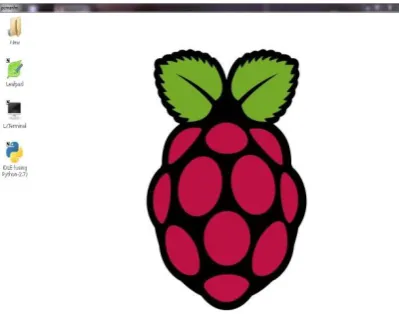
At first, we have to start the raspberry pi module with the internet connection and 10w power supply. When it get started it would looks like the following window,
Then open the python idle software to open the program and then press F5 to run the program in
python shell,
After that send the message from your device such as smartphone, Iphone or a personal computer runs on windows, linux or mac-os as follows,
When, the system receives an email that has sent from user, it will receive and then fetch it. It start reading mail in the voice form and then display the message that the user sent to the system. Also if the user has attach any image with the same mail, it w3ill also display on the GUI designed itself.
V.
CONCLUSION
A voice announcement of notice with raspberry pi has been presented in this project. It offers an edge over other traditional notice boards as well as the new era of digital notice boards because of features such as an announcement of notice that it received without any person to speak it and send message with user’s cell which a common thing that carry every human being with them. The size and cost is very low as compared to other display that gives visual output not the audio. The system has capable to give the output in audio as well as a visual output.
VI.
REFERENCES
[1]. Dharmendra Kumar Sharma, Vineet Tiwari#, Krishan Kumar, B. A. Botre, S.A. Akbar, “Small and Medium Range Wireless Electronic Notice Board using Bluetooth and ZigBee” 978-1-4673-6540-6/15/$31.00 ©2015 IEEE
[2]. Yash Teckchandani, G. Siva Perumal, Radhika Mujumdar, Sridhar Lokanathan, “Large Screen Wireless Notice Display System” 2015 IEEE International Conference on Computational Intelligence and Computing Research
[3]. Sarthak Jain, Anant Vaibhav, Lovely Goyal,
“Raspberry Pi based Interactive Home
Automation System through E-mail”, 2014 International Conference on Reliability, Optimization and Information Technology - ICROIT 2014, India, Feb 6-8 2014
[4]. Abdul Rawoof, Kulesh, Kailash Chandra Ray, “ARM based implementation of Text-To-Speech (TTS) for real time Embedded System”, 2014 Fifth International Conference on Signals and Image Processing
[5]. Michal Swiatkowski, Klaudiusz Wozniak, and Lukasz Olczyk, “Student Notice Board Based on LED Matrix System Controlled over TCP/IP Protocol”, 2006 International Students and Young Scientists Workshop, Photonics and Microsystems
[6]. Darshankumar C. Dalwadi, Ninad Trivedi, Amit Kasundra “Wireless notice board our real-time solution” National Conference on Recent Trends in Engineering & Technology Nivetha S. R, Pujitha. R, Preethi Selvaraj & Yashvanthini S.M “SMS based Wireless Notice board with monitoring system” International Journal of
Advanced Electrical and Electronics
Engineering, (IJAEEE) ISSN (Print): 2278-8948, Volume-2, Issue-3, 2013.
[7]. Price of Basys™2 Spartan-3E FPGA Board
retrieved on 13th August 2014 from
http://www.digilentinc.com/Products/Detail.cf m?Prod=BASYS2&NavTop=2&NavSub=649&CF ID=18448141&CFTOKEN=9715b5fba0c2d007-574B45C2-505602010
[9]. Ali M., V laskamp J.H.A, Eddiny N.N. , Falconer B. and Oram c., "Technical Development and Socioeconomic Implications of the Raspberry Pi as a Learning Tool in Developing Countries",
5th Computer Science and Electronic
Engineering Conference (CEEC), pp. 103- 108,2013.
[10]. Ardam H. and Coskun I., "A remote controller for home and office appliances by telephone", IEEE Transactions on Consumer Electronics, vol. 44, no. 4,pp. 1291-1297, 1998.
[11]. Baudel T. and Beaudouin-Lafon M., "Charade: remote control of objects using free-hand gestures", Communications of the ACM, voI. 36,no. 7,pp. 28-35, 1993.