Higher Education versus Work Experience: A Study of Business Owners and Employees
Sanhachuta Suksomlert (The Institute of International Studies Ramkhamhaeng University Bangkok, Thailand)
Bahaudin G. Mujtaba (H. Wayne Huizenga School of Business and Entrepreneurship, Nova Southeastern University Fort Lauderdale, Florida, United States)
244 Author (s)
Sanhachuta Suksomlert The Institute of International Studies Ramkhamhaeng University
Bangkok, Thailand
Email: [email protected]
Bahaudin G. Mujtaba
H. Wayne Huizenga School of Business and Entrepreneurship Nova Southeastern University Fort Lauderdale, Florida, USA
Email: [email protected]
Higher Education versus Work Experience: A Study of Business Owners and Employees
Abstract
Landing a goodjob in a down economy can be challenging and competitive. Many, but certainly not all, positions will require a college degree in addition to some level of work experience. This study investigates several variables to better understand the importance of candidates’ qualifications in terms of work experience and higher education. The study is based on a total of 400 respondents using a quantitative methodology using descriptive statistics, one-way analysis of variance (ANOVA), t-test, and Pearson’s correlation method for testing purposes.Most respondents surveyed were company officers. The study found that most respondents thought work experience wasmore important than higher education.This research discusses the implications and recommendations for employees, managers, and administrators of modern organizations for recruitment and selection process.
Keywords: Work Experience, Education, College Degree, Satisfaction, Employee Selection.
Introduction
In today’s business environment, the recruitment of an organization or company is more importantthanever before as there is more competition for the best talent. Human resources professionals must have effective strategies for properly dealing with employees andby encouraging them to maximize their performance in the organization. The purpose of this research is to shed light on the issue of recruiting employeesin the organization based on experience and education. The focus is on a sample population from the culture and country of Thailand. Thailand faces a pronounced shortage of skilled labor, with too few skilled candidates for the many existing job openings. Suitable candidates are difficult to acquire, making each skilled employee a valuable asset. With the competition for qualified candidates so high in Thailand, companies are utilizing a variety of measures to recruit employees.
This study investigates the following research questions:1. which is more important in the organization during the recruitment and hiring
process: highereducation or work experience? 2. How do the variables of higher education and work experience affect one’s career? This research studies the impact of higher education and work experience and the following hypotheses are proposed:
1. Most companies will rate higher education as very important when recruiting and selecting employees. 2. Most companies will rate five or more
years of work experience as very important when recruiting and selecting employees.
3. Candidates with higher education will be given higher level management responsibilities.
4. Candidates with five or more years of work experience will be given higher level management responsibilities.
245 process through written questionnaires,
observations and interviews.
Furthermore, the study provides an overview of the existing problems, threats, and opportunities to recruiting and it offers specific
recommendations for managers and
administrators working in modern
organizations. Of course, employees, managers, and administrators of any organization will be able to benefit from the findings of this study to understand the importance of selecting candidates.
This is quite an interesting topic regarding work experience and higher education since the two are connected, yet both are often applied differently (Mujtaba, 2005). It is true that when searching for a job, many employers ask for experience in the job field, but experience is not always going to get you the job. As great as it is to have the experience needed to do a job, this won’t the matter when education keeps constantly changing and more and more people gain knowledge of a job from higher education.
It’s true that many jobs now, require experience in order to be hired, however, not all of the experience gathered throughout the years will work with various careers and job offers. Some of the jobs now require information and competency that can only be gathered with education. Education is as important when it comes to jobs as experience and this is why administrators and faculty members regularly assess the outcomes achieved by their students (Mujtaba and McAtavey, 2006; Mujtaba and Preziosi, 2006). The main difference between experience and education is that education constantly changes and evolves just like jobs and careers.
As an economy develops, changes in the structure of employment mean more job opportunities in middle level technical fields such as clerical workers and various kinds of service workers. Such work often requires at least lower secondary education. As economic development takes place, even farmers, who traditionally were not considered to need education, do in fact need, at the very least, to be literate and numerate. Increasing use of
fertilizers and pesticides, increased agricultural extension activities, and increased complexity of marketing arrangements require higher levels of education in order to meet the inspection standards set by government officials.
For countries which aspire to take full advantage of the opportunities of economic growth afforded by globalization and to avoid its adverse side effects, the expansion of lower secondary education has become crucial. Primary schooling alone cannot provide the insights, skills and competencies needed. Provision of universal lower secondary education implies greater competency among those entering the workforce after completing basic education, and enables the higher levels of education to draw on a larger pool of eligible students.
Education has its benefits in teaching and reinforcing good work habits, such as organization, meeting deadlines and processing information. However, education is a weak substitute for experience in obtaining jobs and career advancement. As beneficial as education might be, it does not always adequately prepare future breadwinners for the work world.
Structure of the Thai Higher Education System
Bangkok is the economic center of Thailand, dominating the country's economy and dwarfing any other urban centers. Development continues to pour in to Bangkok mostly neglecting the rest of the nation. It is ranked as the 54thrichest urban agglomeration, slightly behind Singapore and Metro Manila in the Philippines. Areas such as Silom-Sathon and Asok have for decades been Thailand's business center. The most important business districts of Bangkok include Silom, Bangrak, Pinklao, Sathon, Phra Ram 2, Phetchaburi, Phra Nakhon, Pathumwan, Chatuchak (new central business district), and Phra Ram 3 (new financial center).
246 growth in recent years, future performance
depends on moving up on the value-added ladder away from low-wage industries where regional competition is growing. Key reforms are needed to open the financial sector; improve the foreign investment climate, including updating telecommunications capabilities; and stimulate domestic investment and consumption to balance reliance on exports. Logistics networks and electricity generation increasingly run the risk of bottlenecks and may pose a challenge to growth. Thailand's relative shortage of engineers and skilled technical personnel may limit its future technological creativity and productivity.
In Thailand, there are two main streams of higher education: diploma and degree. The diploma level is attained primarily by students who have pursued a vocational path in high school. It takes between one to four years to complete. Diploma courses are aimed at developing basic skills required to satisfy immediate semi-skilled labor market demands. Diploma holders have an option of pursuing two additional years of courses to attain a Bachelor’s degree, enabling students to cross over from diploma to degree streams.
The degree level consists of undergraduate and graduate coursework. Most undergraduate degrees focus on developing general skills and providing broader knowledge. Students who attain a degree are expected to apply theories to practice in their own as well as across other disciplines. The majority of these degrees are
offered in four years, but those who pursue degrees in medicine and architecture normally take longer. Graduate level coursework provides students with in-depth knowledge in their specific field of study. Thailand currently suffers from a severe imbalance between undergraduate and graduate education. A small number of students enroll in Master’s degree programs and even fewer in doctoral degree programs. Today, the number of doctoral graduates is inadequate to replace retiring professors since only a fraction of these graduates choose teaching as a profession. It is expected that the situation is likely to deteriorate over the next five years as the number of faculty members expected to retire will increase to around 800 per year (Source: Ministry of University Affairs).
Thailand’s higher education system is comprised of 166 postsecondary institutions and two autonomous Buddhist Universities (see Figure 1). Public institutions can be classified into: (a) limited admissions universities, (b) open admissions universities, (c) autonomous universities, and (d) community colleges. Private institutions are grouped into two categories: (a) universities and (b) colleges. During the past decade, we have observed significant growth in the higher education sector. Between 2003 and 2008, 46 new higher education institutions were inaugurated, including 19 community colleges. Although roughly equivalent in terms of numbers (78 public versus 69 private institutions), public universities enroll about 80 percent of students (Figure 2).
247
*Excludes two autonomous Buddhist Universities Source: Commission on Higher Education, 2009
Figure-2 Students In Higher Education, 1971–2006
Source: Ministry of Education, 2007
Student enrollment in higher education institutions, including those attending Open Admissions Universities, increased from 1,872,000 in 2001 to 2,430,600 in 2006. This growth pattern in higher education is likely to continue as it is estimated that high school graduates will increase from 0.7 million in 2000 to 1.8 million in 2016, an increase of 150 percent in 15 years (Ministry of Education, 2007).
Almost 50 percent of Thailand’s higher education institutions are located in Bangkok where 10 percent of the population resides. While there has been a recent expansion of higher education access at the provincial level, the east region has only a small number of institutions (Figure 3). Many provincial institutions also face academic staff shortages and, as a result, many qualified students, migrate to Bangkok and other big cities looking for quality higher education.
Figure-3 Higher Education Institutions by Region
Source: Commission on Higher Education, 2008
Higher education is a key to success both within and outside of the corporate world. Some qualifications are highly sought after and rewarded. A professional degree is particularly
248 management and executive levels in record time
(Teowkul, Seributra, Sangkaworn,
Jivasantikarn, Denvilai, and Mujtaba, 2009).
Recruiting the Best Employees for Business
Thailand faces a shortage of skilled labor, with too few skilled candidates for the many existing job openings. Suitable candidates are difficult to acquire, making each skilled employee a valuable asset. With the competition for qualified candidates so high in Thailand, companies are utilizing a variety of measures to recruit employees. Large firms typically promote from within when management vacancies appear. However, this option is not always available to small businesses. Other options include using university alumni associations that sponsor job placement programs, poaching from other firms, hiring Western-educated Thais, or employing expatriates. To find candidates, companies advertise in both local and campus newspapers, and hire local headhunters or overseas agents based in college towns. While smaller companies tend to search for employees independently, there is a growing trend in hiring executive-search companies; the shortage of managerial talent renders it difficult for a small company to find a qualified match independently. Attendance at job fairs is another method of recruitment, where representatives from various international and Thai companies set up booths to provide information about their company and conduct on-site interviews with attendees.
In order to find a staff that is both qualified and trained, most businesses will look to similar firms within the industry. In order to lure employees away from their current employers, the new company will need to at least offer higher pay and greater benefits. Thai loyalties have traditionally been directed toward the person who hired them. Even personal loyalty does not always ensure a positive outcome in today’s market, as workers can be persuaded by the most attractive offer.
Private enterprises can afford to offer higher wages and attractive benefits, and therefore have the ability to attract employees away
from the public sector. To alleviate depletion of its talent, the government requests the private sector cooperate on measures such as moderating salary levels for highly specialized personnel. Allowing private sector employees to perform temporary projects for the government and vice versa has served as another technique for retaining key talent. Moreover, despite the monetary gains of private enterprise employment, workers who value long-term stability and a better healthcare plan may prefer to stay in the public sector. While recruiting foreign nationals from another firm may provide an educated, qualified candidate with related experience, it does have its drawbacks. Poaching leads to a high employee turnover rate, additional need for foreign workers, and rapid wage increases. In addition, frequent job hoppers may never stay at one job long enough to develop and solidify critical skills.
249 More than anything, interpersonal relations
and respect are vital to the retention of employees anywhere, and Thailand is no exception.
Returnees, or Western-educated Thais, can be another potential employee resource. These Thais, who have studied in Australia, Japan, Europe or North America and are willing to return to Thailand, can be a valuable asset. Many returnees, still proficient in Thai, speak English well and are knowledgeable of Western business practices. Foreign firms find that they experience fewer cultural conflicts with these employees. Hiring returnees who have Western-based knowledge and expertise also reduces the problems associated with finding housing and obtaining work permits/visas for expatriates.
Now that the economy is on a downward trend, many are going back to school or continuing with different degrees to gather the experience that they need in order to get a better job, because there areusually more choices when a person has more education. As an economy develops, changes in the structure of employment mean more job opportunities and many will require at least a secondary education.Education has its benefits in teaching and reinforcing good work habits, such as organization, meeting deadlines and processing information. However, education is a weak substitute for experience in obtaining jobs and career advancement.
Research Methodology
Bangkok is the economic center of Thailand, dominating the country's economy and dwarfing any other urban centers. Furthermore, Bangkok is home to the headquarters of all of Thailand's major commercial banks and financial institutions. So, this study uses a purposive sampling method to gather relevant data for the study at Sathorn, Silom and Asoke road where one can have the opportunity to meet people in a variety of fields including students, new graduates, employees, as well as business owners or managers.
There are many ways to get information. The most common research methods are literature searches, talking with people, focus groups,
personal interviews, email surveys, and internet surveys.Talking with people is a good way to get information during the initial stages of a research project. It can be used to gather information that is not publicly available, or that is too new to be found in the literature. It might include meetings with prospects, customers, suppliers, and other types of business conversations. On the other hand, personal interviews are a way to get in-depth and comprehensive information. They involve one person interviewing another person for personal or detailed information. Typically, an interviewer will ask questions from a written questionnaire and record the answers verbatim.
A well-planned sampling design is intended to ensure that resulting data are adequately representative of the target population and defensible for their intended use. Throughout the sampling design process, the efficient use of time, money, and human resources are critical considerations. Data-collection strategies for the mixed-method technique typically fall within four general categories: 1) asking individuals for information and/or experiences; 2) seeking what people do, recording what they do or making inferences; 3) asking individuals about their relationships with others; and 4) using data collected and/or documented by others.
One of the strengths of this method is that the researcher is able to contact large numbers of people quickly, easily and efficiently using a postal questionnaire (since all he / she has to do is identify the group that will be targeted and post them the list of questions). Furthermore, questionnaires are relatively quick and easy to create code and interpret (especially if closed questions are used). In addition, the respondent -not the researcher - does the time-consuming part of completing the questionnaire.The weaknesses or limitations of this method can include the format or the questionnaire design which makes it difficult for researchers to examine complex issues and opinions.
250 SPSS software for windows. The statistical
analysis includes descriptive research by using frequency, percentage, mean, standard deviation (SD), the F-test, and the t-test of the means. The data analysis was limited to use of frequencies and percentages mean and Correlation Analysis.
Data Analysis and Findings
This study uses a purposive sampling method to gather relevant data from respondents through written questionnaires, observations and interviews. Total respondents are 400 people
from Thailand, 86 (21.5%) are males and 314 (78.5%) are females.
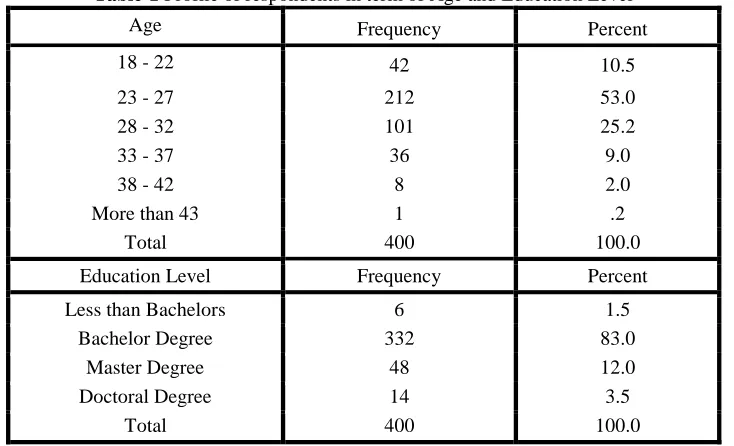
Table 1 shows the profile of respondents in terms of Age and Education level. It divides into 6 groups including 18 – 22 which has 42 (10.5%) respondents, 23 – 27 category has 212 or 53%, 28 -32 has 101 or 25.2%, 33 – 37 has 36 or 9%, 38 – 42 has 8 or 2%, and more than 43 has 1 or 0.2%. For the Education level, it consists of 4 groups such as 6 or 1.5%are under Bachelor Degree, 332 or 83% are Bachelor Degree, 48 or 12% are Master Degree, and 14 or 3.5% are Doctoral Degree.
Table-1 Profile of respondents in term of Age and Education Level
Age Frequency Percent
18 - 22 42 10.5
23 - 27 212 53.0
28 - 32 101 25.2
33 - 37 36 9.0
38 - 42 8 2.0
More than 43 1 .2
Total 400 100.0
Education Level Frequency Percent
Less than Bachelors 6 1.5
Bachelor Degree 332 83.0
Master Degree 48 12.0
Doctoral Degree 14 3.5
Total 400 100.0
Table 2 is divided into 7 groups and 45 (11.2%) are university students, 297 or 74.2% are Company Officers, 20 or 5% are Government
Officers, 12 or 3% are
Housewife/Househusband, 1 or 0.2% is Freelance, 4 or 1% are Business Owner, and 21 or 5.2% are Unemployed.
Table 2 shows the occupations of respondents in order to gather the necessary information in the study. The questionnaire checklist was used as the main instrument for data gathering. It consists of general information, personal information, and attitude toward education and work experiences. Questionnaires were
personally distributed and retrieved by the researchers from the respondents.
Table 3 shows that most respondents do not have higher education (329 or 82.2%).The descriptive statistics show that 329 of respondents or 82.2 percent thought Work Experience is important for working, while 71 or 17.8 percent thought Higher Education is important for working. The mean is at 1.85 and 1.77 as show in Table 4.
1 Table-2 Occupations of respondents
Occupation Frequency Percent
University student 45 11.2
Company Officer 297 74.2
Government Officer 20 5.0
Housewife/Househusband 12 3.0
Freelance 1 .2
Business Owner 4 1.0
Unemployed 21 5.2
Total 400 100.0
Table-3 Frequencies and Percentages
Frequency Percent
Higher Education 71 17.8
Work Experience 329 82.2
Total 400 100.0
Table-4 The Importance of higher education and experience What determines the importance of working
in an organization when compared between
higher education and experience? N % Mean Std. Deviation
Higher Education 71 17.8 1.85 .364
Work Experience 329 82.2 1.77 .420
Total 400 100.0 1.78 .411
It washypothesized that most companies will rate higher education as very important when recruiting and selecting candidates to work forthe company was tested using Levene’s t test and the results are presented in Table 5. The
data showed that 269 of the respondents (67.2 percent) thought that most companies will rate higher education as very important when recruiting and selecting employees to work with the company, while 131 (32.8 percent) did not. Independent Samples Test Levene's Test for Equality
of Variances t-test for Equality of Means
F Sig. t df Sig. (2-tailed)
Occupation Equal variances
assumed .461 .497 1.373 398 .171
Equal variances not
252 The mean was around at 2.27 and 1.98
respectively as seen in Table 5.
The t test showed significant of 0.055, at significance level of 0.05, meaning there is no significant difference between those which rate
higher education and those that did not rate, with regard to work with a company as shown in Table 5.
Table-5 Higher education as very important when recruiting employees
N % Mean Std. Deviation
Yes 269 67.2 2.27 .542
No 131 32.8 1.98 .303
Total 400 100.0 2.18 .495
Independent Samples Test Levene's Test for Equality of
Variances t-test for Equality of Means
F Sig. t df Sig. (2-tailed)
Occupation Equal variances
assumed 13.462 .000 -1.928 398 .055
Equal variances
not assumed -1.721 196.291 .087
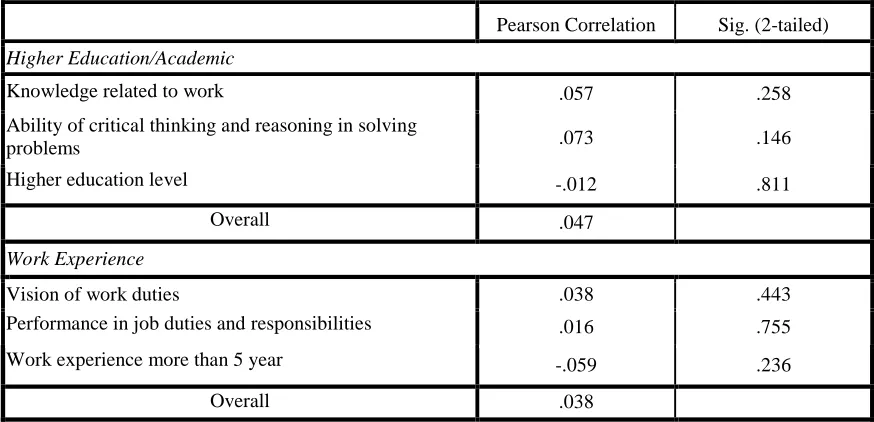
Pearson’s Correlation Coefficient was used to study how the variables of education and work experience affect one’s career. The correlation coefficient between Higher Education and Work experience for recruiting and selection to work with the company is presented in Table 6. It can
be gleaned from the data that attitude toward Education and work experience in term of Higher Education (r = .047), Work experience (r = .038) failed to surpass the r required at 0.05 probability level which is .4438.
Table- 6 Correlation Coefficients of Attitude for Education and work experience
Pearson Correlation Sig. (2-tailed)
Higher Education/Academic
Knowledge related to work .057 .258
Ability of critical thinking and reasoning in solving
problems .073 .146
Higher education level -.012 .811
Overall .047
Work Experience
Vision of work duties .038 .443
Performance in job duties and responsibilities .016 .755
Work experience more than 5 year -.059 .236
Overall .038
1 Hypotheses Testing
Testing of hypotheses used the one-way ANOVA method and the significance level of 0.05; based on the research questions the following hypotheses were developed. The hypotheses were then tested and the results shown below.
Hypothesis 1: The results showed significance to be 0.055; therefore the null hypothesis was accepted. Most companies rate higher education as very important for recruiting and selecting employees to work with the company.
Table- 7 ANOVA for rate higher education as very important when
Sum of Squares df Mean Square F Sig.
Between Groups 9.073 1 9.073 3.719 .055
Within Groups 971.124 398 2.440
Total 980.198 399
Hypothesis 2: The results showed significance to be 0.975; therefore the null hypothesis was accepted. Most companies will rate five or more
years of work experience as very important when recruiting and selecting employee to work with the company.
Table- 8 ANOVA for five or more years of work experience
Sum of Squares df Mean Square F Sig.
Between Groups .599 3 .200 .081 .970
Within Groups 979.598 396 2.474
Total 980.197 399
Hypothesis 3: The results showed significance to be 0.000; therefore the null hypothesis was rejected. Candidates with higher education will
not be given higher level management responsibilities
.
Table- 9 ANOVA for higher education and management
Sum of Squares df Mean Square F Sig.
Between Groups 133.721 3 44.574 20.852 .000
Within Groups 846.477 396 2.138
Total 980.198 399
N Mean Std. Deviation
Do you think higher education is related to higher level management responsibilities?
254
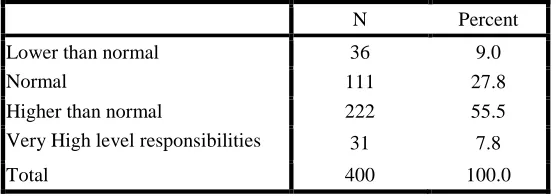
N Percent
Lower than normal 36 9.0
Normal 111 27.8
Higher than normal 222 55.5
Very High level responsibilities 31 7.8
Total 400 100.0
Overall the respondents are of the opinion that people with higher education will be given higher level management responsibilities at higher than normal (mean = 3.62) as seen in Table 9.
Hypothesis4: The results showed significance to be 0.005; therefore the null hypothesis was rejected. Candidates with five or more years of work experience will not be given higher level management responsibilities.
Table-10 ANOVA for work experience and management
Sum of Squares df Mean Square F Sig.
Between Groups 25.494 2 12.747 5.301 .005
Within Groups 954.704 397 2.405
Total 980.198 399
N Mean Std. Deviation
Statistic Statistic Std. Error Statistic
Do you think more years of work experience will be given higher level management
responsibilities?
400 4.14 .026 .524
Frequency Percent
Normal 31 7.8
Higher than normal 283 70.8
Very High Level
responsibilities 86 21.5
Total 400 100.0
Most respondents are of the opinion that five or more years of work experience will be given higher level management responsibilities at a higher level than normal (Mean = 4.14) as seen in Table 10.
Table 11 shows higher education and work experience related with level management responsibilities. The results show that higher
1 Table-11 Higher education and work experience related to management
Management responsibilities Mean DR
Do you think higher education is related to higher level
management responsibilities? 3.62
Higher than Normal
Do you think more years of work experience will be
given higher level management responsibilities? 4.14
Higher than Normal
Do you think you can get more benefit if you continue
studying at a higher level? 3.42 Benefit
Norms Level management responsibilities Performance of Employees
4.21 – 5.00 Very High Level responsibility Most Important 3.41 – 4.20 Higher than Normal Important
2.61 – 3.40 Normal Normal
1.81 – 2.60 Lower than Normal Some 1.00 – 1.80 Lowest Level responsibilities Not Important
additional ―benefit‖ (X = 3.42) if they continue studying at a higher level. Table 12 displays attitude toward education and work experience of employees. Performance of employees is
divided into 3 parts such as
Education/Academic, Work Experience, and Attitude to work. For Education/Academic, the results show knowledge related to work (X = 3.47), ability of critical thinking and reasoning
in solving problems (X = 3.92), and higher education level (X = 4.18) are important for qualified candidates to work within the organization. For Work Experience, the results show that vision of work duties are the most important (X = 4.25), performance in job duties and responsibilities are normal (X = 3.28), and Work experiences are important (X = 3.81).
Table-12 Attitude toward Education and work experience
Performance of Employees Mean DR
Education/Academic
Knowledge related to work 3.47 Important
Ability of critical thinking and reasoning in solving problems 3.92 Important
Higher education level 4.18 Important
Work Experience
Vision of work duties 4.25 Most Important
Performance in job duties and responsibilities 3.28 Normal
Work experience more than 5 year 3.81 Important
Attitude to work
Learning and development to be more efficient 3.53 Important
Positive thinking 3.88 Important
Cooperate and support the activities of the organization 4.23 Most Important
256 Nowadays, attitude toward work has become
more important for selecting people to work within the organization. It consists of learning and development to be more efficient (X = 3.53) and positive thinking (X = 3.88). But, cooperating and supporting the activities of the organization (X = 4.23) are most important for working with others in the organization or company.
Implications and Recommendations
Higher education and work experience are important elements which will benefit the organization. Most businesses showed a slight decrease for the sales and profitability, some business have downsized to reduce their cost. The respondents revealed that this decrease was due to the impact of the economic crisis and natural disaster in Thailand and other countries. In spite of the decrease in the sales and profitability trends, the employee trend mostly remained the same.
In the past, some parents felt that a college education was a waste of time and money, and they wanted their children to work early and gain experience. However, these days, most respondents understand the importance of a degree and what their children will gain by acquiring it. Larger numbers of Thai people have become more concerned about both the access to education and its necessity. Although the patterns in each class of society differ, the overall direction is clear, and people understand the importance of a college degree.
Today, getting a higher education has become an aspiration, as much as owning a home or feeling secure after retirement. People now realize that getting a college degree, or at least some form of education after high school, is the surest way to enter into the middle class strata of society. According to surveys, most people say that attending college and acquiring a degree is a necessity to keep pace with the competition in the workforce, and statistics show that an investment in post-secondary education pays off in higher earnings.
While a college degree is impressive, it does
not necessarily equal experience.
Unfortunately, there is not a college course that
can give you real-world experience in the workplace. Many companies are downsizing so having an employee who has a degree in marketing who also knows how to set up and maintain a computer network may be just the person a small marketing firm will want over someone with years of experience. So when you are competing with individuals who have many years of work experience in the field and can do the job with very little training, you need to bring more to the table than someone with a newly acquired college degree. Think of differentiating yourself from others by offering direct, measurable and immediate value to the employers. To be successful in an interview, one should mention the college degree but must also spend sufficient time on highlighting exactly what strengths and assets he/she will bring to the company to help the company succeed.
Landing a job in a down economy is challenging and competitive. Many, but certainly not all, positions will require a college degree in addition to some level of work experience. Both of these requirements will arm candidates with the essential skills and knowledge to be a star employee. Gain both career and life skills with a college degree. In attending college, you will learn to express your thoughts clearly through speech and writing. You will also gain a better understanding of the world. While you may be focusing your studies on a specific major, you will also be garnering and perfecting all these useful skills that will last a lifetime. Many trade and technical fields will require that candidates have an associate degree in order to apply. Jobs that require more interaction with customers and clients may call for a Bachelor's or Master Degree.
257 benefits like health insurance. And they may
not be very secure, so one could be laid off every time business slumps. A student’s best bet is to get a solid academic foundation and pursue some kind of education after school.
Higher Education is not a guarantee towardhigh earnings. Your income depends on your occupation. If you become an engineer, a biologist, or an advertising manager, for example, you’ll typically earn more than the average college graduate. Or you may decide to pursue a career that pays less but is rewarding in other ways. Teachers, social workers, ministers, and librarians, for instance, don’t earn as much as some other college graduates, but they often find great satisfaction in giving something back to the community. Whether high-paying or not, the jobs available to a graduate are often more interesting and challenging than those typically available to those with a lower education level. Once you gain some work experience, a higher education can increase your chances of getting a promotion or raise.
You can boost your earning power even more by completing more graduate degrees. On average, someone with a master’s degree, a doctorate, or a professional degree earns significantly more than someone with just a bachelor’s degree (Teowkul, Seributra, Sangkaworn, Jivasantikarn, Denvilai, and Mujtaba, 2009; Mujtaba and Scharff, 2007).
Limitations and Future Studies
The topic of comparing higher education and work experience depends on the respondents’ opinion to honestly answer each question on the questionnaire. Information obtained will depend on the respondent’s willingness to divulge his/her true opinions. Hence, accuracy of the primary data depends on the honest disclosure of information. Secondary data from literature relating to the education system and human resource management also provides valuable source of information.
This research comparedresponses between higher education and work experience in Bangkok area, most of the respondents were company officers and not from any specific position or job. Moreover, it can be considered
as the starting point for the topic, which covered a limited aspect of education and work experience. It may be revealing if future studies can be conducted in other areas such as trends of future education in Thailand, trend in higher education of Thailand, and candidates’ work experience in relation to levels of management responsibilities.
Summary
Many colleges and universities have come to realize the importance of both, and incorporate experience as part of the class requirements. Internships will help students stand out as a qualified job candidate after graduation. Some specialized professions will require that students complete an apprenticeship. Supervised work experiences like these are important in helping to make the jump from a classroom setting to a daily job. The key for students is to gain both career and life skills with a college degree. In attending college, you will learn to express your thoughts clearly through speech and writing. You will also gain a better understanding of the world. While you may be focusing your studies on a specific major, you will also be garnering and perfecting all these useful skills that will last a lifetime.
Most of the respondents surveyed were company officers. The study found that most respondents thought work experiences were more important than higher education during recruitment and selection process. While a college degree is impressive, it does not always equal experience. So get the right degree and relevant experience to land the job of your dreams in today’s competitive workplace.
References
Ames Gross (1997)Recruiting in Asia. Published in Benefits & Compensation
International from:
http://www.pacificbridge.com/publication.asp? id=57
258 and Pacific Affairs. Available from
http://www.state.gov/r/pa/ei/bgn/2814.htm Bovonsiri, V. (2003) ―Thailand‖, in Handbook on Diplomas, Degrees and Other Certificates in higher education in Asia and the Pacific. 2nd ed. pp. 271-285. Bangkok: UNESCO Asia and Pacific Regional Bureau for Education. Chantavit sujatanond, Bureau of Higher Education Standards (2003)All in One: Policies, QA and Cooperation. Bangkok: Ministry of University Affairs Publishing. ISBN 9749524667, 9789749524664.
Commission on Higher Education, Bureau of Higher Education Standards and Evaluation(2007)National Qualifications Framework for Higher Education in Thailand. Bangkok: Commission on Higher Education. Cresswell (1999)Anthony M. Education Management and Financing in Thailand. Review and Recommendations Research Papers: Volume II/3. Prepared for UNESCO-Bangkok as part of the Asian Development Bank Social Sector Program Loan in the Framework of the Educational Management and Finance Study Project TA 2996-THA. Friedman, Thomas L (2000)The Lexus and the Olive Tree: Understanding Globalization. New York: Anchor Books.
Fry, Gerald W(2000)"Crisis as Opportunity: Political, Economic, and Educational Reform." In Globalization and The Asian Economic Crisis, ed. Geoffrey B. Hainsworth, 229-256. Vancouver, Canada: Centre for Southeast Asia Research, Institute of Asian Research, University of British Columbia.
Fry, Gerald W. and Ken Kempner(1998)"A Subnational Paradigm for Comparative Research: Education and Development in Northeast Brazil and Northeast Thailand". In Comparative Education: ASHE Reader Series, ed. William Tierney, et al., 384-408. New York: Simon & Schuster.
Green, Paul C (1999)Building Robust Competencies: Linking Human Resource Systems to Organizational Strategies. Jossey-Bass.
Gubman, Edward L(1996)The Gauntlet is Down. Journal of Business Strategy. Retrieved
on August 3, 2011 from:
http://www.accessmylibrary.com/article-1G1-
18957294/gauntlet-down-human-resources.html
Higher Education in South-East Asia (2006) Asia-Pacific Program of Educational Innovation for Development, United Nations Educational, Scientific and Cultural Organization. Bangkok: UNESCO Bangkok. ISBN 92-9223-084-0.
Johnston, John (1996) “Time to Rebuild Human Resources‖ Business Quarterly, Vol.61, No.2, p. 46.
Klein, James R(1998)"The Constitution of the Kingdom of Thailand, 1997." San Francisco: The Asia Foundation.
Margaret Steen(2008)How to decide Between Experience and Education, retrieved on 11
September 2008, from:
http://www.hrworld.com/features/experience-vs-education-091108/
MOE (Ministry of Education)(2010) Available from http://www.moe.go.th.
MUA (Ministry of University Affairs)(2010) Available from http://inter.mua.go.th.
Mujtaba, B. G. (2005) ―Faculty Development Practices in Distance Education for Success with Culturally Diverse Students‖International Business and Economics Research Journal, Vol.4, No.4, pp. 1-13.
Mujtaba, B. G. and Scharff, M. M. (2007)Earning a Doctorate Degree in the 21st Century: Challenges and Joys. ILEAD Academy Publications; Florida, USA.
Mujtaba, B. G. and McAtavey, J. (2006) ―Performance Assessment and Comparison of Learning in International Education: American versus Jamaican Students’ Learning Outcomes‖ The College Teaching Methods & Styles Journal, Vol.2, No.3, pp. 33-43.
Mujtaba, B. G. and Preziosi, R. C. (2006)Adult Education in Academia: Recruiting and Retaining Extraordinary Facilitators of learning (2nd Edition). Information Age Publishing. Greenwich, Connecticut.
Office of the National Education Commission (ONEC) (1999) Office of the Prime Minister. Education in Thailand 1999. Bangkok: Amarin Publishing and Printing.
ONEC (2001) Available from
http://www.onec.go.th.
259 Scott Hipsher (2010) Expatriates, higher
education and globalization. Retrieved on 4 July, from: http://www.ajarn.com/blogs/scott- hipsher/expatriates-higher-education-and-globalization/
Sippanondha Ketudat with Robert B. Textor. (1992)The Middle Path for the Future of Thailand: Technology in Harmony with Culture and Environment. Honolulu: East-West Center.
Sirilaksana Khoman (1999)"Education: Thailand's Key to Long-term Recovery?" paper presented at the conference. "Thailand beyond the Crisis." organized by the National Thai Studies Center and the Asia-Pacific School of Economics and Management. Australian National University, Canberra, 21 April. Solomon, Charlene Marmer (1993)
“Working Smarter: How HR Can
Help‖Personnel Journal, 72, pp. 54-64.
Supang Chantavanich, and Gerald Fry (1985) "The System of Education in Thailand." In The International Encyclopedia of Education: Research and Studies. Eds. Torsten Husén and T. Neville Postlethwaite. Oxford: Pergamon Press.
Suttinee Yuvejwattana and Daniel Ten Kate (2010)Thai Economy May Expand as Much as 8 Percent in 2010 on Exports, Korn Says.
Retrieved on 5 August, from:
http://www.bloomberg.com/news/2010-08- 04/thai-economy-may-expand-as-much-as-8-percent-in-2010-on-exports-korn-says.html Teowkul, K., Seributra, N. J., Sangkaworn, C., Jivasantikarn, C., Denvilai, S. and Mujtaba, B. G. (2009) Motivational Factors of
Graduate Thai Students Pursuing Master and
Doctoral Degrees in Business. RU
International Journal, 3(1), 25-56.
Ulrich, Dave (1998) Delivering Results: A New Mandate for HR Professionals. Harvard Business School Press: United States.
Varaporn Bovornsiri (1985)An Analysis of Access to Higher Education in Thailand. Singapore: The Regional Institute of Higher Education and Development.
Varaporn Bovornsiri, Pornlerd Uampuang, and Gerald Fry (1996)"Cultural Influences on Higher Education in Thailand." In The Social Role of Higher Education: Comparative Perspectives.‖ Eds. Ken Kempner and William G. Tierney, 55-78. New York: Garland. Waraiporn Sangnapaboworm (2003) ―Higher Education Reform in Thailand: Towards Quality Improvement and University Autonomy.‖ A Paper Presented at The Shizuoka Forum on ―Approaches to Higher Education, Intellectual Creativity, and Cultivation of Human Resources seen in Asian Countries.‖ organized by Office of the Education Council. Ministry of Education, Thailand, 12-14 December.
Wichitr Srisa-arn (2000) The Reform of Higher Education in Thailand: Successes and Failures. Journal of Education, 28(2), pp.33-48. (Thai -Chulalongkorn University).
Witt, Johanna. (2000) ―Education in Thailand after the Crisis: A Balancing Act between
Globalization and National
260
Appendix A – Research Questionnaire
This questionnaire has been developed for the purpose of education research and the information will be treatedconfidentially. Please answer the following question by marking ―‖ in the space given below.
PART 1: GENERAL INFORMATION
1. Are you working? _____ Yes _____ No
2. What determines the importance of working in an organization when compare between higher education and experience? (In your opinion)
_____ Higher education _____ Work experiences
3. Most companies will rate higher education as very important when recruiting and selecting to work with company. Do you agree with this sentence?
_____ Yes _____ No
4. Do you think higher education is related to higher level management responsibilities? Lower level responsibilities: ____:____:____:____:____ Higher level responsibilities
5. Do you think more years of work experience will be given higher level management responsibilities?
Lower level responsibilities: ____:____:____:____:____ Higher level responsibilities
261 PART 2: ATTITUDE TOWARD EDUCATION AND WORK EXPERIENCE
Please select one answer for each of the following statements.
5 = Most Important 4 = Important 3 = Normal 2 = Some 1 = Not Important
Performance of Employees
Attitude Level
5 4 3 2 1
Education/Academic
7. Knowledge related to work
8. Ability of critical thinking and reasoning in solving problems
9. Higher education level
Work Experience
10. Performance in job duties and responsibilities
11. Vision of work duties
12. Work experience more than 1 year
Attitude to work
13. Learning and development to be more effectively
14. Positive thinking
15. cooperate and support the activities of the organization
PART 3: PERSONAL DATA
16. Gender: ______ Male ______ Female
17. Age
_____ 18 – 22 years _____ 23 – 27 years _____ 28 – 32 years
_____ 33 – 37 years _____ 38 – 42 years _____ More than 43 years
18. Nationality: _____ Thai _____ Foreigner
19. Educational Level
_____ Under Bachelor Degree _____ Bachelor Degree _____ Master Degree _____ Doctoral Degree
20. Occupation
_____ High – school student _____ Housewife/househusband
_____ University student _____ Freelance
_____ Company office _____ Business Owner
_____ Government officer _____ Unemployed