Contributions to Time-bounded Problem
Solving Using Knowledge-based Techniques
Niladri Chatterjee
A
thesis submitted in partial fulfillment
of the requirements for the degree of
Doctor of Philosophy
of the
University of London
UCL
University College London
Department of Computer Science
ProQuest Number: 10017234
All rights reserved
INFORMATION TO ALL USERS
The quality of this reproduction is dependent upon the quality of the copy submitted.
In the unlikely event that the author did not send a complete manuscript and there are missing pages, these will be noted. Also, if material had to be removed,
a note will indicate the deletion.
uest.
ProQuest 10017234
Published by ProQuest LLC(2016). Copyright of the Dissertation is held by the Author.
All rights reserved.
This work is protected against unauthorized copying under Title 17, United States Code. Microform Edition © ProQuest LLC.
ProQuest LLC
789 East Eisenhower Parkway P.O. Box 1346
To D ear Man & Bapi:
Shrimati Jharna Chatterjee
And
ABSTRACT
Time-bounded computations represent major challenge for knowledge-based techniques. Being primarily non-algorithmic in nature, such techniques suffer from obvious open- endedness in the sense that demands on time and other resources for a particular task cannot be predicted in advance. Consequently, efficiency of traditional knowledge-based techniques in solving time-bounded problems is not at all guaranteed. Artificial Intelligence researchers working in real-time problem solving have generally tried to avoid this difficulty by improv ing the speed of computation (through code optimisation or dedicated hardware) or using heuristics. However, most of these shortcuts are likely to be inappropriate or unsuitable in complicated real-time applications. Consequently, there is a need of more systematic and/or general measures.
We propose a two-fold improvement over traditional knowledge-based techniques for tack ling this problem. Firstly, that a cache-based architecture should be used in choosing the best alternative approach (when there are two or more) compatible to the time constraints. This cache differs from traditional caches, used in other branches of computer science, in the sense that it can hold not just "ready to use" values but also knowledge suggesting which AI tech nique will be most suitable to meet a temporal demand in a given context.
The second improvement is in processing the cached knowledge itself. We propose a tech nique which can be called "knowledge interpolation" and which can be applied to different forms of knowledge (such as symbolic values, rules, cases) when the keys used for cache access do not make exact matches with the labels for any cell of the cache.
The research reported in this thesis comprises development of cache-based architecture and interpolation techniques, studies of their requisites and representational issues and their com plementary roles in achieving time-bounded performance. Ground operations control of an airport and allocating resources for short-wave radio communications are two domains in which our proposed methods are studied.
-ACKNOWLEDGEMENTS
I express my deepest thanks to my supervisor Prof. J.A.Campbell for his invaluable sugges tions and support in carrying out the research. I am also thankful to him for making arrange ments for realistic domain data acquisition which is crucial for conducting the experiments and without which the relevant work could not have been completed. I further acknowledge my indebtedness to him for solving various non-academic problems that occurred during my stay abroad.
I extend my thanks to all my colleagues in the department of computer science at U.C.L for their help of various natures during my period of carrying out the research. In particular, I thank John Washbrook, Dr. Elpida Keravnou (currently at University of Cyprus) and Dr. Maria Fox for their periodic evaluation of my work and their suggestions for improvements.
I would also like to thank those with whom I have discussed at length, or communicated through (e)mail about my research. These exchanges of opinions not only helped me under stand the current state of the art, but also helped in deciding upon the course of this research. Among them I greatly acknowledge Prof. Manuela Veloso of C.M.U and Prof. Janet Kolodner of Georgia Institute of Technology and Prof. Agnar Aamodt of the University of Trondheim, whom I first met during the first European Workshop on GBR, at Kaiserslautern, Germany. I also express my thanks to Dr. Moonis Ali of Southwest Texas University for his appreciation and encouraging comments on my work. My thanks are extended to Dr. Christo pher Owens of Yale University, Dr. Ian Watson of Salford University, and Dr. Michael Red mond of Georgia Institute of Technology for many enlightening communications.
I also express my sincere thanks to Prof. D. DuttaMajumder, Prof. B.B.Chaudhuri and Prof. S.K.Pal of Indian Statistical Institute (I.S.I.), Calcutta, who as my teachers developed my first interests in AI, without which perhaps I would never have come to this stage. I am further grateful to the former two along with Dr. S. Ray of I.S.I. for their recommendations in sup port of my application for a Commonwealth postgraduate scholarship.
I also express my thanks to fellow researchers in this department (Aggeliki, Carl, Felicity, Jonathon, Mauro, to name a few) for the lively discussions I had with them on various aspects of research and thesis writing, and the help I received from them. I am also thankful to my friends Ajit, Bina-di, Chris, Davinder, John, Malpani-ji, Nikhil-da, Paul, Philip, Saadia, San- jay, Shamim, Srirangan, Steve, Sylvia whose excellent company and cooperation at different
stages of my stay in London helped me remain cheerful.
Last but not the least comes my wife Sutapa who suspended her own Ph.D, at least tem porarily, to join me in London and provide me with moral support and constant encourage ment.
Note: The major financial support for doing this research came from Association of Com monwealth Universities in the form of a Commonwealth Postgraduate Research Scholarship.
-TABLE OF CONTENTS
1. IN T R O D U C T IO N ... 16
1.1 GENERAL BACKGROUND ... 16
1.2 OUR APPROACH ... 18
1.2.1 Intuition Behind The Proposed M ethods... 20
1.3 AIM OF THIS RESEARCH ... 21
1.4 DOMAIN(S) OF APPLICATION... 22
1.5 OVERVIEW OF THE THESIS ... 23
2. TIM E-DEPENDENT PROBLEMS AND KNOWLEDGE-BASED A PP R O A C H E S... 25
2.1 INTRODUCTION... 25
2.2 DIFFICULTIES IN TIME-BOUNDED COMPUTATIONS USING KNOWLEDGE-BASED TECHNIQUES ... 25
2.2.1 Difficulties Due To Domain Characteristics ... 25
2.2.2 Difficulties Due To The Temporal E lem ent... 26
2.2.3 Difficulties Due To Nature Of The Problem s... 27
2.2.4 Difficulties Due To The Nature Of Knowledge-Based Computations... 28
2.3 TEMPORAL LOGIC AND REASONING... 29
2.4 KNOWLEDGE-BASED TECHNIQUES FOR REAL-TIME PROBLEM SOLVING... 30
2.4.1 Studies Of Different Search Techniques ... 30
2.4.2 Other Heuristics And Suggestions... 33
2.5 DIFFERENT REAL-TIME SYSTEMS: A BRIEF OVERVIEW ... 34
2.5.1 A IRPLAN ... 34
2.5.2 L*STAR ... 35
2.5.3 R T -1 ... 36
2.5.4 TRUCKER And R U N N ER ... 37
2.5.5 Telephone Switching N etw ork... 37
2.5.6 QES: Quality Expert Systems ... 38
3. CACHE-BASED ARCHITECTURE: THE FIRST L O O K ... 40
3.1 COMPUTATIONS AND C A C H IN G ... 40
3.2 FUNDAMENTALS OF THE CACHE-BASED ARCHITECTURE... 41
3.2.1 Operational Scheme For The S y stem ... 42
3.2.2 Structure Of The C a c h e... 42
3.2.2.1 The Basic D esign... 43
3.2.2.2 Basic Contents of the Cache-cells... 44
3.2.3 Illustration With An Example ... 46
3.2.4 Basic Cache Operations... 47
3.2.4.1 Operation of R etrieval... 47
3.2.4.2 Operation of Interpolation... 47
3.2.4.3 Operation of Propagation ... 48
3.2.5 Treatment Of T im e ... 49
3.3 DESIGN CHOICES FOR THE CACHE-BASED ARCHITECTURE... 50
3.3.1 Choice of Indices... 51
3.3.2 Design Of Interpolation... 52
3.3.3 Identifying Different Time Limits And Corresponding M ethods... 53
3.4 FUNCTIONING OF THE CACHE ... 54
3.4.1 An Example In Numerical A nalysis... 55
3.4.2 Observations From Computational Experim ents... 57
3.5 ADVANTAGES OF CACHING... 58
3.5.1 Different Existing Retrieval Techniques... 59
3.5.1.1 Retrieval from Flat M em ory... 59
3.5.1.2 Hierarchical Memory Organisation... 60
3.5.1.2.1 Breadth-First Graph Search in Shared-Feature Networks... 61
3.5.1.2.1 Depth-First Graph Search in Prioritised Discrimination Networks... 61
3.5.2 Cache-Retrieval vis-a-vis Existing Retrieval Techniques... 61
3.6 CONCLUSION ... 63
-4. BASICS OF THE CACHE SCHEME:
CHOOSING INDICES FOR A C A C H E ... 64
4.1 INTRODUCTION... 64
4.1.1 Considerations For Indexing The C a c h e ... 65
4.1.2 Suitability Of Indexing... 65
4.2 INFLUENCE OF TIME-BOUNDEDNESS ... 66
4.2.1 Reprioritising Goals Depending Upon T im e... 66
4.2.2 Maintaining Time Stipulation Is Preferred To Quality Of The A nsw er... 67
4.2.3 Penalty Varies With Nature Of The Problem ... 68
4.3 KEY ISSUES IN INDEXIN G... 69
4.3.1 Indexing And Domain M odel... 70
4.3.1.1 Analytical M etho d ... 70
4.3.1.2 Statistical M ethod... 71
4.3.1.3 Explanation-based M ethod... 72
4.3.1.4 H euristics... 72
4.3.2 Indexing And Similarity M easurem ent... 74
4.3.3 Choice Of Ind ices... 78
4.3.3.1 Properties of Good Indices ... 78
4.4 ANALYSIS OF CASES. OUR APPROACH... 81
4.5 CHOOSING INDEXING VOCABULARY ... 85
4.6 CONCLUDING REMARKS ... 88
5. BASICS OF THE CACHE SCHEME: INTERPOLATION OF SYMBOLIC K N O W L E D G E... 90
5.1 INTRODUCTION... 90
5.2 INTERPOLATION IN SYMBOLIC COMPUTATIONS ... 91
5.2.1 Past Work Involving Methods That Resemble Interpolation... 92
5.2.2 Considerations For Implementation... 93
5.2.2.1 Theoretical Considerations... 93
5.2.2.1.1 Imposition Of Orderings... 93
5.2.2.1.2 Designing Interpolation Schem es... 94
5.2.2.1.3 Designing Schemes for Knowledge Representation ... 95
5.3 ORDERING ON SYMBOLIC FEATURES... 97
5.3.1 Different Ways Of Imposing O rd er... 97
5.3.1.1 Scalar V alues... 97
5.3.1.1.1 Numerical V alu es... 97
5.3.1.1.2 Symbolic Quantities Masking Numerical V a lu e s... 98
5.3.1.1.3 Fuzzy Quantifiers... 98
5.3.1.1.4 Artificial Enumeration Through Ordinals ... 100
5.3.1.1.5 Referential M odifiers... 100
5.3.1.2 Intervals... 101
5.3.1.3 Sets ... 102
5.3.1.4 Ordering Relative To Some Reference ... 103
5.3.1.5 Are These Orderings Meaningful? ... 103
5.3.2 Use Of Orders For Distance Computation ... 105
5.3.2.1 Scalars... 105
5.3.2 2 Sets ... 108
5.3.2.3 Intervals... 110
5.3.3 Algorithm For Computing D istance... I l l 5.3.4 Use Of Ordered Symbols In Interpolation... 113
5.4 DESIGNING DIFFERENT INTERPOLATION SCH EM ES... 114
5.4.1 Binary Selection ... 115
5.4.2 Discrete Selection -Choosing One Of A Finite Set Of Alternatives... 117
5.4.3 Optimisation Through Inverse M apping... 117
5.4.4 Optimisation Of Certain Functions ... 118
5.4.5 More Advanced Interpolation Techniques... 120
5.4.5.1 Constrained Interpolation... 121
5.4.5.2 Iterative Interpolation... 122
5.5 HOW TO APPLY INTERPOLATION... 123
5.5.1 Selection Of Independent V ariables... 124
5.5.2 Selection Of Dependent Variables ... 124
5.5.2.1 Interpolation at Action Level ... 125
5.5.2.1.1 Parametric Type ... 125
5.5.2.1.2 Tactical T y p e ... 126
5.5.2.2 Interpolation at Plan Level ... 126
5.5.3 Interpolation For Different Paradigms ... 128
5.5.3.1 Interpolation for R ules... 128
-5.5.3.1.1 Preconditions of Both the Rules Match the Situation ... 129
5.5.3.1.2 The Situation Condition Lies Between Preconditions of the R u les... 132
5.5.3.1.3 Algorithm for Rule Interpolation ... 134
5.5.3.2 Interpolation for Cases ... 136
5.5.3.2.1 What Should Be Contained in a Case? ... 136
5.5.3.2.2 How to Represent a Case? ... 139
5.5.3.2.3 How to Carry Out Interpolation? ... 141
5.5.3.2.4 An Illustration for Case Interpolation ... 145
5.5.3.2.5 Algorithm for Case Interpolation ... 146
5.5.3.2.6 Is the Interpolation Robust? ... 149
5.6 CONCLUSION ... 149
6. BASICS OF THE CACHE SCHEME: DESIGNING A CACHE-BASED SY ST E M... 151
6.1 INTRODUCTION... 151
6.2 CACHE-RELATED KNOWLEDGE... 152
6.2.1 Selection of Column Dimensions... 153
6.2.2 Selection of Column H eaders... 154
6.2.2.1 Numeric Column H eaders... 154
6.2.2.2 Symbolic Column H eaders... 155
6.2.2.3 An E xam ple... 155
6.2.3 Knowledge For Cache R eference... 157
6.2.4 Identification of the Right Column H eader... 159
6.2.4.1 Illustration of Column Selection Policies ... 159
6.2.4.1.1 Discrete Column H eaders... 160
6.2.4.1.2 Range-type Colum n-headers... 160
6.2.4.1.3 Suggestions for Column Selection ... 161
6.2.4.1.4 Unordered Column H eaders... 162
6.3 ACTION-RELATED KNOW LEDGE... 163
6.3.1 Definition Of Some Action-Related T erm s... 163
6.3.2 Representation Of Action-Related K nowledge... 166
6.3.3 5dditional Knowledge For Reasoning... 170
6.3.4.1 Determination of A ction... 172
6.3.4.2 Fulfilling the Prerequisite... 173
6.3.4.3 Estimation of Parameters... 174
6.4 CONCLUDING REMARKS ... 175
7. BASICS OF THE CACHE SCHEME: REASONING AND PROBLEM S O L V IN G... 176
7.1 INTRODUCTION... 176
7.2 BASIC REASONING TECHNIQUE ... 177
7.2.1 Properties of the Control Program ... 179
7.2.2 An Elementary Control Program ... 180
7.2.3 Further Requirements For The Control P rog ram ... 181
7.3 SELECTION OF CACHE-CELL FOR RETRIEVAL ... 183
7.3.1 Choice Of Cells When More Than One Are Contending... 183
7.3.1.1 Weighting Scheme ... 184
7.3.1.2 Criterion for S election... 185
7.3.2 Retrieval When Selected Cells Have Null Contents ... 188
7.3.2.1 Retrieval From a Single C e ll... 188
7.3.2.2 Retrieval From Two Cells ... 188
7.3.3 Algorithm For Cell Selection ... 190
7.4 ACTIVITIES CONCERNING CACHED ENTRIES ... 192
7.4.1 Considerations For The Default L e v e l... 194
7.4.1.1 Additional Knowledge and Its U se ... 195
7.4.1.2 Policies for Default-level Decision-making... 199
7.4.1.2.1 Policy for a Single Cell ... 199
7.4.1.2.2 Policy for Two C ells... 200
7.4.2 Considerations For The Rule L evel... 201
7.4.2.1 What Should be Stored? ... 202
7.4.2.1.1 Plan-modification R u le s ... 204
7.4.2.1.2 Action-improvement Rules ... 205
7.4.2.2 Reasoning with the Knowledge... 205
7.4.3 Considerations For The Case Level ... 208
7.4.3.1 Policies for Case Selection... 210
7.4.3.2 Policies for Case Interpolation ... 211
7.5 CONCLUSION ... 212
8. DESIGN OF SYSTEM FOR A NEW DOMAIN: SHORTW AVE RADIO P R O P A G A T IO N... 214
8.1 INTRODUCTION... 214
8.2 DESCRIPTION OF THE D OM A IN ... 217
8.2.1 Natural Obstacles... 217
8.2.2 Human-Created O bstacles... 219
8.2.3 Who Are The Users? ... 220
8.2.4 Amenability To The Cache-based A rchitecture... 221
8.3 ANALYSIS OF THE D O M A IN ... 222
8.3.1 Cache-Related K now ledge... 223
8.3.1.1 Input of a Problem Description ... 223
8.3.1.2 Structure of the Cache ... 224
8.3.1.3 Choice of the Cache C olum ns... 225
8.3.1.4 Determination of Column H eaders... 226
8.3.1.5 Determination Of Cache L ev e ls... 230
8.3.2 Action-Related K now ledge... 231
8.3.2.1 Computation of Frequency... 231
8.3.2.2 Computation of P ow er... 234
8.3.2.3 Selection of Transm itter... 236
8.3.3 Reasoning-Related K now ledge... 236
8.3.3.1 Knowledge about Secondary Indices ... 237
8.3.3.2 Contents of the C ache... 237
8.3.3.3 Knowledge about Interpolation... 239
8.4 CONCLUDING REM ARK... 239
9. EXPERIMENTS AND RESULTS WITH SHORTW AVE RADIO C A C H E... 240
9.1 INTRODUCTION... 240
9.2 OUTCOMES AT DIFFERENT CACHE-LEVELS ... 241
9.2.1 Reasoning At Defaultl L e v e l... 241
9.2.3 Reasoning At Rule Level ... 245
9.2.3.1 Use of Rules at Plan Level ... 246
9.2.3.2 Use of Rules at Action Level ... 248
9.2.4 Reasoning At Case Level ... 250
9.2.4.1 Estimation of Key Param eters... 251
9.2.4.2 Retrieval of Appropriate Cases ... 251
9.2.4.3 Case Adaptation Through Interpolation... 253
9.3 ESTIMATION OF TEMPORAL REQUIREMENTS ... 256
9.3.1 Experiments Using The Softl Schem e... 261
9.3.2 Experiments Using The Soft2 Schem e... 263
9.3.3 Experiments Using A Hard Schem e... 265
9.4 CONCLUSIONS... 266
10. DISCUSSIONS AND C O N C L U SIO N... 268
10.1 GOALS AND MOTIVATION... 268
10.2 WHAT WE HAVE D O N E ... 270
10.3 THE CACHE-BASED SCHEME IN THE PERSPECTIVE OF MIXED-PARADIGM SYSTEMS ... 272
10.4 POSSIBLE FUTURE DEVELOPMENTS ... 273
B IBLIO G R APH Y... 276
-LIST OF FIGURES
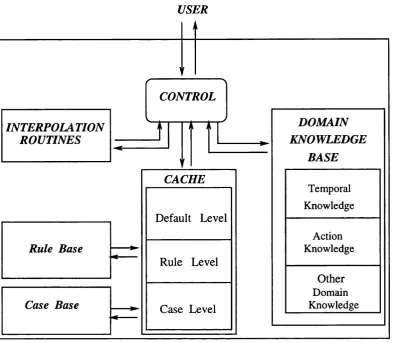
Figure 3.1: Organisation of a Cache-based System ... 43
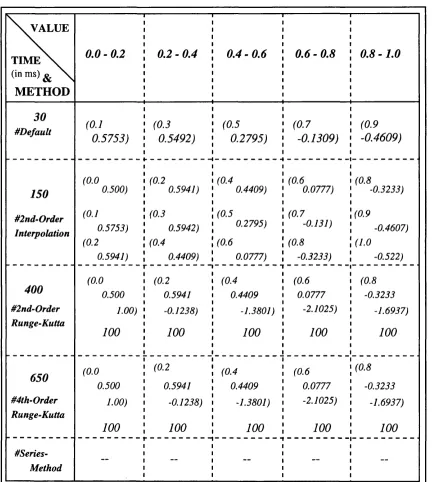
Figure 3.2: Schematic Diagram of a Cache for the Numeric Problem ... 56
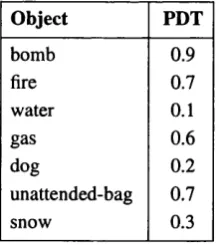
Figure 4.1 : PDT-values for Different Objects in the AGC D om ain... 79
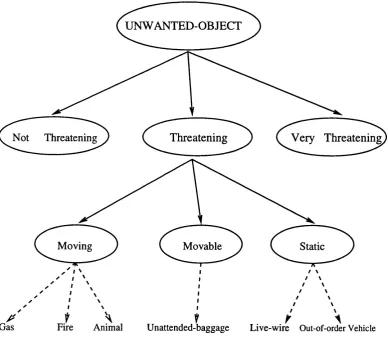
Figure 4.2: Hierarchical Organisation of Threatening Objects ... 86
Figure 5.1 : Algorithm for Computation of Distance between Two Symbols ... 112
Figure 5.2: General-level Procedure for Binary Interpolation ... 116
Figure 5.3: General-level Procedure for Discrete Selection... 117
Figure 5.4: General-level Procedure for Optimisation through Inverse Mapping ... 118
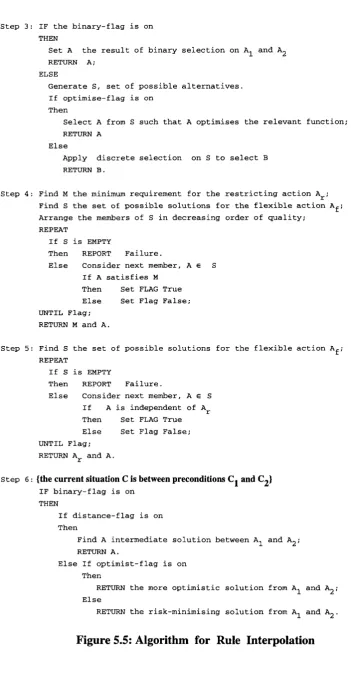
Figure 5.5: Algorithm for Rule Interpolation... 135
Figure 5.6: Example of Action-based Representation of a C a se ... 140
Figure 5.7: Action-based Representation of Another C a s e ... 145
Figure 5.8: Algorithm for Case Interpolation... 148
Figure 6.1 : Frame for the Generic Action "tackle-fire"... 167
Figure 6.2: Hierarchy Tree for the Purpose "passing-message"... 168
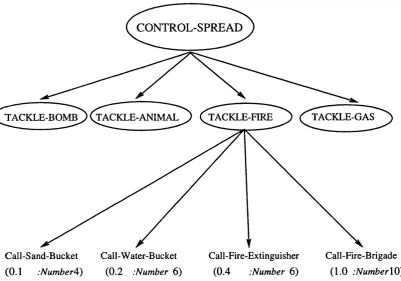
Figure 6.3: Hierarchy Tree for the Purpose "control-spread" ... 169
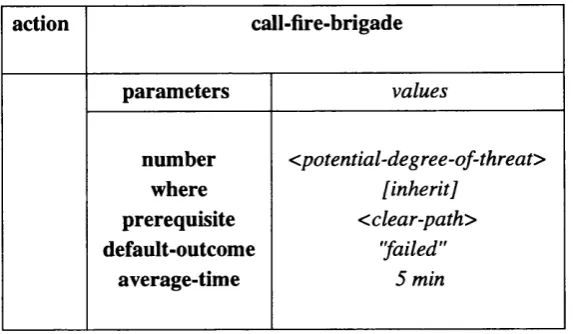
Figure 6.4: Frame for the Action "call-fire-brigade"... 170
Figure 6.5: Example of an Action-selection Table ... 171
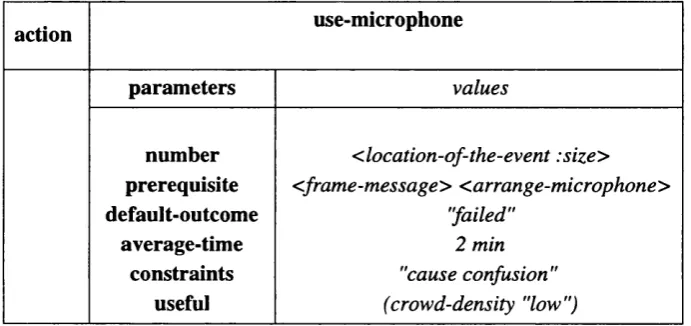
Figure 6.6: Frame for the Action "use-microphone"... 172
Figure 7.1 : Algorithm for Reasoning with the Cache Architecture ... 182
Figure 7.2: Distribution of Weights for a 2-dimensional C a c h e ... 185
Figure 7.3: Algorithm for Cell selection ... 191
Figure 7.4: Contents of a Default-level Cell for AGC Cache ... 195
Figure 7.5: Default-level Reasoning Scheme on Contents of a Single Cell ... 200
Figure 7.6: Contents of a Rule-level Cell for AGC C ache... 204
Figure 7.7: Contents of a Case-level Cell for AGC Cache ... 210
Figure 8.1: A Portion of the Latitude-Longitude Table ... 226
Figure 8.2: Simple Selection of Target-Latitude Columns for Northern Hemisphere ... 228
Figure 8.3: The Frequency Limits for Each Short-wave Band ... 232
Figure 8.4: Organisation of Actions for Determining Frequency ... 233
Figure 8.5: A Portion of the Blocked-Frequency T a b le ... 234
Figure 8.7; Contents of a Default-level Cell for the Radio C a c h e ... 238
Figure 9.1: Temporal Requirements for Different Reasoning Schemes ... 258
Figure 9.2: Selection of Upper Bounds in the Softl Schem e... 262
Figure 9.3: Observed Results from Experiments in the Softl S chem e... 263
Figure 9.4: Selection of Upper Bounds in the Soft2 Schem e... 264
Figure 9.5: Observed Results from Experiments in the Soft2 S chem e... 264
Figure 9.6: Selection of Lower Bounds in the Hard S chem e... 265
Figure 9.7: Observed Results from Experiments in the Hard Schem e... 266
-Chapter 1.
INTRODUCTION
1.1. GENERAL BACKGROUND
As the horizon of knowledge-based applications is expanding, demands on knowledge-based technologies are also increasing. Consequently, researchers in knowledge-based technologies are facing qualitatively new challenges. One of these potential challenges emanates from time-bounded computations where a fixed time limit is prescribed, along with each new request, by which an answer should be provided.
The application of knowledge-based systems has traditionally been confined to simpler domains such as diagnosis, design, planning and configuration. Such domains can be charac terised by properties such as:
the nature of data is static, i.e. the information undergoes no change during the course of its processing;
the control structure is monotonie, i.e. once a decision is made, it remains true throughout the course of the entire computation; and especially
the applications are not time-critical, i.e. there is no pressure caused by limits on the com puting time.
But the gamut of applications of knowledge-based techniques is fast expanding. The type of problems that present knowledge-based systems (KBS) aim to address extends from the presentation of simple, static data to complicated, dynamic-data-based problems involving asynchronous events and non-monotonic flow of control with shifting focuses of attention. Real-time domains such as satellite control, battle management, aerospace systems, commun ication networks, robotics and vision systems all involve the aforementioned characteristics and warrant more sophisticated treatment on the part of the system.
absolute (called "hard" in real-time computing), having a specific time limit within which the result is needed;
graded (or "soft"), i.e. quality of the performance depends on the completion time (e.g. the sooner one gets the result, the better).
and
relative, where the temporal deadline depends on the behaviour of another computation (e.g. to finish task X before task Y);
But a critical look at existing knowledge-based systems suggests that their application in domains where a time-bounded performance is desired has been relatively small. Although various attempts have been made to study the behaviour of time-dependent computations and to build systems for solving real-time problems in different domains, the success is rather limited. This observation leads one to explore the difficulties in carrying out tasks using knowledge-based techniques, when the computing time is stipulated by the imposition of cer tain limits.
Our work is concerned with time-bounded computations where a temporal bound (whether hard or soft) is imposed. Our cache-based system is designed on the assumption that a specific time bound, by which the answer is required, is to be supplied along with the prob lem specification and the cache should return the best possible answer that computed without violating the time limit.
For traditional real-time systems, where the nature of computations is algorithmic and there fore the exact demands on various computational resources are known right at the design phase of the systems, achieving timeliness is fairly straightforward. But as knowledge-based computations are open-ended and indeterministic in nature, the exact temporal requirements for a computation are not so easy to predict, and finishing a task within a small time limit is far from guaranteed. There is therefore a need for suitable techniques to be developed to ensure timeliness for time-bounded knowledge-based systems. The first aim of this research is to develop techniques that go at least some way towards answering this need.
Of course, one way of responding to the above requirement is by enhancing speed through improved technology. For the hardware, as faster processors are being developed and their speed increases from megaflops to gigaflops, the speed of computations should increase enor mously, reducing the temporal requirements for the same computations considerably. Also, attempts are being made to use multiple processors and/or parallel architecture, each of which is aimed at reducing the computational time (e.g. SPHINX, a speech recognition system [Lee 88]). Hence a system that fails to meet the imposed temporal demands may appear to be suc cessful with the same data structure and processing techniques, if much faster processor(s) replace its original ones. Similarly, improved software in the form of parallelism in rule- bases has been contemplated by AI researchers, in order to increase the speed of computa tions [Gupta 86]. Parallélisation of different AI search techniques (e.g. best-first search
-[Kumar 88], alpha-beta pmning [Hsu 89]) have also been suggested and studied by different
researchers.
But comparing a parallel computational approach on an equal footing with a sequential approach is not necessarily helpful. As noticed by Aamodt [Aamodt 91], "success or failure in developing a knowledge-based system depends upon how well expectations map to what is achievable within the given limits. The limits are, to some extent, imposed by the set of methods, techniques and tools that constitute the state-of-the art in knowledge engineering and artificial intelligence in general". We feel that the same holds equally (if not more) strongly for time-bounded knowledge-based systems.
Therefore, the direction of the research reported in this thesis is different. However fast a machine may be, there exists a limit on its speed. Thus the question arises with each occasion when needs for speedier computations appear, "should the system be changed, or should efforts be made to derive improved performance under the existing set-up?". The latter is the concern of our research.
We believe that within any computational framework, a two-way improvement can be accomplished towards the performance of a knowledge-based system:
1. designing an efficient knowledge representation scheme that enables quick access to the right piece of knowledge;
2. developing an efficient reasoning tactic to distil out quick solutions from the retrieved information.
In this research we provide answers to both the requirements by designing a cache-based architecture which provides some ready-to-use answer or solving technique that can settle a current problem; and a novel technique which we call knowledge interpolation that facilitates quick reasoning with the cached answers to compose a solution specifically for the problem at hand while abiding by the temporal stipulation.
1.2. OUR APPROACH
consequently, differences in quality of solutions. Naturally, it is expected of a system that qualitatively better methods will be applied in solving a current problem as the available time increases. Our cache-based architecture is designed to support this expectation.
The initial idea of the cache-based system and some early results have already been reported in some of our earlier publications [Chatterjee 92, Chatterjee 93]. In this thesis we present a deeper description of the system by giving details of knowledge and its representational requirements, procedures for selecting the best indices for access and retrieval of the knowledge, and methods of carrying out different operations on the retrieved information, which are all essential in building a working system.
The main obstacle to using a cache, as described above, in a realistic domain is in the volume and varieties of the knowledge/data that ought to be stored in such a cache. A real-life domain is normally associated with an enormous number of features each having its own significance in any problem that may occur in the domain concerned, causing umpteen varia tions in the nature of the problems. It is unrealistic to store optimal answers to all these varia tions in a cache to be managed in time-bounded mode. Consequently, our suggestion is to store answers to some typical problems in the cache which will be retrieved as and when required, by matching a current problem with the prototype problem situations dealt with in the cache. Evidently, some tactic is therefore required that can adapt the cached answer(s) to render situation-specific solutions to the problems at hand. The idea of "knowledge interpola tion" has been developed to meet this demand. We have named this process of selecting some intermediate position between two extremes "knowledge interpolation", recognising its superficial similarity to numerical interpolation. Resembling what happens in the domain of numerical analysis, this technique aims at deriving a quick approximation to the solution for a current problem by interpolating on the solutions suggested in the cache to some similar problems. The cache, here, will be so designed that it should be able to retrieve at least two solutions for a current request even when the characterisation of this request is imprecise, so that interpolation can be applied on them to calculate a suitable solution from those that are retrieved.
The cache-based architecture aided by the interpolation technique has certain advantages over traditional knowledge-based computing:
1. The cache provides a straightforward access to the relevant knowledge/information, and thereby obviates the need for wading through a knowledge-base in search of appropriate rules or cases (depending upon the underlying reasoning paradigm);
2. The knowledge-interpolation technique does not require to have a cached entry that is the best possible match for the current problem situation (although intuitively the closer is the match, the better should be the interpolated result). Thus, even if the cached answer(s) do not prescribe exact solutions for a given problem, the method can still work on it to pro duce a solution for a problem.
-3. Retrieval from the cache and subsequent knowledge interpolation are both algorithmic in nature, and therefore the required computational time for solving a problem can be estimated. Such an estimation of temporal requirements is essential for time-bounded applications, although it is not normally achievable with other knowledge-based tech niques.
Thus the overall architecture provides a safe footing for any attempt at solving time-bounded problems in knowledge-intensive domains.
1.2.1. Intuition Behind The Proposed Methods
The intuition of our approach finds its root in a type of reasoning that humans commonly indulge in. Humans are quite apt in switching from one mode of reasoning to another depend ing upon the situation, without necessarily regarding one mode as primary. For example, if someone is asked what is the best mode of transportation from location X to location Y within London, the type of answer that one expects will depend on the urgency. An instan taneous answer may be ’the Underground’. But if the replier has some more time, one will probably apply rules such as "if there is no tube station nearby then first take a bus and drop off at a certain place from where one can take the Underground"^ - or, "if it is at the peak of the tourist season and the destination is not too far then take a taxi". However, if the replier has even more time, one will try to find any past experience with respect to either of the locations or the connecting path and may come up with an answer, say, "well, last time I travelled by that route I had a bad experience. It was about to become dark at that time. So, if the travel period is in the evening it will be better to avoid the tube". And when there is no time constraint involved one will try to see the map, distances of nearest tube stations or bus stations, and compare the merits and demerits of various possibilities to arrive at the best solution. A cache is a convenient structure to hold all these common (and heterogeneous) strands of human thinking.
The idea of "knowledge interpolation" also finds its root in the common human tendency of finding a solution that balances two extremes, in order to arrive at an intermediate solution. For example, consider how a human solves the problem of whether to take an umbrella on a particular day. A person normally prefers not be burdened with an extra weight; at the same time getting wet is not desirable either. It is our common experience that humans make their decisions by judging the cloud density (comparing it to some previous examples in memory), and deciding not to take an umbrella if on some past occasion it did not rain even though the density of cloud had been at least as much as it is today. Alternatively, one may even decide to take a small umbrella as an intermediate solution which does not make us feel so burdened if there is no rain and which allows some protection in the event of sporadic rain.
Although quick assessments (as above) of situations do not necessarily yield the best possi ble solution, human instincts for making decisions by choosing a solution that is intermedi ate between two extremes cannot simply be dismissed. The psychologically-based theory of "bounded rationality" [Simon 59] corroborates aspects of the aforementioned line of human decision-making as well.
But discussion of human decision-making in psychological publications revolves around the theory of maximising an expected utility (EU) [Behn 82, vonNeuman 47] where,
EU{A)=^P{Ei)*U(Xi)
when E j , .. E^ are outcomes of the action A, P(E.) is the probability of the i-th outcome and X. is the consequence of outcome E. with a utility U(X.). Solvic [Solvic 90] has illustrated this decision making process with the simple example of whether to carry an umbrella or not on a particular day, by computing the probabilities of whether it will be sunny or raining and the utilities of (not) being burdened and (not) getting wet.
Evidently, these probabilities are worth consideration in a complete picture of informal rea soning, but they seem to be mathematically too regular to capture the essentials of what humans do in problem-solving. On the other hand, typical AI papers that deal with rapid decision-making considers different issues (e.g. indexing schemes [Kolodner 88b, Owens 89]; efficient matching, such as using dynamic similarity measurements [Leake 91], incre mental similarity measurement [Veloso 91]; efficient search techniques [Rich 91]), which put more emphasis on knowledge representation and reasoning but do not represent the common human line of thinking. In our approach we have taken into consideration the common infor mal human problem-solving behaviour in dealing with temporally-stipulated problems and have used the caching technique for its implementation.
1.3. AIM OF THIS RESEARCH
The targets of this research are threefold:
1. Study the necessities to build a cache-based system, which include
- designing the structure of a cache;
- studying the issue of indexing (i.e. cues for retrieval) with respect to a cache;
and
- designing a control algorithm that governs the activities related to problem solving using a cache.
2. Explore a method of "knowledge interpolation". Interpolation is straightforward in numerical analysis, because a natural order exists among numerical quantities which is essential to conduct an interpolation-like act. Such a natural ordering however is absent among symbolic quantities. But a realistic domain can very well be associated with features of different types (e.g. symbolic scalars, range, sets, fuzzy descriptions). Hence designing "knowledge interpolation" necessitates:
- designing schemes for imposition of metrics on symbols of different types and a sys tematic measurement of distance under each scheme;
- identification of the interpolating variables on which interpolation is to be performed.
We should explore various methods of conducting interpolation. Moreover, we want to design policies for knowledge interpolation in different reasoning paradigms i.e. in rule- based and case-based decision-making. We should also therefore examine different ramifications of such specialised interpolations and study the necessary requirements.
3. Finally, study the computational behaviour of an implemented cache-based system in some particular domain. Our interests are:
- study of the qualitative improvements of solutions with successively deeper levels of the cache;
- estimation of temporal bounds for different cache-levels;
and
- most importantly, studying the functional behaviour of the cache-based system in maintaining temporal stipulations and still providing the best possible solution within the given time limit.
In chapters 8-9 we describe a working system with all the key features of caching and interpolation that has been the basis for the study.
1.4. DOMAIN(S) OF APPLICATION
The motivation of our work primarily originates from our studies on knowledge and exam ples in the domain of ground operations control in an airport (AGC). In an airport, the ground operations controller (GOC) is responsible for managing all ground operations within the airport, and solving single problems (i.e. we have not considered complex structures of multiple problems) that may come up during these operations.
beginning of the day. But such a plan needs to be modified quite often, as it is likely to be interrupted by numerous unforeseen events and unanticipated requests throughout the day. Interruptions may come from two types of source: an air traffic control centre that reports actual or predicted deviations from the target times, and an airport management centre that reports significant events in the airport that may affect the targets (e.g. failures in the system of loading or unloading baggage, fires, appearance of some obstacle on a taxi way/run way, etc.). If any such problem occurs, the GOC has to take early action to combat it, e.g. by con tacting the right person who is considered to be a specialist in mitigating the problem, or modifying the basic plan of the day’s operations. Thus actions to solve an immediate problem may generate secondary problems, e.g. allocation of extra time to an airline for loading bag gage may create problems of availability of a gate for the next incoming flight. Although it is desirable for the GOC to attempt deep planning, in the event of some intermption, this may not be practicable in a time-critical situation. Hence the GOC may have to use an ad hoc solution in the case of processing emergencies - and may then take care of the resulting side- effects after the immediate problem is sorted out.
Although developing a full-fledged system to accomplish the task is too time-consuming as well as difficult to manage single-handedly within the time-span for one thesis (and therefore has not been contemplated as such), our studies have helped us identifying certain charac teristics of real-time problem solving and developing techniques to overcome the difficulties.
The ideas generated in this work have subsequently been tested on another domain: allocat ing frequencies and transmitter powers (and transmitter locations where relays are recom mended) for shortwave radio communications, where we have found that the same ideas and the approach continue to hold good. It is a common experience that transmission using shortwave radio is more prone to various types of disturbances than other transmissions e.g. medium wave, FM. However, the physics of long-distance transmission almost invariably calls for shortwave frequencies (between about 2.5 and 30 MHz) to be used. Our application aims at providing the frequency, power of transmitter and if necessary the location of relay point that will be ideal for a proposed transmission between two locations and at a given time of the day.
While the problems of AGC are more or less self-explanatory, the shortwave radio propaga tion needs detailed description of its domain in order that the problems of the domain are better understood. In chapter 8 we describe the topic in detail.
1.5. OVERVIEW OF THE THESIS
The thesis has been organised in the following way:
Chapter 2 contains an examination of real-time problems and the difficulties of solving them
-in general and with knowledge-based techniques, -in particular. We also present a review of the most relevant past works on time-dependent problem-solving that have used AI tech niques.
Chapter 3 introduces the cache architecture and different aspects of its operational behaviour. We also present the encouraging results obtained from trying a preliminary version of the cache on numerical problems.
In chapters 4, 5, 6 and 7 we have studied different fundamental aspects of the cache-based systems from theoretical as well as implementational points of view.
Chapter 4 studies the importance and selection of indices for a cache-based system. Indexing, i.e. selection of appropriate row and column dimensions and the column headers, is essential for quick access to the stored information. This chapter investigates how suitable indexing schemes can be developed commensurate with the cache requirements.
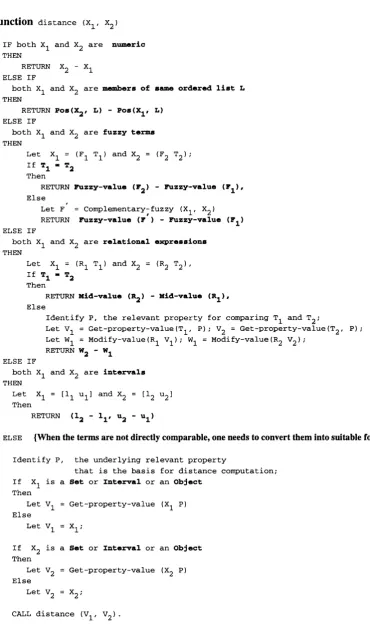
Chapter 5 introduces the notion of "knowledge interpolation". It first investigates the imple mentation of two procedures, fundamental to knowledge interpolation: imposition of order on symbols and measurement of distances. Algorithms for measuring distances under varied situations have been developed. This chapter also identifies different ways of conducting interpolations and how these can be applied to different knowledge stmctures.
Chapter 6 deals with aspects of knowledge representation for the cache-based architecture that facilitate reasoning with the cached knowledge and accomplishing interpolation on them.
Chapter 7 describes how to reason with the cached items in order to find solutions for a current problem while observing the temporal stipulations. It also identifies the essential information that a system is required to store at various levels of the cache. In particular, it discusses three levels where the basic reasoning paradigms are in the form of (i) default solu tions, (ii) rules, and (iii) cases.
In chapter 8 we present a description of the domain of shortwave radio propagation and the considerations for building a cache for handling problems in this domain.
Chapter 2.
TIME-DEPENDENT PROBLEMS AND
KNOWLEDGE-BASED APPROACHES
2.1. INTRODUCTION
In this chapter we first study some of the difficulties that are characteristic of time-dependent problem solving using knowledge-based methods. We then examine different approaches that have been considered by researchers in AI to deal with these difficulties. Finally we sur vey some of the existing real-time systems and their inadequacies in dealing with time- bounded problems.
2.2. DIFFICULTIES IN TIME-BOUNDED COMPUTATIONS
USING KNOWLEDGE-BASED TECHNIQUES
The difficulties that a system may face in achieving true time-bounded performance using knowledge-based techniques can be attributed to several sources:
Difficulties due to domain characteristics;
Difficulties due to the temporal element;
- Difficulties due to nature of the problems;
Difficulties due to the nature of knowledge-based computations.
2.2.1. Difficulties Due To Domain Characteristics
Time-bounded computations using knowledge-based techniques are primarily applied to real-world domains characterised generally by weak (if not intractable) domain theories. For such a domain, the relationships between the relevant concepts are rather uncertain in nature [Porter 89], e.g. causes and effects of different problems do not often follow a general fixed pattern. Naturally, for such a domain it is difficult to proclaim any particular solution to be
-the best possible solution. Frequently, this difficulty is fur-ther aggravated by -the fact that even problem descriptions, here, are generally incomplete and noisy, leading to additional tasks for a system to ascertain the relevance of any piece of information that it happens to receive or generate in its course of operation.
Furthermore, domains where time-bounded computations may be needed reasonably often are in general dynamic, i.e. the relevant data may change during the course of processing. In order to cope with the continuously-varying situations in a dynamic world, a system is required to inspect the problem-solving environment, so that it can determine if any problem more urgent than the one being processed currently has occurred, or if facts that its current problem-solving exercise is based on have undergone any change. In the event of any such situation a system may have to shift its focus of attention to solving the more urgent prob lems, leading to total abandonment or temporary suspension of its current activities (again depending upon the context).
Another important aspect of real-time domains is the nature of their interactions with the outer world. Often a real-time system needs to refer to some values that are to be computed externally and fed back to the system, or the system may need to carry out certain tasks exter nally, the outcome of which will be required before it can continue with its further reasoning. Interaction with the outer world has the obvious problem of resource allocation. Moreover, the system needs to monitor the resources that are available at any instant, and to reset its task priorities and resource allocations depending upon the workload, resource availability etc. - so that a smooth behaviour may be ensured despite potential perturbations in this regard. A system lacking this property may waste time and processing resources in executing less relevant tasks, or in waiting for resources that are not readily available, or even on undertak ing computing tasks that are no longer required.
2.2.2. Difficulties Due To The Temporal Element
Imposition of a temporal bound on the computational activities almost invariably demands certain other properties on the part of the system. The most important of these is speed.
firstly, for a given system there can always be a problem for which the allotted time limit is too small to be respected even using the fastest available (in terms of the system con cerned) method. Naturally, a complete system has to be well enough equipped to provide some sensible response for such contingencies too.
secondly, since in a dynamic world the environment is changing continuously, even resorting to the maximum possible speed (governed primarily by the system configuration) cannot guarantee that the environment will remain unchanged during the course of execution of a certain task. There is always the possibility of occurrence of some new event that will have an influence on the current task. Such new events will act as external inputs to the system. They should be recognised as quickly as possible by the system, and their significance or criticality judged in order to take appropriate actions.
also, the solution steps that a system will resort to should have some pre-definable or identifiable predictability as far as their consequences are concerned. The speediest tactic, if it has an unpredictable outcome, is of no practical value here.
Therefore, merely increasing the speed in calculation may not provide the right kind of treat ment. The calculation procedure has to be predictable enough to ensure a relevant result within the prescribed time bounds.
2.2.3. Difficulties Due To Nature Of The Problems
The types of problems that a system is likely to address may have varying relevance to the overall functioning of the domain. Consequently, different time limits will apply in solving these problems. Therefore, timeliness does not mean that all problems are to be treated with equal urgency. Depending upon the nature of the problem, the length of the deadline may vary. Even for the same problem occurring under different circumstances a system may find different temporal bounds prescribed for the solution.
Moreover, the implication of the time bound may vary with situations. Depending upon the repercussion of any possible failure on the part of the system, time-bounded tasks have been categorised into two classes: hard and soft [Laffey 88a, Stankovic 88]. A real-time problem is
hard when inability to meet the deadline strictly leads to a disastrous consequence. On the other hand, for a soft real-time task a strict time limit cannot be specified but a tentative target can be defined. Exceeding this limit does not lead to any serious consequence but may cause some inconvenience (of varying degrees, depending upon the nature of the problem and the length of delay).
Naturally, a system for time-bounded computations is not expected to have a single method for solving a particular type of problem. Rather, it is more desirable for the system to have
-different tactics in its repertoire, with varying time complexities, for solving a particular type of problem. The system should have the capability of judging the implication of the prescribed time limit and should decide accordingly the problem-solving approach and also the starting and ending times of action. It is reasonable to assume that the higher is the time- complexity for a tactic, the better (qualitatively) will be the solution achieved through its application. Certainly, in the absence of any time limit a system ought to apply the best avail able tactic. But imposition of time bounds usually forces a compromise in quality in order to comply with the temporal demands.
2.2.4. Difficulties Due To The Nature Of Knowledge-Based Computations
The difficulties mentioned above are not particular to knowledge-based systems alone. A designer of any systems intended for time-bounded activities needs to develop strategies and tactics to tackle these obstacles. In systems characterised primarily by algorithmic actions (e.g. control of industrial processes, communication with data-recording equipment, monitor ing of alarms) the nature of the possible computations and their demands on resources are clear during the design phase. Hence, most discussions of time-bounded computations in such systems concentrate on trade-offs among the different features, on the assumption that there is no difficulty in finding at least one way of achieving any of them.
On the other hand, the fundamental nature of knowledge-based computations is too open- ended to guarantee such smooth and predictable behaviour. Whether it is use of search tech niques in a solution space, or application of rules under rule-based reasoning, or selecting appropriate cases from a stored case-base under case-based reasoning, the underlying princi ple is to keep on repeating the same procedure until a desired match is found. Hence, these techniques suffer from some inherent indeterminacy, in the sense that the exact steps that are to be carried out are not well-known beforehand. As a result, the exact demands on time and other computational resources cannot be well-estimated at the design phase of the architec ture. For example, in a rule-based system it is not possible to foretell which rules are going to be fired in order to provide the answer to the next problem. Past studies of rule-based systems [Gupta 85] indicate that in a rule-based system 90% of the computational effort is spent in matching while 10% is used in conflict resolution and actual actions. Time-complexities of different heuristic search techniques do increase exponentially, and consequently, in a rela tively large search space it becomes essentially impossible to predict how much computa tional effort will be required. Locating suitable cases in a case-base with even moderately large numbers of cases has the same difficulty. This open-endedness of knowledge-based computations is a deterrent to their straightforward application in time-bounded problem solving.
along one line researchers have studied the temporal behaviour of time-dependent prob lems, in general, and have developed temporal logics to deal with importance of time as a crucial factor, its representation and relationships between events occurring at different time points/slots;
- the second line comprises development of knowledge-based techniques to cope with the temporal demands of time-bounded problems;
and
the third line consists of endeavours to build real-time systems pertaining to some specific domain, tuned and adjusted in accordance with the terms and needs of that domain.
As we see below, each of the above approaches has certain drawbacks as far as performance is concerned.
2.3. TEMPORAL LOGIC AND REASONING
The notion of time has long been considered as an important aspect of knowledge-based problem solving, as it has been observed by McDermott in 1982 that "No one has ever dealt with time correctly in an AI program, and there is reason to believe that doing it will change everything" [McDermott 82]. This comment sounds up to date even against the background that a considerable amount of work has been done since then in representing and reasoning with the temporal dimension of information.
Many items of work since 1982 have experienced some influence from Allen [Allen 84, Allen 85]. Time here is considered to be a convex interval represented by two points (corresponding to the beginning and end). Any event is associated with an interval during which it has occurred. Allen’s work comprises exploration of the relationship between two intervals, and as many as thirteen relationships have been identified that govern the temporal relationship of two intervals. They are: equal, before, after, overlaps, overlapped-by, starts, started-by, finishes, finished-by, during, contains, meets and met-with. Logics based on these temporal relationships have also been developed.
A new interpretation of interval-based logic has been provided by Tsang [Tsang 87]. Instead of considering time-intervals as the basic unit of reasoning, here, events occurring during cer tain intervals have been studied as the concept of primary interest. The rationale behind this idea is that human mental experience is based on events rather than instances, and therefore two events occurring during the same time interval should be considered as two different primitives, as opposed to what Allen’s interval-based logic seem to suggest. Relationships between event-based and interval-based calculi have also been established, on the basis of their dealings with time.
29-Allen’s theory of time has subsequently been extended by Ladkin [Ladkin 86, Ladkin 87], who considered a non-convex representation of time, in the form of unions of intervals such that they comprise some convex sub-intervals with convex gaps between them. From this, a canonical model of Interval Calculus has been developed.
A different representation of time has been proposed by Shoham [Shoham 89]. Here, time is considered to be linear, described by a pair (T, <) where T is a set of time points and < is a total order on this set.
This theoretical treatment of temporal reasoning constitutes a new (post-1982) dimension in the time-dependent reasoning process. A general overview and state of the art of temporal reasoning and calculus can be found in [Vila 94]. But the work does not certainly address the time-bounded problem solving aspect of knowledge-based reasoning and is therefore outside the scope of our subsequent discussions. However, we feel that such a theoretical approach is still the closest to a formal treatment (logic-based) relevant to our work.
2.4. KNOWLEDGE-BASED TECHNIQUES FOR REAL-TIME
PROBLEM SOLVING
Different techniques have been suggested so far for handling time-bounded problems using knowledge-based techniques. These include different heuristic search algorithms with a view to expediting locating a suitable solution in the solution space. Different heuristics have also been suggested to ensure other aspects of real-time performance.
2.4.1. Studies O f Different Search Techniques
The success of a knowledge-based system in the dimension of interest to us depends on how fast a suitable solution can be retrieved from its knowledge-base. Different heuristic search algorithms have been developed to achieve this objective. Some of these algorithms are quite general in their applicability while others have been attempted on some particular reasoning schemes. Also, search algorithms have been developed with the aim of meeting time- dependent demands of real-time situations. However, an in-depth look at various existing retrieval algorithms reveals that using them isolatedly does not really serve the purpose. For example:
guaranteed to find an optimal solution, their success in the real-time domain is limited only to small search spaces and unrestricted time bounds. In a comparatively large domain with strict temporal deadlines these algorithms are unlikely to produce any result.
A subsequent variation of A*, real-time A* (RTA*), [Korf 88] has been designed specifically to address this problem. This algorithm meets a temporal deadline by producing at least a partial solution within the deadline. The technique adopted here is bounded look ahead search, which searches to a fixed depth horizon (the depth depends upon the given deadline). Like A* , here too a cost function is used to evaluate the frontier nodes, and each move is made towards the minimum-cost value. Thus the algorithm is committed to some action within a fixed time span, and moreover, the requirement of building an entire search tree, right at the outset, is circumvented.
But the major problem with these search algorithms is that, for them to be useful, it is required to have a tree-like structure (either present explicitly or capable of being generated incrementally, i.e. from any node its successors can be generated) in which there is some guaranteed underlying understanding of the general meaning of the structures and the ratings of nodes. For a real-life domain to fit this description, one would need to have a fairly fixed and stable kind of criterion in order to control the search. But the uncertain nature of problem-solving and incompleteness in the information about the domain renders such an assumption grossly impractical, in general, in a real-life domain. Another major problem with the heuristic search algorithms is that while calculating the cost functions they consider the planning costs alone and ignore the execution cost of a plan [Shekhar 89]. Naturally, the search algorithms may spend all the available time only in searching. But in many real-life problems the execution cost is non-trivial and hence needs to be considered while planning, primarily, because of possible interactions of the system with the outer world, to cope with the demands of real-time problems. All these shortcomings of search algorithms preclude straightforward applications of the techniques in real-time domains.
Some other specialised search techniques have been developed to work in particular reason ing modes such as rule-based reasoning or case-based reasoning. But, as we see below, they have their drawbacks too, as far as applications to real-time domains are concerned.
The pioneering work to expedite searches in a rule-base comes from RETE [Forgy 82]. The efficiency of RETE can be attributed to three major sources:
- partial matching of rules’ preconditions, governed by the assumption that the state description remains more or less the same between the firing of rules. It maintains a net work of rule conditions and it considers only the changes in the state descriptions while it is deciding which rule to apply next;
-- organisation of the rules in such a way that they share a common structure of precondi tions and consequently several rules can be tested in one cycle;
remembering of variable bindings from previous calculations and updating these with new binding information instead of computing binding consistencies from scratch each time a new condition is satisfied.
However, RETE and its subsequent improvements (such as TREAT [Miranker 87]) have been designed for production systems only, which by definition are purely rule-based. How ever, in most of the real-life domains compiling an comprehensive rule-base is time- consuming and difficult (if not impossible). Naturally, these algorithms can at best be a part of the overall problem-solving mechanism in most of the real-time knowledge-based problem domains. Hence, for effective design of a real-time knowledge-based system a designer needs to look for some other reasoning mechanisms as well.
Case-based reasoning (CBR) has developed in recent years as a viable alternative, as a mode of informal reasoning [Riesbeck 89, Kolodner 92a, Kolodner 93] (though not with any spe cial reference to time-dependent problems). Instead of holding formal rules, a CBR system depends on informal knowledge structures in the form of solutions of some past cases. In order to solve a current problem a CBR system tries to locate from its case-base similar past case(s) and tailor the past solution(s) according to the need of the current situation. Naturally, as the case-base grows, searching for appropriate solutions becomes a challenging issue as well. Different search algorithms have been developed in recent years for rapid case retrieval from a case-base. But, as we observe below, all of them are based on some oversimplified assumptions regarding the domain and consequently none of them stands the test of being a foolproof solution to the real-time AI problems.
Tree-Hash algorithms [Stottler 89] have the inherent drawbacks of oversimplification in simi larity measurement. They measure similarity on the basis of exact matches of attribute values. But in real-life situations matching of cases based on attribute values may not be practicable, as various aspects of cases need to be considered and therefore massive abstrac tion of cases is required [Owens 88]. As a further example, Lehnert’s algorithm [Lehnert 87] of searching large case-bases considers generating and searching the entire search space. Its domain of application being ’phoneme generation for pronunciation of unknown words’ has the obvious advantage of a rather limited (even enumerated a priori) search space, which is not true for most real-life application domains where a case may be specified in terms of features drawn from very large sets.
The above observations suggest that efficient retrieval cannot be achieved only through supe rior search techniques. Instead, efforts should be made to measure similarity of the current situation to past ones in a judicious manner in order to facilitate worthwhile retrieval within a limited time. The basic limitation of existing mechanisms is that the notion of ’similarity’ remains static throughout the operation. But time-critical situations deviate from this blanket assumption about similarity, where - depending upon the situation - the meaning of similarity may vary. The next section describes some of the salient influences that time-criticality may have on similarity measurement.
2.4.2. Other Heuristics And Suggestions
While speed is considered to be the foremost requirement of real-time systems, there are other aspects too. Different heuristics have so far been developed to satisfy them. For exam ple.
Anytime Algorithms, characterised by some special features, have been suggested in dealing with time-dependent planning problems [Dean 88]. These algorithms are characterised by facilities whereby
reasoning with such an algorithm can be suspended and resumed subsequently with little overhead;
and
it can be terminated at any time, yet it is guaranteed to return some answer, and the answer returned will improve as a well-behaved function of time.
Progressive reasoning [Wright 86] has been suggested to ensure timeliness. Here, inference is performed in several phases such that at each phase a more accurate solution is produced. It prescribes for a system to have several levels of reasoning, each using data that are more time-consuming to retrieve and process than the previous level. The last calculated answer is to be remembered so that as soon as the allowed time expires the system can produce a
response based strongly on that answer. Again, the idea of progressive reasoning is essen tially a subset of a more generalised idea called "progressive deepening" [Winston 84], which searches each situation to successively deeper depths until the time bound is reached. Evi dently, such an approach is likely to work when the problem has a character that allows this multiple-stage treatment to occur. For an arbitrary domain such an assumption is more likely to be false than true.
In order to avoid any repetition of tasks that a system may undertake while reasoning with a given problem, distinctions have been made between reasoning in the future and reasoning in the past [Long 83]. The argument presented is that a real-time system in course of its func tioning may encounter some new or derived data which have influence on some decisions made in the past. In such cases treating this set of data as something entirely new should be erroneous. Instead the system should be able to backtrack and withdraw some of the conclu sions (and related information) made in the past and re-execute its decision module, as it is not possible to revoke any action that has already been taken. On the other hand, any data pertinent for reasoning in the future has influence on both information and the actions to be taken, and a system can be judicious in selecting the next action based on such items of data.
2.5. DIFFERENT REAL-TIME SYSTEMS: A BRIEF OVERVIEW
There have been quite a number of efforts to build real-time systems, each having its own merits as well as limitations with respect to solutions of time-dependent problems. An exhaustive study of all of them is unnecessary; here we describe a representative set of them along with their purpose and behaviour in attempting to achieve the objective.
2.5.1. AIRPLAN
One of the earliest systems designed for time-critical decision making is called AIRPLAN, developed at Camegie-Mellon University [Masui 83]. The purpose of the system is to assist air operations officers with the launch and recovery of aircraft from a carrier at sea. The most important aspect for this system is "graceful adaptation" in the sense that it has to recognise any changes in the environment (such as weather conditions, fuel state of an aircraft) and take appropriate action (here, to alert the officers) to combat the impending problem. AIRPLAN offers four levels of assistance to its users: display of raw data, identification of problems and rough characterisation of possible solutions, refinement of the characterisation of possi ble problems and identification of possible future problems.