ISSN: 2231-5381
http://www.ijettjournal.org
Page 300
Efficient Pattern Mining and Prediction of User
Behavior in Mobile Commerce
S.Kiruthika
Assistant Professor
Department of Computer Science and Engineering Dhirajlal Gandhi College Of Technology
Salem,Tamilnadu, India
Abstract— Mobile commerce has received a lot of interests from both of the industry and academia. A framework called Mobile Commerce Explorer for mining and prediction of mobile user’s movements and purchase transactions under the context of mobile commerce, consists of three major components , Similarity Inference Model (SIM), Personal mobile commerce pattern mine algorithm and Mobile Commerce Behavior Prediction. In the past only purchase data of users were used in recommender system before, while navigational and behavioral pattern data were not utilized.
The method is to develop a recommender system based on navigation and behavior. First, all the data related to the purchase, navigational and behavioral patterns are gathered. The confidence levels obtained by the above analysis were used to determine a preference level for each pair of two products. The confidence levels between clicked products, between the products placed in the basket and between purchased products were calculated respectively and then, the preference level is estimated through the linear combination of above three confidence level. Here Random Walk with Restart (RWR) algorithm is used to retrieve items for recommendation to the user.
Keywords —Mobile Commerce, Data mining
I.INTRODUCTION
With the rapid advance of wireless communication technology and the increasing popularity of powerful portable devices, mobile users not only can access worldwide information from anywhere at any time but also use their mobile devices to make business transactions easily.The availability of location acquisition technology, some m-commerce services will be able to capture the moving trajectories and purchase transactions of users. By developing pattern mining and prediction techniques that explore the correlation between the moving behavior and purchasing transactions of mobile users to explore potential mobile commerce features. When a user enters a building, the user may lose the satellite signal until returning to the outdoors. By matching user trajectories with store location information, a user’s moving sequence among
stores in some shop areas can be extracted. The moving and purchase patterns of a user can be captured together as mobile commerce patterns for mobile users. A personal mobile commerce pattern mining and prediction framework, called Mobile Commerce Explorer which consist of three major components.
The Similarity Inference Model is for measuring the similarities among stores and items, Personal Mobile Commerce Pattern Mine algorithm for efficient discovery of mobile user’s Personal Mobile Commerce Patterns, Mobile Commerce Behavior Predictor for prediction of possible mobile user behaviors. Meanwhile, the availability of location acquisition technology, Global Positioning System (GPS), facilitates easy acquisition of a moving trajectory, which records a user movement history.
II. EXISTING SCHEME
A crucial issue for pattern-based prediction is that the predictions fail if there is no existing pattern to match. In the previous pattern-based prediction models, pattern selection is typically based on exact matching, e.g., the similarity between different stores is 0. If the user has never been to store Q, store R, and store S. Since there is no pattern involving these stores, pattern-based predictions do not work when a user first moves to these stores. To overcome this problem, our idea is to incorporate the similarities of stores and items into the mobile commerce behavior prediction. Since the user has never been to store Q, the mobile patterns mined by this user do not contain any information about store Q. However, if we know that store A (where the user had visited before) is similar with store Q, we can make recommendation to the user based on the patterns exhibited in store A.
III.PROPOSEDSCHEME
ISSN: 2231-5381
http://www.ijettjournal.org
Page 301
incorporates three innovative techniques, includingSimilarity Inference Model for measuring the similarities among stores and items, which are two basic mobile commerce entities considered in this paper, Personal Mobile Commerce Pattern Mine algorithm for efficient discovery of mobile users’ Personal Mobile Commerce Patterns, and Mobile Commerce Behavior Predictor for prediction of possible mobile user behaviors.
The recommender system based on click stream data using Association Rule Mining is proposed consist of three steps. First, all the data related to the purchase, navigational and behavioral patterns are gathered. In addition, the continuous variables are converted to categorical variables in order to apply the association rule mining. The confidence levels obtained by the above analysis were used to determine a preference level for each pair of two products. The confidence levels between clicked products, between the products placed in the basket and between purchased products were calculated respectively and then, the preference level is estimated through the linear combination of the above three confidence level.
A .Mobile Network Database
Table 1, the mobile network database maintains detailed store information which includes the locations. When a mobile users move between the stores, then the mobile information which includes user identification, stores and item purchased are stored in the mobile transaction database.
Table1: Mobile Network Database
When a mobile users move between the stores, then the mobile information which includes user identification, stores and item purchased are stored in the mobile transaction database. When a mobile user moves and purchase items among the stores, the next step will be predicted according to the mobile user’s identification and the recent mobile transactions
B. Data Mining Mechanism
In data mining mechanism, the SIM model and PMCP Mine algorithm is used to discover the store/item similarities. The proposed MCE framework consists of three modules, when mobile users move between the stores, the mobile information which includes user identification, stores, and item purchased are stored in the mobile transaction database. Here there are three modules, Similarity Inference Model, PMCP-Mine Algorithm, and Behavior Prediction Engine.
1. Similarity inference model (SIM): To compute the store and item similarities from the mobile transaction database and to capture mobile users’ moving and transactional behaviors in terms of movement among stores and purchased items similarity inference model is used. Two databases are used, namely, SID and ISD. For a given store, it shows which items are available for sale and for a given item, which stores sell the items are defined. The information can help to infer which stores or items are similar. If the same similarity inference heuristics to both of stores and items, various types of items may be seen as similar since different supermarkets are seen as similar. Based on our heuristics, if two stores provide many similar items, they are likely to be similar; if two items are sold by many dissimilar stores, they are unlikely to be similar.
Table1: SID and ISD
If two stores provide many similar items, they are likely to be similar and if two items are sold by many dissimilar stores, they are unlikely to be similar. SID pq in
database SID represents that a user purchased item q in store p. The entry ISD xy in database ISD represents that
a user purchased item x in store y. In SimRank, the similarity between two given objects is measured based on the average similarities between other objects linked with the given two objects. As a result, two supermarkets selling a number of different items may be considered as dissimilar in SimRank.
ISSN: 2231-5381
http://www.ijettjournal.org
Page 302
∑φεspMaxSim(φ,┌sq) + ∑γε sqMaxSim (γ ,┌sp)
|┌sp | + |┌sq |
In SIM, we use two different inference heuristics for the similarity of stores and items because some stores, such as supermarkets, may provide various types of items.
2. PMCP-Mine Algorithm:
The PMCP-Mine algorithm is used to mine the personal mobile commerce patterns efficiently. PMCP-Mine algorithm is performed in a bottom up manner. First, frequent transaction behaviors is taken place in a single store. Then, these single patterns can be joined to form compound patterns. The PMCP-Mine algorithm is performed in a bottom-up manner. The PMCP-Mine algorithm is divided into three main phases: 1) Frequent-Transaction Mining. A Frequent-Frequent-Transaction is a pair of store and items indicating frequently made purchasing transactions.
In this phase first discover all Frequent-Transactions for each user. 2) Mobile Transaction Database Transformation. Based on the all Frequent-Transactions, the original mobile transaction database can be reduced by deleting infrequent items. The main purpose is to increase the database scan efficiency for pattern support counting. 3) PMCP Mining. This phase is mining all patterns of length k from patterns of length k _ 1 in a bottom-up fashion.Eventually, the complete mobile commerce patterns can be obtained by the PMCP-Mine algorithm. The PMCP-Mine algorithm is divided into three main phases:
3.Frequent-
Transaction Mining: A Frequent-Transaction is a pair of store and items indicating frequently made purchasing transactions. In this phase all Frequent-Transactions for each user are discovered. First the support of each store and item pair is counted for each user. The patterns of frequent-1 transactions are obtained when their support satisfies the user-specified minimal support threshold. Finally, the same procedures are repeated until no more candidate transaction is generated.
4. Mobile Transaction Database Transformation:
Based on the all Frequent-Transactions, the original mobile transaction database can be reduced by deleting infrequent items. The main purpose is to increase the database scan efficiency for pattern support counting. Item sets are represented as symbols for efficiently processing, and transactions with insufficient support are eliminated to reduce the database size.
The PMCP-Mine algorithm to mine the personal mobile commerce patterns efficiently. The PMCP-Mine algorithm is inspired by the TJPF algorithm which is an Apriori-like algorithm.
4. PMCP Mining:
This phase is mining all patterns of length k from the patterns of the length k - 1.Mining algorithm, utilize a two-level tree, called Personal Mobile Commerce Pattern Tree to maintain the obtained PMCP. The upper level of the PMCP-Tree keeps track of the frequent mobile transactions and the lower level of the PMCP-Tree maintains the users and paths.
C. Behavior Prediction Engine
In the Behavior prediction engine, the users’ future mobile commerce behaviors which include movements and transactions prediction is done. Mobile commerce Behavior prediction measures the similarity score of every PMCP with a user’s recent mobile commerce behavior by taking store and item similarities into account. In MCBP, three ideas are considered:
The premises of personal mobile commerce behavior prediction with high similarity to the user’s recent mobile commerce behavior are considered as prediction knowledge. More recent mobile commerce behaviors potentially have a greater effect on next mobile commerce behavior predictions. Personal mobile commerce behavior prediction with higher support provides greater confidence for predicting user’s next mobile commerce behavior.
D.Recommender System:
The recommender system based on click stream data using Random walk with restart algorithm is proposed consist of three steps. First, all the data related to the purchase, navigational and behavioral patterns are gathered. In addition, the continuous variables are converted to categorical variables in order to apply the RWR. The confidence levels obtained by the above analysis were used to determine a preference level for each pair of two products.
ISSN: 2231-5381
http://www.ijettjournal.org
Page 303
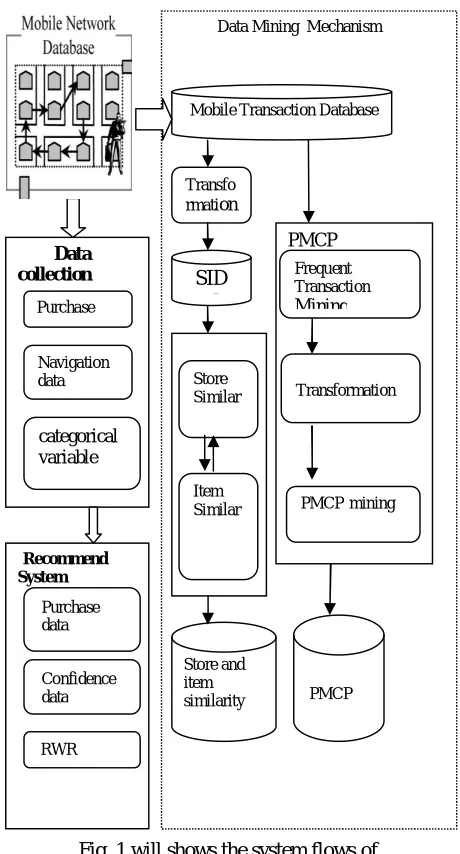
IV. SYSTEM FLOW DIAGRAMSFig. 1 will shows the system flows of proposed works.
Fig. 1 will shows the system flows of recommender system.
Algorithm : Recommendation using RWR
Input: An adjacency matrix W, and a target user uq. Output: A recommended item list l.
1. Let vq= 0 for all its entries, except a ‘1’ for the qth entry;
2. Normalize W using A =D-1/2WD-1/2; 3. Initialize uq = vq;
4. while uq not converged do 5. uq=(1- δ)A uq + δ vq; 6. end while
7. Select top ranked subset e from uq as the
recommendation base; 8. if ei is a user then
9. Select items that ei has purchased recently and put them into l;
10. end if
11. if ei is a product then 12. Put ei into l;
13. end if
14. if e is a category then
15. Select items that contribute more to IC of ei and put them into l;
16. end if 17. return l;
IV. EXPERIMENTAL RESULTS AND DISCUSSIONS
In this section evaluation and performance of MCE takes place. Mining and prediction of mobile user’s movements and transactions in mobile commerce environments, the mobile commerce explorer framework have three major techniques, similarity inference model is used for measuring the similarities among stores and items, Personal mobile commerce pattern mine algorithm is used for efficiently discovering mobile user’s PMCP and mobile commerce behavior predictor for predicting possible mobile user behaviors.
The mobile commerce explorer achieves a very high precision in mobile commerce behavior predictions. The prediction technique Mobile commerce Behavior Predictor in MCE framework integrates the mined Personal mobile commerce Prediction and the similarity information from SIM are used to achieve superior performs in terms of precision, recall.
V. CONCLUSION
The mobile commerce explorer achieves a very high precision in mobile commerce behavior predictions. The prediction technique Mobile commerce Behavior Predictor in MCE framework integrates the mined Personal mobile commerce Prediction and the similarity information from SIM are used to achieve superior performs in terms of precision, recall. The recommended system based on click stream data using Random walk with restart algorithm is proposed consist of three steps. First, all the data related to the purchase, navigational and behavioral patterns are gathered. In addition, the continuous variables are converted to categorical variables in order to apply the RWR.
The confidence levels between clicked products, between the products placed in the basket and between purchased products were calculated respectively Data Mining Mechanism
SIM
PMCP
Transfo rmation
Store Similar
Item Similar
Frequent Transaction Mining
Transformation
PMCPmining Mobile Transaction Database
Store and item similarity
Data collection
Purchase
data
Navigation data
categorical variable
SID
and
PMCP Recommend
System
Purchase data
Confidence data
ISSN: 2231-5381
http://www.ijettjournal.org
Page 304
and then, the preference level is estimated through thelinear combination of the above three confidence level.
REFERENCES
[1] R. Agrawal, T. Imielinski, and A. Swami “Mining Association Rule between Sets of Items in Large Databases,” Proc. ACM SIGMOD Conf. Management of Data, pp. 207-216, May 1993.
[2] R. Agrawal and R. Srikant, “Fast Algorithm for Mining Association Rules,” Proc. Int’l Conf. Very Large Databases, pp. 478-499, Sept. 1994.
[3] R. Agrawal and R. Srikant, “Mining Sequential Patterns,” Proc. Int’l Conf. Data Eng., pp. 3-14, Mar. 1995.
[4] S.F. Altschul, W. Gish, W. Miller, E.W. Myers, and D.J. Lipman, “Basic Local Alignment Search Tool,” J. Molecular Biology, vol. 215, no. 3, pp. 403-410, Oct. 1990. [5] M.-S. Chen, J.-S. Park, and P.S. Yu, “Efficient Data Mining
for Path Traversal Patterns,” IEEE Trans. Knowledge and Data Eng., vol. 10, no. 2, pp. 209-221, Apr. 1998
[6] J. Han and Y. Fu, “Discovery of Multiple-Level Association Rules in Large Database,” Proc. Int’l Conf. Very Large Data Bases, pp. 420- 431, Sept. 1995.