Production of
Y
共共共
1S
兲兲兲
Mesons from
x
bDecays in
pp
Collisions at
p
s
p
s
p
s
5
1
.
8 TeV
T. Affolder,21H. Akimoto,43 A. Akopian,36 M. G. Albrow,10P. Amaral,7S. R. Amendolia,32 D. Amidei,24 J. Antos,1
G. Apollinari,36 T. Arisawa,43 T. Asakawa,41 W. Ashmanskas,7 M. Atac,10 F. Azfar,29 P. Azzi-Bacchetta,30 N. Bacchetta,30 M. W. Bailey,26 S. Bailey,14P. de Barbaro,35 A. Barbaro-Galtieri,21 V. E. Barnes,34 B. A. Barnett,17
M. Barone,12 G. Bauer,22 F. Bedeschi,32 S. Belforte,40 G. Bellettini,32 J. Bellinger,44 D. Benjamin,9J. Bensinger,4 A. Beretvas,10J. P. Berge,10 J. Berryhill,7S. Bertolucci,12 B. Bevensee,31 A. Bhatti,36 C. Bigongiari,32 M. Binkley,10
D. Bisello,30 R. E. Blair,2 C. Blocker,4K. Bloom,24 B. Blumenfeld,17 B. S. Blusk,35 A. Bocci,32 A. Bodek,35 W. Bokhari,31 G. Bolla,34 Y. Bonushkin,5 D. Bortoletto,34 J. Boudreau,33 A. Brandl,26 S. van der Brink,17
C. Bromberg,25 N. Bruner,26 E. Buckley-Geer,10 J. Budagov,8 H. S. Budd,35 K. Burkett,14 G. Busetto,30 A. Byon-Wagner,10K. L. Byrum,2M. Campbell,24A. Caner,32W. Carithers,21J. Carlson,24D. Carlsmith,44J. Cassada,35
A. Castro,30 D. Cauz,40 A. Cerri,32 A. W. Chan,1P. S. Chang,1 P. T. Chang,1J. Chapman,24 C. Chen,31Y. C. Chen,1 M.-T. Cheng,1 M. Chertok,38 G. Chiarelli,32 I. Chirikov-Zorin,8G. Chlachidze,8 F. Chlebana,10 L. Christofek,16 M. L. Chu,1S. Cihangir,10 C. I. Ciobanu,27 A. G. Clark,13 M. Cobal,32 E. Cocca,32 A. Connolly,21 J. Conway,37 J. Cooper,10 M. Cordelli,12 D. Costanzo,32 J. Cranshaw,39 D. Cronin-Hennessy,9 R. Cropp,23 R. Culbertson,7
D. Dagenhart,42 F. DeJongh,10 S. Dell’Agnello,12 M. Dell’Orso,32 R. Demina,10 L. Demortier,36 M. Deninno,3
P. F. Derwent,10 T. Devlin,37 J. R. Dittmann,10 S. Donati,32 J. Done,38 T. Dorigo,14 N. Eddy,16 K. Einsweiler,21
J. E. Elias,10 E. Engels, Jr.,33 W. Erdmann,10D. Errede,16 S. Errede,16 Q. Fan,35 R. G. Feild,45 C. Ferretti,32 I. Fiori,3
B. Flaugher,10 G. W. Foster,10 M. Franklin,14 J. Freeman,10 J. Friedman,22 Y. Fukui,20 S. Gadomski,23 S. Galeotti,32 M. Gallinaro,36 T. Gao,31 M. Garcia-Sciveres,21 A. F. Garfinkel,34 P. Gatti,30 C. Gay,45 S. Geer,10 D. W. Gerdes,24
P. Giannetti,32 P. Giromini,12 V. Glagolev,8 M. Gold,26 J. Goldstein,10 A. Gordon,14 A. T. Goshaw,9 Y. Gotra,33 K. Goulianos,36 H. Grassmann,40 C. Green,34 L. Groer,37 C. Grosso-Pilcher,7 M. Guenther,34 G. Guillian,24 J. Guimaraes da Costa,24 R. S. Guo,1C. Haber,21 E. Hafen,22 S. R. Hahn,10 C. Hall,14 T. Handa,15 R. Handler,44 W. Hao,39 F. Happacher,12K. Hara,41A. D. Hardman,34R. M. Harris,10 F. Hartmann,18 K. Hatakeyama,36 J. Hauser,5 J. Heinrich,31 A. Heiss,18B. Hinrichsen,23 K. D. Hoffman,34C. Holck,31R. Hollebeek,31L. Holloway,16R. Hughes,27
J. Huston,25 J. Huth,14 H. Ikeda,41 M. Incagli,32 J. Incandela,10 G. Introzzi,32 J. Iwai,43 Y. Iwata,15 E. James,24 H. Jensen,10 M. Jones,31 U. Joshi,10 H. Kamabara,13 T. Kamon,38 T. Kaneko,41 K. Karr,42 H. Kasha,45Y. Kato,28
T. A. Keaffaber,34 K. Kelley,22 M. Kelly,24 R. D. Kennedy,10 R. Kephart,10 D. Khazins,9T. Kikuchi,41 M. Kirk,4 B. J. Kim,19 H. S. Kim,23 S. H. Kim,41 Y. K. Kim,21 L. Kirsch,4 S. Klimenko,11 D. Knoblauch,18 P. Koehn,27
A. Köngeter,18 K. Kondo,43 J. Konigsberg,11 K. Kordas,23 A. Korytov,11 E. Kovacs,2 J. Kroll,31 M. Kruse,35
S. E. Kuhlmann,2K. Kurino,15 T. Kuwabara,41 A. T. Laasanen,34 N. Lai,7S. Lami,36 S. Lammel,10J. I. Lamoureux,4
M. Lancaster,21 G. Latino,32 T. LeCompte,2 A. M. Lee IV,9 S. Leone,32 J. D. Lewis,10 M. Lindgren,5 T. M. Liss,16
J. B. Liu,35 Y. C. Liu,1N. Lockyer,31 J. Loken,29 M. Loreti,30 D. Lucchesi,30 P. Lukens,10 S. Lusin,44 L. Lyons,29
J. Lys,21R. Madrak,14K. Maeshima,10 P. Maksimovic,14 L. Malferrari,3M. Mangano,32M. Mariotti,30 G. Martignon,30 A. Martin,45 J. A. J. Matthews,26 P. Mazzanti,3K. S. McFarland,35 P. McIntyre,38E. McKigney,31 M. Menguzzato,30
A. Menzione,32 E. Meschi,32 C. Mesropian,36 C. Miao,24 T. Miao,10 R. Miller,25 J. S. Miller,24 H. Minato,41 S. Miscetti,12 M. Mishina,20 N. Moggi,32 E. Moore,26 R. Moore,24 Y. Morita,20 A. Mukherjee,10 T. Muller,18 A. Munar,32 P. Murat,32 S. Murgia,25 M. Musy,40J. Nachtman,5S. Nahn,45 H. Nakada,41 T. Nakaya,7I. Nakano,15
C. Nelson,10 D. Neuberger,18 C. Newman-Holmes,10 C.-Y. P. Ngan,22 P. Nicolaidi,40 H. Niu,4L. Nodulman,2 A. Nomerotski,11 S. H. Oh,9 T. Ohmoto,15 T. Ohsugi,15 R. Oishi,41 T. Okusawa,28 J. Olsen,44 C. Pagliarone,32 F. Palmonari,32R. Paoletti,32V. Papadimitriou,39 S. P. Pappas,45 A. Parri,12 D. Partos,4 J. Patrick,10 G. Pauletta,40 M. Paulini,21 A. Perazzo,32 L. Pescara,30 T. J. Phillips,9G. Piacentino,32 K. T. Pitts,10 R. Plunkett,10 A. Pompos,34 L. Pondrom,44G. Pope,33F. Prokoshin,8J. Proudfoot,2F. Ptohos,12 G. Punzi,32 K. Ragan,23D. Reher,21A. Reichold,29
W. Riegler,14 A. Ribon,30 F. Rimondi,3L. Ristori,32 W. J. Robertson,9A. Robinson,23 T. Rodrigo,6 S. Rolli,42
L. Rosenson,22 R. Roser,10 R. Rossin,30 W. K. Sakumoto,35 D. Saltzberg,5 A. Sansoni,12 L. Santi,40 H. Sato,41
P. Savard,23 P. Schlabach,10E. E. Schmidt,10 M. P. Schmidt,45 M. Schmitt,14 L. Scodellaro,30A. Scott,5A. Scribano,32
S. Segler,10 S. Seidel,26 Y. Seiya,41 A. Semenov,8 F. Semeria,3 T. Shah,22 M. D. Shapiro,21 P. F. Shepard,33
T. Shibayama,41 M. Shimojima,41 M. Shochet,7 J. Siegrist,21 G. Signorelli,32 A. Sill,39 P. Sinervo,23 P. Singh,16
A. J. Slaughter,45 K. Sliwa,42 C. Smith,17 F. D. Snider,10 A. Solodsky,36 J. Spalding,10 T. Speer,13 P. Sphicas,22 F. Spinella,32 M. Spiropulu,14 L. Spiegel,10 L. Stanco,30 J. Steele,44 A. Stefanini,32 J. Strologas,16 F. Strumia,13 D. Stuart,10K. Sumorok,22T. Suzuki,41 R. Takashima,15 K. Takikawa,41 M. Tanaka,41 T. Takano,28 B. Tannenbaum,5
W. Taylor,23 M. Tecchio,24 P. K. Teng,1 K. Terashi,41 S. Tether,22 D. Theriot,10 R. Thurman-Keup,2P. Tipton,35 S. Tkaczyk,10 K. Tollefson,35 A. Tollestrup,10 H. Toyoda,28 W. Trischuk,23 J. F. de Troconiz,14 S. Truitt,24 J. Tseng,22
N. Turini,32F. Ukegawa,41 J. Valls,37 S. Vejcik III,10G. Velev,32 R. Vidal,10R. Vilar,6I. Vologouev,21D. Vucinic,22 R. G. Wagner,2 R. L. Wagner,10 J. Wahl,7N. B. Wallace,37 A. M. Walsh,37 C. Wang,9 C. H. Wang,1 M. J. Wang,1
T. Watanabe,41 D. Waters,29 T. Watts,37 R. Webb,38 H. Wenzel,18 W. C. Wester III,10 A. B. Wicklund,2E. Wicklund,10
H. H. Williams,31 P. Wilson,10 B. L. Winer,27 D. Winn,24 S. Wolbers,10 D. Wolinski,24 J. Wolinski,25 S. Worm,26
X. Wu,13 J. Wyss,32 A. Yagil,10 W. Yao,21 G. P. Yeh,10 P. Yeh,1J. Yoh,10 C. Yosef,25 T. Yoshida,28 I. Yu,19 S. Yu,31
A. Zanetti,40 F. Zetti,21 and S. Zucchelli3
(CDF Collaboration)
1Institute of Physics, Academia Sinica, Taipei, Taiwan 11529, Republic of China
2Argonne National Laboratory, Argonne, Illinois 60439
3Istituto Nazionale di Fisica Nucleare, University of Bologna, I-40127 Bologna, Italy 4Brandeis University, Waltham, Massachusetts 02254
5University of California at Los Angeles, Los Angeles, California 90024 6Instituto de Fisica de Cantabria, University of Cantabria, 39005 Santander, Spain
7Enrico Fermi Institute, University of Chicago, Chicago, Illinois 60637 8Joint Institute for Nuclear Research, RU-141980 Dubna, Russia
9Duke University, Durham, North Carolina 27708 10Fermi National Accelerator Laboratory, Batavia, Illinois 60510
11University of Florida, Gainesville, Florida 32611
12Laboratori Nazionali di Frascati, Istituto Nazionale di Fisica Nucleare, I-00044 Frascati, Italy 13University of Geneva, CH-1211 Geneva 4, Switzerland
14Harvard University, Cambridge, Massachusetts 02138 15Hiroshima University, Higashi-Hiroshima 724, Japan
16University of Illinois, Urbana, Illinois 61801 17The Johns Hopkins University, Baltimore, Maryland 21218
18Institut f ür Experimentelle Kernphysik, Universität Karlsruhe, 76128 Karlsruhe, Germany 19Korean Hadron Collider Laboratory: Kyungpook National University, Taegu 702-701, Korea,
and Seoul National University, Seoul 151-742, Korea, and SungKyunKwan University, Suwon 440-746, Korea
20High Energy Accelerator Research Organization (KEK), Tsukuba, Ibaraki 305, Japan 21Ernest Orlando Lawrence Berkeley National Laboratory, Berkeley, California 94720
22Massachusetts Institute of Technology, Cambridge, Massachusetts 02139 23Institute of Particle Physics, McGill University, Montreal H3A 2T8, Canada,
and University of Toronto, Toronto M5S 1A7, Canada
24University of Michigan, Ann Arbor, Michigan 48109 25Michigan State University, East Lansing, Michigan 48824 26University of New Mexico, Albuquerque, New Mexico 87131
27The Ohio State University, Columbus, Ohio 43210 28Osaka City University, Osaka 588, Japan 29University of Oxford, Oxford OX1 3RH, United Kingdom
30Universita di Padova, Istituto Nazionale di Fisica Nucleare, Sezione di Padova, I-35131 Padova, Italy 31University of Pennsylvania, Philadelphia, Pennsylvania 19104
32Istituto Nazionale di Fisica Nucleare, University and Scuola Normale Superiore of Pisa, I-56100 Pisa, Italy 33University of Pittsburgh, Pittsburgh, Pennsylvania 15260
34Purdue University, West Lafayette, Indiana 47907 35University of Rochester, Rochester, New York 14627
36Rockefeller University, New York, New York 10021 37Rutgers University, Piscataway, New Jersey 08855 38Texas A&M University, College Station, Texas 77843
39Texas Tech University, Lubbock, Texas 78409
40Istituto Nazionale di Fisica Nucleare, University of Trieste兾Udine, Italy 41University of Tsukuba, Tsukuba, Ibaraki 305, Japan
42Tufts University, Medford, Massachusetts 02155 43Waseda University, Tokyo 169, Japan 44University of Wisconsin, Madison, Wisconsin 53706
45Yale University, New Haven, Connecticut 06520
(Received 12 October 1999)
We have reconstructed the radiative decaysxb共1P兲!Y共1S兲g andxb共2P兲!Y共1S兲ginpp colli-sions atps苷1.8TeV, and measured the fraction ofY共1S兲mesons that originate from these decays. ForY共1S兲mesons withpTY .8.0GeV兾c, the fractions that come fromxb共1P兲andxb共2P兲decays are 关27.166.9共stat兲64.4共syst兲兴%and关10.564.4共stat兲61.4共syst兲兴%, respectively. We have derived the fraction of directly producedY共1S兲mesons to be关50.968.2共stat兲69.0共syst兲兴%.
The large discrepancies between the charmonium pro-duction cross sections measured by the Collider Detector at Fermilab (CDF ) [1] and the predictions of the color sin-glet model (CSM) can be explained in a theoretical frame-work based on nonrelativistic QCD [2]. In this model, originally developed to describe rigorously the decay of heavy quarkonium states, the production process is factor-ized into short distance cross sections to produce the heavy quark pair, and long distance matrix elements, describing their binding into the quarkonium state. These matrix ele-ments must be determined from experimental data but are assumed to be independent of the reaction and can be used to predict other processes. A consequence of this approach, when applied to charmonium production inpp collisions, is the realization thatccpairs, produced at short distance in a color-octet state, are responsible for the bulk of the cross section. In the bottomonium sector CDF has measured the inclusive production cross section of Y共1S兲, Y共2S兲, and
Y共3S兲. The prediction of CSM underestimates the mea-sured rate, although by a smaller amount than found for charmonium [3]. Color-octet contributions can account for the discrepancies, but data on the inclusiveYcross section alone are not enough to extract the matrix elements without assumptions [4]. In order to do this, one needs to separate experimentally theY’s produced directly from those aris-ing from the decays of heavier mesons.
In this Letter we report a study of the reaction
pp !xbX, xb !Y共1S兲g, and Y共1S兲 !m1m2 at
p
s 苷1.8TeV using CDF. This analysis, based on approximately 90pb21 of data collected during the 1994 – 1995 collider run, describes the first observation of
xb mesons at a hadron collider. Since the branching
frac-tions forxb decays into other modes containing anY共1S兲
are expected to be small, this study allows us to measure the contribution ofxb decays toY共1S兲production. Even
thoughYmesons can be reconstructed at CDF throughout the low pYT region, we perform this measurement only for pTY .8.0GeV兾c because at lower pYT the photon emitted in the radiative xb decay is not energetic enough
to be detected efficiently. In this analysis we do not study transitions ofxb mesons to Y共2S兲 because photons from
this decay have even lower energy.
The CDF detector has been described in detail elsewhere [5]. The events used in this analysis were collected with a three-level trigger system which selects events consistent with the presence of two muons. The first level required that two candidates be observed in the muon chambers. The second level required that two or more charged par-ticle tracks, partially reconstructed in the central tracking chamber (CTC) using a fast processor, matched within 15± inf(the azimuthal angle) the muon candidates. The third level required better precision on the azimuthal matching and required the dimuon invariant mass to be between 8.5 and11.4 GeV兾c2.
To identify Y’s we select pairs of oppositely charged muon candidates with pT .2.0GeV兾c2. Since Y
mesons do not originate from long-lived particles [6],
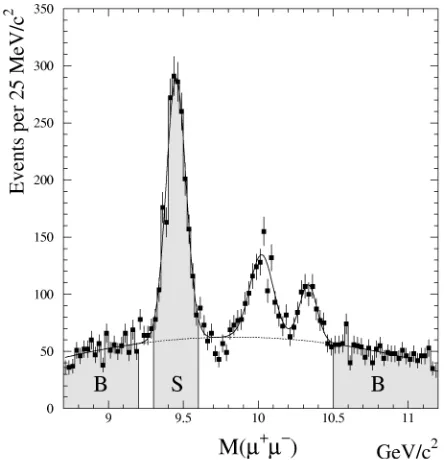
we constrain the muon tracks to originate from the primary interaction point to improve mass resolution. Figure 1 shows the resulting dimuon invariant mass distribution after the requirement that the muon pair has
pT共m1m2兲 .8.0GeV兾c. The three peaks correspond
to the Y共1S兲, Y共2S兲, and Y共3S兲 resonances. Because of the trigger and muon acceptance, the pseudorapidity of the muon pairs is limited to the central region, cor-responding approximately to jh共m1m2兲j,0.7, where
h苷 2ln关tan共u兾2兲兴 andu is the polar angle with respect to the beam axis. A muon pair is considered an Y共1S兲
candidate if its invariant mass is in the signal region de-fined by 9300 MeV兾c2, M共m1m2兲, 9600MeV兾c2;
this selection yields a sample of 2186 events. The number of background events in this sample is obtained by fitting the invariant mass distribution to a polynomial plus three Gaussians and integrating the function associated with the background in the signal region. The resulting number of
Y共1S兲mesons is1462 655.
Photon candidates are selected by demanding a trans-verse energy deposition of at least 0.7 GeV in a cell of the central electromagnetic calorimeter and a signal in the fiducial volume of the proportional chambers (CES) which are embedded in the calorimeter at a depth of six radia-tion lengths. The fiducial volume requirement ensures that the shower is fully contained in a cell. The location of the signal in the CES chambers and the event interaction point determine the direction of the photon momentum; its magnitude is the energy deposited in the calorimeter. We correct the photon energy for the energy lost in the
material in front of the calorimeter based on a simulation of the detector response to photons. For low energy pho-tons the average correction factor varies from 1.03 to 1.14 depending on the polar angle. We have verified that the simulation is trustworthy by comparing the simulated elec-tron response with the response of elecelec-trons from photon conversions found in the data.
To reduce the combinatorial background resulting from multiple photon candidates per event we apply the follow-ing isolation requirements to the photon: (a) no charged particle track should point to the photon cell, (b) only one CES cluster should be associated with the cell, and (c) the total electromagnetic energy in the eight cells neighboring the photon must be less than 0.5 GeV. The Y共1S兲 is combined with all remaining photons within the 90±cone around the Y共1S兲, and the invariant mass difference,
DM 苷M共m1m2g兲 2M共m1m2兲, is calculated. The
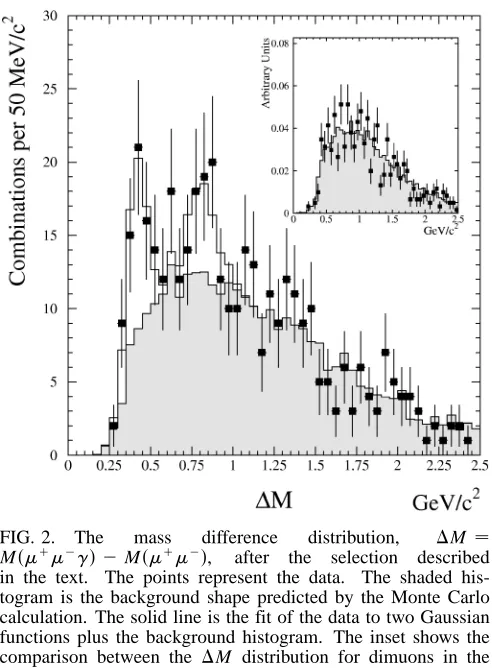
DMdistribution, after the cutpTY .8.0GeV兾c, is shown
in Fig. 2. There are two well separated signals; their masses and widths are consistent with expectations based on a simulation of the radiative decays of the xb共1P兲
and xb共2P兲 mesons. The individual angular momentum
states of the xb’s 共J 苷0, 1, 2兲, however, cannot be
resolved.
FIG. 2. The mass difference distribution, DM苷 M共m1m2g兲2M共m1m2兲, after the selection described
in the text. The points represent the data. The shaded his-togram is the background shape predicted by the Monte Carlo calculation. The solid line is the fit of the data to two Gaussian functions plus the background histogram. The inset shows the comparison between the DM distribution for dimuons in the
Y共1S兲sidebands (region B in Fig. 1) and the corresponding one predicted by the Monte Carlo calculation; the two distributions are normalized to equal area, and the vertical scale is arbitrary. The size of the bin is the same in both figures.
The shape of the background, resulting from combina-tions of theY共1S兲with photons unassociated withxb
de-cays, is obtained with a Monte Carlo method that uses
Y共1S兲 candidate events as input. We consider as sources of photons: (a) decays ofp0 that are not fromh orK0
S
decays, (b) h decays, and (c)KS0 decays. These sources
are simulated by replacing each charged particle in the event, other than the two muons, with ap0,h, orK0
Swith
probabilities proportional to 4:2:1. These proportions fol-low from isospin symmetry and the ratiosK6兾p6 苷0.25,
h兾p0苷0.5[7]. Uncertainties in these ratios are
consid-ered as sources of systematic uncertainty. The response of the detector to the photons resulting from the decay of these embedded neutral particles is calculated using a Monte Carlo simulation. Applying thexb reconstruction
to these events results in a mass distribution that mod-els the shape of the background. This model was tested by comparing the Monte Carlo distribution obtained us-ing events in the mass sidebands of theY共1S兲peak, with the corresponding distribution obtained directly from the data where there should be noxb signal. The two
distri-butions agree well, as shown in the inset of Fig. 2. The number of xb signal events is determined by fitting the
data DM distribution to the sum of the background dis-tribution, with an unconstrained normalization, and two Gaussian functions associated with the signals. The mass resolution was fixed to the value calculated by the simula-tion (60 and 93MeV兾c2). The fit results in 35.36 9.0
and 28.56 12.0 signal events for xb共1P兲 and xb共2P兲,
respectively.
The fraction of Y共1S兲 mesons originating fromxb
de-cays is calculated according to the equation
FxYb共1S兲 苷 N
xb
NYAg
Yeg
,
where Nxb andNY are the numbers of reconstructed x
b
andY共1S兲 mesons, respectively, AgY is the probability to
reconstruct the photon once theY共1S兲is found, andeg is the efficiency of the isolation cuts.
The photon acceptance,AgY, is the product of the
proba-bility that the photon is within the fiducial volume and the reconstruction efficiency of the fiducial photon. The geo-metric acceptance is determined by using a Monte Carlo simulation, wherexb’s are generated uniformly in
pseu-dorapidity, and with a pT distribution equal to the
mea-sured Y共1S兲 spectrum [3]. The xb !Y共1S兲g decay is
generated with a uniform angular distribution in the xb
rest frame. TheY共1S兲 !m1m2 decay is also generated uniformly in the Y共1S兲 rest frame, and the trigger simu-lation is applied to the decay muons. Uncertainties asso-ciated with thepTspectrum used for the production ofxb
mesons and with the unknown xb polarization are
then corrected for the known differences in the detector response between photons and electrons. The reconstruc-tion efficiency rises from 17% to 85% for a photon with
ET ranging from 0.7 to 1.4 GeV. ForpTY .8.0GeV兾c,
the photon acceptance is0.14260.004共stat兲and0.284 6 0.006共stat兲forxb共1P兲andxb共2P兲, respectively. The large
difference is entirely due to the mass difference between the parent particles, resulting in different photon energies. To study the effect of the isolation cuts we use a Monte Carlo method that uses Y共1S兲 candidate events as input. For each event, we generate a vector distributed accord-ing to the angular distribution of the photon, relative to the Y共1S兲 momentum, obtained by simulating the decay
xb !Y共1S兲g. The probability that the isolation
require-ments are satisfied when applied to the calorimeter cell intercepted by the vector gives the cut efficiency. Since there are background events in theY共1S兲signal region, we measure the efficiency in the signal and sideband regions and derive the efficiency associated with Y共1S兲 mesons. The resulting efficiency is eg 苷0.627 60.013共stat兲 for
xb共1P兲 and eg 苷0.6516 0.013共stat兲 for xb共2P兲; the
difference is due to the different kinematics of the de-cays. We assume that this efficiency, calculated from the inclusive sample ofY共1S兲events, is applicable to the sub-sample of interest, where theY共1S兲originates from axb.
This assumption is supported by a study using samples of
J兾cevents. We calculateegusing the inclusive sample of J兾c events, with the Monte Carlo method just described, and independently using a pure sample ofJ兾cfromxc
de-cay. The latter is the sample ofxc !J兾cgreconstructed
by requiring the photon to convert into an electron-positron pair. In this sample we measure the efficiency by apply-ing the isolation cuts to the calorimeter cell which would have been hit by the photon, had it not converted [8]. This measurement yields an efficiency of0.576 0.06共stat兲; the Monte Carlo calculation is in good agreement, yielding an efficiency of0.56 60.01共stat兲.
The systematic uncertainty on FxYb共1S兲 associated with thexb production and decay model is estimated by
vary-ing the shape of thepT spectrum as well as the decay an-gular distribution to account for fully polarizedxb’s; the
uncertainty is 613% for xb共1P兲 and 69% for xb共2P兲.
The uncertainty in the determination of Nxb is 67% for
xb共1P兲and69%forxb共2P兲. This includes the effect of
varying thep0,h, andKS0composition in our background
model from 4:2:1 to all p0, and a variation of 62% of the calorimeter energy scale used in the simulation. It also includes the effect of varying the resolution of the Gaus-sians used in the fit by66%, the uncertainty on the reso-lution. An uncertainty of 66% for xb共1P兲 and 63%
for xb共2P兲 is associated with the estimation of the
de-tector response difference between photons and electrons. An additional 64% uncertainty arises from the statisti-cal and systematic uncertainties associated with eg. We combine these uncertainties, assuming they are indepen-dent, into a total systematic uncertainty of 616.4% for
xb共1P兲and613.7%forxb共2P兲. The fractions ofY共1S兲
mesons, withpY
T . 8.0GeV兾c, which come fromxb共1P兲
and xb共2P兲 decays, are 关27.1 66.9共stat兲6 4.4共syst兲兴%
and关10.5 64.4共stat兲6 1.4共syst兲兴%, respectively. To calculate the fraction of directly produced Y共1S兲
mesons we must estimate the fraction of Y共1S兲’s associ-ated with sources other thanxb共1P兲andxb共2P兲. We
cal-culate the contribution due toY共2S兲,Y共3S兲 !Y共1S兲pp
using a Monte Carlo simulation of these decays normal-ized with theY共2S兲andY共3S兲cross section measured in this experiment [3]. We find that the fraction ofY共1S兲’s, withpYT .8.0GeV兾c, fromY共2S兲andY共3S兲decays, is 共10.7127.74.8兲% and 共0.8120.60.4兲%, respectively. An additional
contribution could be associated with the yet unobserved
xb共3P兲 mesons. These states are predicted to lie below BB¯ threshold and to decay radiatively to Y共1S兲, Y共2S兲, and Y共3S兲. An upper limit on the fraction of Y共1S兲’s fromxb共3P兲decays can be calculated with the
conserva-tive assumption that all Y共3S兲 mesons in our data come from xb共3P兲 decays. To estimate the contribution to
Y共1S兲, relative to Y共3S兲, we have used a theoretical cal-culation of the radiative decay widths of the xb共3P兲 [9]
and the detector simulation to take into account the effect of the trigger and kinematical cuts. Our estimate is that fewer than 6% of the Y共1S兲’s, with pY
T .8.0GeV兾c,
arise fromxb共3P兲 decays. We derive the fraction of
di-rectly producedY共1S兲 mesons according to the equation
FdirY共1S兲 苷12 F
Y共1S兲 xb 2F
Y共1S兲
Y , whereF Y共1S兲
Y is the
frac-tion of Y共1S兲’s from Y共2S兲 and Y共3S兲. Systematic un-certainties onFdirY共1S兲arise from uncertainties on theY共2S兲
cross section and branching fractions. Our upper limit on the contribution from xb共3P兲 decays is also considered
a systematic uncertainty, and is added in quadrature to the negative error. We findFdirY共1S兲 苷关50.9 68.2共stat兲6 9.0共syst兲兴% forpYT .8.0GeV兾c.
In conclusion, we have measured the fraction ofY共1S兲
mesons originating from xb decays and derived the
fraction of directly produced Y共1S兲’s. We find that 关27.1 66.9共stat兲64.4共syst兲兴% of all Y共1S兲 mesons with pY
T .8.0GeV兾c come from xb共1P兲 decays,
关10.5 64.4共stat兲61.4共syst兲兴% come from xb共2P兲
decays, and 关50.9 68.2共stat兲69.0共syst兲兴% are directly produced. A calculation based on the color singlet model [10] predicts a contribution of about 41% from
xb共1P兲, and 13% from xb共2P兲, for pYT .8.0GeV兾c.
This measurement will allow the determination of the matrix elements associated with the production ofxb共1P兲,
xb共2P兲, and Y共1S兲 mesons, thus providing information
[1] F. Abe et al., Phys. Rev. Lett. 79, 572 (1997); 79, 578 (1997).
[2] E. Braaten and S. Fleming, Phys. Rev. Lett. 74, 3327 (1995); G. T. Bodwin, E. Braaten, and G. P. Lepage, Phys. Rev. D 51, 1125 (1995).
[3] F. Abe et al., Phys. Rev. Lett. 75, 4358 (1995).
[4] P. Cho and A. K. Leibovich, Phys. Rev. D 53, 150 (1996);
53, 6203 (1996).
[5] F. Abe et al., Nucl. Instrum. Methods Phys. Res., Sect. A
271, 387 (1988).
[6] F. Abe et al., Phys. Rev. D 57, 5382 (1998).
[7] T. Alexopoulos et al., Phys. Rev. Lett. 64, 991 (1990); M. Banner et al., Z. Phys. C 27, 329 (1985).
[8] The small conversion probability and the lower available statistics prevent us from applying this technique directly in theY共1S兲sample.
[9] F. Daghighian and D. Silverman, Phys. Rev. D 36, 3401 (1987).