ISSN: 2231-5381
http://www.ijettjournal.org
Page 621
Performance Estimation of 2*4 MIMO-MC-CDMA
Using Convolution Code in Different Modulation
Technique using ZF Detection Scheme
Mr. Atul Singh Kushwah, Ms. Priya Rathore & Mr. Ramsewak Kumar
Asst. Professors & Electronics & Communication & Indore Institute of Science & Technology-II, Indore (M.P), India
Abstract - In this paper we estimate the performance of 2*4 MIMO-MC-CDMA system using convolution code in MATLAB which highly reduces BER. MC-CDMA (Multi Carrier Code Division for Multiple Access) is a multi-user and multiple access system which is formed by the combination of OFDM and CDMA and convolution encoding scheme is used in encoder of CDMA as FEC (Forward Error Correction) code to reduce BER (Bit Error Rate). MC-CDMA system is a multi-carrier system in which single wideband frequency selective carrier is converted into parallel narrowband flat fading multiple sub-carriers to optimize the performance of system. Now this system further improved by combination of 2*4 MIMO (Multiple Input Multiple Output) system which utilizes ZF (Zero Forcing) decoder at the receiver to reduce BER and also ½ rate convolutionally encoded Alamouti STBC (Space Time Block Code) block code as transmit diversity of MIMO for multiple transmission of data through multiple transmit antenna. Main advantage of using MIMO-MC-CDMA using convolution code is to reduce the complexity of system and to reduce BER with increased gain. In this paper we analyze system performance in different modulation schemes like, QPSK, 8-PSK, 8-QAM, 16-QAM, 32-QAM and 64-QAM in Rayleigh fading channel using MATLAB.
Keywords: OFDM,CDMA,MIMO,MIMO-MC-CDMA and convolution code.
I. INTRODUCTION
Due to increased demand of high data rate and low probability of error in this paper we utilizes the technique of MIMO, CDMA and OFDM results enhanced technique for minimizing error rate. MC-CDMA is multicarrier and multiple access system which is a combination of OFDM and CDMA [10]. This MC-CDMA forms multiple accesses and multiple carrier system in frequency selective flat fading channel. The MC-CDMA results improved efficiency of the wireless communication system which results high data rate and low probability of error.
In this paper MIMO is combined with MC-CDMA to increase throughput. MIMO is multiple antenna system in which multiple receive diversity and multiple transmit diversity i.e half-rate convolutionally encoded Alamouti STBC code is used for synchronization of system to reduce ISI. To detect signal orthogonality ZF detection scheme is used. And as a result MIMO-MC-CDMA [1] is formed by all above operations using MATLAB is then it will be encoded using convolution code as FEC encoder. This
MIMO-MC-CDMA using convolution code then analyzed in QPSK, 8-PSK, 8-QAM, 16-QAM, 32-QAM and 64-QAM modulation techniques in Rayleigh fading channels.
II. MULTICARRIERCODEDIVISIONMULTIPLE ACCESS(MC-CDMA)
MC-CDMA [2,3,4] is a combination of system of OFDM and CDMA system [11]. This system allows the multiple users to access the wireless channel simultaneously by modulating and spreading their input data signals in frequency domain using PN spreading sequences. MC-CDMA combines the multipath fading of OFDM system with the multi-user access of CDMA system.
A. Mathematical model
In present MC-CDMA system we assume that signal detection scheme will be implemented for two transmitting and four was receiving antennas. Each user use single transmitting antenna system. Suppose H represent a channel matrix as hij for the channel gain between the i-th transmitting
antenna and the j-th receiving antenna, j=1,2,3,4 and i=1,2. Each user data and the equivalent received signals are represented by a=[a1, a2]
T
and y=[y1 y2 y3 y4] T
respectively, in which ai and yj denote the transmit signal from i-th
transmitting antenna and the received signal at the j-th received antenna respectively. Assume nj denote the white
Gaussian noise of variance of σn4 at the j-th receiving antenna and hi denote the i-th column vector of the channel matrix H.
Now received signal y for system can be represented by y=Ha+n ……….……(1) Where, n= [n1,n2,n3,n4]
T
As the interference signals from other transmitting antennas are reduced for detecting the desired signal from the target transmitting antenna, the detected desired signal from the transmitting antenna by inverting channel effect from a weight matrix W is
Ã=[ã1 ã2]=Wy……….(2)
For Zero-Forcing (ZF) scheme, the ZF weight matrix is represented by
WZF=(HHH)-1HH …….(3)
where ()H denotes the Hermitian transpose and the detected desired signal from the transmitting antenna using the following relation
ISSN: 2231-5381
http://www.ijettjournal.org
Page 622
It is intended to find the transmitted signal vector by Sphere Decoding (SD) scheme with minimum least ML metric. Suppose yR and yI represents the real and imaginary parts of
the received signal y, i.e. yR= Re{y} and yI= Im{y}.
Corresponding to that the input signal xi and the channel gain
hij from ith transmitting antenna to jth receiving antenna can
be showed by aiR = Re{ai} and aiI = Im{ai} and hijR = Re{hij}
and hijI = Im{hij} respectively. We can say that, ŷ=[yR jyI]
T
………(5)
From (6), the detected desired signal ãSP with its real and
imaginary components from the transmitting antenna can be represented by [3]:
ãSP=[ã1R ã2R ã1I ã2I] T
=[Ĥ T
Ĥ ]-1*[Ĥ T
ŷ ]…(6)
III.MULTIPLEINPUTMULTIPLEOUTPUT(MIMO)
MIMO systems [5] use multiple transmit antennas and multiple receive antennas at the receiver, so both transmit and receive diversity schemes are applied to reduce fading resulting from signal variations by wireless channel. It depends on the degree at which the multiple data replicas are faded independently; the system provides diversity gains which represents the difference in SNR at the output of the diversity combiner as compared to that of single branch diversity at certain probability level.
A MIMO system consisting of N transmit antenna elements equal to two, and of M receive antenna elements equal to four was modeled, accordingly diversity order of 4 can be achieved. For improving the performance combination of the multiple versions of the signals created by different diversity schemes is required. This paper applies Zero Forcing (ZF) decoder to combine M received signals to resonate on the mostly required desired transmitted signals. The sum of the received SNRs form M different paths is the effectively received SNR of the system with Alamouti STBC of 2*4 diversity. The receiver required to demodulate all M receive signals in case of ZF for a source with independent signals in the received antennas.
IV.CONVOLUTIONCODE
Non-systematic convolution encoder is shown in fig.1. The data were not present at the output of the encoder and were replaced by modulo 2 sum of the data at instant i is di and the
data at instants i − 2 is di-2 and the data at instant i − 3 is di−3
and so on. The rate of the encoder remains is ½ i.e. 2 encoded output bits for each input bits
.
Fig. 1. Non-systematic convolutional encoder [12].
A.
Generic representation
Shift registers, XOR gates and v flip-flops are used for the construction of non-systematic convolution encoder. Now we define the main characteristic of convolutional codes i.e. the
constraint length, here equal to v +1. The register at instant i is characterized by the v no. of bits si
(1)
,si (2)
,...,si (v)
then states of v bits are also represented in the form of a vector si = (si
(1)
, si
(2)
, ··· , si (v)
). There are 2v possible state values in convolution encoder so that we can often denote in natural binary or binary decimal form. So the state of encoder is 24 which is determined by no. of flip flops which is determined by 23=8. Assume s1 =1, s2 =1 and s3=0, then the encoder is in state 110
in natural binary, i.e. 6 in decimal form. Using the m no. of coefficients aj
(l)
,used to form a vector di
is selected then addition is done with the previous content of
flip-flops but not in case of the first flip-flop, which forms the
value to be stored in the following flip-flops. New content of a flip-flop depends on the current input and previous content of
flip-flop. In case of bj null coefficients, the resultant input depends only on the sum of the the components selected of di.
In case when bj coefficients are non-zero then these
components are added with di and the recursive code is
generated. So the successive states of the registers depends on previous inputs and present input through the flip-flop which finally produces redundant components ri which is produced
by the summation of the content of flip-flops by coefficients g.
Fig.2. Generic representation of an encoder for convolutional codes [12].
In this paper we are using non-systematic ½ rate convolution encoder as FEC at the MIMO-MC-CDMA in which 1040 message bits are encoded into 2080 encoded bits i.e two output bits are formed in each message input bits.
V. MIMO-MC-CDMACOMMUNICATIONSYSTEM MODELUSINGCONVOLUTIONCODE Communication system model of MIMO-MC-CDMA using convolution is shown in fig.3.
ISSN: 2231-5381
http://www.ijettjournal.org
Page 623
like QPSK, 8-PSK, 8-QAM, 16-QAM, 32-QAM and 64-QAM
this is represented by modulator block. Previously described system is MC-CDMA system which is already described in section 2 as Multi-Carrier Code Division Multiple Access (MC-CDMA). Now MIMO encoder half- rate convolutionally encoded Alamouti’s STBC block code is used which will be described in section 3 as Multiple Input Multiple Output (MIMO). Combination of MIMO and MC-CDMA forms MIMO-MC-CDMA using convolution code as shown in fig.1. Now signal is then transmitted through Rayleigh Fading Channel [6]. Then receiver receive the signal in reverse fashion with ZF decoder for the recovery of transmitted signal and BER calculation is done for estimating the system performance. In MIMO system two transmit antenna and four receive antenna is used. In this paper we are sending message bits which is random in nature or depend on user then this data is moved through FEC encoder, here ½ rate convolution encoder having constraint length of 3 is used so after this block no. of bits will be double, then this encoded bits are spreaded using PN sequence which forms 8 bits in each input bits i.e. input bits*8 then resultant bits are formed after the spreading of encoded sequence. Then these encoded and spreaded sequences of bits are passed through modulator which is modulated depends on the type of modulation used. Then these modulated data is reshaped into parallel form for OFDM then IFFT is done which convert frequency selective wide-band carriers into parallel flat-fading narrowband carriers which are orthogonal in nature then this data reshaped to parallel to serial then CP addition is done to remove the effect of ISI which completes the process of OFDM then this data then transmitted through MIMO encoder which use Alamouti STBC block code for 2 transmit diversity and 4 receive diversity techniques in which 4*2 channel matrix is formed by using this MIMO diversity, then ZF detection scheme is used at the receiver then reverse process is done for receiving the input bits.
Fig.3. Communication System Model OF 2*1 MIMO-MC-CDMA using convolution code
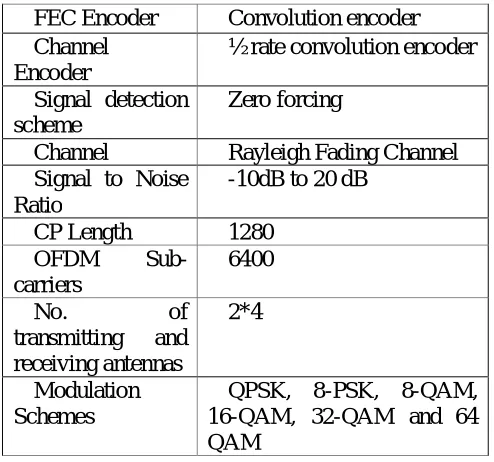
VI.SIMULATIONRESULTSANDDISCUSSION: Table 1 shows the simulated model parameters of MIMO-MC-CDMA [6,7,8,9] using convolution code in mentioned different modulation technique.
Performance estimation of MIMO-MC-CDMA using convolution code is shown in fig.4-9.
Fig. 9 shows the comparative analysis of different modulation schemes in MIMO-MC-CDMA using convolution code.
Table 2 shows the performance estimation of all modulation schemes in terms of gain and BER.
TABLE:1. SIMULATED MODEL PARAMETERS.
FEC Encoder
Convolution encoder
Channel
Encoder
½ rate convolution encoder
Signal detection
scheme
Zero forcing
Channel
Rayleigh Fading Channel
Signal to Noise
Ratio
-10dB to 20 dB
CP Length
1280
OFDM
Sub-carriers
6400
No.
of
transmitting
and
receiving antennas
2*4
Modulation
Schemes
QPSK, 8-PSK, 8-QAM,
16-QAM, 32-QAM and 64
QAM
From table.2 and Fig.10 we can say that QPSK shows high gain (17.56 dB) and very low BER with respect to other modulation schemes in -5dB SNR. This is possible by using convolution code as FEC encoding scheme in MIMO-MC-CDMA errors in QPSK and 8-QAM is zero which shows very low probability of error in system.
ISSN: 2231-5381
http://www.ijettjournal.org
Page 624
Fig.5. Performance estimation of MIMO-MC-CDMA using convolutioncode in 8-QAM modulation scheme.
Fig.6. Performance estimation of MIMO-MC-CDMA using convolution code in 64-QAM modulation scheme.
Fig.7. Performance estimation of MIMO-MC-CDMA using convolution code in 32-QAM modulation
Fig.8. Performance estimation of MIMO-MC-CDMA using convolution code in 8-PSK modulation
Fig.9. Performance estimation of MIMO-MC-CDMA using convolution code in 16-QAM modulation
Fig.10. Performance estimation of MIMO-MC-CDMA using convolution code in 8-QAM, 16-QAM, 32-QAM, 64-QAM, 8-PSK and QPSK modulation scheme.
TABLE: 2. PERFORMANCE ESTIMATION AT -5DB SNR WITH RESPECT TO 64-QAM MODULATION TECHNIQUE AS SHOWN IN
FIG.10:
Modulation
BER at
-1dB
Gain w.r.t
64-QAM
QPSK
0.005769
17.56dB
8-QAM
0.09821
5.25dB
8-PSK
0.1672
2.946dB
16-QAM
0.2144
1.867dB
32-QAM
0.2946
0.486dB
64-QAM
0.3295
0dB
VII. CONCLUSION
ISSN: 2231-5381
http://www.ijettjournal.org
Page 625
schemes which shows that as modulation scheme order is higher results increase in BER. This paper aims to reduce bit error rate which is found in QPSK modulation scheme with gain of 17.56 dB with respect to 64-QAM which represents that the gain of QPSK is higher as compared to other modulation technique with very low probability of error because errors were removed at 0dB in QPSK. For 3G and 4G communication system 64-QAM modulation technique is preferred which contain BER up to 9dB, i.e. errors are removed in 64-QAM at 9dB SNR which is highly optimized by using MIMO-MC-CDMA using convolution code.
REFERENCES
[1] [1] Karmjeet Singh, Rajbir Kaur “ Performance Estimation of MIMO Multi-Carrier CDMA with QPSK Modulation in Rayleigh Channel” , International Journal of Engineering Research and Applications, Vol. 3, Issue 4, Jul-Aug 2013, pp.2562-2565.
[2] [2] Sohag Sarker, Farhana Enam, Md. Golam Rashed, Shaikh Enayet Ullah “ Performance Estimation of Two-Layer Spreading scheme based FEC encoded MC–CDMA wireless communication system under implementation of various signal detection schemes” Journal of Emerging Trends in Computing and Information Sciences, VOL. 3, NO. 4, April 2012.
[3] [3] Shaikh Enayet Ullah and Md. Mahbubar Rahman “BER Performance Estimation of a FEC Encoded Multi-user MIMO MCCDMA Wireless Communication System”, International Journal of Hybrid Information Technology, Vol. 4 No. 3, July, 2011.
[4] [4] Manjinder Singh, Karamjeet Kaur “ BER Performance of MC-CDMA Using Walsh Code with MSK Modulation on AWGN and Rayleigh Channel”, International Journal of Engineering Trends and Technology (IJETT) - Volume4 Issue7- July 2011.
[5] [5] Kai ZHANG and Zhisheng NIU “Multiuser MIMO Downlink Transmission Over Time-Varying Channels”, IEICE TRANS. ??, VOL.Exx{??, NO.xx XXXX 200x
[6] [6] A. Sharmila and Srigitha S. Nath “Performance of MIMO Multi- Carrier CDMA with BPSK Modulation in Rayleigh Channel” International Conference on Computing and Control Engineering (ICCCE 2012), 12 & 13 April, 2012.
[7] [7] Mousumi Haque, Most. Farjana Sharmin and Shaikh Enayet Ullah, ” Secured data transmission in a V-Blast encoded MIMO MCCDMA wireless communication system”, International Journal of Information & Network Security (IJINS), Vol.2, No.3, June 2013, pp. 245~252.
[8] [8] Antonis Phasouliotis “MULTICARRIER CDMA SYSTEMS WITH MIMO TECHNOLOGY”, A thesis submitted to the University of Manchester for the degree of Doctor of Philosophy in the Faculty of Engineering and Physical Sciences, 2010.
[9] [9] Yong Soo Cho, Jaekwon Kim Yonsei, Won Young Yang and Chung G. Kang, MIMO Wireless Communication with MATLAB, 1st ed., August 2010, Wiley-IEEE Press.
[10] [10] Juyul Lee " Maximizing the Worst-User's Capacity for a Multi-User OFDM Uplink Channel” Department of Electrical and Computer Engineering, University of Minnesota.
[11] [11] Harutoshi Yamamoto , Takaya Yamazato , Hiraku Okada , and Masaaki Katayama, “Performance Analysis of MC-CDMA System with and without Guard Interval in Two-Path Channel”, ISSSTA 2004,Sydney, Australia, 30Aug.-2Sep. 2004.
![Fig. 1. Non-systematic convolutional encoder [12].](https://thumb-us.123doks.com/thumbv2/123dok_us/8600313.1723902/2.612.325.506.340.482/fig-non-systematic-convolutional-encoder.webp)