Part I
The Programmer’s
Exam
CHAPTERS
1 Language Fundamentals
2 Declarations and Access Control
3 Operators and Assignments
4 Flow Control, Exceptions, and Assertions
5 Object Orientation, Overloading and Overriding, Constructors, and Return Types
6 Java.lang—The Math Class, Strings, and Wrappers
7 Objects and Collections
8 Inner Classes
9 Threads
CertPrs8(SUN)/ Sun Certified Programmer & Developer for Java 2 Study Guide / Sierra / 222684-6 / Chapter 1 Blind Folio1:1 CertPrs8(SUN)/ Sun Certified Programmer & Developer for Java 2 Study Guide / Sierra / 222684-6 / Chapter 1 Blind Folio1:1
1
Language
Fundamentals
CERTIFICATION OBJECTIVES
•
Java Programming Language Keywords•
Literals and Ranges of All Primitive Data Types•
Array Declaration, Construction, and Initialization•
Using a Variable or Array Element That Is Uninitialized and Unassigned•
Command-Line Arguments to Main✓
Two-Minute Drill Q&A Self TestCertPrs8(SUN)/ Sun Certified Programmer & Developer for Java 2 Study Guide / Sierra / 222684-6 / Chapter 1 Blind Folio1:3
T
his chapter looks at the Java fundamentals that you need to pass the Java 1.4 Programmer exam. Because you’re planning on becoming Sun certified, we assume you already know the basics of Java, so this chapter concentrates just on the details you’ll need for the exam. If you’re completely new to Java, this chapter (and the rest of the book) will be confusing, despite our spectacularly cogent writing. That’s our story and we’re sticking to it!CERTIFICATION OBJECTIVE
Java Programming Language Keywords
(Exam Objective 4.4)
Identify all Java programming language keywords and correctly constructed identifiers.
Keywordsare special reserved words in Java that you cannot use as identifiers (names) for classes, methods, or variables. They have meaning to the compiler; it uses them to figure out what your source code is trying to do. Table 1-1 contains all 49 of the reserved keywords.
Youmustmemorize these for the test; you can count on being asked to select the keywords (and nonkeywords) from a list. Notice none of the reserved words have
4
Chapter 1: Language Fundamentalsabstract boolean break byte case catch char class const continue default do double else extends final finally float for goto if implements import instanceof int interface long native new package private protected public return short static strictfp super switch synchronized this throw throws transient try void volatile while assert
CertPrs8(SUN)/ Sun Certified Programmer & Developer for Java 2 Study Guide / Sierra / 222684-6 / Chapter 1
Java Programming Language Keywords (Exam Objective 4.4)
5
CertPrs8(SUN)/ Sun Certified Programmer & Developer for Java 2 Study Guide / Sierra / 222684-6 / Chapter 1
capital letters; this is a good first step when weeding out nonkeywords on the exam. You’re probably familiar with most of them, but we’ll review them anyway. Don’t worry right now about what each keyword means or does; we’ll cover most of them in more detail in later chapters.
Look for questions that include reserved words from languages other than Java. You might seeinclude,overload,unsigned,virtual,friend, and the like. Besides appearing in questions specifically asking for keyword identification, the “imposter” words may show up in code examples used anywhere in the exam. Repeat after me, “Java is not C++.”
Access Modifiers
The following are access modifiers:
■ private Makes a method or a variable accessible only from within its own class.
■ protected Makes a method or a variable accessible only to classes in the same package or subclasses of the class.
■ public Makes a class, method, or variable accessible from any other class.
Class, Method, and Variable Modifiers
The following are class, method, and/or variable modifiers:
■ abstract Used to declare a class that cannot be instantiated, or a method that must be implemented by a nonabstract subclass.
■ class Keyword used to specify a class.
■ extends Used to indicate the superclass that a subclass is extending.
■ final Makes it impossible to extend a class, override a method, or reinitialize a variable.
■ implements Used to indicate the interfaces that a class will implement.
■ interface Keyword used to specify an interface.
■ native Indicates a method is written in a platform-dependent language, such as C.
■ new Used to instantiate an object by invoking the constructor. Color profile: Generic CMYK printer profile
6
Chapter 1: Language Fundamentals■ static Makes a method or a variable belong to a class as opposed to an instance.
■ strictfp Used in front of a method or class to indicate that floating-point numbers will follow FP-strict rules in all expressions.
■ synchronized Indicates that a method can be accessed by only one thread at a time.
■ transient Prevents fields from ever being serialized.Transientfields are always skipped when objects are serialized.
■ volatile Indicates a variable may change out of sync because it is used in threads.
Flow Control
The following are keywords used to control the flow through a block of code:
■ break Exits from the block of code in which it resides.
■ case Executes a block of code, dependent on what theswitchtests for.
■ continue Stops the rest of the code following this statement from executing in a loop and then begins the next iteration of the loop.
■ default Executes this block of code if none of the switch-case statements match.
■ do Executes a block of code one time, then, in conjunction with the
whilestatement, it performs a test to determine whether the block should be executed again.
■ else Executes an alternate block of code if aniftest is false.
■ for Used to perform a conditional loop for a block of code.
■ if Used to perform a logical test fortrueorfalse.
■ instanceof Determines whether an object is an instance of a class, superclass, or interface.
Java Programming Language Keywords (Exam Objective 4.4)
7
CertPrs8(SUN)/ Sun Certified Programmer & Developer for Java 2 Study Guide / Sierra / 222684-6 / Chapter 1
■ switch Indicates the variable to be compared with thecasestatements.
■ while Executes a block of code repeatedly while a certain condition istrue.
Error Handling
The following are keywords used in error handling:
■ catch Declares the block of code used to handle an exception.
■ finally Block of code, usually following atry-catchstatement, which is executed no matter what program flow occurs when dealing with an exception.
■ throw Used to pass an exception up to the method that called this method.
■ throws Indicates the method will pass an exception to the method that called it.
■ try Block of code that will be tried, but which may cause an exception.
■ assert Evaluates a conditional expression to verify the programmer’s assumption.
Package
Control
The following are keywords used for package control:
■ import Statement to import packages or classes into code.
■ package Specifies to which package all classes in a source file belong.
Primitives
The following keywords are primitives:
■ boolean A value indicatingtrueorfalse.
■ byte An 8-bit integer (signed).
■ char A single Unicode character (16-bit unsigned)
■ double A 64-bit floating-point number (signed). Color profile: Generic CMYK printer profile
■ float A 32-bit floating-point number (signed).
■ int A 32-bit integer (signed).
■ long A 64-bit integer (signed).
■ short A 16-bit integer (signed).
Variable Keywords
The following keywords are a special type of reference variable:
■ super Reference variable referring to the immediate superclass.
■ this Reference variable referring to the current instance of an object.
Void Return Type Keyword
Thevoidkeyword is used only in the return value placeholder of a method declaration.
■ void Indicates no return type for a method.
Unused Reserved Words
There are two keywords that are reserved in Java but which are not used. If you try to use one of these, the Java compiler will scold you with the following:
KeywordTest.java:4: 'goto' not supported. goto MyLabel;
1 error
The engineers’ first-draft of the preceding compiler warning resembled the following:
KeywordTest.java:4: ‘goto’ not supported. Duh.
You have no business programming in Java. Begin erasing Java Software Development Kit? (Yes/OK)
1 life-altering error
■ const Do not use to declare a constant; usepublic static final.
Look for questions that use a keyword as the name of a method or variable. The question mightappearto be asking about, say, a runtime logic problem, but therealproblem will be that the code won’t even compile because of the illegal use of a keyword. For example, the following code will not compile:
class Foo {
public void go() {
// complex code here }
public int break(int b) {
// code that appears to break something }
}
You might be fooled by the use of the keywordbreakas a method name, because the method might genuinely appear to be code that “breaks” something, and therefore the method name makes sense. Meanwhile, you’re trying to figure out the complex code within the methods, when you needn’t look beyond the illegal method name and choose the “Code does not compile” answer.
According to the Java Language Specification,null,true, andfalseare technically literal values (sometimes referred to as manifest constants) and not keywords. Just as with the other keywords, if you try to create an identifier with one of these literal values, you’ll get a compiler error. For the purposes of the exam, treat them just as you would the other reserved words. You willnotbe asked to differentiate between reserved words and these reserved literals.
Be careful of practice exams with questions that, for example, ask iffalse
is a keyword. Many exam candidates worry about how to answer such a question, but the real exam does not expect you to make a distinction between the reserved keywords and the literals ofnull,true, andfalse. Because the certainty of this being on the exam has reached urban legend status, Sun modified the objectives for exam 310-035 to clear up any confusion. Objective 4.4 now includes the statement, “Note: There will not be any questions regarding esoteric distinctions between keywords and manifest constants.” Contrary to popular belief, the exam creators are not evil or malicious. (I will admit, however, that while creating the exam, we experienced a giddy joy when one of us came up with a particularly tricky, er, clever question. High-fives all around!)
CertPrs8(SUN)/ Sun Certified Programmer & Developer for Java 2 Study Guide / Sierra / 222684-6 / Chapter 1
Java Programming Language Keywords (Exam Objective 4.4)
9
CertPrs8(SUN)/ Sun Certified Programmer & Developer for Java 2 Study Guide / Sierra / 222684-6 / Chapter 1
class LiteralTest {
public static void main (String [] args) { int true = 100; // this will cause error }
}
Compiling this code gives us the following error (or something similar depending on which compiler you are using):
%javac LiteralTest.java
LiteralTest.java:3: not a statement.
int true = 100; // this will cause error ^
In other words, trying to assign a value totrueis much like saying:
int 200 = 100;
Look for words that differ from the Java reserved words in subtle ways. For example, you might seeprotectrather thanprotected,extendrather than
extends.
CERTIFICATION OBJECTIVE
Literals and Ranges of All Primitive
Data Types (Exam Objective 4.6)
State the range of all primitive data types and declare literal values for String and all primitive types using all permitted formats, bases, and representations.
more than 60,000 possibilities, 32 bits gives you approximately 4 billion, and so on. But youwillneed to know that the number types (both integer and floating-point types) are all signed, and how that affects the range. First, let’s review the concepts.
Range of Primitive Types
All six number types in Java are signed, meaning they can be negative or positive. The leftmost bit (the most significant digit) is used to represent the sign, where a1
means negative (glass half empty) and0means positive (glass half full), as shown in Figure 1-1. The rest of the bits represent the value, using two’s complement notation. Table 1-2 shows the primitive types with their sizes and ranges. Figure 1-2 shows that with a byte, for example, there are 256 possible numbers (or 28
). Half of these are negative, and half -1 are positive. The positive range is one less than the negative range because the number zero is stored as a positive binary number. We use the formula -2(bits - 1)
to calculate the negative range, and we use 2(bits -1)
–1 for the positive range. The range for floating-point numbers is complicated to determine, but luckily you don’t need to know these for the exam (although youareexpected to know that adoubleholds 64 bits and afloat32).
Forbooleantypes there is not a range; abooleancan be onlytrueor
false. If someone asks you for the bit depth of a boolean, look them straight in the eye and say, “That’s virtual-machine dependent.” They’ll be impressed.
Thechartype (a character) contains a single, 16-bit Unicode character. Although the extended ASCII set known as ISO Latin-1 needs only 8 bits (256 different characters), a larger range is needed to represent characters found in languages other than English. Unicode characters are actually represented by unsigned 16-bit integers, which means 216
possible values, ranging from 0 to 65535 (216
)-1. You’ll learn in Literals and Ranges of All Primitive Data Types (Exam Objective 4.6)
11
CertPrs8(SUN)/ Sun Certified Programmer & Developer for Java 2 Study Guide / Sierra / 222684-6 / Chapter 1
FIGURE 1-1
The sign bit for a byte
Chapter 3 that because acharis really an integer type, it can be assigned to any number type large enough to hold 65535.
Literal Values for All Primitive Types
A primitive literal is merely a source code representation of the primitive data types— in other words, an integer, floating-point number, boolean, or character that you type in while writing code. The following are examples of primitive literals:
'b' // char literal 42 // int literal
false // boolean literal 2546789.343 // double literal
Integer Literals
There are three ways to represent integer numbers in the Java language: decimal (base 10), octal (base 8), and hexadecimal (base 16). Most exam questions with integer literals use decimal representations, but the few that use octal or hexadecimal are worth studying for. Even though the odds that you’ll ever actuallyuseoctal in the real world are astronomically tiny, they were included in the exam just for fun.
12
Chapter 1: Language FundamentalsType Bits Bytes Minimum Range Maximum Range
byte 8 1 -27
27
–1
short 16 2 -215
215
–1
int 32 4 -231
231
–1
long 64 8 -263
263
–1
float 32 4 Not needed Not needed
double 64 8 Not needed Not needed TABLE 1-2 Ranges of Primitive Numbers
FIGURE 1-2
Literals and Ranges of All Primitive Data Types (Exam Objective 4.6)
13
CertPrs8(SUN)/ Sun Certified Programmer & Developer for Java 2 Study Guide / Sierra / 222684-6 / Chapter 1
Decimal Literals Decimal integers need no explanation; you’ve been using them since grade one or earlier. Chances are, you don’t keep your checkbook in hex. (If youdo, there’s a Geeks Anonymous (GA) group ready to help.) In the Java language, they are represented as is, with no prefix of any kind, as follows:
int length = 343;
Octal Literals Octal integers use only the digits 0 to 7. In Java, you represent an integer in octal form by placing a zero in front of the number, as follows:
class Octal {
public static void main(String [] args) { int five = 06; // Equal to decimal 6 int seven = 07; // Equal to decimal 7 int eight = 010; // Equal to decimal 8 int nine = 011; // Equal to decimal 9 System.out.println("Octal 010 = " + eight); }
}
Notice that when we get past seven and are out of digits to use (we are only allowed the digits 0 through 7 for octal numbers), we revert back to zero, and one is added to the beginning of the number. You can have up to 21 digits in an octal number, not including the leading zero. If we run the preceding program, it displays the following:
Octal 010 = 8
Hexadecimal Literals Hexadecimal (hexfor short) numbers are constructed using 16 distinct symbols. Because we never invented single digit symbols for the numbers 10 through 15, we use alphabetic characters to represent these digits. Counting from 0 through 15 in hex looks like this:
0 1 2 3 4 5 6 7 8 9 a b c d e f
Java will accept capital or lowercase letters for the extra digits (one of the few places Java is not case-sensitive!). You are allowed up to 16 digits in a hexadecimal number, not including the prefix0xor the optional suffix extensionL, which will be explained later.
All of the following hexadecimal assignments are legal:
class HexTest {
public static void main (String [] args) {
int y = 0x7fffffff; int z = 0xDeadCafe;
System.out.println("x = " + x + " y = " + y + " z = " + z); }
}
RunningHexTestproduces the following output:
x = 1 y = 2147483647 z = -559035650
Don’t be misled by changes in case for a hexadecimal digit or the ‘x’ preceding it. 0XCAFE and 0xcafe are both legal.
All three integer literals (octal, decimal, and hexadecimal) are defined asint
by default, but they may also be specified aslongby placing a suffix ofLorlafter the number:
long jo = 110599L;
long so = 0xFFFFl; // Note the lowercase 'l'
Floating-Point Literals
Floating-point numbers are defined as a number, a decimal symbol, and more numbers representing the fraction.
double d = 11301874.9881024;
In the preceding example, the number 11301874.9881024 is the literal value. Floating-point literals are defined asdouble(64 bits) by default, so if you want to assign a floating-point literal to a variable of typefloat(32 bits), youmustattach the suffixForfto the number. If you don’t, the compiler will complain about a possible loss of precision, because you’re trying to fit a number into a (potentially) less precise “container.” TheFsuffix gives you a way to tell the compiler, “Hey, I know what I’m doing and I’ll take the risk, thank you very much.”
float f = 23.467890; // Compiler error, possible loss of precision float g = 49837849.029847F; // OK; has the suffix "F"
You may also optionally attach aDordto double literals, but it is not necessary because this is the default behavior. But for those who enjoy typing, knock yourself out.
double d = 110599.995011D; // Optional, not required double g = 987.897; // No 'D' suffix, but OK because the
// literal is a double
Look for numeric literals that include a comma, for example,
int x = 25,343; // Won't compile because of the comma
Boolean Literals
Boolean literals are the source code representation forbooleanvalues. Aboolean
value can only be defined astrueorfalse. Although in C (and some other languages) it is common to use numbers to representtrueorfalse,this will not work in Java. Again, repeat after me, “Java is not C++.”
boolean t = true; // Legal
boolean f = 0; // Compiler error!
Be on the lookout for questions that use numbers where booleans are required. You might see aniftest that uses a number, as in the following:
int x = 1; if (x) { } // Compiler error!
Character Literals
Acharliteral is represented by a single character in single quotes.
char a = 'a'; char b = '@';
You can also type in the Unicode value of the character, using the Unicode notation of prefixing the value with\uas follows:
char letterN = '\u004E'; // The letter 'N'
Remember, characters are just 16-bit unsigned integers under the hood. That means you can assign a number literal, assuming it will fit into the unsigned 16-bit range (65535 or less). For example, the following are all legal:
char a = 0x892; // octal literal char b = 982; // int literal
char c = (char) 70000; // The cast is required; 70000 is out of char range char d = (char) -98; // Ridiculous, but legal
And the following arenotlegal and produce compiler errors:
char e = -29; // Possible loss of precision; needs a cast char f = 70000 // Possible loss of precision; needs a cast
Literals and Ranges of All Primitive Data Types (Exam Objective 4.6)
15
CertPrs8(SUN)/ Sun Certified Programmer & Developer for Java 2 Study Guide / Sierra / 222684-6 / Chapter 1
You can also use an escape code if you want to represent a character that can’t be typed in as a literal, including the characters for linefeed, newline, horizontal tab, backspace, and double and single quotes.
char c = '\"'; // A double quote char d = '\n'; // A newline
Now that you’re familiar with the primitive data types and their ranges, you should be able to identify the proper data type to use in a given situation. Next are some examples of real-life quantities. Try to pick the primitive type that best represents the quantity.
Literal Values for Strings
A string literal is a source code representation of a value of a String object. For example, the following is an example of two ways to represent a string literal:
String s = "Bill Joy";
System.out.println("Bill" + " Joy");
16
Chapter 1: Language FundamentalsWhich primitive type would be best to represent the number of stars in the universe?
long
Which primitive type would be best to represent a single multiple choice question on a test, with only one answer allowed?
char
Which primitive type would be best to represent a single multiple choice question on a test, with more than one answer allowed?
char []
Which primitive type would be best to represent the population of the U.S. in 2003?
int(orlongfor the world population)
Which primitive type would be best to represent the amount of money (in dollars and cents) you plan on having at retirement?
float(ordoubleif you are a CEO of a software company)
CertPrs8(SUN)/ Sun Certified Programmer & Developer for Java 2 Study Guide / Sierra / 222684-6 / Chapter 1
Array Declaration, Construction, and Initialization (Exam Objective 1.1)
17
Although strings are not primitives, they’re included in this section because they can be represented as literals—in other words,typed directly into code. The only other nonprimitive type that has a literal representation is an array, which we’ll look at in the next section.
Thread t = ??? // what literal value could possibly go here?
CERTIFICATION OBJECTIVE
Array Declaration, Construction, and
Initialization (Exam Objective 1.1)
Write code that declares, constructs, and initializes arrays of any base type using any of the permitted forms both for declaration and for initialization.
Arrays are objects in Java that store multiple variables of the same type. Arrays can hold either primitives or object references, but the array itself will always be an object on the heap, even if the array is declared to hold primitive elements. In other words, there is no such thing as a primitive array, but youcanmake an array of primitives.
For this objective, you need to know three things:
■ How to make an arrayreferencevariable (declare)
■ How to make an arrayobject(construct)
■ How topopulatethe array with elements (initialize)
There are several different ways to do each of those, and you need to know about all of them for the exam.
Arrays are efficient, but most of the time you’ll want to use one of the Collection types from java.util (including HashMap, ArrayList, TreeSet). Collection classes offer more flexible ways to access an object (for insertion, deletion, reading, etc.) and unlike arrays, can expand or contract dynamically as you add or remove elements (they’re really managed arrays, since they use arrays behind the scenes). There’s a Collection type for a wide range of needs. Do you need a fast sort? A group of objects with no duplicates? A way to access a name/value pair? A linked list? Chapter 6 covers them in more detail.
18
Chapter 1: Language FundamentalsDeclaring an Array
Arrays are declared by stating the type of element the array will hold, which can be an object or a primitive, followed by square brackets to the left or right of the identifier.
Declaring an Array of Primitives
int[] key; // Square brackets before name (recommended)
int key []; // Square brackets after name (legal but less readable)
Declaring an Array of Object References
Thread[] threads; // Recommended
Thread threads []; // Legal but less readable
When declaring an array reference, you should always put the array brackets immediately after the declared type, rather than after the identifier (variable name). That way, anyone reading the code can easily tell that, for example, keyis a reference to anintarray object, and not anintprimitive.
We can also declare multidimensional arrays, which are in fact arrays of arrays. This can be done in the following manner:
String[][][] occupantName; String[] ManagerName [];
The first example is a three-dimensional array (an array of arrays of arrays) and the second is a two-dimensional array. Notice in the second example we have one square bracket before the variable name and one after. This is perfectly legal to the compiler, proving once again thatjust because it’s legal doesn’t mean it’s right.
It isneverlegal to include the size of the array in your declaration. Yes, we know you can do that in some other languages, which is why you might see a question or two that include code similar to the following:
int[5] scores;
Constructing an Array
Constructing an array means creating the array object on the heap—in other words, doing anewon the array type. To create an array object, Java needs to know how much space to allocate on the heap, so you must specify the size of the array at construction time. The size of the array is the number of elements the array will hold.
Constructing One-Dimensional Arrays
The most straightforward way to construct an array is to use the keywordnewfollowed by the array type, with a bracket specifying how many elements of that type the array will hold. The following is an example of constructing an array of typeint:
int[] testScores; // Declares the array of ints
testScores = new int[4]; //constructs an array and assigns it //the testScores variable
The preceding code puts one new object on the heap—an array object holding four elements—with each element containing anintwith a default value of 0. Think of this code as saying to the compiler, “Create an array object on the heap that will hold four primitives of typeint, and assign it to the previously declared reference variable named testScores. And while you’re at it, go ahead and set each
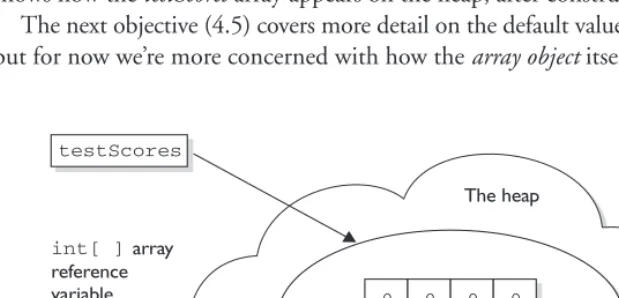
intelement to zero. Thanks.” (The compiler appreciates good manners.) Figure 1-3 shows how thetestScoresarray appears on the heap, after construction.
The next objective (4.5) covers more detail on the default values for arrayelements, but for now we’re more concerned with how thearray objectitself is initialized.
Array Declaration, Construction, and Initialization (Exam Objective 1.1)
19
[image:19.612.156.466.434.583.2]CertPrs8(SUN)/ Sun Certified Programmer & Developer for Java 2 Study Guide / Sierra / 222684-6 / Chapter 1
FIGURE 1-3
A one-dimensional array on the heap
You can also declare and construct an array in one statement as follows:
int[] testScores = new int[14];
This single statement produces the same result as the two previous statements. Arrays of object types can be constructed in the same way:
Thread[] threads = new Thread[5];
The key point to remember here is that—despite how the code appears—the Thread constructor is not being invoked. We’re not creating aThread instance,but rather a singleThread arrayobject. After the preceding statements, there are still no actual Thread objects!
Think carefully about how many objects are on the heap after a code statement or block executes. The exam will expect you to know, for example, that the preceding code produces just one object (the array assigned to the reference variable namedthreads). The single object referenced bythreadsholds five Threadreference variables, but no Threadobjectshave been created or assigned to those references.
Remember, arrays mustalwaysbe given a size at the time they are constructed. The JVM needs the size to allocate the appropriate space on the heap for the new array object. It is never legal, for example, to do the following:
int[] carList = new int[]; // Will not compile; needs a size
So don’t do it, and if you see it on the test, run screaming toward the nearest answer marked “Compilation fails.”
You may see the wordsconstruct,create, andinstantiateused interchangeably. They all mean, “An object is built and placed on the heap.” These words also imply that the object’s constructor runs, as a result of the contruct/create/ instantiate code. You can say with certainty, for example, that any code that uses the keywordnewwill (if it runs successfully) cause the class constructor and all superclass constructors to run.
at that in detail in the section on initialization. For now, understand that because of these syntax shortcuts, objects can still be created even without you ever using or seeing the keywordnew.
Constructing Multidimensional Arrays
Multidimensional arrays, remember, are simply arrays of arrays. So a two-dimensional array of typeintis really an object of typeintarray (int []), with each element in that array holding a reference to anotherintarray. The second dimension holds the actualintprimitives.
The following code declares and constructs a two-dimensional array of typeint:
int[][] ratings = new int[3][];
Notice that only the first brackets are given a size. That’s acceptable in Java, since the JVM needs to know only the size of the object assigned to the variableratings.
Figure 1-4 shows how a two-dimensionalintarray works on the heap.
Initializing an Array
Initializing an array means putting things into it.Things(why, yes thatisa technical term) in the array are the array’s elements, and they’re either primitive values (2,‘a’,
false, etc.), or objects referred to by the reference variables in the array. If you have an array of objects (as opposed to primitives) the array doesn’t actuallyholdthe objects, just as any other nonprimitive variable never actually holds theobject, but instead holds areferenceto the object. But we talk about arrays as, for example, “an array of five strings”, even though what we really mean is, “an array of fivereferences
to String objects.” Then the big question becomes whether or not those references are actually pointing (oops, this is Java, we meanreferring)to real String objects, or are simplynull. Remember, a reference that has not had an object assigned to it is a
nullreference. And if you try to actually use thatnullreference by, say, applying the dot operator to invoke a method on it, you’ll get the infamousNullPointerException.
The individual elements in the array can be accessed with an index number. The index number always begins with zero, so for an array of ten objects the index numbers will run from 0 through 9. Suppose we create an array of three Animals as follows:
Animal [] pets = new Animal[3];
Array Declaration, Construction, and Initialization (Exam Objective 1.1)
21
CertPrs8(SUN)/ Sun Certified Programmer & Developer for Java 2 Study Guide / Sierra / 222684-6 / Chapter 1
We have one array object on the heap, with threenullreferences of type Animal, but we still do not have any Animal objects. The next step is to create some Animal objects and assign them to index positions in the array referenced bypets:
pets[0] = new Animal(); pets[1] = new Animal(); pets[2] = new Animal();
This code puts three new Animal objects on the heap and assigns them to the three index positions (elements) in thepetsarray.
[image:22.612.125.441.101.440.2]22
Chapter 1: Language FundamentalsFIGURE 1-3
Array Declaration, Construction, and Initialization (Exam Objective 1.1)
23
CertPrs8(SUN)/ Sun Certified Programmer & Developer for Java 2 Study Guide / Sierra / 222684-6 / Chapter 1
Look for code that tries to access an out of range array index. For example, if an array has three elements, trying to access the [3] element will raise an
ArrayIndexOutOfBoundsException, because in an array of three elements, the legal index values are 0, 1, and 2. You also might see an attempt to use a negative number as an array index. The following are examples of legal and illegal array access attempts. Be sure to recognize that these cause runtime exceptions and not compiler errors! Nearly all of the exam questions list both runtime exception and compiler error as possible answers.
int[] x = new int[5];
x[4] = 2; // OK, the last element is at index 4
x[5] = 3; // Runtime exception. There is no element at index 5!
int [] z = new int[2];
int y = -3;
z[y] = 4; // Runtime exception.; y is a negative number
These can be hard to spot in a complex loop, but that’s where you’re most likely to see array index problems in exam questions.
A two-dimensional array (an array of arrays) can be initialized as follows:
int[][] scores = new int[3][];
// Declare and create an array holding three references to int arrays
scores[0] = new int[4];
// the first element in the scores array is an int array of four int element
scores[1] = new int[6];
// the second element in the scores array is an int array of six int elements
scores[2] = new int[1];
// the third element in the scores array is an int array of one int element
Initializing Elements in a Loop
Array objects have a single public variablelengththat gives you the number of elements in the array. The last index value, then, is always one less than the length. For example, if the length of an array is 4, the index values are from 0 through 3. Often, you’ll see array elements initialized in a loop as follows:
Dog[] myDogs = new Dog[6]; // creates an array of 6 Dog references for (int x = 0; x < myDogs.length; x++) {
myDogs[x] = new Dog(); // assign a new Dog to the index position x }
Thelengthvariable tells us how many elements the array holds, but it doesnottell us whether those elements have been initialized.
Declaring, Constructing, and Initializing on One Line
You can use two different array-specific syntax shortcuts to both initialize (put explicit values into an array’s elements) and construct (instantiate the array object itself) in a single statement. The first is used to declare, create, and initialize in one statement as follows:
1. int x = 9;
2. int[] dots = {3,6,x,8};
Line 2 in the preceding code does four things:
■ Declares anintarray reference variable nameddots.
■ Creates anintarray with a length of four (four elements).
■ Populates the elements with the values 3, 6, 9, and 8.
■ Assigns the new array object to the reference variabledots.
The size (length of the array) is determined by the number of items between the comma-separated curly braces. The code is functionally equivalent to the following longer code:
int[] dots;
dots = new int[4]; int x = 9;
dots[0] = 3; dots[1] = 6; dots[2] = x; dots[3] = 8;
This begs the question, “Why would anyone use the longer way?” Two reasons come to mind. First, you might not know—at the time you create the array—the values that will be assigned to the array’s elements. Second, you might justprefer
doing it the long, slower-to-type way. Or third (OK, that’sthreereasons), maybe you just didn’t know it was possible. This array shortcut alone is worth the price of this book (well, that combined with the delightful prose).
With object references rather than primitives, it works exactly the same way:
Dog puppy = new Dog("Frodo");
Dog[] myDogs = {puppy, new Dog("Clover"), new Dog("Aiko")};
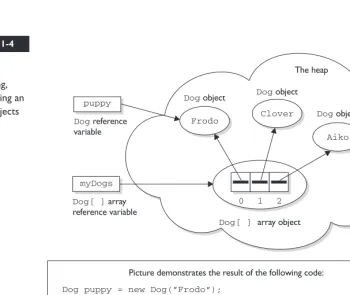
The preceding code creates one Dog array, referenced by the variablemyDogs, with a length of three elements. It assigns a previously created Dog object (assigned to the reference variablepuppy) to the first element in the array, and also creates two new Dog objects ("Clover" and "Aiko"), and assigns the two newly created instances to the last two Dog reference variable elements in themyDogsarray. Figure 1-5 shows the result of the preceding code.
Array Declaration, Construction, and Initialization (Exam Objective 1.1)
25
[image:25.612.116.467.278.573.2]CertPrs8(SUN)/ Sun Certified Programmer & Developer for Java 2 Study Guide / Sierra / 222684-6 / Chapter 1
FIGURE 1-4
Declaring, constructing, and initializing an array of objects
26
Chapter 1: Language FundamentalsYou can also use the shortcut syntax with multidimensional arrays, as follows:
int[][] scores = {{5,2,4,7}, {9,2}, {3,4}};
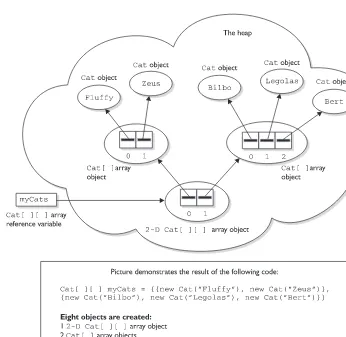
The preceding code creates a total of four objects on the heap. First, an array of
intarrays is constructed (the object that will be assigned to thescoresreference variable). Thescoresarray has a length of three, derived from the number of items (comma-separated) between the outer curly braces. Each of the three elements in thescoresarray is a reference variable to anintarray, so the threeintarrays are constructed and assigned to the three elements in thescoresarray.
The size of each of the threeintarrays is derived from the number of items within the corresponding inner curly braces. For example, the first array has a length of four, the second array has a length of two, and the third array has a length of two. So far we have four objects: one array ofintarrays (each element is a reference to anint
array), and threeintarrays (each element in the threeintarrays is anintvalue). Finally, the threeintarrays are initialized with the actualintvalues within the inner curly braces. Thus, the firstintarray contains the values 5, 2, 4, and 7. The following code shows the values of some of the elements in this two-dimensional array:
scores[0] // an array of four ints scores[1] // an array of 2 ints scores[2] // an array of 2 ints scores[0][1] // the int value 5 scores[2][1] // the int value 4
Figure 1-6 shows the result of declaring, constructing, and initializing a two-dimensional array in one statement.
Constructing and Initializing an Anonymous Array
The second shortcut is calledanonymous array creationand can be used to construct and initialize an array, and then assign the array to a previously declared array reference variable:
int[] testScores;
testScores = new int[] {4,7,2};
Array Declaration, Construction, and Initialization (Exam Objective 1.1)
27
CertPrs8(SUN)/ Sun Certified Programmer & Developer for Java 2 Study Guide / Sierra / 222684-6 / Chapter 1
Maybe you’re wondering, “What good is an array if you don’t assign it to a reference variable?” You can use it to create ajust-in-timearray to use, for example, as an argument to a method that takes an array parameter. The following code demonstrates a just-in-time array argument:
public class Foof {
void takesAnArray(int [] someArray) { // use the array parameter
[image:27.612.91.437.125.462.2]… }
FIGURE 1-5 Declaring, constructing, and initializing a two-dimensional array
public static void main (String [] args) { Foof f = new Foof();
f.takesAnArray(new int[] {7,7,8,2,5}); //we need an array argument }
}
Remember that youdo not specify a sizewhen using anonymous array creation syntax. The size is derived from the number of items (comma-separated) between the curly braces. Pay very close attention to the array syntax used in exam questions (and there will be a lot of them). You might see syntax such as
new Object[3] {null, new Object(), new Object()};
// not legal;size must not be specified
Legal Array Element Assignments
What can you put in a particular array? For the exam, you need to know that arrays can have only one declared type (int[ ],Dog[ ],String[ ], and so on) but that doesn’t necessarily mean that only objects or primitives of the declared type can be assigned to the array elements. And what about the array reference itself? What kind of array object can be assigned to a particular array reference? For the exam, you’ll need to know the answer to all of these questions. And, as if by magic, we’re actually covering those very same topics in the following sections. Pay attention.
Arrays of Primitives
Primitive arrays can accept any value that can be promoted implicitly to the declared type of the array. Chapter 3 covers the rules for promotion in more detail, but for an example, anintarray can hold any value that can fit into a 32-bitintvariable. Thus, the following code is legal:
int[] weightList = new int[5]; byte b = 4;
char c = 'c'; short s = 7;
weightList[0] = b; // OK, byte is smaller than int weightlist[1] = c; // OK, char is smaller than int weightList[2] = s; // OK, short is smaller than int
Array Declaration, Construction, and Initialization (Exam Objective 1.1)
29
CertPrs8(SUN)/ Sun Certified Programmer & Developer for Java 2 Study Guide / Sierra / 222684-6 / Chapter 1
Arrays of Object References
If the declared array type is a class, you can put objects of any subclass of the declared type into the array. For example, if Dog is a subclass of Animal, you can put both Dog objects and Animal objects into the array as follows:
class Car {}
class Subaru extends Car {} class Honda extends Car {} class Ferrari extends Car {}
Car [] myCars = {new Subaru(), new Honda(), new Ferrari()};
It helps to remember that the elements in a Car array are nothing more than Car reference variables. So anything that can be assigned to a Car reference variable can be legally assigned to a Car array element. Chapter 5 coverspolymorphic assignments
in more detail.
If the array is declared as an interface type, the array elements can refer to any instance of any class that implements the declared interface. The following code demonstrates the use of an interface as an array type:
interface Sporty { void beSporty(); }
class Ferrari extends Car implements Sporty { public void beSporty() {
…
// implement cool sporty method in a Ferrari-specific way }
}
class RacingFlats extends AthleticShoe implements Sporty { public void beSporty() {
…
// implement cool sporty method in a RacingShoe-specific way }
}
class GolfClub { } class TestSportyThings {
public static void main (String [] args) { Sporty[] sportyThings = new Sporty [3];
sportyThings[0] = new Ferrari(); // OK, Ferrari implements Sporty sportyThings[1] = new RacingFlats();
// OK, RacingFlats implements Sporty sportyThings[2] = new GolfClub();
30
Chapter 1: Language Fundamentals// Not OK; GolfClub does not implement Sporty
// I don't care what anyone says }
}
The bottom line is this: any object that passes the “IS-A” test for the declared array type can be assigned to an element of that array.
Array Reference Assignments for One-Dimensional Arrays For the exam, you need to recognize legal and illegal assignments for array reference variables. We’re not talking about referencesinthe array (in other words, array
elements), but rather referencestothe array object. For example, if you declare an
intarray, the reference variable you declaredcanbe reassigned to anyintarray (of any size), butcannotbe reassigned to anything that isnotanintarray, including anintvalue. Remember, all arrays are objects, so anintarray referencecannot refer to anintprimitive. The following code demonstrates legal and illegal assignments for primitive arrays:
int[] splats;
int[] dats = new int[4]; char[] letters = new char[5];
splats = dats; // OK, dats refers to an int array
splats = letters; // NOT OK, letters refers to a char array
It’s tempting to assume that because a variable of typebyte,short, orchar
can be explicitly promoted and assigned to anint, an array of any of those types could be assigned to anintarray. You can’t do that in Java, but it would be just like those cruel, heartless (but otherwise attractive) exam developers to put tricky array assignment questions in the exam.
Arrays that hold object references, as opposed to primitives, aren’t as restrictive. Just as you can put a Honda object in a Car array (because HondaextendsCar), you can assign an array of type Honda to a Car array reference variable as follows:
Car[] cars;
Honda[] cuteCars = new Honda[5];
cars = cuteCars; // OK because Honda is a type of Car Beer[] beers = new Beer [99];
cars = beers; // NOT OK, Beer is not a type of Car
Apply the IS-A test to help sort the legal from the illegal. Honda IS-A Car, so a Honda array can be assigned to a Car array. Beer IS-A Car is not true; Beer does
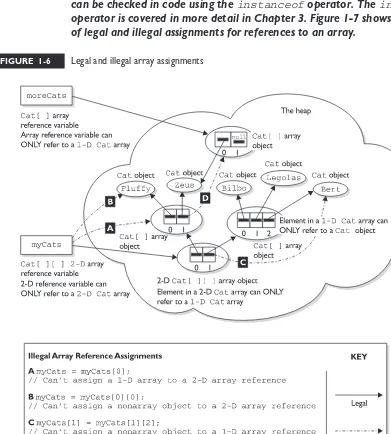
You cannot reverse the legal assignments. A Car array cannot be assigned to a Honda array. A Car is not necessarily aHonda, so if you’ve declared a Honda array, it might blow up if you were allowed to assign a Car array to the Honda reference variable. Think about it: a Car array could hold a reference to a Ferrari, so someone who thinks they have an array of Hondas could suddenly find themselves with a Ferrari. Remember that the IS-A test can be checked in code using theinstanceofoperator. Theinstanceof
operator is covered in more detail in Chapter 3. Figure 1-7 shows an example of legal and illegal assignments for references to an array.
Array Declaration, Construction, and Initialization (Exam Objective 1.1)
31
[image:31.612.70.461.182.616.2]CertPrs8(SUN)/ Sun Certified Programmer & Developer for Java 2 Study Guide / Sierra / 222684-6 / Chapter 1
FIGURE 1-6 Legal and illegal array assignments
32
Chapter 1: Language FundamentalsThe rules for array assignment apply to interfaces as well as classes. An array declared as an interface type can reference an array of any type that implements the interface. Remember, any object from a class implementing a particular interface will pass the IS-A (instanceof) test for that interface. For example, if Box implements Foldable, the following is legal:
Foldable[] foldingThings; Box[] boxThings = new Box[3]; foldingThings = boxThings;
// OK, Box implements Foldable, so Box IS-A Foldable
Array Reference Assignments for Multidimensional Arrays When you assign an array to a previously declared array reference,the array you’re assigning must be the same dimension as the reference you’re assigning it to. For example, a two-dimensional array ofintarrayscannotbe assigned to a regularintarray reference, as follows:
int[] blots;
int[][] squeegees = new int[3][];
blots = squeegees; // NOT OK, squeegees is a two-d array of int arrays int[] blocks = new int[6];
blots = blocks; // OK, blocks is an int array
Pay particular attention to array assignments using different dimensions. You might, for example, be asked if it’s legal to assign anintarray to the first element in an array ofintarrays, as follows:
int[][] books = new int[3][]; int[] numbers = new int[6]; int aNumber = 7;
books[0] = aNumber; //NOT OK, expecting an int array instead of an int books[0] = numbers; //OK, numbers is an int array
CERTIFICATION OBJECTIVE
Using a Variable or Array Element That Is
Uninitialized and Unassigned (Exam Objective 4.5)
Java gives us the option of initializing a declared variable or leaving it uninitialized. When we attempt tousethe uninitialized variable, we can get different behavior depending on what type of variable or array we are dealing with (primitives or objects). The behavior also depends on the level (scope) at which we are declaring our variable. Aninstance variableis declared within the class but outside any method or constructor, whereas alocal variableis declared within a method (or in the argument list of the method).
Local variables are sometimes calledstack,temporary,automatic, ormethod variables, but the rules for these variables are the same regardless of what you call them. Although you can leave a local variable uninitialized, the compiler complains if you try tousea local variable before initializing it with a value, as we shall see.
Primitive and Object Type Instance Variables
Instance variables(also calledmember variables) are variables defined at the class level. That means the variable declaration is not made within a method, constructor, or any other initializer block. Instance variables are initialized to a default value each time a new instance is created. Table 1-3 lists the default values for primitive and object types.
Primitive Instance Variables
In the following example, the integeryearis defined as a class member because it is within the initial curly braces of the class and not within a method’s curly braces:
public class BirthDate {
int year; // Instance variable
public static void main(String [] args) { BirthDate bd = new BirthDate();
bd.showYear(); }
public void showYear() {
System.out.println("The year is " + year); }
}
When the program is started, it gives the variableyeara value of zero, the default value for primitive number instance variables.
Using a Variable or Array Element That Is Uninitialized and Unassigned (Exam Objective 4.5)
33
CertPrs8(SUN)/ Sun Certified Programmer & Developer for Java 2 Study Guide / Sierra / 222684-6 / Chapter 1
34
Chapter 1: Language FundamentalsIt’s a good idea to initialize all your variables, even if you’re assigning them with the default value. Your code will be easier to read; programmers who have to maintain your code (after you win the lottery and move to Tahiti) will be grateful.
Object Reference Instance Variables
When compared with uninitialized primitive variables, Object references that aren’t initialized are a completely different story. Let’s look at the following code:
public class Book {
private String title; public String getTitle() {
return title; }
public static void main(String [] args) { Book b = new Book();
System.out.println("The title is " + b.getTitle()); }
}
This code will compile fine. When we run it, the output is
The title is null
Thetitlevariable has not been explicitly initialized with a String assignment, so the instance variable value isnull. Remember thatnullis not the same as an empty String (“”). Anullvalue means the reference variable is not referring to any object on the heap. Thus, the following modification to the Book code runs into trouble:
public class Book { private String title;
Variable Type Default Value
Object reference null(not referencing any object)
byte,short,int,long 0 float,double 0.0 boolean false
char ‘\u0000’
TABLE 1-3
public String getTitle() { return title;
}
public static void main(String [] args) { Book b = new Book();
String s = b.getTitle(); // Compiles and runs String t = s.toLowerCase(); // Runtime Exception! }
}
When we try to run the Book class, the JVM will produce the following error:
%java Book
Exception in thread "main" java.lang.NullPointerException at Book.main(Book.java:12
We get this error because the reference variabletitledoes not point (refer) to an object. We can check to see whether an object has been instantiated by using the keywordnull, as the following revised code shows:
public class Book { private String title; public String getTitle() {
return title; }
public static void main(String [] args) { Book b = new Book();
String s = b.getTitle(); // Compiles and runs if (s != null) {
String t = s.toLowerCase(); }
} }
The preceding code checks to make sure the object referenced by the variables
is notnullbefore trying to use it. Watch out for scenarios on the exam where you might have to trace back through the code to find out whether an object reference will have a value ofnull. In the preceding code, for example, you look at the instance variable declaration fortitle, see that there’s no explicit initialization, recognize that thetitlevariable will be given the default value ofnull, and then realize that the variableswill also have a value ofnull. Remember, the value ofsis a copy of the value oftitle(as returned by thegetTitle()method), so iftitleis anull
reference,swill be too.
Using a Variable or Array Element That Is Uninitialized and Unassigned (Exam Objective 4.5)
35
CertPrs8(SUN)/ Sun Certified Programmer & Developer for Java 2 Study Guide / Sierra / 222684-6 / Chapter 1
Array Instance Variables
An array is an object; thus, an array instance variable that’s declared but not explicitly initialized will have a value ofnull, just as any other object reference instance variable. But…if the arrayisinitialized, what happens to the elements contained in the array? All array elements are given their default values—the same default values that elements of that type get when they’re instance variables. The bottom line:Array elements are always always always given default values, regardless of where the array itself is declared or instantiated.By the way, if you see the wordalwaysthree times in a row, reread the sentence three times. Now, once more, with feeling!
If we initialize an array, object reference elements will equalnullif they are not initialized individually with values. If primitives are contained in an array, they will be given their respective default values. For example, in the following code, the array
yearwill contain 100 integers that all equal zero by default:
public class BirthDays {
static int [] year = new int[100]; public static void main(String [] args) {
for(int i=0;i<100;i++)
System.out.println("year[" + i + "] = " + year[i]); }
}
When the preceding code runs, the output indicates that all 100 integers in the array equal zero.
Local (Stack, Automatic) Primitives and Objects
Local variables are defined within a method, including method parameters.
“Automatic” is just another term for “local variable.” It does not mean the automatic variable is automatically assigned a value! The opposite is true; an automatic variable must be assigned a value in the code; otherwise, the compiler will complain.
Local Primitives
In the following time travel simulator, the integeryearis defined as an automatic variable because it is within the curly braces of a method.
Using a Variable or Array Element That Is Uninitialized and Unassigned (Exam Objective 4.5)
37
CertPrs8(SUN)/ Sun Certified Programmer & Developer for Java 2 Study Guide / Sierra / 222684-6 / Chapter 1
public class TimeTravel {
public static void main(String [] args) { int year = 2050;
System.out.println("The year is " + year); }
}
Okay, so we’ve still got work to do on the physics.Local variables, including primitives, always always always must be initialized before you attempt to use them(though not necessarily on the same line of code). Java does notgivelocal variables a default value;
you must explicitly initialize themwith a value, as in the preceding example. If you try to use an uninitialized primitive in your code, you’ll get a compiler error:
public class TimeTravel {
public static void main(String [] args) {
int year; // Local variable (declared but not initialized) System.out.println("The year is " + year); // Compiler error }
}
Compiling produces the following output:
%javac TimeTravel.java
TimeTravel.java:4: Variable year may not have been initialized. System.out.println("The year is " + year);
1 error
To correct our code, we must give the integeryeara value. In this updated example, we declare it on a separate line, which is perfectly valid:
public class TimeTravel {
public static void main(String [] args) { int year; // Declared but not initialized int day; // Declared but not initialized
System.out.println("You step into the portal."); year = 2050; // Initialize (assign an explicit value) System.out.println("Welcome to the year " + year); }
}
Notice in the preceding example we declared an integer calleddaythat never gets initialized, yet the code compiles and runs fine. Legally, you can declare a local Color profile: Generic CMYK printer profile
38
Chapter 1: Language Fundamentalsvariable without initializing it as long as you don’tusethe variable, but let’s face it, if you declared it, you probably had a reason. (Although we have heard of programmers declaring random local variables just for sport, to see if they can figure out how and why they’re being used.)
The compiler can’t always tell whether a local variable has been initialized before use. For example, if you initialize within a logically conditional block (in other words, a code block that may not run, such as an if block orforloop without a literal value oftrueorfalsein the test), the compiler knows that the initialization might not happen, and can produce an error. The following code upsets the compiler:
public class TestLocal {
public static void main(String [] args) {
int x;
if (args[0] != null) { //assume you know this will always be true
x = 7; // compiler can’t tell that this statement will run
}
int y = x;
}
}
The preceding code produces the following error when you attempt to compile it:
TestLocal.java:8: variable x might not have been initialized int y = x;
1 error
Because of the compiler-can’t-tell-for-certain problem, you will sometimes need to initialize your variable outside the conditional block, just to make the compiler happy. You know why that’s important if you’ve seen the bumper sticker: “When the compiler’s not happy, ain’tnobodyhappy.”
Local Objects
Using a Variable or Array Element That Is Uninitialized and Unassigned (Exam Objective 4.5)
39
CertPrs8(SUN)/ Sun Certified Programmer & Developer for Java 2 Study Guide / Sierra / 222684-6 / Chapter 1
end of it, buta null reference is not the same as an uninitialized reference.Locally declared references can’t get away with checking fornull before use, unless you explicitly initialize the local variable tonull. The compiler will complain about the following code:
import java.util.Date; public class TimeTravel {
public static void main(String [] args) { Date date;
if (date == null)
System.out.println("date is null"); }
}
Compiling the code results in the following error:
%javac TimeTravel.java
TimeTravel.java:5: Variable date may not have been initialized. If (date == null)
1 error
Instance variable references are always given a default value ofnull, until explicitly initialized to something else. But local references arenotgiven a default value; in other words,they aren’t null. If you don’t initialize a local reference variable, then by default, its value is…well that’s the whole point—it doesn’t haveanyvalue at all! So we’ll make this simple: Just set the darn thing tonullexplicitly, until you’re ready to initialize it to something else. The following local variable will compile properly:
Date date = null; // Explicitly set the local reference variable to null
Local Arrays
Just like any other object reference, array references declared within a method must be assigned a value before use. That just means you must declare and construct the array. You do not, however, need to explicitly initialize the elements of an array. We’ve said it before, but it’s important enough to repeat:array elements are given their default values (0,false,null,‘\u0000’, etc.) regardless of whether the array is declared as an instance or local variable. The array object itself, however, will not be initialized if it’s declared locally. In other words, you must explicitly initialize an array reference if it’s declared and used within a method, but at the moment you construct an array object, all of its elements are assigned their default values. Color profile: Generic CMYK printer profile
40
Chapter 1: Language FundamentalsCERTIFICATION OBJECTIVE
Command-Line Arguments to Main
(Exam Objective 4.3)
State the correspondence between index values in the argument array passed to a main method and command line arguments.
Now that you know all about arrays, command-line arguments will be a piece of cake. Remember that the main method—the one the JVM invokes—must take a String array parameter. That String array holds the arguments you send along with the command to run your Java program, as follows:
class TestMain {
public static void main (String [] args) {
System.out.println("First arg is " + args[0]); }
}
When invoked at the command line as follows,
%java TestMain Hello
the output is
First arg is Hello
Command-Line Arguments to Main (Exam Objective 4.3)
41
CertPrs8(SUN)/ Sun Certified Programmer & Developer for Java 2 Study Guide / Sierra / 222684-6 / Chapter 1
public static void main (String [] args) { if (args.length < 3) {
System.out.println("Usage: [name] [social security #] //[IQ] Try again when you have a clue");
} }
The String array parameter does not have to be namedargsorarg. It can be named, for example,freddie. Also, remember that themainargument is just an array! There’s nothing special about it, other than how it gets passed into main(from the JVM).
EXERCISE 1-1
Creating a Program That Outputs Command-Line Arguments In the following exercise…
1. Create a program that outputs every command-line argument, then displays the number of arguments.
2. You should use the array variablelengthto retrieve the length of the array.
An example of how you might write your code is at the end of this chapter.
CERTIFICATION SUMMARY
After absorbing the material in this chapter, you should be familiar with some of the nuances of the Java language. You may also be experiencing confusion around why you ever wanted to take this exam in the first place. That’s normal at this point. If you hear yourself saying, “What was I thinking?” just lie down until it passes. We wouldliketo tell you that it gets easier… that this was the toughest chapter and it’s all downhill from here.
Let’s briefly review what you’ll need to know for the exam.
There will be more than one question dealing with keywords, so be sure you can identify which are keywords and which aren’t. Make sure you’re familiar with the ranges of integer primitives, and the bit depth of all primitives. And, although this isn’t Java language specific, you must be able to convert between octal, decimal, and hexadecimal literals. You have also learned about arrays, and how they behave when declared in a class or a method.
Be certain that you know the effects of leaving a variable uninitialized, and how the variable’s scope changes the behavior. You’ll also be expected to know what happens to the elements of an array when they’re not explicitly initialized.
For the exam, knowing what you can’t do with the Java language is just as important as knowing what you can do. Give the sample questions a try! They’re very similar to the difficulty and structure of the real exam questions, and should be an eye opener for how difficult the exam can be. Don’t worry if you get a lot of them wrong. If you find a topic that you are weak in, spend more time reviewing and studying. Many programmers need two or three serious passes through a chapter (or an individual objective) before they can answer the questions confidently.
✓
TWO-MINUTE DRILL
Java Programming Language Keywords
❑ Keywords cannot be used as identifiers (names) for classes, methods, variables, or anything else in your code.
❑ All keywords start with a lowercase letter.
Literals and Ranges of All Primitive Data Types
❑ All six number types in Java are signed, so they can be positive or negative. ❑ Use the formula -2(bits-1)to 2(bits-1)-1 to determine the range of an integer type. ❑ Acharis really a 16-bit unsigned integer.
❑ Literals are source code representations of primitive data types, or String. ❑ Integers can be represented in octal (0127), decimal (1245), and hexadecimal
(0XCAFE).
❑ Numeric literals cannot contain a comma.
❑ Acharliteral can be represented as a single character in single quotes (‘A’). ❑ Acharliteral can also be represented as a Unicode value (‘\u0041’). ❑ Acharliteral can also be represented as an integer, as long as the integer is
less than 65536.
❑ Abooleanliteral can be eithertrueorfalse.
❑ Floating-point literals are always double by default; if you want afloat, you must append anForfto the literal.
Array Declaration, Construction, and Initialization
❑ Arrays can hold primitives or objects, but the array itself isalwaysan object. ❑ When you declare an array, the brackets can be to the left or right of the
variable name.
❑ It is never legal to include the size of an array in the declaration.
Two-Minute Drill
43
CertPrs8(SUN)/ Sun Certified Programmer & Developer for Java 2 Study Guide / Sierra / 222684-6 / Chapter 1
❑ You must include the size of an array when you construct it (usingnew) unless you are creating an anonymous array.
❑ Elements in an array of objects are not automatically created, although primitive array elements are given default values.
❑ You’ll get aNullPointerExceptionif you try to use an array element in an object array, if that element does not refer to a real object.
❑ Arrays are indexed beginning with zero. In an array with three elements, you can access element 0, element 1, and element 2.
❑ You’ll get anArrayIndexOutOfBoundsExceptionif you try to access outside the range of an array.
❑ Arrays have alengthvariable that contains the number of elements in the array. ❑ The last index you can access is always one less than the length of the array. ❑ Multidimensional arrays are just arrays of arrays.
❑ The dimensions in a multidimensional array can have different lengths. ❑ An array of primitives can accept any value that can be promoted implicitly
to the declared type of the array. For example, abytevariable can be placed in anintarray.
❑ An array of objects can hold any object that passes the IS-A (orinstanceof) test for the declared type of the array. For example, if Horse extends Animal, then a Horse object can go into an Animal array.
❑ If you assign an array to a previously declared array reference, the array you’re assigning must be the same dimension as the reference you’re assigning it to. ❑ You can assign an array of one type to a previously declared array reference of
one of its supertypes. For example, a Honda array can be assigned to an array declared as type Car (assuming HondaextendsCar).
Using a Variable or Array Element That Is Uninitialized and Unassigned
❑ Just as with array elements, instance variables are always initialized with a default value.
❑ Local/automatic/method variables are never given a default value. If you attempt to use one before initializing it, you’ll get a compiler error.
Command-Line Arguments to Main
❑ Command-line arguments are passed to the String array parameter in the
mainmethod.
❑ The first command-line argument is the first element in the main String array parameter.
❑ If no arguments are passed tomain, the length of themainString array parameter will be zero.
Two-Minute Drill
45
CertPrs8(SUN)/ Sun Certified Programmer & Developer for Java 2 Study Guide / Sierra / 222684-6 / Chapter 1
SELF TEST
The following questions will help you measure your understanding of the material presented in this chapter. Read all the choices carefully! These questions areverysimilar to the kinds of questions you’ll see on the latest exam. Again, don’t worry if you have trouble with them