ISSN: 2231-5381
http://www.ijettjournal.org
Page 277A Full swing Ex-OR/Ex-NOR Gate Circuit
Using Pass Transistor Logic with Five
Transistors
Mrudula Singamsetti #1 Sarada Musala *2
#1
School of electronics, Vignan’s University,Vadlamudi, India
*2
School of electronics, Vignan’s university, Vadlamudi, India
Abstract -- The Ex-OR/Ex-NOR gates are the basic
building blocks of various digital system applications like adder, comparator, and parity generator/checker and encryption processor. This paper proposes a 5T full swing pass transistor based Ex-OR/Ex-NOR circuit using new 3T full swing pass transistor Ex-OR gate. The new Ex-OR with three transistors is proposed by modifying the existed 3T cross coupled Ex-OR gate to get full output voltage swing. Then one bit full adder, 4-bit ripple carry adder and 8-bit ripple carry adder are constructed with use of the proposed 5T full swing Ex-OR/Ex-NOR circuit. All the proposed and existing circuits are simulated and compared with Cadence Spectre 180nm CMOS technology with the supply voltage of 0.6V to1.8V. The simulation results show that the proposed circuits achieve a full output voltage swing for all the input combinations with high speed. And the proposed full adder and ripple carry adder circuits have better Power Delay Product than the existing circuits.
Keyword: Propagation Delay, Power Dissipation, Output voltage swing, PDP, Ex-OR/Ex-NOR, Full adder, Ripple carry adder.
I. INTRODUCTION
In the electronic world, most of the VLSI circuits have been designed by the CMOS Technology. It has become captivating because it reduces the complexity of the circuit and easy to realize the circuit that has excellent noise margins and the most important advantage is low power consumption and has the disadvantage of slow switching speed and CMOS devices can easily be destroyed by the static electricity. Due to this reason a number of researchers has proposed different logic styles like CPL (Complementary pass transistor logic), DPL (Double pass transistor logic), and PTL (Pass transistor logic) etc. CPL is used to perform the logic verification and to comprehend the static and high performance digital system designs. In CPL logic only nMOS transistors are used and the logic at the output is varied from 0 to (Vdd-Vth), i.e. the circuits are unable to get full swing at the output. In order to avoid this problem, static CMOS transistors are to
be used at the following gates, which leads to the static power dissipation and degrades the performance of the device as so, some intermediate buffers have to be used to get full swing at the output as a result delay of the circuit increases gradually with the addition of number of stages in the circuit. To avoid the delay problem in CPL, a pMOS transistor has to be connected in parallel with nMOS to produce a full swing (Vdd) at the output. Hence we are using both pMOS and nMOS it is called Double pass transistor logic (DPL) and its drawbacks are large area and high power. To overcome the drawback of DPL, PTL has been developed for low power applications and the advantage is either pMOS or nMOS can be used to implement the logic design. In PTL the supply rails can be replaced by providing the inputs which results in reduction of number of transistors. In this paper all the logic circuits has been implemented by PTL. The arithmetic and logic operations like full adders, compressors, parity checkers are implemented by using Ex-OR/Ex-NOR gates. Generally the 1-bit full adders are the basic building blocks for many operations like multiplication and division. The number of arithmetic operations in multipliers are very high so the delay is more in the critical path which influence the overall performance of the system, so optimized design and analysis is required for the Ex-OR and Ex-NOR gates, will enhance the performance of 1-bit full adder which in turns increases the performance of ripple carry adders, multipliers etc in larger designs.
ISSN: 2231-5381
http://www.ijettjournal.org
Page 278 proposed circuits achieved the less power, morespeed, full output voltage swing and less area.
II. CONVENTIONAL EX-OR/EX-NOR CIRCUITS
The PTL based Ex-OR/Ex-NOR gate with six number of transistors [1] has full output voltage swing for all the input combinations which was proposed by D.RadhaKrishnan et. al, in 2001. And it has better driving capability and full output voltage swing by using Vdd and Gnd voltages at the source terminals of pMOS T3and nMOS T4
transistors. This circuit schematic and its input/output wave forms are shown in Fig.1 and Fig.2 respectively. In 2003, Elgamel et.al proposed the improved version of circuit [1] but it requires two extra transistors when compared to circuit [1]. This schematic is shown Fig.3. In this circuit the two extra transistors form a forward and backward feedback between the Ex-OR and EX-NOR to get better PDP, higher noise immunity and to rectify the signal degradation problem. And this circuit gives full swing output, is shown in Fig.4. All these can be achieved with the proposed circuit with 5 transistors only.
Fig.1: Conventional 6T Ex-OR/Ex-NOR Circuit
Fig.2: Input & Output waveforms of Conventional 6T Ex-OR/Ex-NOR Circuit
Fig.3: Conventional 8T Ex-OR/Ex-NOR Circuit
Fig.4: Input & Output waveforms of Conventional 8T Ex-OR/Ex-NOR Circuit
A minimum five transistor PTL based Ex-OR/Ex-NOR gate was proposed by Rajiv Kumar et.al in 2011, is shown in Fig.5. This has less delay and better power delay product than [1] and [2] but it suffers from signal degradation problem for Ex-OR logic. From Fig.6, it is shown that the output for Ex-OR is lacked from full voltage swing for some combination of inputs. This problem is eliminated in the proposed circuit with the same area and better PDP.
xnor xor
a b
T1 T2
T6
T5
T4
T3
a
xnor
b
xor
T1 T2
T8
T6
T7
T3
T5
ISSN: 2231-5381
http://www.ijettjournal.org
Page 279 Fig.5: Conventional 5T Ex-OR/Ex-NOR CircuitFig.6: Input & Output waveforms of Conventional 5T Ex-OR/Ex-NOR Circuit
III. PROPOSED EX-OR/EX-NOR CIRCUIT
Fig.7: Proposed5T Ex-OR/Ex-NOR Circuit
In this paper we proposed low-voltage Ex-OR/Ex-NOR gate using five transistors. The schematic of proposed 5T Ex-OR/Ex-NOR circuit is shown in Fig.7. The proposed Ex-OR/Ex-NOR gate is based on the concept of pass transistor logic and Static CMOS Inverter. The Pass transistor design uses small transistor count and operates with very low-power and results high-performance. In this proposed circuit two input Ex-OR gate is designed by using three transistors T1, T2 and T3.
When the input ‘a’ is logic 0 and ‘b’ is logic’0’ all
the three transistors are in ON condition then the strong logic 0 is generated at the output through T3
nMOS transistor. For the input ‘a’ logic ‘0’ and B logic ‘1’ the transistor T2 is in OFF condition and
T1 is in ON condition, then logic ‘1’ is passed to
the output though the PMOS pass transistor T1.
And when ‘a’ is logic ‘1’ and ‘b’ is logic’ 0’then the output is logic ‘1’which is passed from T2.
When both the inputs are at logic ‘1’ the transistors T1 and T2 are in OFF condition, and the transistor
T3 is in ON condition so, logic ‘0’ is passed to the
output. Hence this proposed pass transistor based Ex-OR gate achieves full output voltage swing for all the input combinations with use of only three transistors. This full swing Ex-OR output is applied as an input to the static CMOS inverter which is the combination of T4 and T5 transistors and it
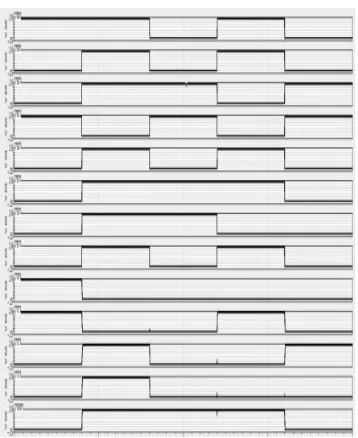
generates inverted output which is acted as an Ex-NOR output. In the conventional circuit-3, output is weak logic ‘0’ for ‘a’ and ‘b’ logic ‘0’ combination because a pMOS device passes a weak logic ‘0’. This weak logic ‘0’ problem is eliminated in the proposed circuit by passing output logic ‘0’ through nMOS transistor T3 which passes a strong logic ‘0’. And in the conventional circuit-3, because of weak logic ‘0’ at the output of Ex-OR, it may generate the weak logic ‘1’ at the output of inverter which is acting as a Ex-NOR output. This problem is also eliminated in the proposed circuit. So the proposed circuit gives full output voltage swing when compared to the conventional circuit-3 with same number of three transistors. The proposed circuit is achieving the same full swing output as conventional circuits [1-2] with five transistors instead of eight and six transistors. And this proposed circuit gives less power consumption, high speed with small area when compared to the conventional circuits [1] and [2]. The transient response of the proposed 5T Ex-OR/Ex-NOR gate is shown in Fig.8.
Fig.8: Input & Output waveforms of Proposed 5T Ex-OR/Ex-NOR Circuit
b
xnor
xor T2
T1
a
a b
T5
T4
T3
T1 T2
T3 T5
a b
xnor
xor
ISSN: 2231-5381
http://www.ijettjournal.org
Page 280IV. SIMULATION RESULTS
All the proposed and existing Ex-OR/Ex-NOR gates are simulated using Spectre Cadence in the voltage range of 0.6V to 1.8V using 180nm CMOS technology. Simulation is performed at varying supply voltages to show the effect of different voltages to the output swing of Ex-OR/Ex-NOR circuits. Here the transient results are shown with the voltage of 1.8V. The transient analyses of the circuits were performed with a load capacitance of 10fF to 50fF. Fig. 8 shows the simulated results of Proposed new Ex-OR/Ex-NOR circuit of Fig.7. In Fig. 8, the results show that there is good output for all the input combinations of A and B for both Ex-OR/Ex-NOR logics.
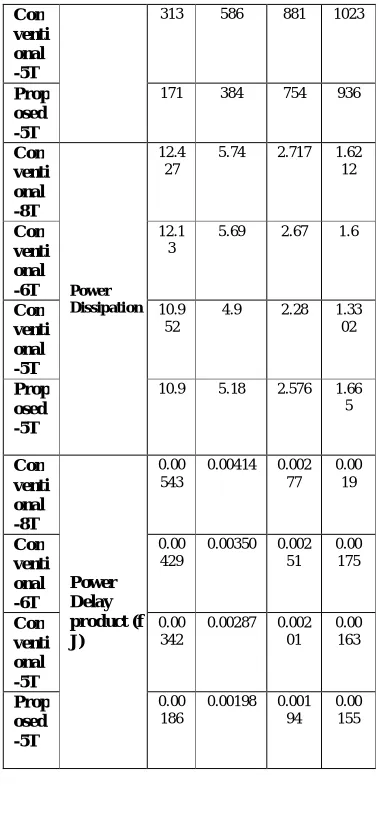
The quantitative analysis of number of transistors, delay, power dissipation and PDP are shown in Table I and Table II. This table shows that the delay of the proposed 5T Ex-OR/Ex-NOR gate is lesser than the circuit [1][2][3] and power is lesser than the [1] ,[2] and it is approximately same as the [3]. And this table shows that PDP is better for proposed Ex-OR/Ex-NOR circuit when compared to circuit [1],[2] and [3]. The delay Vs Voltage characteristics of the conventional circuits [1-3] and proposed Ex-OR circuits are shown in Fig.9. The delay Vs Voltage characteristics of the conventional circuits [1-3] and proposed Ex-NOR circuits are shown in Fig.10. These figures show that the delay is less for the proposed circuit. The Power Vs Voltage characteristics of the all [1-3] and proposed circuits are shown in Fig.11. This figure shows that the power of [1-2] is more than proposed circuit. And power for the circuit [3] and proposed is approximately same. The PDP Vs Voltage characteristic of the all Ex-OR[1-3] and proposed Ex-OR circuits are shown in Fig.12 and Fig.13 shows the PDP Vs Voltage characteristic of the all Ex-NOR[1-3] and proposed circuits. And these two figures show that the proposed five transistor PTL based EX-OR/Ex-NOR circuit is better in PDP than the conventional [1-3] circuits. This is achieved because of the implementation with the new Ex-OR gate.
TABLE I
Quantitative Analysis of, Delay, Power Dissipation and PDP for Ex-NOR Gate Volta ge/ Desig n Paramete r 1.8 V
1.2V 0.8V 0.6V
Con venti onal -8T
Delay
437 722 1021 1174
Con venti onal -6T
354 631 943 1098
Con venti onal -5T
313 586 881 1023
Prop osed -5T
171 384 754 936
Con venti onal -8T Power Dissipation 12.4 27
5.74 2.717 1.62 12 Con venti onal -6T 12.1 3
5.69 2.67 1.6
Con venti onal -5T 10.9 52
4.9 2.28 1.33 02
Prop osed -5T
10.9 5.18 2.576 1.66 5 Con venti onal -8T Power Delay product (f J) 0.00 543
0.00414 0.002 77 0.00 19 Con venti onal -6T 0.00 429
0.00350 0.002 51 0.00 175 Con venti onal -5T 0.00 342
0.00287 0.002 01 0.00 163 Prop osed -5T 0.00 186
0.00198 0.001 94
0.00 155
TABLE II
Quantitative Analysis of, Delay, Power Dissipation and PDP for Ex-OR Gate Volta ge/De sign Paramet er
1.8V 1.2V 0.8V 0.6V
Con venti onal -8T
Delay
390 599 900 1104
Con venti onal -6T
268 548 874 1021
Con venti onal -5T
250 498 850 999
Prop osed -5T
99 250 499 799
Con venti
12.42 7
ISSN: 2231-5381
http://www.ijettjournal.org
Page 281onal -8T
Power Dissipation
Con venti onal -6T
12.13 5.69 2.67 1.6
Con venti onal -5T
10.95 2
4.9 2.28 1.33 02
Prop osed -5T
10.9 5.18 2.576 1.66 5
Con venti onal -8T
Power Delay product (f J)
0.004 84
0.00343 0.002 44
0.00 178
Con venti onal -6T
0.003 25
0.00310 0.002 33
0.00 163
Con venti onal -5T
0.002 75
0.00240 0.001 94
0.00 132
Prop osed -5T
0.001 08
0.00130 0.001 29
0.00 128
Fig.9: Delay Vs Voltage of Ex-OR Circuit
Fig.10: Delay Vs Voltage of Ex-NOR Circuit
Fig.11: Power Vs Voltage of Ex-OR/Ex-NOR Circuit
Fig.12: PDPVs Voltage of Ex-OR Circuit
ISSN: 2231-5381
http://www.ijettjournal.org
Page 282V. IMPLEMENTATION OF 1-BIT FULL ADDER, 4-BIT RIPPLE CARRY ADDER AND 8-BIT RIPPLE CARRY
ADDER
A 1-bit full adder is constructed with the proposed new 5T Ex-OR/Ex-NOR circuit and four transmission gates. That circuit schematic is shown in Fig. 14. The constructed full adder logic is represented in the following equations.
Sum=
(
A
B
).
C
(
A
B
).
C
Carry=
C
(
A
B
)
+B
.
(
A
B
)
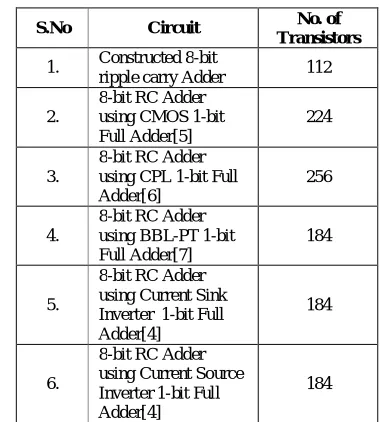
The transient response of this 1-bit full adder is shown in Fig.15. A 4-bit and 8-bit ripple carry adder is constructed with this 1-bit full adder circuit shown in Fig.16 and Fig.18 respectively. And the transient response of Fig.16 is shown in Fig.17. The quantitative analysis of 1-bit full adder and 8 bit ripple carry adder shown in the table III and table IV.
Fig.14: 1- bit full adder circuit
Fig.15:Input & Output wave forms of 1-bit full adder
Fig.16: 4-bit ripple carry adder
Fig.17: Input & Output waveforms of 4-bit ripple carry adder
Table II
Comparison of transistors count for 1-bit Full Adders
Serial
Number Circuit
No. of Transistors
1. Constructed
1-bit Adder 14
2. CMOS 1- bit
Full Adder[5] 28
3. CPL 1-bit Full
Adder[6] 32
4. BBL-PT 1-bit
Full Adder[7] 23
5.
Current Sink Inverter 1-bit Full Adder[4]
23
6.
Current Source Inverter 1-bit Full Adder[4]
23
F A a0
b0
F A a1
b1
F A a2
b2
F A a3
b3
s2 s1 s0
s3
C0
carry
Sum Carr
T8
T13
T1
T15
T16
T11
T12
T9
T1 0
C
T7
B
T3
T2
T1
A
A B
A T5
T4
B A
T6
ISSN: 2231-5381
http://www.ijettjournal.org
Page 283 Fig.18: 8-bit ripple carry adderCONCLUSIONS
This paper presents a five transistor Pass transistor logic based Ex-OR/Ex-NOR circuit with a full-swing voltage output in 180nm CMOS process for low voltage application. The proposed circuit has a good driving capability with good output signal in all input combinations for both Ex-OR and Ex-NEx-OR logics and better performance and better PDP especially in low supply voltage. So these are the better choice for low-voltage application with requirement of small area and better PDP
Table III
Comparison of transistors count for 8-bit Ripple Carry Adders
REFERENCES
[1] D. Radhakrishanan, “Low-voltage low power CMOS full
adder”, in Proc. IEE Circuits Devices Syst ., vol. 148, no. 1, p. 19–24, Feb.2001.[2] M. A. Elgamel, S. Goel, and M. A. Bayoumi, “Noise tolerant low voltage XOR-XNOR for fast arithmetic ,” in Proc. Great Lake Sym. VLSI, Washington DC, April. 28-29, 2003, pp. 285-288.
[3] Rajeev Kumar and Vimal Kant Pandey, “A New 5-Transistor XOR-XNOR circuit based on the pass transistor logic,” in Proc IEEE World Congress on Information and Communication Technologies, 2011.
[4] Venkata Rao Tirumalasetty. and Srinivasulu. Avireni., “Modified level restorers using current sink and current source inverter structures for B B L-PT Full adder,” in Proc. Radio Engineering., vol. 21, December. 2012.
[5] R. Zimmermann, W. Fichtner, “Low power logic styles CMOS versus pass-transistor logic,” in Proc IEEE Journal solid state circuits.,vol. 32,pp. 1079-1090, 1997.
[6] Issam. S, KHATER. A, Bellaouar. A, Elmasry. M. I, “Circuit techniques for CMOS low power high performance multipliers,” IEEE Journal solid state circuits, vol. 31, 1996.
[7] I. Hassoune, Flandre. D, Oconnor. I, Legat. J.D. “A new efficient design of a power-aware full adder,” IEEE Transactions on Circuits and Systems-I, Regular papers, vol. 57, no. 8, p. 2066-2074, 2010.
[8] Weste Neil., Eshraghian Kamaran, Principles of CMOS VLSI Design, A System Perspectives., Addison-Wesley, 1988.
[9] V.V.Shubin, “New CMOS circuit implementation of a one- bit full adder cell,” Russian Microelectronics Journal, vol. 40, no. 2, p. 130-139, 2011.
S.No Circuit No. of
Transistors
1. Constructed 8-bit
ripple carry Adder 112
2.
8-bit RC Adder using CMOS 1-bit Full Adder[5]
224
3.
8-bit RC Adder using CPL 1-bit Full Adder[6]
256
4.
8-bit RC Adder using BBL-PT 1-bit Full Adder[7]
184
5.
8-bit RC Adder using Current Sink Inverter 1-bit Full Adder[4]
184
6.
8-bit RC Adder using Current Source Inverter 1-bit Full Adder[4]
184 F A
a0
b0
F A
a1
b1
F A
a2
b2
F A
a3
b3
s2 s 1 s0
s3
C
0
s5 F A
a5
b5 a4
F . A
s4
b4
s6 F A
a6
b6
s7 F A
a7
b7