ISSN: 2231-5381
http://www.ijettjournal.org
Page 230
Compressive Modulation In Digital
Communication Using QPSK
Lokendra Singh1, Anuj Sharma2
1Post Grad. Scholar, ECE, DIT University, Dehradun, India 2Associate Professor,ECE, DIT University, Dehradun, India
Abstract—In wireless communication system, selection of modulation scheme is very important parameter for good performance. Different parameters are generally considered for selection of modulation scheme i.e. bandwidth occupancy, Bit error rate, Signal to Noise ratio, cost, effectiveness and ease implementation, but one of the important parameter that is being chosen since from very long time is bandwidth efficiency. As the waveform of all modulation scheme is separated in time domain which makes them difficult to improve their bandwidth efficiency. Since, from last decade researchers are continuously trying to combat this problem and finally, they were able to proposed a scheme that is able to reconstruct the original signal in aliasing measurement, named as Compressive Modulation (CM). The key part of Compressive Modulation is Compressive Sensing on the behalf of which former is able to improve the bandwidth efficiency of our existing modulation schemes. In this paper, we are measuring the performance of QPSK in terms of Bandwidth and power efficiency in AWGN Fading channel. Then by using proposed scheme with QPSK, we try to improve the bandwidth efficiency of later one. Theoretical analysis and experimental results shows that bandwidth efficiency of QPSK is improved by using the proposed scheme (CS).
Keywords: Compressive Modulation, Compressive Sensing, QPSK
I. INTRODUCTION
In modern Wireless Communication system digital modulation schemes are used due to their many advantages over analog modulation. The selection of these schemes is based on desired application to fulfill the requirement. The performance of modulation schemes is generally measured in terms of power and bandwidth efficiency [1]. Most commonly used modulation techniques are ASK (Amplitude Shift Keying) PSK (Phase Shift Keying), FSK (Frequency Shift Keying), OFDM (Orthogonal Frequency Division Multiplexing) etc. [2] in digital communication. Researchers are trying to improve their bandwidth efficiency during modulation. Due to the separation of their waveform in time domain make it difficult to improve the bandwidth efficiency
of modulation schemes. While in the current era it is become very essential to attained higher bandwidth efficiency.
Hence, the continuous and effective work of our researchers and engineers in the same field results a effective technique called Compressive Sensing. CS theory says that code element of particular modulation scheme i.e. 4-PSK. contain information can be aliased in time domain during its modulation.
While aliased signal can be obtained by the product of code element and sinusoidal carrier wave, and then adding it with next forward shifted code for a portion of carrier wave period. Compressing and adding all the code elements provides a time domain aliasing modulated signal. According to CS theory, original signal can be reconstructed from the few samples of that signal. It is also able to capture and represent the compressible signals at the lower rate than NYQUIST rate. This theory is also able to deal with sparse and under sampled signals which contain noise.
The modulation technique that arise from the combination on Compressive Sensing with existing modulation schemes is called Compressive Modulation (CM), which early combines CS theory with traditional BPSK to make later one more bandwidth efficient. The basic principle of compressive modulation is that, the original signal can be reconstructed at receiving end using optimization algorithm but transmitted signal should be aliased at modulation.
In this paper, section II & III describe QPSK and CM scheme with in detail respectively.
II. QPSK (Quardature Phase Shift Keying)
ISSN: 2231-5381
http://www.ijettjournal.org
Page 231
In PSK, the phase of a carrier is varied between two or more states to represent zeros and ones. If the phase shift between two states is180 , the modulation is called BPSK. When phase shift between two state is 90 , the modulation is called QPSK.
In QPSK, the data is transmitted by modulating the phase of original signal by 90 .
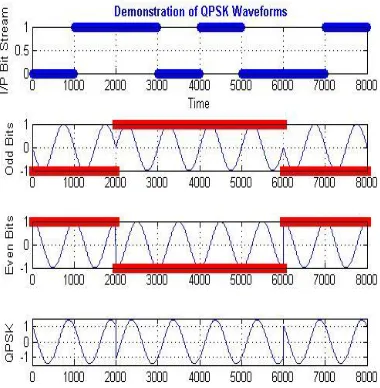
The waveform of QPSK for binary stream 110011001010 is shown in fig. 2 in section IV
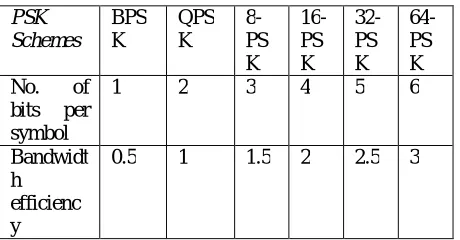
The bandwidth efficiency of different PSK is shown in table no. 1.
Table 1. Bandwidth efficiency
PSK Schemes
BPS K
QPS K
8-PS K
16-PS K
32-PS K
64-PS K No. of
bits per symbol
1 2 3 4 5 6
Bandwidt h efficienc y
0.5 1 1.5 2 2.5 3
In QPSK, two bits are transmitted simultaneously, one per channel and due to this we have four states. Such as,
2 = 2 = 4 (1) These two bits are encoded using Gray Code to minimize the Bit Error Rate. The simulated figure for constellation point for QPSK is shown in fig. 3 in section IV.
The scaling factor of is for normalizing the average energy of the transmitted symbols to 1, assuming that all the constellation points are equally likely.
The implementation of QPSK is more general than BPSK as well as higher order PSK. The symbols in constellation diagram are used to transmit the signal in terms of sine and cosine waves as,
(t) = cos(2 + (2 −1) ), (2)
Where n = 1,2,3,4..
This yields the four phase π/4, 3π/4, 5π/4 and 7π/4 as per our need. This results in a two-dimensional signal with unit basis function as,
∅ ( ) = cos(2 ) (3)
∅ ( ) = cos(2 ) (4)
The first basis function shown in eq. 3 is used as the in-phase component of the signal and the second shown in eq. 4 as the quadrature component of the signal. Hence, the signal constellation is consist of 4 signal space points as follows,
± ⁄2,± ⁄2
Factor ½ indicate that the total power is equally divided between the two carriers.
II.1. Few Definitions
A) Power Efficiency is the ability of a modulation technique to preserve the delity (acceptable BER) of the digital message at low power levels. It is often expressed as the ratio of Energy per bit to noise power ( ⁄ ). ⁄ is the energy per bit to noise power spectral density ratio. It is important parameter during selection of a modulation scheme.
B) Bandwidth Efficiency is the efficient utilization of allocated bandwidth and is defined as the throughput data rate per Hertz. Spectrum is an expensive resource in wireless communication. Therefore, bandwidth efficient modulation schemes are always preferred.
C) Bit Rate ( ) is defined as the rate at which information is passed. For QPSK bit rate is given as
= 1- (1− ) (5) D) Baud Rate is defined as the number of symbols per second. Each symbol represents n bits, and has M signal states, where M = 2 and this is also called as M-ary signaling.
E) Bit Error Rate (BER) is the number of bit errors divided by the total number of transferred bits during a time interval. BER is a unit less performance measure, often expressed as a percentage. The bit error rate of QPSK is given as
ISSN: 2231-5381
http://www.ijettjournal.org
Page 232
F) Signal to Noise Ratio (SNR) is defined as the ratio between signal power to noise power and it is normally expressed in decibel (dB).
For QPSK SNR is given as
≈2 (7)
G) Additive White Gaussian Noise (AWGN) the additive means the noise is superimposed or added to the signal that tends to obscure or mask the signal where it will limit receiver ability to make correct symbol decisions and limit the rate of information transmission.
H) Rayleigh Fading. The Rayleigh distribution is commonly used to describe the statistical time varying nature of the received envelope of flat fading signal or the envelope of an individual multi-path component.
III. COMPRESSIVE MODULATION.
In this paper we combine QPSK with compressive sensing to make it more bandwidth efficient. The key feature of Compressive Modulation is Compressive Sensing which it’s modulation scheme.
II1.1. Modulation scheme
CS theory is said that, if a signal is sparse in a time domain, it will be treated as aliased and then that aliased signal is converted into original signal by using optimization algorithm. So, in this theory we make the aliased modulated signal in time domain in order to make it easy for improving its bandwidth. Compressive sensing is differ from the classical sampling in following two ways:
1) Instead of sampling the signal at specific points in time, CS systems typically acquire measurements in the form of inner products between the signal and more general test functions. The randomness often plays a key role in the design of these test functions. 2) The two frameworks differ in the sense that
they deal with signal recovery, i.e., the problem of recovering the original signal from the compressed measurements.
CS has already had notable impact on several applications. One of them is medical imaging, where it has enabled speedups by a factor of seven in pediatric MRI while preserving diagnostic quality.
CS theory also states that an n-dimensional signal
having a sparse or compressible representation can be
reconstructed from m linear measurements even if m < n.[3]. Acquisition of CS based signal is more efficient than simple sampling for sparse or compressible signal. Let us consider that a(t) is a analog signal that sampled at NQUIST rate and processed with T samples in frames. Each frame is T× vector, a is given as a= ΨT, where Ψ is an T×T matrix whose columns are the similarly sampled basis function ‘a’given by a = Y, where Ψ is an T
matrix whose Ψ( ), and Y is the vector that chooses the linear combination of the basis function, Y is thought as that ‘a’ is in domain of Ψ, Y is considered as sparse signal for CS for its well performance. Yis considered as -sparse if it contains only nonzero elements.
According to CS theory ‘a’ can be reconstructed successfully from M measurements, where M≪ The measurement is achieved by projecting x over another random basis Ф that is incoherent with Ψ. Thus representation of measurement is by M×1 vector given by
= Φa = ΦΨY (8) This is right CS signal for signal reconstruction, CS theory also employs convex optimization algorithm. The time delay between adjacent element is determined by sampling at the receiving end.
The equation (3) can also written as,
=∑ ( ) (9)
Where a(i) is projection of measurement vector in the dictionaryΦ. If the period of original code
element signal is U, then the bandwidth of CM will be ⁄ times that of OFDM modulation.
III.2. Optimization and Reconstruction of original code element
The process of attaining the original code element stream is as follows,
‖ ‖ s. t. = Φa (10) While, the equation (5) is non-convex optimization problem. According to CS theory if dictionary Φ is incoherent, the model of norm is,
‖ ‖ s. t. = Φa (11)
ISSN: 2231-5381
http://www.ijettjournal.org
Page 233
= y + z (12)
Where, z is noise in channel, following the normal distribution z ~ N(0, ). Incoherence of Φ is,
^ = ‖ − ‖ + ‖ ‖ (13)
Where is a weight factor. Optimization result is only obtained when is,
= 2 log (14) Where, n refers to the length of ‘a(t)’, and can be determined by the noise signal received when no signal is sent in the transmitter.
To reduce the influence of noise in received signals on reconstructive results and to reduce the scale of this problem we use SVD. According to the Principle Component Analysis (PCA) theory dictionary of Φ is,
Φ = Ʌ (15)
Φ can be represented approximately by the linear component of first k principle component of it. i. e.
B = , Λ , , (16)
The parameter can be calculated as
= ∑∑ − (17)
Where, and are total energy of the modulated signal and noise. The speed of reconstruction
algorithm is improved by reducing the scale of Φ, and respectively the length of measurement vector
y can be shortened, as follows:
= , , y (18)
Where, is a low noise estimation of y since the first k principle component in have fewer noises than original received signal y has. The optimization model in equation (8) is expressed as,
^ = ‖ − ‖ + ‖ ‖ (19) A good estimation of x which have position information of code elements “1”s can be obtained faster and accurately. Hence, the original code element stream is reconstructed by using 3 -rule.
III.3. Spectral Analysis of Compressive Modulated Signal
In communication system, the bandwidth is very important parameter, which often means higher cost communication.
Let us consider that (t) = (1,2 . . . . n) is carrier wave form sequence correspond to (1,2 . . . . n), in Φ. it is all zeros but a period of code element with different amounts of shift in time domain, then the modulated signal can be formulated as,
(t) = ∑ ( ) (t) (20) Where, ( ) is representing code element stream in time domain and n is number of wave atoms in Φ. Length of (t) and (t) is
L = (n-1) + U (21)
Where, is set of U and L is equal to Tt and (t) is same as QPSK modulated signal, which is given as
η =(
× ) = (22)
where, U is symbol period and is approx. bandwidth of QPSK. According to Linear Theorem of Fourier Transform, spectral characteristics of (t) and QPSK modulated signal are similar. The above process shows that CM will not broadened the bandwidth due to which it is able to improve the bandwidth. Let the bandwidth of CM is and of QPSK is then the relationship between and is,
= (23)
IV. SIMULATION AND EXPERIMENT
This section, tells about the performance of QPSK in Rayleigh Fading channel and estimation that we made which is that, the maximum possible bandwidth efficiency under exactly same channel between CM and QPSK under certain BER values in same additive white Gaussian noise channel.
ISSN: 2231-5381
http://www.ijettjournal.org
Page 234
Fig.1. waveform of QPSK
The constellation points at SNR = 33.0103 for the QPSK are shown in fig. 3. These constellation points shows that the phase between two points is of 90 .
Fig. 2. Constellation plot for QPSK (4-QAM) constellation
The bit error rate simulation graph for QPSK is shown in fig. 4. This graph shows in the respect of beam-forming under the influence of different values of ⁄ dB.
Fig. 3. Bit Error Rate for QPSK using 5 Taps
Rayleigh fading channel shows statistical time varying nature of received envelope of individual multipath component.
The plot for SNR VS BER in Rayleigh fading environment under MATLAB simulation is given as
Fig.4. SNR vs BER of QPSK in Rayleigh channel.
The plot of SNR vs BER under Rayleigh channel shows that Bit Error Rate of QPSK is linearly decreased and reaches to negative values as the SNR is increases. Thus, it is obtained that the performance of QPSK is continuously improved as the SNR increases. While in additive Gaussian noise the noise is superimposed over the signal that tends to mask the signal, where it will limit receiver ability to make correct symbol decisions and limit the rate of information transmission.
ISSN: 2231-5381
http://www.ijettjournal.org
Page 235
Fig.5. Performance of QPSK in Gaussian environment
As the plot of QPSK in terms of SNR vs BER under Gaussian channel, shows that as the SNR increases in less amount than Rayleigh channel the BER tends to increase and performance of QPSK is improved. Thus the better performance of QPSK is obtained in AWGN channel than Rayleigh channel.
Hence, in order to improve the bandwidth efficiency of QPSK, we use AWGN channel and combine it with CS theory.
The channel attenuation rate is set to 0.8 and the SNR of modulated signal at the receiving end is varies in between 5dB-20dB. The baseband frequency is set to 16 kHz and sample rate is 145 . “0” and ”1” are input code elements having equal probability. The solver that is being used in reconstruction process in CM is cvx, and other parameters are considered as default. Generally, BER in the order of 10e-4 is considered as the valid condition of a communication process.
Fig.6. Comparison of code element transmission rate between CM and QPSK (BER in an order of magnitude at 10 ).
From the above experiment it is obtained that is 10 times of at most and 3 times at least of
under the precondition which ensures the reliability of communications.
Traditional QPSK performance is very fine only when the SNR of received signal is higher than 7 dB, while CM can perform very well when SNR is as low as 4dB. Hence the channel bandwidth of OFDM should be increased with increase in transmission rate of code element, while CM will not occupy more channel bandwidth, which obey that CM scheme highly improved the bandwidth efficiency.
CM has good performance in efficient bandwidth, but it also have some drawbacks that can be researched or improved in future works i.e. 1st, the optimization algorithm used in the reconstruction need to spend lot of time and this is one of the main drawback in CS applications. 2nd, the sampling rate at receiving end of CM is much higher than QPSK. 3rd, the SNR level of CM can be improved by using effective error control coding to ensures the reliability of communication.
V. CONCLUSION AND FUTURE WORKS
In this paper, under the Compressive Modulation, CS theory combines with QPSK which results in improvement in bandwidth efficiency of modulation technique. Compressive Modulation is able to improve the bandwidth in digital communication system with good robustness in terms of error even in the image processing.. By the effectiveness of this method it can be applied to various modulation schemes i.e. 8-PSK, FSK etc. so on in the future works and can also be implemented using other fast algorithm. By using CS theory analog-to-information converters can also be implemented.
ACKNOWLEDGEMENT
ISSN: 2231-5381
http://www.ijettjournal.org
Page 236
REFERNCES
[1] Bernard sklar, 2011. Digital communications: fundamentals and applications. Prentice Hall, 277-281.
[2].Bernard Sklar, 2011. Digital communications: Fundamentals and Applications. Prentice Hall, 277-281.
[3] R. Calderbank, S. Jafarpour, and R. Schapire. 2009.
Compressed learning: universal uparse dimensionality reduction and learning in the measurement domain.
[4] B. Sklar, 2011. Digital Communications-Fundamentals And Applications, 2nd, New Jersey: Prentice Hall.
[5] L. Donoho, 2006. Compressed sensing, IEEE Transactions on Information Theory, vol. 52, no. 4, pp. 1289–1306.
[6] G. Baraniuk, 2007. Compressive Sensing, IEEE Signal Processing Magazine, vol. 24, no. 4, pp. 118–121.
[7] J. Candes and B. Wakin, 2008. An introduction to compressive sampling, IEEE Signal Processing Magazine, vol. 25, no. 2, pp. 21–30.
[8] J. Candes, J. Romberg, and T. Tao, 2006. Robust uncertainty principles: Exact signal reconstruction from highly incomplete frequency information, IEEE Transactions on Information Theory, vol. 52, no. 2, pp. 489–509.
[9] J. Candes and J. Romberg, 2006. Quantitative Robust Uncertainty Principles and Optimally Sparse Decompositions, Foundations of Computational Mathematics, vol. 6, no. 2, pp. 227– 254.
[10] G. Shi, C. Chen, J. Lin, X. Xie, and X. Chen, 2012.
Narrowband Ultrasonic Detection with High Range Resolution: Separating Echoes via Compressed Sensing and Singular Value Decomposition, IEEE Transactions on Ultrasonics, Ferroelectrics and Frequency Control, vol. 59, no. 10, pp. 2237–2253.
[11] Z. Yu, S. Hoyos, and B.M. Sadlar, 2008.Mixed Signal parallel compressed sensing and reception for cognitive radio ,in proc. IEEE Int. Conf on Acoustics. Speech and Signal Processing, Las Vegas, Nevads, USA.
[12] G. Shi, J. Lin, X. Chen, F. Qi, D. Liu, and Z. Li, 2008. UWB echo signal detection with ultra-low rate sampling based on compressed sensing, IEEE Transactions on Circuits and Systems II: Express Briefs, vol. 55, no. 4, pp. 379–383.
[13] S. Chen, L. Donoho, and A. Saunders, 1998. Atomic decomposition by basis pursuit, SIAM Journal on Scientific Computing, vol. 20, no. 1, pp. 33–61.
[14] I. Jolliffe, 2002. Principal Component Analysis, 2nd, Berlin: Springer- Verlag.
[15] A. Saleh and R. Valenzuela, A statistical model for indow multipath propagation, IEEEJ Select Areas Commun, vol.5, no.2, pp. 128-137
[16] L. Jacques, J. Laska, P. Boufounos, and R. Baraniuk. 2012.
Robust 1-bit compressive sensing via binary _ stable embeddings of sparse vectors. Arxiv preprint arX- iv:1104.3160v2
[17] Y. Plan and R. Vershynin. 2011. One-bit compressed sensing by linear programming. Arxiv preprint arXiv:1109.4299. [18] R. Calderbank, S. Jafarpour, and R. Schapire. 2009.
Compressed learning: universal sparse dimensionally reduction and learning in the measurement domain.
BIOGRAPHIE