INTRODUCTION
Atherosclerosis has been identified as a chronic inflammatory disease of the ar-tery wall. The demonstration of activated T cells and macrophages within the ath-erosclerotic lesion provides in situ evi-dence for the inflammatory components of this disease (1,2). Activated T cells and macrophages together produce a wide array of cytokines that can exert both pro- and antiinflammatory effects (3,4). Inflammatory proteins, such as CRP and
COX-2, have both been considered mark-ers and mediators of endovascular in-flammation and cardiovascular disorders (5). Reverse cholesterol transport (RCT) is a pathway by which accumulated choles-terol is transported from the vessel wall to the liver for excretion, thus preventing atherosclerosis (6). A critical part of RCT is cholesterol efflux, in which accumu-lated cholesterol is removed from macro-phages in the subintima of the vessel wall to high-density lipoprotein (HDL) or
apolipoprotein (apo)A-I by a variety of mechanisms, including a pathway depen-dent on a cell membrane protein called ATP-binding membrane cassette trans-porter A1 (ABCA1) (7). Evidence from many recent studies indicates that the in-flammatory process impairs RCT (8). The molecular links between inflammation and RCT are not completely known, but evidence reveals the expression and ac-tivity of ABCA1 has been altered in the inflammatory process in vivo(9). The in vitroresults also show that ABCA1 ex-pression is closely associated with many inflammatory cytokines and proteins (10,11), and bacterial lipopolysaccharide (LPS) seems to decrease the expression of ABCA1 and ABCA1-mediated choles-terol efflux (12,13). Interestingly, recent
A Possible Link between Inflammation and Reverse
Cholesterol Transport
Kai Yin,
1Duan-fang Liao,
2and Chao-ke Tang
11Institute of Cardiovascular Research, Key Laboratory for Atherosclerology of Hunan Province, Life Science Research Center, University of South China, Hengyang, China; and 2Department of Traditional Chinese Diagnostics, School of Pharmacy, Hunan University of Chinese Medicine, Hunan, China
Atherosclerosis is characterized by a chronic inflammatory condition that involves numerous cellular and molecular inflamma-tory components. A wide array of inflammainflamma-tory mediators, such as cytokines and proteins produced by macrophages and other cells, play a critical role in the development and progression of the disease. ATP-binding membrane cassette transporter A1 (ABCA1) is crucial for cellular cholesterol efflux and reverse cholesterol transport (RCT) and is also identified as an important tar-get in antiatherosclerosis treatment. Evidence from several recent studies indicates that inflammation, along with other athero-genic-related mediators, plays distinct regulating roles in ABCA1 expression. Proatherogenic cytokines such as interferon (IFN)-γ
and interleukin (IL)-1βhave been shown to inhibit the expression of ABCA1, while antiatherogenic cytokines, including IL-10 and transforming growth factor (TGF)-β1, have been shown to promote the expression of ABCA1. Moreover, some cytokines such as tumor necrosis factor (TNF)-αseem to regulate ABCA1 expression in species-specific and dose-dependent manners. Inflammatory proteins such as C-reactive protein (CRP) and cyclooxygenase (COX)-2 are likely to inhibit ABCA1 expression during inflamma-tion, and inflammation induced by lipopolysaccharide (LPS) was also found to block the expression of ABCA1. Interestingly, recent experiments revealed ABCA1 can function as an antiinflammatory receptor to suppress the expression of inflammatory factors, suggesting that ABCA1 may be the molecular basis for the interaction between inflammation and RCT. This review aims to sum-marize recent findings on the role of inflammatory cytokines, inflammatory proteins, inflammatory lipids, and the endotoxin-medi-ated inflammatory process in expression of ABCA1. Also covered is the current understanding of the function of ABCA1 in modu-lating the immune response and inflammation through its direct and indirect antiinflammatory mechanisms including lipid transport, high-density lipoprotein (HDL) formation and apoptosis.
© 2010 The Feinstein Institute for Medical Research, www.feinsteininstitute.org Online address: http://www.molmed.org
doi: 10.2119/molmed.2010.00004
Address correspondence and reprint requests toChao-ke Tang, Institute of Cardiovascu-lar Research, University of South China, Hengyang, Hunan 421001, China. Phone: 86-734-8281853; Fax: 86-734-86-734-8281853; E-mail: [email protected].
experimental studies reveal that ABCA1 in turn plays a crucial role in the modula-tion of the inflammatory response where direct and indirect pathways have been found (14–16), indicating that ABCA1 may be a promising therapeutic target for inflammation-related diseases. In this article, we will review the most com-pelling evidence regarding the role of immuno- inflammatory response in the expression of ABCA1, and the function of ABCA1 in modulation of the inflamma-tion, which may be useful in understand-ing the molecular mechanism underlyunderstand-ing the interaction between inflammation and RCT.
FUNCTION AND EXPRESSION OF ABCA1
The ATP-binding cassette (ABC) trans-porters are ubiquitous membrane proteins that couple the transport of diverse sub-strates across cellular membranes to the hydrolysis of ATP (17). ABCA1 is a mem-ber of the ABCA subfamily, and recent studies have supported that ABCA1 plays a central role in the HDL cholesterol me-tabolism and lipid clearance from the foam cell, where ABCA1 mediates the transport of cholesterol, phospholipids and other lipophilic molecules across cel-lular membranes to lipid-poor HDL apolipoproteins (18,19). ABCA1 is broadly expressed with high levels in macro-phages, liver cells, intestinal cells, adrenal gland, endothelial cells and placental tro-phoblast (20,21). Its expression is tightly controlled at both transcription and post-transcription levels (22). Sterols and fatty acids serve as known modulators of the liver ×receptors (LXR)/retinoid ×
recep-tor (RXR) pathways, through which the ABCA1 is transcriptionally regulated (23). Cyclic AMP (cAMP), which exerts its ef-fects mainly by activating dependent protein kinase A (PKA), has been shown to play an important role in the upregulation of ABCA1 expression in murine models (24). A growing list of nat-ural and synthetic substances and meta-bolic regulators, such as unsaturated fatty acids, bacterial lipopolysaccharide and drugs, are particularly effective in
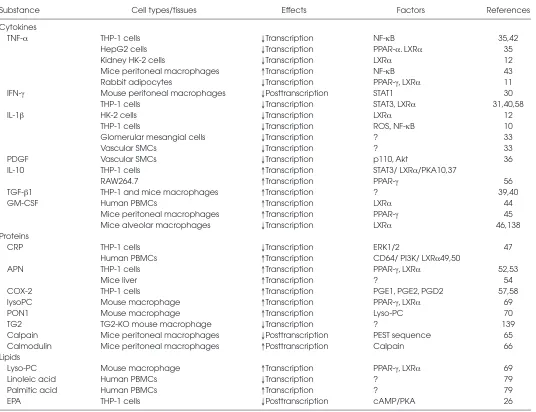
modu-lating ABCA1 expression through tran-scription or posttrantran-scription regulation (25–27). During atherosclerotic lesion de-velopment, numerous inflammatory me-diators such as growth factors or cy-tokines, inflammatory hydrolases and oxidases can influence lipoprotein metabolism and arterial wall biology, re-sulting in the progression and destabiliza-tion of the lesion (28,29). To further eluci-date the influence of these mediators for the development of atherosclerosis, ABCA1 expression was investigated in cells and tissues treated with inflamma-tory cytokines and proteins. The levels of these mediators have been found to cor-relate with the expression of ABCA1 (Table 1), revealing a novel mechanism that could link inflammation to increased atherosclerosis susceptibility.
ROLE OF INFLAMMATORY CYTOKINES AND PROTEINS IN EXPRESSION OF ABCA1
Inflammatory Cytokines
A specified group of proatherogenic cytokines have been shown to inhibit the expression of ABCA1, namely, interferon (IFN)-γ, interleukin (IL)-1βand
platelet-derived growth factor (PDGF). IFN-γ,
primarily produced by T lymphocytes, is a dimerized soluble cytokine and has a variety of proatherogenic effects. Accord-ing to Alfaro et al. (30), both ABCA1 mRNA and protein in mouse peritoneal macrophages are rapidly lost after the ad-dition of IFN-γ, with maximal losses of
ABCA1 mRNA. The downregulation of ABCA1 mRNA was associated with the rapid phosphorylation and translocation of signal transducer and activator of tran-scription (STAT)-1 in these cells induced by IFN-γ. Studies performed at our
labo-ratory have also shown that IFN-γ
down-regulates ABCA1 expression by inhibit-ing LXR-α, a transcription regulator for
ABCA1, which was consistent with the phosphorylation and nuclear translocation of STAT1 in THP-1 macrophage–derived foam cells after addition of IFN-γ(31),
indicating IFN-γdownregulates ABCA1
expression in a JAK/STAT signaling
pathway–dependent manner. IL-1β, a
prototypic proinflammatory cytokine, has been shown to downregulate ABCA1 as well as ABCA1-mediated cholesterol ef-flux in macrophages through attenuating ABCA1 promoter activity via ROS- and nuclear factor (NF)-κB–dependent
path-ways (32). Similar suppression effects by IL-1βare also present in glomerular
mesangial cells (33), vascular smooth muscle cells (SMCs) (34), HK-2 cells (35), and HepG2 cells (12). PDGF is a potent inflammatory mitogen that enables vas-cular SMCs to participate in atherosclero-sis. PDGF suppresses endogenous expres-sion of ABCA1 in vascular SMCs where cultured SMCs exposed to PDGF elicit a rapid phosphorylation of Akt, a kinase downstream from phosphatidylinositol 3-kinase, which inhibits activity of the ABCA1 promoter (36).
Some antiinflammatory cytokines such as IL-10 and TGF-β1 have been shown to
increase the expression of ABCA1. In human THP-1 cells and peripheral monocytes, IL-10 stimulates transcription of the ABCA1 and redirects macrophage cholesterol handling toward efflux (37). In addition, IL-10 has been reported to override the downregulation of ABCA1 by tumor necrosis factor (TNF)-α(10).
Han et al. (38) also found that IL-10 in-creases cholesterol efflux from macro-phages to protect against toxicity of free cholesterol accumulation in the cell through an ABCA1 dependent pathway. TGF-β, a cytokine apparent within the
atheroma, is believed to have antiinflam-matory properties. TGF-β1 has been
found to enhance cholesterol efflux through upregulation of the ABCA1 ex-pression, indicating a protective role for TGF-β1 in controlling cellular lipid
accu-mulation within the intima (39,40). As one of the most important inflam-matory cytokines, TNF-αis specifically
active in both human and rodent athero-sclerotic plaques (4). However, the exact role of TNF-αin atherosclerosis is not
in macrophage ABCA1 expression and cholesterol efflux have been described, e.g., TNF-αdownregulated ABCA1
ex-pression in THP-1 macrophage–derived foam cells through a NF-κB–dependent
pathway (42). However, TNF-αwas
re-ported to induce ABCA1 expression in mouse peritoneal macrophages, reveal-ing an antiatherogenic mechanism of TNF-αsignaling in macrophages (43).
There are two receptors in mice known to elicit TNF-αresponses, termed p55
and p75. According to Schreyer et al. (41), the signaling modulated by p55 TNF-α
receptor is referred to exert a potent
an-tiatherogenic effect (41). It remains to be determined whether the positive interac-tion between TNF-αand ABCA1 in
mouse macrophages is due to the p55 signaling. Granulocyte-macrophage colony-stimulating factor (GM-CSF) has been implicated in a variety of inflamma-tory disorders including atherosclerosis. The role of GM-CSF on the mediated cholesterol metabolism has been investigated in different experimen-tal systems. Kazawa et al. (44) showed that GM-CSF significantly upregulated the expression of ABCA1 in human monocyte–derived macrophage. In apoE
and GM-CSF double knockout mice, ABCA1 expression in peritoneal macro-phages was reduced by 70% compared with apoE–/–mice. These results indi-cated a positive regulatory role of GM-CSF in macrophage ABCA1 expression (45). However, in pulmonary alveolar macrophages of GM-CSF knockout (KO) mice, according to a recent report by Thomassen et al. (46), GM-CSF knockout results in highly increased ABCA1 ex-pression accompanied by increased
LXR-αlevel, suggesting ABCA1 expression is
differently regulated by GM-CSF in a tissue- and species-specific manner. Table 1.Regulation of ABCA1 expression by inflammatory cytokines and proteins.
Substance Cell types/tissues Effects Factors References Cytokines
TNF-α THP-1 cells ↓Transcription NF-κB 35,42 HepG2 cells ↓Transcription PPAR-α. LXRα 35 Kidney HK-2 cells ↓Transcription LXRα 12 Mice peritoneal macrophages ↑Transcription NF-κB 43 Rabbit adipocytes ↓Transcription PPAR-γ, LXRα 11 IFN-γ Mouse peritoneal macrophages ↓Posttranscription STAT1 30
THP-1 cells ↓Transcription STAT3, LXRα 31,40,58 IL-1β HK-2 cells ↓Transcription LXRα 12
THP-1 cells ↓Transcription ROS,NF-κB 10 Glomerular mesangial cells ↓Transcription ? 33 Vascular SMCs ↓Transcription ? 33 PDGF Vascular SMCs ↓Transcription p110, Akt 36 IL-10 THP-1 cells ↑Transcription STAT3/ LXRα/PKA10,37
RAW264.7 ↑Transcription PPAR-γ 56 TGF-β1 THP-1 and mice macrophages ↑Transcription ? 39,40 GM-CSF Human PBMCs ↑Transcription LXRα 44
Mice peritoneal macrophages ↑Transcription PPAR-γ 45 Mice alveolar macrophages ↓Transcription LXRα 46,138 Proteins
CRP THP-1 cells ↓Transcription ERK1/2 47 Human PBMCs ↑Transcription CD64/ PI3K/ LXRα49,50
APN THP-1 cells ↑Transcription PPAR-γ, LXRα 52,53 Mice liver ↑Transcription ? 54 COX-2 THP-1 cells ↑Transcription PGE1, PGE2, PGD2 57,58 lysoPC Mouse macrophage ↑Transcription PPAR-γ, LXRα 69 PON1 Mouse macrophage ↑Transcription Lyso-PC 70 TG2 TG2-KO mouse macrophage ↓Transcription ? 139 Calpain Mice peritoneal macrophages ↓Posttranscription PEST sequence 65 Calmodulin Mice peritoneal macrophages ↑Posttranscription Calpain 66 Lipids
For now, it is clear that inflammation plays a pivotal role in the progression of atherosclerosis. However, the mecha-nisms by which this occurs and the rela-tionship between pro- and antiinflamma-tory cytokines in modulating the development and progress of atheroscle-rotic lesions remain unclear. The finding that proinflammatory cytokines decrease ABCA1 expression and
mediated cholesterol efflux may provide a new basis for understanding the role of cytokines in the pathogenesis of athero-sclerosis, and thus investigating the pre-cise cytokine signaling which decreases ABCA1 expression may provide some specific targets for the treatment of atherosclerosis.
Inflammatory Proteins
CRP, a fundamental marker of inflam-mation, is generally thought to be associ-ated with an increased risk of atheroscle-rosis. Human macrophages treated with clinically relevant concentrations of CRP are found to have a decreased ability in intracellular cholesterol efflux as well as the ABCA1 expression (47). However, ac-cording to new epidemiological findings, the innocent or even antiatherogenic ef-fects for CRP have been implicated (48). Hanriot et al. (49) found that CRP not only increased the secretion of IL-1α,
IL-1β, and IL-6, but also upregulated
LXR-αand ABCA1 expression in human
monocytes, raising the intriguing possi-bility that CRP could activate yet uniden-tified pathways to have more complex effects on atherogenesis than previously thought (50). However, because the bio-logical effects of CRP might depend largely on the source of the protein, we should exclude the possibility that CRP’s paradoxical effects reported in different studies might just be caused by LPS con-tamination of culture medium.
Adiponectin (APN) is one of several important metabolically active proteins secreted from adipocytes (51). Human THP-1 macrophage transduced with the APNgene has decreased lipid accumula-tion compared with control macrophages for upregulating ABCA1-mediated
cho-lesterol efflux (52). Conversely, the ex-pression of ABCA1 and cellular choles-terol efflux are decreased in APN-KO mice (53,54). COX-2, an inducible en-zyme that is responsible for formation of prostanoids, is more often associated with inflammation states (55). This real-ization has driven the development of COX-2 inhibitors such as celecoxib and rofecoxib Vioxx for antiinflammatory therapy. Nevertheless, selective COX-2 inhibitors are often associated with a heightened risk of myocardial infarction, and the precise mechanisms involved have yet to be satisfactorily elucidated (56,57). The selective COX-2 inhibitor has been shown to significantly reduce ABCA1 expression and increases macro-phage foam cell formation (57,58), sug-gesting a possible explanation for the proatherogenic mechanisms of COX-2 inhibitor.
Myeloperoxidase (MPO) is a central inflammatory enzyme secreted by acti-vated macrophages (59). MPO catalyzes oxidation of tyrosine and nitrite to form reactive intermediates capable of initiat-ing oxidation of lipids in plasma. For ex-ample, MPO promotes HDL oxidation in the human artery wall and increases the levels of hypochlorous acid (60). Shao et al. found that HDL or lipid-free apoA-I exposed to hypochlorous acid was less able to remove cholesterol from cultured cells, which was associated with im-paired ABCA1-dependent cholesterol transport (60,61). In addition, MPO can enhance the formation of glycolalde-hyde, an intermediate in the formation of advanced glycosylation end products (62), which strongly inhibits dependent transport of cholesterol from macrophages to apoA-I (63), suggesting that MPO may play an important role in the development of vascular complica-tions in diabetes mellitus.
Calpains, calcium-activated neutral cysteine proteases, play an important role in the acute inflammatory process through activation of NF-κB and
NF-κB–dependent expression of pro
-inflammatory cytokines and adhesion molecules (64). Wang et al. showed that
ABCA1 protein degradation is regulated by calpain protease through regulating a sequence rich in proline, glutamic acid, serine, and threonine (PEST) in the cyto-plasmic region of ABCA1, while apoA-I can reverse the PEST-dependent ABCA1 degradation by calpain and thereby in-crease ABCA1 protein level at the cell surface (65). Because cell surface expres-sion of ABCA1 might be much more rel-evant for its function, the way to stabi-lize ABCA1 against calpain-mediated degradation should be a novel and po-tentially important strategy to prevent atherosclerosis. Recently, Iwamoto et al. found calmodulin interacts with ABCA1 to protect from calpain-mediated degra-dation and upregulates HDL generation, which is consistent with the previous finding that calmodulin increased apoA-I–mediated cell cholesterol release (66). Spiroquinone and diphenoquinone, oxidized products of probucol, have been reported to reduce degradation of ABCA1 without inhibiting its activity or altering transcription of the ABCA1gene (67). Such function may be also due to its ability to inhibit calpain-mediated degradation.
Inflammatory Lipids
A typical abnormality in type II dia-betic patients is elevated plasma levels of free fatty acids (74). There is a close link between fatty acids, inflammation and an increased risk of cardiovascular dis-ease (75). Stearoyl-CoA desaturase (SCD) catalyzes the rate-limiting step in the biosynthesis of monounsaturated fatty acids and is a critical regulator of energy metabolism, inflammation and diabetes (76). SCD activity has been found to de-crease ABCA1 expression and cellular cholesterol efflux by different mecha-nisms. Sun et al. have shown co-transfec-tion of ABCA1 with either SCD1- or SCD2-inhibited ABCA1-mediated choles-terol efflux in HEK 293 cells and CHO cells (77). In addition, SCD was found to inhibit apolipoprotein-mediated lipid ef-flux through generating unsaturated fatty acids, which further destabilize ABCA1 protein (78). Unsaturated fatty acids have been found to have a signifi-cant impact on ABCA1 expression in human macrophages where the ABCA1 protein level is synchronously sup-pressed by the w6-unsaturated fatty acid linoleic acid (79). Moreover, our labora-tory recently demonstrated that polyun-saturated fatty acid eicosapentaenoic acid reduced serine phosphorylation of ABCA1 protein and impaired ABCA1-dependent cholesterol efflux in THP-1 macrophages (26). Epidemiological stud-ies have reported that a polyunsaturated fatty acid diet in humans may decrease plasma HDL and apoA-I levels (80). Ac-tivity of ABCA1 is dramatically lowered in unsaturated fatty acid–treated THP-1 macrophages, and this reduction may re-sult from, at least in part, a regulation of ABCA1, which is a rate-limiting step for generating plasma HDL.
ROLE OF ENDOTOXIN-INDUCED INFLAMMATION IN EXPRESSION OF ABCA1
McGillicuddy et al. (8) provided the first in vivoevidence that induced inflammation impairs cholesterol efflux and RCT in mice, and marked re-duction of cholesterol efflux induced by LPS was consistent with downregulation
of ABCA1 expression. Recently, the global gene expression profile of circulat-ing leukocytes in a human model of sys-temic inflammatory were investigated. The global gene expression in circulating leucocytes isolated from male volunteers shows that the expression of the ABCA1 gene is downregulated after infusion of Escherichia coliendotoxin (9). Dysregu-lated adipose tissue leads to a proinflam-matory state in the cells with reduced se-cretion of APN and increased sese-cretion of several proinflammatory cytokines (81). The inflammation is also regarded to al-ternate the lipid metabolism in adipose tissue (82,83). In C57BL/6 mice, mediated inflammation produces a rapid, marked decrease in mRNA levels of a number of type II nuclear hormone re-ceptors, including peroxisome
proliferator–activated receptor (PPAR)-γ,
LXR-αand thyroid receptor (TR)-α, along
with decreased expression of target genes such as ABCA1(83). In addition, endotoxin-induced inflammatory stress increased cholesterol accumulation in the livers and inhibited expression of LXR-α
and ABCA1, which resulted in the reduc-tion of cholesterol efflux (35). Although the hypothesis that inflammation might link to cholesterol metabolism has been confirmed in these studies, the signaling pathway underlying the potential mecha-nism needs to be further clarified. Ac-cording to Castrillo et al. (84), LPS strongly blocks the induction of LXR as well as its target gene ABCA1in cultured mice peritoneal macrophages, where a specific effector of Toll-like receptor 3/4 (TLR3/4), interferon regulatory factor 3 (IRF3), is shown to mediate the crosstalk between LXR and TLR4 signaling by means of transcriptional activity inhibi-tion of LXR on the ABCA1 promoter. In murine macrophages, LPS does not seem to decrease mRNA expression of ABCA1 and ABCA1-mediated cholesterol efflux through reducing LXR protein or by de-creasing the binding of nuclear protein to the LXR response element, suggesting an unknown mechanism that requires fur-ther exploration (85). Adipocyte enhancer-binding protein 1 (AEBP1), a
transcrip-tional repressor in macrophage, plays a role in the LPS- induced inhibition of ABCA1 (25). A key innate immunity sig-naling kinase (IRAK-1) has also been re-ported to associate with the downregula-tion of ABCA1 expression in response to innate immune signaling (86). These re-sults revealed some novel mechanism of action of LPS-induced innate inflammation response in mediated cholesterol efflux. Although de-creased cholesterol efflux may redirect cholesterol to peripheral cells, such as leukocytes, to acutely promote host de-fense, prolongation of impaired choles-terol efflux may also increase the risk of atherosclerosis observed in chronic infec-tions and inflammatory states (85).
ROLE OF ABCA1 IN REGULATION OF INFLAMMATION AND IMMUNE RESPONSE
New Role for ABCA1 as an Antiinflammatory Mediator
whereas the incidence of atherosclerosis observed in homozygous Tangier pa-tients and ABCA1-deficient mice crossed with either hypercholesterolemic LDLR or apoE-deficient mice are not obviously increased (92). This moderately increased risk for atherosclerosis observed in Tangier patients and ABCA1-deficient mice may be partially due to their low plasma levels of apoB-containing lipopro-tein (40–60% normal) (92,93). In addition, overexpression of macrophage ABCA1 by transplantation of bone marrow from human ABCA1 bacterial artificial chro-mosome (BAC) transgenic mice into LDLR knockout mice inhibits atheroscle-rotic lesion progression, further confirm-ing the major role of macrophage ABCA1 in affecting atherogenesis (94). Moreover,
macrophages isolated from deficient mice have an increased secre-tion of chemokines, growth factors and cytokines, resulting in an increased abil-ity to respond to a variety of chemotactic factors (88). These changes, together with the proinflammatory condition present in ABCA1-deficient mice, may play a vital role in the development of atherosclerosis. Recently, macrophage ABCA1 has been definitively confirmed to be involved in the HDL-induced ex-pressional downregulation of CD11b and the monocyte transmigration (95). In ABC transporter-deficient macrophages, inflammatory genes are significantly increased via TLR4- and MyD88/TRIF-mediated signal transduction (15). In ad-dition, Pradel et al. (96) investigated the
relationship between immunophenotype and ABCA1 expression in different monocyte subsets in the myeloid lineage. The result shows that ABCA1 expression is deficient in the inflammatory mono-cytes that are more apt to the proinflam-matory effect induced by LPS/IFN-γ.
tant role of ABCA1 in the regulation of innate immunity through modulation of plasma membrane cholesterol (16,87). Tellier et al. (97) showed purified apoA-I increased the shedding of TNF by ADAM17, a metalloprotease that cleaves TNF and its receptors (TNFR), which is dependent on the reduced lipid raft con-tent in an ABCA1-dependent manner. Along with the fact that ABCA1 expres-sion results in a significant redistribution of cholesterol and sphingomyelin from rafts to nonrafts through its ATPase-related function (98) (see Figure 1), these results unravel potential mecha-nisms by which ABCA1 decreases in-flammation through modulating the lipid composition of plasma membrane lipid rafts. Recently, two candidate STAT3 docking sites in ABCA1 were found to be required for the apoA-I/ ABCA1/JAK2 activation of STAT3, sug-gesting that the macrophage cholesterol exporter ABCA1 functions as a direct antiinflammatory receptor (14) (see Fig-ure 1). These results implicate ABCA1 as a direct molecular link between the cardioprotective effects of cholesterol export from arterial macro phages and suppressed inflammation.
ATP-binding cassette transporter G1 (ABCG1), another ABC family member, also plays an important role in choles-terol efflux from macrophage foam cells (99). In vitro, ABCG1 induces cholesterol efflux from cholesterol-enriched macro-phages to HDL particles, while ABCA1 promotes cholesterol efflux to lipid-poor apoA-1. Thus, ABCA1 and ABCG1 have complementary activity in mediating cholesterol efflux (100). In vivo, increased macrophage ABCG1 expression was sig-nificantly promoted, while knockout of macrophage ABCG1 expression signifi-cantly reduced macrophage RCT (101). In addition, combined deficiency of ABCA1 and ABCG1 promoted more ac-cumulation of foam cells than individual KO and accelerated atherosclerosis in mice (102), suggesting that additive ef-fects of ABCA1 and ABCG1 in mediating macrophage sterol efflux are central to the antiatherogenic properties of HDL.
In addition to its lipid transport prop-erties, ABCG1 has played a crucial role in the antiinflammatory effects of HDL for its predominant effect in modulating the accumulation of prominent inflammatory macrophage foam cells in various tissues such as lung, liver, spleen or thymus (103–105). Yvan-Charvet et al. found that HDL and apoA-1 exert antiinflammatory effects by promoting cholesterol efflux via ABCG1 and ABCA1 with consequent attenuation of signaling via Toll-like re-ceptors (15). Furthermore, ABCG1 seems to have a more potent antiinflammatory effect than ABCA1, which may be due to the predominant effect of ABCG1 in modulating the lipid composition of membrane lipid rafts (15). Nevertheless, ABCG1 promotes efflux of cholesterol to acceptors without increasing the binding of lipoproteins to cells (106), while ABCA1-mediated lipid efflux requires the direct binding of apolipoprotein to ABCA1, which can further activate the intracellular antiinflammation signaling pathways (14), suggesting some differ-ence in antiinflammation mechanisms be-tween ABCA1 and ABCG1.
Besides mediating macrophage inflam-mation related to vascular disease, ABCA1 may also play important roles in other chronic inflammatory diseases such as nonalcoholic fatty liver and dia-betes mellitus. Specific inactivation of ABCA1 in β-cells of mice showed
mark-edly impaired insulin secretion (107). Similar impairment is also present in pa-tients with Tangier disease; glucose-stim-ulated insulin secretion from pancreatic
β-cells is impaired with the ABCA1
mu-tation (108). These results indicate ABCA1 in pancreatic β-cells may
func-tion as a potent target for prevenfunc-tion and treatment of diabetes.
ABCA1 and Apoptosis
Innate immune responses, as an early warning sign in the immune system, is fine-tuned by specialized counterregula-tory mechanisms. Apoptosis, especially in macrophages, is proposed to be in-volved in this progress (66). Several groups have demonstrated apoptotic cell
death in atherosclerotic plaques (109,110). Although the significance of apoptosis in atherosclerosis depends on the stage of the plaque, sustained induc-tion of apoptosis in advanced lesions seems to favor arterial wall inflammation and enhances recruitment of monocytes, leading to increased plaque burden (110). Several investigators have reported that oxidized low-density lipoprotein or free cholesterol, both of which are believed to be major lipid components of macro-phages in advanced lesions, rapidly in-duces apoptosis in macrophages by dif-ferent mechanisms, such as Fas- and caspase-9–dependent pathways (111–114). Accumulation of free choles-terol in the endoplasmic reticulum is also a likely cause of macrophage apoptosis, which leads to activation of the unfolded protein response and C/EBP homolo-gous protein (CHOP)-induced apoptosis (112). Together with the fact that ABCA1 plays a key role in removing intracellular free cholesterol into vesicles that are translocated to plasma membrane for ex-ocytosis (115), a hypothesis is suggested that there may be a unique role of ABCA1 in protecting free cholesterol loading, endoplasmic reticulum stress and oxidized lipid-mediated apoptosis.
microdomains in macrophages and par-ticipates in the formation of phagosome (117), revealing that ABCA1 is involved in the endocytic processes. Therefore, ABCA1 may promote the clearance of the apoptotic cell via both the phos-phatidylserine signal recognition and the transmembrane receptor–related en-docytic function.
ABCG1 was also found to be involved in macrophage apoptosis processes. Bal-dan et al. found transplantation of ABCG1–/–bone marrow cells into Ldlr–/– or apoE–/–mice resulted in increased numbers of apoptotic cells in atheroscle-rotic lesions (118). Terasaka et al. found that ABCG1 protects macrophages from oxysterol-induced apoptosis by promot-ing efflux of 7-ketocholesterol, the major oxysterol present in oxidized LDL and atherosclerotic lesions (119). In advanced lesions, apoptosis of macrophages and other cells may cause increased inflam-mation and destabilization of atheroscle-rotic plaques (120). Thus, these results indicate that efflux of oxysterol via mac-rophage ABCG1 has a protective role in inflammation and advanced atheroscle-rotic plaques.
ABCA1 in Formation and Function of HDL During Inflammation
The established cardioprotective mechanism of HDL is based on RCT; however, much interest has recently arisen from the antiinflammatory activ-ity of HDL. HDL might protect, at least in part, against the development of ath-erosclerosis by limiting the effects of a potentially harmful inflammatory re-sponse in the vascular wall (121,122). ABCA1 plays a critical role for the bio-genesis of HDL. In ABCA1-deficient mice, the absence of ABCA1 results in almost undetectable levels of HDL (21), revealing ABCA1’s essential role in the formation of newly synthesized HDL. The synthesis of HDL requires at least two well-defined steps. In the first step, apoA-I or other apolipoproteins are lipi-dated through the actions of ABCA1. This process leads to the formation of lipid-poor, nascent HDL particles, also
known as pre–β-HDLs. These nascent
HDLs are transformed into large-size HDL particles with α-mobility by
lecithin:cholesterol acyltransferase (21). However, both the plasma levels and structure of HDL can be significantly al-tered during the acute and chronic in-flammation (123). Acute-phase HDL is characteristically decreased of apoA-I content, whereas serum amyloid A (SAA), an acute-phase response protein, is markedly increased and becomes the major apolipoprotein of HDL during in-flammation (124). In vitro, SAA induces cellular lipid release in a similar manner to apoA-I, which requires ABCA1 or ABCA7 in HEK293 cells (125). Although several studies have shown that SAA can remove lipid from cells by ABCA1-independent mechanisms, such as via scavenger receptor B-I (SR-BI) (125–127), it has been suggested that mediated lipidation status of SAA is the major factor governing cholesterol ac-ceptor properties of SAA. Only overex-pression of SR-BI in HEK-293 cells de-void of ABCA1 fails to mobilize cholesterol to lipid-free SAA, whereas efficient cholesterol efflux by SAA is ob-served from fibroblasts and CHO cells both expressing functional ABCA1 (128), indicating ABCA1 is necessary for SAA-mediated cellular cholesterol efflux dur-ing inflammation. The direct evidence that ABCA1 is a crucial mediator for SAA-containing HDL biogenesis upon acute inflammation in vivohas been de-scribed by Hu et al., who found that HDL is not generated in LPS-treated ABCA1-KO mice, despite SAA being in-duced by acute inflammation (129). This indicates the same essential role for ABCA1 in mediating the SAA-mediated formation of newly synthesized HDL during inflammation.
ABCA1 Gene Variants and Inflammation
Recent genetic studies have shown that loss-of-function mutations in ABCA1 lead to the allelic disorders Tangier disease and familial hypoalphalipoproteinemia as well as increasing cardiovascular
dis-ease risk (130,131). Until now, at least 70 mutations have been identified in the ABCA1gene. However, most studies focus on how genetic alterations of the ABCA1gene highlight its role in lipid homeostasis (132). Oram and colleagues found the two intracellular loops of ABCA1 each contain a tetrameric amino acid motif (YXXQ), which might have po-tential effects on immune function (14). Mutating these sites completely abolished the ability of apoA-I to activate STAT3 without affecting the cholesterol export function of ABCA1, while activated STAT3 in cultured macro phages has been found to abolish LPS-induced inflamma-tory cytokine production (133), indicating that specific amino acids in the intracellu-lar loops may be responsible for the ABCA1-mediated antiinflammatory func-tion (14). Nevertheless, further clinical ge-netic studies need to be performed to confirm the role of these alleles in inflam-mation and immune regulation.
SUMMARY AND CONCLUSIONS Over the past decade, the relationship between RCT and atherosclerosis has been well studied in animals and hu-mans, and many of the molecular com-ponents that mediate the RCT have been elucidated. ABCA1 is a key mediator of cholesterol efflux from cholesterol-loaded macrophages to apoA-I and pre–β-HDL,
indicating that ABCA1 may be a poten-tial modulating target in the impaired RCT proceedings during inflammation. Interestingly, ABCA1, in turn, has the an-tiinflammatory effects that provide new evidence that ABCA1 protects against cardiovascular disease by mechanisms extending well beyond its involvement in cholesterol transport. This effect may also contribute to the novel role of ABCA1 agonists such as PPAR and LXR in the treatment and control of chronic inflammation diseases such as nonalco-holic fatty liver disease, thrombocy-topenic purpura and inflammatory dis-eases of the kidney. However, less attention has been given to this novel function of ABCA1 as well as the factors affecting the mechanical behavior of this transporter. The finding that ABCA1 in-hibits inflammatory response, in part be-cause of its function in modulating the fluidity of the plasma membrane as well lipid raft formation, indicates that the an-tiinflammatory effect of ABCA1 may be secondary to its ability to export lipids from cells, which also indicates complex interactions between the lipid dysfunc-tion and inflammadysfunc-tion response and that ABCA1 may be a direct link between the lipid transport and immune-inflammatory response. In the future, a great effort should be directed toward the identifica-tion of the major determinants of this in-terplay’s response, and special attention should be given to the signaling path-ways responsible for the antiinflamma-tory function of ABCA.
ACKNOWLEDGMENTS
The authors gratefully acknowledge the financial support from the National Natural Sciences Foundation of China (30470720), Post-doctor Sciences Founda-tion of China (2005037157), and The Heng Yang Joint Funds of The Hunan Provincial Natural Sciences Foundation of China (10JJ9019).
DISCLOSURE
The authors declare that they have no competing interests as defined by Molecu-lar Medicine, or other interests that might
be perceived to influence the results and discussion reported in this paper.
REFERENCES
1. Shimada K. (2009) Immune system and athero-sclerotic disease: heterogeneity of leukocyte sub-sets participating in the pathogenesis of athero-sclerosis. Circ. J. 73:994–1001.
2. Tiwari RL, Singh V, Barthwal MK. (2008) Macro-phages: an elusive yet emerging therapeutic tar-get of atherosclerosis. Med. Res. Rev. 28:483–544. 3. Gori AM, et al. (2009) The balance between pro-and anti-inflammatory cytokines is associated with platelet aggregability in acute coronary syn-drome patients. Atherosclerosis202:255–62. 4. Kleemann R, Zadelaar S, Kooistra T. (2008)
Cy-tokines and atherosclerosis: a comprehensive re-view of studies in mice. Cardiovasc. Res. 79:360–376. 5. Alizadeh Dehnavi R, et al. (2008) Elevated CRP
levels are associated with increased carotid ath-erosclerosis independent of visceral obesity. Ath-erosclerosis200:417–23.
6. Rader DJ, Alexander ET, Weibel GL, Billheimer J, Rothblat GH. (2009) The role of reverse cholesterol transport in animals and humans and relationship to atherosclerosis. J. Lipid Res. 50 Suppl:S189–94. 7. Tang CK, et al. (2004) Effect of apolipoprotein A-I
on ATP binding cassette transporter A1 degrada-tion and cholesterol efflux in THP-1 macrophage-derived foam cells. Acta. Biochim. Biophys. Sin. (Shanghai)36:218–26.
8. McGillicuddy FC, et al. (2009) Inflammation im-pairs reverse cholesterol transport in vivo. Circu-lation119:1135–45.
9. Schmidt WM, Spiel AO, Jilma B, Wolzt M, Muller M. (2008) In-vivo effects of simvastatin and rosu-vastatin on global gene expression in peripheral blood leucocytes in a human inflammation model. Pharmacogenet. Genomics. 18:109–20. 10. Mei CL, et al. (2007) Interleukin-10 inhibits the
down-regulation of ATP binding cassette trans-porter A1 by tumour necrosis factor-alpha in THP-1 macrophage-derived foam cells. Cell. Biol. Int. 31:1456–61.
11. Zhao SP, Dong SZ. (2008) Effect of tumor necrosis factor alpha on cholesterol efflux in adipocytes. Clin. Chim. Acta. 389:67–71.
12. Wang Y, Moser AH, Shigenaga JK, Grunfeld C, Feingold KR. (2005) Downregulation of liver X receptor-alpha in mouse kidney and HK-2 proxi-mal tubular cells by LPS and cytokines. J. Lipid Res. 46:2377–87.
13. Baranova I, et al. (2002) Lipopolysaccharide down regulates both scavenger receptor B1 and ATP binding cassette transporter A1 in RAW cells. Infect. Immun. 70:2995–3003.
14. Tang C, Liu Y, Kessler PS, Vaughan AM, Oram JF. (2009) The macrophage cholesterol exporter ABCA1 functions as an anti-inflammatory recep-tor. J. Biol. Chem. 284:32336–43.
15. Yvan-Charvet L, et al. (2008) Increased inflamma-tory gene expression in ABC deficient macrophages: free cholesterol
accumu-lation, increased signaling via toll-like receptors, and neutrophil infiltration of atherosclerotic le-sions. Circulation118:1837–47.
16. Koseki M, et al. (2007) Increased lipid rafts and accelerated lipopolysaccharide-induced tumor necrosis factor-alpha secretion in Abca1-deficient macrophages. J. Lipid Res. 48:299–306.
17. Hollenstein K, Dawson RJ, Locher KP. (2007) Structure and mechanism of ABC transporter proteins. Curr. Opin. Struct. Biol. 17:412–8. 18. Tang C, Oram JF. (2009) The cell cholesterol
ex-porter ABCA1 as a protector from cardiovascular disease and diabetes. Biochim. Biophys. Acta. 1791:563–72.
19. Schmitz G, et al. (1999) ATP-binding cassette transporter A1 (ABCA1) in macrophages: a dual function in inflammation and lipid metabolism? Pathobiology67:236–40.
20. Langmann T, et al. (1999) Molecular cloning of the human ATP-binding cassette transporter 1 (hABC1): evidence for sterol-dependent regula-tion in macrophages. Biochem. Biophys. Res. Com-mun. 257:29–33.
21. Aiello RJ, Brees D, Francone OL. (2003) ABCA1-deficient mice: insights into the role of monocyte lipid efflux in HDL formation and inflammation. Arterioscler. Thromb. Vasc. Biol. 23:972–80. 22. Francone OL, Aiello RJ. (2002) ABCA1:
regula-tion, function and relationship to atherosclerosis. Curr. Opin. Investig. Drugs. 3:415–9.
23. Soumian S, Albrecht C, Davies AH, Gibbs RG. (2005) ABCA1 and atherosclerosis. Vasc. Med. 10:109–19.
24. Lawn RM, et al. (1999) The Tangier disease gene product ABC1 controls the cellular apolipoprotein-mediated lipid removal pathway. J. Clin. Invest. 104:R25–31.
25. Majdalawieh A, Ro HS. (2009) LPS-induced sup-pression of macrophage cholesterol efflux is me-diated by adipocyte enhancer-binding protein 1. Int. J. Biochem. Cell Biol. 41:1518–25.
26. Hu YW, et al. (2009) Eicosapentaenoic acid re-duces ABCA1 serine phosphorylation and im-pairs ABCA1-dependent cholesterol efflux through cyclic AMP/protein kinase A signaling pathway in THP-1 macrophage-derived foam cells. Atherosclerosis204:e35–43.
27. Zhang C, et al. (2006) NO-1886 upregulates ATP binding cassette transporter A1 and inhibits diet-induced atherosclerosis in Chinese Bama minip-igs. J. Lipid Res. 47:2055–63.
28. Judkins CP, et al. (2010) Direct evidence of a role for Nox2 in superoxide production, reduced ni-tric oxide bioavailability, and early atheroscle-rotic plaque formation in ApoE-/- mice. Am. J. Physiol. Heart Circ. Physiol. 298: H24–32. 29. DePalma RG, et al. (2003) Cytokine signatures in
31. Hao XR, et al. (2009) IFN-gamma down-regulates ABCA1 expression by inhibiting LXRalpha in a JAK/STAT signaling pathway-dependent man-ner. Atherosclerosis203:417–28.
32. Chen M, Li W, Wang N, Zhu Y, Wang X. (2007) ROS and NF-kappaB but not LXR mediate IL-1beta signaling for the downregulation of ATP-binding cassette transporter A1. Am. J. Physiol. Cell Physiol. 292:C1493–1501.
33. Zhang GJ, Li H, Li XW. (2008) Effects of ra-pamycin on intracellular cholesterol homeostasis of glomerular mesangial cell in the presence of interleukin-1 beta. Chin. Med. Sci. J. 23:205–11. 34. Ma KL, Ruan XZ, Powis SH, Moorhead JF,
Varghese Z. (2007) Anti-atherosclerotic effects of sirolimus on human vascular smooth muscle cells. Am. J. Physiol. Heart Circ. Physiol. 292:H2721–8. 35. Ma KL, et al. (2008) Inflammatory stress
exacer-bates lipid accumulation in hepatic cells and fatty livers of apolipoprotein E knockout mice. Hepatology48:770–81.
36. Nagao S, et al. (2006) Platelet derived growth fac-tor regulates ABCA1 expression in vascular smooth muscle cells. FEBS Lett. 580:4371–6. 37. Rubic T, Lorenz RL. (2006) Downregulated CD36
and oxLDL uptake and stimulated ABCA1/G1 and cholesterol efflux as anti-atherosclerotic mechanisms of interleukin-10. Cardiovasc. Res. 69:527–35.
38. Han X, Kitamoto S, Lian Q, Boisvert WA. (2009) In-terleukin-10 facilitates both cholesterol uptake and efflux in macrophages. J. Biol. Chem. 284:32950–8. 39. Argmann CA, et al. (2001) Transforming growth
factor-beta1 inhibits macrophage cholesteryl ester accumulation induced by native and oxi-dized VLDL remnants. Arterioscler. Thromb. Vasc. Biol. 21:2011–8.
40. Panousis CG, Evans G, Zuckerman SH. (2001) TGF-beta increases cholesterol efflux and ABC-1 expression in macrophage-derived foam cells: opposing the effects of IFN-gamma. J. Lipid Res. 42:856–63.
41. Schreyer SA, Peschon JJ, LeBoeuf RC. (1996) Accelerated atherosclerosis in mice lacking tumor necrosis factor receptor p55. J Biol. Chem. 271:26174–8.
42. Wang YF, et al. (2010) Protective effect of Astra-galus polysaccharides on ATP binding cassette transporter A1 in THP-1 derived foam cells ex-posed to tumor necrosis factor-alpha. Phytother. Res. 24:393–8.
43. Gerbod-Giannone MC, et al. (2006) TNFalpha in-duces ABCA1 through NF-kappaB in macro-phages and in phagocytes ingesting apoptotic cells. Proc. Natl. Acad. Sci. U. S. A. 103:3112–7. 44. Kazawa T, et al. (2009) Expression of liver X
recep-tor alpha and lipid metabolism in granulocyte-macrophage colony-stimulating factor-induced human monocyte- derived macrophage. Pathol. Int. 59:152–60.
45. Ditiatkovski M, Toh BH, Bobik A. (2006) GM-CSF deficiency reduces macrophage PPAR-gamma expression and aggravates atherosclerosis in
ApoE-deficient mice. Arterioscler. Thromb. Vasc. Biol. 26:2337–44.
46. Thomassen MJ, et al. (2007) ABCG1 is deficient in alveolar macrophages of GM-CSF knockout mice and patients with pulmonary alveolar pro-teinosis. J. Lipid Res. 48:2762–8.
47. Wang X, et al. (2008) C-reactive protein inhibits cholesterol efflux from human derived foam cells. Arterioscler. Thromb. Vasc. Biol. 28:519–26.
48. Nordestgaard BG, Zacho J. (2009) Lipids, athero-sclerosis and CVD risk: is CRP an innocent by-stander? Nutr. Metab. Cardiovasc. Dis. 19:521–4. 49. Hanriot D, et al. (2008) C-reactive protein induces
pro- and anti- inflammatory effects, including ac-tivation of the liver X receptor alpha, on human monocytes. Thromb Haemost99:558–69.
50. Filep JG. (2008) Perplexity of monocyte responses to C-reactive protein (CRP). Thromb. Haemost. 99:461–2.
51. Maury E, Brichard SM. (2010) Adipokine dysreg-ulation, adipose tissue inflammation and meta-bolic syndrome. Mol. Cell. Endocrinol. 314:1–16. 52. Tian L, et al. (2009) Adiponectin reduces lipid
ac-cumulation in macrophage foam cells. Atheroscle-rosis202:152–61.
53. Tsubakio-Yamamoto K, et al. (2008) Adiponectin prevents atherosclerosis by increasing cholesterol efflux from macrophages. Biochem. Biophys. Res.
Commun. 375:390–4.
54. Oku H, et al. (2007) Adiponectin deficiency sup-presses ABCA1 expression and ApoA-I synthesis in the liver. FEBS Lett. 581:5029–33.
55. Baber SR, Champion HC, Bivalacqua TJ, Hyman AL, Kadowitz PJ. (2003) Role of cyclooxygenase-2 in the generation of vasoactive prostanoids in the rat pulmonary and systemic vascular beds. Circulation108:896–901.
56. Reiss AB, Anwar F, Chan ES, Anwar K. (2009) Dis-ruption of cholesterol efflux by coxib medications and inflammatory processes: link to increased car-diovascular risk. J. Investig. Med. 57:695–702. 57. Chan ES, et al. (2007) Effect of cyclooxygenase
inhibition on cholesterol efflux proteins and atheromatous foam cell transformation in THP-1 human macrophages: a possible mechanism for increased cardiovascular risk. Arthritis Res. Ther. 9:R4.
58. Reiss AB, et al. (2008) Atheroprotective effects of methotrexate on reverse cholesterol transport proteins and foam cell transformation in human THP-1 monocyte/ macrophages. Arthritis Rheum. 58:3675–83.
59. Ronald JA, et al. (2009) Enzyme-sensitive mag-netic resonance imaging targeting myeloperoxi-dase identifies active inflammation in experi-mental rabbit atherosclerotic plaques. Circulation 120:592–9.
60. Bergt C, et al. (2004) The myeloperoxidase product hypochlorous acid oxidizes HDL in the human ar-tery wall and impairs ABCA1-dependent choles-terol transport. Proc. Natl. Acad. Sci. U. S. A. 101:13032–7.
61. Shao B, et al. (2006) Myeloperoxidase impairs
ABCA1-dependent cholesterol efflux through methionine oxidation and site-specific tyrosine chlorination of apolipoprotein A-I. J. Biol. Chem. 281:9001–4.
62. Anderson MM, Requena JR, Crowley JR, Thorpe SR, Heinecke JW. (1999) The myeloperoxidase system of human phagocytes generates Nep-silon-(carboxymethyl)lysine on proteins: a mech-anism for producing advanced glycation end products at sites of inflammation. J. Clin. Invest. 104:103–13.
63. Passarelli M, et al. (2005) Advanced glycation end product precursors impair ABCA1-dependent cho-lesterol removal from cells. Diabetes54:2198–205. 64. Letavernier E, et al. (2008) Targeting the calpain/ calpastatin system as a new strategy to prevent car-diovascular remodeling in angiotensin II-induced hypertension. Circ. Res. 102:720–28.
65. Wang N, et al. (2003) A PEST sequence in ABCA1 regulates degradation by calpain protease and stabilization of ABCA1 by apoA-I. J. Clin. Invest. 111:99–107.
66. Iwamoto N, Lu R, Tanaka N, Abe-Dohmae S, Yokoyama S. (2010) Calmodulin interacts with ATP binding cassette transporter A1 to protect from calpain-mediated degradation and upregu-lates high-density lipoprotein generation. Arte-rioscler. Thromb. Vasc. Biol. 30:1446–52. 67. Arakawa R, et al. (2009) Pharmacological
inhibi-tion of ABCA1 degradainhibi-tion increases HDL bio-genesis and exhibits antiatherobio-genesis. J. Lipid Res. 50:2299–2305.
68. Jackson SK, Abate W, Tonks AJ. (2008) Lysophos-pholipid acyltransferases: novel potential regula-tors of the inflammatory response and target for new drug discovery. Pharmacol. Ther. 119:104–14. 69. Hou M, et al. (2007) Lysophosphatidylcholine
promotes cholesterol efflux from mouse macro-phage foam cells via PPARgamma-LXRalpha-ABCA1-dependent pathway associated with apoE. Cell Biochem. Funct. 25:33–44.
70. Rosenblat M, Vaya J, Shih D, Aviram M. (2005) Paraoxonase 1 (PON1) enhances HDL-mediated macrophage cholesterol efflux via the ABCA1 transporter in association with increased HDL binding to the cells: a possible role for lysophos-phatidylcholine. Atherosclerosis179:69–77. 71. Jeon SG, et al. (2009) 15-Lipoxygenase metabolites
play an important role in the development of a T-helper type 1 allergic inflammation induced by double-stranded RNA. Clin. Exp. Allergy39:908–17. 72. Montero A, Badr KF. (2000) 15-Lipoxygenase in
glomerular inflammation. Exp. Nephrol. 8:14–9. 73. Pirillo A, Uboldi P, Kuhn H, Catapano AL. (2006)
15-Lipoxygenase-mediated modification of high-density lipoproteins impairs SR-BI- and ABCA1-dependent cholesterol efflux from macrophages. Biochim. Biophys. Acta. 1761:292–300.
74. Fery F, Paquot N. (2005) Etiopathogenesis and pathophysiology of type 2 diabetes [in French].
Rev Med Liege60:361–8.
mecha-nisms. J. Clin. Endocrinol. Metab91:398–400. 76. Brown JM, et al. Combined therapy of dietary
fish oil and stearoyl-CoA desaturase 1 inhibition prevents the metabolic syndrome and atheroscle-rosis. Arterioscler. Thromb. Vasc. Biol. 30:24–30. 77. Sun Y, et al. (2003) Stearoyl-CoA desaturase inhibits
ATP-binding cassette transporter A1-mediated cholesterol efflux and modulates membrane do-main structure. J. Biol. Chem. 278:5813–20. 78. Wang Y, Kurdi-Haidar B, Oram JF. (2004)
LXR-mediated activation of macrophage stearoyl-CoA desaturase generates unsaturated fatty acids that destabilize ABCA1. J. Lipid Res. 45:972–80. 79. Mauerer R, Ebert S, Langmann T. (2009) High
glucose, unsaturated and saturated fatty acids differentially regulate expression of ATP-binding cassette transporters ABCA1 and ABCG1 in human macrophages. Exp. Mol. Med. 41:126–32. 80. Mattson FH, Grundy SM. (1985) Comparison of effects of dietary saturated, monounsaturated, and polyunsaturated fatty acids on plasma lipids and lipoproteins in man. J. Lipid Res. 26:194–202. 81. Gustafson B, Hammarstedt A, Andersson CX,
Smith U. (2007) Inflamed adipose tissue: a culprit underlying the metabolic syndrome and athero-sclerosis. Arterioscler. Thromb. Vasc. Biol. 27:2276–83. 82. Zechner R, Kienesberger PC, Haemmerle G, Zim-mermann R, Lass A. (2009) Adipose triglyceride lipase and the lipolytic catabolism of cellular fat stores. J. Lipid Res. 50:3–21.
83. Lu B, Moser AH, Shigenaga JK, Feingold KR, Grunfeld C. (2006) Type II nuclear hormone recep-tors, coactivator, and target gene repression in adi-pose tissue in the acute-phase response. J. Lipid Res. 47:2179–90.
84. Castrillo A, et al. (2003) Crosstalk between LXR and toll-like receptor signaling mediates bacterial and viral antagonism of cholesterol metabolism. Mol Cell12:805–16.
85. Khovidhunkit W, Moser AH, Shigenaga JK, Grunfeld C, Feingold KR. (2003) Endotoxin down-regulates ABCG5 and ABCG8 in mouse liver and ABCA1 and ABCG1 in J774 murine macrophages: differential role of LXR. J. Lipid Res. 44:1728–36.
86. Maitra U, Parks JS, Li L. (2009) An innate immu-nity signaling process suppresses macrophage ABCA1 expression through IRAK-1-mediated downregulation of retinoic acid receptor alpha and NFATc2. Mol. Cell. Biol. 29:5989–97. 87. Zhu X, et al. (2008) Increased cellular free
choles-terol in macrophage-specific Abca1 knock-out mice enhances pro- inflammatory response of macrophages. J. Biol. Chem. 283:22930–41. 88. Francone OL, et al. (2005) Increased cholesterol
deposition, expression of scavenger receptors, and response to chemotactic factors in deficient macrophages. Arterioscler. Thromb. Vasc. Biol. 25:1198–1205.
89. McNeish J, et al. (2000) High density lipoprotein deficiency and foam cell accumulation in mice with targeted disruption of ATP-binding cassette transporter-1. Proc. Natl. Acad. Sci. U. S. A. 97:4245–50.
90. Christiansen-Weber TA, et al. (2000) Functional loss of ABCA1 in mice causes severe placental malformation, aberrant lipid distribution, and kidney glomerulonephritis as well as high-density lipoprotein cholesterol deficiency. Am. J. Pathol. 157:1017–29.
91. van Eck M, et al. (2002) Leukocyte ABCA1 con-trols susceptibility to atherosclerosis and macro-phage recruitment into tissues. Proc. Natl. Acad. Sci. U. S. A. 99:6298–6303.
92. Aiello RJ, et al. (2002) Increased atherosclerosis in hyperlipidemic mice with inactivation of ABCA1 in macrophages. Arterioscler. Thromb. Vasc. Biol. 22:630–7.
93. Serfaty-Lacrosniere C, et al. (1994) Homozygous Tangier disease and cardiovascular disease. Atherosclerosis107:85–98.
94. Van Eck M, et al. (2006) Macrophage ATP-binding cassette transporter A1 overexpression inhibits atherosclerotic lesion progression in low-density lipoprotein receptor knockout mice. Arterioscler. Thromb. Vasc. Biol. 26:929–34.
95. Murphy AJ, et al. (2008) High-density lipoprotein reduces the human monocyte inflammatory re-sponse. Arterioscler. Thromb. Vasc. Biol. 28:2071–77. 96. Pradel LC, et al. (2009) ATP-binding cassette
transporter hallmarks tissue macrophages and modulates cytokine- triggered polarization pro-grams. Eur. J. Immunol. 39:2270–80.
97. Tellier E, et al. (2008) HDLs activate dependent shedding. J. Cell Physiol. 214:687–93. 98. Landry YD, Denis M, Nandi S, Bell S, Vaughan AM, Zha X. (2006) ATP-binding cassette trans-porter A1 expression disrupts raft membrane microdomains through its ATPase-related func-tions. J. Biol. Chem. 281:36091–101.
99. Jessup W, Gelissen IC, Gaus K, Kritharides L. (2006) Roles of ATP binding cassette transporters A1 and G1, scavenger receptor BI and mem-brane lipid domains in cholesterol export from macrophages. Curr. Opin. Lipidol. 17:247–57. 100. Adorni MP, et al. (2007) The roles of different
pathways in the release of cholesterol from macrophages. J. Lipid Res. 48:2453–62. 101. Wang X, et al. (2007) Macrophage ABCA1 and
ABCG1, but not SR-BI, promote macrophage re-verse cholesterol transport in vivo. J. Clin. In-vest. 117:2216–24.
102. Yvan-Charvet L, et al. (2007) Combined defi-ciency of ABCA1 and ABCG1 promotes foam cell accumulation and accelerates atherosclero-sis in mice. J. Clin. Invest. 117:3900–8.
103. Wojcik AJ, Skaflen MD, Srinivasan S, Hedrick CC. (2008) A critical role for ABCG1 in macrophage inflammation and lung homeostasis. J. Immunol. 180:4273–82.
104. Baldan A, Gomes AV, Ping P, Edwards PA. (2008) Loss of ABCG1 results in chronic pul-monary inflammation. J. Immunol. 180:3560–68. 105. Kennedy MA, et al. (2005) ABCG1 has a critical role in mediating cholesterol efflux to HDL and preventing cellular lipid accumulation. Cell Metab1:121–31.
106. Wang N, Lan D, Chen W, Matsuura F, Tall AR. (2004) ATP-binding cassette transporters G1 and G4 mediate cellular cholesterol efflux to high-density lipoproteins. Proc. Natl. Acad. Sci. U. S. A. 101:9774–9.
107. Brunham LR, et al. (2007) Beta-cell ABCA1 in-fluences insulin secretion, glucose homeostasis and response to thiazolidinedione treatment. Nat. Med. 13:340–47.
108. Koseki M, et al. (2009) Impaired insulin secre-tion in four Tangier disease patients with ABCA1 mutations. J. Atheroscler. Thromb. 16:292–296.
109. Seimon T, Tabas I. (2009) Mechanisms and con-sequences of macrophage apoptosis in athero-sclerosis. J. Lipid. Res. 50 Suppl:S382–7. 110. Gautier EL, et al. (2009) Macrophage apoptosis
exerts divergent effects on atherogenesis as a function of lesion stage. Circulation119:1795–1804. 111. Li F, et al. (2008) Free cholesterol-induced
mac-rophage apoptosis is mediated by requiring enzyme 1 alpha-regulated activation of Jun N-terminal kinase. Acta. Biochim. Biophys. Sin. (Shanghai)40:226–34.
112. Devries-Seimon T, et al. (2005) induced macrophage apoptosis requires ER stress pathways and engagement of the type A scavenger receptor. J. Cell Biol. 171:61–73. 113. Yao PM, Tabas I. (2001) Free cholesterol loading
of macrophages is associated with widespread mitochondrial dysfunction and activation of the mitochondrial apoptosis pathway. J. Biol. Chem. 276:42468–76.
114. Yao PM, Tabas I. (2000) Free cholesterol loading of macrophages induces apoptosis involving the fas pathway. J. Biol. Chem. 275:23807–13. 115. Zha X, Gauthier A, Genest J, McPherson R.
(2003) Secretory vesicular transport from the Golgi is altered during ATP-binding cassette protein A1 (ABCA1)-mediated cholesterol ef-flux. J. Biol. Chem. 278:10002–5.
116. Venegas V, Zhou Z. (2007) Two alternative mechanisms that regulate the presentation of apoptotic cell engulfment signal in Caenorhab-ditis elegans. Mol. Biol. Cell18:3180–92. 117. Bared SM, et al. (2004) Association of ABCA1
with syntaxin 13 and flotillin-1 and enhanced phagocytosis in tangier cells. Mol. Biol. Cell 15:5399–407.
118. Baldan A, et al. (2006) Impaired development of atherosclerosis in hyperlipidemic Ldlr-/-and ApoE-/- mice transplanted with Abcg1-/-bone marrow. Arterioscler. Thromb. Vasc. Biol. 26:2301–7.
119. Terasaka N, Wang N, Yvan-Charvet L, Tall AR. (2007) High-density lipoprotein protects macro-phages from oxidized low-density lipoprotein-induced apoptosis by promoting efflux of 7-ketocholesterol via ABCG1. Proc. Natl. Acad. Sci. U. S. A. 104:15093–8.
121. Getz GS, Reardon CA. (2008) SAA, HDL bio-genesis, and inflammation. J. Lipid Res. 49:269–70.
122. Sampietro T, Bigazzi F, Puntoni M, Bionda A. (2006) HDL inflammation and atherosclerosis: current and future perspectives. Future Cardiol. 2:37–48.
123. van der Westhuyzen DR, de Beer FC, Webb NR. (2007) HDL cholesterol transport during inflam-mation. Curr. Opin. Lipidol. 18:147–51. 124. Kontush A, Chapman MJ. (2006) Functionally
defective high-density lipoprotein: a new thera-peutic target at the crossroads of dyslipidemia, inflammation, and atherosclerosis. Pharmacol. Rev. 58:342–74.
125. Abe-Dohmae S, et al. (2006) Serum amyloid A generates high density lipoprotein with cellular lipid in an ABCA1- or ABCA7-dependent man-ner. J. Lipid Res. 47:1542–50.
126. van der Westhuyzen DR, Cai L, de Beer MC, de Beer FC. (2005) Serum amyloid A promotes cho-lesterol efflux mediated by scavenger receptor B-I. J. Biol. Chem. 280:35890–5.
127. Stonik JA, et al. (2004) Serum amyloid A pro-motes ABCA1-dependent and ABCA1-indepen-dent lipid efflux from cells. Biochem. Biophys. Res. Commun. 321:936–41.
128. Marsche G, et al. (2007) The lipidation status of acute-phase protein serum amyloid A deter-mines cholesterol mobilization via scavenger re-ceptor class B, type I. Biochem. J. 402:117–24. 129. Hu W, et al. (2008) Biogenesis of HDL by SAA
is dependent on ABCA1 in the liver in vivo. J. Lipid Res. 49:386–93.
130. Schippling S, et al. (2008) Severe Tangier disease with a novel ABCA1 gene mutation. Neurology 71:1454–5.
131. Ishii J, et al. (2002) Clinical variant of Tangier disease in Japan: mutation of the ABCA1 gene in hypoalphalipoproteinemia with corneal lipi-dosis. J. Hum. Genet. 47:366–69.
132. Brunham LR, Singaraja RR, Hayden MR. (2006) Variations on a gene: rare and common variants in ABCA1 and their impact on HDL cholesterol levels and atherosclerosis. Annu. Rev. Nutr. 26:105–29.
133. Matsukawa A, Takeda K, Kudo S, Maeda T, Kagayama M, Akira S. (2003) Aberrant inflam-mation and lethality to septic peritonitis in mice lacking STAT3 in macrophages and neutrophils. J. Immunol. 171:6198–205.
134. Oram JF, Lawn RM. (2001) ABCA1. The gate-keeper for eliminating excess tissue cholesterol. J. Lipid Res. 42:1173–9.
135. Oram JF, Vaughan AM. (2006) ATP-binding cas-sette cholesterol transporters and cardiovascu-lar disease. Circ. Res. 99:1031–43.
136. Oram JF, Heinecke JW. (2005) ATP-binding cas-sette transporter A1: a cell cholesterol exporter that protects against cardiovascular disease. Physiol. Rev. 85:1343–72.
137. Attie AD, Kastelein JP, Hayden MR. (2001) Piv-otal role of ABCA1 in reverse cholesterol
trans-port influencing HDL levels and susceptibility to atherosclerosis. J. Lipid Res. 42:1717–26. 138. Uchida K, et al. (2004) High-affinity