RESEARCH
Last but not the least: effects of laying
sequence on egg color variation and embryonic
development of Russet Sparrow (
Passer
cinnamomeus
)
Juan Huo
1, Tongping Su
1,2, Nan Niu
1, Canchao Yang
1and Wei Liang
1*Abstract
Background: Laying sequence has important effects on eggshell color and embryonic development in birds. Some birds can allocate resources unevenly among the eggs within a clutch, prioritizing those at the beginning of the lay-ing sequence, in order to maximize reproductive success. The changes in egg color accordlay-ing to laylay-ing sequence may be an adaptation to pressure from predators or brood parasites.
Methods: In this study, effects of laying sequence on egg color and embryonic heart rate in Russet Sparrows (Pas-ser cinnamomeus) were investigated using artificial nest boxes. The eggs were divided into three groups: first to be laid, intermediate in the laying sequence, and last to be laid. We maintained the eggs in an incubator and measured embryonic heart rates.
Results: Avian visual modeling showed that the background color brightness of the last eggs laid was significantly higher (whiter) than those of the other eggs. All eggs were about the same size and hatched around 13 days, indicat-ing that layindicat-ing sequence significantly affected embryonic development speed; the last eggs to be laid developed significantly faster than did the first in the clutch.
Conclusions: Our study quantified the effect of laying sequence on egg color variation and proved that laying sequence has an important effect on embryonic heart rate in Russet Sparrows.
Keywords: Egg color variation, Egg color quantification, Embryonic development, Fiber optic spectrometer, Laying sequence, Russet Sparrow
© The Author(s) 2018. This article is distributed under the terms of the Creative Commons Attribution 4.0 International License (http://creat iveco mmons .org/licen ses/by/4.0/), which permits unrestricted use, distribution, and reproduction in any medium, provided you give appropriate credit to the original author(s) and the source, provide a link to the Creative Commons license, and indicate if changes were made. The Creative Commons Public Domain Dedication waiver (http://creat iveco mmons .org/ publi cdoma in/zero/1.0/) applies to the data made available in this article, unless otherwise stated.
Background
Laying sequence in birds strongly affects the color, mass, metabolic rate, and embryonic development rate of the eggs (Ruxton et al. 2001; Moreno and Osorno 2003; Grif-fith and Gilby 2013). The pigments covering eggshells are deposited in the 4 h preceding egg laying by pigment glands (Burley and Vadehra 1989). During the laying period, the pigments in some birds gradually decrease as the number of eggs laid increases, which results in a
shift in eggshell color from dark to light over the course of the laying sequence. This phenomenon, which is rela-tively common among the Passer genus (Yom-Tov 1980; Ruxton et al. 2001; Poláček et al. 2017), produces a clutch with a diversity of egg colors; the lightest egg is the last one laid (Lowther 1988; Poláček et al. 2017). Previous studies showed that variation in egg color reflected dif-ferences in egg quality; the last eggs to be laid with lighter coloration were the poorest quality (Moreno and Osorno
2003; Soler et al. 2005). Parent birds often distribute resources, such as antioxidants and male hormones, une-venly over the course of the laying sequence (Hall et al.
2010; Boncoraglio et al. 2011). Therefore, eggs laid at dif-ferent points in the sequence receive difdif-ferent resources,
Open Access
*Correspondence: [email protected]
which could influence their embryonic development and ultimate fate (Lipar and Ketterson 2000; Nicolai et al.
2004; Groothuis et al. 2005; Granroth-Wilding et al.
2014; Poláček et al. 2017; Cao et al. 2018). Some female use big size and other maternal resources by last laid eggs to compensate for the survival disadvantage experienced (Saino et al. 2010; Newbrey et al. 2015).
Magrath et al. (2009) showed that, given consist-ent environmconsist-ental conditions, eggs laid earlier start to develop before the female bird has finished laying the entire clutch, so the first eggs laid hatch before the last eggs do. As a result, the clutch includes nestlings with an extreme imbalance in mass quality (Magrath et al.
2009). However, other research indicated that the eggs of Canada Geese (Branta canadensis) from the same clutch hatched at about the same time, with a maximum time interval of less than 24 h (Boonstra et al. 2010). There-fore, the embryonic development rate differed for eggs within the same clutch.
So far only a small number of studies have focused on the relationship between laying sequence and embryonic internal development rate in birds showing that laying sequence can affect embryonic development (Nicolai et al. 2004; Boonstra et al. 2010; Cao et al. 2018; Yang et al. 2018). Zebra Finch (Taeniopygia Guttata) clutches number can alter the developmental time of embryos, egg maternal resource allocation across the laying sequence can influence development (Griffith and Gilby 2013). In this study, using artificial nest boxes, we compared the effects of laying sequence on eggshell color variation and embryonic development speed of Russet Sparrows ( Pas-ser cinnamomeus), a passerine species.
Methods
Study site and species
This study was conducted in the Kuankuoshui National Nature Reserve (28°10ʹN, 107°10ʹE), a subtropical ever-green broadleaf forest in southwestern China at an alti-tude of about 1500 m (see Yang et al. 2010 for more details) from April to August 2013.
The Russet Sparrow belongs to the Passeridae family and is mainly found in southern China and the Himala-yan region (Summers-Smith 1988). They are year-round residents at this study site, and they build nests in chim-ney tubes, cavities of stone walls and eaves (Yang et al.
2012b; Huo et al. 2018). Artificial nest boxes were pro-vided to attract sparrows because entrances to their nat-ural nests are usually too deep and small to allow easy access (see below).
Experimental design
Nest boxes were 35 cm in depth with an entrance hole diameter of 4 cm (Fig. 1). We checked each box
periodically until the first Russet Sparrow egg was observed in the nest, after which the nests were checked once a day to confirm if the onset of incubation start with the first egg or until after clutch completion. When a new egg was discovered in the nest, the tip of the egg was numbered with a light blue marker to indicate egg-laying order. After a full clutch of eggs had been laid, they were all replaced with model eggs and moved to an incubator together. We did so because Russet Sparrows start their incubation after clutch completion and accept any model eggs in their nests and seem not to show any egg discrim-ination (Huo et al. 2018). After the nestlings hatched, they were returned to their original nests to be raised by their parents.
We divided the sparrow eggs into three groups. The first eggs to be laid were first group (one egg), the eggs that were intermediate in the laying sequence were mid-dle group (two or three eggs), and the last eggs to be laid were last group (one egg). The middle group has two or three eggs, so we analyze the data using an average for the middle eggs. A caliper (505-681, Mitutoyo, Japan; range 0–150 mm, accuracy ± 0.02 mm) was used to measure the length and width of the eggs. An electronic
balance (EHA501, Guangdong Xiangshan Weighing Apparatus Group Co., Ltd.; range 0–100 g; accuracy 0.01 g) was used to weigh the eggs. The volume of the eggs was calculated according to Hoyt (1979): egg vol-ume = 0.51 × egg length × square egg width. The eggs in each group were weighed from the first day of incuba-tion, and daily afterward, until nestlings had hatched. Egg color was quantified using a USB4000 VIS–NIR spectrometer (Ocean Optics, Inc., Dunedin, Florida, USA). Background and spot color were measured at three randomly chosen places on each egg. A detailed description of the method can be found in Yang et al. (2009, 2010). The values of the ultra-violet (300–400 nm) and visible (400–700 nm) sections of the reflectance spectrum were used for analysis. The eggs were hatched in a Mini EX digital incubator (Brinsea Co. Ltd., UK; also see Yang et al. 2018).
Embryonic heart rates were measured using a digital egg monitor MK1 type heart rate meter (Buddy Digi-tal Egg Monitor, Avitronics Inc., Cornwall, England). In order to avoid errors in heart rate measurement due to differences in temperature, the eggs were placed hori-zontally in the heart rate meter for the measurement immediately after they were removed from the incuba-tor (also see Zhao et al. 2017; Cao et al. 2018; Yang et al.
2018). The heart rate (beats per minute) was recorded after the heart rate became stable. Heart rate measure-ments started on the first day of incubation and were conducted every other day, until the nestlings hatched. The embryonic development time was defined as the time interval between the first appearance of heart rate (which occurred 2–5 days after the start of incubation) and hatching (Cao et al. 2018).
Data analysis
The incubator hatching temperature was set at 7.5 ± 0.5 °C; the relative humidity was 55 ± 5%; the
egg turning interval was r/45 min; the cooling time was 2 h/day. One-sample Kolmogorov–Smimov (K–S) test was used to analyze the normality distribution of the data. If the data satisfied the conditions of normal distribution, one-way analysis of variance (ANOVA) was used to compare the means. If the data were not normally distributed, Welch’s ANOVA was used. Differences at p < 0.05 were considered statistically significant and at p < 0.01 were highly statistically sig-nificant. Unless otherwise stated, data were presented as mean ± SD, and all tests were 2-tailed. Statistical
analyses were performed in IBM SPSS 20.0 for Win-dows (IBM Inc., USA).
Results
Eggshell color variation
Each Russet Sparrow clutch contained 3–5 eggs (n= 69). One egg was laid each day, normally in the
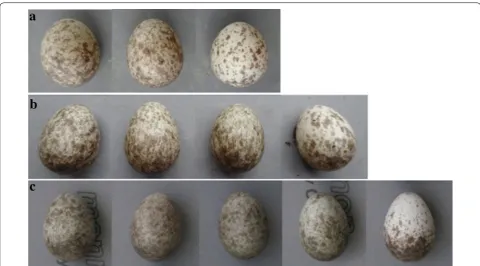
early morning. Whitening in last eggs was relatively apparent to the naked eye in the majority of nests because pale colors reflect more ambient light than dark colors (78.5%, n = 69) (Fig. 2). Background color
reflectance of last eggs was significantly higher than those in the other two groups, confirming that whit-ening occurred (Fig. 3). Spot color reflectance among the three groups was similar, all spots being dark brown (Fig. 3). The brightness reflectance of the back-ground color was significantly higher in last eggs than in the other groups (F = 10.817, p = 0.001). Except for
green light chromaticity, the other lights’ chromatic-ity of the background color showed significant differ-ences between the groups. Last eggs had the highest ultraviolet (UV) and blue light chromaticity (F = 3.531, p = 0.041; F = 3.986, p = 0.028) and the lowest red light
and yellow light chromaticity (F = 3.890, p = 0.030; F = 3.655, p = 0.037). However, there was no
differ-ence in background color hue among the three groups (F = 1.518, p = 0.234) (Table 1). The spots on the eggs
in the three groups did not significantly differ in bright-ness, hue, or chromaticity (Table 2).
Hatching rate and embryonic heart rate
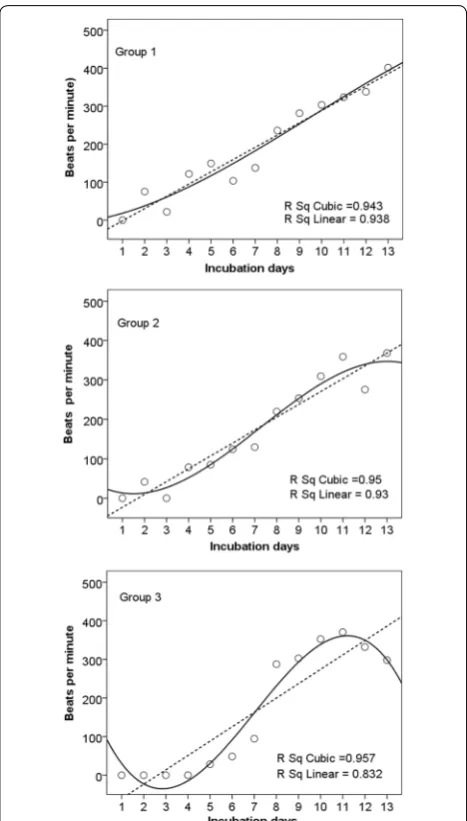
When the first Russet Sparrow egg was observed in the nest, we checked once a day to confirm that Rus-set Sparrows start their incubation until after clutch completion. The three groups did not differ in egg size, mass, or weight loss during development (Table 3). Hatching success rates of first, middle and last groups were 41.7, 46.1, and 25.0%, respectively, without signifi-cant differences (χ2= 1.55, p = 0.46).
three groups, without significant differences (F = 0.589, p = 0.566). The embryonic development time of the last eggs was significantly shorter than those of the first eggs (F = 3.60, p = 0.040) (Fig. 5).
Discussion
Our spectroscopic analysis showed that Russet Spar-row eggs gradually became lighter as the laying sequence progressed, with a relatively large eggshell color varia-tion coefficient. This change is mainly manifested in the background color of the eggs. Lowther (1988) believed that the amount of pigment secreted by glands in birds is limited, and the pigments gradually subside as egg-laying progresses. Therefore, pigments could be exhausted or in short supply by the time the last egg is laid, which results in its whitened appearance. However, in this study, whit-ening also appeared in eggs that were laid earlier. Hence, Lowther’s hypothesis does not hold here.
Some researchers believe that egg colors of cave-nest-ing birds tend to be white and to lack spots. One reason might be that white eggs are more easily seen by parent birds in cave nests with lowlight (Lack 1958).
Another selective pressure, the existence of nest para-sites, can force hosts to increase the evenness of egg color in a clutch, as it enable parent birds to more eas-ily detect an intruder’s egg and at the same time increase the diversity of egg color among clutches of the same species (Stokke et al. 2002; Spottiswoode and Stevens
2011). One hypothesis states that the whitening of the last eggs to be laid could be a signal that prevents nest parasites, by informing the parasites that the hosts have completed egg-laying and the egg incubation period has
Fig. 2 Whitening of the last eggs to be laid in Russet Sparrow clutches. a, b, and c are three clutches of Russet Sparrow eggs, respectively, placed from left to right according to their laying orders. Photo by Juan Huo
started (Yom-Tov 1980; Ruxton et al. 2001). Although there are many parasitic cuckoo species in the study area (Yang et al. 2011, 2012a), despite evidence that cuckoos can parasitize nesting birds and that some cave-nesting birds are suitable hosts for cuckoos (Deng 2013; Grim et al. 2014; Liang et al. 2016), Russet Sparrow was not the host for any type of cuckoos (Huo et al. 2018) in this study area and no intra-species parasitism has been observed so far. Hence, the evolution of egg color diver-sity of Russet Sparrow needs further investigation in the future.
Previous studies believed that the color of birds’ eggs is related to the mass of eggs and that different egg colors reflect different levels of egg quality (Moreno and Osorno
2003; Morales et al. 2006; Newbrey et al. 2015). Our data showed that the color of Russet Sparrow eggs was not associated with egg size or mass, and laying order also did not affect size or mass. However, egg-laying order did
affect embryonic development rate. Russet Sparrow eggs in the same clutch had the same hatching period and all hatched on the same day (within 24 h). The heart rates of eggs laid earlier were detected earlier, and these eggs had relatively longer embryonic development periods, while the heart rates of eggs laid later were detected later. These eggs had shorter embryonic development periods but higher development speed. In House Sparrows (Passer domesticus), most eggs of a clutch hatched synchronously and there was no difference in hatchability in relation to sequence of egg-laying (Singer and Yom-Tov 1988). Full incubation began after the completion of the clutch in clutches of two and three eggs in both House Sparrows and clutches of four eggs in Tree Sparrows (P. monta-nus) but before the clutch was completed (by up to one day) in larger clutches (Seel 1968). In Black Brant (Branta bernicla nigricans), embryonic metabolic rate may affect development in synchronizing hatch (Nicolai et al. 2004). Table 1 Background reflectance parameters of Russet Sparrow eggs
First group (n= 12) Middle group (n= 12) Last group (n= 12) F Sig.
Brightness 13,211.97 ± 4730.26 13,668.24 ± 3956.62 20,162.99 ± 3504.98 10.817 0.001
Hue 0.827 ± 0.712 0.901 ± 0.321 0.378 ± 1.136 1.518 0.234
UV-chroma 0.202 ± 0.030 0.212 ± 0.029 0.231 ± 0.024 3.531 0.041 B-chroma 0.172 ± 0.016 0.168 ± 0.014 0.183 ± 0.008 3.986 0.028 G-chroma 0.198 ± 0.009 0.193 ± 0.006 0.194 ± 0.007 1.450 0.249 Y-chroma 0.209 ± 0.017 0.208 ± 0.016 0.194 ± 0.011 3.890 0.030 R-chroma 0.219 ± 0.027 0.219 ± 0.024 0.198 ± 0.014 3.655 0.037
Table 2 Spot reflectance parameters of Russet Sparrow eggs
First group (n= 12) Middle group (n= 12) Last group (n= 12) F Sig.
Brightness 2952.68 ± 4730.26 3413.34 ± 1126.44 3532.50 ± 1515.39 0.632 0.538
Hue 0.373 ± 0.358 0.522 ± 0.287 0.464 ± 0.177 0.835 0.443
UV-chroma 0.247 ± 0.046 0.236 ± 0.048 0.244 ± 0.037 0.215 0.808 B-chroma 0.149 ± 0.020 0.143 ± 0.019 0.144 ± 0.020 0.245 0.784 G-chroma 0.159 ± 0.014 0.162 ± 0.012 0.155 ± 0.012 1.001 0.378 Y-chroma 0.198 ± 0.025 0.207 ± 0.025 0.201 ± 0.020 0.397 0.675 R-chroma 0.247 ± 0.039 0.252 ± 0.040 0.256 ± 0.043 0.126 0.882
Table 3 Sizes of Russet Sparrow eggs produced at different points in the laying sequence
First group (n= 12) Middle group (n= 12) Last group (n= 12) F Sig.
Mass (g) 2.020 ± 0.178 2.025 ± 0.129 2.028 ± 0.172 0.008 0.992 Length (mm) 19.128 ± 0.532 18.975 ± 0.489 19.071 ± 0.566 0.256 0.775 Width (mm) 14.117 ± 0.478 14.118 ± 0.413 14.165 ± 0.604 0.035 0.965 Volume (cm3) 1.947 ± 0.152 1.930 ± 0.121 1.944 ± 0.183 0.083 0.921
In addition, the decline in egg size as laying progresses could contribute to hatching synchrony because those subsequent embryos tend to have higher metabolic rates which hypothesized also contributes to relatively more rapid development (Nicolai et al. 2004). Such phenom-enon has also been verified in Zebra Finch (Taeniopygia guttata), a passerine bird, as well as in some non-pas-serines (Nicolai et al. 2004; Boonstra et al. 2010; Griffith and Gilby 2013; Granroth-Wilding et al. 2014; Hemmings and Birkhead 2016). The number of Zebra Finch eggs in a clutch also influences the eggs’ embryonic development speed (Griffith and Gilby 2013).
Hatching asynchrony results in a brood with nestlings that differ in age and size. Older and larger nestlings usu-ally outcompete younger ones for food and, as a result, grow more quickly (Zach 1982; Kacelnik et al. 1995), while the last-hatched nestling reduced growth and sur-vival (Wiebe 1996; Ostreiher 1997). Complete hatching synchrony leads to uniformly aged nestlings (Clark and Wilson 1981; Stoleson and Beissinger 1995). The hatch-ing time of some birds can be affected by the vocaliza-tions of parent birds or nestlings of the same clutch, as these sounds can stimulate the embryo to speed its devel-opment (Saino and Fasola 1996).
Conclusions
In summary, we showed that the background color brightness of the last eggs laid by Russet Sparrows was significantly higher (whiter) than those of the other eggs. However, all eggs were hatched around 13 days, indicat-ing that layindicat-ing sequence significantly affected embryonic development speed; the last eggs to be laid developed sig-nificantly faster than did the first in the clutch. Our study also indicated that laying sequence has an important effect on the embryonic heart rate in Russet Sparrows. Authors’ contributions
WL designed the experiment, JH, TS and NN conducted the experiments and collected field data. JH and CY performed data analyses and wrote an earlier version of the manuscript. WL revised and improved the manuscript. All authors read and approved the final version of the manuscript.
Author details
1 Ministry of Education Key Laboratory for Ecology of Tropical Islands, College of Life Sciences, Hainan Normal University, Haikou 571158, China. 2 College of Forestry, Guangxi University, Nanning 530004, China.
Fig. 4 Embryonic heart rates of Russet Sparrow. Linear and cubic models were used in regression analysis showing that a regression curve was the best fit for the heart rate change in the first egg group and the poorest in the last egg group
Acknowledgements
We would like to thank Prof. Anders Pape Møller for his helpful comments on this manuscript. We thank Junqiu Wu, Guoxian Liang, and Ping Ye for their assistance with fieldwork, and the help and cooperation from the Kuanku-oshui National Nature Reserves.
Competing interests
The authors declare that they have no competing interests.
Availability of data and materials
The datasets used and/or analyzed during the current study are available from the corresponding author on reasonable request.
Consent for publication Not applicable.
Ethical approval
The experiments comply with the current laws of China, where they were per-formed. Permit for this study was approved by Kuankuoshui National Nature Reserves, Guizhou Province. Experimental procedures were in agreement with the Animal Research Ethics Committee of Hainan Provincial Education Centre for Ecology and Environment, Hainan Normal University (permit nos. HNECEE-2011-002 and HNECEE-2013-001).
Funding
This work was supported by the National Natural Science Foundation of China (No. 31672303 to CY, and 31772453 to WL).
Received: 7 June 2017 Accepted: 11 June 2018
References
Boncoraglio G, Groothuis TGG, von Engelhardt N. Differential maternal testosterone allocation among siblings benefits both mother and off-spring in the zebra finch Taeniopygia guttata. Am Nat. 2011;178:64–74. Boonstra TA, Clark ME, Reed WL. Position in the sequence of laying,
embry-onic metabolic rate, and consequences for hatching synchrony and offspring survival in Canada geese. Condor. 2010;112:304–13. Burley RW, Vadehra DV. The avian egg: chemistry and biology. New York:
Wiley; 1989.
Cao P, Sun B-J, Wang L, Liang W, Du W-G. Proximate mechanisms of earlier hatching in parasitic cuckoos: yolk energy and embryonic metabolism. Biol J Linn Soc. 2018;123:63–71.
Clark AB, Wilson DS. Avian breeding adaptations: hatching asynchrony, brood reduction, and nest failure. Q Rev Biol. 1981;56:253–77. Deng W. Brood parasitism on the yellow-rumped flycatcher (Ficedula
zanthopygia) by the Oriental cuckoo (Cuculus optatus) in an artificial
nestbox in Beijing. Chin Birds. 2013;4:187–8.
Granroth-Wilding HMV, Burthe SJ, Lewis S, Reed TE, Herborn KA, Newell MA, Takahashi EA, Daunt F, Cunningham EJA. Parasitism in early life: environmental conditions shape within-brood variation in responses to infection. Ecol Evol. 2014;4:3408–19.
Griffith SC, Gilby AJ. Egg development time in the Zebra Finch Taeniopygia
guttata varies with laying order and clutch size. Ibis. 2013;155:725–33.
Grim T, Samaš P, Procházka P, Rutila J. Are tits really unsuitable hosts for the common cuckoo? Ornis Fenn. 2014;91:166–77.
Groothuis TG, Müller W, von Engelhardt N, Carere C, Eising C. Maternal hormones as a tool to adjust offspring phenotype in avian species. Neurosci Biobehav Rev. 2005;29:329–52.
Hall ME, Blount JD, Forbes S, Royle NJ. Does oxidative stress mediate the trade-off between growth and self-maintenance in structured families? Funct Ecol. 2010;24:365–73.
Hemmings N, Birkhead TR. Consistency of passerine embryo development and the use of embryonic staging in studies of hatching failure. Ibis. 2016;158:43–50.
Hoyt DF. Practical methods of estimating volume and fresh weight of bird eggs. Auk. 1979;96:73–7.
Huo J, Yang C, Su T, Liang W, Møller AP. Russet Sparrows spot alien chicks from their nests. Avian Res. 2018;9:12.
Kacelnik A, Cotton PA, Stirling L, Wright J. Food allocation among nestling starlings: sibling competition and the scope of parental choice. Proc R Soc Lond B. 1995;259:259–63.
Lack D. The significance of the colour of turdine eggs. Ibis. 1958;100:145–66. Liang W, Møller AP, Stokke BG, Yang C, Kovařík P, Wang H, Yao C-T, Ding P, Lu X, Moksnes A, Røskaft E, Grim T. Geographic variation in egg ejection rate by great tits across 2 continents. Behav Ecol. 2016;27:1405–12. Lipar JL, Ketterson ED. Maternally derived yolk testosterone enhances the
development of the hatching muscle in the red-winged blackbird
Agelaius phoeniceus. Proc R Soc Lond B. 2000;267:2005–10.
Lowther PE. Spotting pattern of the last laid egg of the house sparrow. J Field Ornithol. 1988;59:51–4.
Magrath MJL, Vedder O, van der Velde MWD, Komdeur J. Maternal effects contribute to the superior performance of extra-pair offspring. Curr Biol. 2009;19:792–7.
Morales J, Sanz JJ, Moreno J. Egg colour reflects the amount of yolk maternal antibodies and fledging success in a songbird. Biol Lett. 2006;2:334–6.
Moreno J, Osorno JL. Avian egg colour and sexual selection: does eggshell pigmentation reflect female condition and genetic quality? Ecol Lett. 2003;6:803–6.
Newbrey JL, Paszkowski CA, McGraw KJ, Ogle S. Laying-sequence variation in yolk carotenoids and egg characteristics in the red-winged blackbird
Agelaius phoeniceus. J Avian Biol. 2015;45:46–54.
Nicolai CA, Sedinger JS, Wege ML. Regulation of development time and hatch synchronization in black brant (Branta bernicla nigricans). Funct Ecol. 2004;18:475–82.
Ostreiher R. Food division in the Arabian babbler nest: adult choice or nestling competition. Behav Ecol. 1997;8:233–8.
Poláček M, Bartíková M, Hoi H. Intraclutch eggshell colour variation in birds: are females able to identify their eggs individually? PeerJ. 2017;5:e3707. Ruxton GD, Broom M, Colegrave N. Are unusually colored eggs a signal to
potential conspecific brood parasites? Am Nat. 2001;157:451–8. Saino N, Fasola M. The function of embryonic vocalization in the little tern
(Sterna albifrons). Ethology. 1996;102:265–71.
Saino N, Romano M, Caprioli M, Ambrosini R, Rubolini D, Fasola M. Sex allocation in yellow-legged gulls (Larus michahellis) depends on nutritional constraints on production of large last eggs. Proc R Soc B. 2010;277:1203–8.
Seel DC. Clutch-size, incubation and hatching success in the house sparrow and tree sparrow Passer spp. at Oxford. Ibis. 1968;110:270–82. Singer R, Yom-Tov Y. The breeding biology of the house sparrow Passer
domesticus in Israel. Ornis Scand. 1988;19:139–44.
Soler JJ, Moreno J, Avilés JM, Møller AP. Blue and green egg-color intensity is associated with parental effort and mating system in passerines: sup-port for the sexual selection hypothesis. Evolution. 2005;59:636–44. Spottiswoode CN, Stevens M. How to evade a coevolving brood parasite:
egg discrimination versus egg variability as host defences. Proc R Soc Lond B. 2011;278:3566–73.
Stokke BG, Honza M, Moksnes A, Røskaft E, Rudolfsen G. Costs associated with recognition and rejection of parasitic eggs in two European pas-serines. Behaviour. 2002;139:629–44.
Stoleson SH, Beissinger SR. Hatching asynchrony and the onset of incuba-tion in birds, revisited: when is the critical period? In: Power DM, editor. Current ornithology. New York: Plenum; 1995. p. 191–277.
Summers-Smith JD. The sparrows. London: T & AD Poyser; 1988. Wiebe KL. The insurance-egg hypothesis and extra reproductive value of
last-laid eggs in clutches of American Kestrels. Auk. 1996;113:258–61. Yang C, Cai Y, Liang W. Visual modeling reveals cryptic aspect in egg
mimicry of Himalayan cuckoo (Cuculus saturatus) on its host Blyth’s leaf warbler (Phylloscopus reguloides). Zool Res. 2011;32:451–5.
Yang C, Cai Y, Zhang S, Liang W. Quantitative analysis of bird egg color by using fiber spectrophotometer. Chin J Ecol. 2009;28:346–9 (in Chinese).
Yang C, Huang Q, Wang L, Du W-G, Liang W, Møller AP. Keeping eggs warm: thermal and developmental advantages for parasitic cuckoos of laying unusually thick-shelled eggs. Sci Nat. 2018;105:10.
•fast, convenient online submission
•
thorough peer review by experienced researchers in your field
• rapid publication on acceptance
• support for research data, including large and complex data types
•
gold Open Access which fosters wider collaboration and increased citations maximum visibility for your research: over 100M website views per year
•
At BMC, research is always in progress.
Learn more biomedcentral.com/submissions
Ready to submit your research? Choose BMC and benefit from:
Yang C, Liang W, Cai Y, Shi S, Takasu F, Møller AP, Antonov A, Fossøy F, Moksnes A, Røskaft E, Stokke BG. Coevolution in action: disruptive selection on egg colour in an avian brood parasite and its host. PLoS ONE. 2010;5:e10816.
Yang C, Liang W, Cai Y, Wu J, Shi S, Antonov A. Variation in russet sparrow
(Passer cinnamomeus) breeding biology in relation to small-scale
altitu-dinal differences in China. Zool Sci. 2012b;29:419–22.
Yom-Tov Y. Intraspecific nest parasitism in birds. Biol Rev. 1980;55:93–108. Zach R. Hatching asynchrony, egg size, growth, and fledging in tree swallows.
Auk. 1982;99:695–700.