PRETERM BIRTH RISK AMONG FOREIGN-BORN AND U.S.-BORN BLACK WOMEN IN NEW YORK CITY: A MIXED METHODS STUDY
Yanica Fedine Faustin
A dissertation submitted to the faculty at the University of North Carolina at Chapel Hill in partial fulfillment of the requirements for the degree of Doctor of Philosophy in the Department
of Maternal and Child Health in the Gillings School of Global Public Health.
Chapel Hill 2020
© 2020
ABSTRACT
Yanica Fedine Faustin: Preterm Birth Risk Among Foreign-Born and U.S.-Born Black Women in New York City: A Mixed Methods Study
(Under the direction of Jon Hussey)
The persistent disparities in preterm birth have still not been fully explained. Potential risk factors worth further attention includes duration of U.S. residence and exposure to racial stress. The objective of this mixed methods dissertation was to examine these factors and provide further insight on the well documented disparities in preterm delivery between U.S.-born,
Caribbean-born, and Sub-Saharan African-born Black women in New York City.
In the first paper, birth records from New York City document the variation in preterm delivery that exists within the U.S. Black population, typically treated as monolithic, and the variation that exists by region of origin and age-at-migration within the foreign-born Black population. It was found that U.S.-born Black women have significantly increased odds of PTB compared to the foreign-born and, within the foreign-born, Caribbean-born have significantly increased odds of PTB compared to the Sub-Saharan African-born. This may be due to differences in perceptions of racial stress.
In the second paper, based on 21 interviews with Black NYC mothers, it was found that there is variation in the ways that U.S.-born, Caribbean-born, and Sub-Saharan African-born women perceive and navigate their U.S. racial context. Simultaneously, the interviews
This dissertation is dedicated to my father Henri Faustin
ACKNOWLEDGEMENTS
During this journey I have been fortunate enough to have had several individuals believe in me and my intellect, and for that alone I am eternally grateful, I could not have completed this dissertation without their assistance and encouragement. First, I would like to express my
gratitude to my family. I especially want to thank my parents, Mariette Aubin Faustin and Henri Faustin who never faltered in their belief and support of my countless intellectual pursuits. My mother continues to be my biggest hero for the courage and persistence she has demonstrated throughout my entire life as an immigrant who taught herself English and went on to earn her Bachelors and Masters degrees. My father, never hesitated to tell me about the greatness he believed I would achieve, he was always my greatest motivator never doubting me and consistently encouraging me all while challenging me to dream big. He continues to serve as inspiration even after his passing. I am also grateful to my siblings, Karline Faustin and Stephen Faustin, for their support, laughter and pride.
grateful to be their mother. My family has always supported me and demonstrated how proud they are of my accomplishments. As the first person in my family to earn a Ph.D. I am honored and proud. I could not have accomplished any of this without you!
I am grateful to my mentor and dissertation advisor and chair, Jon Hussey for his continual support throughout my doctoral program, my personal growth, my dissertation work, research and career. I feel fortunate that I was able to work with such an interdisciplinary and dynamic dissertation committee. I thank my committee members Bob Hummer, Carolyn Halpern, Lisa Pearce, Christine Tucker, and Mosi Ifatunji for their insightful feedback and support which strengthened my research and provided the assistance I needed to complete my dissertation. I am also thankful to my mentors Diane Rowley and Vijaya Hogan and to Paul Mihas from the Odum Institute.
My friends, who have become family to me over these past few years, were invaluable during this journey to the PhD: Kristin Black, Christian Douglass, Diamond Holloman, Brionca Taylor, Kat Tedford, Leslie Adamas, Robyn O’Neill, the Institute of Minority Excellence, and SistahDocs. Thank you for consistently encouraging me and providing me with the
accountability and work-life balance I needed during this journey. I am thankful to the Maternal and Child Health Department and my MCH cohort at the UNC Gillings School of Global Public Health as well as the UNC Sociology department, where I completed my Sociology minor.
TABLE OF CONTENTS
LIST OF TABLES ... xi
LIST OF FIGURES ... xii
CHAPTER 1: INTRODUCTION ... 1
Significance of Preterm Birth ... 1
Conceptual Models ... 8
Limitations of the Literature ... 11
Study Overview ... 13
Dissertation Structure ... 16
CHAPTER 2: PRETERM DELIVERY AMONG BLACK WOMEN IN NYC: EXAMINING DURATION OF U.S. RESIDENCE FOR BLACK MIGRANT MOTHERS ... 17
Introduction ... 17
Methods ... 25
Results ... 29
Discussion ... 36
CHAPTER 3: IDENTITY AND DISCRIMINATION AMONG U.S.-BORN AND FOREIGN-BORN NON-HISPANIC BLACK MOTHERS IN NEW YORK CITY ... 40
Methods ... 47
Findings/Results ... 52
Discussion and Conclusions ... 74
CHAPTER 4: CONCLUSION ... 80
Contributions to the Field ... 82
Strengths and Limitations of the Study ... 83
Conclusions and Study Implications ... 84
APPENDIX A: INTERVIEW GUIDE ... 87
APPENDIX B: CODEBOOK ... 90
LIST OF TABLES
Table 1: Study sample distribution by Nativity ... 15 Table 2: Examining Missingness in Study Variables ... 26
Table 3: Comparison of maternal characteristics by region of origin among U.S. -born and foreign-born Black women ... 30
Table 4: Distribution of preterm birth by maternal nativity ... 31 Table 5: Distribution of preterm birth by duration of U.S. residence among
foreign-born Black women in New York City ... 32
Table 6: Odds Ratios with 95% confidence intervals from logistic regression models for preterm birth ... 33
Table 7: Odds Ratios with 95% confidence intervals from logistic regression models for preterm birth for foreign-born, Caribbean-born, sub-Saharan African-born, ... 34
Table 8: Odds Ratios with 95% confidence intervals from logistic regression
models for preterm birth stratifying by age and region ... 35
LIST OF FIGURES
Figure 1.1: Aim 1: Conceptual Model (Research Question 1a) ... 8
Figure 1.2: Aim 1: Conceptual Model (Research Question 1b) ... 9
Figure 2.1: Analytic sample flow chart, NYC vital statistics birth record data (2008 – 2016) ... 27
LIST OF ABBREVIATIONS PTB Preterm Birth
CHAPTER 1: INTRODUCTION
Immigrants provide a valuable opportunity to advance our understanding of how living in the U.S. affects health within and between major groups. While studies have paid close attention to disparities in birth outcomes between Whites and Blacks and US-born and foreign-born Latino populations (Collins & David, 2009; Crump, Lipsky, & Mueller, 1999; Hummer, R., Biegler, M., De Turk, P., Forbes, D., Frisbie, W., Hong, Y., & Pullum, 1999), not enough attention has been paid to disparities in adverse birth outcomes between US-born and foreign-born Black
populations, and the underlying factors contributing to these disparate outcomes. While a number of studies have documented that foreign-born women collectively, and Latinas and Asians
specifically, have lower rates of adverse birth outcomes, there is less research on the smaller (but growing) population of Black foreign-born women giving birth in the U.S. As foreign-born mothers continue to represent a growing fraction of all Black births in the U.S. (Anderson, 2018), studying their outcomes has the potential to reveal new insights about the etiology of U.S. racial/ethnic health disparities more broadly. There is a particular need for more research on the considerable variability in relative and absolute levels of adverse birth outcomes, by nativity and duration of residence, within the Black immigrant population.
Significance of Preterm Birth
million preterm births in 2014 (Chawanpaiboon et al., 2019). The preterm birth rate in the United States has worsened for a fourth consecutive year, from 9.63% in 2015 to 10.02% in 2018
(National Center for Health Statistics, 2018). Preterm birth is associated with serious short- and long-run cognitive, behavioral, social, emotional, and physical health outcomes (Centers for Disease Control and Prevention, 2015; Gopal K Singh et al., 2013).
Given its importance as a key health outcome, the persistent disparities in PTB, by race and nativity, are particularly troubling. Between-race disparities have received the most
attention, and for valid reason as the PTB rate is 52% higher for Black infants (13.8%) compared to white infants (9.0%) (Burris et al., 2019). However, the study of within-race disparities may also yield valuable insights about the origins of health inequities. In fact, Elo and Culhane (2014) reported that the PTB rate for U.S. -born Black women (12.4%) is higher than the PTB rate for foreign-born Black women (9.4%).
There are well-documented PTB disparities between U.S. -born and foreign-born Black women, and within the foreign-born between sub-Saharan African-born and Caribbean-born Black women. Multiple U.S. studies have documented significant variation in birth outcomes by maternal nativity and have found superior birth outcomes in foreign-born (13.1%) vs. US-born (18.5%) Black women (G K Singh & Yu, 1996). Studies also found that African-born women had a lower PTB rate than Caribbean-born Black women, who in turn had a lower rate than US-born Black women (Almeida, Mulready-Ward, Bettegowda, & Ahluwalia, 2014; Cabral, Fried, Levenson, Amaro, & Zuckerman, 1990; Howard, Marshall, Kaufman, & Savitz, 2006; Mason, Kaufman, Emch, Hogan, & Savitz, 2010; Pallotto, Collins, & David, 2000).
Martinson, & Reichman, 2015). The Black immigrant population is growing. Foreign-born Black women in particular, are continuing to make up a larger share of the overall Black population living in the U.S. (Anderson, 2018). Since 1980, the Black immigrant population has more than quadrupled(Kent, 2007). The rising demographic of Black immigrants in the United States makes it all the more important to gain an increased understanding of the reproductive health differences between U.S. -born and foreign-born Black women.
Potential Key Mechanisms
Theory and evidence have identified perceived racial discrimination and health behavior as two key mechanisms linking maternal nativity and region of origin to birth outcomes. This dissertation will allow U.S. to learn more about how racial discrimination and health behavior pathways may operate to increase PTB risk and if, within the Black population, these
associations differ by maternal nativity, region of origin, or age at migration (childhood vs. adulthood).
Racial Discrimination
discrimination and physical health (Dominguez, Strong, Krieger, Gillman, & Rich-Edwards, 2009; Giscombe & Lobel, 2005).
Chronic Stress Theory and Race-Based Stress
Stressors that contribute to persistent inequalities are typically those that extend across the life course (Ong et al., 2009), influencing health trajectories and creating elevated risk for adverse health outcomes, making it especially imperative to examine chronic stressors or accumulated stress. Pearlin’s stress process model links stress to health, proposing that race/ethnicity and other social characteristics can lead to both acute and chronic stressors that affect health (Pearlin et al., 1981). Similarly, the “weathering hypothesis” proposes that the physical health of African American women may deteriorate earlier on in adulthood because of the accumulation of risk factors that they are experiencing due to increased exposure to
institutional and interpersonal discrimination (Geronimus, 1996).
The exposure to risk factors, such as racial stress, for foreign-born Black women could vary depending on duration of U.S. residence and age at migration. The chronic stress of living in the inherently racially stratified U.S. could result in physiologic wear and tear (also known as allostatic load - a measure of the accumulation of stress over time) and erode the body’s ability to regulate (Dominguez, 2008; Hobel, Goldstein, & Barrett, 2008). Perceived racial
discrimination experiences are indeed considered to be among the stressors that are chronically experienced over the life course (Ong et al., 2009). Indeed, Lu and Halfon (2003) hypothesized that increased allostatic load, due to cumulative stress, over the life course can impact
Bennett, & Taylor, 2012) and how exposures and timing interact, accumulate and influence their health trajectories.
Health Behaviors
Critical insights on the mechanisms that contribute to racial health disparities in the U.S. may be provided through the investigation of where foreign-born Black women1 and U.S.-born Black women2 differ in their health outcomes (Elo & Culhane, 2010a). It is known that health behaviors such as smoking, alcohol use, physical activity and nutrition influence birth outcomes (Cabral et al., 1990; Elo & Culhane, 2010a). Previous studies have shown that health behaviors, health status, and reproductive outcomes were more favorable among foreign-born Black women than among U.S.-born Black women (Cabral et al., 1990; Elo & Culhane, 2010a; Elo, Vang, & Culhane, 2014). One study found that foreign-born Black women were less likely to smoke cigarettes and drink alcohol, and had a better pre-pregnancy weight-for-height than African American women (Cabral et al., 1990). Within the foreign-born population, studies have found that African-born immigrants have fewer adverse health behaviors compared to Caribbean-born immigrants (Elo et al., 2014). The current literature provides evidence for the fact that U.S.-born and foreign-born Black women have health behavior differentials, however, even after
accounting for these differentials and socio-demographic factors, the preterm birth disparities persist (Mason et al., 2010).
1 The terms foreign-born Black women and foreign-born Black will be used interchangeably throughout this paper
and refers to those who identify as Black and were born outside of the U.S. and migrated.
Immigrant Health Advantage
Acculturation and selection are the two most common explanations for health
differentials between U.S. and foreign-born subpopulations. Selection-based arguments contend that immigrants are selected for being healthier and this largely explains the widely observed immigrant health advantage. Acculturation theory suggests that immigrants arrive with more healthy lifestyles than their native-born counterparts, but these health advantages tend to erode over time (Jasso, Massey, Rosenzweig, & Smith, 2004; J. Teitler et al., 2015). Acculturation is the idea that the health behaviors of the foreign-born, particularly drug use, cigarette smoking, alcohol abuse, and unhealthy dieting patterns, more closely resemble their native born
counterparts the longer they live in the US, which in turn compromises their health (J. Teitler et al., 2015). Prior research has also demonstrated that this “healthy immigrant” advantage is lost with increased duration in the U.S. (J. Teitler et al., 2015), suggesting that exposure to the U.S. context can be hazardous to one’s overall health. An additional theory is that, for foreign-born Black women, increased duration may come with the stress of navigating the unique racial hierarchy and landscape of the United States, resulting in negative impacts on their health. Duration
(Nuru-Jeter et al., 2009). This suggests perceptions/attributions about racism may differ by region of origin.
Health disparities across these major groups of the Black population may therefore be attributable to differences in the way these groups conceptualize race and interpret racial
discrimination (Deaux et al., 2007). On average, African-born women have a shorter duration in the U.S. than Caribbean-born women and are more likely to migrate as adults than as children. Ergo, they may have less erosion of their protective health promoting behaviors and less
cumulative exposure to racial discrimination (Elo et al., 2014). For foreign-born Black women in particular, increased duration in the U.S. can be consequential to their health not only because of the loss of protective health behaviors, but also due to the increased exposure to multiple forms of racial discrimination and its accompanying detriments (Viruell-Fuentes et al., 2012).
Research supports the theory that the lifelong cumulative exposures of race-based discrimination constitute an independent risk factor for preterm delivery for African American women (Collins, David, Handler, Wall, & Andes, 2004b). The deregulation that occurs from increased exposure to racial stress is representative of bio-psychosocial mechanisms through which stress can operate over the life course, leading to poor health outcomes, and racial health disparities (Gee et al., 2012; Ong et al., 2009). However, U.S.-born Black women and foreign-born Black women may perceive racial discrimination differently, therefore influencing the way stress from discrimination affects their health, resulting in a differential effect of racial
discrimination on their health outcomes.
study is unable to directly measure stress, however, the concept of chronic stress adversely affecting perinatal health for populations at risk of encountering institutional and interpersonal race-based stressors is an important consideration.
Conceptual Models
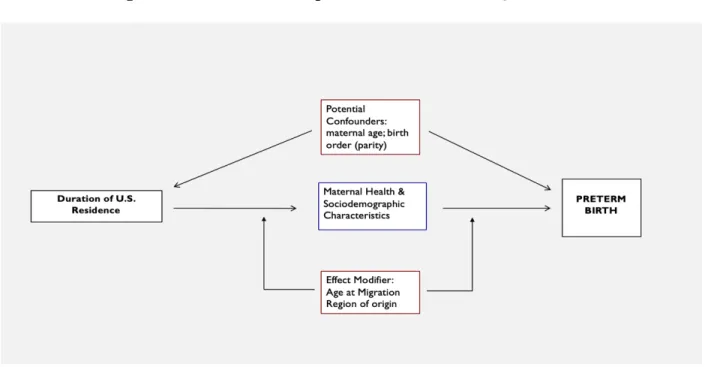
There are two conceptual models guiding this study. The first represents the nativity models examined in Aim 1, in which the focal independent variable is maternal nativity.
Figure 1.1. - Aim 1: Conceptual Model (Research Question 1a)
In this model the direct and indirect—via maternal sociodemographic and health characteristics—effects of maternal nativity on PTB will be evaluated.
duration effects on birth outcomes differ by migration timing (i.e., before age 18 vs. 18+) and/or by maternal birth region (i.e., Caribbean vs. Sub-Saharan Africa).
Figure 1.2. – Aim 1: Conceptual Model (Research Question 1b)
Key studies: Evidence and Gaps
Key studies on U.S. vs foreign-born birth outcomes have contributed different pieces of the larger puzzle. Specifically, Teitler and colleagues (2012; 2015) have examined the effects of duration and timing, but their data sources lacked measures of maternal health and
sociodemographic characteristics and had too few cases to focus on Black women as a distinct subpopulation. Elo and colleagues (2014), by comparison, analyzed births records from multiple states that provided adequate numbers of Black immigrants and measures of maternal health and sociodemographic characteristics, but lacked information on migration duration and timing. Teitler et al., 2012 & Teitler, Martinson, Reichman (2015)
The Teitler et al., 2012 paper examined the effect of duration on the birthweight of
mothers, providing evidence suggesting that duration of residence in the U.S. plays an important role for immigrant health. Although the Teitler et al. articles were able to investigate the effect of duration of U.S. residence on birth outcomes of Latino and Asian immigrant populations, they were unable to conduct an in-depth analysis of Black immigrant’s birth outcomes due to data limitations.
Elo, Vang, Culhane (2014)
Elo, Vang, Culhane (2014) have conducted the most detailed analysis of Black immigrant birth outcomes to date. Analyzing nearly 300,000 U.S. births across 27 states in 2008, they found significant variation in the birth outcomes of Black women by nativity and region of birth. They found that overall US-born Black women had a PTB rate of 12.4% and foreign-born Black women had a PTB rate of 9.4%. Within the foreign-born group Caribbean-born had a PTB rate of 11.0% and Sub-Saharan African-born had a PTB rate of 7.3%. These differences were statistically significant. Controlling for the explanatory variables available in birth records (maternal age, education, marital status, region of residence, prenatal care use, and whether the mother had hypertension and/or diabetes) did not explain the foreign-born PTB advantage (Elo et al., 2014). Although Elo, Vang, and Culhane were able to focus on Black women and examine health/sociodemographics as potential explanatory factors for nativity disparities, their multi-state vital records dataset lacked data on duration and immigration timing.
health outcomes. In fact, research has suggested that perceptions of discrimination may differ by nativity/immigrant status and by duration of U.S. residence, with potentially important
implications for health and well-being (Nuru-Jeter et al., 2009). This dissertation will provide a deeper qualitative exploration into Black identity.
Limitations of the Literature
To date, data limitations have been a major barrier to realizing the potential insights about health disparities that the study of immigrant health promises. Specifically, there is a great need for datasets that contain adequate numbers of Black immigrant births, a measure of
residential duration (not collected on the standard U.S. birth certificate), and key maternal (e.g., health behaviors) and social (e.g., discrimination) factors implicated in prominent theories of immigrant health. For example, recent studies based on survey data have reported intriguing evidence that the association between longer duration of residence and lower birth weight among U.S. immigrants may be non-linear and potentially stronger among women who migrate during childhood (J. Teitler et al., 2015; J. O. Teitler, Hutto, & Reichman, 2012). However, while evidence of these associations was found within Latino and Asian subgroups, sample size limitations prevented a parallel investigation among Foreign-born Black women.
including: African American, African-born, and Caribbean-born Black women, is not yet present in the literature. The lack of research on the health of Foreign-born Black women is a significant gap in the literature.
Contribution to the Field
This study will contribute with data that has duration, timing, and
health/sociodemographic characteristics and enough births to study Black women as a distinct group. The strength of the quantitative data source for this dissertation research project is that maternal duration of residence was measured at the time of the birth, allowing this study to describe the association between duration and key birth outcomes for Foreign-born Black women (as Teitler et al. have done overall, and within Hispanic and Asian subgroups). Additionally, the data source examined in this dissertation contains adequate numbers of foreign-born Black women and measures of health behaviors, sociodemographic characteristics, and duration of U.S. residence.
residence within the Black immigrant population by region. This proposed study would be able to fill this gap in the literature.
Further, qualitative interviews will yield additional insights about possible differences, by nativity and region of birth, in how Black mothers perceive the U.S. racialized context. Focusing on the exploration of the narratives on perceptions of race-based discriminatory experiences by nativity and region of origin for African American, African and Caribbean mothers living in New York City, may shed light on any differential perceptions of racial discrimination.
Providing this context will greatly improve understanding of the impact of racial discrimination on health and is essential to developing a complete understanding of nativity disparities within the Black population.
Study Overview
turn have a differential impact on their health, will allow for the field of public health to better tackle overall racial health disparities. This mixed methods study on foreign-born and U.S. -born Black women will (1) analyze quantitative data to examine differences in PTB by nativity and by duration and (2) analyze qualitative data to examine variations in identity and perceived
discrimination by region of origin. Specific Aims: Quantitative Strand
Aim 1: Document disparities in adverse birth outcomes among subgroups of Black women in NYC and generate the first-ever estimates of the association between duration of U.S. residence and adverse birth outcomes across three major subgroups of the Black population: African-born mothers, Caribbean-born mothers, and African American mothers, using NYC vital statistics data.
• Research Question 1a: What is the association between nativity and preterm birth (PTB)
for African-born, Caribbean-born and U.S. -born Black mothers?
o Hypothesis: U.S. -born Black mothers will have the highest crude and adjusted
prevalence rate of preterm delivery, followed by Caribbean-born and then African-born mothers.
• Research Question 1b: What is the association between duration of U.S. residence and
preterm birth for African-born and Caribbean-born mothers?
o Hypothesis: The association between duration and PTB will be curvilinear.
o Hypothesis: The effect of duration will vary by age at migration
Data Source
education, marital status, reproductive history, parity, medical risk factors, prenatal care use, maternal nativity, maternal country of birth, and duration of residence, if foreign born.
Sample: The data set will include all live births in New York City from 2008 – 2016. These years
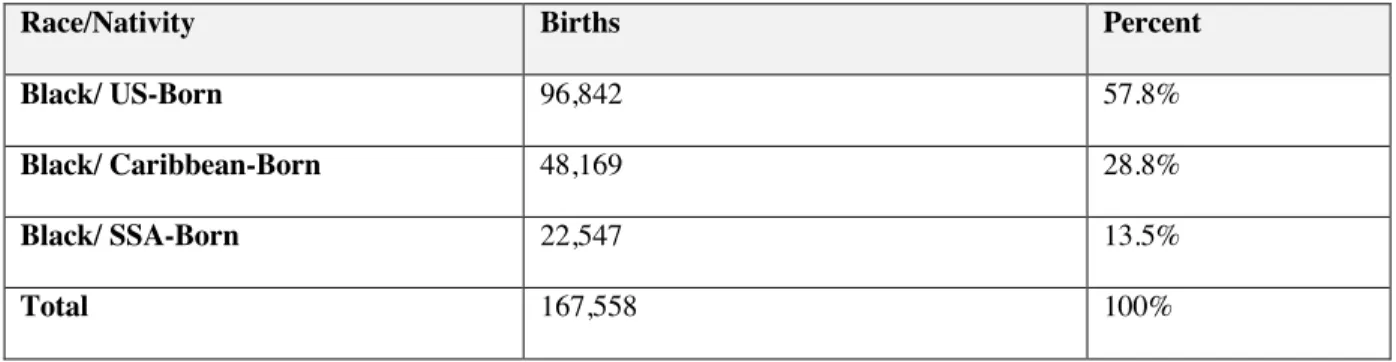
were selected since NYC began asking duration of U.S. residence if foreign-born in the year 2008. The study sample was limited to singleton births for those who identified as Black; after data cleaning the final dataset consists of 176,654 births, see table below for details.
Table 1: Study sample distribution by Nativity
Race/Nativity Births Percent
Black/ US-Born 96,842 57.8%
Black/ Caribbean-Born 48,169 28.8%
Black/ SSA-Born 22,547 13.5%
Total 167,558 100%
Specific Aims: Qualitative Strand
Aim 2: Examine Black identity and perceived discrimination, including the variation by nativity, for African-born, Caribbean-born and U.S. -born Black mothers, via semi-structured interviews in NYC.
• Research Question 2a: Are there qualitative differences in the narratives on one’s
relationship to their racial identity across these Black groups?
• Research Question 2b: Are there differences in the reported instances of racial
discrimination or descriptions of instances of racial discrimination across these Black groups?
Participants are over 18 years old and have at least one child.
Dissertation Structure
The next chapter, Chapter Two, presents quantitative results of this study, in the format of a quantitative manuscript, addressing Aim 1. Chapter two focuses on how migration, duration and timing impact adverse PTB risk within the Black population by nativity. This chapter highlights the analysis of NYC vital statistics data to document the disparities in preterm birth, while controlling for maternal health status (i.e., diabetes, hypertension) and maternal health behaviors (prenatal care, alcohol and smoking), among Black women in NYC. Additionally, this chapter generates estimates of the association between duration of U.S. residence and preterm birth risk by nativity among Black women living in NYC.
Chapter Three addresses Aim 2, presenting the qualitative results of this study, in the format of a qualitative manuscript. Chapter three focuses on how migration, perceived
discrimination and racial identity intersect along the pathway linking migration to adverse PTB risk within the Black population by nativity. Providing this context will greatly improve
understanding of the impact of perceived racial discrimination on health and is essential to developing a complete understanding of nativity disparities within the Black population.
CHAPTER 2: PRETERM DELIVERY AMONG BLACK WOMEN IN NYC: EXAMINING DURATION OF U.S. RESIDENCE FOR BLACK MIGRANT MOTHERS Introduction
Immigrants provide a unique and valuable opportunity to understand how living in the United States affects health and well-being because their exposure to the U.S. context is variable. Compared with their US-born counterparts, immigrants exhibit better health outcomes across the life course (Gopal K. Singh, Rodriguez-Lainz, & Kogan, 2013). However, immigrant health advantages have been shown to erode within one or two generations (Collins, Wu, & David, 2002) (J. Teitler et al., 2015). This suggests that exposure to the U.S. context can be hazardous to one’s health. Preterm birth is one outcome for which this significant, but short-lived, immigrant advantage has been observed.
Adverse birth outcomes, such as preterm birth (PTB; infants born before 37 weeks completed gestation)(Centers for Disease Control and Prevention, 2015) are particularly important topics of investigation, serving as key indicators of maternal reproductive health and as increasingly valuable predictors of health across the life course (Hogan et al., 2012; Lu & Halfon, 2003). By advancing knowledge of how exposure to the U.S. context influences maternal and infant health, the study of immigrant birth outcomes may provide new insights about the etiology of racial/ethnic health disparities more broadly.
The Life Course Perspective
disparities within the Black population. Duration may be a particularly important consideration for foreign-born Black women, as increased duration in the U.S. can be consequential to their health not only because of the loss of protective health behaviors such as avoiding smoking and alcohol use, but also due to the increased exposure to multiple forms of acculturative stress, including racial discrimination (Viruell-Fuentes et al., 2012).
Differential exposures to racial stress for U.S. born and foreign-born Black women over their life course may influence their reproductive health trajectories, and contribute to disparities in birth outcomes (Lu & Halfon, 2003). The lack of exposure to discrimination prior to migrating could also serve as a protective factor for the foreign-born, relative to the US-born who are developing in a societal context that exposes them to institutional/structural level discrimination and potentially interpersonal discrimination as well. A life course approach examines how exposures and timing interact, accumulate, and influence the health trajectories of mothers and their infants.
Duration of U.S. Residence
The current literature documents the differential rates of adverse birth outcomes within the Black population by nativity and cites the importance of studying the role of duration of U.S. residence. Teitler et al., (2012) found that for immigrants overall, and Hispanic immigrants in particular, the relationship between low birthweight and duration was curvilinear, appearing to decline over the first few years in the U.S. and increase thereafter (J. Teitler, 2012).
outcomes relative to foreign-born Black women. We also know that foreign-born Black women have increasingly worse health outcomes the longer they live in the U.S. (Cabral, Fried,
Levenson, Amaro, & Zuckerman, 1990; David & Collins, 2007; Pallotto, Collins, & David, 2000; Parker Dominguez, 2008). Research has suggested that increased duration of U.S.
residence results in the foreign-born “acculturating” to U.S. society (Jasso et al., 2004; J. Teitler et al., 2015). Acculturation is the idea that the health behaviors (drug use, cigarette smoking, alcohol abuse, and unhealthy dieting patterns) of the foreign-born more closely resemble their native born counterparts the longer they live in the US, which in turn compromises their health (J. Teitler et al., 2015).
On average, African-born women have a shorter duration in the U.S. than Caribbean-born women. Ergo, they may have less erosion of their protective health promoting behaviors and due to their shorter duration they may also experience less cumulative exposure to racial
discrimination, relative to Caribbeans who on average have a longer duration in the U.S. (Elo et al., 2014). If acculturation is driving the associations between duration and birth outcomes, then I would expect a longer duration of U.S. residence to result in increased odds of experiencing a preterm birth for both Caribbean-born and African-born mothers.
Age at migration
studies based on survey data have reported intriguing evidence that the association between duration of residence and adverse birth outcomes among U.S. immigrants may be potentially stronger among women who migrate during childhood (J. Teitler, 2012; J. Teitler et al., 2015). Teitler et al., (2015) examined the effect of duration on the birthweight outcomes of Hispanic and Asian mothers and found that for mothers who migrated as children the rates of low
birthweight increased as duration increased. While evidence of this age at migration modification of the association between duration and adverse birth outcome risk was found within Latino and Asian subgroups, sample size limitations prevented a parallel investigation among foreign-born Black women.
Having an increased understanding of the relationship between duration, nativity and age at migration for foreign-born Black women from Africa and the Caribbean, is an important component of our increased understanding of the role duration of U.S. residence plays for within-Black PTB disparities by nativity. I expect that the influence of duration in the U.S. on preterm delivery will vary by age at migration, with childhood migrants having increased odds of experiencing a preterm birth, due to their early U.S. exposure. Additionally, I expect that the effect of duration in the U.S. on preterm delivery will vary by region of origin, with Caribbean-born having increased odds of experiencing a preterm birth, as duration increases, relative to SSA-born.
Adverse birth outcome disparities
David, 2009; Collins, David, Handler, Wall, & Andes, 2004a). However, several studies conducted in New York City have found that African-born women had a lower PTB rate than Caribbean-born Black women, who in turn had a lower rate than US-born Black women (Almeida et al., 2014; Howard et al., 2006; Mason et al., 2010). These studies typically controlled for maternal characteristics available on birth record data, which failed to explain these differential PTB risks by nativity and region of origin. The most detailed evidence on birth outcomes to date within the Black population (Elo et al., 2014) found significant differences; overall, US-born Black women had a PTB rate of 12.4% and foreign-born Black women had a PTB rate of 9.4%. Within the foreign-born group, Caribbean-born had a PTB rate of 11.0% and Sub-Saharan African-born had a PTB rate of 7.3%. This study did not include measures of duration in the United States.
Although the existing disparity is well documented, there is a lack of understanding regarding the potential mechanisms that underly this disparity. The existing preterm birth disparities by nativity among Black women cannot be attributed to or explained by known risk factors (Elo et al., 2014). However, we know that health behaviors such as smoking, alcohol use, physical activity and nutrition influence birth outcomes (Cabral et al., 1990; Elo & Culhane, 2010b) and previous studies have shown that health behaviors, health status, and reproductive outcomes were more favorable among foreign-born Black women than among U.S. -born Black women (Cabral et al., 1990; Elo & Culhane, 2010b; Elo et al., 2014). Although it is well known that US-born and foreign-born Black women have health behavior differentials, the foreign-born advantage in preterm birth persists even after accounting for both these differentials as well as selected socio-demographic factors (Mason et al., 2010). Why PTB disparities persist after accounting for these health behaviors, medical risk factors, duration of U.S. residence and individual-level sociodemographic factors deserves more in-depth study.
Limitations of the Literature
The strength of the quantitative data source for this research project (NYC birth records), is that maternal duration of residence was measured at the time of the birth, allowing this study to investigate the association between duration and key birth outcomes for foreign-born Black women. Specifically, there is a great need for datasets that contain adequate numbers of foreign-born Black births and a measure of residential duration (not collected on the standard U.S. birth certificate). No prior study has described or explained patterns of adverse birth outcomes by duration within the foreign-born Black population by region. This study will be able to fill this gap in the literature.
This study is an examination of duration of U.S. residence, age at migration, maternal health status (diabetes, hypertension) and maternal health behaviors (prenatal care, alcohol and smoking) on preterm birth disparities by nativity and region among Black women in New York City.
Study Aims and Hypotheses
The first study aim was to document disparities in preterm birth outcomes for U.S. -born Black mothers and foreign-born Black mothers in New York City, specifically for the sub-Saharan African- and Caribbean-origin populations. Additionally, from 2000 to 2018 the
The second study aim was to generate estimates of the association between duration of U.S. residence and preterm birth outcomes for African-born and Caribbean-born mothers, in order to further understand the highly understudied but well documented adverse birth outcome differentials within the Black population residing in the U.S. by nativity. This study used New York City Vital Statistics Birth Records from years 2008 to 2016 to ask two questions:
1. How does preterm delivery vary between U.S. -born non-Hispanic Black mothers and foreign-born non-Hispanic Black mothers?
a. Hypothesis: U.S. -born Black mothers will have the highest unadjusted and
adjusted rate of preterm delivery, followed by Caribbean-born mothers and African-born mothers with the lowest rates.
2. How is preterm delivery associated with duration of U.S. residence?
a. Hypothesis: Duration of U.S. residence will be positively associated with the odds
of experiencing a preterm birth for both Caribbean-born and African-born mothers.
b. Hypothesis: The association between duration and preterm delivery will be
stronger for child immigrants than for adult immigrants and for Caribbean immigrants than for African immigrants
for sociodemographic factors, maternal health behaviors, and medical risk factors. No prior study has described or attempted to explain patterns of adverse birth outcomes by duration of U.S. residence within the foreign-born Black population by region and country of origin.
Methods
NYC Vital Statistics Birth Records
I used 2008 – 2016 NYC vital statistics birth record data. The files include measures of infant gestational length (both clinical and LMP; Last Menstrual Period), birthweight, self-reported maternal race, Hispanic origin, maternal age, education, marital status, reproductive history, maternal nativity, maternal country of birth, and, if foreign born, duration of residence in the United States. New York City began collecting data on duration of residence in the year 2008. The inclusion of both duration of U.S. residence and maternal age allowed for the creation of an age at migration variable for the foreign-born. Additionally, this dataset included standard birth record measures of health behaviors such as smoking, alcohol and prenatal care as well as medical risk factors, including hypertension and diabetes. I obtained approval from the
Institutional Review Board of the University of North Carolina, and access via a Data Use Agreement with the NYC Department of Mental Health and Hygiene.
Study Population
All Black mothers born in the U.S., Caribbean or SSA, age 15 – 50, with singleton births in NYC between the years of 2008 – 2016 were eligible for this study (n=185,485 births).
Implausible nativity and duration combos were dropped (n=1), births with gestations below 17 or above 47 weeks (n=3) (Gregory, Martin, Argov, & Osterman, 2019), and implausible
the Caribbean (n=4,071), 181,377 births remained. Last, observations with missing data on any of the study variables were excluded (i.e., complete cases), resulting in a final analysis file of 167,558 births.
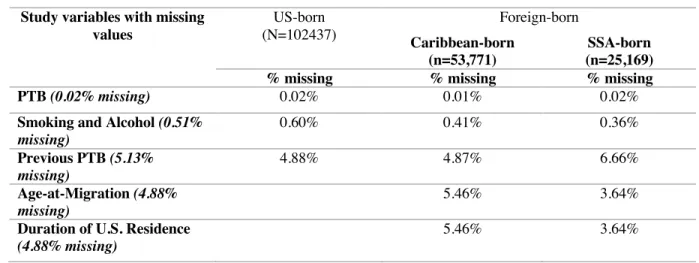
Out of all analysis variables there was missingness on five, none of which exceeded 5% of the total: preterm birth (n=34), smoking/alcohol (n=929), previous PTB (n=9299; 5.1%), age-at-migration (3,855), and duration of U.S. residence (3,855). Therefore, it was decided to conduct analysis with complete cases only. Further examination of missing data patterns by maternal birthplace (Table 2) revealed that the prior PTB variable is more likely to be missing among SSA-born versus Caribbean-born women. Conversely, the question on duration of U.S. residence is more likely to be missing among Caribbean versus SSA-born women.
The resulting analytic dataset consists of 96,842 births to US-born women, 48,169 births to Caribbean-born women, and 22,547 births to sub-Saharan African-born Black women. Among the births to foreign-born women, the majority (68.1%) are to Caribbean-born women and 31.9% are to African-born women.
Table 2: Examining Missing Values in Study Variables
Study variables with missing values US-born (N=102437) Foreign-born Caribbean-born (n=53,771) SSA-born (n=25,169)
% missing % missing % missing
PTB (0.02% missing) 0.02% 0.01% 0.02%
Smoking and Alcohol (0.51% missing)
0.60% 0.41% 0.36%
Previous PTB (5.13% missing)
4.88% 4.87% 6.66%
Age-at-Migration (4.88% missing)
5.46% 3.64%
Duration of U.S. Residence
(4.88% missing)
Figure 2.1: Analytic sample flow chart, NYC vital statistics birth record data (2008 – 2016)
Variable definition/coding
Preterm Birth: I defined preterm birth using the clinical/obstetric estimate of gestational
age between 17 and less than 37 weeks (Gregory et al., 2019). Research has shown the clinical estimate is more accurate than the last menstrual period (LMP) estimate (Martin, Osterman, Kirmeyer, & Gregory, 2015).
Maternal Nativity: Country of birth was grouped into three categories: U.S. -born,
Caribbean-born, sub-Saharan Africa-born. The creation of the Caribbean category was based on the Migration Policy Institute’s definition of Caribbean countries (Zong & Batalova, 2011). Our Caribbean category includes Jamaica (34%), Haiti (20.4%), Trinidad & Tobago (14.2%), Guyana (13.7%), and other Caribbean countries (17.8%). The SSA category was informed by the
All NYC live births to Non-Hispanic Black mothers
age 15-50 singleton births
2008 – 2016 n = 185,485
All NYC live births to Non-Hispanic Black mothers Born in the U.S., Caribbean or SSA
(-exclusionary criteria) n = 181,377
All NYC live births to Non-Hispanic Black mothers Born in the U.S., Caribbean or SSA
(with complete cases) n = 167,558
- observations with missing data on study variables - births to foreign-born moms born outside of SSA or the
Caribbean
Implausible nativity and duration of U.S. residence combinations
- implausible birthweight and gestational age combinations
Migration Policy Institute (Echeverria-Estrada & Batalova, 2019). Our sub-Saharan African category includes Ghana (20.9%), Nigeria (18.1%), Guinea (11.1%), Mali (7.3%) and other SSA countries (42.6%).
Duration of U.S. Residence: NYC began collecting duration of U.S. residence if
foreign-born in 2008. Following prior research (J. Teitler et al., 2015) I captured duration of U.S. residence utilizing the following categories: <1, 1-2, 3-5, 6-10, 11-15, 16-20, and 21+ years.
Age at migration: The duration of U.S. residence variable was subtracted from the
maternal age variable to create the age at migration variable. Following prior research (J. Teitler et al., 2015), I dichotomized the age at migration variable: migrated at age 17 and under (child migrant) or migrated at age 18+ (adult migrant).
Covariates: I examined the following maternal sociodemographic characteristics:
maternal age (19 and under; 20-34 years; and 35+ years), marital status (married and not married).
Health Behaviors and Medical Risk Factors: I constructed a smoking [Cigarette smoking
in the 3 months before or during pregnancy] and alcohol [alcohol used during this pregnancy]
Statistical Analyses
Descriptive statistics for all study variables, by nativity and birth region were generated. Next, binary logistic regression models were estimated to evaluate the crude and adjusted odds of PTB by duration. Finally, potential effect modification by timing and birth region was assessed with stratification.
Results
Descriptive Statistics
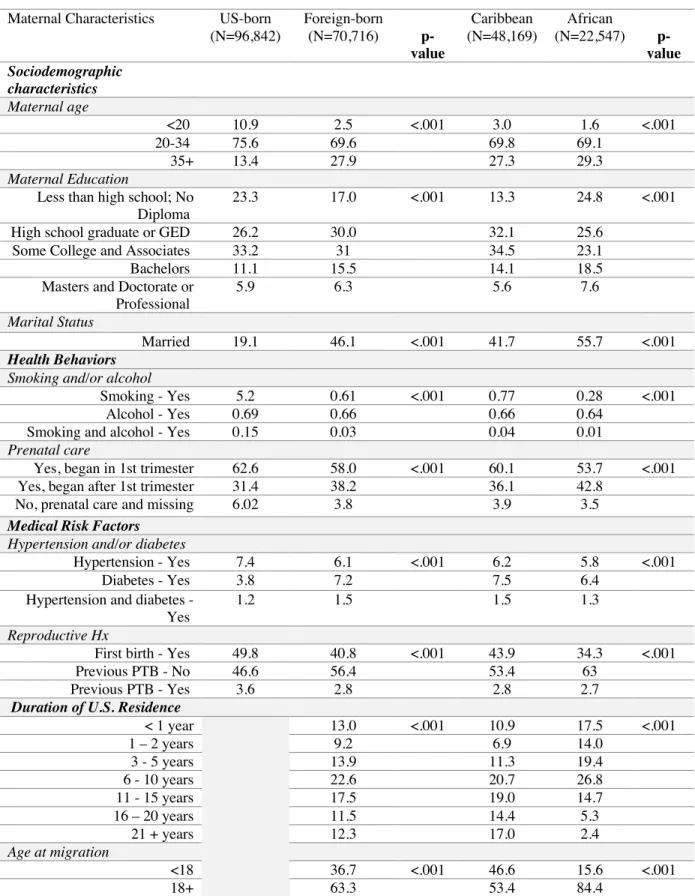
Overall, Black foreign-born women who gave birth in NYC between 2008-2016 had a more favorable PTB risk profile than U.S. -born Black women. These findings are summarized in Table 1, which shows the distribution of the study variables, first comparing U.S. -born Black women with all foreign-born Black women, and then providing further comparisons within the foreign-born by region of origin: Caribbean-born and SSA-born.
In regard to sociodemographic characteristics, foreign-born women have fewer teen births, more education, and are much more likely to be married. Foreign-born women are also more likely to be age 35 or older at delivery, which is generally associated with higher PTB risk. Further examination by region of birth shows that there is a concentration of African-born women at the lowest and highest education levels.
Table 3: Comparison of maternal characteristics by region of origin among U.S. -born and foreign-born Black women, 2008 – 2016 NYC vital statistics birth record data, N = 167,558.
Maternal Characteristics US-born (N=96,842) Foreign-born (N=70,716) p-value Caribbean (N=48,169) African
(N=22,547) p-value
Sociodemographic characteristics
Maternal age
<20 10.9 2.5 <.001 3.0 1.6 <.001
20-34 75.6 69.6 69.8 69.1
35+ 13.4 27.9 27.3 29.3
Maternal Education
Less than high school; No Diploma
23.3 17.0 <.001 13.3 24.8 <.001
High school graduate or GED 26.2 30.0 32.1 25.6
Some College and Associates 33.2 31 34.5 23.1
Bachelors 11.1 15.5 14.1 18.5
Masters and Doctorate or Professional
5.9 6.3 5.6 7.6
Marital Status
Married 19.1 46.1 <.001 41.7 55.7 <.001
Health Behaviors Smoking and/or alcohol
Smoking - Yes 5.2 0.61 <.001 0.77 0.28 <.001
Alcohol - Yes 0.69 0.66 0.66 0.64
Smoking and alcohol - Yes 0.15 0.03 0.04 0.01
Prenatal care
Yes, began in 1st trimester 62.6 58.0 <.001 60.1 53.7 <.001
Yes, began after 1st trimester 31.4 38.2 36.1 42.8
No, prenatal care and missing 6.02 3.8 3.9 3.5
Medical Risk Factors Hypertension and/or diabetes
Hypertension - Yes 7.4 6.1 <.001 6.2 5.8 <.001
Diabetes - Yes 3.8 7.2 7.5 6.4
Hypertension and diabetes - Yes
1.2 1.5 1.5 1.3
Reproductive Hx
First birth - Yes 49.8 40.8 <.001 43.9 34.3 <.001
Previous PTB - No 46.6 56.4 53.4 63
Previous PTB - Yes 3.6 2.8 2.8 2.7
Duration of U.S. Residence
< 1 year 13.0 <.001 10.9 17.5 <.001
1 – 2 years 9.2 6.9 14.0
3 - 5 years 13.9 11.3 19.4
6 - 10 years 22.6 20.7 26.8
11 - 15 years 17.5 19.0 14.7
16 – 20 years 11.5 14.4 5.3
21 + years 12.3 17.0 2.4
Age at migration
<18 36.7 <.001 46.6 15.6 <.001
At the bottom of Table 1 is the first known descriptive information on duration of U.S. residence and timing of immigration for Black foreign-born women recording live births in the U.S. We see that Caribbean-born women delivering in NYC tend to have a longer duration in the U.S. than African-born women. This is reflected in the timing of migration, which shows that 47% of Caribbean-born women versus only 15% of African-born women migrated to the U.S. during childhood (i.e., before their 18th birthday).
PTB Prevalence rates: Nativity, Duration of U.S. residence
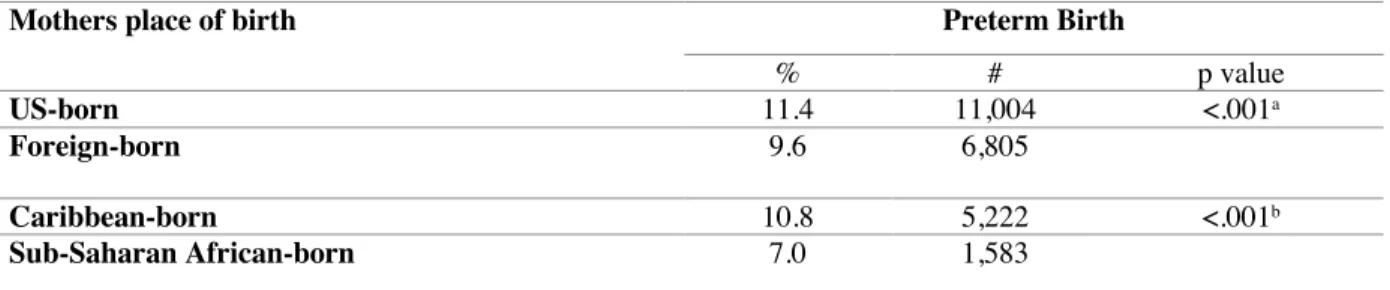
Moving from descriptive analyses to estimating associations, I replicated prior research in finding that U.S. -born Black women had higher rates of PTB compared to their foreign-born counterparts (Table 2). US-born women had a PTB rate of 11.4% compared to 9.6% for foreign-born women overall. I also found that Caribbean-foreign-born women had a higher PTB prevalence rate (10.9%) compared to SSA-born women (7.0%). The results are consistent considering the elevated risk profile exhibited by the Caribbean-born relative to the SSA-born in this study. The PTB rate for the Caribbean-born women is very similar to that of the U.S. -born Black women.
Table 4: Distribution of preterm birth by maternal nativity among Black women in New York City, 2008 – 2016 (N=167,558)
Mothers place of birth Preterm Birth
% # p value
US-born 11.4 11,004 <.001a
Foreign-born 9.6 6,805
Caribbean-born 10.8 5,222 <.001b
Sub-Saharan African-born 7.0 1,583
a Pearson Chi square test for difference in the distribution among US-born and foreign-born Black women b Pearson Chi square test for difference in the distribution among Caribbean-born and SSA-born women
Table 5: Distribution of preterm birth by duration of U.S. residence among foreign-born Black women in New York City, 2008 – 2016 (N=70,716)
Foreign-born
(N=70,716)
Caribbean
(N=48,169)
African
(N=22,547)
Duration % # of PTB % # of PTB % # of PTB
< 1 year 7.9 734 8.5 448 7.3 286
1 – 2 years 7.7 500 9.7 322 5.6 178
3 - 5 years 7.7 754 9.2 498 5.9 256
6 - 10 years 9.2 1,470 10.6 1,059 6.8 411
11 - 15 years 10.7 1,325 11.3 1,023 9.1 302
16 – 20 years 11.5 937 12.1 840 8.2 97
21 + years 12.5 1,085 12.7 1,032 9.7 53
7,185 5,505 1,680
Rate for U.S. -born Black women is 11.4% (n=11,573)
The PTB rate for foreign-born Black mothers with the shortest duration (<1 year) is 7.9% and for the foreign-born mothers with the longest duration (21+years) the PTB rate is 12.5%. For the most part this linear association persists when considering region of origin, with the exception of African-born women who have lived in the U.S. for less than one year.
Multivariable Models
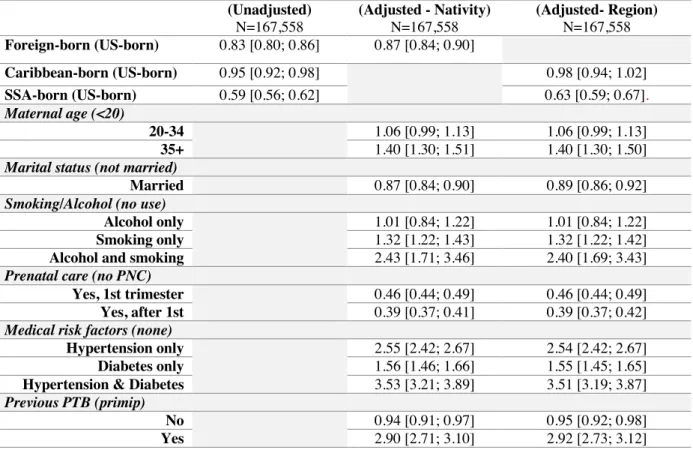
Results from the logistic regression analyses are presented in Table 4. The first column replicates the descriptive findings in showing that the odds of PTB are lower for foreign-born (vs. US-born) Black women. Further, this finding holds for both Caribbean-born and African-born women, although the disparity is much smaller for the former group (OR 0.95). Next, I evaluated the extent to which adjusting for the set of maternal sociodemographic and health risk factors explains the within-Black disparities in the odds of PTB.
Caribbean-born (10.8%), an examination of the difference in PTB odds between the US-born and the foreign-born by region was conducted.
Table 6: Odds Ratios with 95% confidence intervals from logistic regression models for preterm birth for U.S.-born, foreign-born, Caribbean-born and sub-Saharan African-born Black women, New York City
2008 -2016
(Unadjusted)
N=167,558
(Adjusted - Nativity)
N=167,558
(Adjusted- Region)
N=167,558
Foreign-born (US-born) 0.83 [0.80; 0.86] 0.87 [0.84; 0.90]
Caribbean-born (US-born) 0.95 [0.92; 0.98] 0.98 [0.94; 1.02]
SSA-born (US-born) 0.59 [0.56; 0.62] 0.63 [0.59; 0.67].
Maternal age (<20)
20-34 1.06 [0.99; 1.13] 1.06 [0.99; 1.13]
35+ 1.40 [1.30; 1.51] 1.40 [1.30; 1.50]
Marital status (not married)
Married 0.87 [0.84; 0.90] 0.89 [0.86; 0.92]
Smoking/Alcohol (no use)
Alcohol only 1.01 [0.84; 1.22] 1.01 [0.84; 1.22]
Smoking only 1.32 [1.22; 1.43] 1.32 [1.22; 1.42]
Alcohol and smoking 2.43 [1.71; 3.46] 2.40 [1.69; 3.43]
Prenatal care (no PNC)
Yes, 1st trimester 0.46 [0.44; 0.49] 0.46 [0.44; 0.49]
Yes, after 1st 0.39 [0.37; 0.41] 0.39 [0.37; 0.42]
Medical risk factors (none)
Hypertension only 2.55 [2.42; 2.67] 2.54 [2.42; 2.67]
Diabetes only 1.56 [1.46; 1.66] 1.55 [1.45; 1.65]
Hypertension & Diabetes 3.53 [3.21; 3.89] 3.51 [3.19; 3.87]
Previous PTB (primip)
No 0.94 [0.91; 0.97] 0.95 [0.92; 0.98]
Yes 2.90 [2.71; 3.10] 2.92 [2.73; 3.12]
The fully adjusted models control for the following explanatory variables: maternal age, marital status, reproductive history, smoking and alcohol, prenatal care, hypertension and diabetes.
For each comparison the omitted category is given in parentheses
Maternal education was not included due to the variation in education across the regions represented
When examining by region the unadjusted PTB odds for the SSA-born and Caribbean-born were significantly lower, relative to the US-Caribbean-born. However, the PTB odds difference between the Caribbean-born and the US-born was explained in the fully adjusted model
Duration models
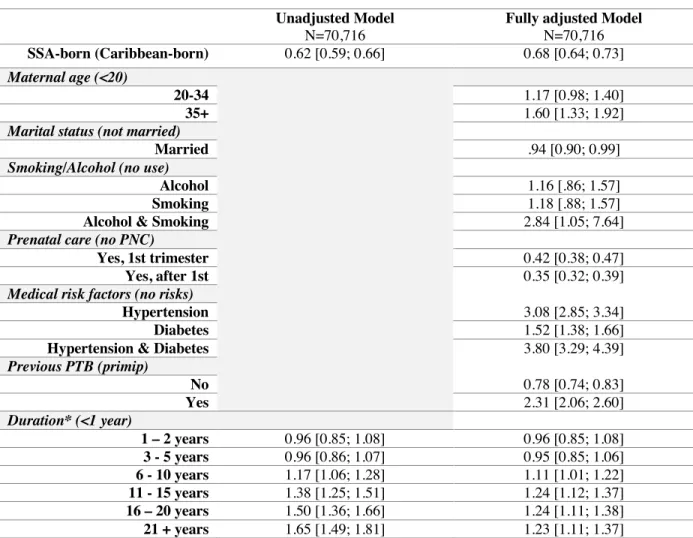
The final series of models was restricted to foreign-born women only in order to estimate the association between duration of U.S. residence and the odds of PTB. Table 5 contains the unadjusted effect of region and duration within the foreign-born, and the fully adjusted model. The unadjusted association between birth region (SSA vs. Carib) and PTB is slightly stronger than the fully adjusted association. When examining the effect of duration, while adjusting only for age and parity/previous PTB, duration was found to be a risk factor for PTB only for women living in the U.S. for six or more years.
* Did control for maternal age and parity in the unadjusted model as informed by Teitler et al., 2015 For each comparison the omitted category is given in parentheses
Maternal education was not included due to the variation in education across the regions represented
Table 7: Odds Ratios with 95% confidence intervals from logistic regression models for preterm birth for foreign-born, Caribbean-born, sub-Saharan African-born, New York City 2008 -2016
Unadjusted Model
N=70,716
Fully adjusted Model
N=70,716
SSA-born (Caribbean-born) 0.62 [0.59; 0.66] 0.68 [0.64; 0.73]
Maternal age (<20)
20-34 1.17 [0.98; 1.40]
35+ 1.60 [1.33; 1.92]
Marital status (not married)
Married .94 [0.90; 0.99]
Smoking/Alcohol (no use)
Alcohol 1.16 [.86; 1.57]
Smoking 1.18 [.88; 1.57]
Alcohol & Smoking 2.84 [1.05; 7.64]
Prenatal care (no PNC)
Yes, 1st trimester 0.42 [0.38; 0.47]
Yes, after 1st 0.35 [0.32; 0.39]
Medical risk factors (no risks)
Hypertension 3.08 [2.85; 3.34]
Diabetes 1.52 [1.38; 1.66]
Hypertension & Diabetes 3.80 [3.29; 4.39]
Previous PTB (primip)
No 0.78 [0.74; 0.83]
Yes 2.31 [2.06; 2.60]
Duration* (<1 year)
1 – 2 years 0.96 [0.85; 1.08] 0.96 [0.85; 1.08]
3 - 5 years 0.96 [0.86; 1.07] 0.95 [0.85; 1.06]
6 - 10 years 1.17 [1.06; 1.28] 1.11 [1.01; 1.22]
11 - 15 years 1.38 [1.25; 1.51] 1.24 [1.12; 1.37]
16 – 20 years 1.50 [1.36; 1.66] 1.24 [1.11; 1.38]
When examining the effect of duration of U.S. residence, in the fully adjusted model, which included all sociodemographic, health behaviors, medical risk factors and duration of U.S. residence, I found that the lower PTB odds for the sub-Saharan African-born (OR 0.68; CI 0.64, 0.73) relative to the Caribbean-born persisted.
Table 8: Odds Ratios with 95% confidence intervals from logistic regression models for preterm birth stratifying by age and region; for foreign-born, Caribbean-born, sub-Saharan African-born, other-born
Black women, New York City 2008 -2016
Age-at-migration stratification Regional stratification
Model 1 (child migrant) N=25,983 Model 2 (adult migrant) N=44,733 Model 3 (SSA region) N=22,547 Model 4 (Caribbean region) N=48,169 SSA-born (Caribbean-born)
0.61 [0.53; 0.71] 0.70 [0.65; 0.75]
Maternal age (<20)
20-34 1.08 [0.87; 1.33] 1.57 [0.92; 2.68] 1.39 [0.85; 2.25] 1.12 [0.93; 1.36]
35+ 1.34 [1.05; 1.72] 2.24 [1.31; 3.84] 2.03 [1.24; 3.32] 1.50 [1.23; 1.83]
Marital status (not married)
Married 0.92 [0.84; 1.00] 0.96 [0.90; 1.03] 0.89 [0.80; 0.98] 0.96 [0.91; 1.02]
Smoking/Alcohol
Alcohol 1.44 [0.93; 2.23] 0.97 [0.64; 1.47] 1.13 [0.62; 2.08] 1.17 [0.83; 1.65]
Smoking 1.22 [0.86; 1.74] 1.08 [0.65; 1.78] 0.72 [0.25; 2.06] 1.23 [0.91; 1.66]
Alcohol & Smoking 4.57 [1.39; 15.03] 1.07 [0.13; 8.87] 12.80 [0.78; 209.58] 2.40 [0.83; 6.96]
Prenatal care (no PNC)
Yes, 1st trimester 0.47 [0.40; 0.55] 0.39 [0.34; 0.45] 0.42 [0.34; 0.52] 0.42 [0.37; 0.48]
Yes, after 1st 0.41 [0.34; 0.49] 0.32 [0.28; 0.37] 0.34 [0.27; 0.42] 0.36 [0.32; 0.41]
Medical risk factors
Hypertension 2.65 [2.32; 3.02] 3.38 [3.06; 3.73] 3.73 [3.21; 4.34] 2.88 [2.62; 3.15]
Diabetes 1.44 [1.23; 1.69] 1.56 [1.40; 1.74] 1.65 [1.36; 1.99] 1.48 [1.33; 1.64]
Hypertension & Diabetes
3.80 [2.95; 4.90] 3.81 [3.20; 4.53] 3.90 [2.91; 5.23] 3.78 [3.20; 4.45]
Prior PTB (primip)
No 0.87 [0.80; 0.95] 0.72 [0.67; 0.78] 0.65 [0.58; 0.73] 0.83 [0.78; 0.89]
Yes 2.64 [2.20; 3.18] 2.08 [1.79; 2.41] 2.10 [1.67; 2.64] 2.36 [2.06; 2.70]
Duration (<1 year)
1 – 2 years 1.09 [0.39; 3.09] 0.94 [0.83; 1.07] 0.75 [0.61; 0.91] 1.10 [0.95; 1.29]
3 - 5 years 1.02 [0.42; 2.46] 0.95 [0.84; 1.06] 0.79 [0.66; 0.95] 1.06 [0.93; 1.22]
6 - 10 years 1.14 [0.48; 2.72] 1.13 [1.01; 1.26] 0.91 [0.77; 1.08] 1.24 [1.10; 1.40]
11 - 15 years 1.31 [0.55; 3.12] 1.25 [1.11; 1.41] 1.14 [0.95; 1.37] 1.32 [1.17; 1.50]
16 – 20 years 1.38 [0.58; 3.29] 1.10 [0.94 1.30] 0.95 [0.74; 1.23] 1.36 [1.20; 1.55]
21 + years 1.35 [0.56; 3.21] 1.48 [1.13; 1.94] 1.06 [0.77 1.46] 1.35 [1.19; 1.53]
The models control for the following explanatory variables: duration of U.S. residence, age at migration, maternal age, marital status, reproductive history, smoking and alcohol, prenatal care, hypertension and diabetes.
For each comparison the omitted category is given in parentheses
The fully adjusted model in table 7 also found support for partial mediation of duration by maternal sociodemographic and health characteristics; duration was an independent risk factor for PTB only for women living in the U.S. for six or more years. The five-year duration buffer persists despite controlling for other known risk factors.
The next two duration models (table 8) evaluated age-at-migration as a potential effect modifier and found support for this interaction. In the fully adjusted models, duration was not associated with PTB for immigration in childhood, but positively associated with PTB for immigration in adulthood.
Evidence for effect modification by region of birth was also found. For women born in Sub-Sahara Africa, residing in the U.S. from one to five years (vs. less than 1 year) was
associated with lower PTB odds. By contrast, for women born in the Caribbean, longer duration was associated with higher PTB odds.
Collectively, the multivariable models did little to explain the foreign-born PTB
advantage relative to the US-born and the SSA-born advantage relative to the Caribbean-born, or the SSA-born advantage relative to the US-born. One exception was the modest PTB differential between U.S. -born and Caribbean-born women (crude OR 0.95), which was attenuated and no longer statistically significant in the fully adjusted model (adjusted OR 0.98).
Discussion
attempted to explain the well documented adverse birth outcome disparities within the Black population living in the U.S. The studies that have focused on this have been unable to examine duration of U.S. residence, which is critical for the examination of maternal and infant health deterioration over time residing in the U.S. The studies that have examined the influence of duration of U.S. residence on the adverse birth outcomes of immigrants have been unable to conduct this examination in the Black population due to data limitations. Even fewer studies have been able to focus on how these differential rates of adverse birth outcomes differ within the Black population while controlling for health behaviors/status and duration of U.S. residence. This study does just that, while investigating how the association between duration and preterm delivery vary by age-at-migration and region of origin.
Our findings show that US-born women have a higher risk profile in regard to
sociodemographic characteristics, health behaviors, and medical risk factors than the foreign-born overall. When comparing within the foreign-foreign-born, the SSA-foreign-born have a lower risk profile than Caribbean-born women. The U.S. -born women have the highest PTB prevalence rate, followed by the Caribbean-born women and then the SSA-born women. These findings are all consistent with prior studies. The overall relationship between PTB prevalence and duration for foreign-born Black mothers is linear with PTB prevalence increasing as duration increased. This differs from the findings in Teitler et al. (2015), which found a curvilinear relationship between duration and infant birth weight among all immigrants.
deterioration with increasing duration only among those who migrated as children. This may be due to the fact that perhaps for Black immigrants the driving force behind immigrant health deterioration over time could be racial stress. Those who migrated as children might not have been as able to perceive discrimination or could have been less of a target of interpersonal discrimination being that they were children.
When stratifying by region there was a significant protective effect for recent SSA-born immigrants (1-5 years duration vs. < 1 year (referent group)) that was not evident among the Caribbean-born. By contrast, duration was positively associated with Caribbean-born Black mothers’ PTB risk. This may be due to differences in perceptions of racial stress. Future research should examine differences in perceived discrimination by region of origin among Black
immigrants.
Strengths of this study include the sample size of both U.S. born and foreign-born Black women and the data on duration of U.S. residence. Limitations include, the dataset being limited to live singleton births in NYC, which may limit the generalizability of the findings. The NYC vital birth record data also only began collecting duration if foreign born in 2008, which limits the years of data and sample size for the estimates of the association between duration and PTB. Conclusions and Study Implications
impacts of the U.S. social stratification system are decreasing over time. After controlling for sociodemographic characteristics, health behaviors, and medical risk factors, this study was still unable to explain the lower PTB risk of the foreign-born relative to the US-born and the lower PTB risk of the Sub-Saharan African-born relative to the Caribbean-born. Foreign-born Black women in general are understudied however, we know even less about sub-Saharan Africans in particular. The finding that relatively recent migration from SSA is potentially protective against PTB, even if confined to the first five years post-migration, is notable and merits further study. Considering how much they varied from the U.S. -born and Caribbean-born women in this study, future research should give more attention to sub-Saharan Africans.
CHAPTER 3: IDENTITY AND DISCRIMINATION AMONG U.S.-BORN AND FOREIGN-BORN NON-HISPANIC BLACK MOTHERS IN NEW YORK CITY Background
While quantitative evidence has allowed for the documentation of an established difference in preterm birth (PTB), which is defined as being born prior to 37 weeks gestation (Centers for Disease Control and Prevention, 2015), within the Black population by nativity, it leaves U.S. unable to fully understand the pathways, mechanisms and contributing factors operating to create such disparities. Developing an understanding of how these disparities operate and continue to persist is essential.
Quantitative studies have controlled for sociodemographic characteristics, medical risk factors, and health behaviors and yet continue to remain unable to explain the documented adverse birth outcome differences within the Black population residing in the United States. Previous quantitative studies (Dominguez et al., 2009; Elo et al., 2014) and qualitative studies (Nuru-Jeter et al., 2009) have provided evidence suggesting the importance of examining the role of stress, particularly racial stress, on the adverse birth outcomes of U.S. -born and foreign-born non-Hispanic Black women. Additionally, race/ethnicity scholarship provides support for an exploration into the relationship between racial identity and perceived discrimination within the Black population by nativity (Waters, 1999). Finally, there is a lack of knowledge on the
differ from one another. An examination of the factors listed above will improve our understanding of PTB disparities within the Back population in the U.S. by nativity.
Understanding the ways in which the health of U.S. -born and foreign-born non-Hispanic Black mothers is impacted by the racial climate of our society, how they navigate their
experiences, and the ways in which their experiences may differ by region is vital to improving population health. This study examines the ways in which seven U.S. -born non-Hispanic Black mothers, seven Caribbean-born non-Hispanic Black mothers, and seven sub-Saharan African-born non-Hispanic Black mothers experience their racial identity, perceived discrimination, and their pregnancy, labor and delivery care while living in New York City. New York City is an ideal setting for such a study considering the diversity and high rates of Black immigrants. Providing this context on the relationship between racial identity and racial stress is essential to developing a complete understanding of nativity disparities. In particular, this study explores their relationship with their Black identity, the ways in which they navigate, and buffer perceived racial discrimination and their experience while seeking care during their pregnancy and
labor/delivery.
Perceived Racial Discrimination and Maternal Health
Racism is a system of oppression that operates at multiple levels (Jones, 2000),
structuring opportunity and assigning value based on an individuals’ perceived race (Slaughter-Acey et al., 2015).Perceived racial discrimination is an interpersonal form of racial
health, proposing that race/ethnicity and other social characteristics can lead to both acute and chronic stressors that affect health (Pearlin et al., 1981). The chronic stress of living in the inherently racially stratified U.S. could result in physiologic wear and tear (also known as allostatic load - a measure of the accumulation of stress over time) and erode the body’s ability to regulate (Geronimus, 1996; Hobel et al., 2008). Indeed, Lu and Halfon hypothesized that allostatic load over the life course can impact reproductive function (Lu & Halfon, 2003). This deregulation is representative of bio-psychosocial mechanisms through which stress can operate over the life course, leading to poor health outcomes and racial health disparities. While
perceived racial discrimination is only one dimension of racism, it is increasingly used for understanding disparities in health, receiving empirical attention as a class of stressors that may have unique consequences for health (Williams & Mohammed, 2009).
Research has suggested an association between racial discrimination and maternal and infant health among U.S. -born non-Hispanic Black women (Collins et al., 2004a; Dominguez et al., 2009; Viruell-Fuentes et al., 2012).While there have been studies that focus on the
discrimination experiences of U.S. -born Black women there has often been a lack of