SYMBIOTIC RELATIONSHIP REVISITED: A STUDY ON THE IMPACT OF MASS MEDIA ON TERRORISM IN THE TRANSATLANTIC REGION
Nourah Shuaibi
A thesis submitted to the faculty of the University of North Carolina at Chapel Hill in partial fulfillment of the requirements for the degree of Master of Arts in the Department of
Political Science, Concentration TransAtlantic Studies.
Chapel Hill
2015
ACKNOWLEDGEMENTS
The strength that Allah gave me to complete this thesis is one of the first pieces of acknowledgements I would like to voice out to the readers. The belief I have for a stronger being is what pushed the flow of ideas to grant my passion in life into reality. I would like to thank Professor Holger Moroff for his constant support of my wild ideas and the patience he portrayed at the many times I was lost for words to express coherent thoughts. His words of encouragement were the fuel that kept me refining my ideas and choosing the most significant statements to make a lasting impact. Moreover, life could not go on without the love and endless support of my mother. She is the beacon of might with a relentless soul to inspire me even at the depths of my despair. The gratitude I have for her is without bounds for she chose to love and care for me unconditionally. Finally, I would like to thank the National Library of France for the abundance of research and database made available for my research. They have opened their gates so that I was able to materialize the flow of knowledge coming from their premises.
ABSTRACT
Nourah Shuaibi: Symbiotic Relationship Revisited: A Study on the Impact of Mass Media on Terrorism in the TransAtlantic Region
(Under the direction of Holger Moroff)
The mass media have had a strong presence in publicizing acts of terror throughout regions where such activities can be seen. Since the late 1960s scholars agreed on the existence of a relationship between mass media and terrorism, which they called ‘a
symbiotic relationship’. However, minimal efforts have been dedicated to empirical studies on the impact of terrorism intensity due to media coverage. This research set out to
examine the literature to support the impact on acts of terror through mass
communication. The study concluded that there is a lack of empirical evidence to support the correlation due to outdated approaches to the matter in question. The existing data is limited to the period until 2005. This thesis provides a refurbished model to collect recent data from 2005 to the present. The renovated model shows promise to establishing a stronger correlation for this symbiotic relationship.
TABLE OF CONTENTS
LIST OF FIGURES . . . vii
INTRODUCTION . . . 1
DETERMINING THE RELATIONSHIP: IS THERE A RELATIONSHIP BETWEEN THE MASS MEDIA AND TERRORISM? . . . 5
THE RELATIONSHIP EXAMINED: IS IT NEGATIVE, POSITIVE, OR NEUTRAL? . . . . . . . . 21
Impact on Public Opinion . . . 23
Impact on Policy: the Government . . . 30
Impact on Terrorism . . . 33
A NEW APPROACH: A HYBRID MODEL . . . 36
CONCLUSION . . . 44
LIST OF FIGURES
Figure 1: The triangle of political communication . . . 9
Figure 2: Salience of terrorism in newspaper headlines . . . . 23
Figure 3: Public priorities on issues concerning their country . . . 24
Figure 4: Public opinion on terrorism and national issues . . . 28
Figure 5: Public perception on terrorism . . . 29
Figure 6: Correlation between fatalities and media coverage . . . 40
Figure 7: Fatalities and injuries comparison per continent . . . 43
INTORDUCTION
A relationship between the media and acts of terror has been debated amongst scholars for years, which resulted in minimal empirical evidence to prove the effects of such a relationship. There might be a common agreement that the media has an impact on the portrayal of terrorist activities as well as the terrorists’ need for media coverage specifically within the transatlantic community, where media plays a special role in defining the essence of democracy and the respect for human rights. Hence, there is a relationship of some sort in this equation, but with very little literature empirically analyzing it and finding correlation on whether the media increases the occurrence of terrorism. There is one study composed by Nelson and Scott in 1992 that empirically studies whether media coverage increases the instances of terrorism in the period between 1968-‐1984, which yielded no results in the significance or strength of the relationship’s correlation.
However, there has been some more recent studies on the psychological impact of media coverage on the public’s opinion and reaction, which present a clue at
following question: does the media have a role in inflating the perceived success of terrorism? Assuming that one of the goals of terrorists is media attention to reach the mass population – which will be examined further in this paper – then more media coverage means more success by definition; hence, deeming the answer to the previous question obvious. However, more research will be applied to prove the assumption presented as well as the evidence for media in encouraging or intensifying acts of terror. The focus of the studies will be mainly on the European Union (EU) and its counterpart, the United States (US). This Transatlantic relationship is extremely essential in examining the role of the media on terrorism, since these regions encompass the very essence of the freedom of the press and the principles of
Democracy that might be a key to the attraction of terrorist activity on their soil. The EU and the US have a unique relationship that made them prone to being the targets of terrorism; hence the empirical data within this research will focus on these regions specifically.
coverage, as well as the intensity in brutality, which equates to the number of casualties and the means to which the killing is executed among other factors.
The methodology of the paper will be an adoption and an evolution of Rohner and Frey’s model, which intends to assess the strategic interaction between terrorists and the media (2007). This model will be further emphasized by several view points of other authors about the role of the media in reporting terrorism such as Adesina Lukuman Azeez (2009), Anita Peresin (2007), and Gabriel Weimann’s “The Psychology of Mass-‐Mediated Terrorism” (2008). Euro barometer polls and other opinion polls from citizens in Europe will be presented to better assess the relationship’s impact on citizens’ views in how they perceive acts of terror as dictated by the media.
Since the majority of literature on terrorism and the media suggest that there is a symbiotic relationship existing between the two factors, this paper will try to
formulate an encompassing model with theoretical as well as empirical factors to demonstrate the inescapable truth of the interaction between media outlets and terrorist activities. A dangerous codependency between the two would represent an inseparable love-‐hate relationship. In other words, terrorist groups require media coverage to grow and gain ideological influence, wherein the media receives great monetary gains from increased viewer ratings and a competitive advantage amongst rival media channels.
essential agent in influencing the perception of terrorism, whether in elevating the phenomenon, or alleviating it.
DETERMINING THE RELATIONSHIP: IS THERE A RELATIONSHIP BETWEEN THE MASS MEDIA AND TERRORISM?
A symbiotic relationship has been identified to exert the very existence of the media and terrorism today. Scholars such as Frey (1988,2004), Hoffman (1998) and Wilkinson (2000) argued that there is a relationship between the mass media and terrorism and this relationship would exemplify the characteristic of symbiosis. This description suggests that there is a common-‐interest pendulum formulating the equation for the media and terrorism to coexist. Abraham Miller, a political scientist further asserts that this relationship operates on codependence where neither actor can step out. He states:
Terrorism is capable of writing any drama – no matter how horrible – to compel the media’s attention … Terrorism, like an ill-‐mannered enfant terrible, is the media’s stepchild, a stepchild which the media, unfortunately, can neither completely ignore nor deny.
According to Hoffman, the anarchists were able to use the papers printed to communicate their message across to a wider audience.
The second revolution in the aid of proving the undoubting symbiotic
relationship is the launching of the first television satellite by the United States in 1968 (Peresin, 2007: 9). This also coincided with the birth of international terrorism. The invention accelerated news broadcasting which enabled terrorists to immediately use it to achieve their goals. An expanded outreach of news enabled terrorists to fathom a revolutionary spread of their ideas to a global audience and not just a local one. The third revolution did not coincide with the invention or creation of a new machine or a technological breakthrough but it changed the way news is administered by the end of the 20th century. News channels produced for the first time a 24/7-‐news cycle with on the clock broadcasting. This technique, according to Hoffman is known as the “CNN syndrome” (Peresin, 2007). This round-‐the-‐clock news proclaimed American media as “the best intelligence agency” (Peresin, 2007: 9).
Another factor that should count, in my opinion, for a strong base of the three revolutions is that mass media communication emerged within a Democratic scene where freedom of speech is one right translated through freedom of the press. This factor portrayed ease in spreading one’s ideology through news. Hence, if this
respective countries, which allow media coverage with limited freedom and heightened governmental censorship.
To further examine the relationship between media and terrorism, the motives for each actor to exist must be examined. The media industry for most cases is a business, which seeks profits. Publicly funded media such as the BBC falls under the same spectrum due to its dependence on viewer ratings and sales of their self-‐launched shows on DVD’s for example. Hence the equation includes all types of media regardless of the funding involved, because they all seek to upsurge their viewer ratings and gain an expanded pool of followers for increased influence. This indubitable truth of the media’s reliance on public ratings to generate profits and other means of recognition gives way to unravel the attraction to theatrical and dramatic news that stirs the public emotions. In fact, the amount of money generated by every percentage of increase in viewer ratings raises the annual profit by tens of millions of pounds with privately owned media (Wilkinson, 2002). This financial reality draws any profit-‐oriented industry to emphasize on increasing publicity by any means possible. Since terrorism became theatrical, the news media is unable to resist any chance of a good story, so the media is obliged to provide intensive coverage of terrorist bombings, kidnappings, assassinations and hijackings.
Terrorists, on the other hand are drawn to news media coverage to gain
expanding influence of the mass media. This means that terrorist activities should always be innovative and changing to attract top news outlets, due to the media
constantly being in need of new angles and diversity in news coverage. Walter Laqueur (1976) emphasizes on the inescapable truth of this unbreakable relationship by stating, “terrorists have learned that the media are of paramount importance in their campaigns that the terrorist act by itself is next to nothing, whereas publicity is all” (Azeez, 2009: 4). The Brazilian Carlos Marighela sums up the importance of the media for any
successful terrorist movement in his book “Minimanual of Urban Guerrilla” (1969). He is considered one of the most influential theorists of modern terror, as he was a
terrorist as well. Marighela outlines the use of the media for successful terrorist movements, which became a manual for terrorists worldwide:
To kidnap figures known for their artistic, sporting, or other activities who have not expressed any political views may possibly provide a form of propaganda favorable to the revolutionaries … modern mass media, simply by announcing what the revolutionaries are doing, are important instruments for propaganda. The war of nerves, or the psychological war, is a fighting technique based on the direct or indirect use of the mass media.
-‐Marighela, 1969:87-‐90 This influential piece became evident with later terrorist attacks and terrorist declarations justifying their acts, which paid careful attention to strategic events, times, and places. An example of that is the 1972 Munich Olympics attack on Israeli athletes. One of the terrorists who orchestrated the attacks testified:
We recognize that sport is the modern religion of the Western world. We knew that the people in England and America would switch their television sets from any program about the plight of the Palestinians if there was a sporting event on another channel. So we decided to use their Olympics … to make the world pay attention to us … from Munich onwards, nobody could ignore the Palestinians of their cause.
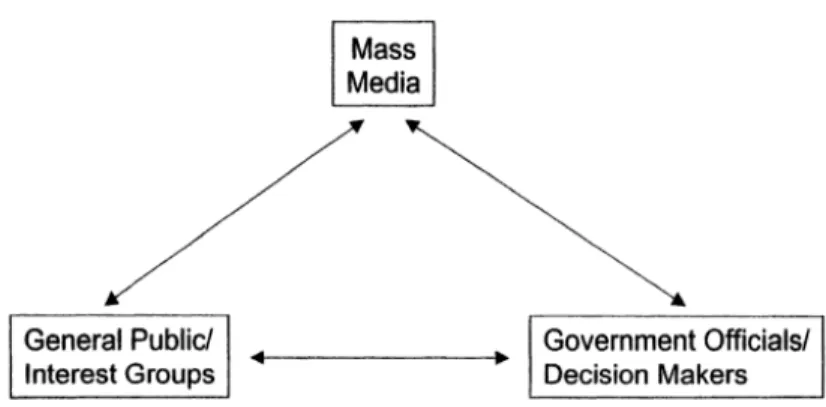
The September 11, 2001 attacks were also theatrical performances greatly amplified by the media to further prove to the terrorists the importance of media exploitation in publicizing their message. In this sense, terrorist acts have been a success in terms of public attention and the ability to promote terrorist agenda to the global community. The model of Triangle of Political Communication by Brigitte L. Nacos (2002) is among the first theoretical models to demonstrate the potency of the symbiotic relationship between terrorist groups and the media. The following figure
demonstrates the communication between the general public and government officials, where the media is the facilitator or transmitter of the communication.
Figure 1: The triangle of political communication (Nacos, 2002:11).
The government can utilize the media to demonstrate a certain agenda item through to the public or use it to sway public opinion on certain policy endeavors. The same relationship applies for the general public, where certain commercials or
Of course media channels are not considered neutral or passive in construing any message on television, hence competing to gain the media’s interest to publicize a message is crucial. The media is in a position to decide which story is newsworthy, which needs to gain maximum media coverage, or what details of a story are excluded from the viewer’s scope. This point brings terrorist groups to strategize their attacks accordingly to gain maximum coverage and to have their political message publicized as well. The certain messages pertaining to the aim of terrorism moreover, must be
understood to better examine the crucial use for the media to deliver terrorist success. David L. Paletz and Alex P. Schmid defined several terrorist goals using the mass media as a means to an end (1992).
The first goal, argued by the authors is the demonstration of a terrorist movement’s strength. This goal pertains to the fact that terrorists want to show
governments that they are compatible challengers and can showcase their opponents as more vulnerable players. They do this by embarrassing or humiliating their enemies (Camphuijsen & Vissers, 2012). The success of this message is dictated by the publicity gained for their cause, which was evident in the September 11th attacks. The publicity of this attack reached a global audience, which in return amplified the capabilities of terrorist groups when infiltrating the world’s hegemony and at the heart of its symbolic power and authority.
because they are not directly involved with restricting their freedoms due to emergency legislation for homeland security for instance. Repressive action on the part of
authorities tends to present a darker side of government entities and would in turn breed resistance from the public and a motive to join the terrorist cause. The media, therefore, is used to portray such repression and publicize government actions and the responsibilities of citizens in the new societal order. This indirectly helps in spreading the terrorists’ political message.
Another goal for terrorists is to polarize public opinion and radicalize a significant portion of the population. This is meant to create chaos and fear among citizens, which might yield uncertainties and increase insecurities towards the authorities. This shows that the government might not be fully in control, which may lead to social conflict. In order to promote this perception, terrorist groups utilize media exposure, which proves to be of utter importance in this matter. Finally, terrorists believe that the violence committed is necessary and is in fact the only recourse to ‘set things right’ and hence would promote their actions as heroic. The media accentuates this goal when the terrorists’ message of violence as a means to an end is publicized as such, rather than an end by itself (Paletz & Schmid, 1992).
The public notion of terrorism has ‘improved’ in the sense that the negative light linked to acts of terror offers alternatives to understanding terrorist persona in the eyes of the public spectators. The shift in reporting has demonstrated an interesting
relationship between the public and terrorist groups through four steps that the media has taken when reporting terrorist attacks. The media has used: rationalization of terrorism, labeling of terrorism, terrorists as solitary fighters, and the Stockholm syndrome when administering reports to the public (Peresin, 2007).
Rationalization of terrorism refers to providing an explanation for the terrorist act in play. The media tends to explain the reasons for aggression committed against the innocent before presenting the news about the terror act itself. Reporters attempt to find the motives and show the political context in which the terrorists are portraying their demands. This process of reporting might have a profound effect on arousing sympathy for the terrorists, where a sense of identification is offered to the public to somehow relate to the terrorists in question.
Labeling of terrorism on the other hand, is when the media gives terrorists different names when identifying them. For example, terrorists are sometimes referred to as “killers”, “fighters for independence” or other labels as such. The labels all have differing connotations and some might be connected to positive values, which can view the terrorists in a brighter light to the public and might aid the cause of their mission. Labeling is a serious matter that needs to be used strategically to convey the right message to the public and have the desired effect for the government being targeted.
to bomb a place. Therefore, showing the terrorists as solitary fighters being surrounded by police forces and special squads creates an asymmetrical fighting scene to the
average person watching the news on television. It is argued by scholars that presenting terrorists as individuals whom are ready to sacrifice their lives as they are
outnumbered by capable forces often yield a positive image of bravery and chivalry (Peresin, 2007). This characteristic connotes to the respected and idealized heroes of Western mythologies and stories told to children. A connotation as such would
inevitably yield undesired sympathy from the public to terrorists and would in return encourage acts of terror.
Finally, the forth and last shift of media reporting is the Stockholm syndrome. Briefly, this term refers to a psychological phenomenon in which hostages express empathy and have positive feelings toward their captures. This syndrome is also known as capture bonding. Victims of terror acts often tend to identify themselves with the perpetrators and their motives. This is seen when a victim sees a humane side to the criminal. An example of that is when terrorists release a pregnant woman in a hostage situation or when helping older hostages and calming down others. The media can portray these unexpected acts of compassion, where the effects are visible on the public’s consciousness following the act.
instance, Manuel Soriano argues that “Al Qaeda … believe the West is using media as a tool of war by lying about the motivations behind both the jihad movement and the motivation of Western governments”(2008:6). The media is claimed to be responsible for distorting the salafis message of liberation and they were immediately seen in a negative light.
From this distortion comes a four point list that Soriano argues to be the
terrorist point of view -‐ in this case the jihadist’s – in the negative impact media has on their message. The first is referred to how the media diverts attention to the bigger issues of the Muslim population as a whole and focuses on insignificant details or on issues of little importance. The bigger picture in this case is always diverted from what the jihadists claim their message as is representative of the whole Muslim cause.
The second point is that the media has been exaggerating the military strength of the West, which puts the terrorists in a weaker stance to influence a bigger crowd. The third point of distress is that the media often distorts the image of Arabs and links their motivation to that of a madman (Baran, 2008). The fourth and final point is that
The above case does not in any way discredit the accusations on terrorists’ acts and so committing acts of terror is not justified, because of the media’s responsibility in tainting what is claimed to be their noble cause. Therefore, terrorists did not only master the use of the television media, but a new phenomenon came across as a valuable tool to exploit to the benefit of the terrorist cause as well. The Internet is another form of mass media communication that had a huge impact on terrorist activity by the end of 1999 (Weimann, 2008: 74). This presence is a fairly new subject to be explored in literature. Scholars are still processing the birth of this phenomenon within the hands of terrorists as it is well alive and in great use amongst today’s terrorist groups.
The facts around the establishment of Web sites, online forums, and chat rooms serving terrorists and their supporters is astonishing. In 1998 there were
approximately a dozen Web sites operated by terrorist organizations, where this number grew to 2,300 in 2003 and up to more than 5,300 Web sites at the end of 2006 (Weimann, 2006: 75). These numbers could easily be quadrupled today. The Internet, according to Gabriel Weimann has started off serving terrorist groups as well as individual terrorists who want to spread their messages of hate and violence and attract followers and fans. Today, moreover, terrorists are benefiting greatly from the use of the Internet than attacking it, where cyberwarfare and cyberterrorism has been one of the evolutionary warfare tactics.
These lucrative characteristics are just the beginning of what terrorists could establish with a playing field that is all theirs. The structure of the Internet made it easier for terrorist groups to communicate and conduct meetings on coded transmissions. This gave way to a new term coined by Arquilla and Ronefeldt (2001, 2003) called “netwar”. Netwar refers to “an emerging mode of conflict and crime at societal levels involving measures short of traditional war in which the propagandists … consist of small,
dispersed groups who communicate, coordinate, and conduct their campaigns” through the internet without any central command per se (Weimann, 2008:75). This has been evident in the case of Al Qaeda due to it being a flexible and adaptive entity with a decentralized structure.
Terrorist groups have established multiple websites and chat rooms and have utilized the Internet to attract supporters, manipulate potential supporters, appeal to the international community and target their enemies. Many terrorist groups have been documented and they include groups from all corners of the world. Those in Europe include organizations such as the Basque ETA movement, Armata Corsa, and the Real Irish Republican Army (Weimann, 2008: 76-‐77). The appeal of such websites extend beyond television media and is in a way a form of attracting news channels to broadcast manipulated images of terrorist causes.
websites to publicize the terrorists’ plans and commitment to perceived justice. The international ‘bystander’ is another public pool that the terrorists attract on their websites. These people are usually the public and surfers who are not involved in the conflict. This is evident through the presentation of simple and basic information about the organization (Weimann, 2008).
The images and uncensored footage on the Internet has also pushed television news channels to adjust their standards on the type of footage they would show. This resulted in a type of competition between news outlets and the Internet to generate higher viewer ratings, which in return pushed television outlets to show visuals that might not been common before (Baran, 2008). This new communication technology is pushing the boundaries for what television audiences are used to viewing, which might have profound consequences on the effect of terrorism on local societies. Press releases are also often placed on the Websites. The detailed background information and other useful material has been luring for other television reporters to gather more material to report on in international news. As a matter of fact, according to Weimann (2008) one of Hezbollah’s sites actually addresses journalists to interact with the organization’s press office via e-‐mail. One main benefit that is seen through the terrorists’ eyes is that the Internet allows a two-‐way communication between the audience and the terrorists, which continues to create a stronger bond for recruitment and other activities in
delivering a message globally.
This determined relationship between mass media and terrorism has
effect on terrorism, this section will briefly examine another byproduct that births from this relationship. Propaganda war as many authors call it, has been evident proof of the strong bond of the symbiotic relationship.
Many scholars contend that propaganda war has been initiated by contemporary media communication (Peresin, 2007). Negative publicity is known to hurt the
terrorist’s mission to absolute justice and hence, committing certain acts such as bank assaults, ambushes and diversion of arms solely for propaganda effects (Marighela, 1969). Propaganda war, according to Peresin can be “a very powerful psychological weapon and can greatly increase the effect of certain actions” within terrorism
(2007:9). Propaganda through media has been used by terrorists numerously and can be identified within four main objectives to deliver terrorist agenda.
Some acts of terror are committed to convey the propaganda of the deed and to create extreme fear among the terrorists’ target group, which is considered the first objective of propaganda war. The second is to mobilize wider support for the cause of terrorists. This is targeted towards the general audience and the international arena by emphasizing that such acts resemble righteousness and are truly morally justified. The promise of victory is once again emphasized to manipulate public opinion through media propaganda.
terrorists’ cause and inciting more support, increased recruitment and raising more funds through the mobilization of the masses.
This is all a careful tactical game that terrorists prepare for to be able to exploit the mass media and deliver their message globally. Of course the media’s objectives are well publicized, hence it is easier for the terrorist groups to strategize a newsworthy story to gain maximum publicity through a highly viewed channel. However, through the market of increased competition, media outlets are instigated by many limitations to reporting. Terrorists, therefore exercise the upper hand on propaganda war through the Internet. The websites created give terrorist organizations complete autonomy and freedom to represent their cause and image in any light they desire, therefore,
infiltrating propaganda war in a more cunning and impressionable way.
Now that a relationship between the media and terrorism has been established as a symbiotic one and encompassing inseparable attraction, it is necessary to examine the effects and consequences of this relationship on the public, the terrorists
themselves as well as on any counter terrorism efforts attempted by targeted
governments. The following section attempts to answer the questions pertaining to the effect of this relationship on terrorism.
THE RELATIONSHIP EXAMINED: IS IT NEGATIVE, POSITIVE, OR NEUTRAL?
The role that the media plays in the occurrence of terrorism, despite the doubtless symbiosis, has been greatly debated and many scholars such as the French sociologist Michel Wieviorka and the Spanish communication theorist Miquel Rodrigo claim that there is not enough evidence to prove that media has any effect on instigating terrorism. Wieviorka denies any symbiosis between the two players and that terrorists relate to the media on four different levels that range from pure-‐indifference to media to media-‐oriented strategy (Biernatzki, 2002: 5). In other words, terrorists do not always commit acts of violence to strategically attract media attention, where publicity could be is their last concern.
Another opposing view is Rodrigo’s, where he argues that the mass media cannot be scientifically shown as the sole player for the complex phenomenon of
However, Margaret Thatcher’s stout remark on the media being the ‘oxygen’ to terrorist activity (Peresin, 2007: 19) hints at an obvious need to prove such a
relationship. Others who followed suit are Peter C. Kratcoski who stated “if one of the elements of terrorism is the wish to obtain publicity for a cause and create propaganda, the media has obviously overreacted in responding to this desire” (Biernatzki, 2002:6). Brian Jenkins, the senior adviser to the RAND corporation also claimed “terrorism is a product of freedom, particularly freedom of the press (Biernatzki, 2002:5). Alex P. Schmid provides another argument that would oppose Rodrigo’s stance on the lack of evidence in his book Violence as Communication (1982) when he identifies the basic view of how terrorist actions should be seen. He argues that terrorism should be seen as a means of communication to deliver a message of political change across, rather than identified as mere unjustifiable violence and “this type of terrorism has to be explained in relation to the prevailing information order and the news values that are paramount within this order” (Biernatzki, 2002:9).
provide a portion of the puzzle to finally gather scientific material to test this recent phenomenon and give way to future research that would open the field of scientific revelation towards today’s terrorism. Each study will be specifically examined hereafter.
Impact on Public Opinion
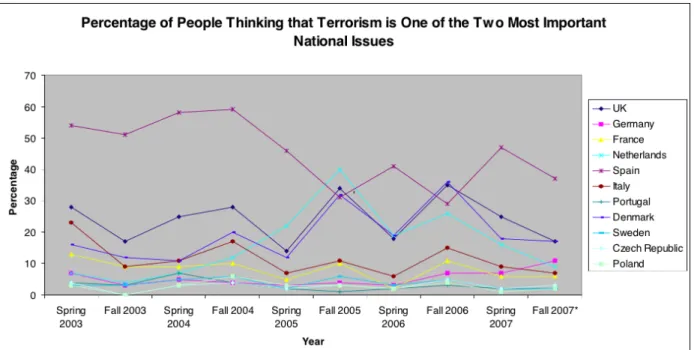
Alexander Spencer conducted a study to examine the salience of the mention of the term ‘terrorism’ in leading British newspapers to observe any effect salience has on British public opinion through the semi-‐annual standardized Eurobarometer polls from 2003 to 2011. The author suggests a correlation between the salience of terrorism in news media and the importance of the term in public opinion. Spencer expected that the salience of terrorism in the media in Britain was highest in the six months following the London bombings in 2005 and this was due to another hypothesis of his that states that an expected increase in violent attacks will lead to more public attention due to it being luring to the mass media (Spencer, 2012 figure 2).
Figure 2:Salience of terrorism in newspaper headlines (Alexander Spencer March 2012)
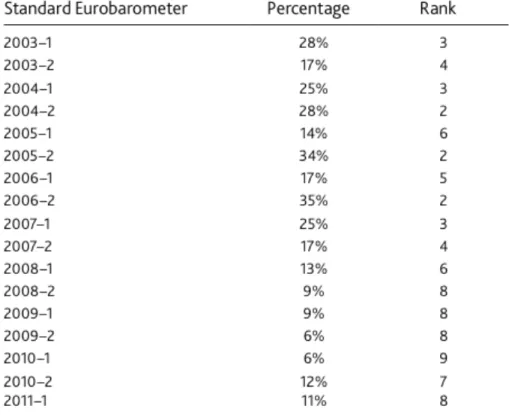
The following chart shows a tally of Eurobarometer results twice a year starting from 2003 to 2011 with a center question: what do you think are the two most
important issues facing Britain at the moment? (Standard Eurobarometer No. 59-‐74).
Figure 3: Public priorities on issues concerning their country (Alexander Spencer March 2012)
From 2003 to 2006 there has been high responses to how the public prioritizes issues concerning their country and terrorism remained mostly ranked the second or the third on the public’s list of importance on consistent basis. This chart along with the previous line graph compiled on the salience of the term terrorism clearly show an impact on media formulating public opinion in publicizing terrorist news.
Spencer then dives into a deeper dimension to explore the effects of this relationship. He looks at another element that could play a significant role in
when composing a certain newsworthy story. His paper considers the implications of how knowledge about terrorists is presented as well as the language used to influence the perception of the public towards terrorism, which might ultimately give way to adding another component of the influence on the spread of terror aided by the media. The first framing technique tackled is the use of metaphors. The author
distinguishes between conceptual metaphors and metaphoric expressions by stating the following:
The conceptual metaphor, for example terrorism is war, involves the abstract connection between one ‘conceptual domain’ to another by mapping a source domain (war) and a target domain (terrorism) … however, metaphorical expressions are directly visible and represent the specific statements found in the text which the conceptual metaphor draws on.
-‐ Spencer 2012:16 The significance for human cognition through the use of media for metaphors
exemplifies importance in justifying the perception of terrorists from the general public. The next metaphor explored is the 9/11 ‘war on terror’. This metaphor
illustrated an actual war and brought back cognitive connections to Pearl Harbor and other battles, where Osama Bin Laden has been declared a ‘terror war lord’ (Spencer, 2012: 17). Hence the salience of the metaphor ‘war on terror’ was studied in British newspapers. The implications of such salience made the prospects of military intervention a viable and an appropriate response. For example, between 67 and 74 percent of people surveyed support military action by Britain against Afghanistan in 2001, and in 2002 the number was consistently high and it continued until 2004
media’s metaphoric use of war terms on terror. Other metaphors were studied as well in Spencer’s research like ‘evil’ and other terms labeled for terrorists with the same correlation occurring.
Moreover, a study by the Sixth Framework Program in 2008 was conducted in Europe to examine the effects of the media on three possible targets: the public, the government or policy decisions, and possible effects on terrorism (terrorists). The researchers affirm Hoffman’s statement that the real issue of the media and terrorism “is not so much the relationship itself, which is widely acknowledged to exist, but whether it actually affects public opinion and government decision making … in a manner that favors or assist terrorists” (Hoffman, 2006:183). Hence, the hunt for answers begins with secondary sources in literature and primary, such as opinion polls and media analyses.
Brigitte Nacos conducted interesting studies to give scholars who followed insight on the correlation of this relationship. She found out that after the 9/11 events, news consumption was tainted by fear of terrorism as opposed to people who did not consume the news very closely (Nacos, 2006). Her studies are mainly focused on the United States, but her findings suggest interesting implications to Europe, as the Sixth Framework Program suggests. Later studies done by Nacos and other scholars found that attention to terrorism in the media does not have a strong effect on the way the public perceives terrorist threat. However, a factor was determined to present correlation into the equation. This factor was ‘who’ conveys the message (Sixth
the message has been delivered by a terrorist or a known leader, then people would react to the threat of terrorism differently (2006).
Another experimental study conducted by Michelle Slone in Israel provided a significant relationship between watching related news footage of terrorists and the creation of a heightened state of anxiety among the public (2000). She conducted this experiment with different groups exposed to different footage, where the clips ranged from terrorism and security threats to one group and other random events to another group. This experiment however, only examines the immediate response of media footage and does not convey the possibility of long-‐term effects.
Figure 4: Public opinion on terrorism and national issues (TTSRL research: Sixth Framework Program 2008)
results on the Eurobarometer would differ, because France actually experienced the proximity of terrorism on its own soil.
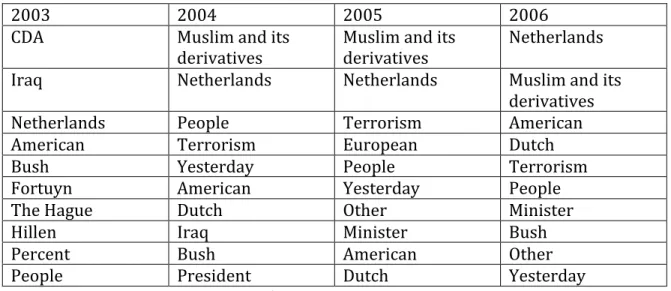
Another study was taken from PARANOID and analyzed to see the significance of certain words and their rank of importance within each year.
2003 2004 2005 2006
CDA Muslim and its
derivatives Muslim and its derivatives Netherlands
Iraq Netherlands Netherlands Muslim and its
derivatives
Netherlands People Terrorism American
American Terrorism European Dutch
Bush Yesterday People Terrorism
Fortuyn American Yesterday People
The Hague Dutch Other Minister
Hillen Iraq Minister Bush
Percent Bush American Other
People President Dutch Yesterday
Figure 5: Public perception on terrorism (TTSRL research: Sixth Framework Program 2008)
literature has been weak in finding a strong correlation due to the complexity of the topic in question. Nevertheless, this research continues to tackle possible factors and material that might aid in the impact or the relevance of the media on terrorism. The previous chart also speaks of obvious trends on major events through the years, but the word Netherlands is seen often ranked high due to the fact that terrorism might have been focused more domestically within the homeland security threat rather than globally. This might be one explanation for the recurrence of domestic terms in different European countries. People moreover, may feel that terrorism is more important when they hear it regularly circulating in their own country, which then resonates globally and hearing about it domestically would logically heighten public perception and fear towards the phenomenon.
Impact on Policy: the Government
The second aspect, which might be affected by media coverage of terrorism, is policy-‐making. Scholars have argued that the media has a strong connection with
government officials where it has the power to set the agenda, promote the salience of a topic and negotiate with terrorists as the media is given some authority over this area. The Triangle of communication by Nacos shown previously demonstrates the
communication network the media has. Hence, the Sixth Framework Program once again conducted a research analysis on the effect the media might have on policy changes.
a region then an equivalent to the CNN station would be the BBC. Hence, the CNN effect will instead be referred to as the BBC effect in this section. Steven Livingston describes three main factors that distinguish the characteristic of this effect. The first is that it entails a policy agenda-‐setting agent, the second is that the BBC (CNN) effect acts as a hindrance to the achievement of policy goals and finally, that it constructs a hastened expectation to policy-‐decision making (Sixth Framework Program, 2008).
Moreover, an emotional and compelling coverage can reorder foreign policy priorities for governments. Coverage intensity is vital to what the government is expected to do on whether it was pressured from the public or the international arena to act. Government officials might have to hastily make a decision largely due to modern technologies and the media’s instant reporting, which creates accelerated demand for action. An example of that would be when an American soldier was killed and dragged in Somalia. There were increased pressures to withdraw US troops and the demands have been greatly successful when the government responded immediately (Hoffman, 2006). The more gruesome visual images are portrayed in the media, the higher the public pressure on the government to act. An example of the rising impact of gruesome imagery would be when European support for the mission in Afghanistan fell drastically after the invasion. European diplomats were convinced that this was due to the BCC effect. The media was reporting on the collateral damage, the humanitarian crisis and the realities of war, where obscene imagery became very common on European television screens (Sixth Framework Program, 2008).
interviewed family members, and the reports had a focus on human interest and drama. This led to an enormous increase in public pressure to give in to terrorist demands. Another influence that the media have had is within disclosing certain information to the public. The amount and type of information media reports on a certain attack might hinder the rescue missions and place the lives of police officers in danger. Television crew can appear too close to the hostage area, or releasing too many information about the terrorists in the media, which might obstruct court trials against them or present more public misinterpretation and intervention in police counter-‐terrorism efforts. There was a case where journalists took on the role of negotiators with terrorists as well. CBS White House correspondent Lesley Stahl once explained “we are an
instrument for the hostages … we force the Administration to put their lives above policy” (Hoffman, 2003:120).
The effect of media on policy changes is evident. The media continues to play a great role in setting agenda priorities. The active role of pressuring the government through media reporting proves that this communication medium is very much involved in defining country politics. Therefore, so many scholars hint at a strong connection between the media and acts of terror as media outlets can be exploited to one’s own agenda. Experts hence, agree that the most fatal effect of this crisis is the confirmation of terrorism as a tactic (Peresin, 2007).
Impact on Terrorism
The final point of analysis is the impact of media on radical thought. Does the media actually have an effect on those who might be swayed to join terrorist groups in the recruitment process? This is a difficult question to answer and it will continue to be for the lack of empirical evidence and the difficulty to obtain any primary sources on terrorist intentions or prospective terrorists’ confessions. However, Rohner and Frey hint at a link to this question in their book as they state, “ there is a common-‐interest-‐ game, whereby both the media and terrorists benefit from terrorist incidents and where both parties adjust their actions according to the actions of the other player” (Frey & Rohner 2007:142). This implies that more terrorism leads to more media coverage and the opposite is true where more media coverage of terrorism leads to more theatrical terrorist acts. The authors’ study focuses on Africa and terrorism there, where they expected terrorist activities to be bloodier in order to reach a global
bloody attacks may account to more explanations than the cause of media attention but media attention could highly be one of the reasons.
Ayla Schbley went on to prove this point by conducting interviews with 2,000 Arab and Muslim demonstrators in European cities. She attempted to explain Al-‐ Manar’s (a television channel based in Lebanon) role on aggravating terrorism. Her question roamed around what Hezbollah coined ‘Jerusalem Day’, where Muslims should demonstrate against Israel and the US. She concluded that although not all of the
demonstrators are radicalized, they exerted “certain propensity to violence”, where much of their information came from the media (Schbley 2004: 130). Her argument raises an interesting factual truth to the relationship of media in intensifying terrorism, however, she did not isolate information coming from other European or American news channels, because these European nationals surely are exposed to their host country’s local news as well.
media has on terrorism. Again, this might be one separate instance, however,
replicating such studies in different countries and comparing the results would be a first step to finally accumulate empirical evidence to demonstrate the strength and impact of this symbiotic relationship between media and terrorism.
After establishing the type of research conducted to find a correlation between the media and terrorism, it is understood that a concise study that encompasses vital elements is needed to carry out fieldwork dedicated to finding a cause-‐effect
relationship between the two factors. The next section will demonstrate a refined study with several changes in variables collected between all the previous researches
presented to compose an upgraded model to guide future scholars on how to approach this relationship.
A NEW APPROACH: A HYBRID MODEL
To begin with, the polls and Eurobarometer questionnaire will be the point of departure here. The type of question asked “what do you think are the two most important issues facing your country at the moment?” is an ambiguous statement that could encompass any number of factors. Hence, we need to narrow down the
possibilities for answering the question in a sense that does not jeopardize the integrity of an unbiased question, but at the same time would lead to the conclusion of the
matter. Therefore, to conclude on whether there is a strong correlation between media and terrorism, polls should ask different types of questions. The model I suggest would start with a roadmap to lead to the right data to examine this relationship. The
questions that the new model should ask are as follows: what are the two main sources of media do you use to obtain your daily news? Which three top channels/newspapers do you follow to obtain your news? How much of your news intake about terrorism activities do you obtain from the television? The Internet? Newspapers?
where the model adopted through the Sixth Framework Program in 2008 on the salience of the word terrorism and its derivatives in various EU counties would be borrowed to examine the salience within the top chosen news channels or newspapers of the questioned pool of people. Focused questions on the specific news coverage gathered through the period from 2005 to 2015 would be beneficial to obtain a sample of perceived reactions of the public towards terrorism activities. Such questions might be a development of Ayla Schbley’s 2004 study when she asked a pool of consumers about their reaction of terrorist news gained from the respective channel. Looking at the reaction to the terrorist-‐centered news to the public opinion on what they learned and how they perceive the risks of the proximity of terrorism within their own country, will give an idea of how to empirically examine the effect of the media on public
opinion. As the news becomes more sensationalized and the type of footage bloodier with higher discern on moral conduct, the actions of average citizens could be observed to shift based on the number of criminal incidents taking place with similar demands, scenarios or methods as inspired in the highly salient footage of the Islamic State, for instance.
As the new model examines the relationship with newly expanding groups such as ISIS and their strong grip on visuals, there would be more empirical evidence to support the hypothesis relating media to higher intensity acts of terror. Crimes and the surfacing of extremist thought around the world have been become more apparent within everyday news. Hence, gathering data on public opinion as well as the