Corporate Headquarters
750 Central Expressway
Santa Clara, California 95050-2627
U.S.A.
Phone: 1 408 970 1000
www.hds.com
[email protected]
Asia Pacific and Americas
750 Central Expressway
Santa Clara, California 95050-2627
U.S.A.
Phone: 1 408 970 1000
[email protected]
Europe Headquarters
Sefton Park
Stoke Poges
Buckinghamshire SL2 4HD
United Kingdom
Phone: +44 (0) 1753 618000
[email protected]
Hitachi Data Systems is registered with the U.S. Patent and Trademark Office as a trademark and service mark of Hitachi, Ltd. The Hitachi Data Systems logotype is a trademark and service mark of Hitachi, Ltd. HiCommand is a registered trademark of Hitachi, Ltd.
Hi-Track is a registered service mark, TagmaStore is a registered trademark and Thunder 9500, Lightning 9980V, Lightning 9960, Thunder 9585V, SplitSecond, Graph-Track, Thunder 9570V, Thunder 9520V, Application Optimized Storage, Lightning 9900, ShadowImage, TrueCopy, Resource Manager, Hi-Star, and
Hitachi T agmaStor e ® En terprise Stor age A rchitec tur
e Guide
Intelligent Virtual Storage
Controllers: Hitachi TagmaStore
®
Universal Storage Platform and
Network Storage Controller
Architecture Guide
Partner Beyond Technology
Executive Summary
Business Challenges and IT Pain Points
Organizations are facing a number of challenges, which, if not addressed, can threaten their very
survival. Some of these challenges are external. Competition is no longer from just the familiar,
traditional competitors in your industry; it now can come from anywhere in the world, often
leveraging products manufactured at much lower cost with acceptable quality, and it may even
come in the form a substitute product from a different industry.
Other challenges are internal—getting products to market faster, reducing manufacturing costs,
making the supply chain more efficient, increasing worker productivity, streamlining business
processes, maintaining customer relationships, integrating acquired companies, and providing a
total customer experience. Further internal challenges have emerged more recently, as government
and industry regulations have become more widespread and demanding. Any public company (or
company that might ever become public) faces financial regulations (Sarbanes-Oxley Act, for
example) and others that require retention of many documents, e-mail messages, etc., for prolonged
periods of time. Other regulations (such as Basel II) require business continuity processes and system
risk mitigation.
These challenges are addressed through a combination of information technology, based on storage
systems, and organizational (people) processes. For many organizations, getting information technology
aligned with business objectives is painful. One of the pain points lies in “islands of storage management.”
Most organizations have storage platforms from a number of different vendors in the data center.
Each platform requires its own procedures and expertise, has its own set of management tools and
software utilities, data replication engines, and business continuity processes. These platform
differences often result in islands of storage management, which cause increased complexity and
significant operational inefficiencies due to duplication of skills, training, and operational expense.
Because these islands of storage management are not integrated, administrators often have to rely
on manually prepared spreadsheets to get a view of the overall enterprise storage environment. In
fact, such non-interoperable multivendor storage environments prevent IT executives from
achieving breakthrough reductions in storage total cost of ownership (TCO) because cost and
operational inefficiencies have become ingrained in storage budgets and no vendor to date has
offered a unifying solution.
Meeting Today’s Challenges with Hitachi TagmaStore® Universal Storage
Platform and Network Storage Controller
To directly address these challenges, Hitachi Data Systems announced on September 7, 2004, the
breakthrough Hitachi TagmaStore® Universal Storage Platform, built on a combination of
revolutionary advances in hardware and software that radically improve storage operations and
management efficiency and make true financial benefits possible. The Universal Storage Platform
not only extends the Hitachi leadership position in performance and capacity at the enterprise level,
but for the first time it also enables multivendor storage virtualization and logical partitioning, plus
universal vendor-agnostic data replication, all through a simplified “single pane of glass” common
storage management approach. Subsequently announced, its space-efficient, smaller-footprint
version, the Hitachi TagmaStore Network Storage Controller, delivers the same enterprise-class
functionality to midsized businesses and enterprise departments.
As foundations for Application Optimized Storage™ solutions from Hitachi Data Systems, the
Universal Storage Platform and Network Storage Controller are powerful enablers that help you
align IT with business objectives. By employing multivendor storage virtualization capabilities of the
Universal Storage Platform and Network Storage Controller, you can deploy a tiered storage strategy
that answers new archiving regulations for data retention and implement out-of-region data
replication to ensure business continuity. You also can extend the life of your current storage and
avoid future capital expenditures, which, depending on your configuration and installed base of
storage, can result in as much as a 40 percent reduction in TCO.
There is no need for forklift upgrades or major changes in storage management operations. Rather,
the Universal Storage Platform and Network Storage Controller simply interconnect your multivendor
systems and then manage all of your organization’s data globally, through a single pane of glass.
There is no longer a need for manual spreadsheets to reconcile the islands of storage management
or wasted costs of duplicated skills, training, and operational expense.
The Network Storage Controller is also available in a disk-less version. The disk-less Network Storage
Controller for midsized enterprises completely separates the commodity media (disks) from the
innovation (intelligent control unit) required to provide storage, data, and content services. It allows
you to adopt the latest functionality and capabilities while utilizing existing storage assets.
Does employing the Universal Storage Platform or Network Storage Controller to achieve these
benefits result in your company getting locked into Hitachi as a vendor? Not really, thanks to the
multivendor approach of this technology. The benefits far outweigh the risks:
: :
New competitive advantage of aligning IT with business goals
: :
New revenue streams through new business agility
: :
Lower TCO, improved return on investment (ROI), and reduced risk
The Hitachi Data Systems Global Solution Services organization can help you map out a plan to
achieve the full benefits of adopting the Universal Storage Platform or the Network Storage
Controller.
Serving Organizations from Growing Midrange Companies to the Largest
Global Organizations
For enterprises seeking a powerful and cost-effective storage solution for managing their growing
data retention and business continuity needs, the Universal Storage Platform is an ideal choice.
Although it is being deployed by many of the world’s largest enterprises, the Universal Storage
Platform also fits the plans and budgets of many smaller companies. These companies are facing the
same issues as the larger ones, just on a different scale and, of course, with much smaller staffs.
Indeed, among the first customers for the Universal Storage Platform, both Pacific Capital Bancorp
and University of Utah Health Sciences Center saw it as a way to consolidate, virtualize, and provide
advanced functionality (remote replication, for example) to their islands of midrange storage
systems and gain significant financial returns. Adding to the range of these intelligent storage
controllers, the Network Storage Controller answers the needs of midsized businesses and bolsters
the lower end of enterprise infrastructures with its cost-efficient modular form factor.
This architecture guide provides an overview of the Universal Storage Platform and the Network
Storage Controller, including breakthrough innovations, components, and features, as well as models
and packaging. In addition, this guide addresses how the Universal Storage Platform and Network
Storage Controller rise to meet the business challenges of storage growth and infrastructure
complexity, data protection, and regulatory compliance while facing flat or decreasing budgets and
staffing. It culminates with a case history of financial and operational benefits gained through
implementation of the Universal Storage Platform.
Table of Contents
Chapter 1: Introducing the Hitachi TagmaStore® Universal Storage Platform and Network Storage Controller ...1
Redefining the Industry Standard, Once Again ...1
A New Paradigm for Storage ...1
Universal Storage Platform: Breakthrough Innovation ...3
Controller-based Virtualization: the Simple and Innovative Hitachi Approach to Storage Virtualization ...3
Breakthrough Software Innovations ...3
Powered by the Hitachi Universal Star Network™ Massively Parallel Crossbar Switch ...5
Universal Storage Platform and Network Storage Controller Models ...5
Answer Performance Challenges with Application Optimized Storage™ Solutions Based on the Universal Storage Platform and Network Storage Controller ...7
Global Solution Services and Best Practices for the Universal Storage Platform and Network Storage Controller ... 10
Chapter 2: Hitachi Controller-based Storage Virtualization ... 11
Storage Virtualization Defined ... 11
Approaches to Storage Virtualization ... 11
Host-based Virtualization ... 11
Network-based, Appliance-based, or Switch-based Virtualization ... 12
Controller-based, “In-the-box” Virtualization ... 12
The Hitachi Approach: Controller-based External Virtualization ... 12
The Evolution of Virtualization at Hitachi ... 14
Hitachi Combines the Strengths of Other Approaches... 15
Hitachi Storage Virtualization Enables Many Financial Benefits ... 16
Chapter 3: Hitachi TagmaStore® Universal Storage Platform and Network Storage Controller Models ... 17
Universal Storage Platform Packaging ... 17
USP1100—High-end Model ... 17
USP600—Enhanced Model ... 20
USP100—Entry-level Model ... 21
Network Storage Controller ... 22
Power Subsystems of the Universal Storage Platform and Network Storage Controller ... 24
The System Monitoring Network of the Universal Storage Platform ... 25
Chapter 4: Hitachi TagmaStore® Universal Storage Platform and Network Storage Controller Components and Features ... 27
An Overview ... 27
The Industry’s Highest Performance Design ... 27
Front-end Design of the Universal Storage Platform and Network Storage Controller ... 31
Connection to Open Systems Hosts ... 32
Connection to Mainframe Hosts ... 33
High-performance, High-capacity Back-end Design ... 34
All Fibre Channel Back-end Design ... 34
Flexible back-end configurations ... 34
High-capacity Back-end Design ... 35
Mix and Match High Density Drives Tailor Capacity and Performance to Application Requirements ... 35
Advantages of the Hitachi RAID Implementations ... 35
Connecting to External Storage ... 37
Chapter 5: Data Availability Solutions ... 39
The Importance of Data Availability Solutions ... 39
The Universal Storage Platform and Network Storage Controller Availability Profile Compared to Competitive Products ... 40
Business Continuity Software Solutions ... 42
Data Movement and Data Protection Software ... 42
Universal Replicator Software ... 43
Hitachi Data Protection Suite ... 45
Hitachi HiCommand® Backup Services Manager software ... 45
Business Continuity and Disaster Recovery Services ... 45
Hitachi SplitSecond™ Solutions for Rapid Recovery ... 46
Remote Copy Planning and Design Service ... 46
Business Continuity Software Services ... 46
Tape Backup Service ... 46
Replication Automation Conversion Services: EMC to Hitachi Storage Systems or IBM PPRC to Hitachi Storage Systems ... 46
Business Continuity Manager Environments ... 46
Chapter 6: Enterprise Regulatory Compliance Solutions ... 47
Message Archive for E-mail Solution ... 48
Message Archive for Compliance Solution ... 49
Hitachi Content Archive Platform ... 49
Chapter 7: Simplification Solutions ... 51
Driving Complexity and Cost out of Multivendor Storage Environments through Consolidation, Virtualization, and Common Management ... 51
Virtualization and Logical Partitioning ... 51
Hitachi Universal Volume Manager Software ... 52
Hitachi Virtual Partition Manager Software ... 52
Common Storage Management via Hitachi Storage Management and HiCommand® Suite Software ... 52
Hitachi Resource Manager™ Utility Package ... 53
Hitachi HiCommand® Storage-specific Management ... 53
Hitachi HiCommand Heterogeneous Storage Management ... 54
Storage Management Consulting and Services ... 55
External Storage Implementation Service for Hitachi TagmaStore® Universal Storage Platform and Network Storage Controller ... 55
Storage Consolidation Services ... 55
Storage Economics Strategy Service ... 56
Tiered Storage Services ... 56
Tiered Storage Planning and Design Service ... 56
Implementation Service for Tiered Storage ... 56
Implementation Service for Hitachi Storage Systems ... 56
Chapter 8: Competitively Unique Financial Benefits—Building a Business Case ... 57
Building a Business Case for the Universal Storage Platform ... 57
Start with Realistic Assumptions ... 57
Define and Align Storage Objectives with Business Objectives ... 57
A Powerful Mix of Unique Features and Benefits ... 58
Business Continuity Benefits ... 58
Regulatory Compliance Benefits ... 59
Storage Management Benefits ... 60
Storage Consolidation Benefits ... 60
Storage Aggregation Benefits ... 61
Storage Virtualization Benefits ... 61
Storage Utility Chargeback Benefits ... 62
Total Cost of Ownership and Return on Investment Benefits ... 62
Storage Economics Strategy Service ... 63
An ROI Case History of Virtual Architecture Justification... 64
Appendix A: Technical and Economic Benefits of the University of Utah Health Sciences Center (UUHSC) Case History ... 68
Technical Benefits ... 68
Economic Benefits ... 69
Basis for ROI Calculations ... 69
Introducing the Hitachi TagmaStore
®
Universal Storage Platform and
Network Storage Controller
Redefining the Industry Standard, Once Again
With capabilities generations ahead of any competitive offering, the Hitachi TagmaStore® Universal Storage Platform establishes a new industry category of intelligent virtual storage controllers that IDC calls Networked Storage Controllers. It brings into reality the virtualization of both internal and external heterogeneous storage into one pool of storage that is manageable through a single interface. In its space-efficient, smaller-footprint version, the Network Storage Controller model NSC55 delivers the same enterprise-class functionality without the need for a raised-floor data center environment. Both the Universal Storage Platform and the NSC55 are wrapped in a comprehensive set of software and services, including application-centric storage management and simplified and unified data replication across heterogeneous storage systems.
A New Paradigm for Storage
The Universal Storage Platform and Network Storage Controller empower IT executives to look at storage deployment and management in a whole different way. By placing the Universal Storage Platform or Network Storage Controller at the apex of their storage infrastructure and attaching existing storage systems directly or through a storage area network (SAN), CIOs can gain significant savings through radical IT efficiencies of scale. These efficiencies can be achieved through “single-pane-of-glass” management for all storage; implementation of data lifecycle management strategies that allocate data to storage devices according to a variety of criteria, including availability, performance, capacity, and cost; or deploying heterogeneous out-of-region data replication to comply with business continuity requirements.
Today, the Universal Storage Platform and the Network Storage Controller can move mainframe data to midrange storage systems—an industry first. These platforms can underpin applications such as Enterprise Content Management by aggregating all sources of information and protocols across the organization and optimizing the placement of content across all tiers of storage. Further, by serving as foundation platforms for Hitachi Content Archive Platform, the Universal Storage Platform and Network Storage Platform support an active archive environment—a single online repository that enables protection, search, and retrieval across all content types. Hitachi Data Systems offers additional flexibility in the disk-less version of the Network Storage Controller, which completely separates the commodity media (disks) from the innovation (intelligent control unit) required to provide storage, data, and content services, enabling midsized enterprises to adopt the latest functionality and capabilities while utilizing existing storage assets.
“ Hitachi Data Systems has delivered on a vision for a new approach for
simplifying storage management, improving overall storage efficiency, and
implementing data lifecycle management. The Hitachi TagmaStore Universal
Storage Platform is a combination of the next-generation enterprise-class
storage system and a high-end storage virtualization platform, resulting in a
new breed of intelligent networked storage.”
— “The Hitachi TagmaStore Universal Storage Platform” (7 September 2004) Enterprise Strategy Group
The Universal Storage
Platform maintains a
two-generation lead over
the competition.
Bringing together industry-leading Hitachi, Ltd., hardware, software, and networking technology, the Universal Storage Platform and Network Storage Controller provide the best features in storage technology available today to solve the problems you are facing from both a strategic and tactical perspective..
1. The Universal Storage Platform is a new industry category that reaches previously unattainable levels of consolidation and virtualization of up to 32PB of internal and externally attached heterogeneous storage in one pool with a unique embedded virtualization layer (illustrated in Figure 1). The Network Storage Controller joins the Universal Storage Platform in offering up to 16PB of internal and externally attached heterogeneous storage in a single pool via the same unique embedded virtualization layer.
: :
Logically partitioned storage resources maximize application quality of service (QoS)and facilitate chargeback and utility-like operations.
Figure 1. The Universal Storage Platform provides a consistent data management
and storage services platform for up to 32PB of internal and externally attached
heterogeneous storage.
Hitachi TagmaStore® Universal Storage Platform
SAN
Hitachi Lightning
9900™ V Series Hitachi Thunder 9500™ V Series
Third-party Storage SATA Intermix Option
for Hitachi Thunder 9500 V Series Sun HP IBM® IBM Mainframe Microsoft Windows
3. The Universal Storage Platform and Network Storage Controller provide the foundation for a total infrastructure solution powered by third-generation crossbar switch architecture.
: :
The mega-scalable crossbar switch architecture delivers an unsurpassed 68GB/sec of aggregate bandwidth and up to 2.5 million IOPS (input output operations per second, 700,000 IOPS for the Network Storage Controller), delivering unmatched performance for all measures of system design.: :
Front-end support options include all major open systems platforms and IBM® z/OS®-compatible mainframe computers, providing unsurpassed functionality.: :
The Universal Storage Platform and Network Storage Controller dramatically increase front-end connectivity by making available multiple “virtual” Fibre Channel ports, enabling truly large-scale data hyper-consolidation.Universal Storage Platform: Breakthrough Innovation
Several breakthrough hardware innovations from Hitachi, Ltd., enable the Universal Storage Platform and Network Storage Controller to deliver the significant economic and information architecture benefits discussed in this architecture guide.
Controller-based Virtualization: the Simple and Innovative Hitachi Approach
to Storage Virtualization
The objective of storage virtualization is to “melt” groups of heterogeneous storage systems into a common pool of storage resources. This simplifies management, enables increased utilization of storage resources, provides seamless migration across tiers of storage, removes interoperability barriers, and integrates common functionality across this pool of
heterogeneous storage.
With the Universal Storage Platform and the Network Storage Controller, virtualization is embedded in the Hitachi controller architecture, and it is extended to external storage systems in a way that neither adds complexity nor creates a proprietary lock-in. There are no appliances or application blades required in front of the storage, and there is no need to crack the packets and redirect I/O. Additional storage services such as replication and mirroring do not have to impact the core switches and directors. None of that added complexity and resultant latency is needed.
The Universal Storage Platform and Network Storage Controller eclipse all previous attempts at storage virtualization and, in dramatic fashion, deliver on a bold vision with immediate business value. Unlike virtualization approaches by other companies, the Hitachi approach does not introduce another layer of complexity between the application server and storage. Further, it does not reside in the Fibre Channel SAN and is not dependent on the SAN for virtualization. Therefore, it is not limited to virtualization of open systems Fibre Channel-based storage. It can support direct-attached Fibre Channel hosts as well as IBM ESCON®/FICON®-attached mainframes. Mainframe LDEVs can be mapped to lower-cost external ATA or serial ATA (SATA) storage.
Breakthrough Software Innovations
With organizations facing increasingly complex storage infrastructures, the groundbreaking virtualization and universal replication software for the Universal Storage Platform and Network Storage Controller provides centralized management of software suites that enable the deployment of many advanced business solutions, including:
: :
Business continuity and disaster recovery: :
Consolidation and aggregation: :
Data lifecycle managementThe Universal Storage
Platform and Network
Storage Controller
combine the best in
servers, software, and
telecommunications.
These solutions allow enterprises and midrange businesses to substantially reduce costs and maximize business value.
Hitachi Universal Volume Manager Software
Through the use of Hitachi Universal Volume Manager software, Hitachi extends its Virtual Storage Ports/Host Storage Domains technology into the first large-scale embedded virtualization layer, enabling internal and external storage—up to 32PB on the Universal Storage Platform and 16PB on the Network Storage Controller—to be aggregated into one common pool and managed by a single set of tools and software. Universal Volume Manager software also allows data replication and migration capabilities across heterogeneous storage systems, while enabling efficient integration and utilization of older storage systems. When combined with Hitachi Volume Migration software, Universal Volume Manager software enables data lifecycle management across multiple tiers of storage, including the storage of mainframe data on low-cost, SATA-based, midrange storage systems such as Hitachi TagmaStore Adaptable Modular Storage and Workgroup Modular Storage and the Hitachi Thunder 9500™ V Series systems.
Hitachi Virtual Partition Manager Software
As the first implementation in storage systems of the logical partitioning technology featured in large-scale Hitachi mainframes, Virtual Partition Manager software allocates Universal Storage Platform and Network Storage Controller resources, including ports, cache, and disk (internal and externally attached) into independently managed Private Virtual Storage Machines. Partitions can be dynamically modified to meet application QoS requirements based on changing business and application priorities. You can use Virtual Partition Manager software to create up to 32 Private Virtual Storage Machines on the Universal Storage Platform or 8 Private Virtual Storage Machines on the Network Storage Controller. Meanwhile, to the host, each Private Virtual Storage Machine appears as if it were its own storage system and, as such, allows efficient utilization of storage across the platform, enabling chargeback and utility-like operations through a virtual serial number.
Hitachi Universal Replicator Software
Universal Replicator software builds on the success of Hitachi TrueCopy™ Heterogeneous Remote Replication software bundle’s asynchronous version and provides a robust business continuity solution that supports both internal and externally attached storage. As it continues to advance the superior Hitachi asynchronous remote replication technology, Universal Replicator software features several industry firsts, including heterogeneous replication, disk-based journaling, protection against link failure, “pull” copying, and multi-data-center support. This ensures enhanced business continuity over any distance, including out-of-region disaster recovery centers, and improved IT operations without the need for redundant servers or replication appliances.
Hitachi Content Archive Platform
For long-term preservation and retention of the fixed content required for corporate governance and regulatory compliance, the Hitachi Content Archive Platform offers a highly scalable and reliable foundation for an active archive environment that ensures content will be available and accessible when needed. This solution supports multipetabyte active archives of
Internal and external
storage can be aggregated
into one common pool.
Ports, cache, and
disk capacity can be
independently managed.
Industry firsts include
heterogeneous replication,
disk-based journaling,
protection against link
failure, “pull” copying, and
multi-data-center support.
Storage Platform and the Network Storage Controller. Furthermore, users can standardize on tools such as HiCommand Chargeback software to enable centrally metered storage resource charging and HiCommand Application Modules for optimizing the QoS requirements for Microsoft Exchange and SQL Server, Oracle, Sybase, and File Server applications.
Heterogeneous HiCommand Application Modules are based on open architecture. These modules protect investments by working with almost any storage infrastructure to manage business and application demands. The Hitachi storage-specific management modules provide granular discovery and control of your Hitachi storage environment, including attached storage systems that are virtualized into the storage pool of the Universal Storage Platform or Network Storage Controller.
Powered by the Hitachi Universal Star Network™ Massively Parallel
Crossbar Switch
To perform storage virtualization, move data among storage tiers, and enable heterogeneous replication requires a powerful system with the highest performance in the industry. The Universal Storage Platform and Network Storage Controller deliver with the Hitachi Universal Star Network™, the third generation of patented Hitachi “non-blocking” mega-scalable crossbar switch architecture. The Universal Star Network is a radically enhanced version of the Hi-Star™ architecture in the Hitachi Lightning 9900™ V Series enterprise storage systems, delivering four times the internal processing power and bandwidth of the Lightning 9900 V Series systems, which previously led the competition by a wide margin.
The Universal Star Network is a massively parallel crossbar switch-processing engine implemented in industry-leading VLSI silicon chips. On the Universal Storage Platform it delivers an unsurpassed 68GB/sec of cached bandwidth and 2.5 million IOPS while performing 256 concurrent memory operations and supporting 332TB of internal storage capacity. On the Network Storage Controller, this translates to 8.5GB/sec cached bandwidth, 700,000 IOPS, 64 concurrent memory operations and 69TB internal storage capacity. This represents advantages ranging from 400 percent to 850 percent range compared to other storage products.
Universal Storage Platform and Network Storage
Controller Models
The Universal Storage Platform is offered in three seamlessly upgradable packages: entry-level model USP100, enhanced model USP600, and high-end model USP1100. Model USP1100 is recommended for users requiring large storage capacities of up to 332TB of raw storage in one system and the ability to virtualize and consolidate up to 32PB of heterogeneous external storage in one pool. With the same advanced architecture, model USP100 and model USP600 bridge the gap between standard midrange and advanced-function storage, with capacities up to 74TB and 148TB, respectively. Model USP100 is recommended for users who require advanced-function capabilities, yet do not need the actual storage capacity of models UPS600 and USP1100. For midsized businesses or those seeking to bolster the lower end of enterprise infrastructures, the Network Storage Controller model NSC55 offers 69TB of capacity in a cost-efficient, space-cost-efficient, modular form factor. Table 1 compares the key differences of the Universal Storage Platform and Network Storage Controller models.
A mega-scalable crossbar
switch delivers up to
68GB/sec of cached
bandwidth on the Universal
Storage Platform and
8.5 GB/sec on the Network
Storage Controller.
From the entry level to the
high end, there is simply
no comparison.
Table 1. Comparison of the characteristics of the Universal Storage Platform and
Network Storage Controller models.
Characteristics NSC55 USP100 Entry-level Model USP600 Enhanced Model USP1100 High-end Model Connectivity/Virtualization
of External Storage Systems
Yes Yes Yes Yes
Logical Partitioning Yes Yes Yes Yes
Private Virtual Storage Machines
8 32 32 32
Hitachi Universal Star Network™ Crossbar Switch Architecture
Yes Yes Yes Yes
Maximum Internal Concurrent Bandwidth
12.1GB/sec 23.5GB/sec 40.5GB/sec 81GB/sec
Number of Cabinets 1 or 2 Racks 1 1-2 1-5
Number of Disks 0–240 5–256 64–512 129–1152
Maximum Internal Raw Capacity
69TB 74TB 148TB 332TB
Maximum Virtualized External Raw Capacity
16PB 32PB 32PB 32PB
Maximum Data Cache Capacity
64GB 64GB 128GB* 256GB
Percentage of Internal Memory Available for Data
0-100 100 100 100
Maximum Control Memory 6GB 6GB 12GB 12GB
Maximum Number of LUNs 16,384 for Open Systems 65,536 for Mainframes 16,384 for Open Systems 65,536 for Mainframes 16,384 for Open Systems 65,536 for Mainframes 16,384 for Open Systems 65,536 for Mainframes
Fibre Channel Ports 16–48 0–128 0–192 0–192
Virtual Storage Ports 1,024 per
physical port, up to 16,384 per system 1,024 per physical port, up to 16,384 per system 1,024 per physical port, up to 24,576 per system 1,024 per physical port, up to 32,768 per system FICON Ports 0–16 0–64 0–96 0–96 ESCON Ports 0–16 0–64 0–96 0–96 NAS Blades**/Ports 0–1/0–8 0–4/0–16 0–4/0–16 0–4/0–16 iSCSI Blades 0–1/0–8 0–4/0–32 0–4/0–32 0–4/0–32
Nondisruptive Upgrades Yes Yes Yes Yes
Hi-Track® “Call-home” Service/Remote Maintenance Tool Support Package
Standard Standard Standard Standard
Note: All capacities are based on 1GB = 1,000,000,000 bytes (1TB = 1000GB) * Upgradable to 256GB
Selecting the right model of the Universal Storage Platform or Network Storage Controller depends on capacity requirements, including expected growth of data, performance, and connectivity requirements, such as external storage support. The Universal Storage Platform and Network Storage Controller offer storage system alternatives that cover a very broad range of scalability, as illustrated in Figure 2.
Figure 2. Both model NSC55 and entry-level model USP100 provide for
managed growth and open systems exploitation while the enhanced model
USP600 and the high-end model USP1100 provide for exploding growth and
data hyper-consolidation.
Answer Performance Challenges with Application Optimized
Storage™ Solutions Based on the Universal Storage Platform
and Network Storage Controller
The Universal Storage Platform and Network Storage Controller provide the architectural foundation not only for simplification, but also for Application Optimized Storage™ solutions from Hitachi Data Systems, which match business application performance and business continuity/disaster recovery requirements to different classes of storage. The Universal Storage Platform and Network Storage Controller enable enterprises to deploy applications within an Application Optimized Storage solutions framework and fully leverage and add value to current investments, aligning IT and business objectives, as shown in Figure 3. This is accomplished by leveraging the unique Hitachi approach to storage virtualization and logical partitioning.
100,000 50,000 200,000 300,000 400,000 20,000 10,000 8,000 4,000 2,000 0 Ra w Capacity in GB
Hitachi TagmaStore® Universal
Storage Platform and Network Storage Controller
Removing the Barriers to Scalability
148.0TB 74.0TB 332.0TB USP1100 USP600 USP100 NSC55 69.0TB
Rapid Business Growth and Consolidations
Managed Growth and Open Exploitation
Model USP1100 Growth Limit Model USP600 Growth Limit Model USP100 Growth Limit Model NSC55 Growth Limit
Figure 3. Application Optimized Storage solutions—a framework for aligning IT
and business objectives.
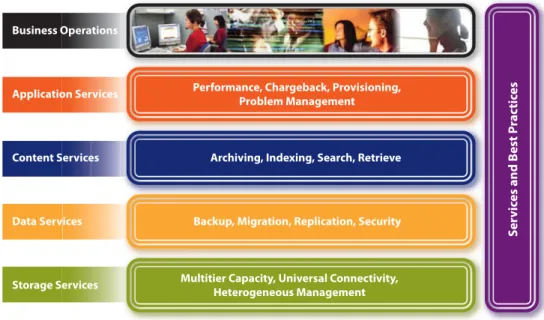
Complete solutions depend on many variables, including hardware design, connectivity infrastructure, and application, storage management, and business continuity software, as well as operators and services, whether outsourced or insourced. The Universal Storage Platform and Network Storage Controller are more than just breakthrough hardware and software innovations. They are wrapped in industry-leading software and service solution sets that address the top two business problems facing the enterprise today—business continuity/ disaster recovery and simplification—as shown in Table 2.
Business Operations
Performance, Chargeback, Provisioning, Problem Management Application Services
Archiving, Indexing, Search, Retrieve Content Services
Backup, Migration, Replication, Security Data Services
Multitier Capacity, Universal Connectivity, Heterogeneous Management Storage Services S e rvic es and B est P rac tic es
Application Optimized
Storage solutions closely
align IT and business
objectives.
Table 2. The Universal Storage Platform comprehensively solves the top two
business problems facing the enterprise today.
Business
Solution Solution Category Solution Elements
Storage Challenges Addressed Business C o n tinuit y/Disaster Rec o v er y
System Design Hitachi Universal Star Network™
massively parallel crossbar switch; redundant, hot-swappable components; global dynamic hot sparing; mirrored write cache with battery backup; Hitachi nondisruptive microcode upgrades; RAID-1+ and RAID-5 for data protection; Hi-Track® “call-home” service/remote maintenance tool
Internal processing power, bandwidth, high transaction rate, fault tolerance
Disk-to-disk Backup Application Backup/Recovery Mainframe Tape Replacement In-region Local Disaster Recovery In-region Metro Disaster Recovery Out-of-region Disaster Recovery IBM® GDPS™ Support Remote replication/disaster recovery: Hitachi TrueCopy™ Heterogeneous Remote Replication software bundle and Hitachi Universal Replicator software; Hitachi Compatible Replication for IBM® XRC software; Hitachi ShadowImage™ Heterogeneous In-System Replication software bundle (includes ShadowImage and Hitachi Copy-on-Write Snapshot software); Hitachi Serverless Backup Enabler software; Compatible Mirroring for IBM® FlashCopy® software; and Hitachi HiCommand® Dynamic Link Manager software
Disaster recovery, replication, application availability, risk reduction, service level agreements (SLAs), data protection, performance, QoS
Services Risk Analysis Workshop, Hitachi
SplitSecond™ Solutions, Remote Copy Planning and Design Services, Business Continuity Services
Total cost of ownership (TCO), return on investment (ROI), risk management, business continuity planning, outsourcing
Common Storage Management
Hitachi Storage Management and HiCommand® Suite software, Hitachi TagmaStore® Universal Storage Platform and Network Storage Controller for external and internal storage virtualization
Explosive data growth; fast-moving technology and business landscape;
management of heterogeneous environments; complex and costly management infrastructure; failure to meet application QoS and SLAs
Simplifica tion Open and Mainframe: Consolidation, Aggregation, and Virtualization
Hitachi Universal Volume Manager, Hitachi Virtual Partition Manager, Hitachi Volume Migration, and Hitachi Cross-System Copy software; Host Storage Domains
Explosive data growth; fast-moving technology and business landscape; management of heterogeneous environments; complex and costly management infrastructure; failure to meet application QoS and SLAs
Services Storage Consolidation Services,
External Storage Implementation Service for Universal Storage Platform and Network Storage Controller, Storage Economics Strategy Service
Maintenance
Corporate Compliance
Industry Solutions
Application Optimized Solutions
Enterprise Archive
E
ducation S
e
rvic
es
Storage Services
Infrastructure
Storage Area Management
Business Continuity
Product-based Services
Quick Start
Consulting
Consulting
E-mail Database Enterprise Application Filesystem
Consulting Process
Development ManagedServices
Utility Enablement
Replication RecoveryDisaster
Backup
SAN Implementation Migrate, Upgrade & Consolidate Fabric
Advanced Implementation Custom Services
Global Solution Services and Best Practices for the Universal
Storage Platform and Network Storage Controller
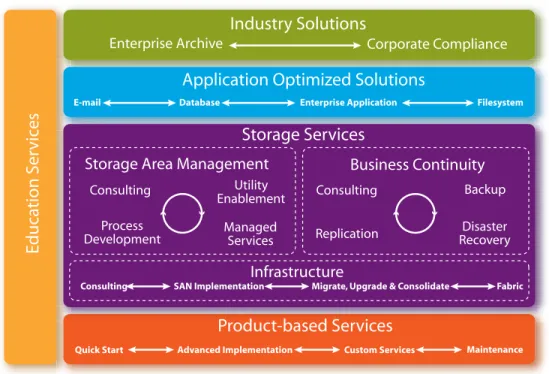
To ensure that you maximize your investment, Hitachi Data Systems Global Solution Services offers a comprehensive suite of technology, storage, education, and professional services and best practices for implementation of Application Optimized Storage solutions with the Universal Storage Platform or Network Storage Controller. These are shown in Figure 4.
Figure 4. Hitachi Data Systems Global Solution Services offerings.
Global Solution Services consultants can help you assess, deploy, implement, integrate, manage, and optimize storage infrastructure solutions that meet your needs. Areas in which Global Solution Services consultants can assist you include:
Industry Solutions—including enterprise content archival solutions that incorporate hardware, software, and professional services to address your business and regulatory compliance requirements
Application Optimized Solutions—bridging the gap between business applications and IT’s ability to precisely deliver service levels with Global Solution Services strategic consulting, design integration, and robust deployment capabilities
Storage Services—applying proven best practices along with appropriate tools and training to help with all stages of your storage infrastructure—from planning to maintenance
The Hitachi Data
Systems Global Solution
Services group offers
a comprehensive
suite of technology,
storage, education, and
professional services.
Hitachi Controller-based
Storage Virtualization
Storage Virtualization Defined
Virtualization is a technique that has been used for many years to mask complexity, enable new functionality, and drive improvements in performance, connectivity, capacity, and availability. Although the meaning of the phrase varies from speaker to speaker, the Enterprise Strategy Group defines virtualization as “a technology that gathers data location information from physical storage devices, network services, and applications, and then abstracts the locations into logical views for end users. “The Storage Networking Industry Association (SNIA) dictionary defines virtualization as “an act of integrating one or more (back-end) services or functions with additional (front-end) functionality for the purpose of providing useful abstractions. Typically, virtualization hides some of the back-end complexity, or adds or integrates new functionality with existing back-end services.” Essentially, virtualization is the abstraction of the logical view of storage from the physical layout. The benefit, of course, is ease of management. The Hitachi TagmaStore® Universal Storage Platform and Network Storage Controller fulfill this definition and provide simplified management of virtual assets in a way that no other product can match in terms of completeness of vision and ability to execute. Driven by the demand for data hyper-consolidation, Hitachi consolidation and virtualization software has evolved through a number of technology firsts, including LDEV, Host Storage Domains, and finally to the leading-edge.
Approaches to Storage Virtualization
Storage virtualization, which has been the “Holy Grail” for storage management, first began with host-based software schemes. With the increasing adoption of SANs, many vendors introduced storage virtualization solutions that resided as an appliance or switch blade in the SAN. The industry has also seen some attempts at virtualization1 via dedicated, add-on
appliances or through server- or switch-hosted virtualization software that sits in the data stream between client systems and storage.
Host-based Virtualization
Storage virtualization in the host has been around for some time. Initially, it amounted to abstracting the application view of a “volume” from the physical target and LUN addressing that was seen by the host interface. A class of software known as volume managers provides this type of virtualization. Additional functions, such as snapshots, mirroring, and replication have been added by the volume manager vendors. Volume managers were originally developed during the direct-attach era and were not necessarily SAN-aware. While some functions like replication could be completed between heterogeneous devices, virtual volumes were generally limited to one type of storage device per volume. The disadvantages of host-based virtualization are that it requires host cycles and is limited to the host in which the volume manager resides. Volume managers are also specific to a host platform, and are often embedded in the host software.
1 For a definitive technical economic discussion of the pros and cons of different approaches to virtualization and the evolution of the Hitachi approach, see the white paper “Hitachi TagmaStore® Universal Storage Platform: Virtualization without Limits.” This paper is authored by Naoya Takahashi, Ph.D., Chief Operating Officer Information & Telecommunication Systems at Hitachi, Ltd., and Hu Yoshida, Vice President and Chief Technology Officer at Hitachi Data Systems, and can be found on the Hitachi Data Systems Web site at: http://www.hds.com/pdf/ wp168_tagmastore_virtualization.pdf
Chapter
2
No other vendor can match
Hitachi consolidation and
virtualization solutions in
terms of completeness of
vision and ease of execution.
Host-based virtualization
requires host cycles and is
limited to the host in
which the volume
manager resides.
Network-based, Appliance-based, or Switch-based Virtualization
Over the last four to five years a number of SAN-based virtualization products have been introduced in the market. The arguments for in-band versus out-of-band appliances or intelligent switch blades have waged back and forth with religious fervor. However, instead of reducing complexity they have added another layer of complexity into the core of the storage network. Functionality, which was being accomplished on the edge of the network by storage controllers, was then reinvented for implementation in the core of the SAN. Everyone connected to the SAN feels the resulting latency from the overhead of this functionality. Intelligence in the SAN is important. However, it can only be useful if it has access to the right information. An appliance or switch blade residing in the core of the network does not have information about the I/O intent of the host application or the placement of data in the storage system. This information is obtained by intercepting and redirecting the I/O, which violates the integrity of the original I/O request. However, this information is directly available to the storage controller, which is the intended recipient of the host I/O. In addition, end-to-end security protocols, like IPSEC and ESP, do not tolerate proxies (virtualization intelligence) in between the end points (host and storage).
However, these approaches haven’t gained much momentum. These solutions were offered as a panacea to help administrators cope with accelerating storage capacity demand and the increasingly complex storage infrastructure, while also reducing costs. However, the network-based storage virtualization approaches and the products developed and marketed up to now have not satisfied the needs of organizations. They are limited in scalability and robustness, and introduce yet another layer of complexity into the data path, which results in increased network congestion, increased availability exposures, and higher costs.
Controller-based, “In-the-box” Virtualization
Other vendors introduced in-the-box (storage box) solutions, which present a proprietary pool of blocks that can be assembled into logical units. While in-the-box solutions provide some advantages in ease of configuration, they do not provide a multitier pool of storage, and they introduce new challenges for integrity and QoS. Fragmentation of the data space also adds housekeeping complexity. In-the-box solutions do not work well with applications like databases, which control their own address space. Moreover, other controller-based solutions do not provide heterogeneous vendor support, limiting their virtualization capabilities and “locking-in”
customers to that one vendor. None of these approaches, SAN-based appliances/switches or in-the-box solutions, can provide the scalability and flexibility to meet current and future storage growth. As a result, while there have been a plethora of storage virtualization offerings, none of them have earned significant market acceptance.
The Hitachi Approach: Controller-based External Virtualization
The implementation of storage virtualization by Hitachi, Ltd., in the Universal Storage Platform and Network Storage Controller is through an intelligent controller and combines the strengths of both network-based and controller-based virtualization. The arguments for in-band versus out-of-band solutions, or appliances versus intelligent switch blades, are no longer relevant.
Everyone connected
to the SAN feels
the performance
degradation of an
appliance.
“In-the-box” solutions
don’t work with
databases.
The Hitachi approach
offloads resource-intensive
functions to the edge of the
While the Universal Storage Platform and Network Storage Controller have increased host connectivity by orders of magnitude with virtual host ports, they are not a replacement for intelligent switches. Intelligent switches are best suited for routing and management of the SAN. Intelligent switches process routing information and monitor the health and performance of the network, providing valuable services like credit buffer decongestion and virtual SANs for resilience. The Universal Storage Platform and Network Storage Controller work in concert with intelligent switches to ensure availability, QoS, and security of the storage network.
Furthermore, they provide the scalable hardware and software solutions to meet current and future storage and data requirements with a simple, evolutionary approach to virtualization that is unlike any other in the industry. The Hitachi controller-based external virtualization approach is compared to host-based and network-based approaches in Figure 5.
Figure 5. The Hitachi Data Systems approach to storage virtualization with the
Universal Storage Platform and Network Storage Controller is controller-based
and at the edge of the network, closest to the data.
The Universal Storage
Platform and Network
Storage Controller
work in concert with
intelligent switches to
ensure availability, QoS,
and security.
Hitachi TagmaStore® Adaptable Modular Storage model AMS500
Figure 3: External Storage Virtualization
Function A, B Function A+, B+, C Current Situation Hitachi Thunder 9585V™ Host SAN SAN New Concept Hitachi TagmaStore® Adaptable Modular Storage model AMS200 Hitachi TagmaStore®
Adaptable Modular Storage model AMS200
Hitachi TagmaStore® Adaptable Modular Storage model AMS500
Hitachi TagmaStore® Adaptable Modular Storage model AMS1000 Hitachi HiCommand®
Suite modules
Hitachi TagmaStore® Universal Storage Platform or Network Storage Controller Seamless operations
and management
Host
Function A+, B+, C, D
With New Concept
: : Value add for existing storage devices
: : Latest software functions for all devices
: : Latest host connectivity
The Evolution of Virtualization at Hitachi
Recognizing the cost benefits of consolidation during the economic downturn that followed the dot com bust, Hitachi enhanced Lightning family storage with port virtualization. This provided greater connectivity, safe multitenancy, and the ability to prioritize access so that multiple applications or users could share the costs of the same storage resources and still be guaranteed that no one else could see or modify their data. The result was the Hitachi Lightning 9900™ V Series enterprise storage systems, introduced in May 2002, which enabled each physical Fibre Channel port to support up to 128 virtual ports for increased connectivity. Each virtual port could also be assigned its own Host Storage Domain for safe multitenancy. This ensured that users of different virtual storage ports could not access each other’s address space even though they shared the same physical storage port. The dual-controller Hitachi Thunder 9500™ V Series modular storage systems were also enhanced with this capability. Virtual storage ports, available in the Universal Storage Platform as well as the Lightning 9900 V Series and Thunder 9500 V Series storage systems, enable each Fibre Channel physical port to support 128 heterogeneous open systems servers as shown in Figure 6. Each server has its own secure storage partition and bootable LUN 0 through Host Storage Domains. This capability simplifies the storage network infrastructure, eases management, and enables large-scale consolidation, resulting in lower data center TCO.
Figure 6. Both the Universal Storage Platform and the Network Storage
Controller enable each Fibre Channel port to support 1,024 virtual ports, up to
32,728 virtual ports in a fully configured model USP1100 or model NSC55.
Virtual Storage Ports/
Host Storage Domains,
a step on the evolution
of Hitachi’s
controller-based virtualization,
offer safe multitenancy
for heterogeneous open
systems connected to the
same physical port.
Hitachi Combines the Strengths of Other Approaches
The Hitachi approach eclipses all previous attempts at storage virtualization, and, in a dramatic fashion, delivers on a bold vision that provides immediate business value. Unlike other virtualization approaches, the Hitachi design does not introduce another layer of complexity between the application server and storage. Since it does not reside in the Fibre Channel SAN it is not dependent on the SAN for virtualization. Therefore, it is not limited to virtualization of open systems Fibre Channel-based storage but rather can support direct-attached Fibre Channel hosts as well as ESCON/FICON attached mainframes.
In direct-attached configurations where SANs have not yet been implemented, open systems and mainframe hosts can attach directly to up to 192 Fibre Channel or 96 FICON ports on the Universal Storage Platform or 48 Fibre channel or 16 FICON ports on the Network Storage Controller as a first step toward implementation of a SAN. As the configurations grow, SAN switches and directors can be added for routing efficiency, fanning in to the larger number of virtual ports on the Universal Storage Platform or Network Storage Controller, and fanning out to attach external storage systems. With external storage virtualization, mainframes are no longer limited to high-end storage. Mainframe LDEVs can now be mapped to lower-cost external SATA storage, further reducing TCO.
With the Universal Storage Platform and Network Storage Controller, virtualization is automatically managed in the Hitachi console resident and Universal Storage Platform/ Network Storage Controller resident software, and it can now be extended to external storage systems in a way that neither adds complexity nor creates a proprietary lock-in as with competitive virtualization solutions. The applications are connected directly to a cache image in the Universal Storage Platform or Network Storage Controller. There are no appliances or application blades sitting in front of the storage. There is no performance degradation from cracking open network transmission packets, reading them, and then redirecting I/O as is common for fabric-based virtualization approaches. Additional storage services such as replication and mirroring do not have to impact the core switches and directors. None of that added complexity and resultant latency is needed.
Also, unlike in-the-box virtualization approaches, the Hitachi virtualization solution does not require a proprietary data format. The data stays in the format of the external device. If you want to go back to native attachment of the external device for open systems, you do not have to reformat the data. However, going back to native attach means losing all the considerable controller functionality of the Universal Storage Platform or Network Storage Controller. These capabilities include access to a high-speed global cache and advanced software, such as Hitachi ShadowImage™ Heterogeneous In-System Replication software bundle (which includes ShadowImage and Hitachi Copy-on-Write Snapshot software), Hitachi TrueCopy™
Heterogeneous Remote Replication software bundle (which includes synchronous and asynchronous capabilities), Hitachi Volume Migration software, Hitachi Universal Replicator software, and Hitachi Data Retention Utility software.
The virtualization in the Universal Storage Platform and Network Storage Controller extends the innovative Hitachi port-virtualization technology to all enterprise storage assets. The ultimate goal is the abstraction of physical storage systems as Private Virtual Storage Machines, including ports and cache for each client (application, server, or group of users), in order to guarantee QoS and to shield your organization from the complications of sharing storage. Having virtualization in the storage fabric (as opposed to the network fabric) improves performance through tight integration with physical storage operations (including cache allocation), and creates an optimal balance of economy and functionality. You can have the same confidence in the availability and scalability of the breakthrough virtualization solution as current Hitachi Data Systems customers have in Hitachi high-end storage architecture. In fact, the Hitachi virtualization approach simplifies your environment, rather than adding questions about scalability, a single point of failure, and another layer of complexity.
The Hitachi design does
not introduce another
layer of complexity
between the application
server and storage.
With external storage
virtualization, mainframes
are no longer limited to
high-end storage.
There is no performance loss
from cracking open network
transmission packets and
redirecting I/O.
Proprietary data formats
common to competitors
of Hitachi Data Systems
are avoided.
Simplify your management
of all virtualized global assets.
Hitachi Storage Virtualization Enables Many Financial
Benefits
All vendors will tell you that their storage solutions reduce TCO and create high ROI. In almost all cases their financial benefits story depends on storage virtualization. There is no doubt that storage virtualization enables data consolidation and is probably the most important
technology in generating real financial returns for storage investments. As you compare Hitachi virtualization and competitive solutions, you will see that no vendor offers a storage
virtualization architecture on the scale and scope of the Hitachi solution, and no vendor offers virtualization benefits to all your storage assets. Virtualization is the umbrella concept to keep in mind when evaluating storage hardware, software, and services TCO and ROI. You will quickly see that in whatever financial justification area you are considering, the Hitachi architecture offers significantly more financial return due to the key virtualization enabler.
Continued business uncertainty has IT wary and looking to extend the life of and maximize returns on previous investments rather than strike out in new and unproven directions. One of the unintended results of this stance is that IT may see some of the very technologies that could best help them deal with these challenges as too risky. A good example is storage virtualization. IT clearly has to reduce storage complexity to cope with rising volumes of data on multiple tiers and brands of storage. But enterprises hesitate to insert an unproven virtualization platform into the data stream that delivers the lifeblood of the organization. Some even think that virtualization needs to become more mainstream before it can have a real impact on solving the complexity problem. However, effective virtualization has arrived in the Universal Storage Platform and Network Storage Controller.
Whether IT administrators are looking for ways to mask the management complexity of existing networked storage environments or scaling their environments to meet dramatic growth, Hitachi storage virtualization technology is the key differentiator. At a time in which technology lifecycles are shorter than capitalization rates, the breakthrough Hitachi virtualization approach enables new functionality to be mapped across older assets to optimize the benefits of simplified common management for multivendor storage. The University of Utah Health Sciences Center in Salt Lake City, Utah, experienced these benefits in their recent implementation of the Universal Storage Platform. Extreme growth and the resulting heightened storage access rate challenged the Center’s SAN islands and underutilized storage. The Universal Storage Platform eliminated the waste cost of stranded disk space with increased disk utilization, aligned storage in tiers, and reduced risk of outages. (See “An ROI Case History of Virtual Architecture Justification,” in Chapter 8 and Appendix A for more details.)
In summary, virtualization provides tremendous flexibility that:
: :
Enables better utilization, allocation, and adjustment of resources (no “islands of storage”): :
Frees businesses from being constrained by physical limits of storage: :
Allows businesses to match technology to business requirements, rather than the other way around.Hitachi virtualization
offers significantly more
financial return than
competitive solutions.
Hitachi global
virtualization maximizes
returns on previous
investments.
Hitachi TagmaStore® Universal
Storage Platform and Network
Storage Controller Models
Universal Storage Platform Packaging
The Hitachi TagmaStore® Universal Storage Platform is available in a one-to-five cabinet configuration depending on capacity, performance, and connectivity needs. Starting with the model USP100 entry-level configuration, you can easily upgrade to the largest configuration by adding power supplies, battery modules, control logic, and additional cabinets with disk modules. An integrated Control/Array Frame serves as both the basic model USP100 and as the control center of models USP600 and USP1100. The control logic modules manage up to four Array Frames that are connected via high-speed Fibre Channel links. A fully configured model USP1100 is contained in five cabinets, as shown in Figure 7.
USP1100—High-end Model
: :
Maximum internal raw capacity of 332TB and up to 1,152 disk drives with the capacity to manage a maximum external raw capacity of 32PB: :
68GB/sec of cached bandwidth; 13GB/sec of control bandwidth: :
Up to 256GB of Data Cache; 12GB of Control Memory: :
Four crossbar switches; 64 data paths; 192 control paths: :
Up to 192 physical Fibre Channel ports and 24,576 virtual storage ports for open systems and attached storage connectivity: :
Up to 96 FICON, 96 ESCON ports for mainframe connectivity: :
Up to 4 NAS Blades: :
Up to 4 iSCSI BladesFigure 7. Universal Storage Platform model USP1100.
Chapter
3
All models are upgradable
and based on common
modules.
The high-end model
USP1100 provides up to
332TB internal raw capacity
with 1,152 disk drives.
USP1100 Control Frame
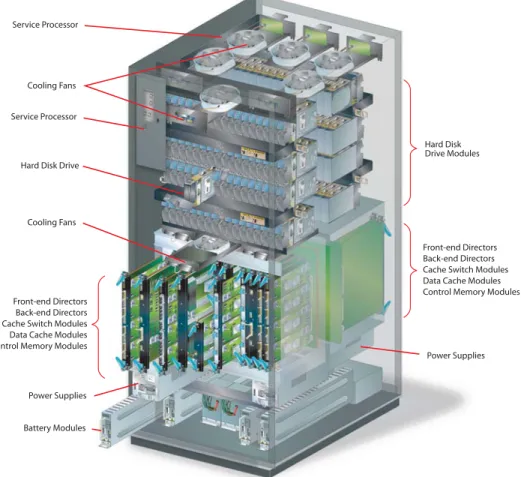
The Control Frame of model USP1100 contains the front-end directors, back-end directors, cache switch modules, data cache expansion modules, control memory modules, hard disk drive modules, power supplies, battery modules, and cooling fans. An illustration of the Control Frame is shown in Figure 8.
Figure 8. Universal Storage Platform model USP1100 Control Frame with its
major components.
Battery Modules Power Supplies Power Supplies Front-end Directors Back-end Directors Cache Switch Modules Data Cache Modules Control Memory ModulesFront-end Directors Back-end Directors Cache Switch Modules Data Cache Modules Control Memory Modules Cooling Fans
Service Processor
Cooling Fans Hard Disk Drive
Hard Disk Drive Modules Service
USP1100 Array Frame
Each Array Frame of model USP1100 contains the service processor (SVP) hard disk drive modules, power supplies, battery modules, and cooling fans, plus communication interfaces to the Control Frame. An Array Frame is shown in Figure 9.
Figure 9. Universal Storage Platform model USP1100 Array Frame with its
major components.
Hard Disk Drive Modules Power Supplies Power Supplies Battery Modules Cooling FansUSP600—Enhanced Model
: :
Maximum internal raw capacity of 148TB and up to 512 disk drives with the capacity to manage a maximum external raw capacity of 32PB: :
34GB/sec of cached bandwidth; 6.5GB/sec of control bandwidth: :
Up to 128GB of data cache (upgradable to 256GB); 12GB control memory: :
Four crossbar switches; 64 data paths; 192 control paths: :
Up to 192 physical Fibre Channel ports and 24,576 virtual storage ports for open systems and attached storage connectivity: :
Up to 96 FICON, 96 ESCON ports for mainframe connectivity: :
Up to 4 NAS Blades: :
Up to 4 iSCSI BladesFigure 10. Universal Storage Platform models USP600 and USP100.
The enhanced model
USP600 provides up
to 148TB internal raw
capacity with 512
disk drives.
The entry-level model
USP100 provides up
to 74TB internal raw
capacity with 256
disk drives.
USP100—Entry-level Model
: :
Maximum internal raw capacity of 74TB and up to 256 disk drives with the capacity to manage a maximum external raw capacity of 32PB: :
17GB/sec of cached bandwidth; 6.5GB/sec of control bandwidth: :
Up to 64GB of data cache; 6GB control memory: :
Two crossbar switches; 16 data paths; 16 control paths: :
Up to 128 physical Fibre Channel ports and 16,384 virtual storage ports for open systems and attached storage connectivity: :
Up to 64 FICON, 64 ESCON for mainframe connectivity: :
Up to 4 NAS Blades: :
Up to 4 iSCSI BladesModel USP100 is a single-cabinet storage system that can be upgraded by adding as many as four Array Frames. Model USP100 is targeted for IT environments where floor space is a premium and data growth is limited, yet where premium storage functionality, virtualization, and universal replication are required. From the front, model USP100 looks very much like the Control Frame of model USP1100 but with fewer power supplies and battery modules, as shown in Figure 11.
Figure 11. Universal Storage Platform model USP100 with its major components.
Battery Modules Power Supplies
Power Supplies Front-end Directors
Back-end Directors Cache Switch Modules Data Cache Modules Control Memory Modules
Front-end Directors Back-end Directors Cache Switch Modules Data Cache Modules Control Memory Modules Cooling Fans
Cooling Fans Hard Disk Drive
Hard Disk Drive Modules Service Processor
Network Storage Controller
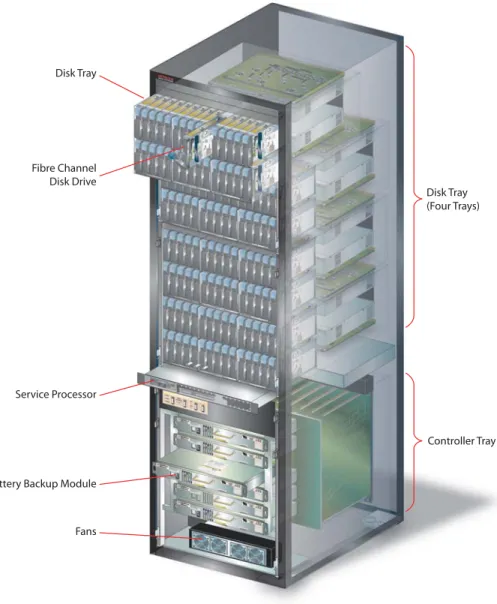
The Network Storage Controller package is based on a 15U-high controller unit with interface boards, power supplies, cooling fans, and battery backup modules to protect cached data in the event of a power failure. The optional disk trays are 6U high and comprise two rows of 15 disk drives, or 30 disk drives per tray. An NSC55 can be configured with zero (0) disk drives (disk-less version), and a maximum configuration is 6 disk trays spanning 2 racks and containing 240 total Fibre Channel disk drives.
Figure 12 shows the front of an NSC55 and the major components. A standard 42U rack contains one controller unit and four disk trays of two rows each (that is, eight rows, or 120 disks). The “built in” service processor module and battery backup modules (to protect cached data in the event of a power failure) are accessible from the front.
Figure 12. Front view of an NSC55 in a 42U rack.
Disk Tray (Four Trays) Controller Tray Service Processor Fibre Channel Disk Drive Disk Tray Fans Battery Backup Module
Figure 13 provides a back view of an NSC55, illustrating the control tray’s card cage and showing accessibility to power supplies, fans, and the disk-tray Fibre Switch (FSW) boards and the control-tray card cage. In the card cage, slots from left to right are:
: :
One adapter board for front- and back-end channels: :
Two optional front-end director boards: :
One memory controller board (also known as the base board): :
Two optional front-end director slots: :
One adapter board for front- and back-end channels: :
One subservice processor moduleFigure 13. Rear view of an NSC55 chassis in a 42U rack.
Disk Tray (Four Trays)
Controller Tray Fans
Fibre Switch Board Disk Tray Power Supply
Controller Tray Power Supply Mix Adapter Board Optional Front-end Channel Board Base Board Sub-service Processor Module