Semantic Grid Platform in Support of Engineering Virtual Organisations
Matevž Dolenc, Robert Klinc and Žiga Turk
University of Ljubljana, Faculty of Civil and Geodetic Engineering, Jamova 2, SI-1000 Ljubljana, Slovenia
E-mail: {mdolenc, zturk, rklinc}@itc.fgg.uni-lj.si
Peter Katranuschkov
Technical University of Dresden, Mommsenstr. 13, 01062 Dresden, Germany E-mail: [email protected]
Krzysztof Kurowski
Poznan Supercomputing and Networking Center, Noskowskiego 10 Street, 61-704 Poznan, Poland E-mail: [email protected]
Keywords: virtual organisation, interoperability, service oriented architecture, ontologies, semantic grid, engineering software, InteliGrid
Received:January 15, 2008
The EU project InteliGrid (2004-2007) combined and extended the state-of-the-art research and technolo-gies in the areas of semantic interoperability, virtual organisations and grid technology to provide diverse engineering industries with a collaboration platform for flexible, secure, robust, interoperable, pay-per-demand access to information, communication and processing infrastructure. This paper describes the system architecture and the technical aspects of the developed platform as well as the key components it offers, including services for document management, access to product model servers and utilisation of high-performance computing infrastructure.
Povzetek: Predstavljena je semantiˇcna grid platforma za podporo inženirskim virtualnim organizacijam.
1 Introduction
Grids are generally known as infrastructures for high per-formance computing. However, the original idea behind grid computing was to support collaborative problem solv-ing in virtual organizations (VO). This coincides with the EU project InteliGrid (2004-2007) vision: to provide com-plex industries with challenging integration and interoper-ability needs (such as automotive, aerospace and construc-tion) a flexible, secure, robust, ambient accessible, interop-erable, pay-per-demand access to (1) information, (2) com-munication and (3) processing infrastructure.
The isolation and lack of interoperability of software ap-plications - identified in the late 1980s as theislands of au-tomationproblem [1] - is well known in various industries. The term was largely used during the 1980s to describe how rapidly developing automation systems were at first unable to communicate easily with each other. Industrial commu-nication protocols, network technologies, and system in-tegration helped to improve this situation. A number of European projects such as ATLAS [2], COMBI [3], COM-BINE [4], ToCEE [5], ISTforCE [6], OSMOS [7] and oth-ers have proven theoretically and by developed prototypes that interoperability based on product data technology is achievable and can provide many benefits to the industry. Nevertheless, solutions for the practice require comprehen-sive environments that must incorporate coherently all
as-pects of interoperability. This is the reason for rare use of such solutions in the industry despite all research and development efforts. However, most of the necessary tech-nology for solving this problem, particularly the standards and tools for interoperability, is either already existing or emerging in ongoing grid and web services developments. An overview of past computer integrated construction re-search is presented by Boddy et al. [8].
InteliGrid project.
Key requirements for the InteliGrid platform were gath-ered through an extensive requirements elicitation and analysis process and were used as a baseline in the de-sign of the high-level InteliGrid architecture [9]. Based on the work done by the OSMOS project, InteliGrid inter-nal requirements ainter-nalysis and feedback from various public demonstrations, as well as various formal and informal dis-cussions with different members of the engineering com-munity, the top requirements can be summarised with the term5S Grid:
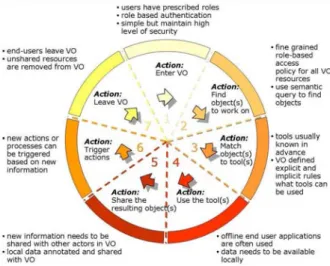
Figure 1: Generic virtual organisation end-user scenario actions.
– Security. Industry is eager to move to a ground-up secure environment [10]. InteliGrid addressed this by adopting Grid Security Infrastructure (GSI) and integrating the Role Based Access Control model (RBAC) [11] into the platform authorisation pro-cesses [12].
– Simplicity. The platform must work seamlessly with current client applications and operating systems and should not require end users to redefine their usual work processes.
– Stability & standards. The need for stable long-term specifications and (open) standards is well known [13]. The developed platform complies with such open standards, including WS-Resource Framework (WSRF) [14] and WS+Interoperability (WS+I) [15] for grid technology related develop-ments, RBAC model for VO security, etc.
– Scalable service oriented architecture (SOA). The service-oriented architecture [16] is a well-accepted and known system architecture. The InteliGrid project adopted the Open Grid Service Architecture OGSA [17] as a baseline, and developed the platform using an OGSA compliant grid middleware.
– Semantics. The platform must support rich, domain specific semantics [18]. The InteliGrid project ad-dressed this issue by developing a set of domain spe-cific ontologies [19].
A number of different use cases were considered while designing the InteliGrid platform, ranging from basic ones, such as joining a virtual organisation, to more advanced cases involving the use of semantic information [9]. The developed use cases were abstracted into the generic virtual organisation end user scenario presented in Fig. 1. Starting from available technologies, industry practices and trends, the project aim was to create knowledge, infrastructure and toolkits that allow a broad transition of the industry to-wards semantic, model based and ontology committed col-laboration based on the grid technology (rather than the web, which is the infracturcture technology of the SWOP project [20]).
The rest of the paper is organised as follows: Section 2 presents the background information on three key technolo-gies (grid technology, semantic interoperability and virtual organisations), Section 3 describes the high-level system architecture of the platform as well as the developed tools and services, and finally Section 4 presents our conclu-sions and outlines proposed future research and develop-ment work.
2 Technology
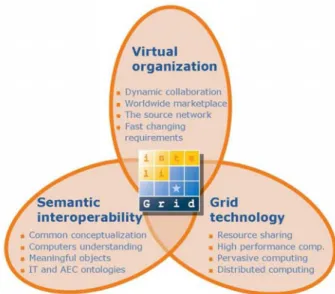
The InteliGrid project addressed the challenge by success-fully combining and extending the state-of-the-art research and technologies in three key areas: (a) semantic interop-erability, (b) virtual organisations, and (c) grid technology (see Fig. 2) to provide standards-based collection of on-tology based services and grid middleware in support of dynamic virtual organisations as well as grid enabled engi-neering applications. It was recognized that if a grid tech-nology is to ensure the underlying engineering interoper-ability and collaboration infrastructure for a complex engi-neering virtual organisation, the grid technology needs to support shared semantics.
2.1 Grid technology
At its core, grid technology can be viewed as a generic en-abling technology for distributed computing, based on an open set of standards and protocols that enable communi-cation across heterogeneous, geographically dispersed en-vironments. With grid computing, organizations can op-timize computing and data resources, pool them for large capacity workloads, share them across networks and enable collaboration [21].
com-Figure 2: The InteliGrid project addressed three key tech-nology areas: grid techtech-nology, semantic interoperability and virtual organisations.
puting resources anywhere and anytime. The termresource
has evolved from covering only computing power and stor-age to covering a wide spectrum of concepts, including: physical resources (computation, communication, storage), informational resources (databases, archives, instruments), individuals (people and the expertise they represent), capa-bilities (software packages, brokering and scheduling ser-vices) and frameworks for access and control of these sources [23]. By using a grid for sharing resources, re-searchers and small enterprises can gain access to resources they cannot afford otherwise. Research institutes, on the other hand, can leverage their investment in research facili-ties by making them available to many more scientists. An overview of grid technology in civil engineering (includ-ing different grid technology standards, middleware and specific challenges related to technology addoption within engineering industries) has been published by Dolenc et al. [24].
2.2 Semantic interoperability
The development of grids and the increased use of agent and service based technologies have a profound impact on the way of data being exchanged on the Internet. The im-portant feature of new semantic based approaches is the separation of content from presentation, which makes the use and reuse of data easier.
To achieve that kind of (semantic) interoperability, sys-tems must be able to exchange data and information in a way that the precise meaning of the data is not lost and is readily accessible, and that the data itself can be translated into a form that is understandable by almost any system. It is important that the meaning of the exchanged information is interpreted accurately. The benefits of semantic interop-erability are numerous, but the most notable one is that it
assures the processing and reasoning of data by computers. The state-of-the-art developments and corresponding stan-dards that are developed and used for semantic web appli-cations can be reused in the grid computing environments with some modifications.
Semantic interoperability and its content description standards are in particular about ontologies and their inher-ent rules. Whilst the continher-ent description standard addresses the general applicability in distributed environments (as in InteliGrid), an important aspect in ensuring semantic inter-operability is extensibility, i.e. the content description stan-dard is required to make an ’open world assumption’. That is, semantic concepts are not confined to a single file or scope. While a concept may be defined originally in a ba-sic ontology, it can be extended and instantiated in another definition or exchange file. The ontologies for semantic interoperability are therefore designed mostly in a layered approach, allowing for vertical and horizontal extensions. This means that the ontology has to support abstraction layers (from high-level concepts, such as ’resource’, to spe-cific concepts, such as ’construction-site-meeting-memo’), as well as the possibility for horizontal extensions targeting different domain/application areas. These requirements are especially addressed by ontology standards for the seman-tic web. Therefore they have been gaining more impor-tance.
Semantic interoperability issues in the context of infor-mation and communication technology as well as recent semantic web developments have been addressed by Velt-man [25].
2.3 Virtual organisations
Client demands for one-of-a-kind-products and services demand a one-time collaboration of different organisations, which have to consolidate and synergise their dispersed competencies in order to deliver the desired product or ser-vice. Each organisation is usually involved in the delivery of one or more components of the requested product or ser-vice. To deliver the complete product or service, organisa-tions need to rely on each other for information complete-ness, as all product components are inter-related. Conse-quently, this has an implication not only on the way infor-mation (related to the to-be-delivered product or service) is exchanged and shared, but also on the way in which se-cure, quick to set-up, transparent (to the end-user) and non-intrusive (to the normal ways of work of an individual/or-ganisation) information and communication technology is used for this purpose.
Virtual organisation is quickly becoming the preferred organisational form for one-of-a-kind settings to deliver one-of-a-kind product and typically goes through four dis-tinct lifecycle stages (Fig. 3) [26]:
Figure 3: Typical virtual organisation lifecycle [26].
combine competencies to deliver the product and/or service that the client needs.
2. Formation/configurationfocuses on the establishment of the VO in terms of role definitions, definition of in-formation flow mechanisms, identification of informa-tion exchange formats and modalities, interoperabil-ity of inter- organisational tools, shared resource and services definition and configuration, etc. According to Kazi and Hannus [27] one of the key ICT require-ments in a VO environment is the capability of a quick set-up and configuration.
3. Operation/collaborationis the main stage of a typical VO where different VO tasks are carried out in paral-lel and/or in series based on task needs. Within this stage there is a significant degree of work taking place within a distributed (engineering) setting with the pos-sibility of some partners leaving and others joining ac-cording to the need of the VO.
4. Termination/reconfiguration.When a VO consortium completes the delivery of the required product/service, it is terminated or reconfigured to form another VO (e.g. from a VO that develops a product to a VO that provides maintenance or service for that product). During this stage, it is very important to have proper mechanism in place for archiving the data/information used and produced during the operation and collabo-ration stage.
3 InteliGrid platform
Grids were expected to be the solution to the "islands of computation" problem, but they were also expected to en-sure the interoperability and collaboration platform pro-viding that they include the key ingredient required for a complex engineering virtual organization - the support for the shared semantics. Scientific research and technical de-velopment in the project have advanced the state-of-the-art in the field of semantic grids and in the field of virtual organization interoperability; while the architecture, engi-neering and construction sector (including facility
manage-ment) has provided the testing environment for the project, all technologies developed are generic and applicable in any kind of virtual organisation environment.
A grid environment, in the context of the InteliGrid project, is an infrastructure for secure and coordinated resource-sharing among individuals and institutions with the aim to create dynamic virtual organizations. In-teliGrid’s hypothesis was that the meaning of the resources should be explicit which leads us to the issue of seman-tics and ontologies. The vision of the project was to create virtual dynamic organizations through secure and coordi-nated resource-sharing among individuals, institutions, and resources. Grid computing is an approach to distributed computing that spans not only locations but also organi-zations, machine architectures and software boundaries to provide unlimited power, collaboration and information ac-cess to everyone connected to a grid.
3.1 Architecture
The InteliGrid architecture is based on the SOA concept as well as on lessons learned in earlier related projects [5, 6]. It is a high-level architecture, conforming to the key re-quirement of a generic approach which can be proven by trying to fit the existing architectures of systems developed over the last decade into it. The architecture is used also to identify the components that exist and the components that need to be developed. It includes (see Fig. 4): (1) the layer representing the conceptually modelled real world domain that is being addressed (e.g. buildings, aeroplanes, organi-zations, engineers, processes etc.), (2) the conceptual layer containing things that exist in the form of standards, ideas, graphs, schemas, ontologies, notions etc., (3) the software layer comprised of software that can be compiled, installed, executed, and runs and communicates with other software, and (4) the basic resource layer that include IT resources which are needed to run the applications and services de-fined in the layer above, e.g. hardware, firmware, software, etc.
Figure 4: Four main layers of the InteliGrid conceptual ar-chitecture and their relationships - it is important that all architectural layers commit to common ontologies.
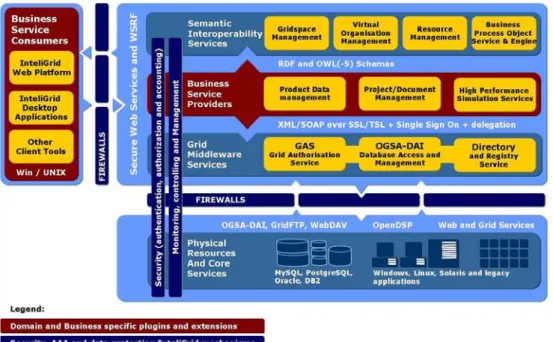
integra-Figure 5: InteliGrid high-level platform architecture.
tion and a semantic-web based interoperability platform for creating and managing networked virtual organisations. The developed service-oriented architecture is presented in Fig. 5, together with all its principal components and their interfaces. From the security perspective, a virtual organi-sation is a collection of individuals and institutions, repre-sented by various services and service consumers that are defined according to a set of resource and data sharing se-curity policies and rules. Those resource sharing rules must be dynamically controlled and then enforced into the whole virtual organisation environment. Thus, one of the most challenging tasks in the project was to create an appropri-ate security infrastructure covering all aspects of operat-ing within a dynamically established virtual organisation. The InteliGrid platform enables both service consumers and service providers to manage and share their resources securely with any of the individual organizations partici-pating in the virtual organisation.
Technically speaking, components are deployed either at some workstation or at a remote node on the grid. If on the grid, it is not important where they are deployed physically, the resource where they run will be very likely allocated dynamically. The grouping of the various services in Fig. 5 is presented according to the logic of the service and does not necessarily imply who uses which service. There are four main types of components in the InteliGrid platform:
– Business specific applications.These applications are the consumers of the business service providers and are usually accessed through a web based portal inter-face, although desktop applications can also make use of different available services.
– Secure Web Services and WSRF compliant services.
They can be further divided into: (1) inter-operability services (top tier) that simplify the interoperability among all services, and (2) domain and business spe-cific services that perform some value added work. There are two kinds of business services: (a) collab-oration services that provide file and structured data sharing and collaboration infrastructure, and (b) ver-tical business services that create new design or plan information.
– Middleware services. These services offer traditional grid middleware functionality extended with partic-ular needs of the InteliGrid platform. The services are based on mature grid technologies and their open source reference implementations.
– Other resources.The bottom layer consists of various physical infrastructure resources that suppliers offered to the platform. All these resources are available and can be accessed remotely through well-defined inter-faces and secure communication protocols.
3.2 Tools and services
(a) A single sign on entry point to all InteliGrid available online ser-vices - the authentication process is based on a defined RBAC model.
(b) The platform requires that all business services and resources are registered - a portlet enables registration of several different types of services and resources.
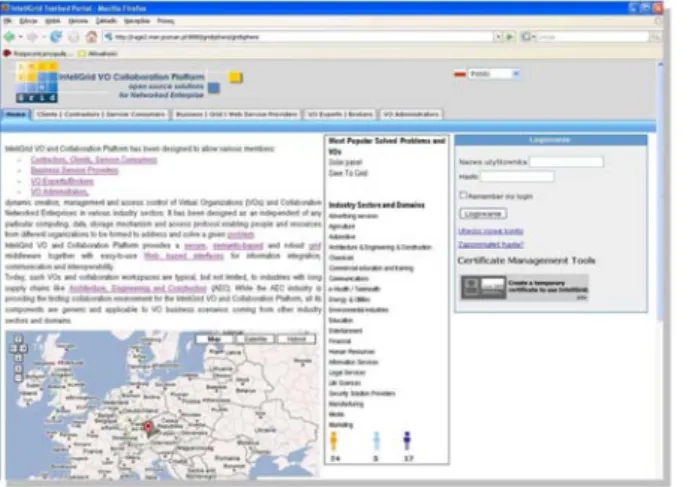
Figure 6: InteliGrid testbed portal implementation is based on the GridSphere portal framework.
– Collaboration platform that provides a working testbed environment, including online access to avail-able resources;
– Ontology services that together with the developed ontologies, establish the conceptual and architectural backbone of a semantic grid infrastructure;
– Semantic document management service and tools
that provide a major testing application for the ontol-ogy services;
– High-performace servicesthat provide easy integra-tion of existing engineering software (for example fi-nite element codes, etc.);
– Product model servicesthat provide access and itegra-tion of engineering product models.
3.2.1 Collaboration platform
The InteliGrid collaboration platform for virtual organi-sations allows dynamic creation and management of vir-tual organizations in various engineering industry sectors. The platform is independed of the underlying computing technologies, data storage mechanisms or access proto-cols. The platform enables secure sharing and control of resources across dynamic and geographically dispersed or-ganizations. It features a secure, semantic-based and ro-bust grid middleware together with easy-to-use web based interfaces for information integration, communication and interoperability.
The web interface is built on the GridSphere portal framework [28] which provides an open source portlet-based web portal. Built-in single sign on (Fig. 6a), au-thentication, authorization and control mechanisms allow end users such as engineers, designers, architects, etc. to create their own space within a virtual organization to se-curely share relevant information and resources with other
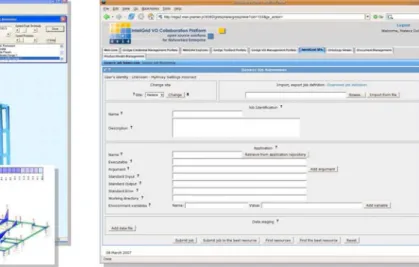
business partners and groups. The platform enables local administrators and IT staff to monitor the status and condi-tions of all provided services (Fig. 7a). It also allows virtual organisation managers to orchestrate and control access to different business service providers (Fig. 6b). Other actors such as virtual organisation project managers and grid ad-ministrators are able to establish and dynamically modify virtual organisations and their resources including users, services, databases and computation resources (Fig. 7b).
3.2.2 Ontology services
To fully utilise the advantages of the ontology-based ap-proach, ontology services - providing convenient methods for management of ontology instances, i.e. semantic meta-data about entities in the IT environment - need to be de-veloped and made available through the platform service framework [29]. These services constitute the interoper-ability layer and make use of the grid middleware services that provide basic authorisation management and generic access to all grid resources. The ontology services provide generic and specific convenience methods to create, manip-ulate and manage the ontology instances of classes defined in the ontology framework.
(a) A desktop application for platform management - service and re-source monitoring, searching, etc.
(b) A portlet enabling dynamic user roles and resource access manage-ment - a single user can have different roles depending on the projects state.
Figure 7: The InteliGrid ontology based virtual organisation management clients.
3.2.3 Semantic document management service
As the majority of the communication in a typical engineer-ing project is still document based it is essential for col-laboration environments to provide tools and services that enable end users as well as other services to access docu-ment based information in a secure, location independent, personalised and on-demand way.
To address these requirements as well as the problem of information overload [31], a semantic document manage-ment system has been developed based on the InteliGrid semantic grid architecture. The design goal of the system was that the right document should be delivered to the right place at the right time to support the dynamic decision-making process at any level of a virtual organization. The document management system offers a generic, grid based ontology enabled document management solution that pro-vides client (Fig. 8a) as well as server side components with a well-defined web services interface which enables a remote access to the underlying document management services. Some of the main features of the developed sys-tem are: security based on RBAC model, use of domain specific ontologies and taxonomies (Fig. 8b) for document annotations, semantic search based document retrival using SPARQL query language [32], etc.
3.2.4 High-performace service
Engineering end users and application developers are in-terested in running complex computing experiments con-sisting of thousands of jobs or scientific services which have to be dynamically managed over distributed grid en-vironments. The workflow is a widely accepted approach to compose grid experiments defining thousands of
differ-ent parallel or sequdiffer-ential tasks together with various de-pendencies among them in advance. Consequently, people are interested in a high-level intuitive description of scien-tific workflows as well as a grid workflow management sys-tem providing a support for remote workflow execution and runtime control. If the complexity and security constraints of the distributed infrastructures on which workflow exper-iments have to be performed efficiently are realized, some additional mechanisms to the grid workflow management system are required, for instance secure data transfer mech-anisms, data replica and management services, etc. All these components together are parts of InteliGrid High Per-formance Services. In addition to aforementioned func-tionalities the graphic tools, portals and GUIs are also de-sired to enable end users a visual workflow composition and animation (Fig. 9).
InteliGrid High Performance Service is in fact a resource management system [33] with a workflow engine that ex-ecutes and manages jobs on remote grid resources. It is possible to submit to this service workflow experiments based on an XML workflow schema, defining flexible and mechanisms for dynamic workflow control, including var-ious types of precedence constraints, different locations of the final data products, executables, etc. All these features allow end users to speed up remote workflow calculations and improve data management mechanisms.
3.2.5 Product model services
(a) Users can browse or search (using SPARQL query language) for documents independet of their location.
(b) Documents can be annotated using domain specific ontologies and taxonomies as well as free text.
Figure 8: InteliGrid semantic based document management system.
partial model data and must be able to immediately, in-crementally and transparently update the persistent stor-age. The challenge of the grid enabled product model servers (to be available anywhere, any time and without regard to where the model data actually resides) is that the grid environment must be designed to make a single source of a product data model available for collaborative work sessions and sharing between many different applications, spread over multiple coupled organizations in virtual enter-prises. Besides, it must be able to create a single, virtual visualization of a collection of product model data sources, federated, for sharing by a single enterprise in a workgroup, multi-project environment.
The InteliGrid Product Data Management Service, as a part of the InteliGrid Platform, addresses the above stated challenges by providing interfaces and different services for product model access and integration (Fig. 10):
– Product model server provides a back-end product model storage and management including various pro-gramming possibilities enabling development of addi-tional server side operations or stored procedures.
– Product data management serviceis the main server side component of the product data management sys-tem and provides an easy to use programming inter-face for the development of client and server side ap-plications that exploit product model server resources.
4 Conclusions and future work
The paper describes the overview of a collaboration plat-form developed within the InteliGrid project which com-bines and extends the state-of-the-art in technology areas of grid technology, semantic interoperability, and virtual or-ganisations. The underlying system architecture is largely
technology independent and can support different engi-neering domains. Although the main integrated demon-strator was from the architecture, engineering and con-struction sector, it has been shown in a number of partial demonstrations that the developed platform can be adapted for other engineering sectors as well. The demonstrations presented several advantages over other collaboration plat-forms for the support of virtual organisations. Nevertheless it is recognised that several questions about the effective use of the technologies remain unanswered:
– Grid services (technology) standards are converging with already widely accepted web service standards and container implementations. It is therefore rele-vant to question whether grid technology was the right choice for the underlying communication technology or not. We argue that it was as it does provide one of the core added values; namely secure communication environment required by the industry.
– Dynamic virtual organisations providing one-of-a-kind products require dynamic configuration of the in-formation and communication infrastructure. This can be achieved by adopting certain design principles and the use of advanced information technologies. But there are many legal issues that need to be addressed before dynamic virtual organisations can became pri-mary organisational form in the global economy, e.g. data management after the project is finished, the use of different national regulations, etc.
– The InteliGrid project focused its efforts on provid-ing virtual organisation related communication and
(a) The InteliGrid platform integrates various client side structural anal-ysis software - client side libraries are available to ease the development of integrated applications.
(b) A portlet based application for online job submittion - any com-mandline client side application can be used as a part of an analysis workflow.
Figure 9: InteliGrid high-performance services enable integration of existing engineering applications.
(a) A portled based application provides location independent access to various product models.
(b) An end-user application for extracting partial information models described by an Information Delivery Manual (IDM) description.
Figure 10: InteliGrid services enable access and integration of product information models.
specific industry sectors. Currently, there are several on-going initiatives addressing these issues [35].
– Relatively straight forward business model adopted for the InteliGrid platform requires that all available resources must be registered (including providing se-mantic annotation) in the platform. But it should be investigated whether a peer-to-peer system architec-ture supporting dynamic resource discovery and inte-gration would be more appropriate for supporting dy-namic virtual organisations providing one-of-a-kind products.
The future work following the project ending is focused on maintaining the established testbed as well as on ad-dressing some of the above mentioned issues. One of the immediate research efforts is addressing issues of
alterna-tives to the use of ontologies for semantic annotation of services and resources. In addition, it is expected that de-veloped system architecture, concepts and platform will be tested in real world scenario.
Acknowledgement
Conject AG (Germany) is gratefully acknowledged.
References
[1] M. Hannus, H. Penttila, P. Silen, “Islands of Au-tomation”, (1987 - updated by Hannus, M. 2002) http://cic.vtt.fi/hannus/islands.html
[2] R. Greening and M. Edwards,“ATLAS implementa-tion scenario”. Scherer R. J. (ed.) Proc. ECPPM 1995 Product and Process Modelling in the Building Indus-try, Balkema, Rotterdam, 1995.
[3] R.J. Scherer,“EU-project COMBI - Objectives and overview”, Scherer R. J. (ed.) Proc. ECPPM 1995 Product and Process Modelling in the Building Indus-try, Balkema, Rotterdam, 1995.
[4] G. Augenbroe, “An overview of the COMBINE project”, Scherer R. J. (ed.) Proc. ECPPM 1995 Prod-uct and Process Modelling in the Building Industry, Balkema, Rotterdam, 1995.
[5] R.J. Scherer, R. Wasserfuhr, P. Katranuschkov, D. Hamann, R. Amor, M. Hannus, Z. Turk,“A Con-current Engineering IT Environment for the Build-ing Construction Industry”, In: D. Fichtner D. and R. MacKay (eds.) Facilitating Deployment of Infor-mation and Communication Technologies for Com-petitive Manufacturing, Proc. of the European Conf. on Integration in Manufacturing, IiM97, ISBN 3-86005-192-X, pp. 31-40, 1997.
[6] P. Katranuschkov, R.J. Scherer, Z. Turk,“Intelligent services and tools for concurrent engineering: An approach towards the next generation of collabora-tion platforms”, ITcon Vol. 6, Special Issue Informa-tion and CommunicaInforma-tion Technology Advances in the European Construction Industry, pp. 111-128, 2001, http://www.itcon.org/2001/9
[7] I. Wilson, S. Harvey, R. Vankeisbelck and A.S. Kazi,
“Enabling the construction virtual enterprise: the OSMOS approach”, ITcon Vol. 6, Special Issue In-formation and Communication Technology Advances in the European Construction Industry, pp. 83-110, 2001, http://www.itcon.org/2001/8.
[8] S. Boddy, Y. Rezgui, G. Cooper and M. Wetherill,
“Computer integrated construction: A review and proposals for future direction”, Advances in Engi-neering Software, Vol. 38, Issue 10, p. 677-687, Oc-tober 2007.
[9] P. Katranuschkov, A. Gehre, E. Balaton, R. Balder, S. Bitzarakis, M. Dolenc, C. Ebert, C. Hans, J. Hyvarinen, K. Kurowski, T. Pappou, E. Petrinja, V. Stankovski, Z. Turk, U. Wagner,“InteliGrid Deliv-erable D12 - Requirements Analysis, Rev. 1.4”, The
InteliGrid Consortium c/o University of Ljubljana, www.InteliGrid.com, 2006,
http://www.inteligrid.com/data/works/ att/d12.content.03122.pdf
[10] Deloitte,“Global Security Survey”, 2005, http://www.deloitte.com/dtt/cda/doc/ content/dtt_financialservices_2005/ GlobalSecuritySurvey_2005-07-21.pdf
[11] D.F. Ferraiolo, D.R. Kuhn, R. Chandramouli,“Role Based Access Control”, Artech House, 2003.
[12] M. Adamski, M. Kulczewski, K. Kurowski, J. Nabrzyski, A. Hume, “Security and Perfor-mance Enhancements to OGSA-DAI for Grid Data Virtualization”, 2nd VLDB Workshop on Data Management in Grids, Seoul, Korea, 11 September 2006.
[13] R.S. Sutor,“Open Standards vs. Open Source: How to think about software, standards, and Service Ori-ented Architecture at the beginning of the 21st cen-tury”, 2006, http://www.sutor.com/newsite/essays/ Sutor-OpenStdsVsOpenSrc-20060527.pdf
[14] Web Services Resource Framework (WSRF), http://www.oasis-open.org/committees/ tc_home.php?wg_abbrev=wsrf
[15] WS-I Basic Profile 1.1 Specification,
http://www.ws-i.org/Profiles/BasicProfile-1.1.html
[16] T. Erl, “Service-Oriented Architecture (SOA): Con-cepts, Technology, and Design”, Prentice Hall PTR, 2005.
[17] I. Foster, H. Kishimoto, A. Savva, D. Berry, A. Djaoui, A. Grimshaw, B. Horn, F. Ma-ciel, F. Siebenlist, R. Subramaniam, J. Tread-well, J. von Reich, “The Open Grid Ser-vices Architecture, Version 1.0”, 2005, http://www.gridforum.org/documents/
GWD-I-E/GFD-I.030.pdf
[18] Z. Turk, “Understanding Grid seman-tics for virtual collaboration”, 2005, http://istresults.cordis.lu/index.cfm/section/
news/tpl/article/BrowsingType/Features/ ID/79773
[19] A. Gehre and P. Katranuschkov, “InteliGrid De-liverable D32.2 - Ontology Services”, The In-teliGrid Consortium c/o University of Ljubljana, www.inteliGrid.com, 2007.
[20] Semantic Web-based Open engineering Platform (SWOP), http://www.swop-project.eu
E. Petrinja, V. Stankovski,“D11.1 State of the art and market watch report”, The InteliGrid Consortium c/o University of Ljubljana, www.InteliGrid.com, 2006, http://www.inteligrid.com/data/works/att/
d11_1.content.05914.pdf
[22] I. Foster, “What is the Grid: A Three Point Check-list”, Grid Today, July 20. 2002.
[23] I. Foster, C. Kesselman, J.M. Nick & S. Tuecke,“The Physiology of the Grid: An Open Grid Services Archi-tecture for Distributed Systems Integration”, 2002, http://www.gridforum.org/ogsi-wg/drafts/
ogsa_draft 2.9_2002-06-22.pdf
[24] M. Dolenc, V. Stankovski and Z. Turk,“Grid Tech-nology in Civil Engineering”, Topping B.H.V. (ed.) Innovation in Civil and Structural Engineering Com-puting, Saxe-Coburg publications on computational engineering. Stirling: Saxe-Coburg, pp. 75-96, 2005.
[25] K.H. Veltman, “Syntactic and Semantic Interoper-ability: New Approaches to Knowledge and the Se-mantic Web”, The New Review of Information Net-working, vol. 7, 2001,
[26] M. Hannus, “Guidelines for Virtual Or-ganisations”, VOSTER Project Consortium, http://cic.vtt.fi/projects/voster, 2004.
[27] A.S. Kazi and M. Hannus,“Interaction Mechanisms and Functional Needs for One-of-a-kind Production in Inter-enterprise Settings”, Global Engineering and Manufacturing in Enterprise Networks (Karvonen I., et al., editors), VTT Symposium Series, pp.301-312, 2003.
[28] J. Novotny, M. Russell and O. Wehrens, “Grid-Sphere: A Portal Framework For Building Collabo-rations”, http://www.gridlab.org/Resources/Papers/ gridsphere_mgc_2003.pdf
[29] A. Gehre, P. Katranuschkov and R.J. Scherer, “Man-aging Virtual Organization Processes by Semantic Web Ontologies”, Rebolj D. (Ed.) Proc. CIB 24th W78 Conference Maribor Bringing ITC knowledge to work, University Library Maribor, ISBN 978-961-248-033-2, pp. 177-182, 2007.
[30] A. Gehre and P. Katranuschkov, “InteliGrid De-liverable D32.2 - Ontology Services”, The In-teliGrid Consortium c/o University of Ljubljana, 2007, http://www.inteliGrid.com.
[31] K.A. Miller,“Surviving Information Overload: The Clear, Practical Guide to Help You Stay on Top of What You Need to Know”, Zondervan, 2004.
[32] E. Prud’hommeaux and A. Seaborne, “SPARQL Query Language for RDF”, W3C Working Draft, 26 March 2007, http://www.w3.org/TR/2007/WD-rdf-sparql-query-20070326/
[33] OpenDSP,
http://sourceforge.net/projects/opendsp
[34] Z. Turk, “Constraints of Product Modelling Ap-proach in Building”, 8th International Conference on Durability of Building, Vancouver, Canada, May 30 -June 3, 1999.
[35] buildingSMART,
![Figure 3: Typical virtual organisation lifecycle [26].](https://thumb-us.123doks.com/thumbv2/123dok_us/8046174.2130588/4.892.106.438.132.324/figure-typical-virtual-organisation-lifecycle.webp)