A System for Publishing Sensor Data
on the Semantic Web
Alexandra Moraru
1, Carolina Fortuna
2and Dunja Mladenic
11Artificial Intelligence Laboratory, J. Stefan Institute, Ljubljana, Slovenia 2Department of Communication Systems, J. Stefan Institute, Ljubljana, Slovenia
The development of sensor technologies in the last years offers support for new applications for the Internet of Things. The availability of the data resulting from sensor networks deployed in different environments is important for a number of advanced services, such as traffic flow prediction and power consumption monitoring.
We propose a system for publishing sensor data following the linked data principles and providing hereby integra-tion with the Semantic Web. The main components are the Semantic Enrichment component and the Data Publishing component, while for storing sensor data we use a relational database.
Keywords: semantic web, linked data, sensor web
1. Introduction
The Internet of Things is gaining popularity with the development of the Internet towards a network of interconnected objects. From mo-bile phones to transportation cargos, to electri-cal appliances and to any type of sensing de-vices new applications are finding their way to daily life. This development will provide new services and will enable new directions for com-munication. (i.e. “things-to-persons” or “thing-to-thing”) [1].
A major role in the development of Internet of Things is played by “web accessible sen-sor networks and archived sensen-sor data that can be discovered and accessed using standard pro-tocols and application program interfaces” [2], defined as Sensor Web by the Open Geospatial Consortium(OGC). However, for obtaining the maximum impact that Sensor Webs can have on the development of Internet of Thing, chal-lenges have appeared not only for the physical
infrastructures, but also for data management and processing, as the amount of data that sen-sors can produce is significant[3].
Traditional approach applied for handling ex-isting sensor data(i.e., measurements collected by a sensor network)is to store it in a database and process it at a later time. Recent research in the context of relational databases is tackling problems such as prioritization in case of lim-ited bandwidth, modeling and cleaning of sen-sor readings, uncertain data management[4]. In data mining and machine learning communities, technology has been developed to process and build models based on streams of data[5], there-fore being able to build real-time applications based on such streams(e.g., intrusion detection systems using stream mining).
Up to this point, the systems are built in such a way that the integration of sensor data from two different systems is non-trivial to achieve. By describing the meanings of data streams and the context under which these data were collected in a computer understandable manner, truly large scale distributed sensing systems can be built. This is where the semantic web protocol stack and semantic technologies can play a key role. Extending Sensor Web towards applying se-mantic technologies leads to the development of Semantic Sensor Web (SSW) [6] enabling the integration of different systems. Some of the directions adopted for achieving such inte-gration are related to Linked Open Data(LOD) (including Linked sensor data [7][8][9]), or to semantic annotation and composition of web services[10].
system for publishing real-world sensor data collected from a sensor network that includes sensing devices for monitoring environmental conditions such as temperature, humidity, lumi-nance and pressure. A semantic layer is added for enriching the sensor data(measurements ob-tained from sensors) and metadata (properties of sensors including location and observed phe-nomena). The semantic enrichment is based on mapping rules that are connecting the database that stores the sensor data and metadata to a standardized ontology in the sensor network do-main. The output of the system is a dataset of semantic sensor descriptions and real-time mea-surements, published following the principles of linked open data and therefore web accessible. The rest of this paper is structured as follows. Section 2 describes related work and puts the proposed system in the perspective of the exist-ing research. Section 3 discusses requirements for publishing real world data on the semantic web. In Section 4 we describe the proposed system, while in Section 5 we present an imple-mentation for publishing enriched sensor data. Section 6 gives an example of possible interac-tion with the system and we conclude the paper in Section 7.
2. Related Work
One way of making sensor descriptions and measurements available on the Web is to pub-lish them on LOD cloud. The advantages and challenges of Linked Sensor Data are discussed by Keßler and Janowicz[9]. Integrating the de-scriptions of sensors into LOD can provide bet-ter sensor data accessibility without introduc-ing very high complexity. The paper stresses the importance of finding the appropriate links between different datasets from LOD and pro-poses a semiautomatic way for generating them. Patni et al.[7]were the first to add to the LOD cloud a large dataset of sensor descriptions and measurement, by first representing it in Obser-vation and Measurements(O&M)standard and then converting it to a standard representation in Resource Description Framework(RDF). Bar-naghi and Presser [8] propose a platform for publishing linked sensor data defined by spatial, temporal and thematic attributes. The platform offers an interface for publishing linked sensor
data without requiring from the users a semantic technological background. However, the user is requested to manually enter relevant keywords that describe the sensors for obtaining a list of suggested concepts from on-line repositories. In contrast, in our work we propose manually mapping structured sensor data and metadata from a database to semantic concepts. In ad-dition, we chose a W3C standardized ontology that contains the semantic concepts needed. The advantage of using a standardized ontology is that it can offer mediation between different rep-resentations of sensor descriptions. While we do not cover the problem of database popula-tion, we assume it can be automatized through different protocols[11].
Similar to our work, Le-Phouc et al. [12] pro-pose a system for publishing sensor data based on D2R Server and linking it to existing on-tologies. In addition, the authors approach the problem of having multiple sensor sources and suggest using specialized wrappers for every different format of sensor data. In our work, we focus on a single sensor source and optimize the semantic enrichment using a standardized ontology.
3. Integration of Sensor Data in the Semantic Web
The Semantic Web[13], uses representation lan-guages such as RDF and OWL to provide a for-mal description of data and knowledge. The purpose of the Sematic Web is to provide a machine understandable representation of data, while creating links in these data makes it easier to discover and allows reasoning.
publishing such data. One of the categories of knowledge representation appropriated for the model required is by means of ontologies. With the development of semantic sensor net-works a number of ontologies describing the sensor networks domain have been brought forth in the last years. A detailed survey is provided in[15], where eleven sensor network ontologies are analyzed. Therefore, considering the need of standardization regarding sensor networks ontologies, an incubator group from W3C has been formed with the purpose of developing on-tologies for sensor networks – referred to as Se-mantic Sensor Network(SSN)ontology1– and search for appropriate methods for enhancing available standards with semantic technologies.
4. System Description
The process of publishing sensor data on the web involves several steps and poses different challenges. Starting with storing the data from the sensing devices and resulting with public datasets containing semantically enriched mea-surements and the related metadata, various methods can be applied in the process. We present a system that includes all the steps of the publishing process. Although this is not the
only way to treat the problem of storing and pub-lishing linked sensor data, the proposed system offers an efficient and user friendly way of solv-ing it, besolv-ing optimized for a real deployment of a sensor network.
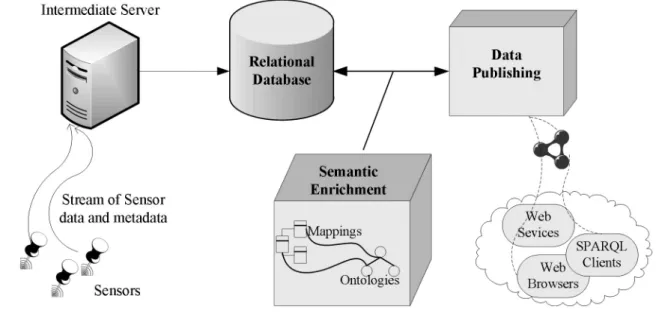
Figure 1 illustrates the proposed system show-ing the main components of the system and the relation between them. The sensor data results from a sensor network deployed in the envi-ronmental domain which sends streams of raw measurements and metadata to an intermediate server. Next, a relational database is updated when the server receives new messages.
The main components are the Semantic En-richment component and Data Publishing com-ponent. The first component contains mod-ules which allow semantic enrichment of meta-data and measurements. This component uses vocabularies (i.e. ontologies) and mapping rules for defining the relationships between and within the data and metadata from the database. The Data Publishing component contains mod-ules which permit exposing the sensor infor-mation on the Web. We have used a publicly available D2R Server2as an implementation of this component, as it offers an interface to the database and does not require replicating the database content into a separate RDF triple-store. In order to provide semantic meaning
Figure 1.Architecture of the proposed system
1http://purl.oclc.org/NET/ssnx/ssn
for the sensor data and metadata contained in the database, we have used existing ontologies for editing the mapping file used by the D2R Server. Finally, the database content can be accessed by different web services, SPARQL clients or browsed using a HTML interface.
5. Publishing Semantically Enriched Sensor Data
Making sensor data available for a large num-ber of users enables the development of new and useful applications. The methods for publishing sensor data can vary from standardized web ser-vices, such as OGS’s Sensor Observation Ser-vice (SOS), to applications specific methods, as the ones used by Pachube3 or Sensorpedia4. However, such methods require prior know-ledge of the infrastructures used, while Linked Sensor Data would enable better accessibility. Moreover, the support for integration with exist-ing knowledge would increase also the usability of data.
Properly exposing and linking data is essen-tial for the success of the Semantic Web. Ac-cording to the principles of Linked Data, each entity should have at least three correspond-ing dereferenceable URIs [17]: one URI for the real-world object itself and two more URIs for related information resources that describes the real-world object and have a HTML and a RDF/XML representation.
5.1. Semantic Vocabulary
In order to provide meaning for the data pub-lished, we have chosen representative concepts from related ontologies. The majority of the concepts used are described in the SSN ogy, which is a sensor network specific ontol-ogy. Its alignment with the DOLCE Ultra Lite upper ontology helps in describing linked data resources.
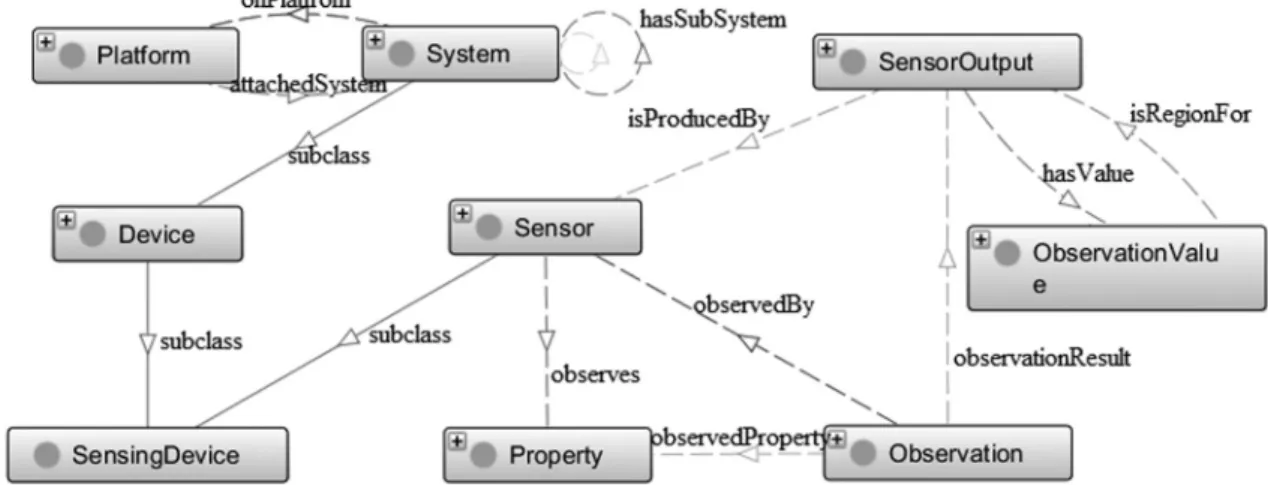
As our experimentation work required just a subset of the SSN ontology concepts and rela-tionships, we will provide details just on those concepts, as they are illustrated in Figure 2. The classSystemrepresents a sensing infrastructure and its sub-systems can be represented using the predicatehasSubSystem. The physical location of a system is represented by the classPlatform, which can have multiple systems attached. The class Sensoris used to represent concrete sensing objects and the predicate observes and indicates the Property observed by a sensor (e.g. temperature, humidity). In order to rep-resent sensor devices, the class SensingDevice
can be used, which inherits all the properties of the classes Sensor and Device. For rep-resenting sensor measurements we have used three classes: Observation, SensorOutput and
ObservationValue. An observation represents a
situation in which a value of a property is esti-mated by a sensor. The result of an observation is a sensor output which has a specific value.
Figure 2.Subset of concepts and relationships from SSN ontology
3http://www.pachube.com/ 4
For the geographical location of the platforms on which the sensors are attached we have used concepts from other ontologies that are also part of linked data cloud. For latitude and longitude coordinates we have used the Basic GeoWGS84 Vocabulary5, which provides the namespace for representing the coordinates. In addition, for
geographical names we have used GeoNames6
database, in RDF format, and links to platforms were represented using the based near predi-cate from FOAF ontology7. Each platform was linked to the nearby location, based on geo-graphical coordinates and determined using the
findNearbyPlaceNameweb service provided by
GeoNames.
5.2. Mapping Rules for Semantic Enrichment
For the mapping between the database content and the corresponding semantic concepts we have used the D2RQ language [16]. The map-ping was done respecting the SSN ontology and not the database structure, therefore some of the instances in the database were mapped to more than one concept, as it will be explained further. The information about the systems deployed in the network and the sensing devices attached, were represented in separate tables. Each row of a table was describing an instance, which was uniquely identified by the primary key of the table. Therefore, these instances were mapped directly toSystem, respectively to the subclasses
ofSensingDeviceclasses. However for the
con-crete instances of thePlatformclass, represent-ing the physical objects to which the systems are attached, there is no unique identifier in the database. Therefore, we used the geographical coordinates to identify the platforms, with the assumption that at one exact point in space there cannot be more than one platform. The D2RQ mapping corresponding is represented in Fig-ure 3. It can be observed that the platforms are defined as individuals of the LightPole class, which is then defined as a subclass of Platform
and SpatialThing (the latter class is from the
GeoWGS84 Vocabulary)classes. The creation of theLightPoleclass is related to the real world scenario of the deployment used.
Figure 3.Platfrom mapping using D2RQ
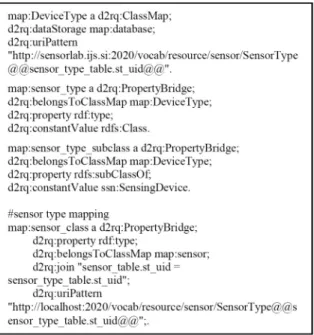
Figure 4.Sensing Device subclasses using D2RQ
Another piece of information stored in the data-base is the type of the sensing device placed on a sensor node. We have extracted types of sens-ing devices from a table of the database, which were mapped as subclasses of the SensingDe-vice class of SSN ontology and next used for specifying the type of individuals from sensing devices, using the “join” command from D2RQ language(Figure 4).
For the content related to sensor observations the unique ids from the database were used to identify all the individuals corresponding to
Ob-servation,SensorOutputandObservationValue.
The sensor measurements registered over the last day are mapped one by one, while for the past measurements average of the last hour is calculated in a separate view of the database and then mapped to RDF representation.
Figure 5.Web Interface of the D2R Server presenting all the classes used in mapping
The D2R Server manages the URIs created for the RDF representation of the database content and allows data to be browsed and searched us-ing web browsers or SPARQL endpoints. All the classes can be browsed for listing their in-stances, as it can be observed in Figure 5, and also they can be checked athttp://sensorlab .ijs.si:2020/.
6. Conclusions
Following the LOD principles is a promising approach for making sensor data available on the Web, as it addresses users from diverse do-mains of interest – through the openness of the format – which can access and process it. Also, by facilitating the integration with other exist-ing knowledge already represented in LOD, it provides the means for a more complete and detailed description of the data published. The proposed system facilitates publishing sen-sor data on the Semantic Web, contributing also to the development of the Internet of Things. It follows the principles of LOD and uses stan-dardized vocabularies for describing the data. The sensor data is stored in a relational database, while access to the RDF representation of data-base content is provided using a publicly avail-able tool. The semantic enrichment of sensor data is done through mapping rules and the meaning of data is mainly represented using
the SSN ontology. The system presents also the advantage of publishing real time data for the last day, while for the archived data averages for each hour are made available.
7. Acknowledgments
We would like to thank all our colleagues in Sen-sorLab who contributed indirectly to this work. This work was supported by the Slovenian Re-search Agency and the IST Programme of the
EC under PASCAL2 (IST-NoE-216886),
EN-VISION (IST-2009-249120) and PlanetData
(IST-NoE-257641).
References
[1] Commission of the European Communities. Internet of Things — An action plan for Europe. Commu-nication from the Commission to the European Parliament, the Council, the European Economic and Social Committee and the Committee of the Regions; 2009 June 18; Brussels.
[2] M. BOTTS ET AL., OGC White Paper OGC Sen-sor Web Enablement: Overview and High Level Architecture. White Paper. OpenGIS. 2007.
[3] A sea of sensors. The Economist. The Economist Newspaper Limited 2010 Nov 4; London.
[4] S. MADDEN, Database Abstractions for Managing Sensor Network Data. Proceedings of the IEEE 2010; 98(11): 1879–1886.
[5] M. G. MOHAMED, A. ZASLAVSKY, S. KRISH -NASWAMY, Mining data streams: a review.SIGMOD Rec. 2005; 34(2): 18–26.
[6] A. SHETH, C. HENSON, S. S. SAHOO, Semantic Sen-sor Web. IEEE Internet Computing 2008; 12(4): 78–83.
[7] H. PATNI, C. HENSON, A. SHETH, Linked sensor data. In2010 International Symposium on Collabo-rative Technologies and Systems; 2010 May 17–21; Chicago, IL,USA. p. 362–370.
[8] P. BARNAGHI, M. PRESSER, Publishing Linked Sen-sor Data. InProceedings of the 3rd International Workshop on Semantic Sensor Networks; 2010 November.
[9] C. KESSLER, K. JANOWICZ, Linking Sensor data – Why, to What and How? In Proceedings of the 3rd International Workshop on Semantic Sensor Networks; 2010 November.
[11] A. MORARU ET AL., Exposing Real World Informa-tion for the Web of Things. InProceedings of the 8th International Workshop on Information Integration on the Web, 2011 March 28, Hyderabad, India.
[12] D. LE-PHUOC ET AL., Live linked open sensor database. In Proceedings of the 6th International Conference on Semantic Systems. New York, NY, USA: ACM, Article 46, 4 pages.
[13] G. ANTONIU, F.VANHARMELEN,A Semantic Web Primer. The MIT Press; March 31 2008.
[14] T. BERNERS-LEE, J. HENDLER, O. LASSILA, The se-mantic web a new form of web content that is meaningful to computers will unleash a revolution of new possibilities,Scientific American; 2001 May 17.
[15] M. COMPTON ET AL., A Survey of the Semantic Specification of Sensors. In Proceedings of the 2nd International Workshop on Semantic Sensor Networks; 2009 October.
[16] C. BIZER ET AL., The D2RQ Platform v 0.7 – Treating Non-RDF Relational Databases as Virtual Graphs. http://www4.wiwiss.fu-berlin.de/bizer/d2rq/spec/ [02/01/2011]
[17] T. HEATH, C. BIZER, Linked Data: Evolving the Web into a Global Data Space. Morgan & Claypool 2011. ISBN 978-1608454303.
Received:June, 2011
Accepted:November, 2011
Contact addresses:
Alexandra Moraru Artificial Intelligence Laboratory J. Stefan Institute Jamova 39 Ljubljana Slovenia e-mail:[email protected] Carolina Fortuna Department of Communication Systems J. Stefan Institute Jamova 39 Ljubljana Slovenia e-mail:[email protected] Dunja Mladeni´c Artificial Intelligence Laboratory J. Stefan Institute Jamova 39 Ljubljana Slovenia e-mail:[email protected]
ALEXANDRAMORARUis a PhD student at the J. Stefan International Postgraduate School in the Information and Communication Technolo-gies program. She received her BSc in computer science from the Technical University of Cluj-Napoca in 2009 and her MSc in infor-mation and communication technology from the J. Stefan International Postgraduate School in 2011. She started her collaboration with J. Ste-fan Institute in 2008, with a 2 months internship program, and since 2009 she has been a student there. Her general research interests are in the area of Semantic Web and semantic technologies, more specifically, the applicability of semantics in sensor networks.
CAROLINAFORTUNAis a senior research assistant and a PhD student working at the Department of Communication Systems, Jozef Stefan Institute. She received her BSc in electrical engineering from the Technical University of Cluj-Napoca, Romania. Her research is in-terdisciplinary focusing on semantic technologies with applications in modelling of communication and sensor systems and on combining semantic technologies, statistical learning and networks for analyzing large datasets. She has published papers in refereed conferences and journals, served in the program committee of conferences such as ICC, Globecom and WCNC. She has also been to industry internships at Bloomberg LP and Siemens PSE.