Cold-start Problem in Collaborative
Recommender Systems: Ef
fi
cient
Methods Based on Ask-to-rate Technique
Mohammad-Hossein Nadimi-Shahraki and Mozhde Bahadorpour
Faculty of Computer Engineering, Najafabad branch, Islamic Azad University, Najafabad, Iran
To develop a recommender system, the collaborative filtering is the best known approach, which considers the ratings of users who have similar rating profiles or rating patterns. Consistently, it is able to compute the similarity of users when there are enough ratings expressed by users. Therefore, a major challenge of the collaborative filtering approach can be how to make recommendations for a new user, that is called cold-start user problem. To solve this problem, there have been proposed a few efficient methods based on ask-to-rate technique in which the profile of a new user is made by integrating information gained from a quick interview. This paper is a review of these proposed methods and how to use the ask-to-rate technique. Consequently, they are categorized into non-adaptive and adaptive methods. Then, each category is analyzed and their methods are compared.
Keywords: recommender systems, collaborative filter-ing, new user, user cold-start
1. Introduction
The idea of personalizing searching engines, in-telligent software agents and recommender sys-tems is taken into consideration by users who ask for help in sorting, classifying, personal-izing, filtering and sharing a large amount of information. One of the common recommender techniques is Collaborative Filtering(CF) [1-3] which offers preferred items to a user based on the items previously rated by their collaboration. The essential supposition is that, if usersXand
Yassign a similar rate tonitems or have a simi-lar behavior, they will rate or behave other items similarly [4]. Therefore, a major challenge of CF technique can be how to make recommen-dations for a new user who has recently entered
the system; that is called cold-start user prob-lem. In other words, the system must attempt to gather information about the new user before being able to fully use the system.
To solve the cold-start user problem, a few ef-ficient methods have been proposed based on ask-to-rate technique[5], in which a new user is asked to rate the selected items until hav-ing a sufficient number of rated items. The methods can be categorized to two non-adaptive and adaptive methods depending on whether the presented items are similar to “all” new users or not. In this paper, both non-adaptive and adap-tive methods are explained and their efficient methods are reviewed.
The rest of this paper is organized as follows. The recommender systems are introduced in Section 2. The concept of CF recommender sys-tems is described in Section 3. A comprehen-sive survey of ask-to-rate technique and some of the efficient methods are discussed in Section 4. Finally, in Section 5, the related methods are discussed and conclusion of this work is pre-sented.
2. Recommender Systems
so-cial factors like people or groups that have not been seen by users yet. When recommender systems are able to predict ratings for items that have not been observed yet, the item(s)can be recommended to a target user. A target user is a user for whom the recommendations are made. A movie recommender system, for ex-ample, might memorize explicit or implicit user ratings to recommend new movies to the same user, based on the ones that s/he has already seen.
Thus, how would the recommendation be pro-duced? There is a taxonomy provided by [6] with five different techniques including collabo-rative filtering, content-based, demographic[7, 8], utility-based[9]and knowledge-based ones. There is another category to overcome limita-tions of the mentioned methods by combining techniques, which tries to use advantages of one technique to fix disadvantages of others. Sev-eral ways have been proposed for their combi-nation to come up with a new hybrid system (see [6] for precise descriptions, where seven categories of hybrid system are presented). CF systems are described here since repeating the detailed explanation of other categories in this paper might be redundant. The interested au-thors could refer to original articles[1, 6, 10].
3. Collaborative Filtering Recommender Systems
Collaborative filtering recommender systems are one of the biggest sub-domains of informa-tion retrieval. The basic concentrainforma-tion of these systems is on finding users with similar interests to the target user and aggregating their opinions to make a recommendation. So, it calculates similarity between users instead of the content of items. Under the existing amount of infor-mation, both users and website owners receive benefit from CF systems; thus, users are able to come across preferred items; moreover, the profit from e-commerce websites potentially go up because of persuading the user to buy more related products or accessories.
Researchers have already classified many al-gorithms for collaborative recommendation in-cluding the memory-basedor model-basedCF [11]. Also, for taking advantages and alle-viating certain drawbacks of two algorithms,
some studies have suggestedhybrid algorithms
[6, 12]. This section focuses on a common memory-based CF algorithm, nameduser-based kNN(k-Nearest Neighbors) [2].
Memory-based algorithms are essentially heu-ristics as in the user-based kNNsystem which calculates the prediction of a target item based on statistical techniques in order to find users with similar tastes as follows:
• First, the similarity,sim(ut,ui), between tar-get user, ut, and all other users, ui, who have rated target item, at, is computed by different measures such as Pearson’s Cor-relation (shown in Equation (1)), Cosine measure, a recent measure like proximity-impact-popularity[13]and so on, which re-flects distance, correlation or weight be-tween two users.
sim(ut,ui)= h
m=1(rut,am−rut)·(rui,am−rui)
h
m=1(rut,am−rut) 2·
h
m=1(rui,am−rui) 2
(1)
where ru,a is rating of itema by user u, ru is mean of rating by usersut oruifor all the co-rated items andhis the number of items co-rated by both users. The similarity rang-ing is between−1(the least similar users to target user)and 1(the users most similar to the target user).
• Second, prediction for a target item by a tar-get user can be calculated using at most k
nearest neighbors, who have also rated the target item, found from the former step as Equation(2).
prediction(ut,at) = k
h=1(ruh,at−ruh)·sim(ut,uh)
k
h=1|sim(ut,uh)|
+rut
(2)
where rut and ruh are mean of ratings for the target user and userh on all other rated items and sim(ut,uh) is similarity between the target user and userh.
pure CF systems is that the new data can be added increasingly and without difficulty since they do not require any tagging of the items’ content, like content-based filtering, and rec-ommendations are made only using the rating data. Hence, this approach is suitable for any domain, especially in domains the contents of which are either rare(like restaurants)or accru-ing contents are difficult(like movies or music). Collaborative systems have their own limita-tions like cold-start problem[5, 14-16], scalabil-ity[17]and sparsity[4]. As an important prob-lem, thecold-start user problemoccurs when a user, who is new to the recommender system, enters the system and there are no ratings by the user. The user-based CF cannot compute simi-larity between new and other users [14-16, 18, 19]Hence, it is difficult to make recommenda-tions.
To solve this problem, there have been different techniques. The ask-to-rate technique [5, 14, 16, 18, 19] is the most direct way for obtain-ing some information about the new user and for learning the user’s preferences. The next section explains the ask-to-rate technique.
4. Asking for Explicit Ratings
The most direct way to cope with cold-start user problem and make a rapid profile of a new user is to ask for explicit ratings by presenting items to the user. It can elicit initial information about the new user with a quick and short interview. After presenting some items to the new user,
Figure 1.The new user prompting process.
this process is completed and, whereas in user-item matrix the row of a new user is not empty, the new user enters the normal phase of rec-ommender system. The CF system should use these ratings to compute similarity between new and other users. Whereby, s/he gets precise rec-ommended items, shown in Figure 1.
The system must be cautious about presenting informative items that gather useful informa-tion before a new user is allowed to normally use the system. If the ratings are obtained by a well-designed selection strategy compared with a strategy in which the users self-select the items to rate, the recommendation accuracy can be improved.
Generally, techniques should not appear severe to the new users and they must move toward minimizing user effort and maximizing recom-mendation accuracy. Of interest in [14, 18], evaluation of elicitation methods on user effort and accuracy metrics is shown in Table 1. The methods are mentioned in the following sec-tion. This paper provides an overview of the efficient methods based on the ask-to-rate tech-nique. Reasonably, they are categorized to non-adaptive and non-adaptive methods, based on how the next items are selected.
Methods User Effort RecommendationAccuracy
IGCN
(Log pop)×Ent
Entropy0
HELF
Popularity
Item-Item
Entropy
Random
Table 1.The Evaluation of elicitation strategies in
[14, 18]over both online and offline experiments on user effort and accuracy metrics,( : best,: worst).
4.1. Non-adaptive methods
the new user’s problem. The advantage of these methods is that order only needs to be calcu-lated once, although these techniques provide little information. Some of the techniques are classified as non-personalised methods in[16]. Various strategies have been proposed for non-adaptive methods such as Variance and Entropy strategies [19]; Random, Popularity, Pure en-tropy and Balanced strategies [14]; Entropy0, HELF strategies[18]; and Greedy strategy and the Other People’s Greedy and Variations strate-gies[16]. Details of each non-adaptive strategy are:
1. Active WebMuseum is the first CF recom-mender system which uses the ask-to-rate technique[19]. This web-based virtual mu-seum has a dynamic topology in which art paintings are personalized and ordered by museum visitors’ taste and preferences. This paper proposesEntropyandVariance meth-ods to present sequence of items to be rated by new users. These methods are the statis-tical analysis of distribution of item ratings given by other users in the dataset. Accord-ing to Equation(3)the variance of the target itematis computed.
Variance(at) =
u∈Uat(ru,at−rat)
2
|Uat| (3)
whereUatis all users which have rated items
at,ru,at is rating of itematby useruandrat is mean ofat’s rating. Experiments use
ran-dom strategy (select items to present with-out prior planning) as a baseline measure and point out that these two methods gener-ate more accurgener-ate predictions for new users than random strategy.
2. In 2002, MovieLens research group extended the aforesaid idea in web personalization [14]. In this research, some strategies were proposed which contained use of informa-tion theory and aggregated statistics to learn about new users. These strategies focused on the issue of which items to be presented to the new user during an initial interview. Dif-ferent strategies have been tested through of-fline and online experiments to select movies that have used MovieLens dataset. Their evaluation considered user effort and rec-ommendation accuracy related to the user
experience. All the proposed methods have been measured based on rating prediction ac-curacy –MAE(Mean Absolute Error) evalu-ation metric. These methods are as follows:
• Random strategy: selects the items randomly. It learns about new user preferences in terms of all available items. Random strategy is a baseline strategy which is used for com-parison. The analysis of the rating matrix is not intelligent and the results of online and offline experiments point out that it needs much more user effort and that accuracy of predictions is unfavorable. If the distribution of ratings is not uniform, the user will prob-ably not have any opinion about presented items.
• Popularity strategy: It has been suggested to take an item’s popularity into account, i.e. how many users have rated an item. The items are ordered by the number of ratings that they have been given by all users and present some of the most popular items to the new user. According to Equation (4), popularity of itematis computed, whererat shows its rating.
Popularity(at) =|rat| (4) Implementation of this method is easy and its computation is inexpensive. It has ac-complished the important goal of minimiz-ing user effort. However, ratminimiz-ings may be uninformative since most users like popu-lar items. Moreover, the popupopu-larity measure suffers from prefix bias – it is derived from popular items which receive ratings increas-ingly but not from unpopular items. This problem causes unequal distribution of rat-ings in the dataset.
extreme user effort and performs extremely poorly on accuracy. It has not been evaluated in the online experiment. Hence, in terms of accuracy and user effort, Entropy and Ran-dom methods lag behind all the methods mentioned in[14].
Function Entropy(at)
entropy(at) =0
for each itematin dataset
forias each of the possible rating values //in movielensi=1. . .5 ifat’s rating=i
value[i]+=1 //rating frequencies end for
proportioni=value[i]/total number of users who
rateat
entropy(at)+=proportioni*Math.log
(proportioni, 2)
end for each
entropy(at) =−entropy(at)
End
Figure 2.Pseudocode of entropy approach.
• Balanced strategy: The logarithmic of pos-sibility with which the user has rated the item (popularity score) is multiplied by entropy, that is (log popularity) *entropy and some items are presented in a descending order. This method combines advantages of two components, has the best accuracy toward other methods proposed in [14] and needs medial user effort.
3. In 2008, idea of ask-to-rate by MovieLens research group was further extended in[18] to improve order of items and more pre-cisely elicit opinion of new users at regis-tration time. This paper was a winner in Yahoo! Research Best Paper Award [20]. They proposed an offline simulation frame-work and an online experiment with real users of the MovieLens live recommender system. Three new information theoretic strategies were presented: Entropy0, HELF and IGCN. Details of the two non-adaptive strategies include:
• Entropy0 (Entropy Considering Missing Val-ues): In [14], missing ratings(non-ratings) were ignored in entropy’s calculation. En-tropy0 was proposed to handle the problem of an item with the missing evaluation as all
missing evaluations were filled with a sepa-rate category like “0” whereas “1-5” was the usual scale. A weighted entropy formulation was used as Equation(5):
Entropy0(at) =−1 i wi
5
i=0
piwilog(pi) (5) wherew=0.5 is the weight to identify miss-ing values andwi = 1 fori =1,2,3,4,5 since this selection of weights provided the best re-sults for the original experimentation. Note that,
w0 =0 changed Entropy0 into the pure entropy
measure. The Entropy0 method dominates one of the limitation of entropy and distinguishes be-tween most unknown items(infrequently rated items)and frequently rated items. It is slightly more successful than Popularity method.
• HELF(Harmonic mean of Entropy and Log-arithm of Frequency): This strategy is a hy-brid of Popularity and Entropy strategies. It uses suitable feature of harmonic mean and logarithmic function. HELF combines har-monic mean of Popularity(rating-frequency of items) and Entropy scores of items; The combined measures are not correlated. HELF is defined as Equation(6):
HELFat = 2∗LF
at ∗H(at)
LFat +H(at) (6)
whereLFat =log(|at|)/log(|U|)is the nor-malized logarithm of the rating frequency of target item, and H(at) = H(at)/log(5) is the normalized entropy of target item. 4. Other criteria were suggested in[16], which
showed progression of methods for dealing with the new user. Below, details of some non-adaptive approaches called Greedy and Other People’s Greedy and variations are ex-plained.
• Greedy strategy: where the next item is cho-sen from those that the user can rate such that the prediction error for its test set is min-imized. This method is not feasible in prac-tice and requires knowing what each person can rate and the actual ratings. It is used as a baseline.
user from the top-n lists of other users’ items obtained through a greedy method. It uses other people’s opinions and selects items which reduce prediction error.
4.2. Adaptive methods
We define those approaches asAdaptivebecause selected items are consistent with “each” new user’s opinions. For present items that best fit user’s personal preferences the system should adapt to the earlier rates given by the new user. Thereupon, they rate items with personalized orderings and the interview process will be
con-trolled more effectively than in non-adaptive approaches. Adaptive approaches take into ac-count the user’s historical ratings among initial interview and consider the system’s changing profile of the new user; thereby, the number of items familiar to the new user is maximized. Dealing with the cold-start user problem by ask-ing to rate, there are a few adaptive approaches for a personalized items’ ordering, such as Item-item personalized[14]; IGCN[18]; na¨ıve Bayes, perturbed Other People’s Greedy and Variations [16] (which are classified as personalised meth-ods in [16]) and clustering method [21]. The details of each strategy are:
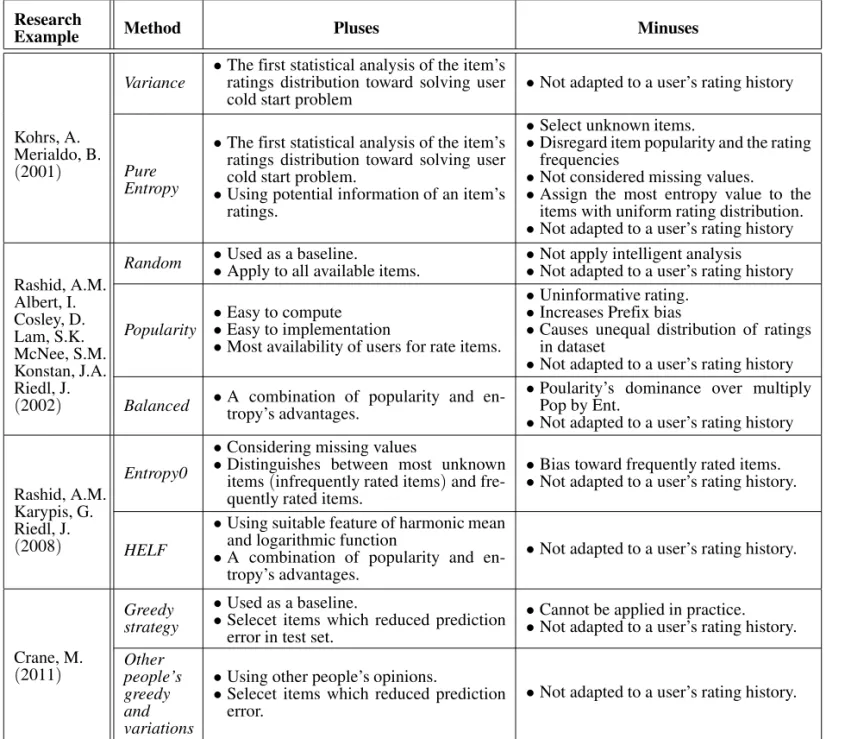
Research
Example Method Pluses Minuses
Variance •The first statistical analysis of the item’sratings distribution toward solving user
cold start problem •Not adapted to a user’s rating history Kohrs, A.
Merialdo, B.
(2001) Pure
Entropy
•The first statistical analysis of the item’s ratings distribution toward solving user cold start problem.
•Using potential information of an item’s ratings.
•Select unknown items.
•Disregard item popularity and the rating frequencies
•Not considered missing values. •Assign the most entropy value to the
items with uniform rating distribution. •Not adapted to a user’s rating history Random ••Used as a baseline.Apply to all available items. ••Not apply intelligent analysisNot adapted to a user’s rating history Rashid, A.M.
Albert, I. Cosley, D. Lam, S.K. McNee, S.M. Konstan, J.A. Riedl, J.
(2002)
Popularity ••Easy to computeEasy to implementation
•Most availability of users for rate items.
•Uninformative rating. •Increases Prefix bias
•Causes unequal distribution of ratings in dataset
•Not adapted to a user’s rating history Balanced •A combination of popularity and en-tropy’s advantages. •Poularity’s dominance over multiplyPop by Ent.
•Not adapted to a user’s rating history
Entropy0
•Considering missing values
•Distinguishes between most unknown items(infrequently rated items)and fre-quently rated items.
•Bias toward frequently rated items. •Not adapted to a user’s rating history. Rashid, A.M.
Karypis, G. Riedl, J.
(2008) HELF
•Using suitable feature of harmonic mean and logarithmic function
•A combination of popularity and en-tropy’s advantages.
•Not adapted to a user’s rating history.
Greedy strategy
•Used as a baseline.
•Selecet items which reduced prediction error in test set.
•Cannot be applied in practice. •Not adapted to a user’s rating history. Crane, M.
(2011) Otherpeople’s greedy and variations
•Using other people’s opinions.
•Selecet items which reduced prediction
error. •Not adapted to a user’s rating history.
• Item-item personalized, where items are pro-posed until the user gives at least one rat-ing; then, similarity between the items will be computed using a recommender system based on some similarity measures and some items that the user would be most likely to
buy (or see in movie domain) will be pre-sented. Whenever the user gives more rat-ings, the list of similar movies will be up-dated. Evaluation of strategy over both ex-periments on their metrics points out that it provides the best user effort like Popularity and Entropy0 strategies and the worst ac-curacy like Entropy and Random strategies since the approach tends not to identify items that the user willlike[14]
• IGCN(Information Gain through Clustered Neighbors): Toward achieving an adaptive designed selection strategy, at first,[18] con-sidered using decision trees. Initially, the users are clustered to groups and then a de-cision tree algorithm such as ID3 is used to come across the right cluster for the target user and learn user profile. This approach takes into account the items that are rated by a user so far. The goal of target user is to follow a route through the decision tree from the root node (with the highest infor-mation gain)to the leaf node(which infers the user’s true class or neighborhood).
However, the authors refuse to consider this ideal decision tree scenario because it may not be practically feasible with most members of a recommender system; instead, they have proposed a two-phase algorithm named IGCN. Before starting the first step, user clusters are created using bisecting k-mean approach and the information gain (IG)of items is computed. In the first phase called non-personalized step, the user gives several ratings to the items that are ordered by their information gain scores, to build an initial profile until the user has rated at least some threshold numbers of items. In the sec-ond phase, named personalized step, toward creating an affluent profile, information gain of the items is computed using only the best neighbors of the target user as long as the best neighbors have no changes. IGCN re-quires assuming a predefined clustering of users. The 20 days online experiment per-formed on 468 users presented that IGCN
approach offers greater accuracy than all other proposed information theoretic mea-sures in[18].
• Na¨ıve Bayes: This method is a variant of Popularity method which is personalized. When a user is capable, or incapable, of rat-ing an item, it uses na¨ıve bays probability in which the user is capable of rating other items. The selecting items to be presented are the highest probable items which are able to be rated.
• Perturbed Other People’s Greedy and Vari-ations: This method combines na¨ıve bayes probability and Other People’s Greedy me-thod to generate a list of personalized items. It utilizes advantages of both by selecting items which the user is able to rate and the amount by which the item cuts down on pre-diction error.
• In [21], the authors extended the item-item method to create a personalized methodol-ogy for dealing with the new user problem using ask-to-rate technique.
• Clustering: This proposed strategy enjoys item(in this paper, items were news articles) and user clustering information. This ap-proach uses W-kmeans clustering algorithm, to choose which items to select next for rat-ing by the user. The authors have demon-strated that it performs better than all of the common strategies like Random, Popularity, Pure Entropy, Balanced and Item-Item per-sonalized and minimizes user effort
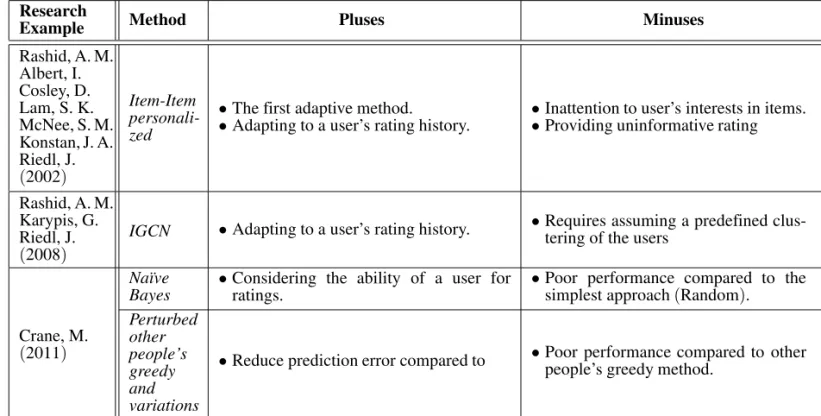
A brief comparison of the classification of meth-ods to alleviate user cold-start problem by ask-ing to rate, and their advantages and disadvan-tages are depicted in Table 3.
5. Conclusion
Research
Example Method Pluses Minuses
Rashid, A. M. Albert, I. Cosley, D. Lam, S. K. McNee, S. M. Konstan, J. A. Riedl, J.
(2002)
Item-Item personali-zed
•The first adaptive method.
•Adapting to a user’s rating history. ••Inattention to user’s interests in items.Providing uninformative rating
Rashid, A. M. Karypis, G. Riedl, J.
(2008)
IGCN •Adapting to a user’s rating history. •Requires assuming a predefined clus-tering of the users Na¨ıve
Bayes •Considering the ability of a user forratings. •Poor performance compared to thesimplest approach(Random). Crane, M.
(2011)
Perturbed other people’s greedy and variations
•Reduce prediction error compared to •Poor performance compared to otherpeople’s greedy method.
Table 3.Classification of asking to rate, Adaptive approaches.
about the new user. In this paper we have re-viewed several methods for dealing with the new user problem via ask-to-rate technique. The methods are categorized into two, non-adaptive and adaptive categories.
Although a few efficient methods to solve the cold start new user problem have been proposed, it is still not a stone in the corner. During the items selection, the new incoming ratings of other users are not considered. Therefore, a fu-ture direction can be developing a new method, which will adapt to the earlier ratings given by other users.
References
[1] G. ADOMAVICIUS, A. TUZHILIN, Toward the next
generation of recommender systems: A survey of the state-of-the-art and possible extensions. Know-ledge and Data Engineering, IEEE Transactions,
17(2005), 734–749.
[2] D. BILLSUS, M. J. PAZZANI, Learning collaborative
information filters,(1998), pp. 48.
[3] B. SARWAR, G. KARYPIS, J. KONSTAN, J. RIEDL, Item-based collaborative filtering recommendation algorithms, pp. 285–295.
[4] X. SU, T. M. KHOSHGOFTAAR, A survey of
collab-orative filtering techniques.Advances in Artificial Intelligence,2009(2009), pp. 4.
[5] T. N. LILLEGRAVEN, A. C. WOLDEN, Design of a Bayesian recommender system for tourists present-ing a solution to the cold-start user problem. Master of Science in Computer Science, Department of Computer and Information Science, Norwegian University of Science and Technology, 2010.
[6] R. BURKE, Hybrid recommender systems: Survey
and experiments.User modeling and user-adapted interaction,12(2002), 331–370.
[7] E. RICH, User modeling via stereotypes.Cognitive
science,3(1979), 329–354.
[8] T. MAHMOOD, F. RICCI, Towards learning
user-adaptive state models in a conversational recom-mender system,(2007), pp. 373–378.
[9] R. H. GUTTMAN, Merchant differentiation through
integrative negotiation in agent-mediated electronic commerce, 1998.
[10] F. RICCI, L. ROKACH, B. SHAPIRA, Introduction
to recommender systems handbook.Recommender Systems Handbook,(2011), 1–35.
[11] J. S. BREESE, D. HECKERMAN, C. KADIE, Empirical
analysis of predictive algorithms for collaborative filtering. In Proceedings of the Fourteenth Con-ference on Uncertainty in Artificial Intelligence,
(1998), pp. 43–52.
[12] J. WANG, A. P. DEVRIES, M. J. T. REINDERS,
[13] H. J. AHN, A new similarity measure for
collabora-tive filtering to alleviate the new user cold-starting problem.Information Sciences,178(2008), 37–51.
[14] A. M. RASHID, I. ALBERT, D. COSLEY, S. K. LAM, S. M. MCNEE, J. A. KONSTANet al., Getting to know
you: learning new user preferences in recommender systems. In Proceedings of the 7th International Conference on Intelligent User Interfaces,(2002)
San Francisco, California, USA, pp. 127–134.
[15] A. I. SCHEIN, A. POPESCUL, L. H. UNGAR, D. M.
PENNOCK, Methods and metrics for cold-start
rec-ommendations, pp. 253–260.
[16] M. CRANE, The new user problem in collaborative
filtering. Thesis for the degree of Master of Science, Department of Computer Science, University of Otago, Dunedin, New Zealand, 2011.
[17] B. SARWAR, G. KARYPIS, J. KONSTAN, J. RIEDL,
Application of dimensionality reduction in recom-mender system-a case study, DTIC Document2000.
[18] A. M. RASHID, G. KARYPIS, J. RIEDL, Learning preferences of new users in recommender systems: an information theoretic approach.ACM SIGKDD Explorations Newsletter,10(2008), 90–100.
[19] A. KOHRS, B. MERIALDO, Improving collaborative
filtering for new users by smart object selection. InProceedings of the International Conference on Media Features (ICMF),(2001).
[20] O. NASRAOUI, M. SPILIOPOULOU, O. R. ZADANEˇ , J. SRIVASTAVA, B. MOBASHER, WebKDD 2008: 10 years of knowledge discovery on the web post-workshop report.ACM SIGKDD Explorations Newsletter,10(2008), 78–83.
[21] C. BOURAS, V. TSOGKAS, Clustering to Deal with
the New User Problem. InComputational Science and Engineering (CSE), 2012 IEEE 15th Interna-tional Conference on,(2012), pp. 58–65.
Received:September, 2013
Revised:May, 2014
Accepted:May, 2014
Contact addresses:
Mohammad-Hossein Nadimi-Shahraki Faculty of Computer Engineering Najafabad branch Islamic Azad University Najafabad Iran e-mail:[email protected] Mozhde Bahadorpour Faculty of Computer Engineering Najafabad branch Islamic Azad University Najafabad Iran e-mail:[email protected]
MOHAMMAD-HOSSEINNADIMI-SHAHRAKIwas born in Iran. He
re-ceived his Ph.D in computer science from University Putra of Malaysia (UPM)in 2010. Currently, he is a full time Assistant Professor at the Faculty of Computer Engineering of Islamic Azad University of Najafabad(IAUN), His research interests include data mining, web mining, social network mining and recommender systems.
![Table 1. The Evaluation of elicitation strategies in [14, 18] over both online and offline experiments on user](https://thumb-us.123doks.com/thumbv2/123dok_us/8039788.2128832/3.1006.109.477.1014.1300/table-evaluation-elicitation-strategies-online-offline-experiments-user.webp)